
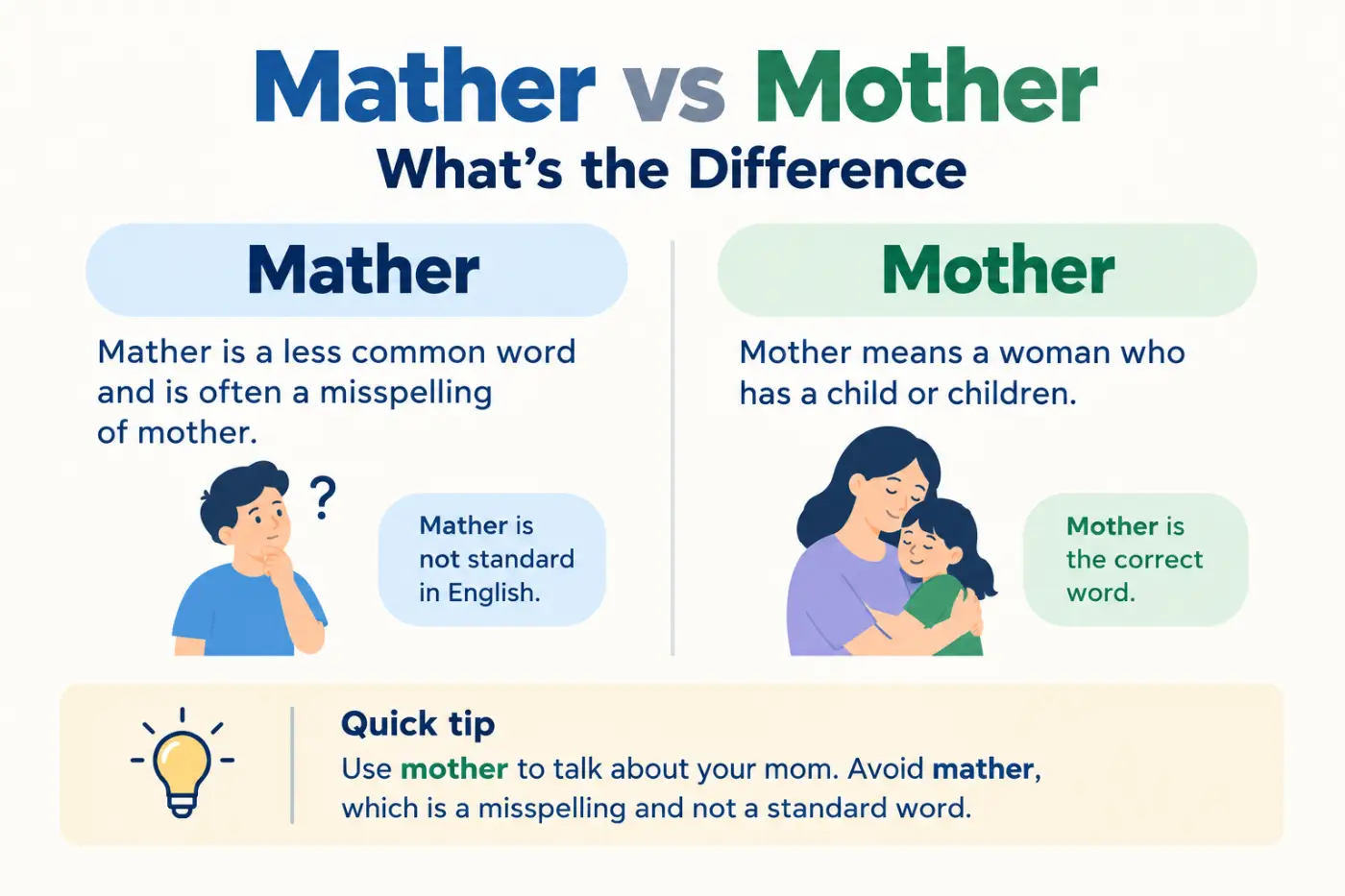
The difference between mather vs mother comes down to one letter, but that small change matters. Mother is the correct standard English spelling for a female parent. Mather is generally a misspelling when someone intends to write the word for a parent.
This confusion can happen when you hear a word spoken aloud and try to write it from memory. The vowel sounds in English can be tricky, and the letters A and O do not always sound the way learners expect. A quick typing mistake can also change the spelling without changing what you intended to say.
The good news is that the rule is simple. Use mother when you mean a female parent, a person who raises or cares for a child in a maternal role, or a figure described as a mother in a broader sense. The spelling Mather can also appear as a surname or proper name, so it is not automatically an invalid combination of letters.
Understanding this distinction will help you avoid spelling errors in messages, school assignments, emails, family documents, and professional writing.
Learn the difference in Shown vs Showed Which Form Is Correct.
Quick Answer
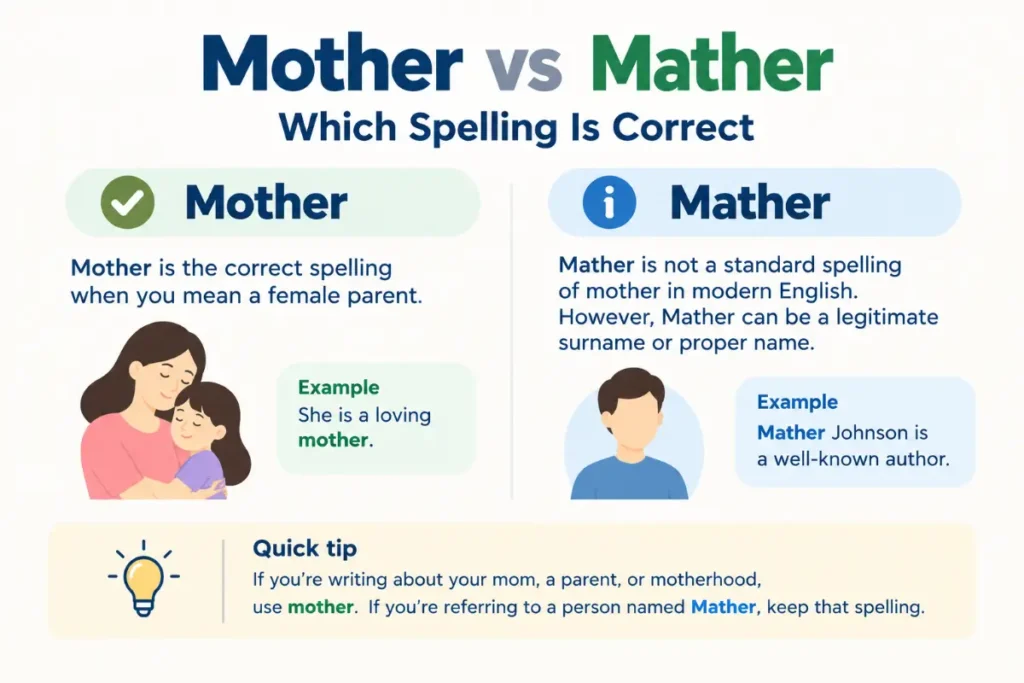
Mother is the correct spelling when you mean a female parent. Mather is not the standard spelling of that word, although it can be a legitimate surname or name. If you are writing about your mom, use mother, not mather.
Featured Snippet Definition
Mother is a noun that commonly means a female parent. It can also describe a woman who raises or cares for a child in a maternal role or a person who creates or leads something. Mather is not a standard alternative spelling for this meaning, but it can occur as a proper name.
Comparison Table for Mather vs Mother
| Feature | Mother | Mather |
|---|---|---|
| Standard spelling | Correct for a female parent | Incorrect for this meaning |
| Meaning | A female parent or maternal figure | No standard meaning as a common noun for a parent |
| Part of speech | Noun and sometimes a verb | Usually a proper noun when used as a name |
| Pronunciation | Commonly /ˈmʌðər/ in American English | Depends on the person or name |
| Formality | Standard in formal and informal English | Appropriate when it is the intended name |
| Common contexts | Family, parenting, biology, literature, and everyday speech | Surnames, family names, and other proper names |
| Example | My mother called me this morning. | Professor Mather joined the meeting. |
The key difference is meaning. The two spellings are not interchangeable when you refer to a parent. However, you should consider the context before correcting Mather because a person’s name may use that spelling correctly.
Meaning and Definition
What Mother Means
Mother is a noun that most often refers to a female parent. It can describe a woman who has given birth to a child, an adoptive parent, or a woman who serves as a child’s mother through a caregiving relationship.
The word also has broader meanings. For example, a person may call someone a mother figure if that person offers guidance, protection, and care. In other contexts, mother can describe the source of something, as in the phrase mother tongue, which means a person’s first language.
Here are some common uses.
- Family relationship. My mother helped me prepare for the interview.
- Adoption and caregiving. Her adoptive mother supported her throughout school.
- Figurative meaning. She became a mother figure to several young artists.
- Language. English is his mother tongue.
- Source or origin. The phrase mother ship describes a main vessel associated with smaller craft.
The intended meaning usually becomes clear from the surrounding words. In ordinary conversation, mother often refers to a person’s own parent.
What Mather Means
Mather is not the standard common noun for a female parent in modern English. If you write My mather works at a hospital, readers will usually understand your intended meaning, but the spelling is incorrect for that sentence.
However, Mather can be a valid proper noun. It appears as a surname and may form part of a person’s full name, an institution’s name, or another named entity. Proper nouns follow their established spelling, so you should not automatically change Mather to Mother when the word identifies a person or place.
For example, consider these sentences.
- My mother works at a hospital.
- Ms. Mather works at the hospital.
The first sentence describes a family relationship. The second identifies someone by surname. The spelling depends on the intended meaning, not simply on which form looks more familiar.
Key Differences Explained
Spelling
The standard spelling for a female parent is mother. It contains the letters M, O, T, H, E, and R in that order.
Mather contains an A instead of an O. That single letter changes the written form and prevents it from serving as the standard spelling of the family term.
A reliable way to avoid the mistake is to memorize the complete word rather than trying to spell it by sound alone. English spelling does not always match pronunciation closely, so listening to a word may not provide enough information to write it correctly.
Meaning
Mother has an established meaning as a family term. It refers to a female parent and can also describe a maternal figure or the source of something.
Mather does not carry that ordinary meaning as a common noun. When it appears as a surname, its function is different because it identifies a person rather than describing a family relationship.
This distinction matters in sentences such as My mother is a teacher and My teacher is Mrs. Mather. The first sentence names a relationship. The second uses a person’s surname.
Grammar
Mother can function as a noun and a verb.
As a noun, it names a person or relationship. For example, My mother lives nearby.
As a verb, it can mean to care for or protect someone in a maternal way. For example, She mothered the younger children after their parents moved away.
Mather generally functions as a proper noun when used as a name. It does not replace the noun mother or the verb mother in ordinary writing.
Pronunciation
In common American English, mother is pronounced with an initial vowel sound represented by /ʌ/. The middle consonant is the voiced dental sound /ð/, which also appears in words such as this and brother.
Mather may have a pronunciation that differs from mother, depending on the individual or family using the name. You should follow the person’s own pronunciation rather than assuming that the name sounds like the common family term.
Formality
Mother is suitable for nearly every type of English writing. You can use it in personal messages, school assignments, formal letters, medical forms, academic discussions, and literature.
Mather is also appropriate in formal writing when it is a person’s correct name. However, using it as a substitute for mother in an ordinary sentence is a spelling error.
Context
Context helps readers understand what a word means, but it does not make the two spellings interchangeable. If a sentence discusses family relationships, parenting, or a maternal figure, mother is generally the intended word.
If the sentence refers to a named person, Mather may be correct. Before changing a spelling during editing, check the sentence and confirm what the writer wants to communicate.
Regional Usage
American, British, Canadian, and Australian English all use mother as the standard spelling for a female parent. There is no established regional spelling rule that makes mather an acceptable alternative for this meaning.
Pronunciation may vary across accents, but the standard spelling remains the same. A difference in accent does not justify changing the spelling from mother to mather.
Which Form Is Correct
Mother is correct when you mean a female parent. This is the established spelling in standard English dictionaries and ordinary written usage.
The reason is straightforward. English words have conventional spellings that writers use to communicate clearly. A word may sound different across accents, but writers generally preserve its standard written form.
For instance, you would write My mother taught me to read, not My mather taught me to read. The intended meaning remains understandable in the second sentence, but the spelling does not follow standard English conventions.
There is one important exception to keep in mind. Mather can be correct when it is someone’s actual name. If you are editing a person’s biography, a school record, a business document, or an academic reference, confirm the spelling of the name before making a correction.
The safest rule is to use mother for the family relationship and preserve Mather when it is a verified proper noun.
Sentence Examples
The following examples show how to use mother naturally in different situations.
- Everyday conversation. My mother makes the best soup whenever our family visits.
- Text messages. I called my mother after work to tell her the good news.
- Workplace communication. I need to leave early today because my mother has a medical appointment.
- School writing. My mother encouraged me to read every day when I was young.
- Academic writing. The study examines how a mother’s support can affect a child’s early learning.
- Formal communication. Please contact the child’s mother to confirm the meeting time.
- Social situations. Her mother joined us for dinner and enjoyed meeting everyone.
- Online communication. I shared a photo of my mother and me from our family vacation.
- Storytelling. His mother stood by the window and watched the rain fall across the garden.
- General discussion. A mother can influence a child’s values through everyday actions and conversations.
Each sentence uses the same standard spelling. The meaning changes with the context, but the spelling does not.
Common Spelling Mistakes
Several errors can occur when people write words related to family relationships. Knowing the difference can help you catch mistakes before sending a message or submitting an assignment.
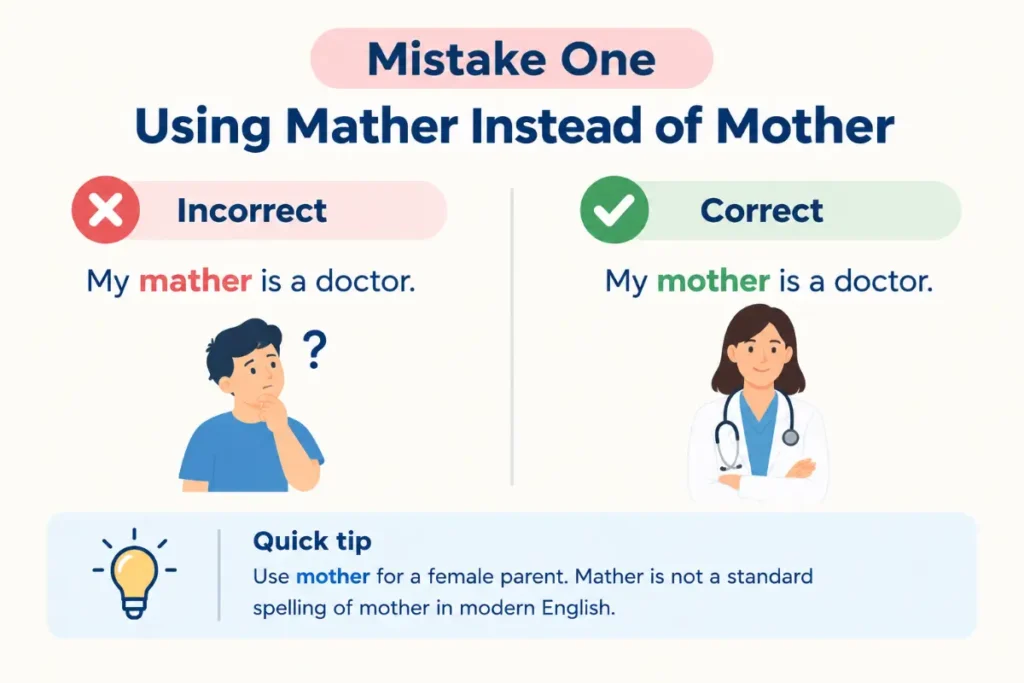
Writing Mather Instead of Mother
Incorrect: My mather is coming to visit.
Correct: My mother is coming to visit.
The mistake changes the vowel in the word. The correct form uses O, not A. Remember the complete spelling rather than relying only on how the word sounds.
Writing Mother as a Proper Name Without a Reason
Incorrect: I spoke with Mother about the weather.
Correct: I spoke with my mother about the weather.
The first sentence is not always wrong. Some families use Mother as a form of address, and some writers capitalize family terms when using them like names. However, when you refer to your parent in a general sentence, lowercase mother is normally appropriate unless a specific style or context calls for capitalization.
Confusing Mother With Mom
Incorrect: My mother called, so I answered Mom.
Correct: My mother called, so I answered the phone.
Mother and mom refer to the same family relationship in many contexts, but they do not fit every sentence in the same way. Mom is common in American conversation, while mother often sounds more formal or neutral.
Misspelling the Plural Form
Incorrect: The mathers attended the school meeting.
Correct: The mothers attended the school meeting.
The plural of mother is mothers. You add S to the standard singular spelling. Changing the O to A creates a different written form rather than a valid plural.
Correcting a Person’s Name Incorrectly
Incorrect: Professor Mother gave a presentation, when the professor’s surname is Mather.
Correct: Professor Mather gave a presentation.
This is a context error rather than a simple spelling mistake. Names need to match the person’s established spelling. Always verify proper nouns before changing them during proofreading.
Many readers also check Propose vs Purpose Which One Should You Use 2026.
Pronunciation Guide
Mother has two syllables and is pronounced /ˈmʌðər/ in common American English. The stress falls on the first syllable. The middle sound is voiced, meaning your vocal cords vibrate as you make it.
Use this guide to practice the word.
- IPA. /ˈmʌðər/.
- Syllables. Moth er.
- Easy pronunciation. The first part rhymes approximately with the vowel sound in cup, followed by the voiced th sound and the final unstressed syllable.
- Stress pattern. Place the strongest emphasis on the first syllable.
- Common mistake. Avoid replacing the middle voiced th sound with the unvoiced sound found in thin.
The voiced th sound can take practice for English learners. Place the tip of your tongue lightly between your teeth or just behind your upper front teeth, then let air pass while your voice remains active.
Do not confuse pronunciation with spelling. Even if your accent changes the exact vowel or final sound, the standard written form remains mother.
Etymology and Word Origin
The word mother has a long history in English and belongs to a group of family words that share ancient linguistic roots. Related forms appear in several Indo European languages, including Latin mater and Greek mētēr. These similarities reflect an old inherited word for a female parent.
Old English used the form mōdor. Over time, changes in English pronunciation and spelling helped produce the modern form mother. The spelling became established through the normal development of the language rather than through a recent spelling rule.
The initial M and the final R are also found in related forms across several languages. These similarities are part of a broader pattern in the history of words for family members.
Mather should not be treated as a historical spelling alternative simply because it looks similar. In present day standard English, mother is the conventional spelling for the family relationship. The surname Mather has its own history as a name and should be understood in that context.
Regional Usage
American English
Mother is the standard spelling in the United States. It is common in family discussions, formal writing, educational materials, and professional communication.
Americans often use mom in casual conversation. For example, someone might say, I am visiting my mom this weekend, while using mother in a school essay or formal document.
The spelling mather is not an accepted regional alternative for a female parent.
British English
British English also uses mother as the standard spelling. The word has the same central meaning, although pronunciation can vary across British accents.
Informal alternatives such as mum are common in the United Kingdom. These alternatives do not change the spelling of mother itself.
Australian English
Australian English uses mother as well. Mum is a familiar everyday term, but mother remains appropriate in formal, educational, and personal contexts.
There is no standard Australian rule that changes the spelling to mather.
Canadian English
Canadian English follows the same standard spelling. Both mother and mom are widely understood, with the choice depending on tone and context.
Canadian writers do not use mather as a regional spelling for a female parent. The same distinction between a common noun and a proper name applies across these English varieties.
Grammar Rules and Part of Speech
Mother as a Noun
Mother is most often a countable noun. It can refer to one parent or to a person who serves in a maternal role.
Use an article or possessive word when the sentence needs one.
- My mother is a nurse.
- The mother waited outside the classroom.
- Her mother enjoys gardening.
- A mother called the school this morning.
You can also use the plural form mothers when referring to more than one person. For example, The mothers met with the principal after class.
Mother as a Verb
Mother can also function as a verb. It means to care for, protect, or treat someone in a maternal way.
For example, She mothered her younger siblings after their father became ill. In this sentence, mothered describes an action rather than naming a person.
The common verb forms are mother, mothers, mothered, and mothering. These forms follow ordinary English verb patterns.
Mother as a Modifier
Mother sometimes appears before another noun to describe a relationship or function. Examples include mother tongue, mother country, and mother ship.
In these expressions, the word adds meaning to the noun that follows it. The spelling remains unchanged.
Capitalization
Capitalize Mother when it functions as a name or direct form of address in a context that calls for capitalization. For example, a person might write, I will ask Mother when she gets home.
Use lowercase mother when it follows a possessive or appears as an ordinary noun. For example, My mother will arrive at six.
Capitalization can depend on sentence structure and the writer’s style. The spelling itself does not change.
Punctuation and Formal Writing
Mother does not require special punctuation. Use ordinary sentence punctuation based on the sentence’s structure.
For example, My mother, who lives in Texas, is visiting next week. The commas set off extra information about the person. They are not required simply because the word mother appears in the sentence.
In formal writing, choose the term that suits your audience. Mother is suitable for professional and academic work, while mom may sound more personal or conversational.
Real Life Usage Examples
Daily Conversation
People use mother when discussing family, memories, responsibilities, and relationships. The word can sound warm and personal without being informal.
- My mother taught me how to ride a bicycle when I was six.
- His mother usually calls him before an important exam.
Email and Workplace Communication
In workplace messages, mother often appears when someone explains a family commitment or discusses a family related matter. Keep the sentence clear and share only the details needed by the reader.
- I will be unavailable this afternoon because I am taking my mother to an appointment.
- Please update the emergency contact form with your mother’s current phone number.
Academic Writing
Academic writing may use mother in research about family relationships, child development, language, health, and social history. The word should fit the subject and the meaning of the sentence.
- The researchers studied the role of mothers in early childhood language development.
- A child’s mother tongue can influence how the child learns additional languages.
News and Journalism
News writing uses mother to describe people and family relationships. Journalists should confirm names and relationships before publication because small errors can affect accuracy.
- The mother thanked the rescue workers who helped her family.
- Police said the mother and child were taken to a nearby hospital.
Literature and Storytelling
Writers use mother to develop characters, show family bonds, and explore themes such as love, loss, responsibility, and memory.
- Her mother kept every drawing she brought home from school.
- The old woman remembered her mother whenever the first snow fell.
These examples show that the word works across many writing styles. The spelling stays consistent even as the subject and tone change.
Related and Confused Terms
Several words are closely related to mother. Understanding their meanings can help you choose the right term for the person, relationship, or situation you want to describe.
Mom
Mom is a familiar American English term for a mother. It is common in everyday conversation, family messages, and informal writing.
Example: My mom is picking me up after school.
Mum
Mum is a common informal term for a mother in British and Australian English. It is also understood in other English speaking communities.
Example: I bought my mum flowers for her birthday.
Mommy
Mommy is an affectionate form often used by young children or in close family settings. Some adults also use it when speaking warmly about their mothers.
Example: The little boy ran to his mommy after the show.
Mama
Mama is an affectionate family term used in many English speaking communities. Its use can vary by family, region, and cultural background.
Example: She called her mama to share the news.
Motherhood
Motherhood is a noun that describes the experience, role, or condition of being a mother.
Example: The book explores the joys and challenges of motherhood.
Maternal
Maternal is an adjective meaning related to a mother or to the qualities commonly associated with motherly care.
Example: The child received maternal support throughout the recovery process.
Parent
Parent is a broader term for a mother or father, or another person who raises a child. It is useful when the person’s gender or specific family role is not the focus.
Example: Each parent must sign the school permission form.
Mather
Mather is the form that causes the spelling confusion in this article. It may be a surname or another proper name, but it is not the standard common noun for a female parent.
Example: Dr. Mather presented the research at the conference.
These words are related by meaning or context, but they do not all serve the same grammatical role. Mom and mum are informal alternatives, maternal is an adjective, motherhood names a concept, and parent is a broader family term.
Expert Editor Insight
An experienced editor treats mother as the standard spelling for the family relationship and checks Mather carefully before changing it. The error often comes from writing a word as someone thinks it sounds, especially when typing quickly. A spellchecker may flag mather in ordinary prose, but it may not recognize every surname or specialized name. The best editing habit is to check the sentence’s meaning first, confirm proper names when necessary, and correct the spelling only after establishing the intended word.
Key Takeaways
- Mother is the standard spelling for a female parent.
- Mather is not a standard alternative spelling of mother.
- Mather can be correct as a surname or proper name.
- The words have different meanings and should not be used interchangeably.
- In standard American English, mother is pronounced /ˈmʌðər/.
- The same spelling distinction applies in American, British, Canadian, and Australian English.
- Always check the meaning of a sentence before correcting an unfamiliar name.
Learn the difference in Skull or Scull Which Spelling Is Correct..
Conclusion
The difference between mather vs mother is simple once you understand the meaning behind each spelling. Mother is the correct standard English word for a female parent, a maternal caregiver, or a source in expressions such as mother tongue. Mather can be correct as a surname or proper name, but it does not replace mother in ordinary sentences about family relationships.
To avoid this mistake, remember that mother contains the letter O. Before submitting an assignment or sending an important message, check the spelling and make sure the word matches your intended meaning. A quick review can prevent a small error from distracting readers from what you want to say.
FAQs
Is Mather a Real Word?
Mather is a real spelling used as a surname and in proper names. However, it is not the standard common noun for a female parent in modern English. If you are talking about your parent, write mother. If Mather is someone’s verified name, preserve that spelling instead of changing it automatically.
What Does Mother Mean?
Mother usually means a female parent. The word can refer to a biological parent, an adoptive parent, or someone who fulfills a maternal caregiving role. It can also appear in broader expressions such as mother tongue, which refers to a person’s first language. The exact meaning depends on the context in which the word appears.
Which Spelling Is Correct for a Female Parent?
Mother is the correct standard spelling for a female parent. Mather is not an accepted alternative spelling for this meaning in standard American English. Although the difference involves only one vowel, the forms have different uses. Remember the O in mother, and check carefully before using the word in formal writing or important documents.
How Do You Pronounce Mother?
In common American English, mother is pronounced /ˈmʌðər/. It has two syllables, with the main stress on the first. The middle sound is the voiced th sound, similar to the sound in this. Regional accents can affect the precise vowel and final syllable, but they do not change the standard spelling.
Can Mother Start a Sentence?
Yes. Mother can begin a sentence when it functions as the subject or a name used in direct address. For example, Mother prepared dinner before everyone arrived. You can also write, My mother prepared dinner before everyone arrived. Capitalization depends on how the word functions in the sentence.
What Is Another Word for Mother?
Common alternatives include mom, mum, mommy, and mama. The best choice depends on your audience, region, and relationship with the person. Mom is widely used in American English, while mum is common in British and Australian English. Parent is a broader term that can refer to a mother or father without specifying gender.
Why Do People Misspell Mother as Mather?
People may confuse the two forms because English spelling does not always match pronunciation in a predictable way. Fast typing, unfamiliarity with the word, and memory errors can also lead to the wrong vowel. Reading the sentence aloud may help with meaning, but checking the written form is more reliable for catching this particular spelling mistake.
Is Mother Appropriate in Formal Writing?
Yes. Mother is a standard English word that works in formal, academic, professional, and personal writing. It is suitable for school reports, research discussions, family records, and workplace messages. Mom may feel more conversational in some contexts, but it is also widely accepted in ordinary writing. Choose the term that fits the purpose and audience.