
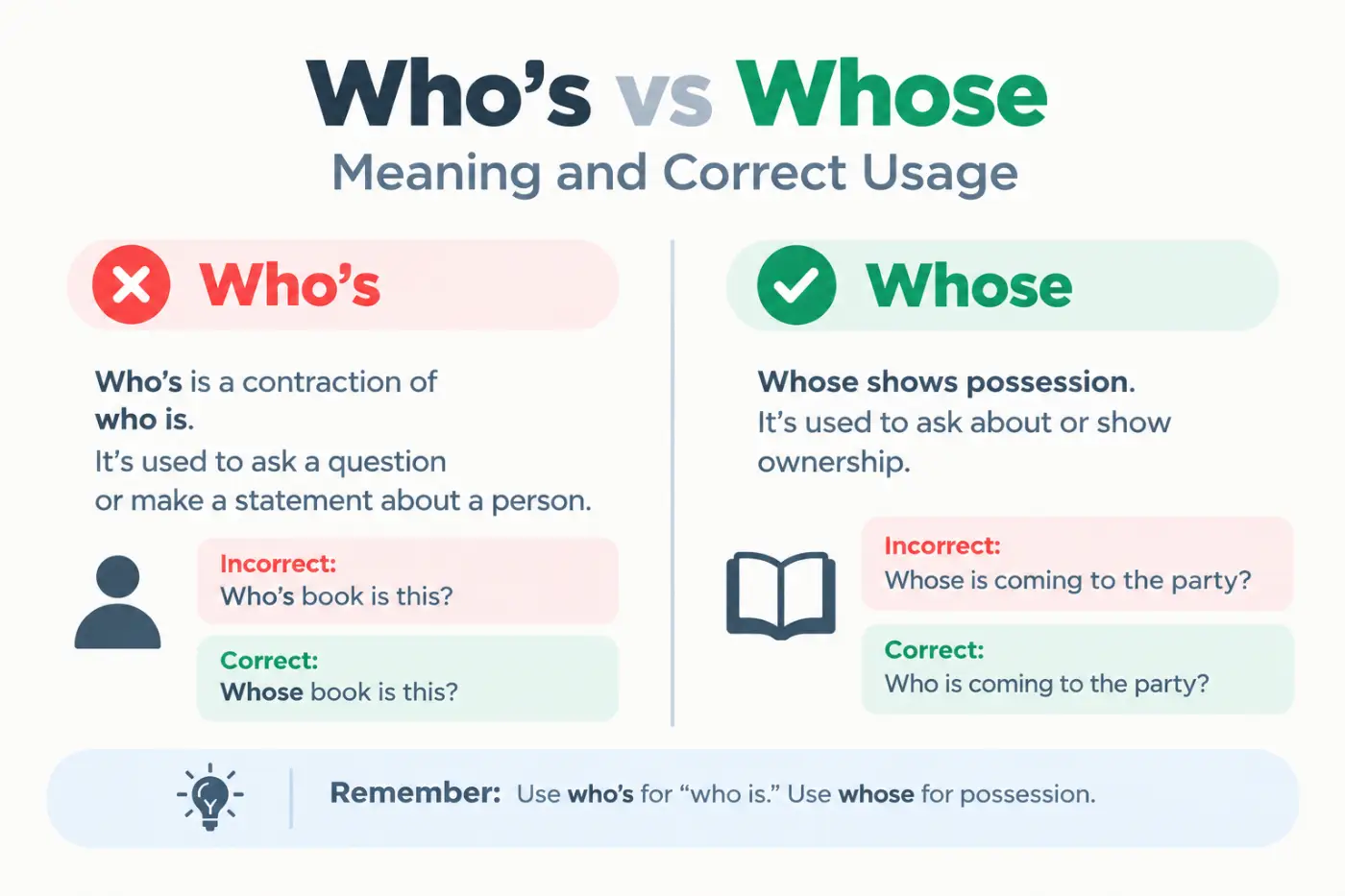
The difference between who’s vs whose comes down to one simple question. Are you shortening two words into one, or are you showing ownership or a connection? Both forms are correct English, but they serve different purposes. Mixing them up can make an otherwise clear sentence look careless.
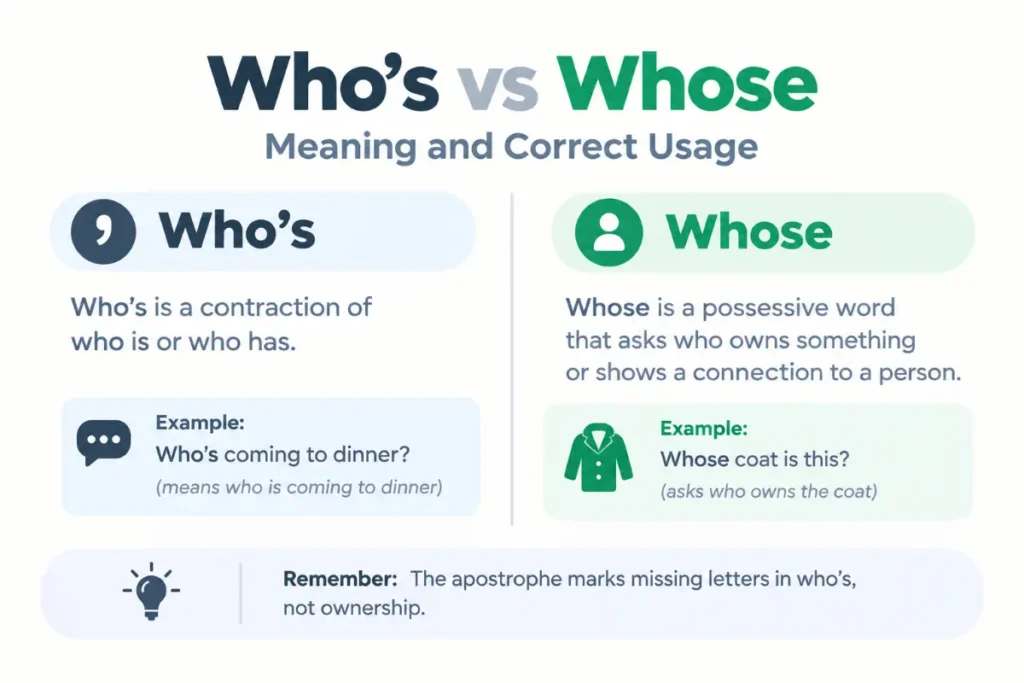
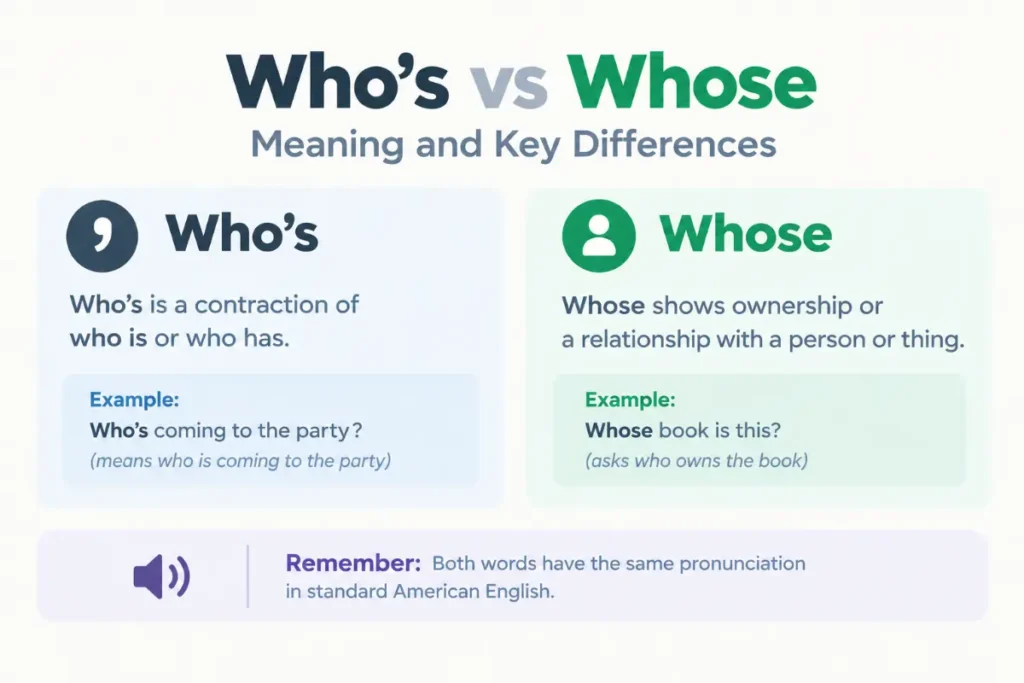
Who’s is a contraction of who is or who has. Whose shows possession or identifies the person or thing connected to something. For example, Who’s coming to dinner? asks who will attend. Whose jacket is this? asks who owns the jacket.
The confusion makes sense because both forms sound the same in standard American English. Their similar pronunciation makes it easy to choose the wrong spelling when typing quickly or writing from memory. However, a simple substitution test can help you make the right choice every time.
Once you understand the role each word plays in a sentence, the difference becomes much easier to remember. You can apply the same rule to text messages, school assignments, workplace emails, social media posts, and formal documents.
For another common grammar confusion, see Stationary vs Stationery The Easy Way To Tell Them Apart.
Short Answer
Who’s means who is or who has. Whose indicates ownership, possession, or a connection to someone or something. Both are correct words, but they aren’t interchangeable. If you can replace the word with who is or who has and preserve the sentence’s meaning, use the contraction. Otherwise, you may need the possessive form.
Comparison Table for the Two Forms
| Feature | Who’s | Whose |
|---|---|---|
| Main function | Forms a contraction | Shows possession or connection |
| Meaning | Who is or who has | Belonging to or associated with whom |
| Part of speech | Contraction | Possessive form of who |
| Example | Who’s at the door? | Whose shoes are these? |
| Common use | Questions and statements | Questions and relative clauses |
| Pronunciation | /huːz/ | /huːz/ |
| American English | Standard | Standard |
| British English | Standard | Standard |
| Formal writing | Acceptable when appropriate | Acceptable and often necessary |
| Common error | Using it to show ownership | Using it to mean who is |
The main difference is grammatical rather than phonetic. Both forms have the same standard pronunciation, so you cannot reliably choose the spelling by sound alone. Instead, look at the meaning and structure of the sentence.
What Does Each Word Mean?
The Meaning of Who’s
Who’s is a contraction that combines who with either is or has. A contraction joins words and replaces one or more letters with an apostrophe.
Here are two examples.
- Who’s responsible for this project? This means Who is responsible for this project?
- Who’s finished the assignment? This means Who has finished the assignment?
The intended meaning depends on the words that follow and the sentence’s grammatical structure. In the first example, the contraction represents who is. In the second, it represents who has.
The apostrophe matters because it marks the shortened form. However, an apostrophe does not automatically indicate possession. In this case, it signals that letters have been left out.
Who’s can appear at the beginning of a question, in the middle of a sentence, or in a statement.
For example, I know who’s in charge means I know who is in charge. Similarly, She’s the person who’s helped us most means She’s the person who has helped us most.
In everyday American English, this contraction sounds natural and direct. It is common in conversations, emails, messages, interviews, and many forms of published writing.
The Meaning of Whose
Whose is the possessive form of who. It asks about ownership or identifies a person or thing associated with something.
Consider these examples.
- Whose phone is ringing? The speaker wants to know who owns or is responsible for the phone.
- Whose idea was this? The speaker wants to identify the person connected to the idea.
- I met a student whose artwork won an award. The word connects the artwork to the student.
Notice that possession does not always mean legal ownership. A person can be associated with an idea, a family, a decision, a problem, or an achievement without owning it in the usual sense.
For instance, the employee whose report impressed the manager identifies an employee through the report associated with that person.
Whose can also refer to things in established English usage. For example, a company whose products are sold worldwide is a natural and grammatically correct sentence. The word connects the products to the company.
This form works in direct questions and in clauses that provide extra information about a person or thing. Unlike the contraction, it does not use an apostrophe.
Is Whose Only Used for People?
No. Whose most often refers to people in everyday speech, but it can also refer to animals, organizations, and things.
For example, the dog whose collar went missing refers to an animal. A business whose profits increased refers to an organization. A building whose roof needs repairs refers to a structure.
This usage is useful because English does not always require a separate possessive word for things. Whose can express the relationship clearly without making the sentence awkward.
Some writers use of which when referring to objects, especially in formal prose. However, whose is widely accepted in this role and often creates a smoother sentence.
Key Differences Explained
Spelling and the Apostrophe
The most visible difference is the apostrophe in who’s. It shows that the contraction leaves out letters from who is or who has.
Whose has no apostrophe because it is already a complete possessive form. Adding an apostrophe changes the grammatical function and can create an error.
Compare these sentences.
- Who’s waiting outside? This means Who is waiting outside?
- Whose bag is waiting outside the office? This asks who the bag belongs to.
The apostrophe is not a decoration. It signals a specific grammatical structure. When you choose between the two forms, focus on what the sentence needs rather than what the word sounds like.
Meaning and Function
Who’s identifies a person through a question or statement about what that person is or has done. Whose identifies a relationship between someone and something.
For example, Who’s taken my notebook? asks which person has taken it. Whose notebook is on the desk? asks who the notebook belongs to.
The difference can change the entire meaning of a sentence. A single apostrophe may seem minor, but the grammatical role behind it is not.
Part of Speech
Who’s is a contraction. It combines a pronoun with a form of a verb.
Whose is a possessive form of the interrogative or relative pronoun who. It can function as a determiner before a noun or help introduce a relative clause.
In Whose coat is this? it comes before the noun coat. In the woman whose coat was stolen, it introduces information that identifies the woman.
You do not need to memorize technical grammar terms to use these words correctly. You only need to recognize the difference between shortening a phrase and showing a relationship.
Pronunciation
In standard American English, both words are pronounced /huːz/. The sound begins with the breathy consonant in who and ends with a voiced Z sound.
Because they sound alike, listening alone will not tell you which spelling belongs in a sentence. Context and grammar must guide your choice.
This is a common example of English homophones. Homophones are words that share a pronunciation but have different meanings or spellings. Other familiar examples include there and their, as well as to and too.
Formality and Context
Both forms are standard English and can appear in formal writing. The best choice depends on the sentence.
Who’s is acceptable in formal questions and clear professional prose. For example, Who’s responsible for approving the final report? is direct and grammatically sound.
Whose is equally suitable for formal writing. For example, The committee identified the applicant whose research best matched the project goals uses the possessive form correctly.
Some formal documents avoid contractions as a matter of style. In those cases, a writer might use who is or who has instead of who’s. That preference does not make the contraction incorrect.
Regional Usage
American, British, Canadian, and Australian English follow the same basic distinction. Who’s represents who is or who has, while whose expresses possession or association.
There is no standard regional spelling difference that changes this rule. You can use the same substitution test across these varieties of English.
Which Form Is Correct?
Both forms are correct. The right choice depends on what you want the sentence to say.
Use who’s when the full phrase is who is or who has. Use whose when you are asking about possession or connecting a person or thing to something associated with it.
The distinction follows established English grammar. The apostrophe in a contraction marks omitted letters. Possessive forms such as whose do not need an apostrophe simply because they express possession.
Consider these examples.
- Who’s calling my phone? The full sentence is Who is calling my phone?
- Whose phone is calling? The question asks who owns or uses the phone.
- Do you know who’s leading the meeting? This means Do you know who is leading the meeting?
- Do you know whose meeting starts at noon? This asks which person’s meeting starts at noon.
A useful test is to expand the contraction. If replacing who’s with who is or who has makes sense, the contraction is appropriate. If that replacement sounds wrong or changes the intended meaning, use whose when possession or association is the point.
Ten Example Sentences
These examples show how the two forms work in different situations. Read each sentence for meaning instead of relying on pronunciation.
Examples Using Who’s
- Who’s bringing snacks to the study group? The question asks who is bringing them.
- I wonder who’s knocking at the front door. The phrase means who is knocking.
- Who’s already submitted the application? Here, the contraction means who has.
- Do you know who’s in charge of the new schedule? The sentence asks who is responsible.
- She’s the colleague who’s helped me learn the new software. Here, the contraction means who has helped.
Examples Using Whose
- Whose keys did you find near the entrance? The question asks who the keys belong to.
- The teacher whose class I joined gave clear instructions. The word connects the teacher to the class.
- Whose turn is it to present the results? The question asks who should take the next turn.
- We hired a designer whose work stood out during the interview. The word connects the work to the designer.
- The charity supports families whose homes were damaged by the storm. The word shows the relationship between the families and their homes.
These examples cover questions, statements, work, school, and community settings. The same grammatical rule applies in every case.
Common Mistakes and How to Fix Them
The most common error is choosing the spelling based on how the word sounds. Since both forms sound alike, the best solution is to check the sentence’s meaning.
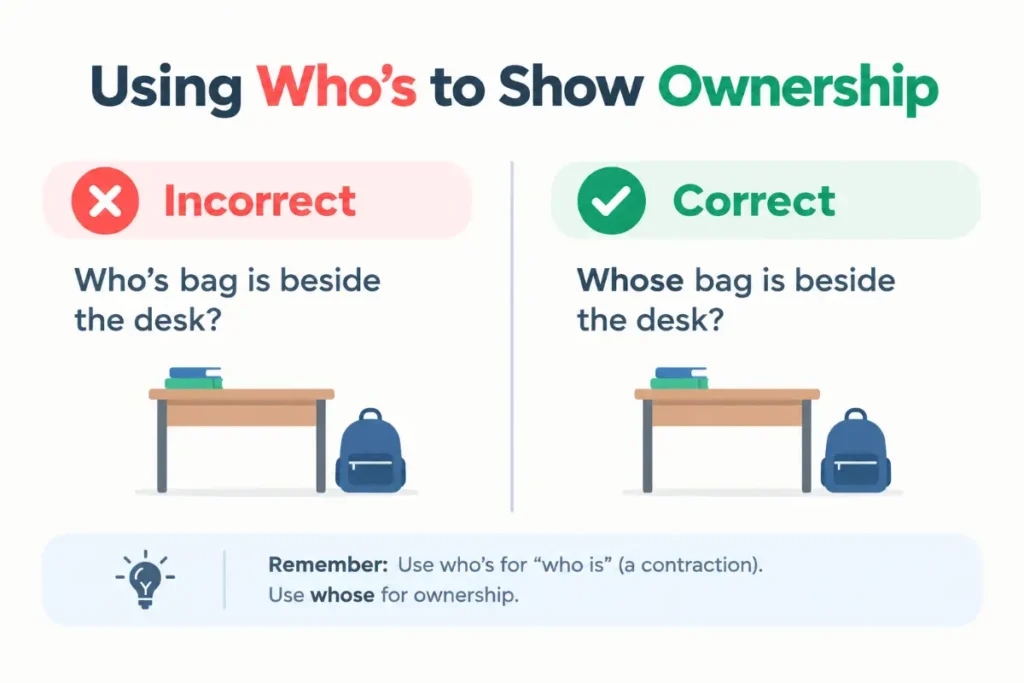
Mistake One Using Who’s to Show Ownership
Incorrect: Who’s jacket is hanging by the door?
Correct: Whose jacket is hanging by the door?
The question asks who owns the jacket. It does not ask who is or who has done something, so the possessive form is needed.
Mistake Two Using Whose Instead of Who’s
Incorrect: Whose coming to the party tonight?
Correct: Who’s coming to the party tonight?
The sentence means Who is coming to the party tonight? The contraction is the right choice because it replaces two words.
Mistake Three Adding an Apostrophe to Whose
Incorrect: Whose’s notebook is this?
Correct: Whose notebook is this?
Whose is already the correct possessive form. Adding an apostrophe and an S creates an unnecessary and incorrect form in standard English.
Mistake Four Confusing Possession With Action
Incorrect: Whose taken my seat?
Correct: Who’s taken my seat?
In this example, who’s means who has. The sentence asks which person has taken the seat. The word does not show ownership of the seat.
Mistake Five Choosing the Form by Sound Alone
Incorrect: Do you know whose in the office?
Correct: Do you know who’s in the office?
The intended meaning is Do you know who is in the office? Both words sound the same, but only the contraction fits this sentence.
One reliable habit can prevent all five errors. Expand the contraction in your mind before you choose the spelling.
Pronunciation Guide
How to Pronounce Both Forms
In standard American English, who’s and whose share the same pronunciation.
IPA pronunciation
\[ /huːz/ \]
The pronunciation has one syllable. The vowel is the long OO sound heard in food, and the final consonant sounds like the Z in zoo.
An Easy Way to Say the Words
- Begin with the H sound as in home.
- Add the long OO vowel as in moon.
- Finish with the voiced Z sound as in zero.
Keep the word to one syllable. You do not need to stress one part more than another because there is only one syllable.
Common Pronunciation Problems
Some learners pronounce the final sound as an S instead of a Z. In standard American English, the ending is voiced. You can feel your throat vibrate when you say the Z sound.
However, even perfect pronunciation will not help you distinguish the spellings in speech. You must use the surrounding words and the intended meaning. In writing, grammar does the work that sound cannot do.
You may also want to read Perspective or Prospective Which Word Is Correct.
Etymology and Word Origin
The two forms share a historical connection through the English pronoun who. Their different spellings developed from different grammatical functions.
The History of Who’s
Who’s developed as a shortened form of who is and who has. English has used contractions for centuries to make speech and writing more compact. The apostrophe marks the letters omitted when the words combine.
The same general pattern appears in contractions such as it’s, she’s, and he’s. Each form can represent different words depending on context. For example, she’s can mean she is or she has.
The History of Whose
Whose developed as the possessive form associated with who. Its history reaches back through earlier stages of English, when pronouns had more visible grammatical endings than they do in modern English.
Over time, English simplified many parts of its grammar. Whose remained as the standard possessive form used to ask about ownership and to connect people or things with related information.
The important point for modern writers is its current function. You do not need to know the full history of either form to use it correctly, but their origins help explain why they look different despite sounding alike.
Regional Usage in English
The distinction remains consistent across major English varieties. There is no widely accepted regional rule that makes one spelling correct in the United States and the other correct in Britain or Australia.
American English
Both forms are standard in American English. Who’s appears often in conversation, questions, text messages, and everyday writing. Whose appears in questions about ownership and in sentences that connect a person or thing to something associated with it.
For example, Who’s driving us to the airport? asks who is driving. Whose car are we taking? asks which person’s car will be used.
British English
British English uses the same distinction. The spelling and basic grammar do not change, although pronunciation can vary slightly by accent.
A British speaker might ask, Who’s at the front door? or Whose umbrella is this? Both sentences follow the same rules used in American English.
Australian English
Australian English also uses both forms in the same way. In casual conversation, who’s is common as a contraction. Whose remains the standard form for possession and association.
For example, Who’s on the phone? asks who is speaking. Whose phone is ringing? asks who owns or uses the device.
Canadian English
Canadian English follows the same standard usage. Writers do not need a special Canadian spelling rule for these forms.
Across all four varieties, the most dependable method is to identify the grammatical role of the word. Regional pronunciation may vary, but the written distinction remains the same.
Grammar Rules and Sentence Structure
Understanding where each form fits in a sentence makes the choice much easier. The following rules cover the most common patterns.
When to Use Who’s
Use who’s when the sentence needs who is or who has.
- Who’s available for the afternoon shift? This means Who is available for the afternoon shift?
- Who’s completed the training? This means Who has completed the training?
- I know who’s responsible for the delay. This means I know who is responsible for the delay.
- She’s the person who’s organized the event. This means She’s the person who has organized the event.
The form can appear in direct questions and in statements that contain an indirect question or a relative clause. The position of the contraction does not change its basic meaning.
When to Use Whose
Use whose when the sentence asks about possession or identifies a relationship.
- Whose desk is beside the window?
- I met the author whose book you recommended.
- The manager whose team won the award gave a short speech.
- Whose name appears at the top of the form?
In each example, whose connects a person with an object, a work, a team, or a name. The relationship may involve ownership, responsibility, authorship, or another close association.
Can Whose Come Before a Noun?
Yes. Whose often comes directly before a noun because it identifies the person connected to that noun.
Examples include whose bag, whose decision, whose idea, and whose responsibility. In each phrase, the noun tells you what the question or statement is about.
The word can also introduce a clause. In the student whose project won first place, the clause whose project won first place gives more information about the student.
Can Who’s Start a Sentence?
Yes. Who’s can begin a direct question or a statement that uses an indirect question.
Examples include Who’s at the door? and I wonder who’s coming to dinner. Both are correct. The first asks a direct question, while the second reports what the speaker wonders.
Can Whose Start a Sentence?
Yes. Whose commonly begins questions about ownership or association.
For example, Whose coat is on the chair? is a direct question. Whose can also appear at the beginning of a larger sentence, as in Whose idea we should follow remains unclear. The second sentence is more formal, but it is grammatically possible.
Do These Words Need Special Punctuation?
Who’s includes an apostrophe because it is a contraction. Whose does not need an apostrophe.
Neither word automatically requires a question mark. Use punctuation according to the sentence type. A direct question normally ends with a question mark, while a statement normally ends with a period.
Compare Who’s in the meeting? with I know who’s in the meeting. The first is a direct question. The second is a statement, even though it contains an indirect question.
Real Life Usage Examples
The difference becomes clearer when you see how these forms appear in different settings. The basic rule stays the same, but the context helps reveal the intended meaning.
Daily Conversation
In casual conversation, who’s often appears in questions about people and activities. Whose helps speakers identify the person connected to an object or situation.
- Who’s picking up the groceries on the way home?
- Whose water bottle did you leave in the kitchen?
The first question asks who is picking up the groceries. The second asks who owns or uses the bottle.
Workplace Communication
Both forms are useful in workplace emails, meetings, and project discussions. The contraction can keep a question direct, while the possessive form can identify responsibility or ownership.
- Do you know who’s presenting the quarterly results?
- We need to confirm whose approval is required before we proceed.
The first sentence asks who is presenting. The second identifies the person whose approval matters.
Academic Writing
Academic writing often uses these forms to ask questions or connect people with their work. Both are grammatically acceptable, although a writer may choose to expand contractions in a highly formal document.
- Who’s responsible for checking the final data set?
- The researcher whose findings shaped the study received additional recognition.
The second example uses whose to connect the researcher with the findings. This structure is common in academic prose because it keeps related ideas together.
News and Journalism
News writing uses concise questions and descriptive clauses to identify people and explain their roles.
- Who’s leading the investigation into the reported incident?
- Officials interviewed residents whose homes suffered damage during the storm.
The first asks who is leading the investigation. The second connects the residents with their homes.
Literature and Storytelling
Writers use both forms to create dialogue and provide details about characters. Who’s can make dialogue sound natural, while whose can reveal relationships between people and objects.
- Who’s waiting for me in the garden? Maya asked.
- The traveler whose lantern had gone out searched for shelter before nightfall.
These examples show that the distinction works in creative writing just as it does in everyday communication.
Related and Confused Terms
Several other English words cause similar problems because they sound alike or express related grammatical ideas. Learning these distinctions can help you proofread more accurately.
Who and Whom
Who generally refers to the person performing an action or serving as the subject of a clause. Whom traditionally refers to the person receiving an action or serving as an object.
For example, Who called you? asks about the person who performed the action. Whom did you call? asks about the person who received the call. In everyday American English, many speakers use who in both situations.
Who’s and Whose
These are the two forms covered in this article. The contraction stands for who is or who has, while the possessive form expresses ownership or association.
A quick substitution test is usually enough to tell them apart.
It’s and Its
It’s means it is or it has. Its is the possessive form of it.
For example, It’s getting late means It is getting late. In The dog wagged its tail, the possessive form shows that the tail belongs to the dog.
This pair follows a similar pattern, but the possessive form behaves differently from many other possessive words. Its does not take an apostrophe.
They’re and Their
They’re is a contraction of they are. Their shows possession or association.
For example, They’re ready for the test means They are ready for the test. In Their books are on the table, the possessive word identifies whose books they are.
There and Their
There can refer to a place or introduce certain sentence structures. Their identifies possession or association.
Compare Put the box over there with Their box is near the door. The first refers to a location. The second identifies the people connected to the box.
You’re and Your
You’re means you are. Your indicates possession or a relationship.
For example, You’re doing well means You are doing well. Your answer is correct identifies the answer associated with you.
Whose and Which
Whose asks about possession or identifies a relationship. Which selects or identifies something from a group of options.
For example, Whose notebook is this? asks who owns the notebook. Which notebook is yours? asks you to identify one notebook among several.
Who’s and Who Has
Who has is the full form that who’s can represent. However, who’s can also mean who is, so context matters.
For example, Who’s got the keys? means Who has got the keys? In American English, the contraction is natural in conversation. In more formal writing, expanding it can make the meaning explicit.
Expert Editor Insight
An experienced editor checks meaning before checking the apostrophe. Since the two forms sound alike, spelling tools may miss the mistake when the wrong word still forms a valid sentence. A grammar checker might flag some errors, but it cannot always understand the writer’s intended meaning. The most reliable editing habit is to expand the contraction into who is or who has. If the sentence no longer makes sense, check if the possessive form is needed instead.
Key Takeaways
- Who’s is a contraction of who is or who has.
- Whose shows ownership or a relationship with a person or thing.
- Both words have the same pronunciation in standard American English.
- The apostrophe in who’s marks missing letters, not possession.
- Whose can appear in direct questions, indirect questions, and relative clauses.
- Both forms are used in American and British English.
- Replace who’s with who is or who has to test the sentence.
- Use whose when the sentence asks who owns something or identifies a connection.
- Don’t rely entirely on spell check because it may accept the wrong word in context.
- The meaning of the sentence determines the correct spelling.
Many readers also check Cancelation vs Cancellation Which Spelling Is Correct?.
Conclusion
The difference between who’s vs whose is simple once you focus on meaning rather than sound. Who’s is a contraction of who is or who has. Whose shows possession or a connection between a person or thing and something associated with it. Both forms are correct, but they serve different grammatical purposes.
The easiest way to remember the rule is to expand the contraction. If who is or who has fits your sentence, use who’s. If you’re asking about ownership or describing a relationship, use whose. Make this quick check part of your proofreading routine, and you’ll avoid one of the most common spelling mistakes in English.
FAQs
Is who’s ever correct for showing ownership?
No. Who’s is a contraction of who is or who has, so it does not express possession by itself. Use whose to ask who owns something or to connect a person with something associated with them. For example, Whose backpack is this? asks about ownership, while Who’s carrying the backpack? asks who is carrying it.
What does whose mean in a sentence?
Whose shows ownership or a relationship between a person or thing and something connected to it. You can use it in questions such as Whose keys are these? or in statements such as The artist whose work won the prize thanked the judges. The word does not always indicate legal ownership. It can also show responsibility or association.
Is who’s short for who has or who is?
Who’s can mean either who is or who has. The correct expansion depends on the sentence. In Who’s ready for lunch? it means who is. In Who’s finished the report? it means who has. Reading the full sentence helps you identify the intended meaning and choose the contraction correctly.
How do you pronounce who’s and whose?
In standard American English, both forms are pronounced /huːz/. Each word has one syllable and ends with a voiced Z sound. Since they sound the same, pronunciation cannot tell you which spelling to use. You need to consider the sentence’s grammar and meaning to choose the correct written form.
Can whose refer to things instead of people?
Yes. Whose can refer to people, animals, organizations, and objects. For example, the company whose profits increased connects the profits to the company. Similarly, the house whose roof needs repairs connects the roof to the house. This use is standard English and can make sentences smoother than some alternatives.
Can who’s begin a sentence?
Yes. Who’s often begins a direct question, such as Who’s calling? It can also begin a question about a completed action, such as Who’s finished the assignment? In both cases, the contraction represents who is or who has. The apostrophe is correct because it marks the omitted letters in the shortened form.
Why do people confuse these two words?
People confuse them because both forms have the same pronunciation in standard American English. Their spelling also looks similar, so a writer may select the wrong form while typing quickly. The confusion disappears when you focus on grammar. Ask yourself if the sentence needs who is, who has, or a word that shows possession.
Should you use who’s in formal writing?
Yes. Who’s is standard English and can appear in formal writing when a contraction suits the tone and style. However, some academic papers, legal documents, and professional style guides prefer expanded forms. In those cases, write who is or who has. Whose remains appropriate in formal writing when you need to show possession or association.