
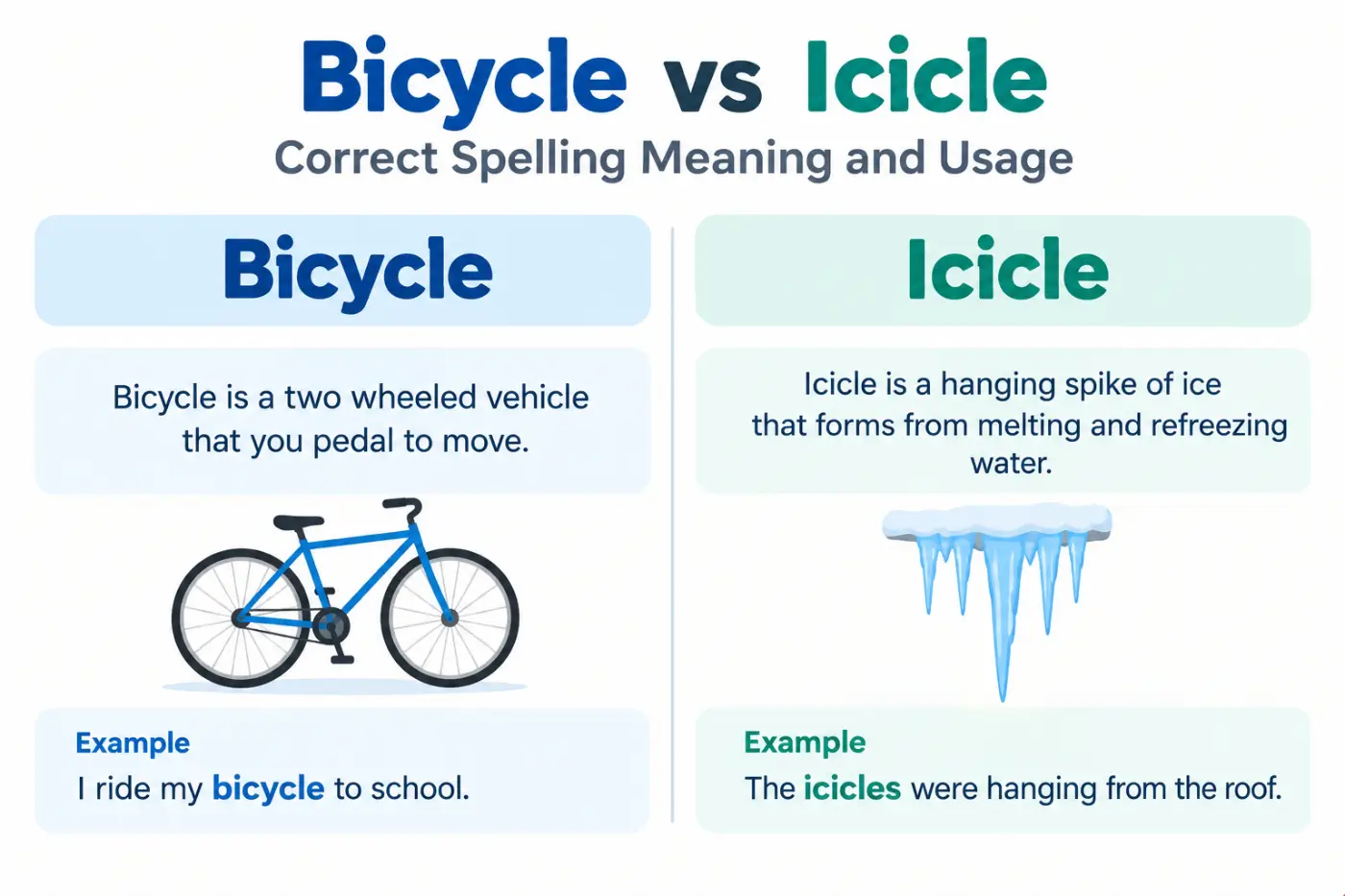
Confused about icycle vs icicle? The correct spelling for a pointed piece of ice that hangs from a roof or branch is icicle. The spelling icycle is generally a misspelling of this word in standard modern English.
The confusion makes sense. Both forms begin with the same letters and have similar sounds. When you hear the word in conversation, the middle consonant can be easy to miss. That small spelling difference can lead to mistakes in school assignments, text messages, emails, and other writing.
The good news is that the rule is simple. If you mean a long piece of ice that forms when dripping water freezes, write icicle. You do not need a special American or British spelling rule to remember it.
This guide explains the meaning of the standard word, how to pronounce it, why the other spelling causes confusion, and how to use the correct form in everyday sentences. You’ll also find practical examples, related winter vocabulary, and answers to common spelling questions.
Still confused? Compare Comprable Vs Comparable Which Word Is Correct in 2026.
Quick Answer
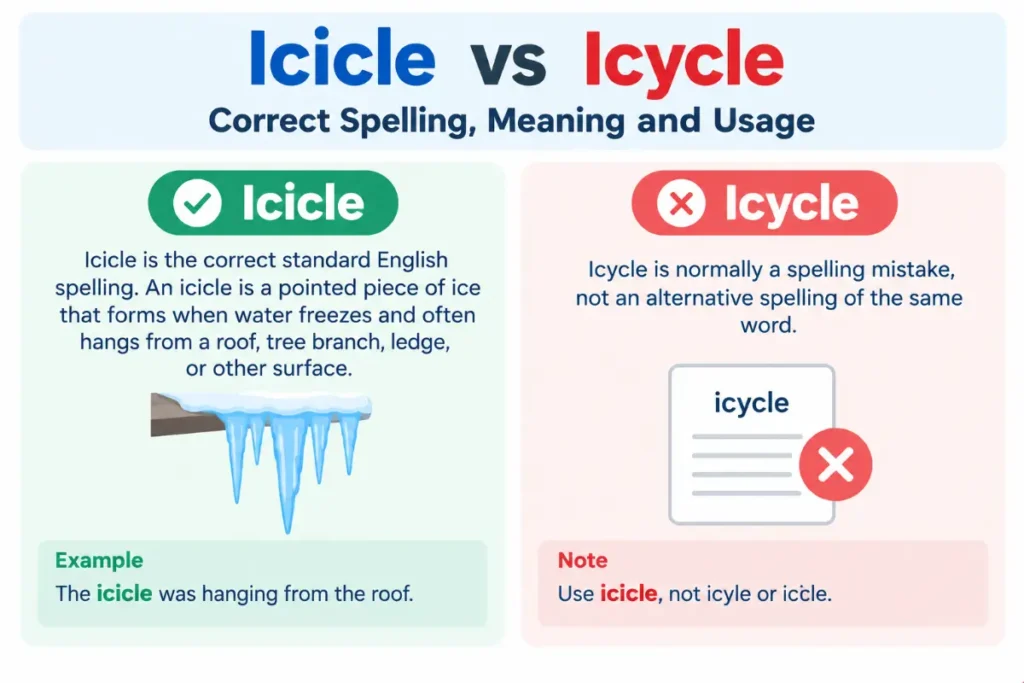
Icicle is the correct standard spelling for a pointed piece of ice that hangs from a surface. Icycle is not the standard spelling for this object and should generally be treated as a spelling mistake. Remember the letter c in the middle of icicle to spell the word correctly.
Comparison Table
| Feature | Icicle | Icycle |
|---|---|---|
| Standard spelling | Correct | Incorrect for the usual meaning |
| Meaning | A hanging piece of ice | No standard general meaning as a noun for hanging ice |
| Part of speech | Noun | Usually a misspelling in this context |
| Pronunciation | Usually /ˈaɪ.sɪ.kəl/ | Intended pronunciation usually matches icicle |
| American English | Standard | Nonstandard spelling for this meaning |
| British English | Standard | Nonstandard spelling for this meaning |
| Common contexts | Winter weather, roofs, trees, frozen water | Accidental spelling errors |
| Example | An icicle hung from the roof. | Write icicle instead of icycle. |
Meaning and Definition
What Does Icicle Mean?
An icicle is a narrow piece of ice that forms when water freezes as it drips or runs from an edge. It often has a pointed shape and hangs downward from roofs, gutters, tree branches, rocks, or other surfaces.
Icicles are common during cold weather. For example, melting snow may drip from a roof during the day. If the temperature falls below freezing, the water can freeze again and build up into long, narrow pieces of ice.
The word is a noun because it names a thing. You can use it as the subject or object of a sentence.
- An icicle hung from the gutter.
- The children watched a large icicle melt.
- Several icicles formed along the edge of the roof.
The word can also appear in descriptive writing. A writer might describe icicles shining in the sunlight or hanging like glass ornaments from a tree. These descriptions help readers picture a cold winter scene.
Is Icycle a Real Word?
Icycle is not the standard English spelling for a hanging piece of ice. In ordinary writing, it is best treated as a misspelling of icicle.
That does not mean the letter sequence could never appear in a name, a brand, or a specially created term. Names and invented words can use unusual spellings. However, those special cases do not make icycle an accepted alternative spelling for the common winter object.
If you are writing a school paper, an email, a story, or a weather report, use icicle. If a spelling checker flags icycle, it is likely identifying the missing letter c.
Why the Difference Matters
The two forms look almost identical, so a reader can usually guess the intended meaning. Still, a recognizable mistake is not the same as a correct spelling.
Standard spelling helps readers understand your message without distraction. It also matters in schoolwork, professional writing, published material, and online content. Using the established form makes your writing easier to read and more consistent.
Key Differences Explained
The main difference is spelling. The standard word icicle names a real object, while icycle is generally an error when used to describe that object. The distinction becomes easier to understand when you look at the letters, sounds, grammar, and context.
Spelling
The correct word contains a c between the first i and the ending cle. Its letters follow this pattern.
I C I C L E
The incorrect form removes the second letter c, producing icycle. Although the difference is only one letter, the standard spelling does not allow you to leave it out.
A useful way to remember the spelling is to look for both c letters in the word. The first appears near the beginning, and the second comes immediately before the final le.
Meaning
Icicle has a clear meaning in standard English. It describes a hanging piece of ice formed by freezing water.
By contrast, icycle does not normally carry this meaning as a standard English word. If you see it in a sentence about winter weather, the writer probably intended to use icicle.
For example, the sentence The icicle fell from the roof is correct. The sentence The icycle fell from the roof contains a spelling error.
Grammar and Part of Speech
Icicle is a countable noun. This means you can talk about one object or several objects.
- Singular: An icicle formed overnight.
- Plural: Icicles formed overnight.
- With an article: The icicle was unusually long.
- With a number: Three icicles hung from the roof.
The plural form is icicles. You add s to the standard singular spelling. You do not need to change the middle letters.
Pronunciation
The standard pronunciation is approximately the same across common American and British English varieties. In American English, the word is usually pronounced with three syllables: eye, sih, and kuhl.
The first syllable receives the strongest stress. Since the two spellings look similar, someone reading the incorrect form might still understand the intended word. However, pronunciation does not make the alternative spelling correct.
Formality and Context
The correct form works in both formal and informal writing. You can use it in a casual conversation, a school assignment, a weather report, or a piece of fiction.
The incorrect spelling has no place as the ordinary name for this object in edited standard English. It might appear in a typo, an informal post, or an invented name, but readers should not treat it as a regular spelling variant.
Regional Usage
American, British, Canadian, and Australian English all use icicle for the hanging piece of ice. There is no widely accepted regional spelling rule that changes it to icycle.
This is useful because some English words have legitimate regional spelling differences. This word is not one of those cases. You can use the same spelling regardless of the English variety you are writing in.
Which Form Is Correct?
Use icicle whenever you mean a pointed piece of ice hanging from a surface. It is the established spelling in standard English dictionaries and everyday usage.
The reason is straightforward. English spelling often preserves specific letter patterns even when a word’s pronunciation does not make every letter obvious. A familiar sound cannot tell you the full spelling by itself, so writers need to learn the accepted written form.
For this word, there is no need to choose between an American spelling and a British spelling. Both varieties use the same standard form.
Consider these examples.
- Correct: A thick icicle hung from the garage roof.
- Incorrect: A thick icycle hung from the garage roof.
- Correct: Sunlight made the icicle sparkle.
- Incorrect: Sunlight made the icycle sparkle.
The intended meaning remains understandable in the incorrect examples. However, the spelling still needs correction.
Sentence Examples
Here are ten natural sentences showing how to use the correct word in different situations.
- Everyday conversation: Look at that huge icicle hanging from the porch roof.
- Text message: Be careful near the garage because a large icicle is hanging above the door.
- School assignment: An icicle forms when dripping water freezes in cold conditions.
- Workplace communication: Please check the entrance for falling icicles before opening the building.
- Weather report: Overnight freezing temperatures allowed icicles to form along exposed gutters.
- Social conversation: I took a picture of a beautiful icicle hanging from a pine branch.
- Academic writing: The formation of an icicle depends on water flow and freezing conditions.
- Formal writing: Building maintenance staff should remove dangerous ice formations when it is safe to do so.
- Online communication: Those icicles look amazing in the morning sunlight.
- Storytelling: A crystal clear icicle dangled from the cabin roof as snow covered the path below.
Each sentence uses the standard spelling. Notice that the word fits naturally into several types of writing because it names a specific object.
Common Spelling Mistakes
The most useful corrections involve the missing letter in the main word and a few related words that people may confuse with it.
| Incorrect form or confusion | Correct form | Reason |
|---|---|---|
| Icycle | Icicle | The standard spelling contains a second c. |
| Icicel | Icicle | The final letters appear in the wrong order. |
| Icicle’s used for a simple plural | Icicles | A regular plural does not need an apostrophe. |
| Icicles used for one object | Icicle | The singular form names one piece. |
| Ice sickle used as the ordinary spelling | Icicle | The phrase may describe the shape but is not the standard name. |
1. Leaving Out the Middle Letter
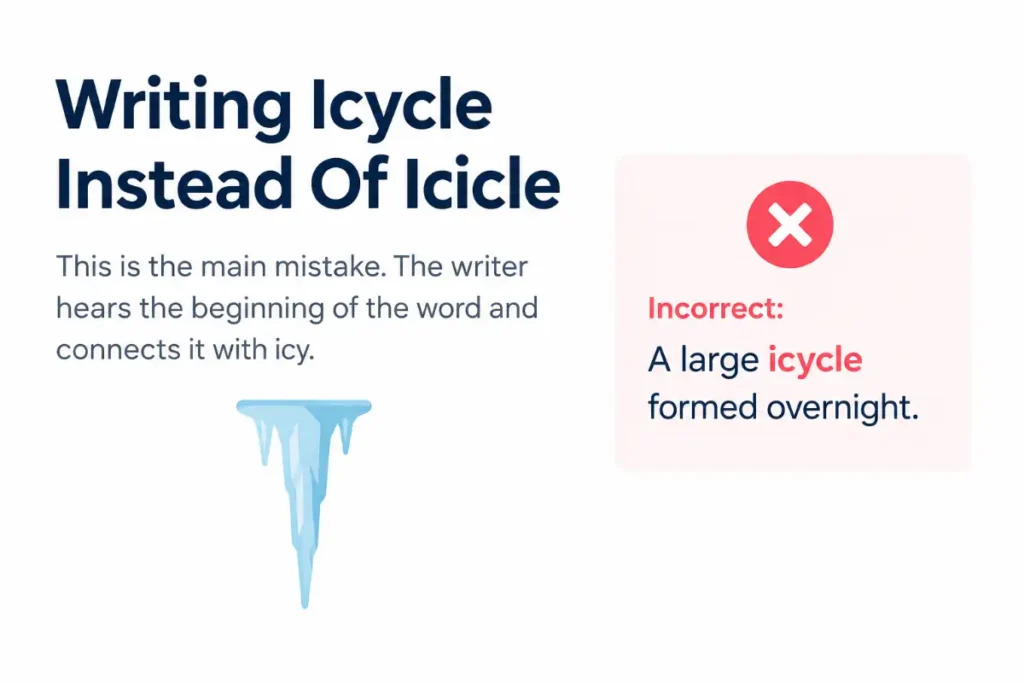
The most direct mistake is writing icycle instead of icicle. This usually happens because the writer remembers the sound but not the full sequence of letters.
Correction: Write icicle and check that both c letters appear in the word.
2. Reversing the Final Letters
A writer may accidentally produce icicel. This is a letter order error. The correct ending is cle, not cel.
Correction: Read the final three letters before submitting your writing.
3. Using an Apostrophe for the Plural
The plural is icicles, not icicle’s. An apostrophe normally marks possession or a contraction, not a regular plural.
For example, The icicles melted is correct. The icicle’s melted is not correct if you mean that several pieces of ice melted.
An apostrophe can be appropriate when showing possession. The icicle’s tip broke means the tip belonging to one icicle broke.
4. Confusing Singular and Plural Forms
Use icicle for one piece and icicles for two or more. The change is small, but it affects the grammar of the sentence.
For example, One icicle fell is correct. Two icicles fell is also correct.
5. Relying Only on Sound
English contains many words whose spellings cannot be worked out perfectly from pronunciation. This word is one example. A person may hear the correct word clearly and still leave out a letter when typing it.
Correction: Learn the spelling as a complete unit rather than guessing each letter from the sound.
Pronunciation Guide
The standard American English pronunciation of icicle is represented in the International Phonetic Alphabet as /ˈaɪ.sɪ.kəl/.
How to Say Icicle
American English pronunciation
EYE suh kuhl
For another common grammar confusion, see incall vs outcall What Is the Difference.
1
First syllable
Say eye. This is the stressed syllable.
2
Second syllable
Say a short, relaxed sih sound.
3
Third syllable
Finish with a relaxed kuhl sound.
Syllable Breakdown
The word has three syllables: i ci cle. The first syllable carries the primary stress, and the remaining two are unstressed.
Say the word slowly at first. Then bring the syllables together at a natural speaking speed. This helps you recognize the word when you hear it and connect the sound with the correct spelling.
Common Pronunciation Mistakes
One possible mistake is placing too much stress on the final syllable. Another is trying to pronounce every letter as a separate sound. In ordinary American speech, the final syllable is relaxed, and the word flows naturally.
Keep in mind that the written form and spoken form serve different purposes. You can pronounce the word correctly while spelling it incorrectly. For accurate writing, remember the full letter pattern as well as the sound.
Etymology and Word Origin
The word icicle has a long history in English. Its development is linked to older English forms associated with ice and to the noun ending ickle or icicle found in the historical form of the word.
Older forms included isikel and related spellings. Over time, the spelling developed into the modern form icicle. The word has remained associated with the narrow pieces of ice that form when water freezes as it drips.
The history helps explain why the modern spelling is not simply icycle. English words often preserve letter patterns that have developed over centuries. A spelling may not seem obvious from the sound alone, yet it remains the accepted written form.
There is no need to memorize every historical spelling to use the word correctly. The practical lesson is that icicle is the modern standard spelling, and its established history supports that form.
Regional Usage in English
Spelling differences between English varieties can cause real confusion. For example, American English uses color, while British English commonly uses colour. The same kind of regional difference does not apply to this word.
American English
In the United States, icicle is the standard spelling. You will see it in weather descriptions, school materials, children’s books, home maintenance advice, and everyday conversation.
For example, an American homeowner might say, Three icicles are hanging from the gutter. A teacher might use the same word when explaining how freezing water forms ice.
The spelling icycle is not a standard American alternative.
British English
British English also uses icicle. The word has the same general meaning and grammatical role as it does in American English.
A British writer might describe icicles hanging from a cottage roof or forming along a garden wall. The spelling remains unchanged.
Canadian English
Canadian English uses icicle as well. Cold winters make the word especially familiar in descriptions of snow, freezing rain, and ice formation, but the spelling rule is the same.
Australian English
Australian English follows the same standard spelling. Although many parts of Australia experience fewer prolonged freezing conditions than colder regions of North America, the word remains part of standard English vocabulary.
The regional rule is simple. Use icicle in American, British, Canadian, and Australian English. You do not need to change the spelling to match your audience.
Grammar Rules and Part of Speech
Understanding how a word works in a sentence makes it easier to use correctly. Icicle is a noun, and it follows regular noun patterns.
Countable Noun
An icicle is a countable object. You can identify one, several, or a specific number of them.
- An icicle formed overnight.
- The icicle began to melt.
- Several icicles hung from the roof.
- Two long icicles fell onto the snow.
Use a or an according to the sound that follows. Since icicle begins with a vowel sound, the correct phrase is an icicle.
Singular and Plural Forms
The singular form is icicle. The regular plural form is icicles.
You do not change the spelling of the root when forming the plural. You simply add s at the end.
Incorrect: Three icicle hung from the roof.
Correct: Three icicles hung from the roof.
The singular form works with singular determiners and verbs. The plural form normally works with plural verbs.
Articles and Determiners
You can use icicle with articles and other words that identify a noun.
- An icicle hung from the window.
- The icicle was longer than the others.
- That icicle looks dangerous.
- Several icicles formed overnight.
These patterns are useful in both speech and writing. They also show that the word behaves like an ordinary countable noun.
Adjectives Before the Noun
Adjectives can describe an icicle’s size, shape, appearance, or condition.
Examples include a long icicle, a clear icicle, a sharp icicle, and a melting icicle.
You can also use a more detailed description, such as a thin icicle covered in fresh snow. The adjective does not change the spelling of the noun.
Using the Word as a Subject or Object
A noun can perform different functions in a sentence.
As a subject: The icicle melted in the afternoon sun.
As a direct object: The worker removed the icicle from the entrance.
After a preposition: Water dripped from the icicle.
In each example, the word names the same object. Its grammatical function depends on how the sentence is built.
Punctuation and Possession
Use an apostrophe only when the sentence calls for possession or another accepted apostrophe construction.
The icicle’s tip was sharp means the tip belonged to one icicle. The icicles’ tips were sharp refers to the tips of several icicles.
However, the ordinary plural does not take an apostrophe. Write icicles, not icicle’s, when you mean more than one.
Real Life Usage Examples
The word appears in many kinds of writing. The examples below show how it works in ordinary communication and more descriptive contexts.
Daily Conversation
In everyday speech, people usually use the word to point out ice they can see or to warn someone about a possible hazard.
- There is an icicle hanging above the front door.
- Watch your step because the icicles are melting and falling.
These sentences are direct and easy to understand. They show how the word fits naturally into a conversation about winter weather.
Email and Workplace Communication
In workplace messages, the word may appear in a safety notice or a maintenance request.
- Please inspect the roof for large icicles before the crew begins work outside.
- The entrance has been cleared, but an icicle remains above the side door.
The first example gives a clear instruction. The second communicates a specific condition that may need attention.
Academic Writing
In science or school assignments, the word may appear in explanations of freezing water and ice formation.
- An icicle can grow when liquid water repeatedly freezes along its surface.
- Changes in temperature affect the growth and melting of icicles.
These examples use the word in an informative context. The spelling stays the same even when the explanation becomes more technical.
News and Journalism
News writing often uses familiar vocabulary to explain weather conditions and their effects.
- Falling icicles prompted officials to warn pedestrians near the building.
- The overnight freeze left icicles hanging from trees and roadside structures.
These sentences illustrate possible news style. They are examples of how a journalist might write, not quotations from actual news reports.
Literature and Storytelling
In fiction, an icicle can help create a sense of cold, stillness, danger, or beauty.
- A single icicle glittered beneath the cabin roof as the sun rose.
- She hurried past the old shed, avoiding the sharp icicles hanging overhead.
The first sentence creates a calm visual image. The second uses the object to add a small element of danger to the scene.
Related and Confused Terms
Learning a few related words can strengthen your understanding of winter vocabulary and reduce spelling confusion.
1. Ice
Ice is frozen water. An icicle is a particular form of ice that hangs from an edge or surface.
Example: The lake was covered with ice, and an icicle hung from the nearby dock.
2. Icicles
Icicles is the plural of icicle. Use it when referring to more than one hanging piece of ice.
Example: Icicles lined the edge of the roof.
3. Icy
Icy is an adjective meaning covered with ice, very cold, or slippery because of ice.
Example: The driveway was icy after the overnight freeze.
Do not confuse the adjective icy with the noun icicle. They are related in meaning but serve different grammatical roles.
4. Ice Formation
Ice formation describes the process or result of ice developing under suitable conditions. It is a broader expression than icicle.
Example: The science lesson explained ice formation in cold weather.
5. Frost
Frost consists of ice crystals that form on cold surfaces under suitable conditions. It usually appears as a thin coating rather than a long hanging piece of ice.
Example: Frost covered the grass early in the morning.
6. Freezing
Freezing refers to the process in which a liquid becomes a solid because of a change in temperature. It can also describe extremely cold conditions.
Example: Freezing temperatures helped the icicle grow.
7. Sleet
Sleet refers to a type of frozen precipitation. In American English, it commonly means small ice pellets that form when raindrops freeze before reaching the ground.
Example: Sleet made the roads slippery during the storm.
Sleet falls from the sky, while an icicle forms on a surface from freezing water.
8. Stalactite
A stalactite is a mineral formation that hangs from the ceiling of a cave. It may resemble an icicle in shape, but the two are different things.
Example: A long stalactite hung from the cave ceiling.
An icicle is made of ice. A stalactite usually develops through mineral deposits over a much longer period.
Expert Editor Insight
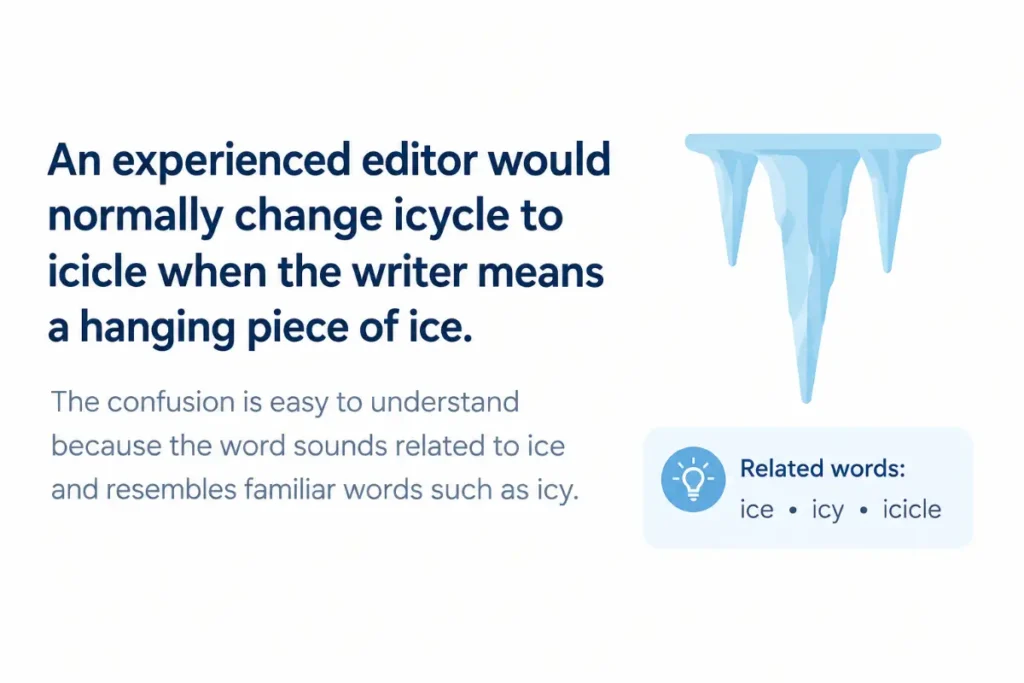
An experienced English editor would correct icycle to icicle when the sentence refers to a hanging piece of ice. The mistake is easy to make because the two forms look and sound similar, and a quick spellcheck may catch it only if the incorrect form is not recognized as a name or specialized term. Editors check the meaning as well as the spelling. The best practical habit is to read the sentence in context, confirm the intended meaning, and then verify the written form. A spelling tool can help, but it should support careful proofreading rather than replace it.
You may also want to read comment vs coment Which Spelling Is Correct..
Conclusion
The difference between icycle vs icicle comes down to one missing letter. Icicle is the correct standard spelling for a pointed piece of ice that hangs from a roof, branch, or other surface. Icycle is generally a spelling mistake when used with this meaning. The same rule applies in American, British, Canadian, and Australian English, so you do not need to learn separate regional forms.
To remember the correct spelling, focus on the two c letters in icicle. Before submitting an assignment or publishing a message, take a moment to check the spelling in context. That small habit can make your writing clearer and more accurate.
FAQs
Is Icycle a Real Word?
Icycle is not the standard English word for a hanging piece of ice. In ordinary writing, it is considered a misspelling of icicle. It could appear as an invented name or in a special context, but that does not make it a standard spelling variant. For schoolwork, professional communication, and general writing, use icicle.
What Does Icicle Mean?
An icicle is a long, narrow piece of ice that forms when water drips or runs from a surface and freezes. It often hangs from roofs, gutters, branches, or rocks. Icicles commonly develop during cold weather when liquid water freezes as it moves or collects along an edge.
Which Is Correct Between Icycle and Icicle?
Icicle is correct when you mean a hanging piece of ice. Icycle is not an accepted standard alternative for this meaning. The correct spelling contains two c letters, with one near the beginning and another immediately before the final le. Remembering both letters can help you avoid this common spelling mistake.
How Do You Pronounce Icicle?
In American English, icicle is usually pronounced /ˈaɪ.sɪ.kəl/. It has three syllables, and the first syllable receives the main stress. An easy pronunciation guide is eye suh kuhl. Saying the word slowly and then at a natural speed can help you connect its pronunciation with its standard spelling.
Can Icicle Start a Sentence?
Yes. Icicle can begin a sentence when it functions as the subject. For example, An icicle hung from the edge of the roof. The word follows normal English capitalization rules, so its first letter becomes uppercase at the start of a sentence. The spelling remains the same everywhere else in the sentence.
What Is a Synonym for Icicle?
There is no perfect everyday synonym that means exactly the same thing. Expressions such as hanging piece of ice and pointed piece of ice can describe the object, although they are longer than the standard noun. The word ice formation is broader and may refer to many shapes of ice, not just a hanging one.
Why Do People Confuse Icycle and Icicle?
People confuse the forms because they differ by only one letter and look very similar. A writer may remember the sound but forget the second c when typing. Fast writing and weak spelling recall can also contribute to the mistake. Learning the complete spelling and checking it during proofreading are simple ways to reduce errors.
Is Icicle Appropriate in Formal Writing?
Yes. Icicle is a standard English noun that works in formal and informal writing. You can use it in academic explanations, weather reports, workplace safety notices, and descriptive writing. The choice depends on the context rather than formality. If you are referring to a hanging piece of ice, the accepted spelling remains icicle across standard English varieties.