

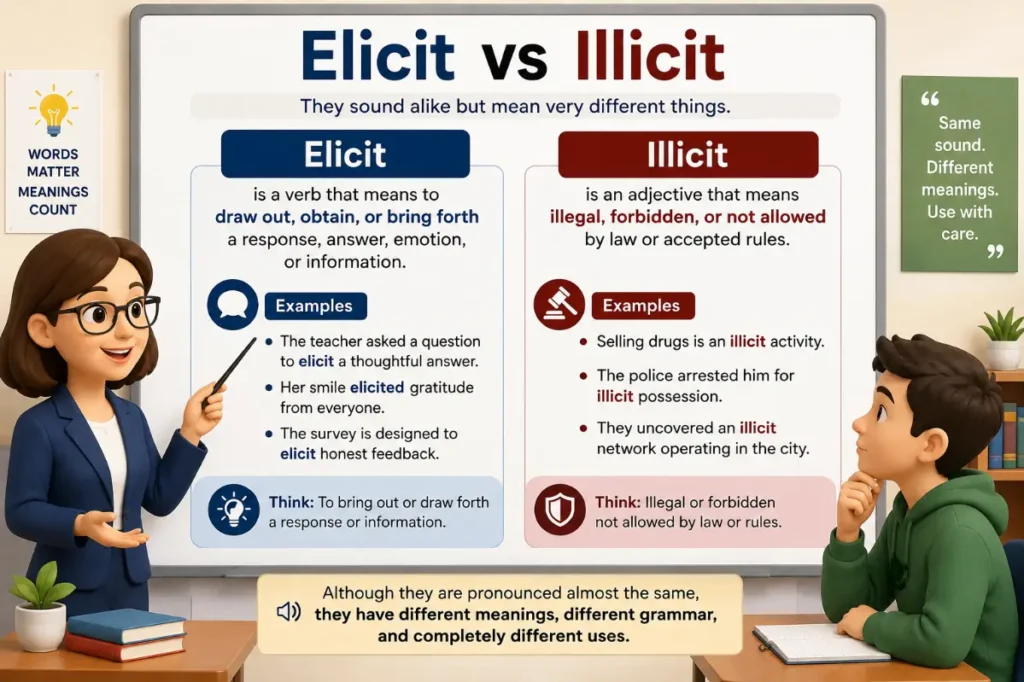
Some English words look almost identical but carry completely different meanings. That is exactly what happens with elicit vs illicit. Both words are spelled with six letters, share several sounds, and often appear in formal writing. However, they serve very different purposes.
Elicit is a verb that means to draw out a response, feeling, answer, or piece of information. Illicit is an adjective that describes something illegal, forbidden, or not allowed by rules or accepted standards.
For example, a teacher might elicit answers from students during a discussion. An investigator might elicit information from a witness. By contrast, illicit drugs or illicit trade involve activities that break the law or violate legal restrictions.
The confusion often comes from their similar spelling and pronunciation. A small change at the beginning creates a major difference in meaning. Using the wrong word can make an otherwise clear sentence confusing or even change its entire message.
Understanding these terms is easier once you connect each word to its grammatical role and meaning. The examples and explanations below will help you recognize the difference, avoid common spelling mistakes, and choose the right word with confidence.
Need another quick comparison? Read complement vs compliment Explained With Examples.
Short Answer
Elicit is a verb that means to draw out a response, reaction, or information. Illicit is an adjective that describes something unlawful, forbidden, or prohibited. Both are correct English words, but they are not interchangeable. Use elicit for an action that brings something out and illicit for something that is not permitted.
Comparison Table for Elicit and Illicit
| Feature | Elicit | Illicit |
|---|---|---|
| Meaning | To draw out a response or information | Illegal or forbidden |
| Part of speech | Verb | Adjective |
| Pronunciation | ih LIS it | ih LIS it |
| Syllables | Three | Three |
| Stress | Second syllable | Second syllable |
| Common contexts | Interviews, teaching, research, conversation | Law, crime, trade, prohibited activity |
| Common phrase | Elicit a response | Illicit activity |
| Example | The question elicited an honest answer. | Police investigated illicit trade. |
| Formality | Common in formal and professional writing | Common in legal, professional, and everyday writing |
| Correct usage | Used for an action | Used to describe a noun |
The key difference is grammatical as well as semantic. One word describes an action performed to obtain a response or reaction. The other describes a person, object, or activity that is prohibited.
What Does Elicit Mean
Elicit means to draw out, bring forth, or obtain a response, feeling, reaction, or piece of information from someone or something. It is a verb, so it expresses an action.
People often use this word when a question, event, action, or situation causes someone to respond. The response might be spoken, emotional, physical, or written.
For example, a teacher may ask a thoughtful question to elicit ideas from students. A comedian may tell a joke to elicit laughter. A researcher may conduct an interview to elicit detailed answers from participants.
In each case, something prompts a response that might not have appeared on its own.
Common Uses of Elicit
The word appears in several settings.
- Education. Teachers elicit answers by asking questions that encourage students to think and explain their ideas.
- Research. Researchers elicit feedback from participants to understand their opinions and experiences.
- Psychology. A particular memory or situation may elicit an emotional response.
- Journalism. An interviewer may elicit new information from a source.
- Business. A manager may elicit suggestions from employees during a planning meeting.
- Everyday conversation. A kind gesture may elicit a smile, while an unexpected comment may elicit surprise.
Notice that the word usually connects an action or situation to a result. Someone asks a question, and the question draws out an answer. Someone tells a funny story, and the story brings out laughter.
Grammatical Forms of Elicit
Like other regular verbs, this word changes form depending on the sentence.
- Base form. The counselor hopes to elicit an honest response.
- Third person singular. Her question elicits useful feedback.
- Past tense. The interview elicited several new details.
- Present participle. The teacher is eliciting ideas from the class.
- Past participle. The survey has elicited strong reactions.
These forms all describe the same basic action. The spelling changes according to tense and grammatical structure, but the central meaning remains the same.
Synonyms for Elicit
Several words have a similar meaning, but each carries a slightly different emphasis.
- Draw out. To encourage someone to share a response or thought.
- Obtain. To get information, often through a request or process.
- Evoke. To bring a feeling, memory, or image to mind.
- Prompt. To encourage a response or action.
- Provoke. To cause a reaction, sometimes a strong or negative one.
- Extract. To obtain something from a source, sometimes with difficulty.
- Generate. To produce a result, response, or idea.
- Bring forth. To cause something to appear or become known.
These alternatives are not perfect substitutes in every sentence. A question can elicit an answer, evoke a memory, or provoke an argument. The best choice depends on the type of response and the effect you want to describe.
What Does Illicit Mean
Illicit is an adjective that describes something illegal, forbidden, or prohibited by a law, rule, or accepted standard. It commonly appears before a noun to describe an activity, product, relationship, or transaction.
For example, illicit drug trafficking involves the illegal movement or sale of controlled substances. Illicit trade can involve goods moved or sold in violation of applicable laws. An illicit payment may refer to money given as part of a prohibited transaction.
The word often appears in news reports, legal discussions, government statements, and formal writing. It can also appear in ordinary conversation when people discuss conduct that is not allowed.
Common Uses of Illicit
The meaning depends on the situation, but the central idea is that something is not permitted.
- Law enforcement. Investigators may look into illicit financial transactions.
- Trade. Authorities may work to stop illicit sales of protected goods.
- Drugs. Reports may describe illicit drug production or distribution.
- Politics. An investigation may uncover illicit payments or hidden financial dealings.
- Personal conduct. A story may describe an illicit relationship that violates established rules or commitments.
- Journalism. News reports may discuss illicit markets or prohibited activities.
One important distinction is that illicit does not always describe an activity that is inherently illegal in every place or situation. Its exact meaning depends on the relevant law, rule, or standard. Some uses refer to conduct that is unlawful, while others refer more broadly to conduct that is forbidden or considered improper.
Grammatical Forms of Illicit
Illicit is an adjective, not a verb. It does not take verb endings such as illicits, illicited, or illiciting to express an action.
Instead, it modifies nouns.
- The agency investigated an illicit transaction.
- Officials discovered illicit goods during the inspection.
- The report examined illicit financial activity.
- Authorities are working to prevent illicit trade.
- The investigation revealed that the payments were illicit.
The word itself usually stays the same. You can use it with singular or plural nouns without changing its spelling.
Synonyms for Illicit
The best synonym depends on the type of restriction involved.
- Illegal. Against the law.
- Unlawful. Not permitted by law.
- Forbidden. Specifically prohibited by a rule or authority.
- Prohibited. Not allowed under a particular rule or policy.
- Unauthorized. Done without the required permission.
- Unlawful in nature. A phrase that emphasizes a legal violation.
- Banned. Officially not allowed.
- Improper. Contrary to accepted standards or expected conduct.
These words differ in strength and scope. Illegal and unlawful point directly to legal restrictions. Unauthorized focuses on missing permission. Forbidden can refer to laws, rules, or personal boundaries. Improper may describe conduct that is unacceptable without necessarily being illegal.
Key Differences Explained
The clearest way to separate these words is to focus on what each one does in a sentence. One describes an action that brings out a response. The other describes something prohibited.
Difference in Spelling
Both words contain six letters and share the ending licit. Their first two letters differ.
- Elicit begins with E.
- Illicit begins with I.
That small difference is easy to miss while typing. However, it changes the word’s meaning and grammatical role.
A useful memory aid is to connect the E in elicit with extract or evoke. Both ideas involve drawing something out. Connect illicit with illegal, since both relate to conduct that is not permitted.
Difference in Meaning
Elicit describes an action that produces or draws out a response. Illicit describes a thing or activity that is prohibited.
Compare these sentences.
- The interviewer tried to elicit a clear answer.
- The investigators uncovered an illicit payment.
In the first sentence, the interviewer is trying to obtain a response. In the second, the payment is being described as prohibited or unlawful.
The meanings are unrelated despite the similar spelling.
Difference in Grammar
Elicit functions as a verb. It commonly appears after a subject or after a verb such as try, hope, or want.
Examples include the following.
- The question elicited a strong reaction.
- We hope to elicit more feedback.
- Her comments may elicit further questions.
Illicit functions as an adjective. It usually appears before a noun or after a linking verb.
Examples include the following.
- They uncovered an illicit operation.
- The transaction was illicit.
- Authorities investigated illicit sales.
If you are unsure which word belongs in a sentence, identify the grammatical job first. If the sentence needs an action, elicit may fit and If it needs a description of something prohibited, illicit may be the right choice.
Difference in Pronunciation
In standard American English, the two words are generally pronounced alike. Both have three syllables, with stress on the second syllable.
Because their pronunciation is so similar, listening alone may not help you choose the correct spelling. The surrounding words usually provide the strongest clue.
For example, a phrase about eliciting answers points toward the verb. A phrase about illicit trade points toward the adjective.
Difference in Formality
Both words are standard English and appear in formal and informal settings. Neither is limited to one level of formality.
Elicit is especially common in education, research, interviews, counseling, and business communication. Illicit appears frequently in legal writing, journalism, law enforcement, and discussions about prohibited conduct.
The difference comes from meaning rather than formality.
Difference in Context
The words usually appear with different types of nouns and verbs.
Common expressions with elicit include elicit a response, elicit information, elicit feedback, and elicit sympathy.
Common expressions with illicit include illicit trade, illicit drugs, illicit payments, and illicit activity.
Learning these common word combinations can help you choose the correct form more quickly. Writers and speakers often remember words as part of familiar phrases rather than as isolated definitions.
Which Form Is Correct
Both forms are correct. The right choice depends on what you want to say.
Use elicit when you mean to draw out an answer, feeling, reaction, or piece of information. Use illicit when you mean illegal, forbidden, or prohibited.
For example, the sentence The detective tried to elicit information is correct because the detective is trying to obtain information. The sentence The detective investigated illicit activity is also correct because illicit describes the activity being investigated.
Neither spelling is a variation of the other. They are separate words with different meanings and grammatical functions.
Established dictionary practice treats them as distinct entries. Their definitions and parts of speech provide the clearest guidance for correct usage. You do not need to memorize a complicated grammar rule to distinguish them. You only need to identify the meaning your sentence requires.
Sentence Examples
The following examples show how to use both words in natural American English.
Ten Examples Using the Correct Forms
- Elicit. The teacher asked an open question to elicit thoughtful answers from the class.
- Elicit. Her apology elicited a warm response from the audience.
- Elicit. The reporter hoped to elicit more details during the interview.
- Elicit. We sent a short survey to elicit feedback from our customers.
- Elicit. His unexpected comment elicited laughter around the table.
- Illicit. Police investigated a network involved in illicit drug sales.
- Illicit. The company introduced new controls to prevent illicit payments.
- Illicit. The article examined the growth of illicit trade in the region.
- Illicit. Investigators found evidence of an illicit financial transaction.
- Illicit. The documentary explored the risks associated with illicit markets.
Each sentence uses the word according to its grammatical function. The first five describe an action that draws out a response or information. The remaining five use an adjective to describe prohibited conduct or transactions.
Five Examples of the Common Mix Up
These examples show how replacing one word with the other can produce the wrong meaning.
1. Incorrect for the intended meaning. The teacher tried to illicit answers from the students. Correct. The teacher tried to elicit answers from the students.
2. Incorrect for the intended meaning. The interview elicited drug trade in the area. Better. The interview revealed illicit drug trade in the area.
3. Incorrect for the intended meaning. The report discussed elicit payments made to officials. Correct. The report discussed illicit payments made to officials.
4. Incorrect for the intended meaning. The survey illicit strong reactions from customers. Correct. The survey elicited strong reactions from customers.
5. Incorrect for the intended meaning. Investigators worked to illicit information from the witness. Correct. Investigators worked to elicit information from the witness.
These mistakes happen because the words look and sound similar. The solution is not to avoid either word. It is to connect each one to its meaning and grammatical role.
Common Mistakes and Spelling Confusion
The two words are easy to confuse, but a few simple checks can help you catch errors before they reach the page.
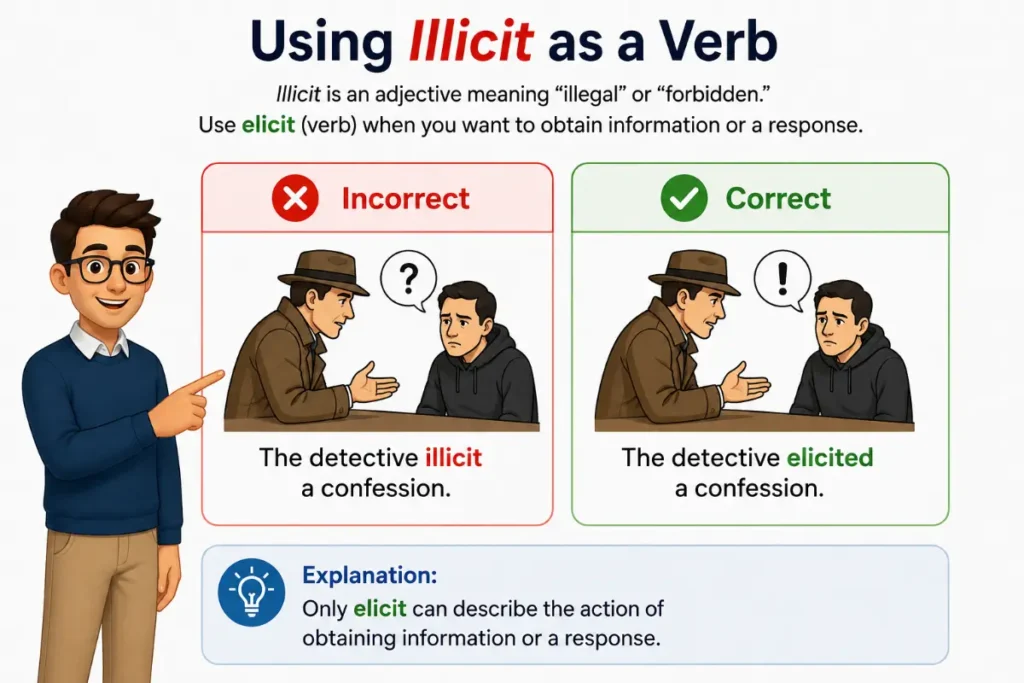
Mistake One Using Illicit as a Verb
Illicit is an adjective. It cannot replace a verb meaning to obtain or draw out.
Incorrect. The counselor tried to illicit an honest response.
Correct. The counselor tried to elicit an honest response.
The verb tried needs another verb after to. Elicit supplies that action. Illicit does not.
Mistake Two Using Elicit as an Adjective
Elicit does not mean illegal or forbidden.
Incorrect. Officials uncovered an elicit business arrangement.
Correct. Officials uncovered an illicit business arrangement.
The sentence needs an adjective to describe the arrangement. Illicit provides that description.
Mistake Three Relying Only on Pronunciation
Since the words sound alike in standard American English, pronunciation may not reveal the intended meaning.
For example, a listener might hear a sentence about a person trying to obtain an answer but choose the adjective spelling by mistake. The surrounding words and grammatical structure offer better clues than sound alone.
When editing, read the whole sentence rather than checking the word in isolation.
Mistake Four Assuming One Word Is a Misspelling
Neither word is inherently incorrect. Both are established English words.
The error occurs when a writer uses a valid word in the wrong context. A spell checker may accept both forms because both exist in English. That does not guarantee that the selected word fits the sentence.
Mistake Five Confusing Similar Word Patterns
English contains many words that look alike but have unrelated meanings. Writers may assume that similar spelling indicates a similar function.
In this case, the words share several letters but belong to different grammatical categories. Learning their meanings and common word combinations helps prevent confusion.
Pronunciation Guide
Both words are generally pronounced the same way in standard American English.
Elicit
Still confused? Compare Mute Point or Moot Point Which Is Correct.
ih LIS it
IPA /ɪˈlɪsɪt/
Illicit
ih LIS it
IPA /ɪˈlɪsɪt/
Syllable Breakdown
Both words contain three syllables.
- The first syllable has a short vowel sound, similar to the sound at the beginning of it.
- The second syllable carries the main stress.
- The final syllable has a short, unstressed vowel followed by a T sound.
Say the words naturally rather than giving equal stress to every syllable. The middle syllable receives the strongest emphasis.
Common Pronunciation Mistakes
Some speakers may try to pronounce the opening letters differently because they expect the spelling to create a different sound. In standard American English, the two words generally sound alike.
Regional accents can affect individual vowel sounds, but the main distinction remains the same. The words are usually distinguished by context rather than pronunciation.
Etymology and Word Origin
The histories of these words help explain why they look similar but mean different things.
The Origin of Elicit
Elicit comes from Latin elicere, meaning to draw out or entice. The Latin word combines a prefix with a verb associated with drawing or bringing something out.
English adopted the term through historical language development, and it became established as a verb for bringing forth a response, reaction, or piece of information.
Its modern meaning remains closely connected to the original idea of drawing something out. When a question elicits an answer, it brings that answer forth through a prompt or interaction.
The Origin of Illicit
Illicit comes from Latin illicitus, meaning unlawful or not permitted. The word is connected to the Latin verb licere, meaning to be permitted or allowed.
The prefix il expresses negation in this word. As a result, illicit carries the idea of something not allowed.
That historical connection explains its modern use in phrases involving prohibited activities, unauthorized transactions, and conduct that violates applicable rules.
Why Their Histories Matter
The shared appearance can make the words seem closely related, but their histories point to different ideas.
Elicit connects to drawing something out. Illicit connects to the absence of permission. Remembering those underlying meanings gives you a practical way to select the right word.
Regional Usage
These terms are standard in several major English varieties. Their core meanings do not change significantly across regions.
American English
Both words are accepted in American English. Elicit appears in conversations about interviews, education, customer feedback, and emotional reactions. Illicit is common in legal discussions, news reports, and descriptions of prohibited activity.
American writers should choose between them based on meaning and grammar rather than regional spelling rules.
British English
British English uses both words with the same basic meanings. There is no major British spelling variation that changes the distinction.
Writers in the United Kingdom use elicit for drawing out information or responses and illicit for describing something unlawful or forbidden.
Australian English
Australian English follows the same distinction. Both forms are standard, and their meanings remain consistent with general English usage.
The choice depends on the intended meaning rather than an Australian spelling convention.
Canadian English
Canadian English also uses both words in their established senses. Writers should not treat either as an American only or British only form.
Across these varieties, context and grammatical function remain the most reliable guides.
Grammar Rules and Sentence Structure
Knowing the basic definitions is useful, but grammar provides another reliable way to identify the correct word.
How to Use Elicit in a Sentence
Elicit usually takes a direct object. That object identifies the response, information, or reaction being drawn out.
Common patterns include the following.
- Elicit + a response. The question elicited a surprising answer.
- Elicit + information. The interview elicited useful information.
- Elicit + a feeling. Her speech elicited sympathy.
- Try to elicit + a response. The coach tried to elicit honest feedback.
- Be elicited by + a cause. The response was elicited by a carefully worded question.
The word can appear in different tenses, and it can take a range of objects. However, the central meaning remains the same.
How to Use Illicit in a Sentence
Illicit usually describes a noun. It can appear before the noun or after a linking verb such as be.
Common patterns include the following.
- Illicit + noun. Investigators uncovered illicit payments.
- Be + illicit. The transaction was illicit.
- Evidence of + illicit activity. The report found evidence of illicit activity.
- Prevent + illicit conduct. The new controls aim to prevent illicit transactions.
- Investigate + illicit activity. Authorities investigated illicit sales.
The adjective does not change to show tense. The surrounding verb carries that grammatical information.
Sentence Position and Punctuation
Neither word requires special punctuation. Use ordinary sentence punctuation according to the structure of your sentence.
Elicit may appear near the beginning, middle, or end of a sentence, as long as the grammar supports its role as a verb.
For example, To elicit useful feedback, the manager asked each employee to share one suggestion. The opening phrase explains the manager’s goal, while asked describes the main action.
Illicit can also appear in different positions.
For example, The payments were illicit, according to the investigation. The adjective follows the linking verb and describes the payments.
Formal and Informal Usage
Both terms are appropriate in formal writing, and both can appear in casual conversation. The topic determines how natural each word sounds.
A person might casually say, That joke elicited a huge laugh. A news report might state, Authorities uncovered an illicit trading operation.
Neither word needs to be replaced simply to make the sentence sound more professional. Choose the word that expresses the intended meaning accurately.
Real Life Usage Examples
The following examples show how the words fit into common communication settings.
Daily Conversation
- I asked a few questions to elicit more details about the trip.
- The neighbors reported an illicit dumping operation near the road.
In casual conversation, the verb often describes a response, while the adjective describes a prohibited activity.
Email and Workplace Communication
- Please share your comments so we can elicit useful feedback before the meeting.
- The compliance team is reviewing the report for signs of illicit payments.
The first sentence describes a process for gathering input. The second describes a review of potentially prohibited transactions.
Academic Writing
- The researchers used follow up questions to elicit detailed responses from participants.
- The paper examined the social and economic effects of illicit trade.
Academic writing often uses both terms because research involves gathering information and studying unlawful activities.
News and Journalism
- The reporter’s questions elicited new details about the public inquiry.
- Investigators announced an inquiry into an alleged illicit financial network.
The first sentence focuses on information obtained through questioning. The second focuses on suspected prohibited conduct.
Literature and Storytelling
- Her quiet confession elicited sympathy from the people listening to her story.
- The novel follows a detective who uncovers an illicit arrangement between powerful rivals.
Writers can use these words to describe emotional responses and unlawful events without changing their established meanings.
Related and Confused Terms
Several English words share part of the meaning of one of these terms. Understanding the differences helps you choose a more precise expression.
Elicit Related Words
- Evoke. To bring a memory, feeling, or image to mind. A song may evoke childhood memories.
- Provoke. To cause a reaction, often a strong one. A rude comment may provoke an argument.
- Extract. To obtain something from a source. An investigator may extract details from a record.
- Solicit. To ask for something, such as feedback or support. A nonprofit may solicit donations.
- Prompt. To encourage a response or action. A reminder may prompt someone to reply.
These words overlap with elicit, but their meanings are not identical. Evoke often focuses on feelings or memories. Solicit emphasizes asking for something. Extract can suggest a more direct or difficult process of obtaining information.
Illicit Related Words
- Illegal. Against the law. The term is often the clearest choice when a specific legal violation is involved.
- Unauthorized. Done without the required permission. An unauthorized payment may violate a policy even if the available facts do not establish a criminal offense.
- Prohibited. Not allowed by a law, rule, or policy. A prohibited item may be banned from a particular place or activity.
Illicit is useful when you need an adjective that conveys prohibited or unlawful conduct. However, the more specific alternatives can be clearer when the distinction between a legal violation and a rule violation matters.
Elicit and Evoke
These verbs are sometimes confused because both involve bringing something forth.
Elicit often describes obtaining a response or information through a question, action, or interaction. Evoke more often describes bringing a feeling, memory, or image to mind.
For example, The interviewer elicited a detailed response emphasizes information obtained from a person. The photograph evoked memories of childhood emphasizes memories brought to mind.
Illicit and Illegal
Illegal directly means against the law. Illicit can also describe illegal conduct, but it may carry the broader sense of something forbidden or improper.
For example, illegal parking usually refers to parking that violates the law or applicable regulations. Illicit dealings may refer to unlawful transactions or other prohibited conduct.
Choose the more precise term when legal accuracy matters. A description of conduct as illicit does not by itself establish that a court has found someone guilty of a crime.
Quick Self Test
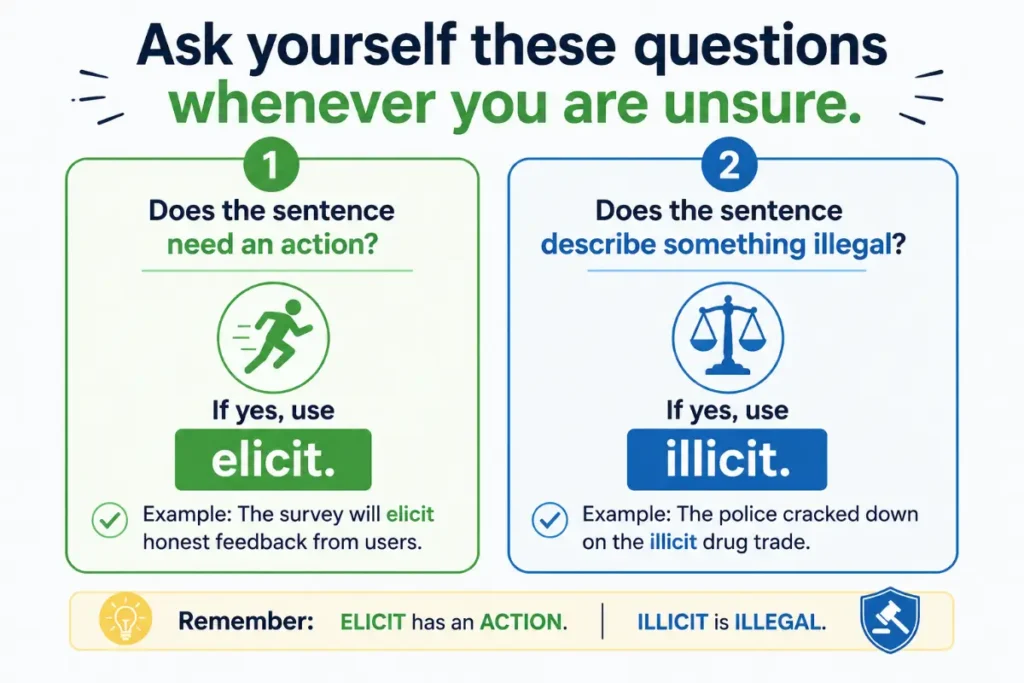
Ask yourself these questions whenever you are unsure.
Does the sentence need an action?
If yes, use elicit.
Does the sentence describe something illegal?
Expert Editor Insight
An experienced editor checks meaning before correcting spelling. Since both words are valid and often sound alike, an ordinary spell checker may accept either one even when the writer has chosen the wrong word. The editor looks at the sentence structure and asks what the word needs to express. If the sentence describes obtaining information or drawing out a reaction, the verb is the likely choice. If it describes prohibited conduct, the adjective fits. Reading the entire sentence aloud can help reveal awkward grammar, but context remains the deciding factor.
Many readers also check function vs functionality Which Word Should You Use.
Conclusion
Elicit vs illicit comes down to one simple distinction. Elicit is a verb that means to draw out a response, reaction, or information. Illicit is an adjective that describes something illegal, forbidden, or prohibited. Both are correct English words, and neither is a spelling variation of the other.
To avoid confusion, identify the role the word plays in your sentence. If someone is trying to obtain an answer, use the verb. If you are describing an activity that breaks a law or rule, use the adjective. Remember the connection between elicit and extract, and between illicit and illegal. That small memory trick can help you choose the right spelling in emails, schoolwork, reports, and everyday writing.
FAQs
Is Elicit a Real Word?
Yes. Elicit is a standard English verb meaning to draw out a response, feeling, answer, or piece of information. Teachers elicit answers from students, interviewers elicit information from sources, and questions can elicit strong reactions. The word is appropriate in everyday conversation, academic work, business communication, and formal writing.
Is Illicit a Real Word?
Yes. Illicit is a standard English adjective that means illegal, forbidden, or prohibited. It commonly describes activities, transactions, goods, or conduct that violate a law, rule, or accepted standard. Expressions such as illicit trade and illicit payments are established uses. The word is not a misspelling of the verb with the similar sound.
What Is the Main Difference Between Elicit and Illicit?
Elicit describes an action that draws out a response or information. Illicit describes something unlawful or forbidden. For example, a teacher may elicit answers from students, while an investigator may examine illicit payments. Both words are spelled correctly, but they have different meanings and grammatical roles, so you cannot substitute one for the other.
How Do You Pronounce Elicit and Illicit?
In standard American English, both words are generally pronounced the same way, with three syllables and stress on the second syllable. Their shared pronunciation makes them easy to confuse during speech and writing. To select the right spelling, focus on the meaning and sentence structure instead of trying to hear a difference that usually is not present.
Can Elicit Start a Sentence?
Yes. Elicit can start a sentence when the grammar supports its use as a verb or in an introductory phrase. For example, Elicit honest feedback by asking clear questions. You can also write, To elicit a better response, the interviewer changed the question. In both cases, the word expresses the idea of drawing something out.
What Is a Synonym for Elicit?
Useful synonyms include draw out, obtain, evoke, prompt, and extract. The best choice depends on the sentence. Draw out works well for encouraging someone to share information. Evoke often describes feelings or memories. Obtain focuses on getting something, while extract can suggest a more direct or difficult process. These words overlap but are not always interchangeable.
Why Do People Confuse These Two Words?
People confuse them because they have similar spellings and usually identical pronunciations in standard American English. Their meanings, however, are different. Elicit is a verb, while illicit is an adjective. Writers can remember the distinction by connecting elicit with extracting a response and illicit with illegal or prohibited activity.
Is Illicit Appropriate in Formal Writing?
Yes. Illicit is appropriate in formal writing, including legal discussions, academic papers, business reports, and journalism. It is useful for describing unlawful or prohibited conduct. However, writers should use precise language when discussing legal matters. Calling something illicit does not establish a specific criminal offense, so the surrounding facts and applicable rules still matter.