
Have you ever paused while writing an email or shopping for school supplies because you couldn’t remember which spelling to use? The confusion between stationary vs stationery is common because the two words sound almost identical, yet their meanings are completely different.
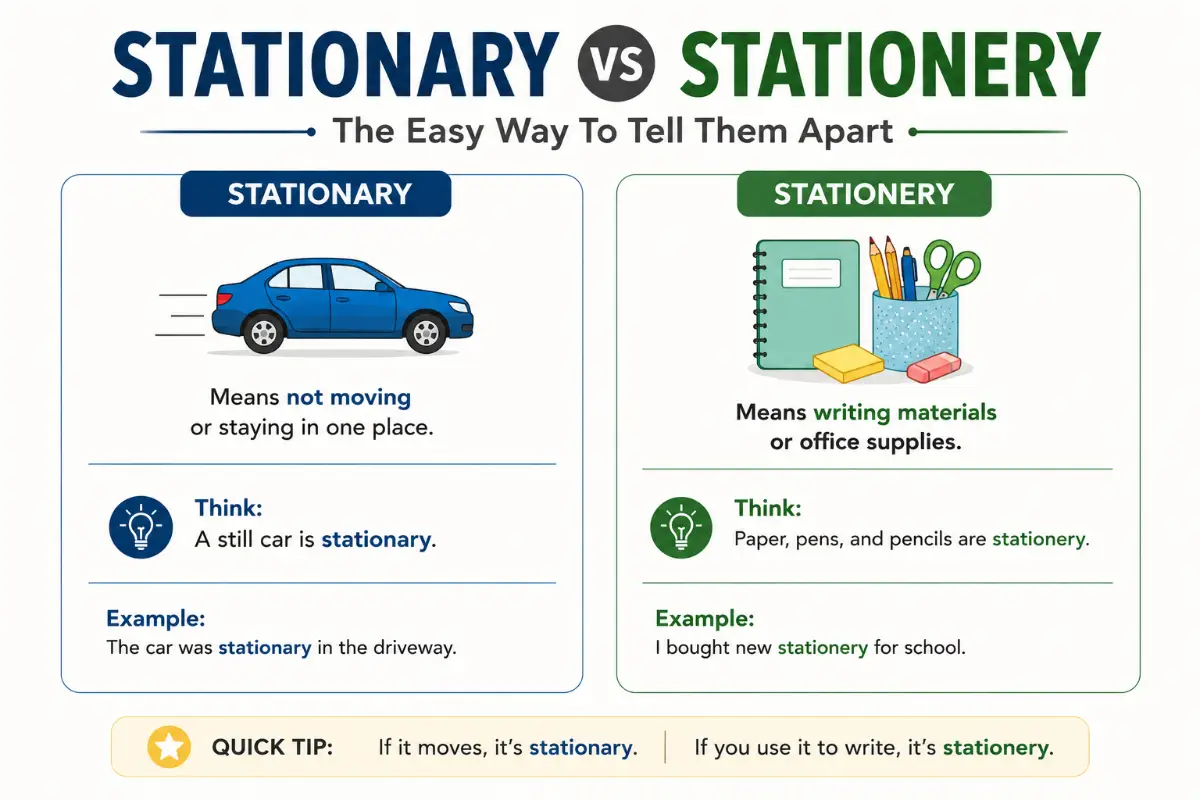
The good news is that both spellings are correct English words. The difference comes down to what you want to say. Stationary describes something that stays in one place or does not move. Stationery refers to paper, envelopes, writing supplies, and related office materials.
For example, a parked car remains stationary, while a notebook belongs to your stationery collection. One letter changes the spelling, but that small change makes a big difference in meaning.
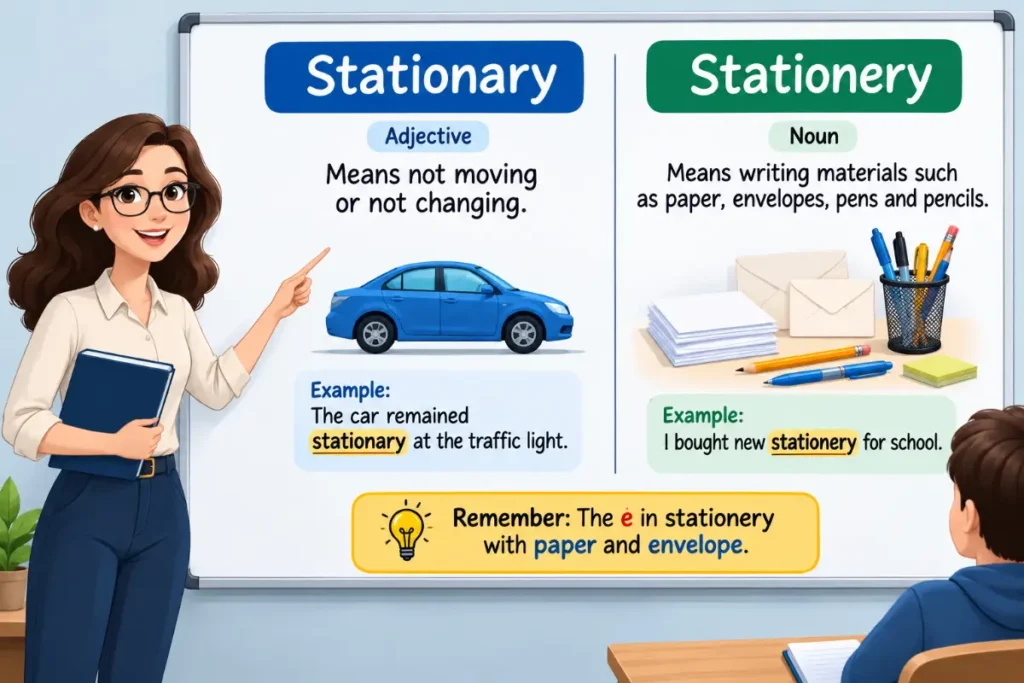
The easiest way to remember the distinction is to connect the e in stationery with envelope. Once you understand the meanings, recognize the grammar patterns, and practice a few examples, choosing the correct spelling becomes much easier. This guide explains how both words work in American English and how to avoid common mistakes in schoolwork, business writing, emails, and everyday conversation.
You may also want to read complement vs compliment Explained With Examples.
Short Answer
Stationary is an adjective that means staying in one place or not moving. Stationery is a noun that refers to writing materials such as paper, envelopes, notepads, and letter paper. Both are standard English words, but they are not interchangeable. Use stationary to describe a lack of movement and stationery to talk about writing supplies.
Comparison Table
| Feature | Stationary | Stationery |
|---|---|---|
| Meaning | Not moving or staying in one place | Paper and writing supplies |
| Part of speech | Adjective | Noun |
| Typical use | Describing position or movement | Naming writing materials |
| Example | The train remained stationary. | She bought new stationery. |
| Common contexts | Traffic, vehicles, machines, objects | Schools, offices, letters, invitations |
| Formality | Standard in formal and informal English | Standard in formal and informal English |
| Spelling clue | Ends in ary | Ends in ery |
| Regional usage | Standard in American and British English | Standard in American and British English |
Meaning and Definition
What Does Stationary Mean
Stationary is an adjective that describes something that does not move or remains in one position. It can refer to a physical object, a person, a vehicle, or a machine. The word can also describe a situation that stays unchanged instead of progressing.
For example, a bicycle leaning against a wall is stationary. A car waiting at a red light is also stationary while it remains stopped. In a business report, a stationary sales figure might describe a number that has not changed over a given period, although unchanged or stable may sound more natural in some contexts.
The word usually answers a question such as, What is the object doing? It describes the object’s state rather than naming the object itself.
Consider these examples.
- The bus remained stationary until the road cleared.
- Keep the camera stationary while taking the picture.
- The machine must stay stationary during the inspection.
- The cyclist noticed a stationary vehicle near the entrance.
In each sentence, the word describes something that is not moving.
What Does Stationery Mean
Stationery is a noun that refers to materials used for writing, printing, or sending messages. Common examples include paper, envelopes, writing pads, letterheads, and personalized note cards. Depending on the context, the term can also cover other paper based office supplies.
A student might buy stationery before the new school year. An office might order stationery printed with its company name. Someone planning a wedding might choose matching stationery for invitations, response cards, and thank you notes.
Here are a few examples.
- I need to buy stationery before classes begin.
- The company ordered stationery with its logo.
- She chose elegant stationery for her handwritten letters.
- Please keep the stationery in the top drawer.
Unlike the adjective described earlier, this word names a category of things. You can purchase it, organize it, store it, or give it to someone as a gift.
Is Stationery Only Paper
Traditionally, stationery referred mainly to paper and writing materials. Modern usage can be broader, especially in retail settings. A stationery store may sell notebooks, pens, pencils, greeting cards, folders, and other supplies associated with writing and correspondence.
However, context still matters. A pen is a writing instrument and may be sold alongside stationery, but the word stationery does not always refer to every tool used for writing. The exact range depends on how a store or business uses the term.
Key Differences Explained
Spelling
The main spelling difference appears in the final part of each word.
- Stationary ends with ary.
- Stationery ends with ery.
The words share most of their letters, so it is easy to type one when you mean the other. Since both are valid words, a spell checker may accept either spelling even when the sentence uses the wrong one.
Meaning
The meaning provides the clearest distinction. Stationary describes a condition of staying still, while stationery names writing materials.
For example, the sentence The truck was stationary describes the truck’s position. The sentence The truck carried stationery describes the cargo. Both sentences are grammatically correct, but they communicate different ideas.
Grammar and Part of Speech
Stationary is an adjective. It commonly appears before a noun or after a linking verb such as is, was, remained, or seemed.
Examples include a stationary bike, a stationary object, and The vehicle remained stationary.
Stationery is a noun. It can function as the subject or object of a sentence.
Examples include Stationery is available at the store and I ordered stationery for the office.
Stationery is generally an uncountable noun when it refers to writing materials as a category. You would usually say some stationery or a pack of stationery, not a stationery when referring to the category as a whole.
Pronunciation
In standard American English, both words are pronounced the same way. They are homophones, which means they share a pronunciation but have different meanings and spellings.
This makes listening alone unreliable when you need to identify the intended word. In speech, surrounding words and context usually reveal the meaning. In writing, you must select the spelling that fits the sentence.
Formality and Context
Neither spelling is more formal or more correct than the other. Both work in academic papers, business emails, casual messages, and professional documents when used correctly.
The context determines your choice. A safety report might describe a stationary machine. A purchasing request might ask a supplier to deliver stationery. The important point is to match the spelling to the intended meaning.
Which Form Is Correct
Both forms are correct. The right choice depends on the meaning you want to express, not on a difference in spelling standards or formality.
Use stationary when describing something that does not move or stays in one position. Use stationery when referring to writing paper, envelopes, and related supplies.
English dictionaries recognize both as separate words with different meanings and grammatical roles. This distinction is based on established English usage rather than a preference for one spelling over the other.
A useful editing test is to replace the word with a simple synonym. If still or not moving fits the sentence, stationary is likely correct. If writing supplies or paper products fits, stationery is likely the word you need.
For example, The guard remained still makes sense, so The guard remained stationary is appropriate. Likewise, I bought writing supplies makes sense, so I bought stationery is appropriate.
Ten Sentence Examples
These examples show how each spelling works in everyday situations, at school, and in the workplace.
- The car stayed stationary while the driver checked the map.
- Please keep the camera stationary so the picture doesn’t blur.
- The train remained stationary for several minutes because of a signal problem.
- A stationary bike lets you exercise indoors without traveling anywhere.
- The teacher asked everyone to remain stationary during the safety drill.
- I bought new stationery for my first day at college.
- Our office needs more stationery before the next meeting.
- She picked floral stationery to write thank you notes to her friends.
- The school store sells notebooks, pens, folders, and other stationery.
- He keeps his favorite stationery in a wooden box beside his desk.
Notice how the spelling changes with the meaning. The first five sentences describe a lack of movement. The remaining examples refer to writing supplies.
Common Mistakes and How to Fix Them
Mistake One Using Stationary for Writing Supplies
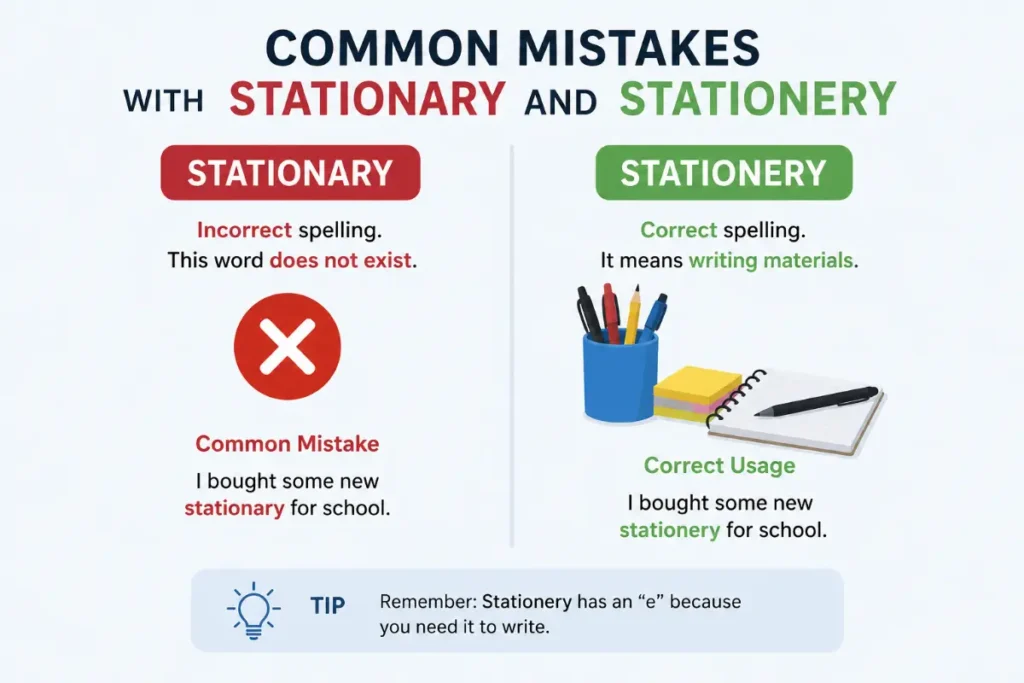
Incorrect: I bought new stationary for school.
Correct: I bought new stationery for school.
The sentence refers to school supplies, so the noun stationery is the correct choice. The error often happens because the writer remembers the sound but forgets the final letters.
Mistake Two Using Stationery to Describe Something That Is Not Moving
Incorrect: The truck remained stationery during the inspection.
Correct: The truck remained stationary during the inspection.
The truck is not a writing supply. The sentence describes its position, so it needs the adjective stationary.
Mistake Three Trusting Spell Check Without Checking Meaning
A spell checker may accept both spellings because both are legitimate words. It may not flag The office ordered stationary if the sentence is grammatically possible on the surface.
To catch this mistake, read the full sentence and check what the word describes or names. Proofreading for meaning is just as important as checking individual letters.
Mistake Four Assuming the Words Have Different Pronunciations
Some writers expect the final letters to create a clear difference in sound. In standard American English, however, both words sound alike. Trying to remember the distinction through pronunciation alone won’t reliably solve the problem.
Instead, connect each spelling to its meaning. Think of stationary as staying still and stationery as writing supplies.
Mistake Five Treating Stationery as a Countable Item
Incorrect: I bought three stationeries for the office.
More natural: I bought three stationery sets for the office.
When stationery refers to writing materials as a general category, it is normally uncountable. If you mean several organized collections, use a countable noun such as sets, packs, or boxes.
Pronunciation Guide
Both words have the same standard pronunciation in American English. They are homophones, so their sounds alone do not reveal the intended spelling.
- Stationary. IPA: /ˈsteɪʃəˌneri/.
- Stationery. IPA: /ˈsteɪʃəˌneri/.
A simple pronunciation guide is STAY shuh nair ee. The main stress falls on the first syllable, and the remaining sounds follow in a similar pattern.
The words contain four spoken syllables in this pronunciation: stay, shuh, nair, ee. Some speakers may reduce the middle vowel sounds, so the exact rhythm can vary slightly by accent.
The common pronunciation mistake is not usually a major difference in sound. It is assuming that a different spelling must produce a different pronunciation. In this case, context carries the meaning.
When speaking, you can usually rely on the sentence to make your meaning clear. When writing, you must select the correct form because readers cannot use pronunciation to distinguish the two.
Need another quick comparison? Read Hanged vs Hung Which Word Is Correct.
Etymology and Word Origin
The histories of these words help explain why their spellings look so similar.
The Origin of Stationary
Stationary entered English through Latin and French word forms connected with the idea of standing or remaining in one place. It is related to station, which can refer to a place or position. The shared history helps explain why stationary describes something that remains fixed rather than moving.
Over time, the word developed its familiar adjective meaning. Today, it appears in everyday descriptions of vehicles, machines, objects, and positions.
The Origin of Stationery
Stationery developed from words associated with a stationer, a person who sold books, paper, and writing materials. The term has historical roots in the Latin word stationarius and later French and English forms associated with established sellers.
The connection to a stationer helps explain the spelling and the modern meaning. Stationery refers to the goods associated with that trade, especially paper and writing materials.
Although the words share a historical connection through related forms, their modern meanings differ. Their history is useful for understanding the spelling, but a simple memory clue is often easier to recall in daily life.
Regional Usage
The distinction remains the same across major varieties of English. American, British, Canadian, and Australian English all use stationary for something that is not moving and stationery for writing materials.
American English
In the United States, both words are standard. You might see stationary in driving instructions, equipment manuals, science lessons, and descriptions of exercise machines. Stationery commonly appears in school supply lists, office orders, invitations, and retail product descriptions.
There is no special American spelling rule that makes one form preferable to the other. The intended meaning determines the choice.
British English
British English uses the same distinction. A stationary object does not move, and stationery refers to writing materials. The meanings and basic spelling patterns match standard American usage.
Differences in other vocabulary or spelling conventions do not change this pair.
Australian English
Australian English follows the same rule. Writers use stationary to describe something fixed in place and stationery to name paper and related writing supplies. The distinction remains consistent in school, business, and everyday writing.
Canadian English
Canadian English also uses both forms with the same meanings. Writers should choose the spelling based on the sentence rather than regional preference.
In short, you do not need separate spelling rules for these words based on the country where you write.
Grammar Rules and Sentence Patterns
Understanding the grammatical role of each word makes the spelling easier to remember. One describes something, while the other names a category of things.
How to Use Stationary in a Sentence
Stationary is an adjective, so it describes a noun or follows a linking verb. It can appear in several common patterns.
- Before a noun. A stationary vehicle blocked the entrance.
- After a linking verb. The vehicle remained stationary.
- With an instruction. Keep the equipment stationary during the test.
- In a technical description. The sensor measures the movement of a stationary object.
The adjective can also describe a situation that remains unchanged. For example, a company’s output may remain stationary over a period. However, unchanged, flat, or stable may express that idea more naturally, depending on the sentence.
How to Use Stationery in a Sentence
Stationery is a noun that usually refers to writing materials as a group. It commonly appears as the subject or object of a sentence.
- As a subject. The stationery is stored in the cabinet.
- As a direct object. We ordered stationery for the new office.
- After a quantity word. She bought some stationery for her classes.
- With a descriptive phrase. The store sells personalized stationery for weddings.
Because stationery is generally uncountable when it refers to supplies as a category, avoid placing a or a number directly before it in that meaning. Instead, name the unit or collection you mean, such as a pack of stationery or two stationery sets.
Can Stationary Be a Noun
Stationary is mainly used as an adjective in modern everyday English. In some specialized contexts, related forms or established expressions may use it in other ways, but ordinary writing usually needs the adjective.
If you want to name something that stays still, choose a more specific noun when possible. For instance, write a fixed object, a parked car, or a stationary machine. These phrases make the intended meaning clear.
Can Stationery Describe Something
Stationery can modify another noun when it forms part of a compound expression, such as a stationery store or stationery supplies. In these phrases, stationery still identifies the type of goods or business involved. It does not mean that the store or supplies are motionless.
This is a useful distinction because the words may appear in similar sentence positions while still performing different jobs.
Real Life Usage Examples
The following examples show how these words fit naturally into different settings.
Daily Conversation
- The car stayed stationary while we waited for our friend to arrive.
- I need to pick up some stationery before the school year starts.
In casual conversation, the surrounding words usually make the intended meaning obvious. You rarely need to explain the distinction aloud.
Email and Workplace Communication
- Please keep the testing equipment stationary until the technician finishes the inspection.
- Could you order more stationery for the front office before Friday.
The first sentence gives a practical instruction. The second requests office supplies. In professional writing, using the right word helps prevent confusion and keeps instructions precise.
Academic Writing
- The researchers placed a stationary sensor beside the experimental setup.
- Students should bring notebooks and other stationery to the examination.
The adjective may appear in scientific descriptions of an object that remains fixed. The noun may appear in classroom instructions and lists of required materials.
News and Journalism
- Traffic slowed after a stationary vehicle blocked one lane of the highway.
- The local retailer introduced a new range of stationery for students and office workers.
News writing relies on accurate wording because readers expect a clear account of events. The meaning of each word should be apparent from the facts being reported.
Literature and Storytelling
- She watched the stationary train through the station window as the rain fell.
- He opened the drawer and found a stack of old letters beside a box of stationery.
In storytelling, the adjective can help establish a scene, while the noun can add detail about a character’s habits, belongings, or setting.
Eight Related and Confused Terms
Several other words can help clarify the meanings of these two spellings. Some describe stillness, while others refer to paper products or writing tools.
1. Still. This word can mean not moving. A still car is not moving, much like a stationary car. It can also have other meanings, so context matters.
2. Motionless. This adjective means completely without movement. It is a close synonym for stationary when describing a person or object that does not move.
3. Fixed. Something fixed stays in a set position or is attached securely. A fixed camera may remain stationary during filming, though the two words are not interchangeable in every context.
4. Stable. Stable can describe something that is steady or unlikely to change. It overlaps with stationary in some situations, but it often emphasizes balance or consistency rather than physical stillness.
5. Writing paper. This phrase refers to paper used for writing. It is a useful alternative when you want to describe one specific part of a stationery collection.
6. Office supplies. This broad term includes materials used for office tasks, such as paper, pens, folders, and other equipment. It often overlaps with stationery but can include products beyond traditional writing materials.
7. Letterhead. Letterhead is paper printed with an organization’s name, address, logo, or other identifying details. It is one specific type of stationery used for professional correspondence.
8. Notepad. A notepad is a pad of paper used for writing notes. It can be part of a stationery collection, but it refers to one particular item rather than the whole category.
These terms are not all direct synonyms. Their value lies in helping you describe the intended meaning more precisely.
Expert Editor Insight
An experienced editor checks meaning before accepting a spelling suggestion. Since both words are legitimate, a standard spell checker may miss a context error even when every letter is spelled correctly. Read the whole sentence and ask what the word does. If it describes a lack of movement, use stationary. If it names paper or writing supplies, use stationery. A quick meaning check often catches errors that automatic tools overlook.
Key Takeaways
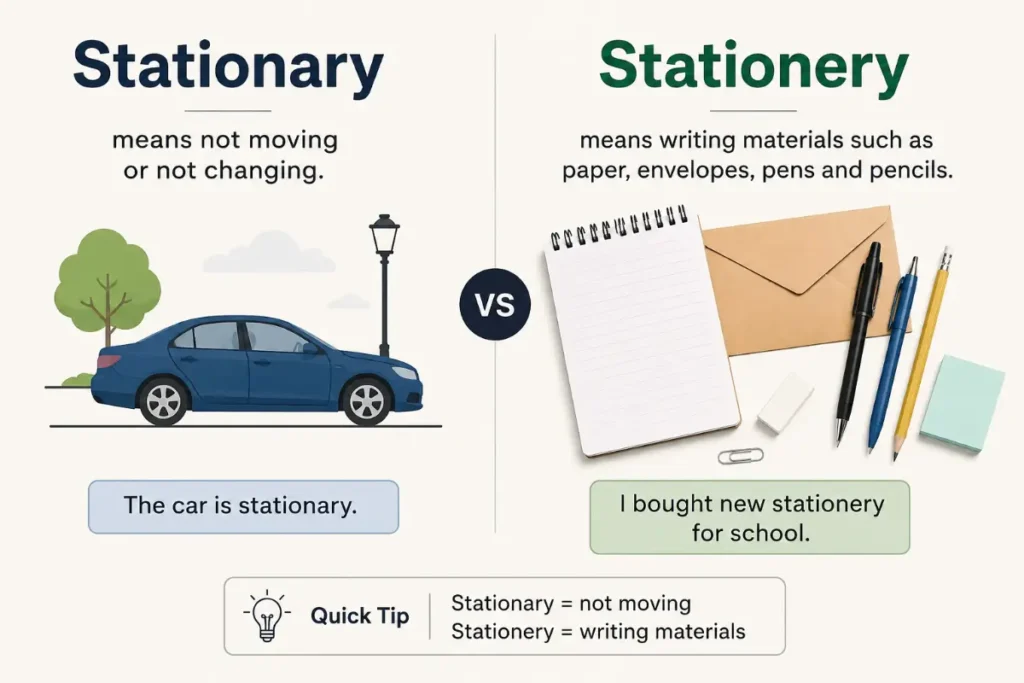
- Stationary means not moving or not changing.
- Stationery means writing materials such as paper envelopes pens and pencils.
- Stationary is an adjective.
- Stationery is a noun.
- The two words are homophones because they share the same pronunciation.
- Think of stationary as staying still.
- Think of stationery as writing materials.
- Remember the e in stationery with paper or envelope.
- Stationery store is the correct phrase for a store that sells writing supplies.
- Stationary store would suggest a store that stays in one place rather than a store selling writing materials.
- Both spellings are standard in American and British English.
- The words have related historical roots but developed different meanings.
Need another quick comparison? Read function vs functionality Which Word Should You Use.
Conclusion
The difference between stationary vs stationery comes down to meaning. Stationary describes something that stays in one place or does not move, while stationery refers to paper, envelopes, notebooks, and related writing supplies. Both are correct spellings in American English, so neither should be treated as a mistake on its own.
The key is to choose the word that fits your sentence. Remember the letter e in stationery by connecting it with envelope. That small memory trick can save you from a common spelling error. Before you finish writing, check the meaning as well as the spelling. Your sentence will be clearer and more accurate.
FAQs
Is Stationary or Stationery the Correct Spelling?
Both spellings are correct, but they have different meanings. Stationary is an adjective that describes something that stays in one place or does not move. Stationery is a noun that refers to paper, envelopes, and related writing supplies. Choose the spelling that matches your meaning rather than assuming one form is a misspelling.
What Does Stationery Mean in American English?
In American English, stationery refers to writing materials such as paper, envelopes, notepads, and letter paper. The term can also cover related products sold by stationery shops. For example, a student might buy stationery before school starts, while a business might order personalized stationery for letters and other professional correspondence.
How Do You Pronounce Stationary and Stationery?
Both words have the same standard pronunciation in American English. They sound like STAY shuh nair ee, with the main stress on the first syllable. Since they sound alike, pronunciation alone cannot tell you which spelling to use. Pay attention to the sentence and decide if you mean something motionless or a collection of writing supplies.
Can Stationary and Stationery Be Used Interchangeably?
No. The words serve different purposes and cannot replace each other without changing the meaning. A stationary bicycle is an exercise machine that stays in place, while stationery may include paper and notebooks. Replacing one with the other can create a confusing or incorrect sentence, even though both spellings are valid English words.
Is Stationary a Real Word Outside of Science?
Yes. Stationary is a common adjective in everyday English, not just a scientific term. You can use it to describe a parked vehicle, a person who remains still, or a machine that does not move. It also appears in technical writing when a fixed position matters, but the word is not limited to specialized contexts.
Is Stationery Countable or Uncountable?
Stationery is generally uncountable when it refers to writing materials as a category. You can say some stationery, a little stationery, or a box of stationery. If you need to count collections, use a countable noun such as three stationery sets or two packs of stationery rather than treating stationery itself as a countable item.
Why Do People Confuse These Two Words?
People often confuse them because they share nearly all their letters and have the same pronunciation. A person may know both meanings but select the wrong ending while typing quickly. Spell checkers can also miss the problem because both words exist. Connecting stationery with envelopes and stationary with staying still helps make the distinction easier to remember.
Which Word Should I Use in Formal Writing?
Use both words in formal writing when the meaning calls for them. Stationary belongs in descriptions of objects or situations that remain still, while stationery belongs in references to paper and writing materials. Before submitting a report, email, essay, or business document, check the meaning of the word in context instead of relying on a spell checker alone.