
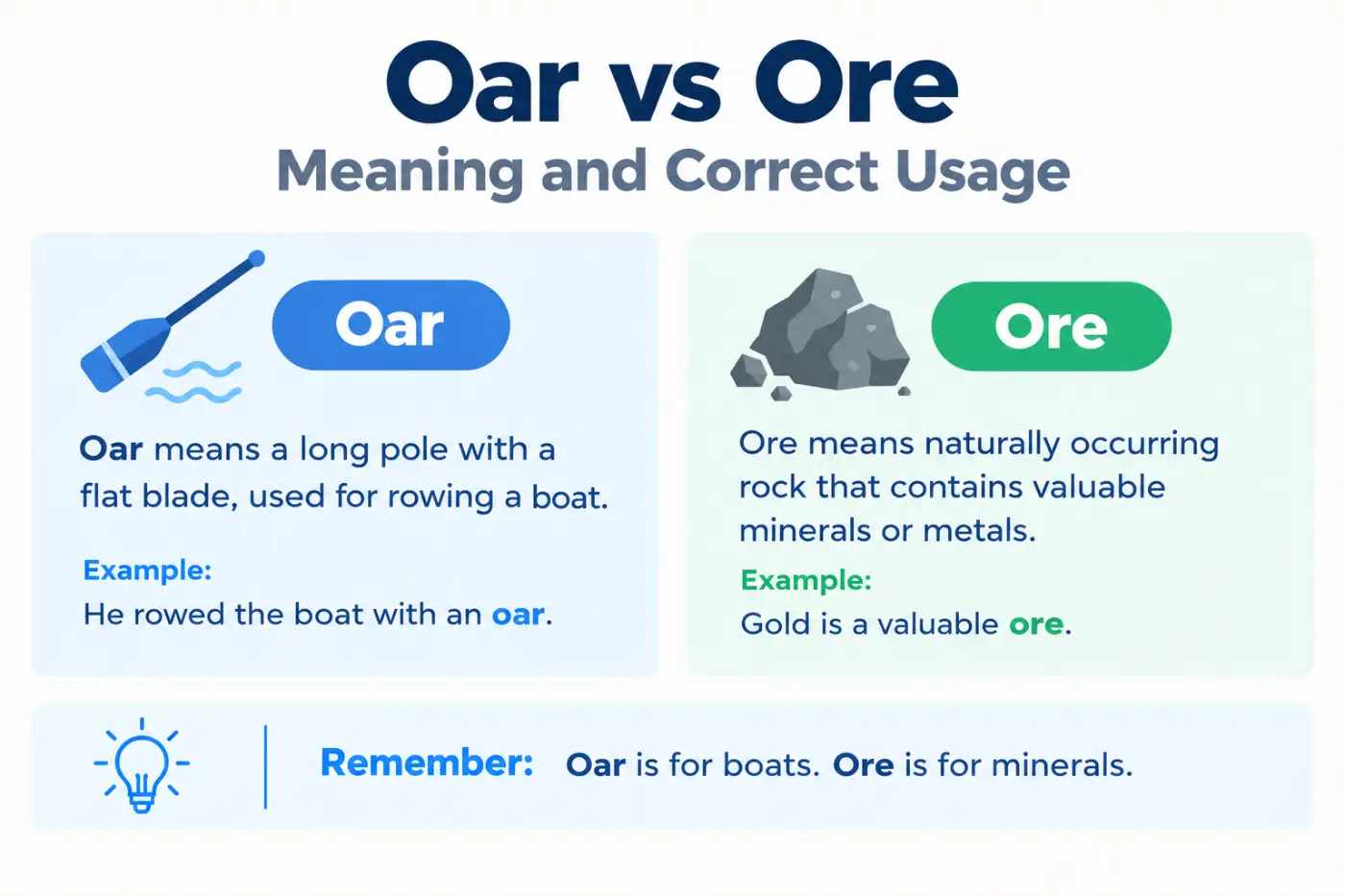
Have you ever paused while writing about a boat or a mining operation because you couldn’t decide between oar vs ore? The two words sound the same in standard American English, so hearing them doesn’t tell you which spelling to use. Their meanings, however, are completely different. One belongs on the water, and the other comes from the ground.
An oar is a tool used to propel or steer a boat. Ore is rock or mineral material that contains a useful substance that can be recovered economically. You might see an oar in a rowing boat or read about iron ore in a science textbook. The surrounding words usually make the intended meaning clear.
Learning this distinction will help you write more accurately in school assignments, workplace documents, emails, stories, and everyday messages. You’ll also learn how the words are pronounced, how they function in sentences, why writers confuse them, and how to remember the right spelling without relying on a spell checker.
Many readers also check Copys or Copies Which Spelling Is Correct in 2026.
Quick Answer
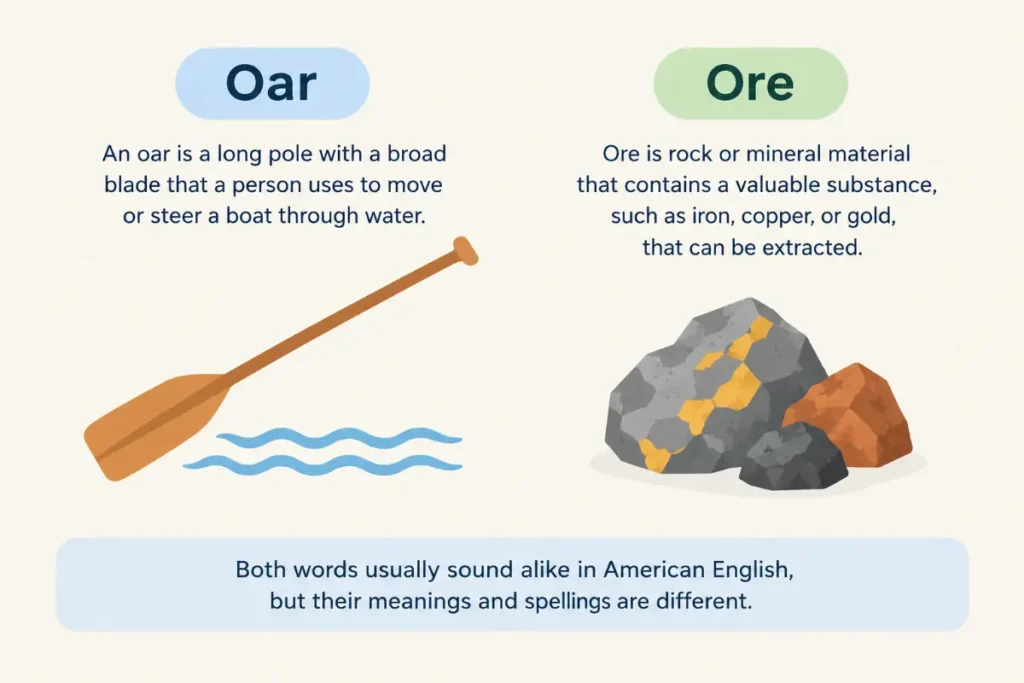
An oar is a long pole with a broad blade that a person uses to move or steer a boat through water. Ore is rock or mineral material that contains a valuable substance, such as iron, copper, or gold, that can be extracted. Both words usually sound alike in American English, but their meanings and spellings are different.
Meaning and Definition
What Does Oar Mean
An oar is a long tool with a broad, flat blade used to move a boat through water. A rower pushes and pulls the oar through the water to propel the boat forward or help control its direction.
Oars are common in rowboats, rowing shells, lifeboats, and other small watercraft. Depending on the boat’s design, an oar may rest against an oarlock attached to the side of the boat or fit into another support system.
For example, consider this sentence.
The fisherman used an oar to guide his small boat toward the shore.
The word oar refers to the physical tool the fisherman uses to move the boat. It doesn’t refer to the boat itself or the person operating it.
An oar can also appear in sports, recreation, rescue work, and historical stories. In competitive rowing, athletes use oars to move their boats through the water. In a survival story, a broken oar might prevent someone from reaching land.
The plural of oar is oars.
Examples include a pair of oars, wooden oars, and rowing oars. The word can also appear in familiar expressions such as put an oar in, which means to interfere in a conversation or situation, especially in British English.
What Does Ore Mean
Ore is rock or mineral material containing a substance that can be extracted and used. That substance might be a metal, such as iron, copper, or gold, or another valuable material.
The word appears frequently in mining, geology, chemistry, manufacturing, and discussions about natural resources.
For example.
The miners discovered a deposit of copper ore near the mountain.
Here, ore refers to the mineral material containing copper that may be recovered through mining and processing.
Not every rock that contains a trace of metal qualifies as ore in practical mining. The amount of the useful substance, the cost of extraction, available technology, and market conditions all influence its economic value.
Common examples include iron ore, copper ore, gold ore, and uranium ore. These materials matter because they provide raw materials for industries that make steel, electrical equipment, jewelry, and other products.
The plural of ore is ores. Writers use it when referring to different types of ore or separate ore deposits.
For example.
The region contains several ores that support its mining industry.
The word can also appear in scientific explanations of mineral deposits, mining methods, and metal production.
The Main Difference Between the Two Words
The essential distinction is easy to remember. An oar is a tool used on water, while ore is material taken from the earth for its useful contents.
| Feature | Oar | Ore |
|---|---|---|
| Meaning | A tool used to propel or steer a boat | Rock or mineral material containing a useful substance |
| Part of speech | Noun | Noun |
| Main context | Boating and rowing | Mining and geology |
| Pronunciation | Usually /ɔːr/ in American English | Usually /ɔːr/ in American English |
| Plural | Oars | Ores |
| Common combinations | Rowing oar and wooden oar | Iron ore and copper ore |
| Related activity | Rowing a boat | Mining and processing minerals |
| Example | She picked up an oar. | The mine produces iron ore. |
Both are standard English words. Neither spelling is a misspelling of the other. The correct choice depends entirely on the meaning of your sentence.
Why Context Matters
Because the two words are homophones in standard American English, a listener generally can’t distinguish them by sound alone. Readers rely on spelling and context to understand the intended meaning.
Compare these examples.
1. The crew replaced a damaged oar before leaving the dock.
The sentence concerns a boat, so oar is correct.
2. The crew examined the iron ore before processing it.
The sentence concerns mining and mineral material, so ore is correct.
3. The museum displayed an old wooden oar beside its collection of mining tools.
The sentence includes both words, but each has a separate meaning.
4. The workers transported the ore while the guide carried an oar to the lake.
The workers are moving mineral material, while the guide is carrying a boating tool.
These examples show why choosing the correct spelling requires more than knowing how a word sounds. You must also understand the idea you want to express.
Which Spelling Is Correct
Both spellings are correct. Oar is the correct word for the tool used to propel or steer a boat. Ore is the correct word for rock or mineral material from which a useful substance can be extracted.
You shouldn’t replace one spelling with the other simply because they sound alike. Doing so can make a sentence confusing or change its meaning entirely.
For example, this sentence is correct.
The rower lifted the oar out of the water.
Writing ore in that sentence would suggest mineral material rather than a rowing tool.
Likewise, this sentence is correct.
The company processes iron ore to produce material for steelmaking.
Replacing ore with oar would make the sentence incorrect in its intended meaning.
The best way to choose is to identify the subject of the sentence. If it concerns rowing, boating, or moving a vessel through water, oar is likely the word you need. If it concerns minerals, mining, metals, or valuable material from the earth, ore is likely correct.
Sentence Examples
The following examples show how both words work in ordinary English.
Examples Using Oar
1. She picked up an oar and helped row the boat back to shore.
The oar is the tool she uses to move the boat.
2. One oar broke when the boat struck a rock.
The sentence describes damage to a boating tool.
3. The guide handed each beginner an oar before the lesson began.
The word refers to the equipment provided for rowing practice.
4. He stored the wooden oars in the garage after the trip.
Oars is the plural form of oar.
5. The rower dipped his oar into the water and pushed backward.
The sentence describes an action used to propel a boat.
6. Our school team practiced with new oars before the competition.
The word refers to the tools used by the rowing team.
7. A spare oar can be useful when a small boat travels far from shore.
The sentence explains why carrying an extra tool may help.
8. The old painting showed a sailor holding an oar beside a wooden boat.
The word appears in a description of a scene.
9. The rescue crew used an oar to move the stranded boat away from the rocks.
The tool helps the crew control the boat.
10. She learned to row by keeping both oars moving in a steady rhythm.
The sentence refers to the two tools used to move the boat.
Examples Using Ore
1. The miners found iron ore deep beneath the surface.
Ore refers to mineral material containing iron.
2. Copper ore is processed to recover copper for industrial use.
The sentence explains how a useful metal is obtained from its source material.
3. The geology class studied samples of gold ore.
Ore appears in an educational context about rocks and minerals.
4. The company built a facility near the ore deposit.
The deposit contains mineral material that may be mined.
5. The workers transported the ore to a processing plant.
The sentence describes the movement of mined material.
6. Iron ore plays a major role in steel production.
The sentence connects a mineral resource with manufacturing.
7. The students compared several ore samples under a microscope.
The samples were used to study mineral content and structure.
8. The mine closed after the remaining ore became too costly to extract.
The sentence highlights the economic side of mining.
9. The documentary explained how gold ore is separated from unwanted material.
The word refers to the source material used to recover gold.
10. The country exports iron ore to manufacturers in other regions.
The sentence describes a commercial activity involving mineral resources.
Common Mistakes and Misspellings
Confusion between these words usually comes from their identical pronunciation in many English accents. Here are five mistakes to watch for.
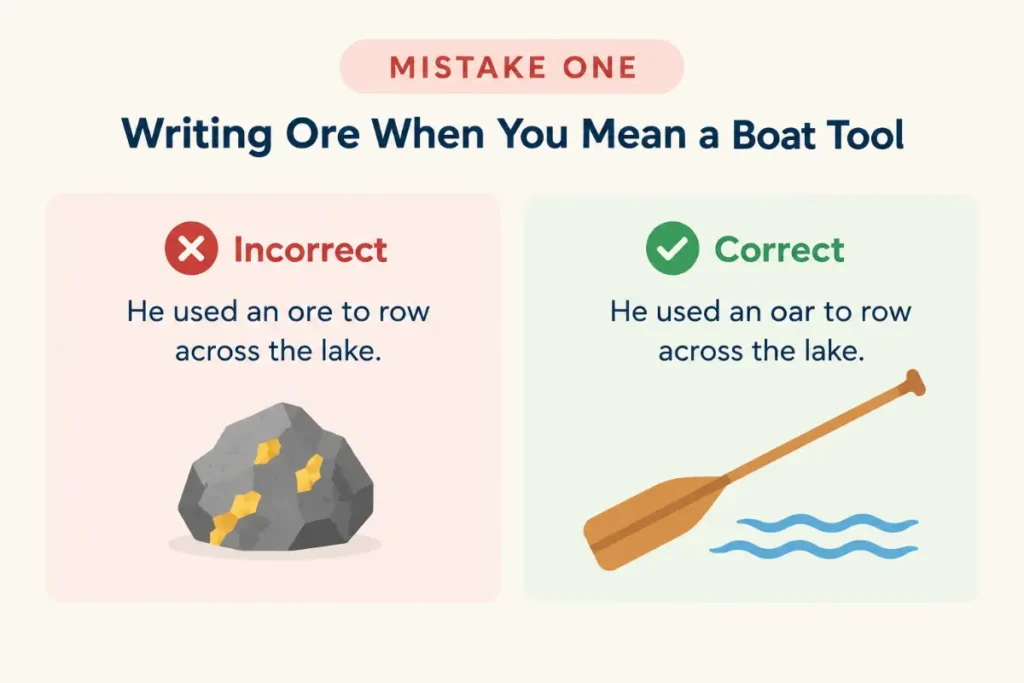
Mistake One: Writing Ore When You Mean a Boat Tool
Incorrect: He used an ore to row across the lake.
Correct: He used an oar to row across the lake.
The sentence describes rowing, so the correct word is oar. The word ore refers to mineral material, not boating equipment.
Mistake Two: Writing Oar When You Mean Mineral Material
Incorrect: The workers loaded the copper oar onto the truck.
Correct: The workers loaded the copper ore onto the truck.
Copper ore is mineral material containing copper. The spelling oar would refer to a boating tool and doesn’t fit this context.
Mistake Three: Assuming Both Words Have the Same Meaning
Incorrect: The museum displayed an ancient ore used by sailors.
Correct: The museum displayed an ancient oar used by sailors.
The sentence describes an object used by sailors to move a boat. The word oar identifies that object.
Mistake Four: Choosing a Spelling Based Only on Sound
Incorrect: The geologist collected samples of iron oar.
Correct: The geologist collected samples of iron ore.
Both words can sound alike, so pronunciation alone doesn’t settle the spelling. The phrase iron ore is the established term for mineral material containing iron that can be extracted.
Mistake Five: Using the Wrong Word in a Technical Sentence
Incorrect: The report measured the quality of the gold oar.
Correct: The report measured the quality of the gold ore.
The report concerns mineral material, not a tool for rowing. In technical writing, the surrounding subject often provides the clearest clue.
A useful editing habit is to read the entire sentence rather than checking a word in isolation. Spell checkers may accept both spellings because both are legitimate words. A grammar tool may also miss the error if the sentence remains grammatically sound.
Pronunciation Guide
The words oar and ore are pronounced alike in standard American English. They are homophones, which means they share a pronunciation but have different meanings and spellings.
How to Pronounce Oar
The standard American pronunciation is /ɔr/ or /ɔːr/, depending on the transcription system used.
- Syllables: One.
- Simple pronunciation guide: OR.
- Stress pattern: The word has one syllable, so the whole word receives stress.
- Sound: Begin with the vowel sound heard in many American pronunciations of or, then finish with the r sound.
How to Pronounce Ore
The word ore has the same usual American pronunciation, /ɔr/ or /ɔːr/.
- Syllables: One.
- Simple pronunciation guide: OR.
- Stress pattern: The whole word is stressed.
- Sound: Use the same pronunciation as oar.
American accents differ in how they produce the vowel in words such as or, more, and four. Some speakers have a vowel closer to /ɔ/, while others use a sound closer to /oʊr/. These accent differences don’t create a standard pronunciation distinction between the two spellings.
The most useful lesson is that you can’t reliably identify the intended word from pronunciation alone. You need to understand the sentence.
You may also want to read tweeks or tweaks correct spelling.
Etymology and Word Origin
Understanding the history of these words adds useful context, although you don’t need to memorize their origins to spell them correctly.
The Origin of Oar
The English word oar comes from Old English ār, which referred to an oar used for rowing. Related forms appear in other Germanic languages, reflecting the long history of rowing as a way to travel and transport goods.
People used oars long before modern engines became common. Boats powered by human effort played important roles in fishing, trade, exploration, and transportation. The word has retained its basic meaning over time.
Today, oar still refers to the tool used to propel or steer a boat. Its meaning remains closely tied to rowing and water travel.
The Origin of Ore
The English word ore comes through Middle English from older Germanic forms. Its history is connected with words for metal, bronze, or mineral material. Over time, its modern meaning became associated with material from which a valuable substance can be extracted.
The word now appears in geology, mining, engineering, and manufacturing. Expressions such as iron ore, copper ore, and gold ore identify material that contains a useful substance.
Although the two words look and sound alike today, they developed along different historical paths. Their shared pronunciation doesn’t mean they have the same origin or meaning.
Regional Usage
The distinction between these words remains consistent across major English varieties. American, British, Canadian, and Australian English all use oar for the boating tool and ore for mineral material.
American English
Both words are standard in the United States.
Americans use oar in boating, rowing, sports, and recreational contexts. They use ore in discussions about mining, geology, metal production, and natural resources.
For example, an American school textbook might describe a rower using an oar and then explain how iron ore is processed to produce materials for steelmaking.
British English
British English uses the same spellings and meanings. The two words are also homophones in standard British pronunciation, although regional accents may produce different vowel sounds.
British English has an expression worth knowing: put your oar in. It means to interfere in a conversation or situation when your involvement isn’t wanted or needed.
For example, I didn’t ask for advice, so please stop putting your oar in.
The expression uses oar metaphorically. It doesn’t refer to mineral material.
Canadian English
Canadian English follows the same spelling distinction. A Canadian writer would use oar when discussing a rowing boat and ore when discussing a mineral deposit.
For example, a report about mining might refer to iron ore deposits, while a guide to canoeing might recommend carrying a spare oar.
Australian English
Australian English also keeps the meanings separate. Both words appear in their usual contexts, including recreational boating, competitive rowing, mining, and geology.
Australia’s mining industry makes expressions such as iron ore and ore deposit familiar in technical and news writing. The word oar remains associated with boats and rowing.
There is no major regional spelling difference to learn for this pair. The meaning of the sentence determines the correct choice.
Grammar Rules and Parts of Speech
Both words are nouns. They name things rather than describe qualities or actions.
Using Oar in a Sentence
An oar can serve as the subject or object of a sentence. It can also follow a preposition or appear in a phrase that describes a boating activity.
Examples.
1. The oar slipped from his hands.
Oar is the subject of the sentence.
2. She borrowed an oar from her neighbor.
Oar is the object of the verb borrowed.
3. He rested his hand on the oar.
The word follows the preposition on.
4. They practiced rowing with two oars.
Oars is the plural form.
Use a before the singular word when the next word begins with a consonant sound, as in an oar.
The correct phrase is an oar, not a oar. The choice of article depends on sound, and the initial vowel sound in oar requires an.
Using Ore in a Sentence
Ore follows the same basic noun rules.
Examples.
1. The ore contains iron.
Ore is the subject.
2. The company exports ore.
Ore is the object of the verb exports.
3. The researchers studied samples of ore.
The word follows the preposition of.
4. The mine produces several types of ores.
Ores is the plural form, used here to refer to multiple types.
You can use a singular or plural form depending on the meaning. Ore often appears as an uncountable noun when referring to mineral material in general, as in The mine produces ore. It can also be countable in contexts that distinguish types or deposits.
Common Grammar Patterns
Both words appear in noun phrases.
For oar, common phrases include:
- A wooden oar.
- A broken oar.
- A pair of oars.
- The boat’s oar.
For ore, common phrases include:
- Iron ore.
- A deposit of ore.
- Samples of copper ore.
- The mine’s ore supply.
The words don’t normally replace each other in these phrases. Their grammatical function may be the same, but their meanings are different.
Real Life Usage Examples
The following situations show how the words appear in everyday life and specialized writing.
Daily Conversation
Example one: Can you pass me the oar? I want to help move the boat.
The speaker needs a boating tool. The spelling oar fits the situation.
Example two: My uncle works at a mine that extracts iron ore.
The conversation concerns mining. The word ore refers to material containing iron.
Workplace Communication
Example one: Please check that the boat has two working oars before departure.
This instruction concerns equipment and safety on the water.
Example two: The team submitted a report on the quality of the copper ore.
This sentence belongs in a workplace involving mining, geology, or mineral processing.
Academic Writing
Example one: The experiment compared the movement of a boat using different oar designs.
The sentence concerns a physical tool and its effect on rowing.
Example two: The students examined the mineral composition of iron ore samples.
The sentence concerns the properties of mineral material.
News Writing
Example one: Rescuers used an oar to guide the damaged boat toward shallow water.
The word refers to a tool used during a rescue.
Example two: The mining company announced plans to increase iron ore production.
The word refers to a mineral resource produced through mining.
Literature and Storytelling
Example one: With one final pull of the oar, the sailor reached the quiet shore.
The word helps readers picture the action of rowing.
Example two: The miners carried the heavy ore through the dark tunnel.
The word establishes a mining setting and describes the material being moved.
These examples show that the surrounding topic usually makes the intended spelling clear. A boat scene calls for oar, while a mining scene calls for ore.
Related Words and Confusing Terms
Several words connect to the same topics or create similar spelling challenges.
Row
To row means to propel a boat using oars.
Example: We learned to row before taking the boat onto the lake.
An oar is the tool. Row is the action.
Paddle
A paddle is a tool used to propel a boat through water. Unlike many rowing oars, a paddle is usually held by the user rather than supported by an oarlock.
Example: She used a paddle to move the kayak.
Oarlock
An oarlock is a fitting that holds an oar in place while allowing it to move during rowing.
Example: The rower checked the oarlock before starting.
Rowboat
A rowboat is a boat designed to be moved by rowing.
Example: They rented a rowboat for the afternoon.
Mineral
A mineral is a naturally occurring substance with a characteristic chemical composition and structure.
Example: The geologist identified a mineral in the rock sample.
Ore may contain one or more useful minerals, but not every mineral deposit qualifies as economically recoverable ore.
Iron Ore
Iron ore is mineral material from which iron can be extracted.
Example: Iron ore is a key raw material in steelmaking.
Copper Ore
Copper ore contains copper in minerals that can be processed to recover the metal.
Example: The mine processes copper ore for industrial use.
Gold Ore
Gold ore is material containing gold that can be recovered through suitable processing.
Example: The geologists tested the sample to determine its gold content.
These related terms help establish context. If a sentence mentions rowing, paddles, or boats, the intended word may be oar. If it mentions minerals, metals, or extraction, ore is usually the right choice.
Expert Editor Insight
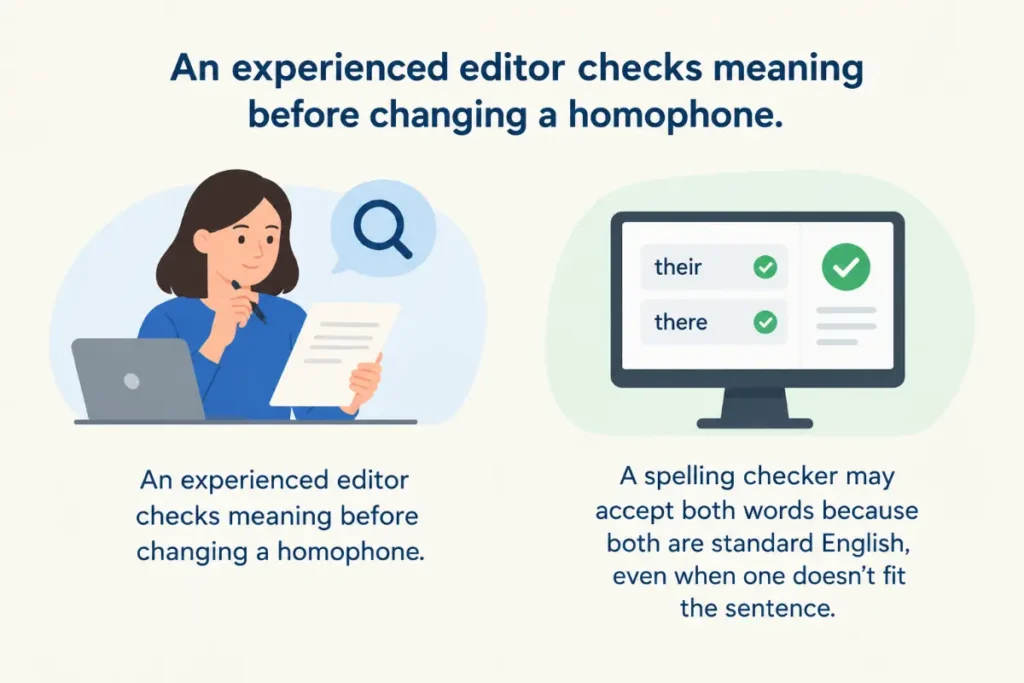
An experienced editor checks meaning before changing a homophone. A spelling checker may accept both words because both are standard English, even when one doesn’t fit the sentence. The most reliable approach is to read the sentence in context, identify the intended object or material, and then confirm the spelling. In technical writing, checking the surrounding terms can quickly reveal the intended meaning. For example, iron strongly points toward ore, while rowboat points toward oar.
A related grammar guide is Comming or Coming Which Spelling Is Correct?.
Conclusion
The difference between oar and ore comes down to meaning. An oar is a tool used to move or steer a boat, while ore is rock or mineral material containing a substance that can be extracted. Both words are correctly spelled and usually sound alike in American English.
To remember the distinction, picture a rower holding an oar and a miner collecting ore. Then check the subject of your sentence before choosing the spelling. If you’re writing about boats or rowing, use oar. If you’re writing about mining, rocks, or metals, use ore. This simple habit will help you avoid the mistake in everyday and professional writing.
FAQs
Is oar or ore the correct spelling?
Both spellings are correct English words. Use oar for the tool used to propel or steer a boat. Use ore for rock or mineral material containing a useful substance that can be extracted. Neither is universally more correct than the other. The subject and meaning of your sentence determine the right spelling.
Is ore a real English word?
Yes. Ore is a standard English noun used in mining, geology, and related fields. It refers to rock or mineral material containing a substance that can be recovered for use. Common examples include iron ore, copper ore, and gold ore. The word is not a misspelling of oar.
What does oar mean?
An oar is a long tool with a broad blade that a person uses to propel or steer a boat. Rowers move oars through water to move their boats forward or change direction. Oars are used in many types of small watercraft and in competitive rowing. The plural form is oars.
Do oar and ore sound the same?
Yes. In standard American English, the two words are usually pronounced alike, with one syllable and a sound represented as /ɔr/ or /ɔːr/. Some regional accents pronounce the vowel differently, but that doesn’t usually distinguish the words. You must use context to determine the intended meaning.
How can I remember the difference?
Connect oar with rowing and boats. Connect ore with rocks, minerals, and mining. Picture a rower holding an oar on a lake, then picture a miner carrying ore from a mine. These two mental images help connect each spelling with its meaning and make the distinction easier to recall.
Can oar and ore be used in the same sentence?
Yes. For example, The guide carried an oar while the miners loaded iron ore onto a truck. Both words are correct because they refer to different things. The oar is a boating tool, while the ore is mineral material. Using both in one sentence can help demonstrate their different meanings.
Are oar and ore homophones?
Yes. Homophones are words that share a pronunciation but have different meanings and spellings. These two words fit that definition in standard American English. Other familiar examples include sea and see, right and write, and brake and break. Context helps readers identify the intended word.
Why do people confuse these two words?
People confuse them because they sound alike and contain similar letter patterns. When someone writes from memory or relies only on pronunciation, the wrong spelling can slip into a sentence. Spell checkers may not catch the mistake because both words are valid. Understanding the meaning of each word is the best way to prevent errors.