
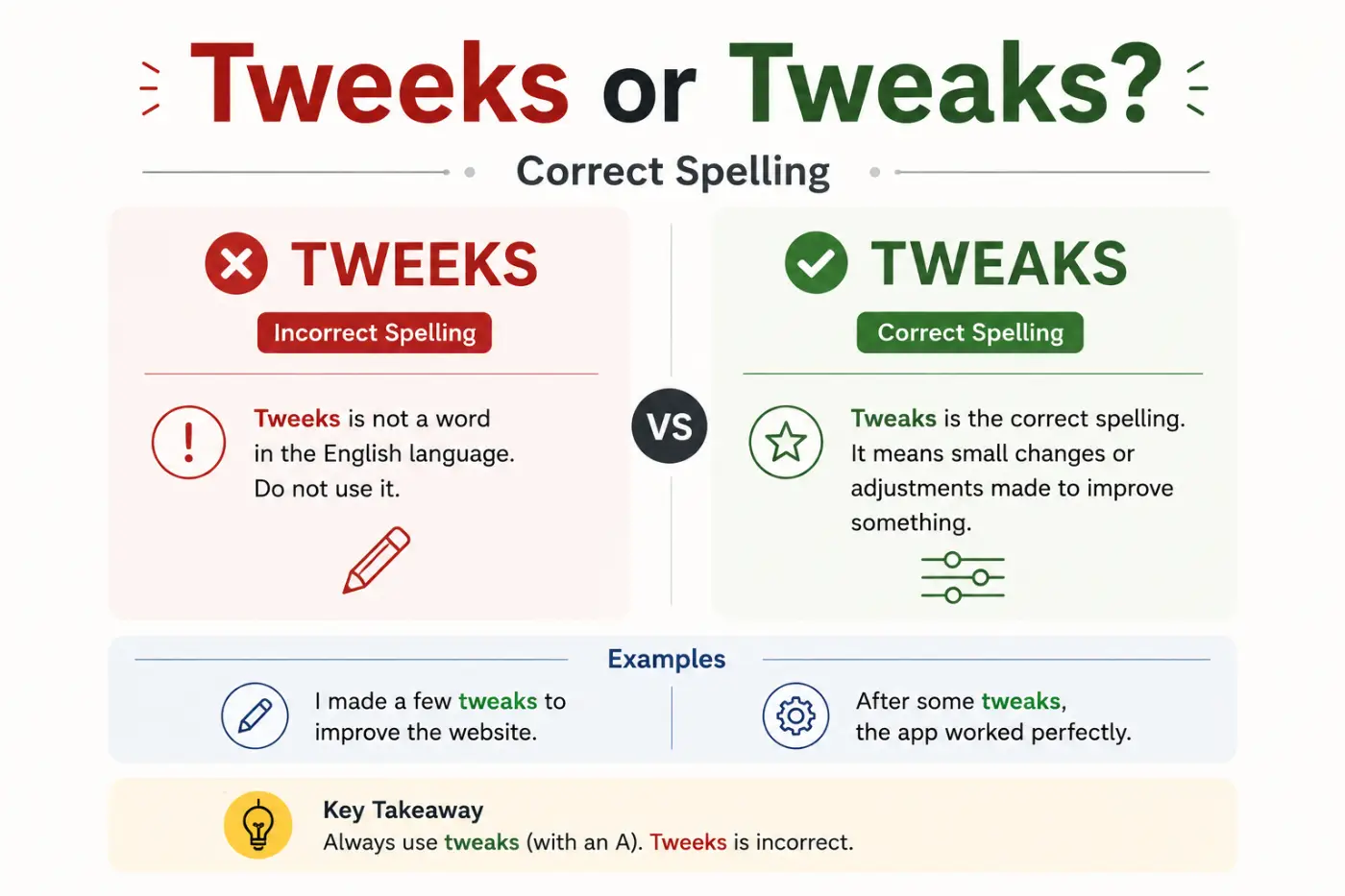
If you’re trying to write about small changes or adjustments, you may pause over tweeks or tweaks. The correct spelling is tweaks. The word comes from tweak and refers to small changes made to improve something or make it work better.
The confusion is easy to understand. Tweak is pronounced /twiːk/ in both American and British English. That sound resembles the spelling pattern found in words such as week. When people hear the plural form, they may naturally write tweeks.
English spelling doesn’t always follow sound in a neat way. A familiar sound can point you toward the wrong letters. That’s exactly what happens here.
This guide explains the correct spelling, meaning, grammar, pronunciation, word history, regional usage, common mistakes, and real world examples. You’ll also see how professional editors handle the form in formal writing and how to remember the spelling without having to stop and think about it every time.
For another common grammar confusion, see Dought Vs Doubt Which Word Is Correct (2026).
Quick Answer
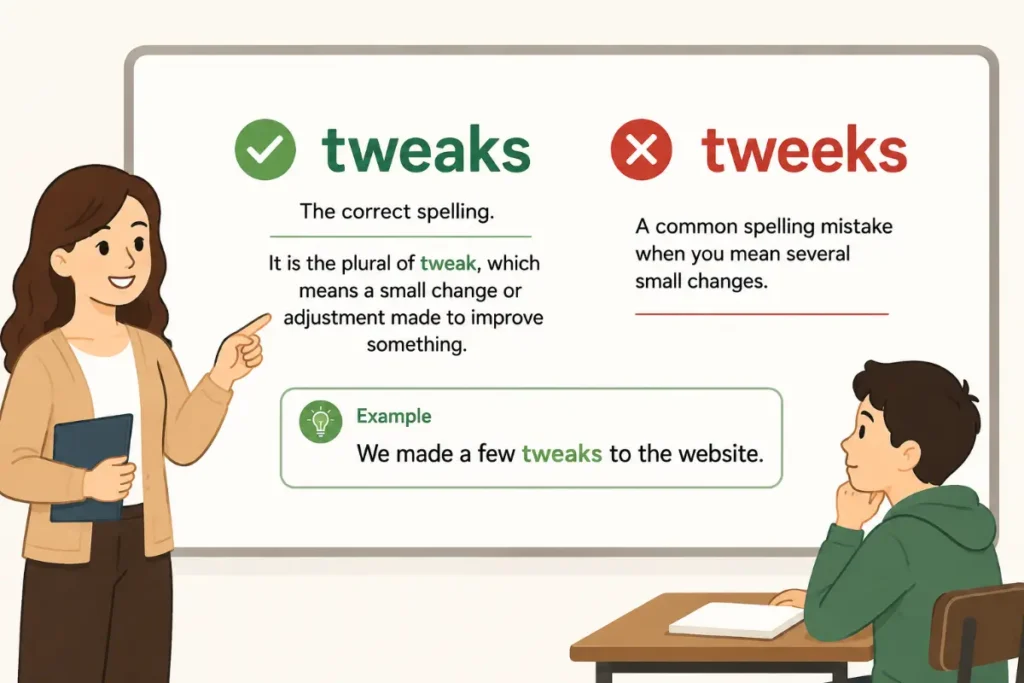
The correct spelling is tweaks. It is the plural of tweak, which means a small change or adjustment made to improve something. Tweeks is generally a spelling mistake when you mean several small changes. For example, We made a few tweaks to the website is correct.
Comparison table for tweeks or tweaks
| Correct Form | Meaning | Part of Speech | Origin | Usage Frequency | Formality | Common Contexts | Example |
|---|---|---|---|---|---|---|---|
| tweaks | Small changes or adjustments | Plural noun or third person singular verb | From tweak | Common | Neutral | Work, writing, software, design, everyday speech | We made a few tweaks to the plan. |
| tweeks | Usually an incorrect spelling of tweaks | Nonstandard spelling | Spelling error | Uncommon in standard English | Not appropriate in formal writing | Typing errors and spelling mistakes | We made a few tweeks to the plan. |
Meaning and definition
The word tweak has several meanings, but the most common modern use involves making a small adjustment.
As a verb, tweak means to change something slightly. The purpose is often to improve it, correct it, refine it, or make it more suitable for a particular situation.
For example, a writer might tweak a sentence before publishing an article. A designer might tweak a layout to make it easier to read. A software developer might tweak a setting to improve performance.
As a noun, tweak means a small change or adjustment.
The plural noun is tweaks.
You can therefore think of the relationship this way.
- Tweak means one small change.
- Tweaks means more than one small change.
- Tweaked is the past tense and past participle of the verb.
- Tweaking is the present participle and gerund form.
- Tweeks is normally not the standard spelling of any of these forms when you mean small adjustments.
Cambridge Dictionary defines the verb as making a slight change to something, especially to make it more correct, effective, or suitable. It also lists the noun as a slight change made for improvement.
Merriam Webster gives the verb the meaning of making usually small adjustments and lists the noun tweak as a small change or adjustment.
Meaning of the incorrect form
In ordinary English writing, tweeks is usually a misspelling of tweaks.
That distinction matters because English contains many words that sound as though they could take the letters ee. Consider week, seek, keep, and sleep. Those words use ee to represent the long vowel sound.
However, English spelling contains many different patterns for the same sound. The long e sound can appear as ee, ea, ie, and other combinations. The word tweak uses ea.
That means the plural keeps the original spelling.
Tweak becomes tweaks.
It does not become tweeks.
You may still encounter tweeks online. A spelling error can spread easily because people often type quickly and rely on sound rather than checking the written form. Search results can also contain nonstandard spellings because people can publish text without editorial review.
There is one important exception worth knowing. Tweeks can appear as a name or brand. For example, a company or website may intentionally use Tweeks as part of its name. One current example is a web modification service that uses the name Tweeks and explains its branding around website modifications. That is a proper name rather than evidence that tweeks is the standard plural spelling of tweak.
Meaning of the correct form
Tweaks has two common grammatical roles.
First, it can be the plural noun.
In that use, it means several small changes or adjustments.
For example:
The editor suggested a few tweaks to the article.
Here, tweaks refers to several changes.
Second, tweaks can be the third person singular present form of the verb tweak.
For example:
She tweaks the wording before sending the email.
Here, tweaks describes an action performed by she.
The surrounding sentence tells you which grammatical role the word has.
This flexibility is common in English. A single spelling can serve different grammatical functions depending on context.
Key differences explained
The main difference is simple. Tweaks is the standard English form. Tweeks is normally a spelling error when the intended meaning is small changes.
Several details help explain the confusion.
- Spelling
The standard spelling is tweaks. The base word is tweak and the plural is formed by adding s.
- Meaning
Tweaks can mean small changes or adjustments. It can also describe an action performed by someone or something when used as a verb.
- Grammar
As a noun, tweaks is plural. As a verb, it is the third person singular present form.
- Pronunciation
The standard word is pronounced /twiːks/. The vowel sound is the long e sound.
- Formality
Tweaks works in casual speech and professional writing. It is common in discussions about editing, design, software, business plans, products, and everyday improvements.
- Regional usage
The standard spelling remains tweaks in American English and British English. There is no standard regional spelling that changes tweaks to tweeks.
- Standard usage
Dictionaries recognize tweak and its grammatical forms. Cambridge gives the pronunciation /twiːk/ and identifies tweaks as the plural noun form. Merriam Webster also lists tweaks among the forms of the verb.
Which form is correct
Tweaks is correct when you mean small changes or adjustments.
The reason is grammatical as well as lexical. English forms the plural of tweak by adding s to the established spelling.
The base word contains ea.
Tweak
Add s.
Tweaks
The vowel sound does not change the spelling.
This is a useful lesson in English spelling. Pronunciation can help you identify a word, but it doesn’t always tell you which letters to write. If you wrote tweeks because the word sounds similar to weeks, you’re following a reasonable sound pattern. The problem is that the dictionary form uses a different spelling pattern.
Merriam Webster traces tweak to older English forms connected with pulling or plucking. It records the first known use of the verb in 1601 and the noun in 1616.
Sentence examples
Here are natural examples that show how tweaks works in different settings.
- We made a few tweaks to the presentation before the meeting.
- The editor suggested several tweaks to the opening paragraph.
- I made some small tweaks to my resume before applying for the job.
- The designer made a few tweaks to the layout.
- Our teacher asked us to make some tweaks to the final draft.
- The software needs a few tweaks before it is ready for release.
- She usually tweaks her schedule when her workload changes.
- The chef made a few tweaks to the recipe.
- The team made several tweaks to its strategy after reviewing the results.
- I only made a couple of tweaks to your message.
Notice how naturally the noun form works with words such as few, several, small, and couple. These expressions commonly introduce the idea of minor adjustments.
The word also works well in professional settings because it suggests a change that is limited rather than a complete overhaul. If you say that a document needs a few tweaks, you normally suggest that the document is already close to finished.
Common mistakes and misspellings
The spelling problem usually comes from sound. Still, several related mistakes can appear around the same word family.
- Tweeks instead of tweaks
Incorrect: We made a few tweeks to the design.
Correct: We made a few tweaks to the design.
The error comes from choosing ee because of the long vowel sound.
- Tweek instead of tweak
Incorrect: I need to tweek this sentence.
Correct: I need to tweak this sentence.
The same spelling problem appears in the singular form. The standard base word uses ea.
- Tweeked instead of tweaked
Incorrect: We tweeked the settings yesterday.
Correct: We tweaked the settings yesterday.
The past tense is built from tweak. Add ed to the correct base form.
- Tweeking instead of tweaking
Incorrect: She is tweeking the design.
Correct: She is tweaking the design.
The spelling of the base word stays intact before the ending ing.
- Tweakings instead of tweaks
Incorrect: The client requested several tweakings.
Correct: The client requested several tweaks.
The noun tweaks is usually the natural choice for separate small changes. Tweaking can function as a gerund when you are talking about the activity itself.
Pronunciation guide
The standard pronunciation of tweak is /twiːk/. Cambridge gives this pronunciation for both US and UK English.
The word has one syllable.
You can think of it as sounding close to tweek.
That sound similarity explains much of the spelling confusion.
The plural tweaks is pronounced /twiːks/. The final s adds an s sound.
A simple sound guide is:
tweak sounds like tweek
tweaks sounds like tweeks
This creates an interesting spelling trap. The correct word tweaks sounds almost exactly like the mistaken spelling tweeks would suggest.
That means pronunciation alone cannot reliably tell you which spelling to use.
The best solution is to remember the written form of the base word.
Tweak uses ea.
Once you remember that small detail, the rest of the word family becomes much easier.
A related grammar guide is Inbalance Or Imbalance Which Spelling Is Correct? (2026).
Etymology and word origin
The history of tweak is older than its modern business and technology uses might suggest.
Merriam Webster traces the verb to Middle English twikken meaning to pull sharply. It connects that form to Old English twiccian meaning to pluck. Merriam Webster records the first known use of the verb in 1601 and the noun in 1616.
The modern meaning of making a small adjustment developed from the physical idea of pulling or moving something slightly.
Think about making a tiny physical adjustment. You don’t completely rebuild the object. You move it a little.
That idea fits the modern figurative meaning very well.
Today, you can tweak a sentence, tweak a recipe, tweak a setting, tweak a design, or tweak a plan. The common thread is a small change rather than a complete replacement.
The word has also developed several other meanings. Merriam Webster lists uses connected with pinching, pulling, slight injury, annoying someone, criticizing someone, and making small adjustments.
For most writing questions about spelling, however, the adjustment meaning is the one that matters.
Regional usage
American English
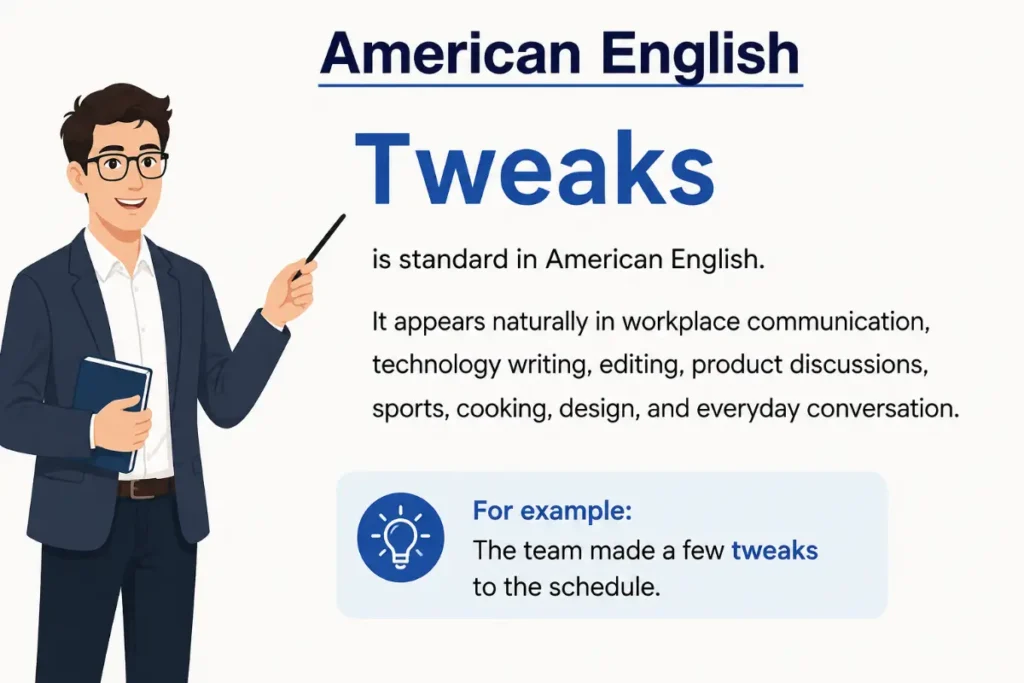
Tweaks is standard in American English.
It appears naturally in workplace communication, technology writing, editing, product discussions, sports, cooking, design, and everyday conversation.
For example:
The team made a few tweaks to the schedule.
I made some tweaks to the settings on my phone.
American speakers also use tweak as a verb in ordinary conversation.
I’ll tweak the wording before I send it.
The form tweeks is not an alternative American spelling.
British English
British English also uses tweak and tweaks.
Cambridge lists the same core spelling and pronunciation in UK and US English.
There is no standard British spelling that changes tweaks to tweeks.
Australian English
Australian English follows the same standard spelling in ordinary English usage. Tweaks is the expected plural form of tweak.
Canadian English
Canadian English also uses tweak and tweaks in the standard spelling.
The main point across these varieties is simple. You don’t need to change the spelling based on the country.
Grammar rules and part of speech
Understanding the grammar makes the spelling easier to remember.
Tweaks as a noun
As a noun, tweaks is plural.
The article needs a few tweaks.
The singular version is:
The article needs a tweak.
You can use common plural markers before it.
several tweaks
a few tweaks
many tweaks
two tweaks
You can also describe the noun with adjectives.
small tweaks
minor tweaks
final tweaks
simple tweaks
technical tweaks
The noun usually refers to changes that are limited in size or scope.
Tweaks as a verb
The same spelling can function as a verb.
He tweaks the settings before every test.
Here, tweaks means makes small adjustments.
The subject is singular, so the verb takes the s ending.
Compare these sentences.
I tweak the settings.
You tweak the settings.
They tweak the settings.
She tweaks the settings.
The spelling stays connected to the same base word.
Tweak in the past tense
The past tense is tweaked.
She tweaked the paragraph yesterday.
The spelling remains based on tweak.
Tweak in the continuous form
The present participle is tweaking.
He is tweaking the design now.
Again, the base spelling stays intact.
These forms give you a useful spelling family.
tweak
tweaks
tweaked
tweaking
Once you learn the base word, the other forms follow naturally.
Real life usage examples
Daily conversation
People often use tweak when they want to describe a small improvement.
I just need to tweak this recipe a little.
Can you make a few tweaks to the schedule?
The word feels natural because it suggests that the basic idea already works.
Workplace communication
The word is common in professional writing because it can describe controlled adjustments without making a change sound dramatic.
We made a few tweaks to the proposal before sending it to the client.
The manager requested some tweaks to the final report.
This makes tweak useful in emails and meetings. It communicates improvement without implying that the entire project needs to start again.
Academic writing
Academic writers can use the word in less formal contexts.
The researchers made several tweaks to the procedure.
In highly formal academic prose, alternatives such as adjustments, revisions, or modifications may sometimes sound more precise.
That doesn’t make tweak incorrect. It simply reflects a difference in tone.
News and journalism
Journalists often use tweak to describe small policy or strategy changes.
The company made several tweaks to its pricing model.
The coach made a few tweaks to the lineup.
The word works well because readers immediately understand that the changes are limited.
Literature and storytelling
The physical meaning can appear in stories.
He gave his brother’s nose a playful tweak.
The word can also carry the figurative adjustment meaning.
She tweaked the ending until it felt right.
Context makes the intended sense clear.
Related and confused terms
Several words overlap with tweak, but they don’t always carry the same tone.
- Adjustment
An adjustment is a change made to improve fit, function, or accuracy. It is often more formal than tweak.
- Modification
A modification is a change made to something existing. It can describe a small change or a much larger one.
- Revision
A revision usually involves reviewing and changing written work or a plan. It often suggests more deliberate editing.
- Change
Change is the broadest term. It can describe anything from a tiny adjustment to a complete transformation.
- Alteration
An alteration is a change made to something. The word can sound more formal and deliberate.
- Adjustment
This is one of the closest alternatives when tweak means a small improvement.
- Fine tuning
Fine tuning means making small adjustments to improve performance or precision. It often suggests careful final improvements.
- Refinement
Refinement means improving something by making careful changes. It often carries a polished or sophisticated tone.
The choice depends on context.
If you changed one sentence in an email, you might say you tweaked it.
If you changed a machine setting for better performance, adjusted or fine tuned may fit well.
Expert editor insight
An experienced editor sees this spelling mistake as a sound based error rather than a mysterious grammar problem. The pronunciation makes tweeks feel logical because it sounds like the word is built from tweek. The safest editing habit is to check the base form before adding an ending. If the base word is tweak, then the standard forms naturally become tweaks, tweaked, and tweaking. A spell checker can catch the mistake, but knowing the word family lets you catch it before the software does.
Why the spelling causes so much confusion
English spelling is full of patterns that compete with one another.
The sound /iː/ appears in many common words.
week
seek
keep
green
sleep
That makes ee a familiar spelling choice.
But English also uses ea for the same sound.
team
dream
clean
speak
tweak
The problem becomes especially noticeable when a word is heard rather than read.
Imagine someone saying:
We made a few tweaks.
If you have never seen the word in writing, tweeks may seem perfectly reasonable.
That is why pronunciation mistakes and spelling mistakes often travel together. Your brain tries to connect a new sound with a spelling pattern it already knows.
Reading the word repeatedly in context builds a stronger visual memory.
Tweaks to the plan.
Tweaks to the article.
After a while, the correct spelling starts to look familiar.
A simple way to remember the spelling
Use the singular form as your memory anchor.
Don’t try to memorize the plural separately.
Remember:
tweak
Then add s.
tweaks
You can also connect the spelling to the word speak.
Both speak and tweak use ea for the long vowel sound.
That gives you a simple mental link.
speak
tweak
tweaks
This method is more reliable than trying to remember that the word sounds like week.
The sound can mislead you.
The base spelling gives you the answer.
When to use alternatives
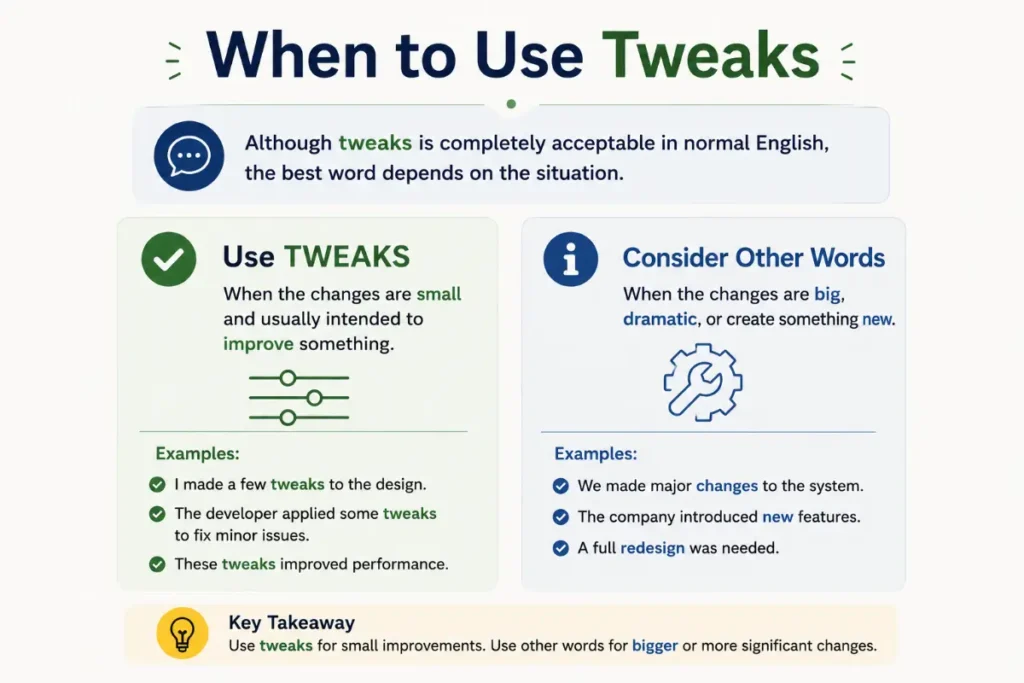
Although tweaks is completely acceptable in normal English, the best word depends on the situation. Use tweaks when the changes are small and usually intended to improve something. Use adjustments when you want a neutral or slightly more formal word. Choose revisions when you are changing written material or a plan after review. Use modifications when the changes may be technical or more substantial. Use refinements when the goal is to polish something that is already close to finished. For example: I made a few tweaks to the email. This sounds natural and conversational. I made several revisions to the report. This sounds more formal and editorial. The engineer made several adjustments to the system. This sounds technical and precise. Good writing isn’t only about choosing a correct word. It’s also about choosing the word that fits the situation.
You may also want to read Encode Vs Incode Which Word Should You Use 2026.
Conclusion
The correct spelling is tweaks when you mean small changes or adjustments. Tweeks is normally a misspelling caused by the pronunciation of tweak. The standard word uses ea even though it has the long e sound.
The easiest way to remember it is to start with the base word tweak. Add s and you get tweaks. The same spelling family gives you tweaked and tweaking.
When editing your work, don’t rely on sound alone. Check the base form and build the word from there. That small habit can prevent a surprisingly common spelling mistake.
FAQs
Is tweeks a real word?
In ordinary standard English tweeks is not the normal spelling for the plural of tweak. It can appear as a proper name or brand name. For example a current website uses Tweeks as a brand. That does not make it the standard spelling for small changes.
What does tweaks mean
Tweaks can mean small changes or adjustments. It is the plural noun form of tweak. It can also be the third person singular present form of the verb. For example The editor made a few tweaks uses the word as a noun. She tweaks the wording uses it as a verb.
Which is correct tweaks or tweeks
Tweaks is correct when you mean small changes or adjustments. The spelling comes from the base word tweak. The spelling tweeks usually results from the pronunciation because tweak sounds similar to a word written with ee. Standard dictionaries list tweak and tweaks.
How do you pronounce tweak
Tweak is pronounced /twiːk/ in both US and UK English. It has one syllable. The vowel sound is the long e sound found in words such as see. The plural tweaks adds an s sound at the end.
Can tweaks start a sentence
Yes. Tweaks can start a sentence when the grammar and meaning support it. For example: Tweaks to the schedule helped the team finish on time. Here the word functions as a plural noun. Starting a sentence with the word does not create a grammar problem.
What is a synonym for tweaks
Useful alternatives include adjustments, changes, modifications, revisions, and refinements. The best choice depends on context. Adjustments is neutral. Revisions often fits written work. Modifications can sound technical. Refinements suggests careful improvement.
Why do people misspell tweaks as tweeks
The main reason is pronunciation. Tweak contains the long e sound and is pronounced /twiːk/. Many common words use ee for that sound. People may therefore spell the word based on what they hear. English has several spelling patterns for the same sound so pronunciation does not always reveal the correct letters.
Is tweaks appropriate in formal writing
Yes. Tweaks is a standard English word and can appear in professional and formal writing. Still, context matters. In highly technical or academic prose, adjustments, revisions, or modifications may communicate the exact idea more precisely. In ordinary professional writing, tweaks is natural and widely understood.