
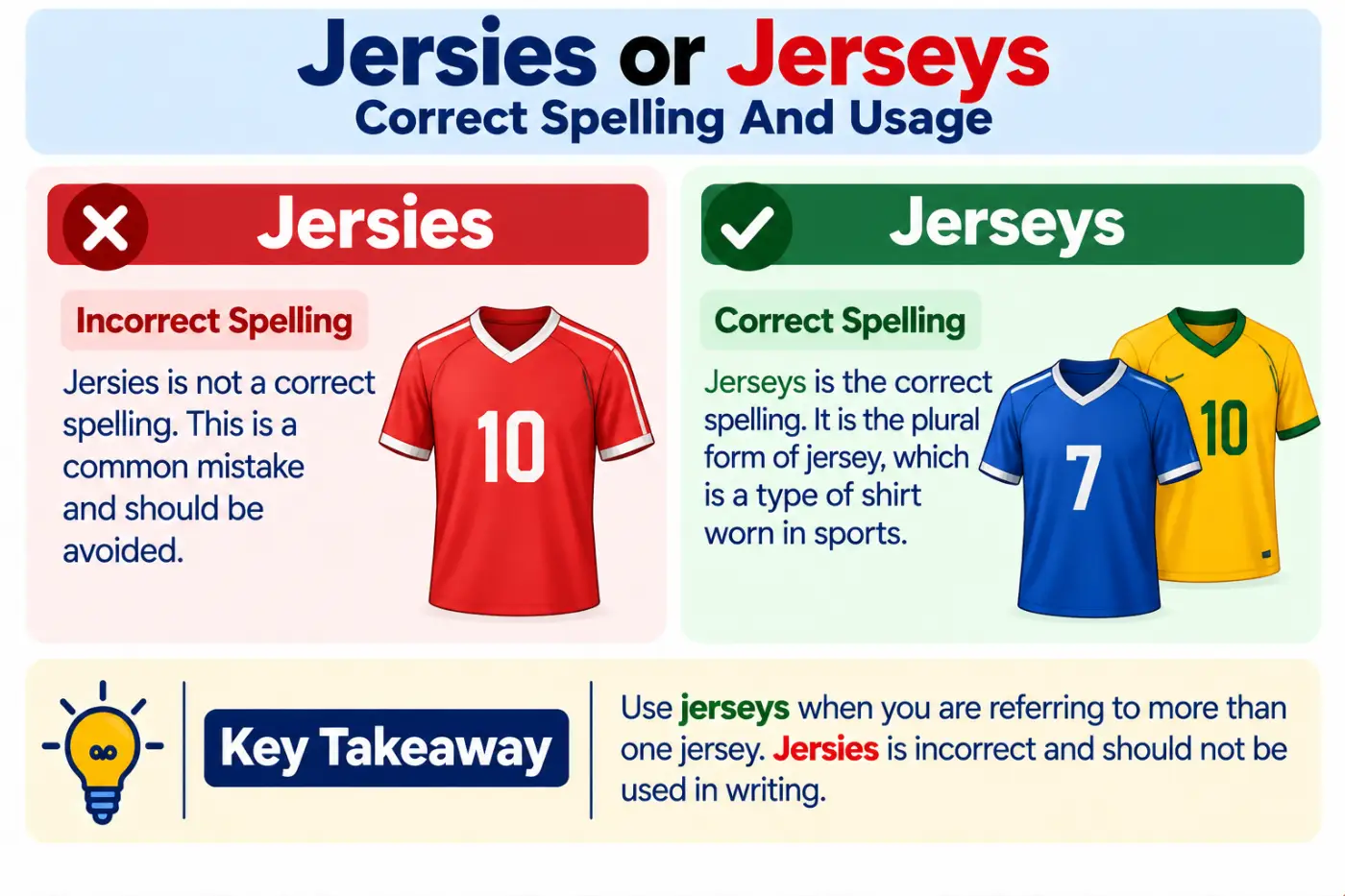
jersies or jerseys is a common spelling question because the two forms look almost identical and both seem like they could follow normal English plural rules. The correct plural spelling is jerseys. The form jersies is not the standard plural of jersey. If you are writing about sports shirts, clothing, or several items called a jersey, use jerseys.
The confusion comes from a familiar spelling pattern in English. Many words ending in a consonant plus y change the y to ies when they become plural, such as city and cities or baby and babies. Jersey looks as if it might follow that pattern, but it does not. The letter before y matters. In jersey, the y follows a vowel sound and the word keeps its y when you add the plural ending s.
That small spelling rule explains the whole difference. This guide shows you how the plural works, what jersey means, how to pronounce it, where the word came from, and how native speakers use it in real sentences. You’ll also see common spelling mistakes, regional usage, grammar examples, related terms, and an easy way to remember the correct form.
Learn the difference in is timeframe one word Correct Spelling And Usage.
Quick Definition
Jerseys is the standard plural of jersey. A jersey can mean a knitted garment or a shirt worn by a sports team or player. The spelling stays jersey when singular and becomes jerseys when plural. Jersies is a common spelling mistake caused by applying the plural rule used with words such as city and baby.
Quick Answer
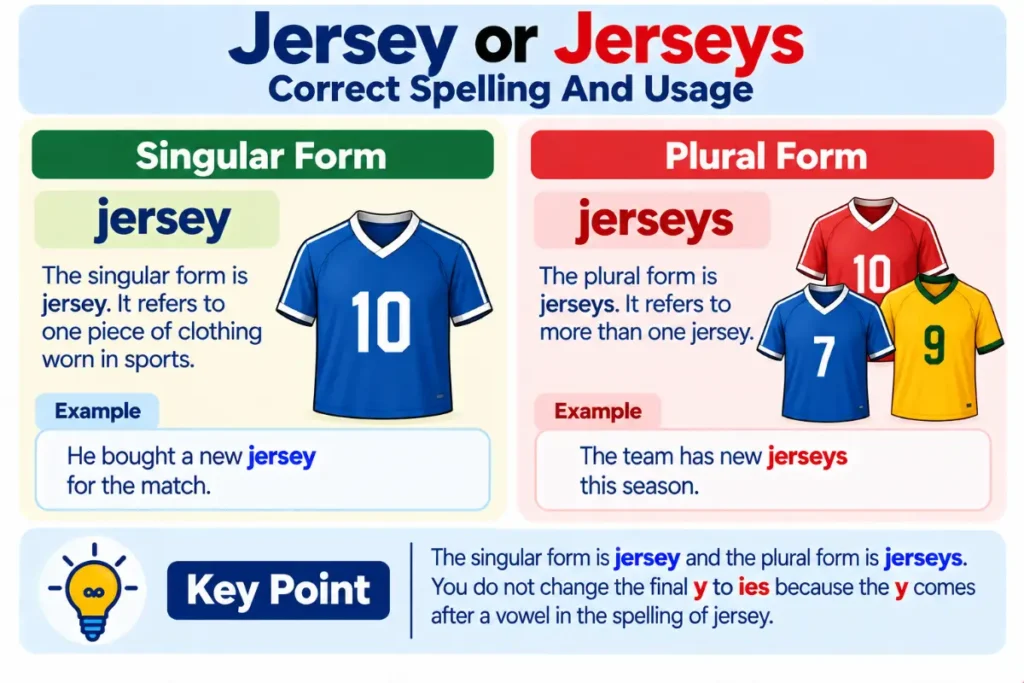
The correct plural spelling is jerseys.
The singular form is jersey and the plural form is jerseys. You do not change the final y to ies because the y comes after a vowel in the spelling of jersey.
For example:
The player wore a new jersey.
The players wore new jerseys.
Comparison Table For The Two Forms
| Form | Meaning | Part Of Speech | Origin | Usage Frequency | Formality | Common Contexts | Example |
|---|---|---|---|---|---|---|---|
| Jersey | One jersey or one garment | Noun | Connected to Jersey and the history of the fabric and garment | Very common | Neutral | Sports, clothing, fashion, textiles | He bought a new jersey. |
| Jerseys | More than one jersey | Plural noun | Plural form of jersey | Very common | Neutral | Sports, clothing, teams, retail | The store sells team jerseys. |
| Jersies | Not the standard plural spelling | Nonstandard plural form | Spelling mistake based on an incorrect y to ies pattern | Uncommon in edited writing | Nonstandard | Typing errors and learner writing | The word should be written as jerseys. |
The key point is simple. Jersey takes the regular plural ending s without changing the y.
Meaning And Definition
Meaning Of Jersies
Jersies is not the standard plural spelling of jersey in modern English. It usually appears because someone applies the wrong pluralization rule.
For example, an English learner may know that baby becomes babies and city becomes cities. From that pattern, it can seem logical to write jersey as jersies.
The problem is that English does not apply the y to ies rule to every word ending in y.
The spelling before the final y matters.
Compare these words:
city becomes cities.
party becomes parties.
baby becomes babies.
But:
boy becomes boys.
toy becomes toys.
key becomes keys.
jersey becomes jerseys.
The difference comes from the letter immediately before the final y. Words ending in a consonant plus y often change y to ies. Words ending in a vowel plus y normally keep the y and add s.
Because the spelling of jersey contains an e before y, the plural is jerseys.
Meaning Of Jersey
Jersey is a noun with several related meanings.
The most familiar modern meaning for many people is a shirt or top worn by a sports player. A basketball jersey, soccer jersey, football jersey, or hockey jersey can identify a player, team, number, or sponsor.
For example:
She bought a new basketball jersey.
The team released three new jerseys.
Jersey can also refer to a knitted garment. In clothing and textile contexts, the word can describe a type of garment or fabric.
The word may also appear in geographical names. Jersey is the name of an island in the Channel Islands. New Jersey is a US state. Context makes the intended meaning clear.
This creates an interesting language point. The same spelling can represent a garment, a fabric related term, an island, or part of a place name.
The Key Spelling Difference
The entire spelling issue becomes easier once you identify the letter before the final y.
In jersey, the ending is ey.
The plural is formed by adding s.
Jersey becomes jerseys.
The y stays in place.
This follows the same basic pattern seen in other words that end with a vowel followed by y.
- Key becomes keys.
- Boy becomes boys.
- Toy becomes toys.
- Day becomes days.
- Journey becomes journeys.
- Jersey becomes jerseys.
Now compare words ending in a consonant followed by y.
- City becomes cities.
- Party becomes parties.
- Country becomes countries.
- Family becomes families.
- Baby becomes babies.
- Story becomes stories.
This is why jersies looks plausible but remains incorrect. The writer is applying a real English rule to a word that belongs to a different spelling pattern.
Which Form Is Correct
The standard plural is jerseys.
The spelling rule is straightforward. When a singular noun ends in a vowel followed by y, the plural generally keeps the y and adds s.
Jersey ends in ey. The e is a vowel, so the plural becomes jerseys.
This is different from nouns ending in a consonant followed by y. In those words, the y commonly changes to i before the plural ending es.
That distinction is useful beyond this one word.
Think of jersey alongside key.
Key becomes keys.
Jersey becomes jerseys.
The visual pattern is similar and the same plural principle applies.
The form jersies is best treated as a spelling error in standard edited English. You should not use it in school assignments, professional writing, product descriptions, sports reporting, business communication, or published material.
Why The Mistake Happens
The error is easy to understand because English has several competing plural patterns.
A learner may remember the familiar rule:
Consonant plus y becomes ies.
That rule is correct for many nouns.
City becomes cities.
Baby becomes babies.
But then the learner sees jersey and applies the same transformation.
Jersey becomes jersies.
The missing step is checking the letter immediately before y.
This is a useful example of pattern based language processing. Your brain often predicts a word form from patterns it has already learned. When a familiar pattern feels strong, it can override the smaller spelling detail that actually determines the correct form.
Fast typing can make the problem worse. If you have seen many words such as cities and parties, your fingers may produce ies automatically.
The best solution is not memorizing dozens of isolated words. Learn the underlying rule and then check the letter before y.
Grammar Rules For The Plural
Jerseys is a plural count noun.
That means you can use it when talking about two or more jerseys.
One jersey.
Two jerseys.
Several jerseys.
Many jerseys.
The word can appear as the subject or object of a sentence.
The jerseys are hanging in the locker room.
The store sells jerseys.
The team ordered new jerseys.
You can also use it with numbers.
Five jerseys arrived this morning.
The coach bought twenty jerseys for the players.
You do not normally use jerseys with a singular determiner such as a or an.
Incorrect:
I bought a jerseys.
Correct:
I bought a jersey.
For more than one:
I bought two jerseys.
The same basic rule applies to possessive forms.
One player’s jersey.
Two players’ jerseys.
The apostrophe changes based on the noun that owns the jerseys rather than changing the spelling of the plural itself.
Singular And Plural Examples
The easiest way to learn the form is to compare singular and plural sentences.
Singular Examples
The player wore a blue jersey.
I ordered a new soccer jersey.
Her favorite jersey has the number ten.
The jersey is hanging in my closet.
He signed the jersey after the game.
Plural Examples
The players wore blue jerseys.
I ordered two new soccer jerseys.
Her favorite jerseys are from different teams.
The jerseys are hanging in my closet.
The athletes signed several jerseys after the game.
Notice that nothing happens to the y. The plural ending is simply added.
Sentence Examples
Here are ten natural examples using the standard plural form in different contexts.
- The team released its new jerseys before the season began.
- The store has several basketball jerseys in different sizes.
- Fans wore their favorite jerseys to the game.
- We washed all the jerseys after the tournament.
- The players signed jerseys for young fans after the match.
- The school ordered new jerseys for the soccer team.
- Those jerseys are available in both adult and youth sizes.
- The museum displayed several historic sports jerseys.
- She collects jerseys from teams she has followed for years.
- The company designed custom jerseys for the charity event.
These examples show that the plural form works naturally across sports, retail, school, collecting, fashion, and general conversation.
Common Mistakes And Misspellings
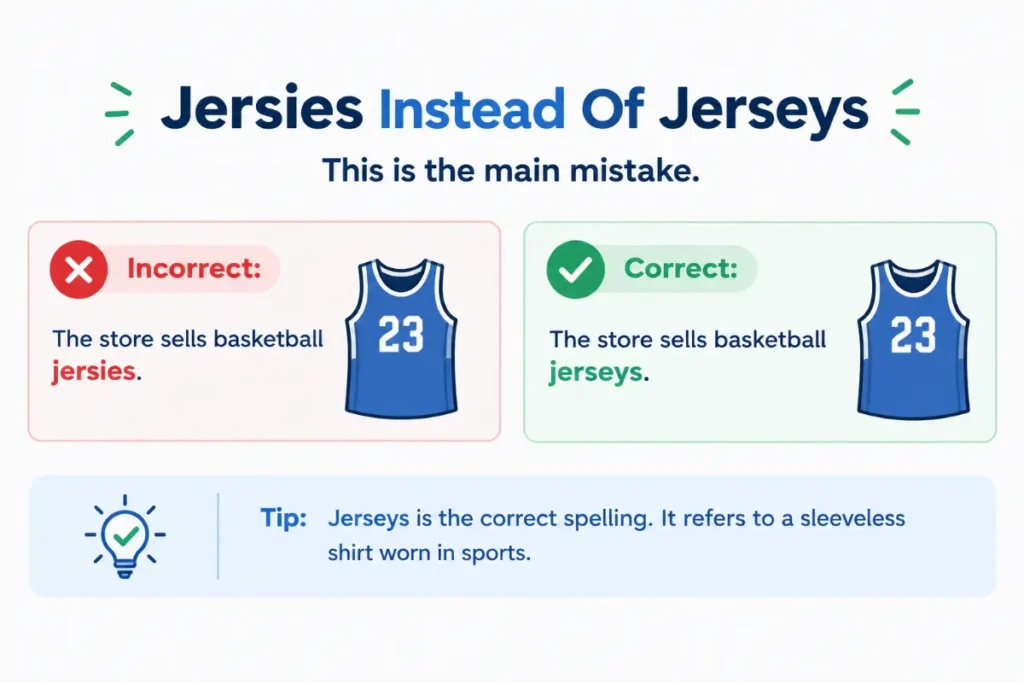
Jersies Instead Of Jerseys
This is the main mistake.
Incorrect:
The store sells basketball jersies.
Correct:
The store sells basketball jerseys.
The error comes from applying the consonant plus y plural rule to a word that has a vowel before y.
Jersey’s For The Plural
Another common mistake is adding an apostrophe before s.
Incorrect:
The team ordered new jersey’s.
Correct:
The team ordered new jerseys.
An apostrophe does not form a normal plural. It usually shows possession or contraction.
For example:
The jersey’s color is bright.
Here jersey’s means the color belongs to the jersey.
Jerseyses
Some writers may add an extra syllable or ending when they are unsure of the plural.
Incorrect:
The team received new jerseyses.
Correct:
The team received new jerseys.
The standard plural already ends in s. No additional ending is needed.
Jersy
This form drops the e from the singular.
Incorrect:
He bought a jersy.
Correct:
He bought a jersey.
The singular spelling must be learned first. Once jersey is correct, adding s gives you jerseys.
Jerseyz
This informal phonetic style may appear in usernames or playful writing, but it is not the standard spelling.
Correct formal spelling:
jerseys.
If you are writing for school, work, publication, or general communication, use the standard form.
A related grammar guide is How to Spell Until Correctly and Use It 2026.
Pronunciation Guide
The singular word jersey is commonly pronounced /ˈdʒɝːzi/ in American English.
A simple pronunciation guide is:
JUR zee.
The plural jerseys is commonly pronounced /ˈdʒɝːziz/.
A simple guide is:
JUR zeez.
The plural adds a final z sound and another light syllable.
You can think of the difference this way.
Jersey.
Jerseys.
The final s in jerseys is pronounced as a voiced z sound rather than an unvoiced s sound.
This is a normal feature of English plural pronunciation. The exact sound can vary slightly across accents, but the spelling remains the same.
One reason learners may spell the plural incorrectly is that the pronunciation does not clearly tell you whether the written form should be jerseys or jersies. English spelling cannot always be predicted from sound alone.
Etymology And Word Origin
The word jersey has a long history connected with Jersey, one of the Channel Islands.
The name became associated with a type of knitted garment and textile. Over time, the word developed broader clothing and sports related uses.
The modern sports sense became especially familiar as knitted or stretch garments became part of athletic uniforms. Today, a jersey can refer to a shirt worn by players in many sports.
The word also remains a geographical name. Jersey is the name of an island in the English Channel, while New Jersey is one of the United States.
The plural spelling does not change based on these different meanings when jersey is being used as a common noun for garments.
One jersey.
Two jerseys.
The history of the word does not change the basic English plural rule.
Regional Usage
American English
Jersey and jerseys are standard in American English.
In the United States, the word commonly refers to sports shirts, especially those worn by basketball, football, baseball, hockey, and soccer players. It can also refer to clothing or textile material depending on context.
The plural jerseys follows the standard spelling rule.
Jersies is not the standard plural form in edited American English.
British English
British English also uses jersey and jerseys.
The word has an additional clothing association because jersey can refer to a knitted pullover or similar garment. The sports meaning is also common.
The plural remains jerseys.
There is no major British spelling variation that changes the plural into jersies.
Australian English
Australian English uses jersey and jerseys in much the same way.
Sports culture makes the word especially common, but the spelling rule remains unchanged.
Jerseys is the standard plural form.
Canadian English
Canadian English also uses jerseys as the plural.
The word is common in sports and clothing contexts. Canadian spelling does not create a different plural form for jersey.
The same y rule applies because jersey ends in a vowel followed by y.
Jersey In Sports
Sports is one of the most common contexts for the word.
A jersey can identify a player through a number, name, team logo, colors, or other design elements.
For example:
The quarterback wore his new jersey.
The basketball team unveiled its new jerseys.
Fans bought jerseys with their favorite player’s number.
In many sports, the jersey forms part of a larger uniform that may include shorts, pants, socks, helmets, or other equipment.
The exact meaning can vary by sport.
In basketball, the jersey is typically a sleeveless top.
In American football, the jersey is part of a protective uniform and is worn over equipment.
Despite these differences, the plural spelling remains the same.
Jersey In Clothing And Fashion
The word is not limited to sports.
Jersey can also describe a knitted fabric or a garment made from that type of material.
For example:
She bought a soft jersey dress.
The shirt is made from lightweight jersey fabric.
In fashion and textile contexts, jersey can describe fabric with a particular knitted construction. The material is often associated with comfortable clothing because it can be soft and flexible.
The plural depends on what you mean.
Several jerseys can mean several garments called jerseys.
Different jersey fabrics can refer to different types or examples of the material.
Context tells the reader how the word is being used.
Jersey As A Place Name
New Jersey is a state in the United States.
These uses should not be confused with the common noun meaning of a garment.
Proper nouns are capitalized because they name specific places.
For example:
She visited Jersey during her vacation.
He moved to New Jersey.
The plural spelling question mainly concerns jersey as a common noun. When you are talking about multiple garments, the plural is jerseys.
Real Life Usage Examples
Daily Conversation
I need to wash my jerseys before the tournament.
Those jerseys look great.
People often use the word casually when talking about sports, shopping, or clothing.
Workplace Communication
The company ordered custom jerseys for the annual charity event.
Please confirm the sizes before we place the jersey order.
In workplace writing, the standard plural is especially important because product names, inventory records, and customer communication should use consistent spelling.
Academic Writing
The study examined how sports jerseys contribute to team identity.
Researchers compared the designs of professional jerseys from different periods.
Academic writing may discuss jerseys in studies of sports culture, marketing, fashion, history, or design.
News Writing
The team unveiled its new jerseys before the opening game.
Fans lined up outside the store to buy the latest jerseys.
Sports journalism uses the word frequently, particularly when teams introduce new uniforms.
Literature And Storytelling
The children wore matching jerseys as they ran onto the field.
A pile of old jerseys sat in the corner of the room.
Creative writing can use the word in both sports and everyday clothing scenes.
Related And Confused Terms
Uniform
A uniform is a complete set of clothing worn by members of a group. A jersey can be one part of a sports uniform.
Shirt
Shirt is a broader term for a garment worn on the upper body. A sports jersey is one specific type of shirt.
Kit
In sports, especially outside North America, kit can refer to the complete set of clothing and equipment used by a team. A jersey may be one part of the kit.
Top
Top is a broad clothing term for something worn on the upper body. It can include many garments beyond sports jerseys.
Sweater
A sweater is generally a knitted or woven upper body garment designed for warmth. It is not automatically a sports jersey.
Uniform
Uniform describes coordinated clothing used by a team, school, organization, or workplace. A jersey can form part of that uniform.
Team Shirt
Team shirt is a straightforward phrase that can describe a sports jersey. It is especially useful when the audience may not know the word jersey.
Sportswear
Sportswear refers to clothing designed for sports or athletic activities. Jerseys are one type of sportswear.
Understanding these related terms helps you choose a more precise word. A jersey is not always the same thing as a uniform, and a uniform is not always a jersey.
A Simple Memory Trick
The easiest way to remember the spelling is to look at the letter before y.
Jersey has e + y.
Because e is a vowel, keep the y and add s.
Jersey becomes jerseys.
Compare that with city.
City has t + y.
Because t is a consonant, the y changes to i and es is added.
City becomes cities.
So remember this:
Vowel plus y keeps y.
Consonant plus y usually changes y to ies.
This simple pattern explains why keys, boys, toys, journeys, and jerseys keep their y.
It also explains why cities, parties, babies, countries, and stories change their y.
Why Spellcheck Can Still Be Helpful
Spelling software can often identify jersies as a likely error, but it is better to understand the rule than depend entirely on a tool.
A spellchecker may recognize that jersies is unusual, but the strongest editing habit is knowing why it is wrong.
This matters because automated tools do not always understand context perfectly. They can miss unusual errors, accept proper names, or suggest a form that does not fit your intended meaning.
For a word like jersey, the spelling rule is simple enough to check yourself.
Ask:
Does the word end in vowel plus y?
If yes, the plural usually keeps y and adds s.
That gives you jerseys.
Expert Editor Insight
An experienced editor would treat jersies as a straightforward plural spelling error and jerseys as the standard form. The mistake is common because writers often remember the y to ies rule without checking the letter before y. A good proofreading habit is to look at the two letters at the end of the singular noun rather than relying on pronunciation. If you see vowel plus y, test the regular s plural first. This quick check catches the error before it reaches a finished article, report, product page, or school assignment.
Learn the difference in plural of loaf Is Loaves Correct.
Conclusion
jersies or jerseys has a clear answer. Jerseys is the standard plural of jersey, while jersies is a common spelling mistake. The reason is simple: jersey ends in a vowel plus y, so the y stays in place when you form the plural and you simply add s.
The word jersey can refer to a sports shirt, a knitted garment, or a type of fabric, and its plural spelling stays the same across these meanings. The same form is used in American, British, Australian, and Canadian English.
For a quick editing check, look at the final two letters of jersey. Since they are ey, keep the y when making the plural. Think of jersey and key together. One jersey becomes jerseys just as one key becomes keys. That small connection makes the correct spelling easy to remember.
FAQs
Is jersies a correct spelling?
No. Jersies is not the standard plural spelling of jersey. The correct plural is jerseys. The mistake usually happens because writers apply the same pattern used with words such as city and party. Those words change y to ies because a consonant comes before y. Jersey has a vowel before y, so the y stays and s is added.
What is the plural of jersey?
The plural of jersey is jerseys. You simply add s to the singular form without changing the final y. For example, one jersey becomes two jerseys. This follows the same general pattern as words such as key and boy, where a vowel appears before the final y. The spelling jersies is therefore a common pluralization error.
Why does jersey become jerseys instead of jersies?
Jersey becomes jerseys because the final y follows the vowel e. English nouns ending in a vowel plus y usually keep the y when forming the plural and add s. Words such as key and toy follow the same pattern. Words ending in consonant plus y, such as city, usually change y to ies.
How do you pronounce jerseys?
Jerseys is commonly pronounced /ˈdʒɝːziz/ in American English. A simple guide is JUR zeez. The singular jersey is pronounced /ˈdʒɝːzi/. The plural adds a final voiced z sound and another light syllable. The pronunciation can vary slightly across accents, but the standard spelling remains jerseys.
Is jersey a noun or an adjective?
Jersey is mainly a noun when it refers to a sports shirt, garment, or type of fabric. It can also appear as part of compound expressions that describe clothing or material. Jersey is also a proper noun in geographical names such as Jersey and New Jersey. The grammatical role depends on the sentence and context.
What does jersey mean in sports?
In sports, a jersey is a shirt or top worn as part of a team’s uniform. It often displays a player’s number, name, team colors, logo, or other identifying details. Different sports use different jersey designs. The term is common in basketball, football, soccer, hockey, baseball, and many other sports.
Is jersies ever acceptable in informal writing?
You may encounter jersies in casual posts, messages, comments, or other unedited writing, but it is still not the standard plural spelling. Informal communication can contain many spelling errors without affecting understanding. For school, work, publication, websites, product descriptions, and other polished writing, use jerseys.
What is the easiest way to remember the spelling?
Look at the letter before the final y. Jersey ends in vowel plus y, so the y stays and you add s. Jersey becomes jerseys. Compare city, which ends in consonant plus y and becomes cities. Remembering this small spelling pattern is more useful than memorizing the plural as an isolated word.