
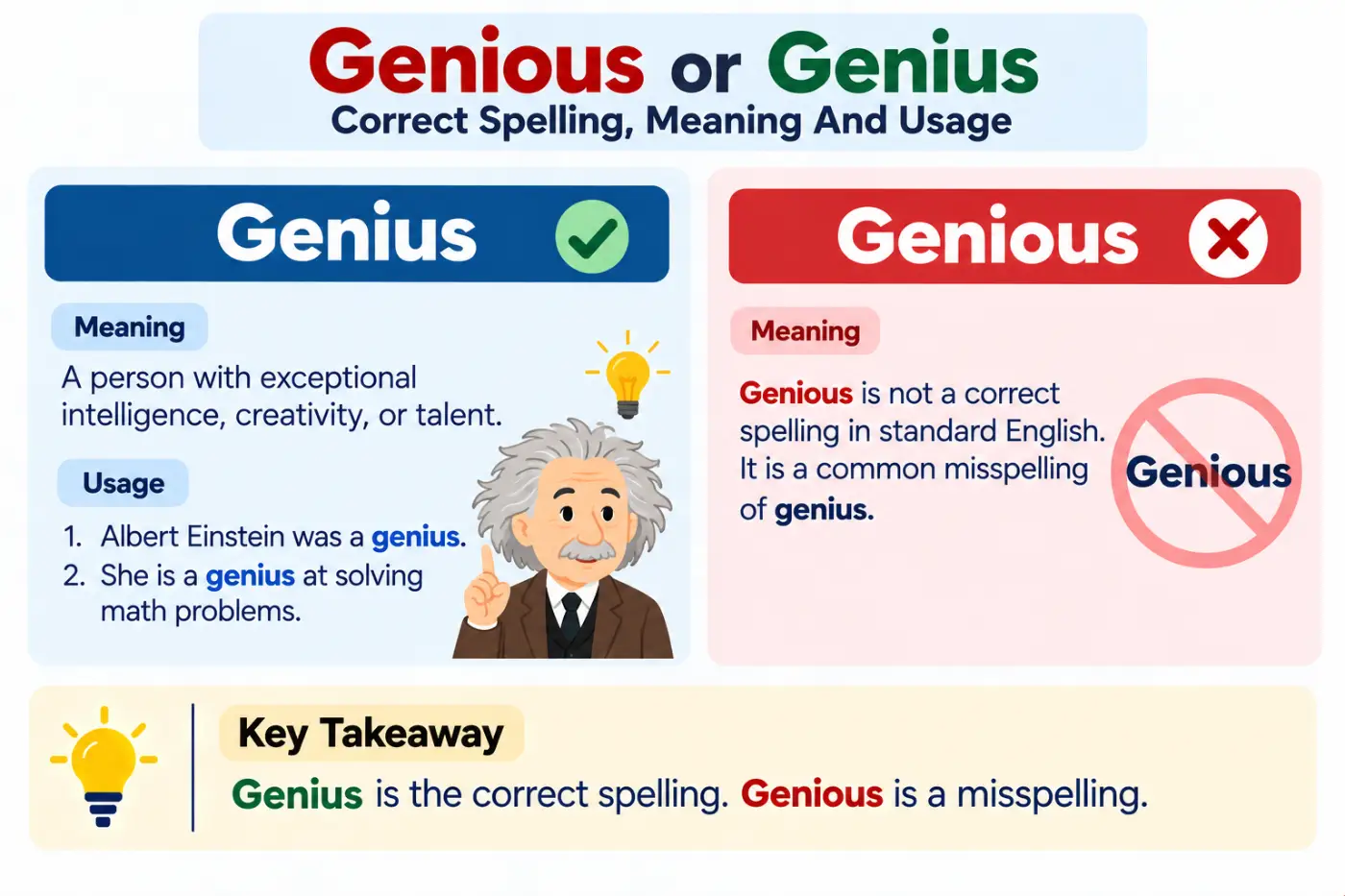
genious or genius is a common spelling question because the two forms look close enough to create hesitation. The correct spelling is genius. Genious is a common misspelling and is not the standard spelling of the English word. If you are describing someone with exceptional intelligence or referring to exceptional creative ability, use genius.
The confusion is understandable because the pronunciation does not clearly reveal the spelling. When you hear the word, the middle sounds can make the vowel pattern difficult to picture. English also contains many words with similar letter combinations, so it is easy to insert an extra o after the n when writing from memory. A quick visual check can save you from the mistake.
This guide explains the meaning and grammar of genius, shows why genious is incorrect, and gives natural examples from everyday, academic, professional, and formal English. You’ll also learn the pronunciation, word origin, related terms, regional usage, common spelling mistakes, and a simple memory trick. The goal is straightforward: by the end, you should be able to recognize and write the standard form without hesitation.
Still confused? Compare Sentence Or Sentance 2026 Which Spelling Is Correct?.
Quick Definition
Genius is the correct English spelling. It is mainly a noun meaning exceptional natural intelligence, talent, creativity, or skill, or a person who possesses such ability. Genious is a common spelling mistake. The standard word is spelled g e n i u s, with no o after the n.
Quick Answer
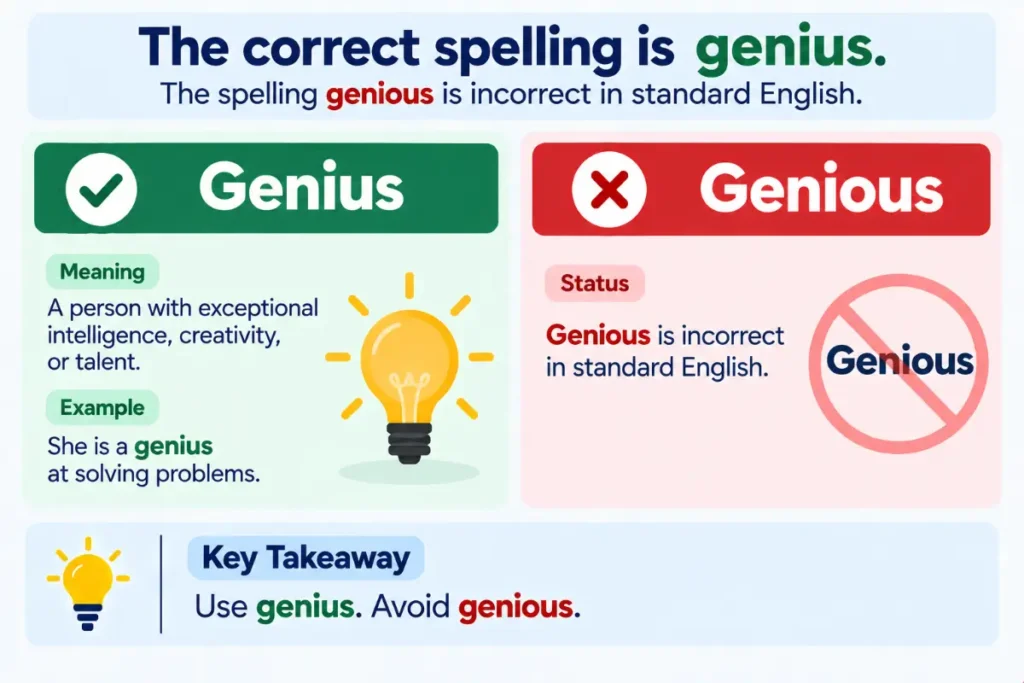
The correct form is genius.
Genious is a misspelling and should not be used in standard English writing. Genius is a noun that can describe a person with exceptional ability or the exceptional ability itself. Cambridge Dictionary lists genius as a noun and gives examples connected with artistic, creative, musical, and mathematical ability.
For example:
She is a musical genius.
That was a stroke of genius.
The first sentence describes a person. The second describes an exceptionally clever idea or action.
Comparison Table For The Two Spellings
| Form | Meaning | Part Of Speech | Origin | Usage Frequency | Formality | Common Contexts | Example |
|---|---|---|---|---|---|---|---|
| Genius | Exceptional natural ability or a person with exceptional ability | Noun | Latin genius through Middle English | Very common | Neutral to formal | Education, science, art, conversation, writing | He is a mathematical genius. |
| Genious | No standard English meaning as the intended spelling | Misspelling | Incorrect spelling of genius | Common as an error | Nonstandard | Typing mistakes, learner errors, informal drafts | Genious should be corrected to genius. |
The difference is not a matter of two accepted English spellings. Genius is the standard word. The other form usually appears because someone remembers the sound but not the exact sequence of letters.
Meaning And Definition
Meaning Of Genious
Genious is not the standard spelling of the English noun that means exceptional intelligence or ability.
You may encounter it in social media posts, comments, student assignments, text messages, online searches, or quickly written drafts. Its appearance in real writing does not make it a recognized alternative spelling.
The error is easy to understand. A writer may hear the word and mentally construct it as genious because several familiar English words contain similar letter patterns. The spelling can also be influenced by words such as previous, serious, curious, and various, where vowel combinations create different visual patterns.
Still, standard English uses genius.
If you are writing an essay, email, report, application, article, school assignment, or professional document, correct genious to genius.
Meaning Of Genius
Genius is primarily a noun.
It can mean an exceptionally high level of natural intelligence, creativity, talent, or skill. It can also refer to a person who possesses such ability. Cambridge Dictionary describes the word as referring to very great and rare natural ability or skill, especially in an area such as science or art, or to a person who has that ability.
Consider these two uses.
Albert Einstein was a genius.
The idea was a stroke of genius.
In the first sentence, genius refers to a person.
In the second sentence, genius refers to exceptional intellectual or creative ability.
The word can also describe a special talent for a particular activity.
She has a genius for solving difficult problems.
Here the expression genius for means a special or exceptional ability in a particular area.
The word can also appear in phrases such as creative genius, artistic genius, musical genius, mathematical genius, and stroke of genius.
Key Differences Explained
- Spelling. Genius is spelled g e n i u s. The incorrect form inserts an o after the n.
- Meaning. Genius has established meanings connected with exceptional ability and exceptional talent. The misspelled form does not carry a separate standard meaning.
- Grammar. Genius is primarily a noun in standard modern English. It can refer to a person or to an exceptional quality or ability.
- Pronunciation. Genius is commonly pronounced with the first syllable stressed. The spelling mistake usually comes from trying to reconstruct the written form from its sound.
- Formality. Genius works in casual conversation as well as formal writing. The misspelled form should be corrected in polished writing.
- Context. Genius can appear in discussions about education, science, mathematics, art, music, creativity, problem solving, and everyday clever ideas.
- Regional usage. The standard spelling remains genius across major English varieties.
- Standard usage. Only genius should be used as the standard spelling for the intended meaning.
The central lesson is simple. You do not need to choose between two legitimate forms. You need to remember the correct sequence of letters.
Which Form Is Correct?
Genius is correct. Genious is incorrect.
The standard spelling is supported by major English dictionaries. Cambridge lists genius as a noun with the meanings connected to exceptional natural ability and a person who possesses that ability. Oxford also records genius as a noun and traces its development from Latin through Middle English.
The spelling is not based on the pronunciation alone. English spelling often preserves historical forms that are not perfectly predictable from modern speech. That is one reason learners can know exactly how a word sounds but still struggle to spell it.
A useful spelling check is to remember the central sequence:
gen i us
There is no o between n and i.
If you see genious in your writing, remove the extra o.
Why The Spelling Causes Trouble
The mistake often comes from a conflict between sound and visual memory.
When you hear genius, you hear something close to JEE nee us. The sound does not tell you that the written form moves directly from n to i. As a result, a writer may insert an o because it feels natural when constructing the word.
Another factor is analogy. English contains many words with combinations such as eous and ious. A learner who has seen words such as serious, curious, mysterious, and various may unconsciously apply a familiar spelling pattern to genius.
Typing speed can add another layer. When people write quickly, they often rely on partial visual memory. If the word is not firmly stored in memory, a small letter can slip into the middle.
This is a normal spelling problem. It does not mean the writer does not understand the word.
The best solution is not to memorize a complicated rule. It is to build a strong visual connection between the word and its meaning.
Sentence Examples
Here are natural examples using the correct form.
- Everyone in the class thought she was a genius at mathematics.
- That was a genius idea for solving the problem.
- He showed signs of creative genius from an early age.
- The scientist was widely recognized for his work in physics.
- You don’t have to be a genius to understand the basic concept.
- Her ability to organize complicated information is impressive.
- The designer came up with a stroke of genius.
- He has a genius for explaining difficult ideas in simple language.
- The novel is often praised for the author’s creative genius.
- Finding a faster solution was a real stroke of genius.
These examples show that the word can describe a person, an ability, an idea, or a special talent.
Common Spelling Mistakes
Genious
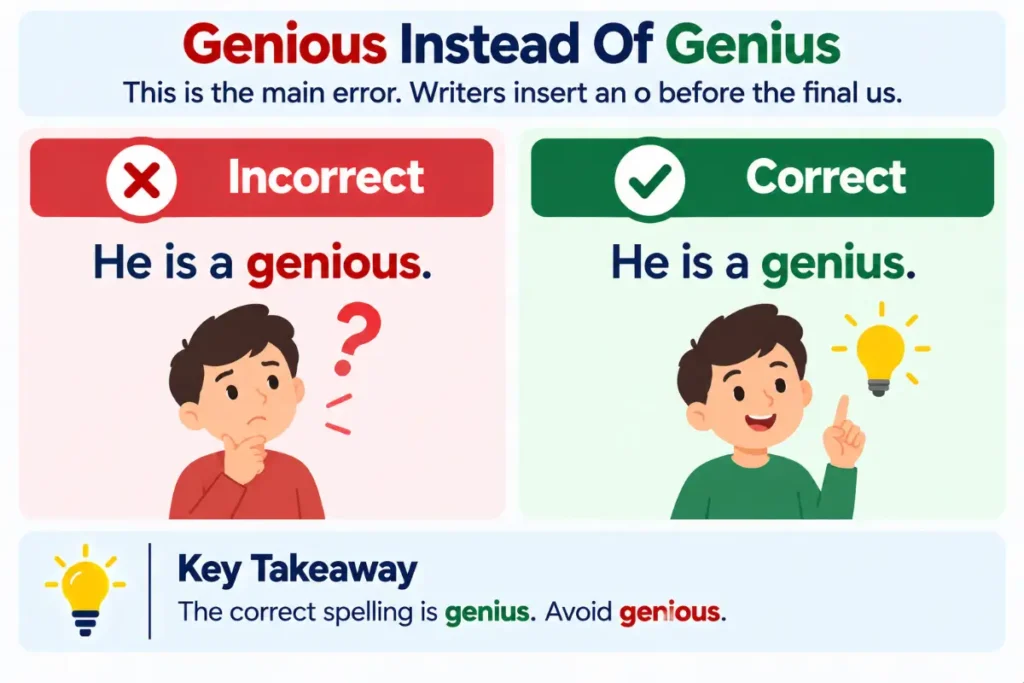
This is the main spelling error. The writer inserts o after n.
Incorrect:
He is a genious.
Correct:
He is a genius.
The easiest fix is to remember that the word moves directly from n to i.
Geniouss
Some writers add an extra s because the final sound may feel longer than the spelling suggests.
Incorrect:
She is a geniouss.
Correct:
She is a genius.
The singular noun ends with one s.
Geneus
This version usually comes from trying to spell the word phonetically.
Incorrect:
He is a geneus.
Correct:
He is a genius.
The vowel sequence in the middle should be i u rather than eu.
Geniousness
This form combines the spelling error with an unnecessary noun ending.
If you need to describe exceptional ability, use genius or exceptional ability instead.
Geniuse
Some writers add a final e because of uncertainty about the ending.
The standard singular form is genius.
These errors have the same basic cause. The writer remembers the sound or general shape of the word but not the exact internal letter sequence.
Pronunciation Guide
Cambridge gives both US and UK pronunciation as /ˈdʒiː.ni.əs/.
A simple American English pronunciation guide is:
JEE nee us
The word has three syllables.
Genius = JEE + nee + us.
The first syllable carries the main stress.
The opening sound is like the j in jump. The second syllable has a long e sound. The final syllable has a relaxed uh sound.
One common mistake is trying to pronounce the word as though it contains a strong o sound in the middle. It does not.
Another issue is rushing the final syllable. In natural speech, the final sound is lighter than the first syllable.
Pronunciation can explain why the spelling feels confusing. When spoken quickly, the word sounds compact. The spelling, however, contains six letters with a specific sequence that you need to remember.
Etymology And Word Origin
The history of genius is surprisingly interesting because the word did not originally mean exactly what it means today.
English borrowed the word from Latin genius. The original Latin word was connected with an attendant or guardian spirit associated with a person. It was also connected with ideas of innate nature, talent, and creative ability. Oxford traces the English word through Latin and Middle English and explains how the meaning developed over time.
The word eventually developed a stronger connection with a person’s characteristic nature and natural ability. By the seventeenth century, the modern idea of exceptional natural ability had become established.
This history helps explain why the word can refer to both a person and an ability.
For example:
She is a genius.
This focuses on the person.
The painting shows artistic genius.
This focuses on the exceptional ability.
The modern word therefore carries several layers of its long history. What began as an idea connected with an innate spirit or nature gradually became a word for exceptional intellectual and creative ability.
Many readers also check Undecisive or Indecisive Which Is Correct.
Regional Usage
American English
Genius is the standard spelling in American English. It is common in everyday speech, education, business, science, technology, entertainment, and formal writing.
Americans may use the word seriously or casually.
She’s a genius at math.
That was genius.
The second example uses genius in a more informal way to mean exceptionally clever or effective.
British English
British English uses the same standard spelling.
Genius is also common in British academic, literary, journalistic, and conversational English. There is no major British spelling variant that replaces the standard form.
The pronunciation can have small regional differences, but the spelling remains the same.
Australian English
Australian English also uses genius as the standard spelling. The word functions in much the same way as it does in American and British English.
There is no meaningful regional spelling distinction between genius and the incorrect form.
Canadian English
Canadian English follows the same standard spelling.
Genius is used for exceptional ability, a person with exceptional ability, and informal descriptions of an exceptionally clever idea or action.
Again, the incorrect form does not become acceptable because of regional usage.
Grammar Rules And Part Of Speech
Genius is primarily a noun.
It can be a count noun when it refers to a person.
He is a genius.
She is a genius.
They are geniuses.
The plural form is geniuses in ordinary modern English. Cambridge gives geniuses as the plural form.
Genius can also be a noncount noun when it refers to exceptional ability rather than an individual person.
The painting demonstrates genius.
The project required technical genius.
In these examples, the word refers to an exceptional quality rather than one person.
Another common structure is:
genius for + noun or gerund
She has a genius for organization.
He has a genius for solving difficult problems.
The word can also appear in phrases such as:
a genius at mathematics
a creative genius
a musical genius
a mathematical genius
a stroke of genius
a work of genius
There is also an adjective use in modern English in which genius can informally mean extremely clever or excellent. The Oxford entry and recent linguistic research note this development in modern English usage.
For example:
That was a genius move.
This use is common in casual speech and informal writing.
Count Noun And Noncount Noun Uses
Understanding countability helps you use the word naturally.
When you mean a person, use the count noun.
She is a genius.
Three geniuses worked on the project.
When you mean exceptional ability in general, the word can be noncount.
His work shows genius.
Her performance displayed remarkable genius.
The difference is similar to many English nouns that can describe either a person or a quality.
The context normally makes the meaning clear.
A useful editing question is this:
Am I talking about a person or about an exceptional ability?
If you are talking about a person, the count noun is usually the natural choice.
If you are talking about the quality or power itself, the noncount use may fit better.
Formal And Informal Usage
Genius works comfortably across different levels of English.
In formal writing, it can describe exceptional intellectual or creative ability.
The scientist demonstrated exceptional mathematical ability.
The writer showed unusual creative genius.
In casual speech, people often use genius more loosely.
That shortcut was genius.
You’re a genius.
In these casual examples, the word does not necessarily mean that the person possesses extraordinary intellectual ability in every area. It can simply express admiration for one clever action or idea.
That distinction matters.
Calling someone a genius in casual conversation can be praise without making a serious claim about their overall intelligence.
For formal writing, precision matters more. If you are discussing a person’s documented achievements, exceptional ability, creativity, or influence, explain the specific quality rather than relying on the word alone.
Real Life Usage Examples
Daily Conversation
You’re a genius for remembering that shortcut.
My brother is a genius at fixing computers.
The first sentence uses the word casually as praise. The second describes a particular area of strong ability.
Workplace Communication
The team found an elegant solution to the problem. It was a real stroke of genius.
Her ability to simplify complicated processes shows exceptional creative skill.
The first example works well in an informal workplace conversation. The second is more measured and suitable for professional discussion.
Academic Writing
The scientist is widely recognized for exceptional contributions to theoretical physics.
The artist’s work demonstrates unusual creative genius.
Academic writing usually benefits from explaining the evidence behind a claim of exceptional ability.
News Writing
The invention was described by supporters as a stroke of genius.
The musician’s work has been associated with exceptional creative ability.
News writing often distinguishes between a factual description of achievement and a subjective judgment about genius.
Literature And Storytelling
Everyone in the village believed the young inventor was a genius.
The old professor possessed a remarkable genius for seeing patterns that others missed.
In storytelling, the word can help establish a character’s exceptional talent or reputation.
Related And Confused Terms
Intelligent
Intelligent describes someone who can learn, understand, reason, or solve problems effectively. A person can be intelligent without being described as a genius.
Brilliant
Brilliant can describe exceptional intelligence, talent, or performance. It is often used more freely than genius.
Talented
Talented refers to natural ability or skill. A talented person does not necessarily have the extraordinary ability associated with genius.
Gifted
Gifted describes someone with unusually strong ability in a particular area. The term is common in education.
Clever
Clever usually means quick to understand or good at finding solutions. It can describe a specific idea or action without making a broad claim about someone’s abilities.
Intelligent
Intelligent focuses on mental ability and understanding. Genius usually suggests a much higher or rarer level of ability.
Prodigy
A prodigy is a young person who shows exceptional ability at an unusually early age. The term is more specific than genius.
Ingenuity
Ingenuity means cleverness and inventiveness in solving problems. It refers to a quality or ability rather than necessarily describing a person as a genius.
These words overlap, but they are not perfect substitutes. Choosing the right one depends on exactly what you want to say.
Genius And Ingenious
Both words are related in history but have different meanings and grammatical roles.
Genius is mainly a noun.
She is a genius.
Ingenious is an adjective.
She created an ingenious solution.
Ingenious means clever, inventive, or skillful at solving a problem. It does not normally mean a genius person.
This distinction creates another common spelling and vocabulary problem. The words look similar because they share historical connections, but their modern grammar is different.
Compare:
He is a genius.
He designed an ingenious device.
The first sentence describes a person. The second describes the quality of a device or solution.
Genius And Ingenuous
Ingenuous is another word that looks similar but has a completely different meaning.
Ingenuous usually describes someone who is innocent, sincere, or straightforward.
For example:
Her ingenuous response surprised everyone.
This does not mean she was exceptionally intelligent.
The visual similarity between genius, ingenious, and ingenuous can create confusion. They belong to related historical word families, but their modern meanings should not be mixed.
When spelling a word, focus on the meaning you intend before choosing the letters.
Why Genious Is Such A Common Error
The spelling mistake is a good example of how English spelling can conflict with pronunciation.
People often learn a word by hearing it first. Later, they need to produce the written form from memory. If the internal letter pattern is not stored strongly, the brain may substitute a familiar sequence.
This is especially likely with a word that contains less predictable vowels.
A learner may think:
gen + ious
and accidentally produce genious.
The problem is not the beginning or ending. The issue is the internal sequence.
The correct sequence is:
gen + ius.
That one letter difference creates the entire spelling error.
NLP systems and spellcheck tools can usually identify the misspelling because the intended word is highly predictable from context. A sentence such as He is a genious at mathematics gives a strong contextual signal that genius was intended.
Still, automated correction should not replace proofreading. A spellchecker may suggest the right word, but learning the spelling means you can recognize the error yourself.
A Simple Memory Trick
Here is an easy way to remember the spelling.
Think of the word as three parts:
gen + i + us
Do not insert o after n.
Another useful trick is to connect the spelling with the word genius itself rather than trying to spell it from pronunciation.
Write it three times:
genius
genius
Then use it in a sentence:
She is a genius at solving puzzles.
The goal is to build visual memory.
You can also remember that the middle of the word contains niu rather than nio.
genius = niu
genious = nio
The first one is the standard spelling.
Expert Editor Insight
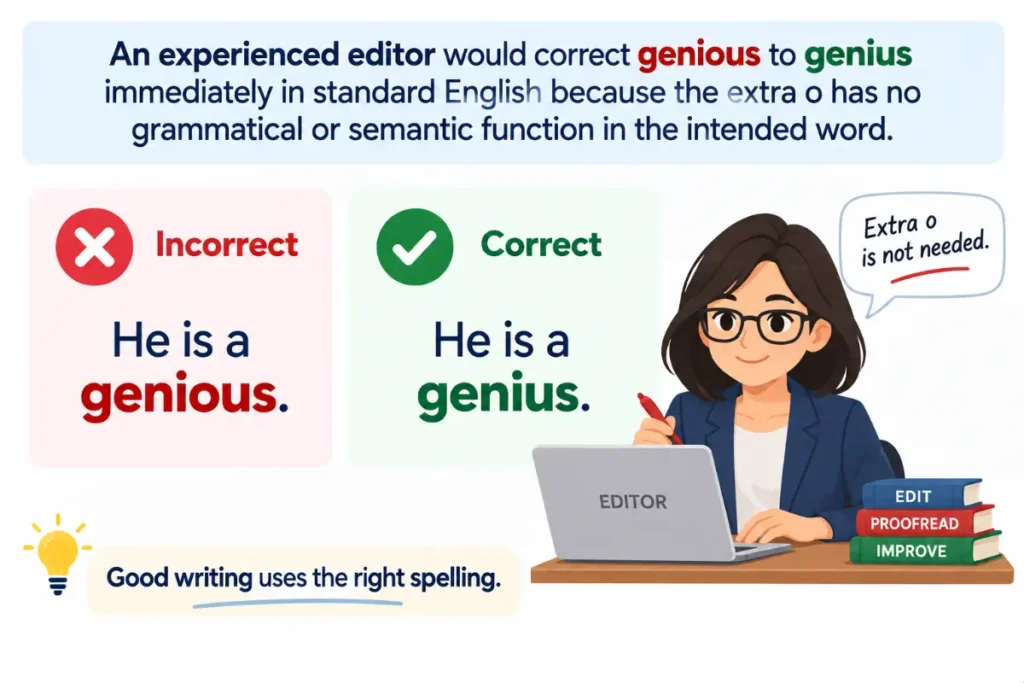
An experienced editor would correct genious immediately in standard English because the intended word is clear and the spelling is not an accepted alternative. The mistake is common because the pronunciation does not make the internal vowel sequence obvious. Professional editors also check the surrounding grammar because genius can function as a count noun, a noncount noun, and in informal modern usage as an adjective. Spelling tools usually recognize the error, but a strong writer should know the correct form without depending entirely on automated correction.
Need another quick comparison? Read convertor vs converter Which Form Is Correct.
Conclusion
genious or genius has a clear answer. Genius is the correct spelling, while genious is a common spelling mistake. The standard word is mainly a noun referring to exceptional natural intelligence, creativity, talent, or skill, or to a person who possesses such ability. It can also appear in informal expressions that praise a clever idea or action.
The spelling becomes easier once you remember the middle sequence niu. Do not add an o after the n. Think of the word as gen plus ius and keep that visual pattern in mind whenever you write it.
If you are proofreading an essay, email, assignment, or professional document, search for genious and replace it with genius. One quick spelling check can keep this small mistake from distracting the reader from your actual message.
FAQs
Is genious a real English word?
Genious is not the standard spelling of the English word used for exceptional intelligence or ability. In ordinary writing, it should be corrected to genius. You may encounter the incorrect form in online posts, student work, messages, or search queries, but frequent mistakes do not turn a misspelling into a standard variant. Use genius in formal and informal English.
What does genius mean?
Genius mainly refers to exceptional natural intelligence, talent, creativity, or skill. It can also describe a person who possesses such ability. For example, She is a genius refers to a person, while The invention showed genius refers to exceptional ability. The word can also describe a special talent for an activity, as in a genius for solving problems.
Which spelling is correct?
Genius is the correct spelling. Genious is a common misspelling caused by adding an o after the n. The standard sequence is g e n i u s. If you are describing someone with exceptional ability or referring to an exceptionally clever idea, use genius. Major English dictionaries recognize genius as the standard word.
How do you pronounce genius?
Genius is commonly pronounced /ˈdʒiː.ni.əs/ in both US and UK English. A simple guide is JEE nee us. The first syllable receives the main stress. The final syllable is light and relaxed in natural speech. The spelling can be difficult because pronunciation does not clearly show the exact i u sequence in the middle.
Can genius be used as an adjective?
Yes. In modern informal English, genius can be used as an adjective to mean extremely clever or excellent. For example, That was a genius move. This use is especially common in casual speech and informal writing. In formal writing, a more precise adjective such as brilliant, ingenious, or exceptionally effective may communicate the intended idea more clearly.
What is the plural of genius?
The usual modern plural is geniuses. For example, The museum features several famous geniuses from different fields. The form genii also exists in historical or specialized contexts connected with older senses of the word, but geniuses is the normal plural when referring to exceptionally talented people. Cambridge lists geniuses as the standard plural form.
Why do people spell genius incorrectly?
People often make this mistake because the pronunciation does not clearly reveal the internal spelling. The sequence of sounds can encourage writers to insert an o between n and i. Similar looking English words can also influence spelling from memory. The easiest solution is to memorize the visual form genius and remember that there is no o after the n.
Is genius appropriate in formal writing?
Yes. Genius is a standard English word and can be used in formal writing when the meaning is appropriate. Academic and professional writers may use it to discuss exceptional intellectual or creative ability. Still, formal writing should support strong claims with specific evidence. Instead of simply calling someone a genius, explain the achievement, skill, or contribution that justifies the description.