
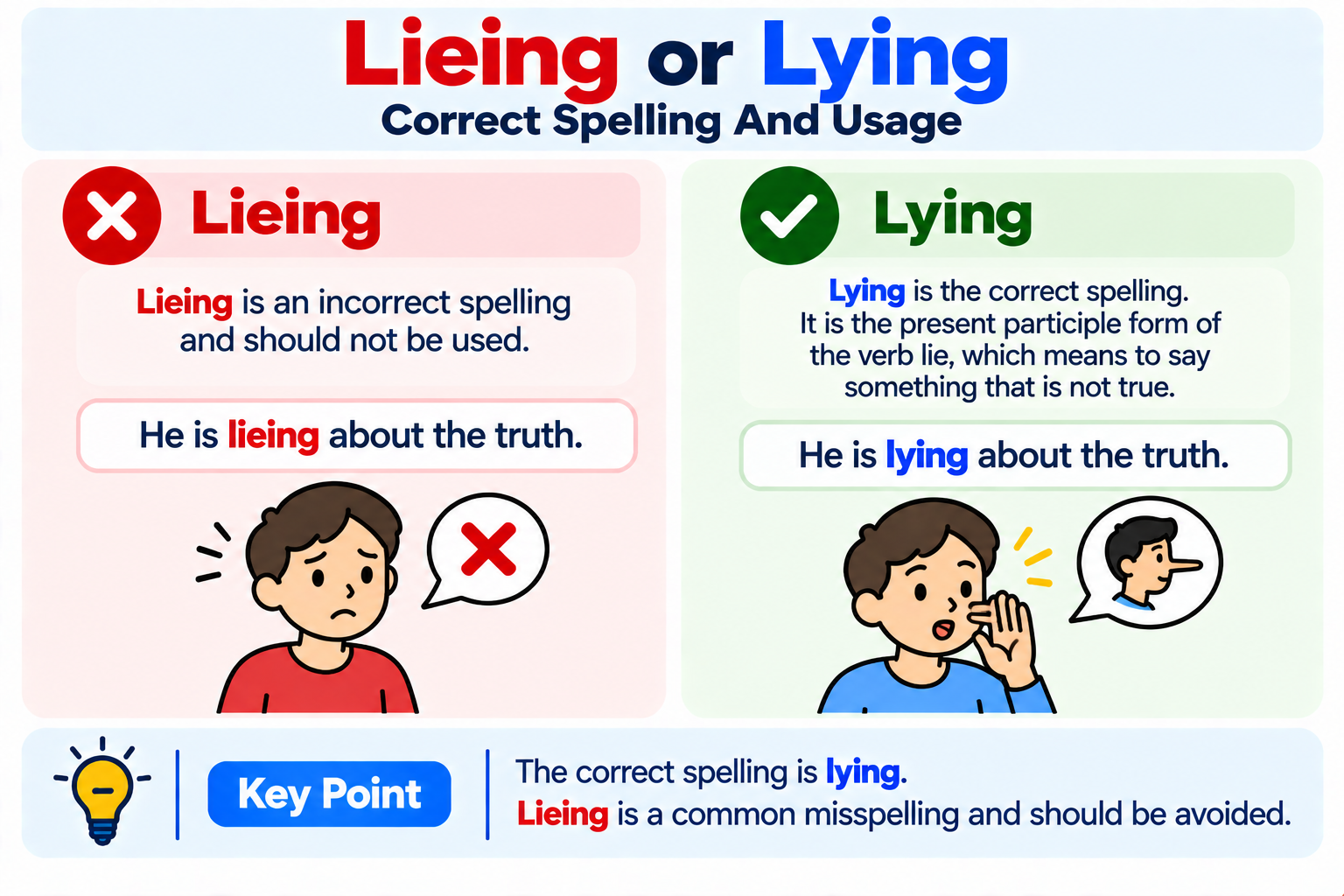
lieing or lying is a common spelling problem because the verb lie changes its spelling when you add the ending ing. The correct form is lying. The spelling lieing is incorrect when you mean resting in a position or telling an untruth. If you have ever hesitated before typing this word you’re not alone. The change from lie to lying can look unusual at first.
The confusion comes from a basic English spelling rule. When a verb ends in a silent e, English often drops the final e before adding ing. With lie, the change goes a little further because the spelling also changes from ie to y before the ending is added. That gives us lie, lying, and not lieing.
This distinction matters because lying has more than one meaning. It can describe someone resting in a horizontal position, or it can describe someone telling something untrue. In this guide you’ll learn the spelling rule, grammar, pronunciation, word history, common mistakes, regional usage, and natural examples so you can use the form confidently in everyday and formal writing.
Many readers also check Implicit vs Complicit Which Word Should You Use 2026.
Quick Definition
Lying is the correct spelling for the present participle of lie. It can mean resting or being positioned in a horizontal or flat position, or it can mean telling an untruth. Lieing is a common spelling error. The spelling changes from ie to y before the ending ing is added.
Quick Answer
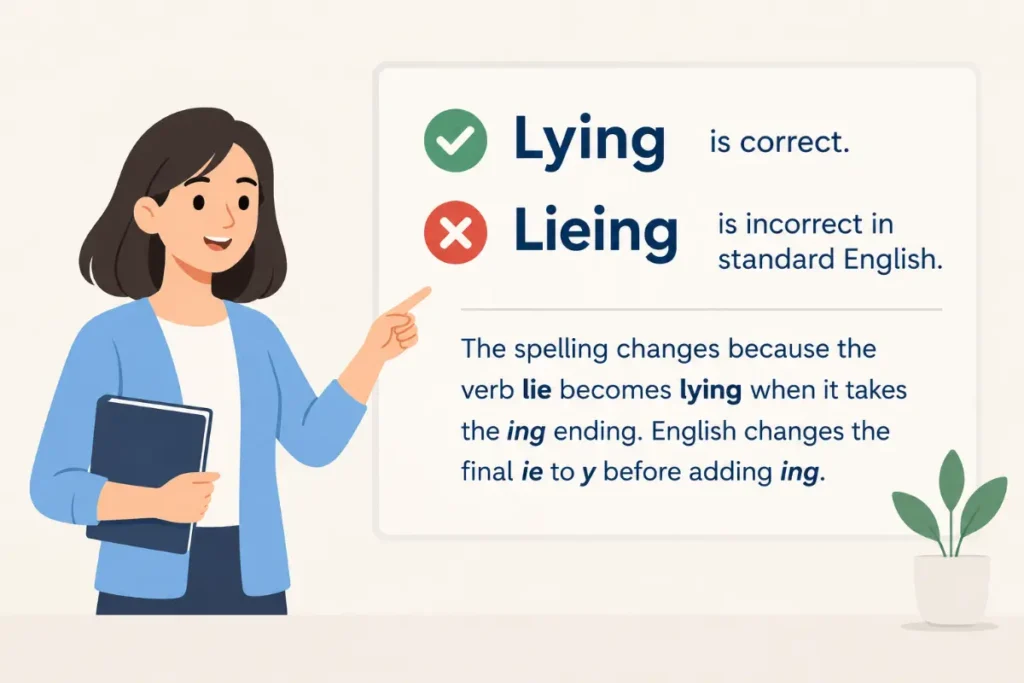
Lying is correct. Lieing is incorrect in standard English. The spelling changes because the verb lie becomes lying when it takes the ing ending. English changes the final ie to y before adding ing.
Examples:
I am lying on the couch.
She is lying about what happened.
The word looks unusual because you might expect lie plus ing to produce lieing. English spelling does not form the word that way.
Comparison Table For The Two Forms
| Form | Meaning | Part Of Speech | Origin | Usage Frequency | Formality | Common Contexts | Example |
|---|---|---|---|---|---|---|---|
| Lying | Resting in a horizontal position or telling an untruth | Present participle and gerund | From the verb lie | Very common | Neutral | Conversation, school, work, literature, journalism | He is lying on the sofa. |
| Lieing | No standard meaning as the present participle of lie | Incorrect spelling | Misspelling of lying | Uncommon in edited writing | Nonstandard | Typing errors and spelling mistakes | Lieing is incorrect. |
The key point is simple. Lying is the established English form. Lieing does not follow the standard spelling pattern used for this verb.
Meaning And Definition
Meaning Of The Incorrect Form
Lieing is a common spelling mistake rather than a standard alternative form of lying.
People usually create this spelling by applying a simple formula:
lie + ing = lieing
That calculation looks logical. The problem is that English spelling changes the ending of lie before ing is added.
The correct transformation is:
lie → lying
The final ie changes to y and then ing is added.
You may see lieing in online comments, informal messages, drafts, student writing, or quickly typed text. Search engines and spelling tools may understand what the writer intended, but recognition does not make the spelling standard.
If you are writing an essay, email, article, report, application, or other polished material, use lying.
Meaning Of Lying
Lying is the present participle and gerund form of the verb lie.
The verb lie has two important meanings, and both can produce lying.
The first meaning is to be in a flat or horizontal position.
For example:
The baby is lying on the bed.
Here lying describes the baby’s position.
The second meaning is to tell an untruth.
For example:
He is lying about his age.
Here lying describes dishonest speech.
These meanings come from different senses of the verb lie, but the present participle has the same spelling.
Lying can also work as a gerund.
Lying to your friends can damage trust.
In this sentence, lying acts like a noun because it names an activity.
The surrounding words tell you which meaning applies.
Why The Spelling Changes
The spelling rule is the heart of this question.
The base verb is lie.
When you form the present participle, you normally add ing. However, English does not simply attach ing to the existing spelling in this case.
Instead:
lie → lying
The final ie changes to y.
This pattern also appears in related verbs.
die → dying
tie → tying
lie → lying
These examples make the pattern easier to remember.
Compare them with verbs that simply drop a final e.
make → making
write → writing
take → taking
The spelling behavior depends on the structure of the base verb.
A useful rule is this:
When a verb ends in ie, the ie commonly changes to y before ing is added.
That gives you a reliable pattern:
ie + ing → ying
So:
lie becomes lying.
die becomes dying.
tie becomes tying.
This is one of those English spelling rules that looks strange until you see several examples together. Once the pattern clicks, the correct form becomes much easier to remember.
Key Differences Explained
- Spelling. Lying is the standard spelling. Lieing incorrectly keeps the original ie before adding ing.
- Meaning. Lying can describe resting in a position or telling an untruth. Lieing does not have a separate standard meaning.
- Grammar. Lying is the present participle and gerund form of lie.
- Pronunciation. Lying is pronounced differently from the base form lie because the ending adds another syllable.
- Formality. Lying is appropriate in both informal and formal writing. Lieing is nonstandard and should be corrected.
- Context. Lying appears in everyday conversation, academic writing, journalism, fiction, business communication, and many other contexts.
- Regional usage. Standard English varieties use lying. There is no major regional English variety that treats lieing as the standard spelling.
- Spelling pattern. The important pattern is ie changing to y before ing.
The biggest lesson is that this is a spelling rule rather than a difference in meaning.
Which Form Is Correct
Lying is the correct form.
The reason is grammatical and orthographic. The base verb lie changes its spelling when it takes the ing ending. The final ie becomes y, producing lying.
Major English dictionaries recognize lying as the present participle of lie. Standard dictionary entries also distinguish the verb lie from related verbs such as lay and from the adjective lying.
This matters because several English words can look similar while serving different grammatical roles.
For example:
I lie on the couch every afternoon.
I am laying the book on the table.
These forms belong to different verbs and should not be treated as interchangeable.
If you remember only one spelling rule from this article, remember this:
Lie changes to lying.
Do not add ing directly to the unchanged spelling.
Sentence Examples
Here are natural examples showing the correct form in different situations.
- I am lying on the couch and watching a movie.
- The dog is lying under the table.
- She was lying about where she had been.
- He spent the afternoon lying in the sun.
- The patient is lying comfortably in bed.
- I knew he was lying as soon as I heard his explanation.
- The children were lying on the grass and talking.
- She apologized for lying to her parents.
- The book was lying on the desk when I arrived.
- Lying to someone can damage a relationship.
These examples show that the word can describe physical position or dishonesty.
The following sentences contain the common misspelling. They are shown only to make the error easy to recognize.
- Incorrect: She is lieing on the sofa.
- Incorrect: He was lieing about the situation.
- Incorrect: The dog is lieing under the chair.
- Incorrect: I caught him lieing to his teacher.
- Incorrect: They were lieing in the grass.
Every sentence should use lying instead.
Common Mistakes And Misspellings
Writing Lieing
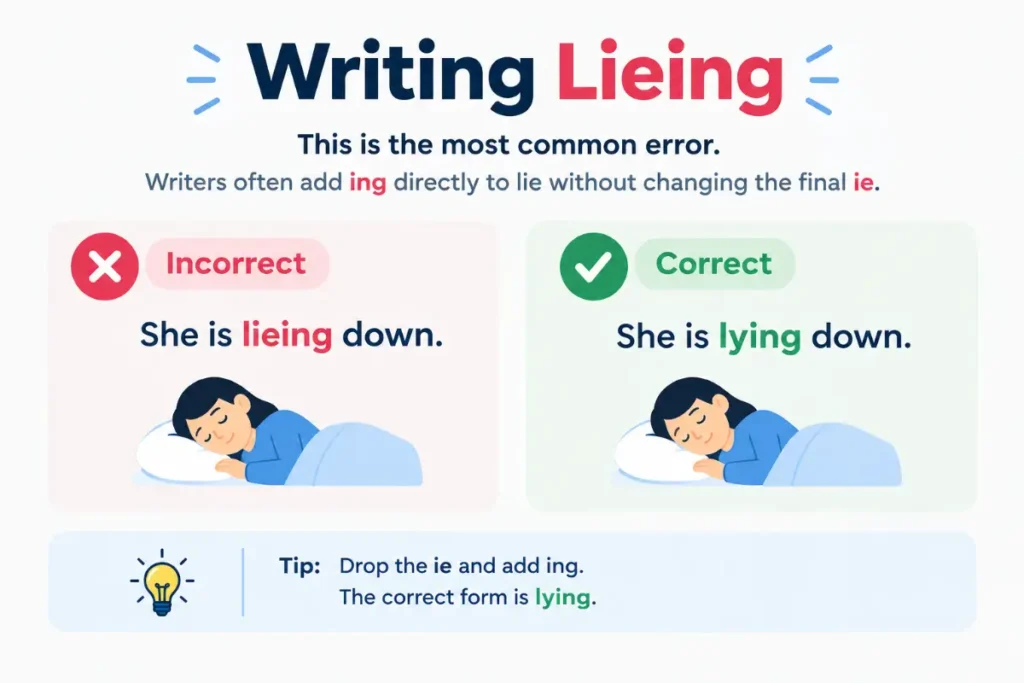
This is the most common error. Writers often add ing directly to lie without changing the final ie.
Incorrect:
She is lieing down.
Correct:
She is lying down.
The mistake makes sense from a simple letter by letter perspective, but English uses a different spelling pattern.
Confusing Lying With Laying
Lying and laying come from different verbs.
Lying comes from lie.
Laying comes from lay.
Compare:
I am lying on the bed.
I am laying the clothes on the bed.
The first describes the position of the person. The second describes someone placing something somewhere.
This distinction causes many grammar errors because the words sound similar in some forms.
Confusing Lie With Lay
Lie means to recline or rest.
Lay means to put or place something.
You lie down.
You lay something down.
For example:
I need to lie down.
I need to lay the book down.
The object helps you identify the verb. Lay normally takes an object when it means place.
Forgetting The Meaning Of Lying
Lying can refer to physical position or dishonesty.
The cat is lying on the floor.
The student is lying about the missing homework.
Context determines the intended meaning.
Using The Wrong Past Forms
Lie has an irregular past form when it means recline.
Present:
I lie down.
Past:
I lay down.
Past participle:
I have lain down.
Present participle:
I am lying down.
That sequence is worth learning because it prevents several common errors at once.
Pronunciation Guide
Lying is commonly pronounced /ˈlaɪ.ɪŋ/.
A simple pronunciation guide is:
LYE ing.
It normally has two syllables:
LYE + ing
The main stress falls on the first syllable.
The first part sounds like the word lie. The second part is the familiar ing ending.
The pronunciation does not contain a sound that tells you to spell the word with y. This is one reason learners can easily write lieing when spelling from sound.
Compare:
lie → one syllable.
lying → two syllables.
The extra syllable comes from the ing ending.
Do not pronounce it as if the spelling were lee ing. The first part should sound like lie.
A useful practice method is to say the word slowly:
lie … ing
Then blend the sounds:
lying
Once the pronunciation feels natural, connect it with the spelling pattern lie to lying.
Etymology And Word Origin
The word lying comes from the verb lie.
English actually has more than one verb spelled lie, and this creates an interesting historical distinction.
The lie that means to recline or rest has Old English roots. It developed from an old Germanic verb connected with remaining in a resting or horizontal position.
The lie that means to tell an untruth has a different historical background. It is also an old English verb but developed from a separate Germanic root associated with falsehood or deception.
Modern English uses the same spelling for both verbs even though their historical origins differ.
The present participle of both is written lying.
This historical detail explains why the word can have two very different meanings while looking exactly the same.
The spelling rule itself is much more practical for everyday writing. Remember that verbs ending in ie often change ie to y before ing.
That gives you:
lie → lying.
die → dying.
tie → tying.
Still confused? Compare emersion vs immersion: Correct Meaning and Usage.
Regional Usage
American English
American English uses lying as the standard present participle of lie. The form appears naturally in conversation, journalism, education, business writing, fiction, and formal documents.
The misspelling lieing may appear in informal digital writing, but it is not the standard American spelling.
American English also maintains the distinction between lie and lay in careful writing.
British English
British English uses lying in the same way. There is no meaningful spelling difference between standard American and British English for this form.
British writers also distinguish lie from lay and use lying for the present participle of lie.
Australian English
Australian English follows the same standard spelling pattern.
Lying is the accepted form, while lieing is treated as a spelling mistake.
The same ie to y pattern applies to related words such as dying and tying.
Canadian English
Canadian English also uses lying as the standard form.
There is no major regional variation that makes lieing acceptable as the standard present participle.
For general English writing across these varieties, lying is the safe and correct choice.
Grammar Rules And Part Of Speech
Lying is a present participle.
A present participle commonly combines with forms of be to create continuous verb forms.
For example:
I am lying down.
She is lying on the floor.
They were lying in the grass.
He has been lying about the problem.
In these examples, lying forms part of a verb phrase.
Lying can also function as a gerund.
Lying to your parents can create serious problems.
Here lying acts as the subject of the sentence. It names the activity itself.
This distinction is useful because the same ing form can perform different grammatical jobs.
The spelling remains the same in both cases.
Lying For Physical Position
When lie means to rest or remain in a horizontal position, lying describes that action.
The child is lying on the bed.
The books are lying on the floor.
The dog was lying beside the door.
The word does not require a direct object in this sense.
Lying For Dishonesty
When lie means to make a false statement, lying describes the act of being dishonest.
He is lying to his parents.
She admitted to lying.
They were lying about the results.
In this meaning, the verb can take a prepositional phrase such as lying to someone or lying about something.
Lying At The Beginning Of A Sentence
It can start a sentence when it functions as a gerund.
Lying to your friends can destroy trust.
Lying about the facts won’t solve the problem.
The form does not need special punctuation simply because it begins the sentence.
Lie Down And Lying Down
One common phrase is lie down.
Lie down means to move into or remain in a horizontal resting position.
For example:
I need to lie down.
When the action is already happening, use lying down.
I am lying down.
This distinction is important because speakers sometimes use laying down incorrectly.
Incorrect:
I am laying down.
Correct:
I am lying down.
However, laying can be correct when you are placing something.
I am laying the baby down.
Here the speaker is putting the baby in a particular position. The verb lay has an object, baby.
This is one of the most useful ways to separate the two verbs.
Lying About Something
When lying means telling an untruth, English commonly uses the preposition about to identify the subject of the false statement.
She is lying about her experience.
He was lying about the missing money.
They accused him of lying about the event.
You can also use to when identifying the person who receives the lie.
She was lying to her parents.
He lied to his manager.
A sentence can contain both.
He was lying to his manager about the missing report.
Here to identifies the person being deceived, while about identifies the subject of the false statement.
Real Life Usage Examples
Daily Conversation
I’m tired, so I’m lying on the couch for a while.
The dog is lying by the front door waiting for you.
These are natural everyday uses describing physical position.
Workplace Communication
The employee admitted to lying about the missing documents.
The files were lying on the manager’s desk.
The first example uses the dishonesty meaning. The second uses the position meaning.
Academic Writing
The evidence suggests that the subject was lying about the reported sequence of events.
The samples were lying on a temperature controlled surface before testing.
Academic writing can use both meanings, although the exact wording depends on the field.
News Writing
The injured passenger was lying near the roadside when emergency workers arrived.
Officials said the suspect had been lying about his identity.
News writing often uses the word in both physical and factual contexts.
Literature And Storytelling
She was lying beneath the old tree, watching the clouds move across the sky.
He knew the stranger was lying, but he said nothing.
In storytelling, the two meanings can create useful contrast because the physical and figurative senses are both familiar.
Related And Confused Terms
Lie
Lie can mean to rest in a particular position or to tell an untruth. Its meaning comes from context.
Lay
Lay means to put or place something somewhere. It normally takes an object in its basic present tense use.
Lain
Lain is the past participle of lie when lie means recline or rest.
I have lain in bed all morning.
Laid
Laid is the past tense and past participle of lay.
She laid the book on the table.
Lying Down
Lying down describes the act of resting in a horizontal position.
I am lying down.
Telling A Lie
This phrase describes making a false statement.
He was telling a lie.
Deceiving
Deceiving means deliberately causing someone to believe something untrue. It is broader than lying because deception can occur without words.
Misleading
Misleading means giving someone information or creating an impression that causes them to understand something incorrectly. A person can mislead someone without making a direct false statement.
These related terms help show that lying belongs to a larger group of words connected with position, truth, deception, and communication.
Why Lieing Looks Tempting
The incorrect spelling looks logical because English often forms present participles by adding ing directly to the base verb.
For example:
play → playing.
read → reading.
jump → jumping.
So a learner may naturally think:
lie → lieing.
The problem is that lie belongs to a spelling pattern that changes before ing is added.
This is similar to:
tie → tying.
die → dying.
The change is not based on pronunciation. It is a spelling convention.
Another reason for the confusion is that the final e in lie is easy to notice. A learner may know that many verbs drop final e before ing but may not remember what happens when the word ends in ie.
The result is a predictable spelling error.
The best solution is not simply memorizing one isolated word. Learn the pattern.
ie becomes y before ing.
Once you know that pattern, several words become easier at the same time.
How To Remember The Spelling
A short memory trick can save you from this mistake.
Think:
lie becomes lying.
Then connect it with:
die becomes dying.
tie becomes tying.
All three follow the same useful spelling pattern.
You can also remember that English does not normally leave the sequence ie directly before ing in these words.
So when you see:
lie + ing
do not write the letters exactly as they appear.
Change ie to y first.
Then add ing.
That produces:
lying
This method is more reliable than trying to remember the spelling visually each time.
Lieing In Digital Writing
You may encounter lieing in text messages, comments, social media posts, search queries, student drafts, and other informal digital spaces.
People often type quickly and rely on sound. Because lying sounds like lie plus an ing ending, the incorrect spelling can seem reasonable.
Spellcheckers usually identify the form because standard dictionaries recognize lying as the correct present participle.
Still, automatic correction should not replace understanding the rule. If you know why the spelling changes, you can apply the same principle to other words.
This is particularly useful when writing without spellcheck or when reviewing someone else’s work.
Expert Editor Insight
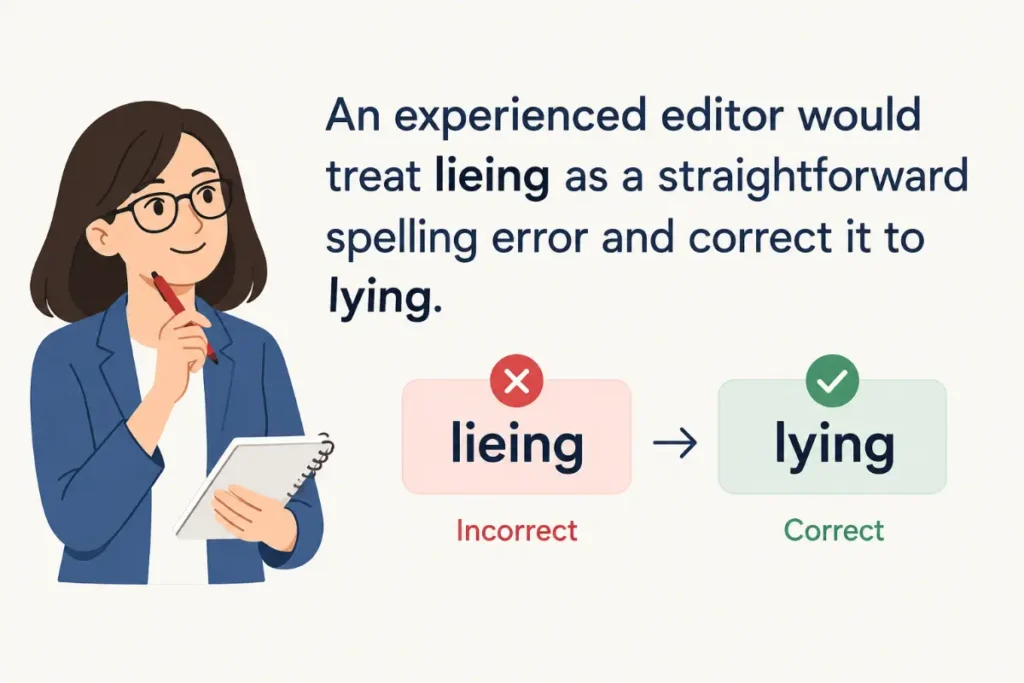
An experienced editor would treat lieing as a straightforward spelling error and correct it to lying. The confusion is understandable because writers often apply the basic rule of adding ing directly to a verb. The better editing habit is to check verbs ending in ie before adding ing. If the base form is lie, die, or tie, change ie to y first. Grammar tools may catch the error, but understanding the pattern lets you catch it yourself and avoid similar mistakes.
A related grammar guide is signalling or signaling Which Spelling Is Correct.
Conclusion
lieing or lying has a clear answer. Lying is the correct spelling, while lieing is a common spelling error. The correct form comes from the verb lie and follows the English spelling pattern that changes final ie to y before the ing ending. This gives us lie becoming lying.
The word can describe someone resting in a horizontal position or someone telling an untruth. It also appears as a present participle and as a gerund, so you’ll see it in many different sentence structures. The related forms lie, lay, lain, and laying can create additional confusion, but each has its own grammatical role.
The easiest memory trick is to connect lying with dying and tying. All three change ie to y before ing. Once you remember that pattern, you can avoid lieing and apply the same rule to other English words.
FAQs
Is lieing a correct spelling?
No. Lieing is not the standard spelling of the present participle of lie. The correct form is lying. English changes the final ie in lie to y before adding ing. This gives us lying. The same spelling pattern appears in words such as dying and tying, which can help you remember the rule.
Why is lying spelled with a y?
Lying is spelled with a y because verbs ending in ie commonly change that ending to y before the ing suffix is added. The base form is lie. Change ie to y and then add ing. The result is lying. This spelling pattern also appears in die becoming dying and tie becoming tying.
What does lying mean?
Lying has two main meanings. It can describe being in a resting or horizontal position, as in She is lying on the bed. It can also mean telling an untruth, as in He is lying about what happened. Context makes the intended meaning clear. The spelling is the same for both meanings.
Is lying a verb or an adjective?
Lying is primarily the present participle of the verb lie, but it can also function as a gerund when the ing form acts like a noun. In some contexts it can also function adjectivally. For example, in She is lying down, it forms part of the verb phrase. In Lying can damage trust, it functions as a gerund.
What is the difference between lying and laying?
Lying comes from lie and usually means resting or remaining in a position, or telling an untruth. Laying comes from lay and means putting or placing something. You can say I am lying on the bed, but I am laying the book on the bed. The presence of a direct object often helps identify the difference.
How do you pronounce lying?
Lying is commonly pronounced /ˈlaɪ.ɪŋ/. A simple pronunciation guide is LYE ing. It has two syllables with the main stress on the first. The first part sounds like lie. The second part is the familiar ing sound. The spelling with y does not create a new vowel sound in the first syllable.
Can lying refer to telling an untruth?
Yes. Lying commonly refers to the act of telling something that is not true. For example, He is lying about his whereabouts means he is giving false information. The word can also mean resting in a horizontal position. These two meanings come from separate historical senses of the verb lie but share the same modern spelling.
Is lying appropriate in formal writing?
Yes. Lying is a standard English word and is appropriate in formal and informal writing. You can use it in academic papers, reports, professional communication, journalism, and everyday conversation. The important point is to use the correct spelling. Lieing is nonstandard, so it should be corrected to lying in polished writing.