
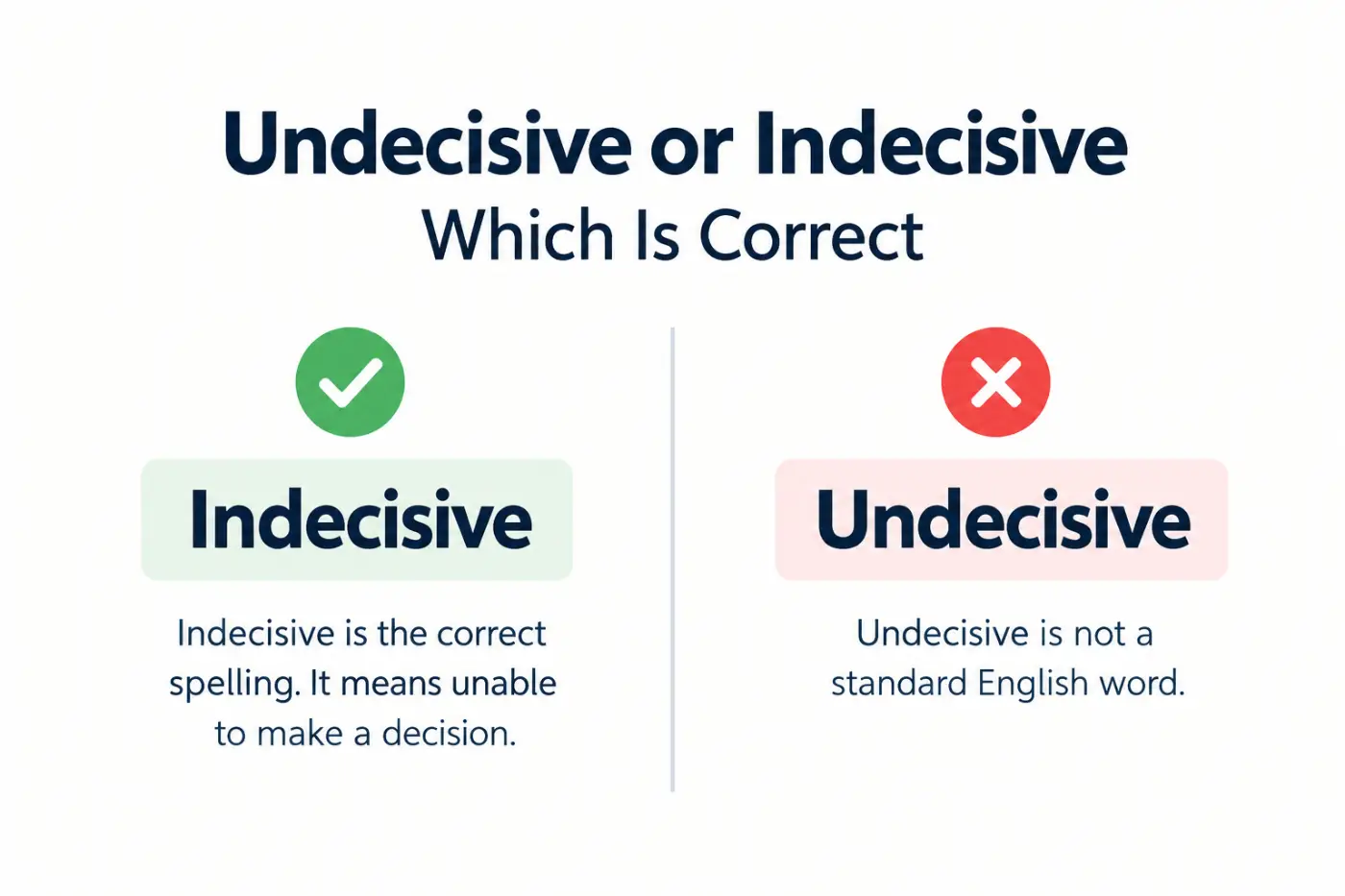
If you are wondering about undecisive or indecisive, the safest answer is simple. Use indecisive in normal modern English. It describes a person who has trouble making decisions and can also describe something that is inconclusive or fails to produce a clear result. Cambridge and Oxford both list it as a standard adjective.
The confusion comes from the way English forms negative words. Since un can mean not, it may seem perfectly natural to build undecisive from decisive. In fact, that form has appeared in English and is still recorded as a rare alternative. However, the established modern form is indecisive, built with the prefix in before decisive.
That small difference matters if you are writing an email, school paper, report, article, or other polished English. This guide explains why the preferred form is used, what the word means, how to pronounce it, how it works in a sentence, and why the less common form can still appear from time to time.
Need another quick comparison? Read genious or genius Correct Spelling Meaning And Usage.
Quick Answer
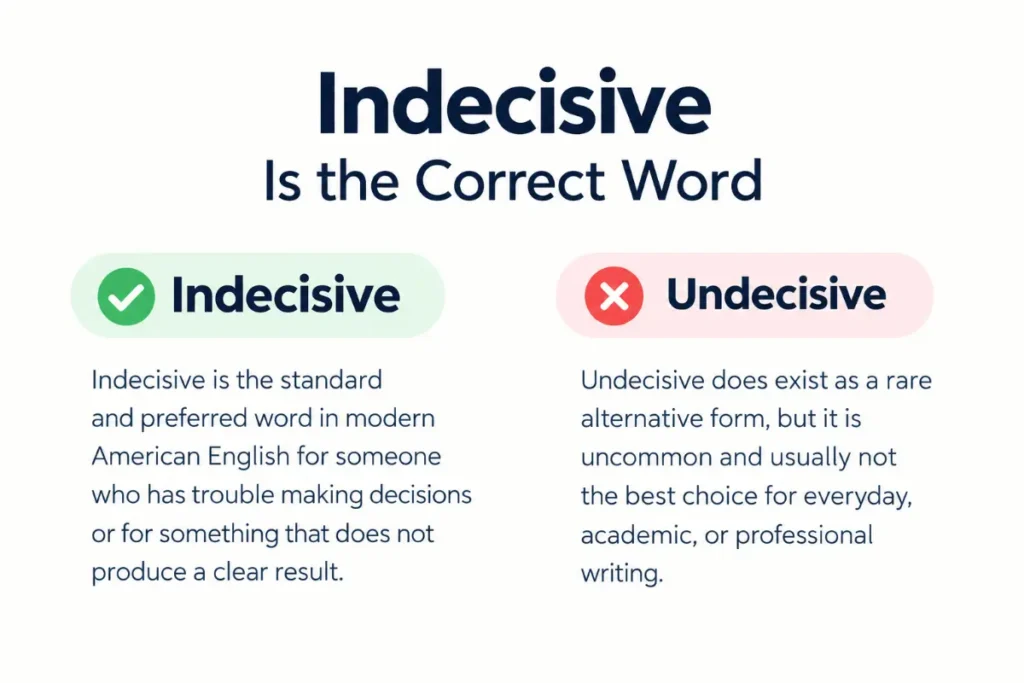
Indecisive is the standard and preferred word in modern American English for someone who has trouble making decisions or for something that does not produce a clear result. Undecisive does exist as a rare alternative form, but it is uncommon and usually not the best choice for everyday, academic, or professional writing.
What Is The Correct Word
The standard word you should choose is indecisive.
It is an adjective connected with the noun decision and the adjective decisive. It can describe a person who struggles to make a decision or an outcome that is not clear or final. Oxford gives both of these meanings and lists indecisive as the opposite of decisive.
For example:
- Maria is indecisive when she has too many options.
- The committee reached an indecisive result.
- He seemed indecisive during the meeting.
- The battle produced an indecisive outcome.
The first three examples focus on difficulty making a decision. The last example uses the word in another established sense. The outcome did not clearly settle the matter.
Undecisive is not simply a made up spelling. Collins records it as a British English adjective meaning indecisive. Historical evidence also shows that the form has existed for centuries. Still, it is rare in current usage, so it is not the form most writers should reach for.
Comparison Table
| Form | Meaning | Part of Speech | Origin | Usage Frequency | Formality | Common Contexts | Example |
|---|---|---|---|---|---|---|---|
| Indecisive | Unable or unwilling to make a clear decision or not producing a definite result | Adjective | Formed with in plus decisive | Common and established | Standard | Everyday speech, work, school, formal writing | She is indecisive about which option to choose. |
| Undecisive | A rare alternative form meaning indecisive | Adjective | Formed with un plus decisive | Rare | Uncommon | Older or unusual usage | The result was described as undecisive. |
The table shows an important point. The two forms are not perfectly equal in modern usage. Indecisive is the familiar standard choice for contemporary English. Undecisive has a documented history, but its rarity makes it a poor choice when you want clear and conventional wording.
What Indecisive Means
Indecisive is an adjective with two closely related uses.
The first describes a person who has difficulty making decisions.
For example:
- I am indecisive when I have too many choices.
- She was indecisive about which college to attend.
- The manager seemed indecisive during the discussion.
In this sense, the word suggests hesitation, uncertainty, or difficulty settling on one option.
The second use describes something that does not provide a clear or final result.
For example:
- The vote was indecisive.
- The evidence was indecisive.
- The battle ended in an indecisive result.
This meaning is close to inconclusive. The event or evidence does not settle the issue clearly.
Cambridge gives both major meanings. It defines the word in relation to difficulty making decisions and also describes it as something that does not have a clear meaning or produce a decision.
What Undecisive Means
Undecisive is a real but rare adjective.
Collins records it as an alternative form of indecisive. Wiktionary also identifies it as a rare alternative form and traces it to un plus decisive.
That means calling it an absolute spelling error would be too strong.
Still, there is a big difference between being a possible English word and being the word most people should use.
Modern readers are far more familiar with indecisive. Standard dictionaries such as Cambridge and Oxford prominently recognize indecisive as the established adjective for this meaning.
If you write undecisive in a normal American English sentence, some readers may think you made a spelling mistake. A grammar checker may also suggest indecisive. For clear professional writing, choosing the familiar form is the better decision.
Why The Confusion Happens
The confusion makes sense once you look at English word formation.
English has several negative prefixes. Un is extremely common.
We have words such as:
- unhappy.
- uncertain.
- unfair.
- unclear.
- unsuccessful.
Because decisive means able to make decisions or producing a clear result, a writer might naturally think that un plus decisive should give undecisive.
There is another pattern at work too. English uses in to create many negative adjectives.
Examples include:
- inaccurate.
- incomplete.
- indirect.
- ineffective.
- invisible.
- impatient.
- indecisive.
The spelling of a negative word cannot always be predicted by one simple rule. English has developed through many different language influences, so prefixes do not behave like pieces in a mathematical formula.
That is why a word can look logical and still not be the usual modern choice.
The Difference In Spelling
The spelling difference is only two letters, but it changes the form you should choose.
The preferred modern form is:
indecisive
The rare alternative is:
undecisive
The beginning of the standard word is in rather than un.
A useful visual comparison is:
- decide.
- decisive.
- indecisive.
- indecision.
The word family around decide strongly supports the form that most readers already know.
Notice the related noun indecision. It means a lack of ability or willingness to make a decision.
For example:
She couldn’t hide her indecision.
From the same family, indecisively is an adverb.
For example:
He answered indecisively.
Indecisiveness is a noun describing the quality or condition of having trouble making decisions.
For example:
Her indecisiveness delayed the project.
These related forms make the standard spelling easier to remember.
Which Form Should You Use
Use indecisive in almost all ordinary modern writing.
That includes:
- School assignments.
- College papers.
- Business emails.
- Reports.
- Websites.
- News writing.
- Personal messages.
- Professional documents.
- Academic writing.
- Everyday conversation.
You might encounter undecisive in older writing, specialized discussions, historical texts, or dictionaries that record rare alternatives. That does not make it the preferred form for current general English.
The practical rule is simple.
If you need the normal adjective meaning unable to make a decision, choose indecisive.
If you are editing a sentence for a broad modern audience, indecisive is almost always the clearer choice.
Grammar And Part Of Speech
Indecisive is an adjective.
That means it can describe a noun or follow a linking verb.
Here are several common patterns.
Before A Noun
The adjective can come directly before a noun.
For example:
She is an indecisive manager.
The word describes the manager.
You can use the same structure with other nouns.
- An indecisive student.
- An indecisive leader.
- An indecisive customer.
- An indecisive response.
- An indecisive policy.
- An indecisive result.
After A Linking Verb
The adjective can also follow verbs such as be, seem, become, or appear.
For example:
He became indecisive after hearing the new information.
She seems indecisive today.
The committee was indecisive about the final proposal.
The word still describes the subject.
With About
A common pattern is adjective plus about.
For example:
She is indecisive about her career choice.
He was indecisive about which apartment to rent.
I am indecisive about what to order.
This pattern is especially common when someone is struggling to choose between options.
With When
You can also use the adjective in situations involving a particular time or circumstance.
For example:
I become indecisive when I have too many options.
He gets indecisive when people pressure him to choose quickly.
This structure focuses on the situation that causes hesitation.
Sentence Examples
Here are ten natural examples showing how the preferred form works in different settings.
- Everyday conversation: I get indecisive when a restaurant has a huge menu.
This describes a person’s difficulty choosing what to order.
- Text message: Sorry for taking so long to answer. I was being indecisive about where to go.
The speaker is explaining a delay caused by hesitation.
- Work: The manager seemed indecisive during the budget meeting.
The word describes the manager’s difficulty reaching a decision.
- School: The student was indecisive about which research topic to choose.
The sentence describes uncertainty between several possible topics.
- Academic writing: An indecisive policy can make it difficult for an organization to respond to a crisis.
Here the adjective describes a policy that lacks a clear direction.
- Formal writing: The committee reached an indecisive conclusion after several hours of discussion.
The result did not settle the issue clearly.
- Social situation: She looked indecisive when her friends asked her to choose the movie.
The word describes hesitation between choices.
- Online communication: I know I need to pick one, but I am so indecisive right now.
The speaker uses the word casually to describe personal hesitation.
- Leadership: An indecisive leader may delay an important decision.
The adjective describes a leadership style marked by difficulty making decisions.
- News style: The first vote produced an indecisive result, so another vote was needed.
Here the word means the result did not clearly settle the matter.
These examples show that the adjective is not limited to people. It can describe decisions, policies, results, contests, battles, evidence, and other things that fail to produce a clear conclusion.
Common Mistakes
Several mistakes can lead writers away from the preferred spelling.
Mistake One
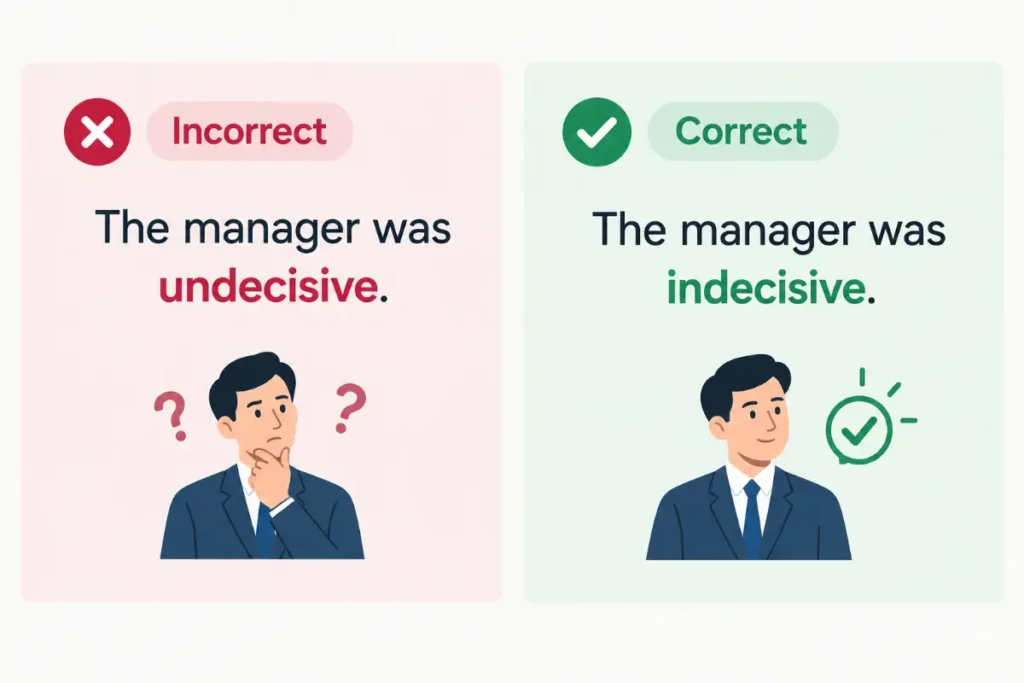
Incorrect for standard modern usage: The manager was undecisive.
Preferred: The manager was indecisive.
The first form exists as a rare alternative, but the second is the established choice most readers expect.
Mistake Two
Incorrect: She couldn’t decide because she was indecisive about the options.
This sentence is grammatically possible, but the phrase can sometimes become repetitive if the surrounding sentence already explains the hesitation.
A cleaner version may be:
She couldn’t decide which option to choose.
The lesson is not that indecisive is wrong. It is that precise writing does not need to repeat an idea.
Mistake Three
Incorrect: He acted indecision during the meeting.
Correct: He acted indecisively during the meeting.
Indecision is a noun. Indecisive is an adjective. Indecisively is the adverb.
Mistake Four
Incorrect: Her indecisive caused delays.
Correct: Her indecisiveness caused delays.
The noun form is needed because the sentence requires the name of a quality or condition.
Mistake Five
Incorrect: The team made an indecisively choice.
Correct: The team made an indecisive choice.
An adjective modifies a noun. An adverb modifies a verb, adjective, or another adverb.
Pronunciation Guide
Indecisive has four syllables.
The standard American pronunciation is represented in the International Phonetic Alphabet as /ˌɪn.dɪˈsaɪ.sɪv/. Cambridge gives the same basic pronunciation for American and British English.
The main stress falls on the third syllable.
A useful way to hear the rhythm is to notice that the middle part containing the long i sound receives the strongest emphasis.
The related noun indecision has a similar rhythm, while indecisiveness adds another syllable at the end.
One common pronunciation problem comes from trying to read every letter too carefully. English spelling does not always tell you exactly how each sound should be produced. Listening to the word and learning its stress pattern is more useful than sounding it out letter by letter.
The rare form undecisive has a different first vowel because it begins with un rather than in. That difference is another reason readers can immediately notice the two forms.
Etymology And Word Origin
Indecisive comes from decisive with the negative prefix in. Collins gives its word origin as dating to the early eighteenth century and identifies the structure as in plus decisive.
The base word decisive comes from decide, which ultimately traces back through French to Latin roots connected with cutting off or settling a matter. The basic idea fits the modern meaning nicely. To decide is to settle on a choice. Something decisive settles an issue clearly. Something indecisive does not.
The rare form undecisive has a different prefix. It is formed with un plus decisive and has a much longer documented history. Wiktionary records an example from a seventeenth century work and identifies the form as rare. Collins also records it as an alternative form of indecisive.
So the story is more interesting than saying one spelling was simply invented and the other was correct. Both forms have existed, but modern usage strongly favors indecisive for ordinary writing.
Need another quick comparison? Read excel vs accel Which One Should You Use in 2026.
Regional Usage
American English
Indecisive is the standard form used in American English. Major American English dictionary sources list it as an adjective meaning unable to make decisions or not producing a clear result.
Undecisive is much less familiar to American readers. It can be understood, but it may look like a spelling mistake in ordinary American writing.
For a US audience, use indecisive.
British English
Indecisive is also standard British English. Oxford and Cambridge both list it as a normal adjective.
British English also has evidence for undecisive as a rare form. Collins lists it in British English as an alternative meaning indecisive.
That does not mean British writers commonly prefer it. It remains an uncommon choice.
Canadian English
There is no major spelling distinction that requires Canadian writers to switch from indecisive to undecisive. The standard choice remains indecisive.
Australian English
Indecisive is the ordinary form in Australian English as well. There is no practical reason for general Australian writing to prefer the rare alternative.
The broad regional picture is therefore simple. English varieties may record the rare form, but indecisive is the form that gives you the clearest and safest result across modern English.
Real Life Usage
The word appears in many settings because difficulty making decisions is a common idea.
Daily Conversation
- I was indecisive about what to eat, so my friend chose for me.
- He gets indecisive whenever there are too many choices.
These sentences sound natural in everyday speech.
Workplace Communication
- The team needs a clear plan rather than indecisive leadership.
- The manager’s indecisive response left employees unsure about the next step.
In workplace writing, the word can describe behavior, leadership, decisions, or policies.
Academic Writing
- The study found that an indecisive response did not resolve the question.
- The committee’s indecisive conclusion left room for further research.
Academic writing often uses the second meaning, where something fails to provide a definite result.
News Writing
- The vote ended with an indecisive result.
- The first round produced an indecisive outcome, so another round followed.
News writers often use the adjective when a contest, vote, or political process does not settle an issue.
Storytelling
- He stood by the door, indecisive about leaving.
- She gave him an indecisive look before choosing the smaller box.
In storytelling, the word can quickly show hesitation without requiring a long explanation.
Related Words And Expressions
Understanding related vocabulary can help you choose the right word with more confidence.
Decisive
Decisive is the opposite of indecisive in many contexts. It describes someone who makes decisions confidently or something that settles an issue.
Example:
She is a decisive manager who acts quickly when problems arise.
Indecision
Indecision is a noun meaning difficulty or inability to make a decision.
Example:
His indecision delayed the project.
Indecisiveness
Indecisiveness is also a noun. It refers to the quality or state of being unable to decide.
Example:
Her indecisiveness frustrated the team.
Indecisively
Indecisively is an adverb.
Example:
He answered indecisively when asked about the plan.
Decisively
Decisively is the adverb related to decisive.
Example:
The manager acted decisively after reviewing the evidence.
Hesitant
Hesitant describes someone who pauses or shows uncertainty before acting.
Example:
She was hesitant to accept the offer.
Hesitant can be close in meaning to indecisive, but it does not always suggest an ongoing inability to choose.
Uncertain
Uncertain means not sure or not known.
Example:
I am uncertain about the best option.
Someone can be uncertain without being generally indecisive.
Wavering
Wavering describes moving back and forth between choices or positions.
Example:
His wavering made it difficult for the team to know what he wanted.
Wavering can suggest repeated changes of mind.
Indecisive Versus Undecided
Both words are related but not identical.
Indecisive often describes a person’s tendency or behavior.
For example:
She is indecisive.
This suggests that difficulty making decisions is a characteristic of her behavior.
Undecided usually describes a current state.
For example:
She is undecided about which job to accept.
This tells us that she has not chosen yet.
A person can be undecided about one choice without being generally indecisive.
That distinction is useful.
Someone might say:
I am undecided about dinner.
That does not necessarily mean:
I am an indecisive person.
The first describes one unresolved choice. The second describes a broader tendency.
Indecisive Versus Hesitant
These words overlap, but they focus on different ideas.
Hesitant often describes a pause before an action.
Indecisive focuses more directly on difficulty choosing or settling a decision.
For example:
He was hesitant to sign the contract.
This suggests that he had concerns about taking the action.
He was indecisive about signing the contract.
This emphasizes difficulty choosing whether to sign.
The difference is small in some sentences, but the emphasis changes.
Indecisive Versus Inconclusive
These words are especially easy to confuse because both can describe results.
Indecisive can describe a result that does not settle an issue.
Inconclusive more directly means that evidence, testing, discussion, or a result does not provide a definite answer.
For example:
The evidence was inconclusive.
The election produced an indecisive result.
Both sentences communicate uncertainty, but they use different patterns.
When describing a person’s difficulty choosing, indecisive is the natural word.
You would not normally say:
She is inconclusive.
You would say:
She is indecisive.
Can The Word Describe Things Besides People
Yes.
Many readers first learn the word as a description of people, but dictionaries also recognize a second meaning involving results or outcomes.
Cambridge describes it as something that does not have a clear meaning or produce a decision. Oxford gives the example of an indecisive battle.
That gives you two major patterns.
A Person
He is indecisive about his career.
The person has difficulty choosing.
A Result
The vote was indecisive.
The result did not clearly settle the issue.
This distinction is useful because a sentence can sound strange if you assume the word only describes people.
Formal And Informal Usage
Indecisive works in both casual and formal English.
In conversation, you might say:
I am so indecisive about what to wear.
In professional writing, you might say:
The committee’s indecisive response created uncertainty among employees.
The word itself is not informal slang. It is a standard adjective suitable for serious writing.
However, context matters. Calling a person indecisive can sound critical because the word often suggests a weakness in decision making.
Compare these sentences:
She is indecisive about which color to choose.
She is indecisive in her leadership role.
The first is mild. The second can sound strongly negative because leadership usually requires clear decisions.
Professional writers should therefore consider the tone of the sentence, not just its grammar.
Is The Word Always Negative
Not necessarily.
Indecisive often carries a negative suggestion when it describes a person’s behavior. Someone who takes too long to choose may be seen as uncertain or ineffective.
Still, the word can be neutral when describing an outcome.
For example:
The first round of voting was indecisive.
This sentence does not criticize anyone’s personality. It simply says that the result did not settle the matter.
The surrounding context determines the tone.
Expert Editor Insight
An experienced editor would normally change undecisive to indecisive in contemporary general writing unless the unusual form is intentional or appears in a historical quotation. The reason is practical rather than mysterious. Readers expect the established form, dictionaries prominently recognize it, and the related words indecision and indecisiveness reinforce the same spelling pattern. The rare alternative may be technically defensible in specific contexts, but clear writing usually favors the form that readers recognize immediately.
A Simple Memory Trick
The easiest memory trick is to connect the word with indecision.
Think of the family this way:
- Decide.
- Decision.
- Decisive.
- Indecision.
- Indecisive.
- Indecisiveness.
The same in beginning appears in the standard negative forms.
You can also remember the meaning through a simple contrast.
Decisive means ready to settle the choice.
Indecisive means struggling to settle the choice.
That contrast is more useful than memorizing a spelling rule.
If you are writing quickly and hesitate over the spelling, think of the noun indecision. That will usually lead you back to the preferred adjective.
Final Usage Check
Before you submit a sentence, ask yourself three questions.
- Am I describing someone who has trouble making a decision?
- Am I describing something that does not produce a clear result?
- Do I need the standard modern word that most readers will recognize immediately?
If the answer to any of these questions is yes, indecisive is the form to choose.
For example:
She was indecisive about the offer.
The result was indecisive.
His indecisiveness caused delays.
He responded indecisively.
These forms work together as a clear word family.
Key Takeaways
- Indecisive is the standard modern form.
- Undecisive exists, but it is rare.
- Use indecisive in normal American English.
- Indecisive is an adjective.
- It can describe a person who struggles to make decisions.
- It can also describe an outcome that is unclear or inconclusive.
- Indecision and indecisiveness are related noun forms.
- Indecisively is the related adverb.
- Indecisive is appropriate in both informal and formal writing.
- If you are editing for a broad modern audience, choose the familiar form.
Need another quick comparison? Read Sentence Or Sentance 2026 Which Spelling Is Correct?.
Conclusion
The answer to undecisive or indecisive is straightforward for most modern writing. Choose indecisive. It is the established standard adjective for someone who has difficulty making decisions and for results that fail to settle an issue clearly. Major dictionaries such as Cambridge and Oxford recognize it as the normal form.
Undecisive is not completely imaginary. It has a documented history and is recorded as a rare alternative, particularly in British English sources. Still, its limited use means it can look unusual or incorrect to modern readers. That makes it a poor choice for most everyday, academic, and professional writing.
For an easy editing rule, connect indecisive with indecision. If someone struggles to choose or an outcome fails to settle an issue, indecisive is the form to use. Once you remember that word family, the spelling becomes much easier to get right.
FAQs
Is undecisive a real word?
Yes. Undecisive is recorded as a rare alternative form of indecisive. Collins lists it as a British English adjective meaning indecisive, while other references describe it as rare. It has a documented history, so calling it completely nonexistent would be inaccurate. Still, indecisive is the normal choice for modern general writing.
Which is correct undecisive or indecisive?
Indecisive is the standard and preferred form in modern English. Use it for a person who has trouble making decisions or for something that does not produce a clear result. Undecisive exists as a rare alternative, but most readers will expect indecisive.
Is undecisive a misspelling?
Not exactly. It can be found as a rare English word and is listed by Collins as an alternative form. However, many modern readers may interpret it as a spelling mistake because indecisive is much more familiar. For clear American English, use indecisive.
What does indecisive mean?
Indecisive describes someone who has difficulty making decisions. It can also describe something that does not produce a clear or definite result. For example, an indecisive person may struggle to choose a restaurant, while an indecisive result may fail to settle a contest or vote.
How do you pronounce indecisive?
In standard American English, indecisive is pronounced with four syllables and the strongest stress on the third syllable. The International Phonetic Alphabet representation is /ˌɪn.dɪˈsaɪ.sɪv/. The word has a long i sound in the stressed syllable.
What is the noun form of indecisive?
The main noun forms are indecision and indecisiveness. Indecision refers to difficulty making a decision, while indecisiveness refers to the quality or condition of being unable to decide. For example, you can say that someone’s indecision delayed a choice or that their indecisiveness caused repeated delays.
Is indecisive appropriate for formal writing?
Yes. Indecisive is a standard English adjective and is appropriate for formal writing. It appears in professional, academic, journalistic, and everyday contexts. The word can sound critical when used to describe a person’s leadership or behavior, so writers should consider the tone and context.
What is a synonym for indecisive?
Useful synonyms include hesitant, uncertain, wavering, undecided, and vacillating. They are not exact substitutes in every sentence. Hesitant often emphasizes reluctance, undecided describes an unresolved choice, and wavering can suggest movement between different positions or choices.