
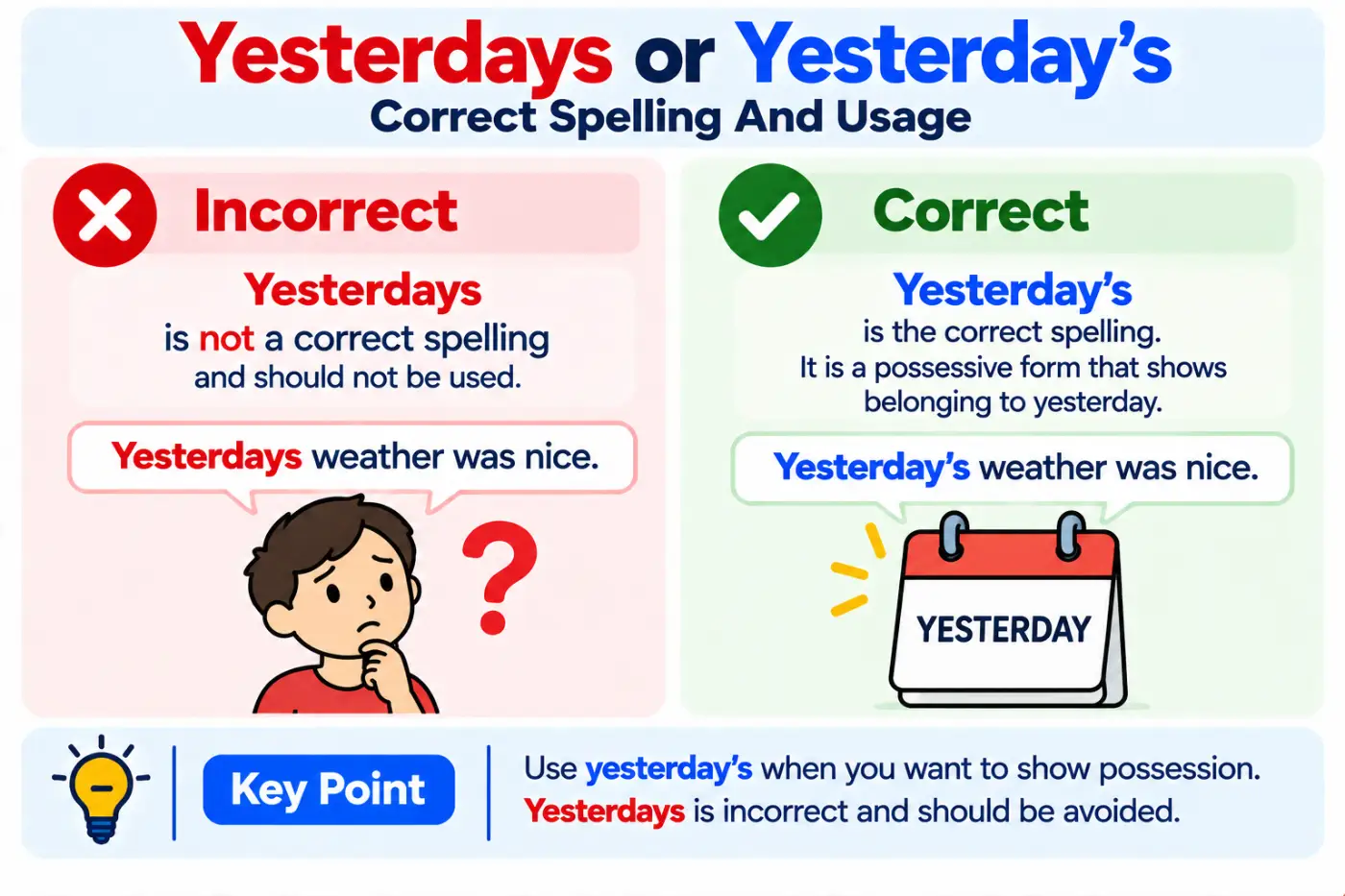
yesterdays or yesterday’s is a common grammar question because the two forms look almost identical but they do not serve the same purpose. Yesterday’s is the standard form when you need the possessive form of yesterday. Yesterdays can be grammatically possible in a very different context but it is uncommon because yesterday normally refers to one specific day.
The confusion usually comes from the apostrophe. Many writers know that possessive words often use an apostrophe but may not realize that yesterday can act as a possessive modifier. For example you can write yesterday’s meeting because the meeting is associated with yesterday. You can also write yesterday’s news or yesterday’s weather. The apostrophe tells the reader that the phrase refers to something connected with the previous day.
This guide explains the difference between the two forms in plain English. You’ll learn the grammar rule the role of the apostrophe pronunciation sentence structure common mistakes regional usage and practical examples. You’ll also see when yesterdays can technically appear and why yesterday’s is almost always the form you need in everyday writing.
You may also want to read Distress Vs Duress Which Word Fits Your Sentence 2026.
Quick Definition
Yesterday’s is the standard possessive form of yesterday and means belonging to or associated with yesterday. For example yesterday’s meeting means the meeting that took place yesterday. Yesterdays without an apostrophe is rarely needed because yesterday normally names one specific day. It may appear only when yesterday is treated as a plural noun in a special context.

Quick Answer
Use yesterday’s when you mean something connected with yesterday.
For example:
I read yesterday’s newspaper.
The apostrophe shows the possessive relationship between yesterday and newspaper.
Yesterdays without an apostrophe is not normally the form you need. It could theoretically refer to multiple instances of yesterday but such usage is unusual and usually sounds awkward. In normal English writing choose yesterday’s when you mean something from or connected with the previous day.
Comparison Table For Yesterdays And Yesterday’s
| Form | Meaning | Part Of Speech | Grammar | Usage Frequency | Formality | Common Contexts | Example |
|---|---|---|---|---|---|---|---|
| Yesterday’s | Belonging to or associated with yesterday | Possessive noun phrase | Possessive modifier | Very common | Neutral | News weather meetings events reports | Yesterday’s meeting lasted two hours. |
| Yesterdays | Plural form of yesterday in unusual contexts | Noun | Plural noun | Very rare | Literary or specialized | Discussion of multiple past days | The yesterdays of childhood seemed far away. |
The practical distinction is simple. If you mean something that happened on the previous day or something associated with that day use yesterday’s.
Meaning And Definition
Meaning Of Yesterdays
Yesterdays without an apostrophe is not the normal plural form used in everyday English.
The word yesterday usually identifies one particular day. It refers to the day immediately before today. Because of that fixed time reference there is normally no reason to make it plural.
Still English allows writers to treat time words as ordinary nouns in special contexts. In literary or figurative writing you may encounter yesterdays when someone refers to several past periods or several remembered days.
For example:
The yesterdays of her childhood remained vivid in her memory.
Here yesterdays does not mean several calendar days immediately before today. Instead it refers figuratively to different days or periods in the past.
This kind of usage is unusual. It may sound poetic or reflective rather than conversational.
You would not normally write:
I checked yesterdays weather.
That form is incorrect for the intended meaning.
The correct sentence is:
I checked yesterday’s weather.
The apostrophe changes the grammatical relationship. It tells the reader that the weather is associated with yesterday.
Meaning Of Yesterday’s
Yesterday’s is the possessive form of yesterday.
It commonly means belonging to yesterday associated with yesterday or occurring yesterday.
Consider these examples:
Yesterday’s meeting was productive.
Yesterday’s weather was unusually warm.
I forgot yesterday’s homework.
In each sentence yesterday’s modifies another noun.
The meeting was yesterday.
The weather was yesterday’s weather.
The homework was assigned or due yesterday.
The apostrophe is not simply decoration. It marks the possessive relationship.
This is similar to other time expressions.
today’s news
tomorrow’s schedule
Monday’s meeting
Friday’s event
last night’s dinner
The same basic idea applies. A time expression can act as a possessive modifier before another noun.
The Main Difference
The biggest difference is grammatical rather than semantic.
- Yesterday’s is possessive. It connects yesterday with another noun.
- Yesterdays is a plural noun form. It would refer to multiple yesterdays or multiple past days.
- Yesterday’s is extremely common. You’ll see it in everyday speech writing news school work emails and reports.
- Yesterdays is rare. Most speakers do not use it in ordinary conversation.
- The apostrophe matters. Removing the apostrophe changes the grammatical form.
Compare these sentences:
Yesterday’s game was exciting.
The yesterdays of my childhood feel distant.
The first sentence refers to one specific day. The second uses yesterdays in a figurative plural sense.
That difference explains why the apostrophe appears in the first sentence.
Why The Apostrophe Matters
An apostrophe can show possession or a close relationship between two nouns.
Consider:
Sarah’s book.
The book belongs to Sarah.
Now consider:
Yesterday’s book.
That phrase does not mean a book belongs to yesterday in a literal physical sense. Instead it means the book is associated with yesterday. Perhaps it was published yesterday or assigned yesterday or discussed yesterday. Context gives the exact meaning.
English often uses possessive structures for time.
Today’s lesson.
Tomorrow’s appointment.
Monday’s deadline.
Last night’s movie.
Yesterday’s announcement.
These expressions are natural and common.
The apostrophe makes the relationship clear.
Without it the phrase can become confusing or simply incorrect.
For example:
I read yesterdays news.
Most readers will recognize the intended meaning but the spelling is not standard for this context.
The correct form is:
I read yesterday’s news.
When To Use Yesterday’s
Use yesterday’s when a noun follows it and you want to show a connection with yesterday.
Common examples include:
yesterday’s meeting
yesterday’s game
yesterday’s weather
yesterday’s news
yesterday’s newspaper
yesterday’s homework
yesterday’s announcement
yesterday’s results
yesterday’s discussion
yesterday’s appointment
The construction works because yesterday functions as a noun and the apostrophe plus s creates a possessive form.
For example:
Yesterday’s game was canceled.
The game happened yesterday.
Yesterday’s results surprised everyone.
The results came from yesterday.
Yesterday’s meeting ended early.
The meeting took place yesterday.
The structure is flexible because the relationship does not always mean literal ownership. Possessive grammar can show association or connection.
When Yesterdays Can Appear
Yesterdays without an apostrophe has a very limited role.
It can appear when a writer intentionally treats yesterday as a countable noun referring to different past days or periods.
For example:
The yesterdays of her childhood were filled with simple pleasures.
This sentence treats different remembered days as separate yesterdays.
Another example is:
He often thought about the yesterdays that shaped his life.
This is literary and reflective.
You probably will not need this plural form in everyday writing.
If you are writing an email about something that happened yesterday you need yesterday’s.
If you are talking about several days in the past you can usually choose clearer wording such as:
the days of my childhood
the days we spent together
those days from the past
past experiences
Using these alternatives can make the sentence more natural.
Grammar Rules
Yesterday is normally a noun that refers to the day before today. It can also work as an adverb.
Consider:
I arrived yesterday.
Here yesterday tells us when the action happened. It functions as an adverb of time.
Now consider:
Yesterday’s meeting was long.
Here yesterday’s modifies meeting. The phrase is possessive.
That difference is important.
In the first sentence yesterday stands alone.
In the second sentence yesterday’s appears before a noun.
You can think of the pattern this way:
Yesterday + action
I called yesterday.
Yesterday’s + noun
Yesterday’s call was important.
The first form tells us when something happened. The second describes a noun connected with the previous day.
This is one of the easiest ways to choose the correct form.
Sentence Examples
Here are natural examples using the possessive form.
- Yesterday’s meeting lasted almost three hours.
- I watched yesterday’s game after dinner.
- Did you read yesterday’s news?
- Yesterday’s weather was much cooler than today’s.
- I still need to finish yesterday’s homework.
- The manager reviewed yesterday’s sales numbers.
- Yesterday’s announcement surprised everyone in the office.
- She found yesterday’s receipt in her bag.
- We discussed yesterday’s problem during today’s meeting.
- The doctor reviewed yesterday’s test results.
These examples show a consistent pattern. The possessive form comes before a noun and connects that noun with the previous day.
Now consider some examples where the plural form can appear in a literary sense.
- The yesterdays of his youth seemed like another life.
- She often remembered the yesterdays she spent with her grandparents.
- The yesterdays of that small town were slowly disappearing.
- He carried the memories of many yesterdays with him.
- Those yesterdays shaped the person she became.
These examples are possible but much less common. They treat yesterday as a poetic or figurative countable idea.
Common Mistakes
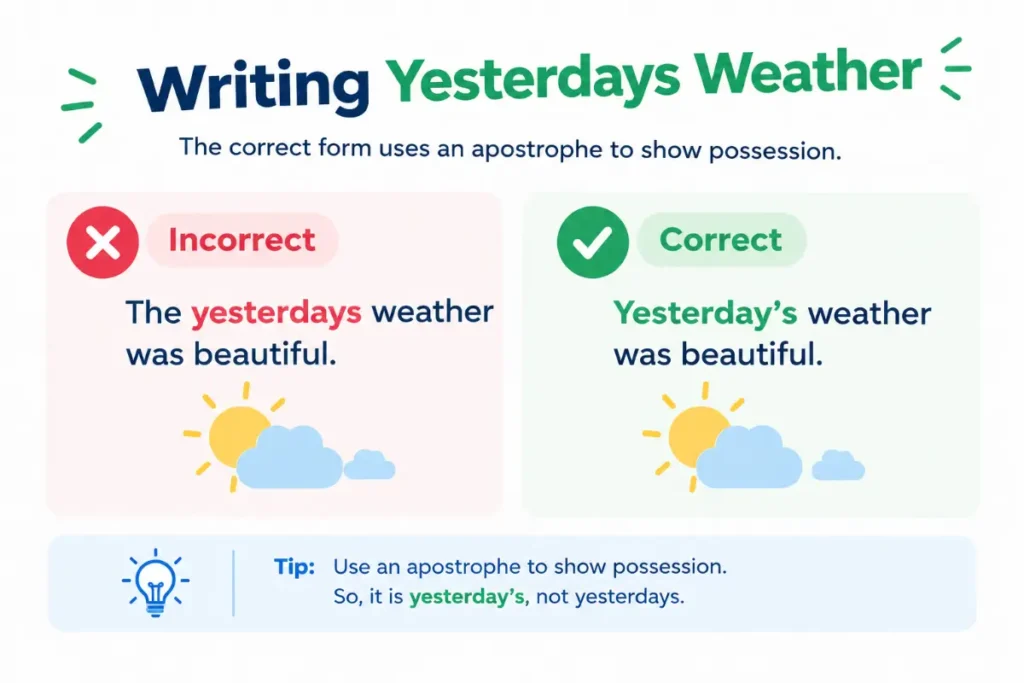
Writing Yesterdays Weather
Incorrect:
The yesterdays weather was beautiful.
Correct:
Yesterday’s weather was beautiful.
The problem is the missing apostrophe. You are describing weather associated with yesterday so the possessive form is needed.
Writing Yesterdays News
Incorrect:
I watched yesterdays news.
Correct:
I watched yesterday’s news.
News is associated with the previous day. The apostrophe marks that relationship.
Adding An Apostrophe To A Plural Idea
Some writers may assume that every form involving yesterday needs an apostrophe.
For example:
I remember yesterday’s.
That sentence can be correct if the missing noun is understood from context.
But:
I remember the yesterdays of my childhood.
Here no apostrophe is needed because yesterdays is functioning as a plural noun.
The grammar depends on the intended structure.
Confusing Yesterday’s With Yesterdays
This is the main spelling and punctuation mistake.
Yesterday’s has an apostrophe before s.
Yesterdays has no apostrophe.
The first is normally possessive. The second is an unusual plural form.
Confusing Yesterday’s With Yesterday Is
An apostrophe can also represent omitted letters in contractions.
For example:
Yesterday’s been busy.
This sentence is unusual but could represent yesterday has been in certain informal constructions.
In ordinary writing yesterday’s most often indicates possession or association.
The context determines the grammatical function.
Pronunciation Guide
Yesterday is commonly pronounced /ˈjɛstərdeɪ/ in American English.
A simple pronunciation guide is:
YES ter day.
The stress falls on the first syllable.
Yesterday’s is pronounced approximately:
YES ter dayz.
The final s sound becomes a z sound in normal speech.
Yesterdays has essentially the same ending sound:
YES ter dayz.
This creates an interesting point. The possessive form yesterday’s and the rare plural form yesterdays can sound almost identical or identical in ordinary speech.
That means pronunciation cannot always tell you which written form you need.
You have to look at grammar and context.
If you mean something connected with yesterday use the possessive spelling yesterday’s.
If you intentionally mean several past instances of yesterday use the plural form yesterdays. In most normal situations that plural meaning can be expressed more naturally with another phrase.
Etymology And Word Origin
Yesterday has a long history in English. The word developed from Old English forms that referred to the day before the present day.
Its structure has changed over time but the core meaning has remained stable.
The modern word can function as a noun or an adverb.
As a noun:
Yesterday was difficult.
As an adverb:
I called yesterday.
The possessive form develops naturally from the noun use:
Yesterday’s meeting was difficult.
The apostrophe and s mark the possessive relationship.
English has many similar time expressions that developed possessive forms in the same way.
Today’s schedule.
Tomorrow’s appointment.
Yesterday’s news.
These forms allow speakers and writers to connect a particular time with an event object or idea.
The unusual plural yesterdays develops from treating yesterday as a countable concept. That usage is possible but generally belongs to literary or figurative language rather than everyday communication.
Learn the difference in Instalments or Installments Which Spelling Is Correct 2026.
Regional Usage
American English
American English commonly uses yesterday’s in everyday speech and writing. You will see it in phrases such as yesterday’s meeting yesterday’s weather yesterday’s game and yesterday’s news.
Yesterdays without an apostrophe is rare. If an American writer wants to discuss several past days they will usually choose clearer phrases such as past days or days from the past.
The possessive form is therefore the natural choice for ordinary US writing.
British English
British English follows the same basic grammar. Yesterday’s is standard when referring to something connected with the previous day.
British writers may occasionally use yesterdays in literary writing when referring to multiple past days or memories. This does not change the standard rule for ordinary writing.
Australian English
Australian English also uses yesterday’s as the normal possessive form. The spelling and grammar follow the same general pattern used in other major English varieties.
The rare plural yesterdays can appear in creative writing but is not the normal everyday form.
Canadian English
Canadian English uses yesterday’s in the same way as American and British English.
There is no major regional spelling difference here. The apostrophe remains important when the word modifies a noun.
Possessive Grammar Explained
Possessive grammar does not always mean physical ownership.
Consider:
John’s car.
John owns the car.
Now consider:
Yesterday’s meeting.
Yesterday does not literally own the meeting. Instead the meeting is connected with yesterday.
English uses possessive constructions to express many kinds of relationships.
Examples include:
the company’s policy
the school’s schedule
the city’s history
Monday’s meeting
last night’s dinner
yesterday’s announcement
These structures are all natural.
The same principle explains why yesterday’s needs an apostrophe when it modifies a noun.
The apostrophe tells the reader that yesterday is being used as a possessive modifier.
Can You Say Yesterday’s Without A Noun
Yes. The noun can sometimes be understood from context.
For example:
I prefer today’s weather to yesterday’s.
Here yesterday’s stands for yesterday’s weather.
The noun weather is omitted because the reader already knows what the speaker means.
Another example:
Today’s game was better than yesterday’s.
The second phrase means yesterday’s game.
This is called a possessive construction with an understood noun. The apostrophe remains because the possessive relationship remains.
This use is very common and perfectly natural.
Can Yesterday Be Plural
In ordinary conversation yesterday normally refers to one day. That makes a plural form unusual.
Still a writer can use yesterdays when treating different past days as separate experiences or memories.
For example:
She wanted to forget the yesterdays that had caused her pain.
This sentence is grammatically possible but has a literary tone.
In everyday writing you would probably say:
She wanted to forget the painful days of her past.
The second version is more direct.
This illustrates a broader writing principle. A word can be grammatically possible without being the most natural choice for ordinary communication.
Yesterday’s In Formal Writing
Yesterday’s is perfectly acceptable in formal writing.
For example:
The committee reviewed yesterday’s findings.
The report summarizes yesterday’s meeting.
The research team analyzed yesterday’s results.
There is nothing informal about the possessive construction itself.
However formal writing sometimes benefits from an exact date instead of yesterday.
For example:
The committee reviewed the September 25 findings.
That sentence can be clearer in a document that readers may access weeks or months later.
Yesterday is relative to the day the reader encounters the document. A specific date does not change.
This distinction matters in reports records instructions and archived documents.
If timing matters for long term reference use the actual date.
Yesterday’s In Email And Workplace Writing
Yesterday’s appears frequently in professional communication.
Examples include:
Please review yesterday’s meeting notes.
I’ve attached yesterday’s sales report.
The team discussed yesterday’s customer feedback.
Could you update yesterday’s figures?
These phrases are short and natural.
Still there is one practical issue. In a long email thread the word yesterday can become unclear because the reader may not know which date you mean.
If a message could be read later use the date.
For example:
Please review the notes from September 25.
That is clearer than yesterday’s notes when the timing matters.
Yesterday’s In Academic Writing
Academic writing can use yesterday’s when discussing a recent event.
For example:
The researchers reviewed yesterday’s observations before beginning the next phase.
However academic papers usually have longer time frames. Because of that yesterday may be uncommon compared with exact dates.
If the event occurred during a controlled experiment the writer may use a date or study day instead.
For example:
The researchers reviewed the observations collected on September 25.
This gives the reader a fixed reference point.
The grammar of yesterday’s remains correct. The choice depends on the document’s purpose.
Related And Confused Terms
Today
Today refers to the current day.
Today’s meeting means the meeting associated with today.
Tomorrow
Tomorrow refers to the day after today.
Tomorrow’s schedule means the schedule associated with tomorrow.
Last Night
Last night refers to the previous night.
Last night’s game follows the same possessive pattern as yesterday’s game.
Previous Day
Previous day is a more formal phrase that can replace yesterday in some contexts.
It is useful in reports and technical writing where exact reference matters.
The Day Before
The day before can refer to the preceding day.
It is often useful when the reference point is not the current day.
Past
Past refers broadly to earlier time.
It does not necessarily mean the day immediately before today.
Former
Former means previous or earlier in one of its common uses. It does not mean yesterday.
Earlier
Earlier describes a time before another point. It can refer to something that happened before now without identifying a specific calendar day.
These related expressions help show why yesterday’s has a specific function. It identifies a connection with the previous day while other expressions cover wider periods of time.
Expert Editor Insight
An experienced editor would usually make a quick grammar check before making a spelling correction. If the writer means something associated with the previous day and another noun follows then yesterday’s is almost certainly the required form. If the writer has deliberately turned yesterday into a plural noun then yesterdays can work but it will usually have a literary feel. Grammar tools may catch the missing apostrophe in obvious phrases but they cannot always understand the writer’s intended meaning. Context remains the final test.
Practical Editing Test
When you are unsure which form to use ask one simple question.
Am I describing something connected with one previous day?
If the answer is yes use yesterday’s.
For example:
yesterday’s meeting
yesterday’s report
yesterday’s weather
yesterday’s appointment
If you mean several separate past days as ideas or memories then yesterdays may be possible.
For example:
the yesterdays of my childhood
Even then ask if a simpler phrase would sound better.
The days of my childhood.
That version is usually clearer.
Why People Leave Out The Apostrophe
The mistake often happens because speakers cannot hear the apostrophe.
When we say yesterday’s we hear a sound that is very close to a simple plural ending. There is no special spoken pause telling us where the apostrophe belongs.
Fast typing can make the problem worse.
A writer may type:
yesterdays meeting
because the brain focuses on the meaning rather than the punctuation.
This is common with possessive phrases.
Other examples include:
todays news
tomorrows plans
Mondays meeting
last nights dinner
The corrected forms are:
today’s news
tomorrow’s plans
Monday’s meeting
last night’s dinner
The same editing principle applies across all of them.
A Simple Memory Trick
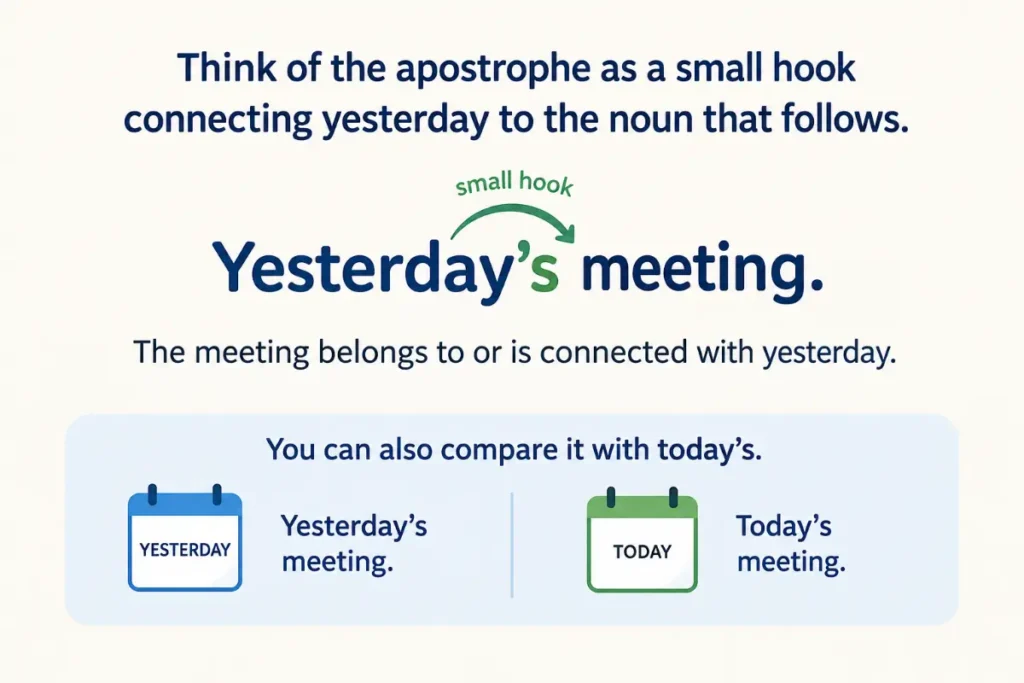
Think of the apostrophe as a small hook connecting yesterday to the noun that follows.
Yesterday’s meeting.
The meeting belongs to or is connected with yesterday.
You can also compare it with today’s.
Today’s meeting.
Yesterday’s meeting.
Tomorrow’s meeting.
All three use the same possessive pattern.
This makes the rule much easier to remember.
If a noun follows and you mean that the noun is connected with a specific day use the apostrophe.
A related grammar guide is christmases or christmass Correct Spelling and Usage.
Conclusion
yesterdays or yesterday’s has a straightforward answer for normal English writing. Yesterday’s is the correct form when you mean something connected with the previous day. The apostrophe shows the possessive relationship in phrases such as yesterday’s meeting yesterday’s news and yesterday’s weather.
Yesterdays without an apostrophe is not normally used in everyday English because yesterday usually refers to one specific day. It can appear as a rare plural noun in literary writing when a writer talks about several past days or memories. In most practical situations however another phrase will sound clearer.
The easiest editing trick is to compare yesterday’s with today’s and tomorrow’s. If a noun follows and you are linking that noun to a particular day use the apostrophe. Once you see the pattern the correct form becomes much easier to choose.
FAQs
Is yesterdays a correct word?
Yesterdays can be grammatically possible when yesterday is deliberately treated as a plural noun referring to several past days or periods. However this use is rare and often literary. In ordinary writing you normally need yesterday’s when describing something connected with the previous day. For example yesterday’s meeting is standard while yesterdays meeting is incorrect.
Is yesterday’s always possessive?
Yesterday’s is normally the possessive form of yesterday when it appears before or stands in for a noun. For example yesterday’s meeting means the meeting connected with yesterday. The same spelling can theoretically represent a contraction in a different sentence structure but the possessive use is by far the relevant form in phrases such as yesterday’s news or yesterday’s weather.
Which is correct yesterdays or yesterday’s?
For normal expressions involving something from the previous day use yesterday’s. The apostrophe shows the possessive relationship. Yesterdays without an apostrophe is rare and usually appears only when a writer intentionally treats different past days as plural yesterdays. In everyday English you should choose yesterday’s for phrases such as yesterday’s meeting and yesterday’s report.
Can yesterdays ever be used without an apostrophe?
Yes but only in unusual contexts. A writer can use yesterdays as a plural noun when talking about several past days or periods. For example the yesterdays of her childhood can refer to many remembered days. This style is more literary than conversational. In ordinary writing it is usually clearer to say past days or days from the past.
What does yesterday’s mean?
Yesterday’s means belonging to yesterday or associated with yesterday. It commonly appears before another noun. Examples include yesterday’s news yesterday’s meeting yesterday’s weather and yesterday’s results. The apostrophe and s create the possessive form. The relationship does not mean literal ownership. It simply connects the noun with the previous day.
How do you pronounce yesterday’s?
Yesterday’s is commonly pronounced like YES ter dayz in American English. The possessive ending sounds like z. The apostrophe itself has no separate sound. This is why people sometimes confuse the written possessive form with yesterdays. The spoken forms can sound the same or nearly the same so grammar and context determine the correct spelling.
Can yesterday’s appear at the end of a sentence?
Yes. The noun can be omitted when the meaning is clear. For example today’s weather is better than yesterday’s is completely natural. Here yesterday’s stands for yesterday’s weather. The apostrophe remains because the possessive relationship remains even though the noun weather is understood rather than written.
Is yesterday’s appropriate in formal writing?
Yes. Yesterday’s is grammatically standard and can appear in formal writing. Examples include yesterday’s findings yesterday’s meeting and yesterday’s results. However long term documents may benefit from an exact date because yesterday changes depending on when someone reads the document. If the timing needs to remain clear later use the specific date instead.