
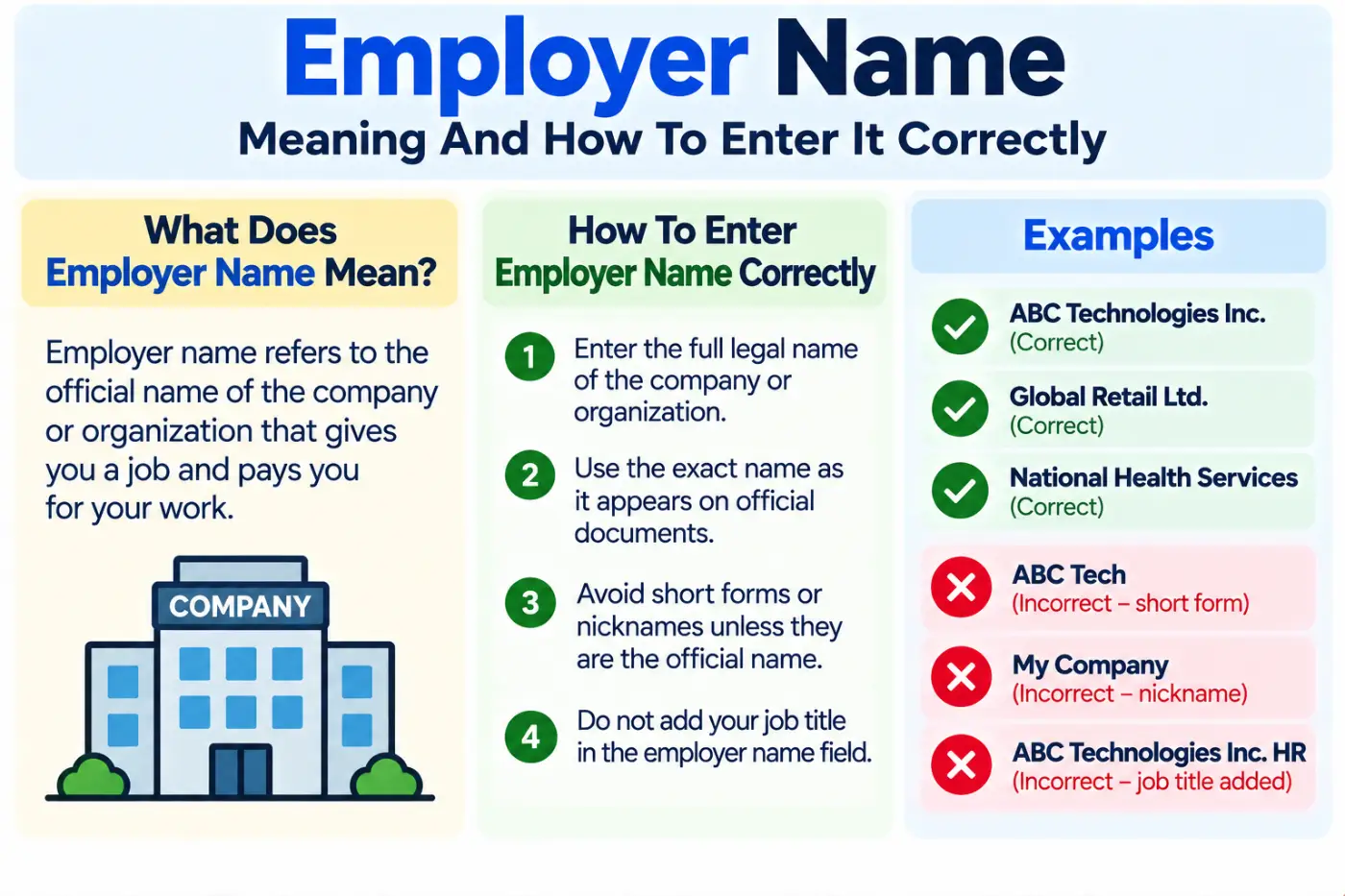
employer name meaning is simple once you know what the word employer refers to. Your employer is the person or organization that employs you and pays you for your work. So when a form asks for your employer name, it usually wants the official name of the company, organization, business, or individual that employs you.
This question can become confusing because the name you use at work may not always match the legal name of your employer. You might work at a store but be employed by a larger company. You might report to a manager but your manager is not your employer. You might also work through a staffing agency while performing your daily duties at another company.
The right answer depends on your employment arrangement and the purpose of the form. This guide explains what the term means, what name to enter, how it differs from a company name and supervisor name, and what to do if you are self employed, unemployed, retired, or working through an agency. You will also see practical examples for job applications, school forms, financial paperwork, and other common situations.
You may also want to read alr meaning in Texting and Online Chat.
Quick Definition
Employer name means the name of the person, company, organization, or business that officially employs you. On most forms, you should enter the employer that hires you and is responsible for your employment relationship. If a form asks for the employer name, it usually does not want your supervisor’s name or the name of the place where you simply perform your work.
Quick Answer
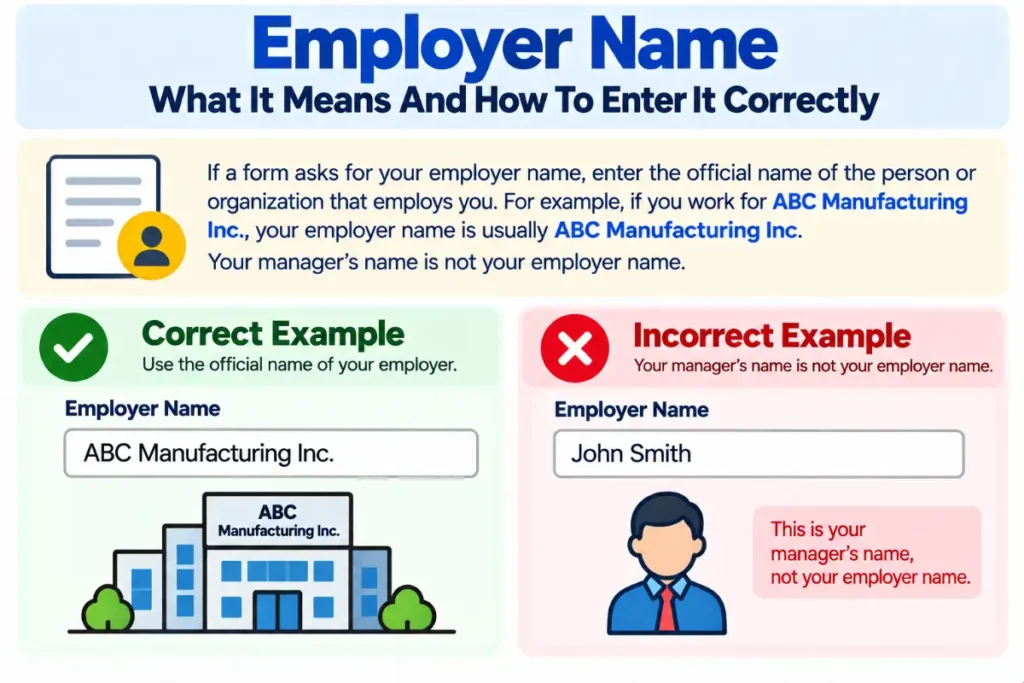
If a form asks for your employer name, enter the official name of the person or organization that employs you. For example, if you work for ABC Manufacturing Inc., your employer name is usually ABC Manufacturing Inc. Your manager’s name is not your employer name.
If you work through a staffing agency, the correct employer may be the agency rather than the company where you physically work. Check your employment paperwork or pay records if you are unsure.
What Does Employer Mean
An employer is a person or organization that hires someone to perform work in exchange for compensation. In ordinary employment, the employer has an employment relationship with the worker and provides payment for the work performed.
For example, imagine that Maria works as an administrative assistant for Green Valley Medical Center. Green Valley Medical Center employs Maria. Her supervisor might be James Carter. In that situation, James is her supervisor, while Green Valley Medical Center is her employer.
The distinction becomes important when you complete paperwork.
If a form asks for your employer name, entering James Carter would usually be incorrect. The form normally wants Green Valley Medical Center.
An employer can take many forms. It may be a large corporation, a small business, a nonprofit organization, a government agency, a school, a hospital, or an individual who directly employs someone.
The word does not describe the worker. The worker is generally called an employee.
That gives you a useful pair to remember.
Employer means the party providing employment.
Employee means the person performing the work.
What Does Employer Name Mean On A Form
When you see an employer name field on a form, the question usually asks you to identify who officially employs you.
The exact requirement can vary by form. A job application might want the name of your current or previous company. A loan application might want your current employer. A government document might ask for the legal employer connected with your employment.
In most ordinary cases, enter the name shown on your employment records.
For example, suppose you work at a restaurant called Sunny Kitchen. If your pay statement lists Sunny Kitchen LLC as the employer, that legal business name is generally the best answer.
If the form has a separate field for business name, company name, or organization name, follow the instructions provided by the form.
The safest approach is to use the name that appears on your official employment documents when the form serves a legal, financial, tax, or verification purpose.
What Name Should You Enter
The answer depends on how you work.
If You Work For A Company
Enter the company’s official name.
For example:
Employer: Bright Star Technologies Inc.
You do not need to enter your supervisor’s name unless the form separately asks for a supervisor or manager.
If You Work For A Small Business
Enter the business name used by your employer.
For example:
Employer: Miller Family Dental
If the business operates under a different legal name, use the name requested by the particular form.
If You Work For An Individual
Some people work directly for another individual. A household employee, personal assistant, caregiver, or private tutor may have an individual as the direct employer.
In that situation, the person’s name may be the appropriate employer name if that person directly employs you.
If You Work For A Government Agency
Use the official name of the government department or agency.
For example:
Employer: City of Austin
or
Employer: United States Department of Agriculture
The exact name should match the records used for the purpose of the form.
If You Work For A School
A teacher or staff member may be employed by a school district, college, university, or private school rather than the individual school building where they work.
For example, someone may work at Lincoln High School while the actual employer is Lincoln Unified School District.
In that case, the district may be the appropriate employer name.
Employer Name Vs Company Name
Employer name and company name often refer to the same organization, but they are not always identical concepts.
A company name identifies a business. Employer identifies the party that employs a particular worker.
For example, a company can own several brands.
Imagine that Horizon Foods Inc. owns Fresh Market and Daily Harvest. You may work at a Fresh Market location, but Horizon Foods Inc. could be the legal employer.
This distinction matters because a brand name is not always the same as the legal employing entity.
For ordinary situations, the difference may not matter much. For official documents, however, accuracy becomes more important.
If you are completing a tax form, background check, financial application, immigration document, or employment verification form, use the employer name shown in your official records whenever possible.
Employer Name Vs Employer Address
These are two different pieces of information.
The employer name identifies who employs you.
The employer address identifies the location associated with that employer.
For example:
Employer name: Northside Medical Group
Employer address: 125 Main Street, Denver, Colorado
Do not place your home address in the employer address field unless the form specifically asks for a remote work address or another location.
Some companies have multiple offices. If the form asks for the employer address, use the address requested by the form or the address associated with your employment records.
Employer Name Vs Supervisor Name
Your supervisor is the person who manages or oversees your work. Your employer is the person or organization that employs you.
These roles can overlap in small businesses, but they are not automatically the same.
For example, David owns a construction company and directly employs five workers. David may be both the employer and the supervisor.
Now imagine a large company with hundreds of workers. Your supervisor might be Lisa, while your employer is Global Tech Corporation.
If the form asks for your employer name, enter Global Tech Corporation.
If it asks for your supervisor name, enter Lisa.
Reading the exact field label matters. Small differences in wording can change the information the form wants.
Employer Name Vs Job Title
Your employer name tells the form who employs you.
Your job title tells the form what position you hold.
For example:
Employer: Riverdale Community College
Job title: Admissions Coordinator
These are completely different pieces of information.
Common job titles include teacher, cashier, software developer, nurse, accountant, sales associate, manager, technician, and administrative assistant.
Do not enter your job title in the employer field.
Employer Name Vs Workplace
Workplace and employer can also mean different things.
Your workplace is the location or environment where you perform your job. Your employer is the party responsible for employing you.
For example, a security guard may work inside a shopping mall but be employed by a private security company.
The mall is the workplace.
The security company is the employer.
This distinction is especially useful for contract workers, temporary workers, cleaning staff, security personnel, and other workers who provide services at a location operated by another organization.
Staffing Agency And Temporary Workers
Temporary employment creates one of the most common sources of confusion.
Suppose you apply through StaffPro Agency and the agency assigns you to work at Retail Company.
You perform your daily work at Retail Company. However, StaffPro Agency may be your actual employer if it hired you, pays you, and manages the employment relationship.
In that case, a form asking for your employer name may require StaffPro Agency.
However, the answer can depend on the particular employment arrangement. Some workers are directly employed by the company where they work. Others are employees of a staffing agency. Some contractors operate independently.
If you are unsure, check your employment agreement, pay statement, tax documents, or other official records.
Do not simply choose the company where you physically spend most of your working day.
Self Employed Workers
Self employment changes the answer.
If you operate your own business and work for yourself, you may not have a separate employer in the traditional employee sense.
A form may provide options such as self employed, business owner, or independent contractor.
If you own a business, the form may ask for your business name instead.
For example:
Business: Johnson Web Design
If you operate as a sole proprietor under your own name, your personal name may be used for some purposes.
The correct entry depends on the form and the legal structure of your business.
If the document has detailed instructions, follow them instead of assuming that every form treats self employment the same way.
Independent Contractors
Independent contractors are another special case.
An independent contractor generally works under a service arrangement rather than as a traditional employee. The organization paying for the contractor’s services may be a client rather than an employer.
For example, suppose Alex operates an independent photography business and provides services to several companies.
One company may pay Alex for a project, but that does not automatically make the company Alex’s employer.
If a form asks for employer name and you are an independent contractor, look for a separate option such as self employed or independent contractor.
If none exists, read the instructions carefully. Some forms use employer as a broad term for the organization that provides income, while others use it in the strict employment sense.
Unemployed And Job Seekers
If you are unemployed, you normally should not invent an employer name.
If the form asks for your current employer and you do not have one, the appropriate response may be unemployed, not currently employed, or not applicable.
Use the option provided by the form when available.
For a job application, the situation can be different. The employer name field usually appears under previous employment history, where you should enter a former employer rather than your current status.
The surrounding fields provide the clue.
Retired People
If you are retired and a form asks for your current employer, you may be able to enter retired or not applicable if the form permits it.
If the form asks about your previous employer, provide the relevant organization from your employment history.
Do not use a former employer as your current employer simply because you worked there for many years.
The word current changes the question.
Students
Students may or may not have an employer.
If you have a part time job, enter the name of the business or organization that employs you.
If you do not work, do not invent an employer.
A school, college, or university is not your employer simply because you attend it.
If you receive a scholarship, grant, or financial aid, that does not automatically create an employment relationship.
Many readers also check Shiny Vs Shiney Meaning Usage And Examples2026.
Employer Name On A Job Application
Job applications commonly ask for employer name as part of employment history.
For each previous position, the application may ask for:
- Employer name.
- Job title.
- Start date.
- End date.
- Employer address.
- Supervisor name.
- Reason for leaving.
These fields are different.
Suppose you worked at Green Valley Pharmacy as a pharmacy technician. Your entry might look like this:
Employer name: Green Valley Pharmacy
Job title: Pharmacy Technician
Employment period: January 2023 to May 2025
Supervisor: Mark Davis
Each piece of information answers a different question.
Employer Name On A Resume
A resume normally does not require a field labeled employer name. Instead, you usually list the company or organization alongside your job title.
For example:
Marketing Coordinator
Brightline Media
Chicago, Illinois
January 2024 to Present
Here Brightline Media identifies the organization where you work.
If the employer operates under a brand name but has a different legal entity, you may choose the name that is most useful to the reader unless the resume is being used for formal verification.
Employer Name On Tax Forms
Tax related documents require extra care.
Your tax documents may identify the legal entity connected with your employment. If a tax form specifically asks for employer information, use the name and identification information shown on the relevant tax document or official instructions.
Do not guess based on the sign above your workplace.
For example, the name of a restaurant shown on its storefront may differ from the legal business name used for payroll.
Official documents are the better source when accuracy matters.
Employer Name On Bank And Loan Applications
Banks and lenders may ask for your employer as part of an income or employment application.
In that setting, the goal is often to identify the organization connected with your employment and income.
Use the employer name shown on your pay statement or employment records.
If you work for yourself, follow the application’s instructions for self employment.
If you recently changed jobs, make sure the employer you enter matches the period the application asks about.
For example, current employer and previous employer are not interchangeable.
Employer Name On School Forms
School forms may ask parents or guardians for employer information.
For example, a school registration form might ask:
Parent or guardian employer: Bright Star Logistics
This field normally wants the organization that employs the parent or guardian.
It does not usually want the person’s job title.
If the parent is self employed, the appropriate response may be the business name or self employed depending on the form.
If the parent does not work, the form may provide an option such as unemployed or not applicable.
Employer Name On Immigration And Government Forms
Government and immigration forms often use precise terminology.
If a form asks for employer information, do not rely only on memory. Check your employment documents and the instructions attached to the specific form.
A company may have several related entities, subsidiaries, brands, or locations. The legal entity connected with your employment can matter.
For official government paperwork, accuracy should come before convenience.
If the form provides a definition of employer, use that definition. If the question is unclear and the information has legal consequences, getting guidance from the relevant agency or a qualified professional can prevent an avoidable error.
Grammar And Part Of Speech
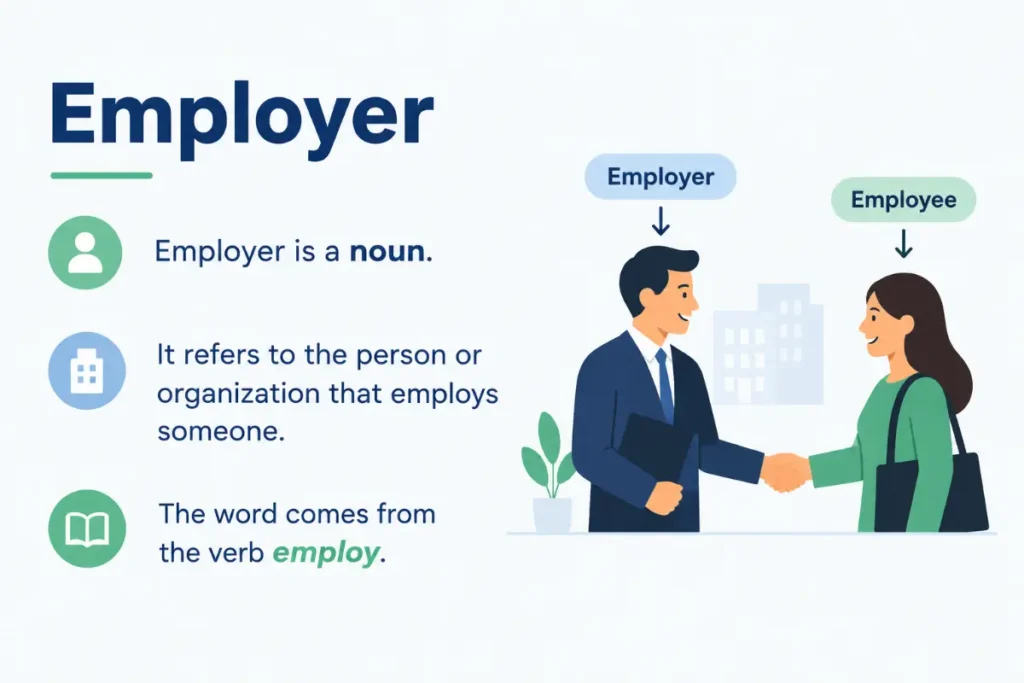
Employer is a noun.
It refers to the person or organization that employs someone.
The word comes from the verb employ.
Here is the basic word family:
Employ: to give someone work or use someone for a particular purpose.
Employee: a person who works for an employer.
Employer: a person or organization that employs a worker.
Employment: the state or condition of having a job.
These words are closely related but they have different grammatical roles.
For example:
The company employs 500 workers.
She is an employee of the company.
The company is her employer.
She found employment after graduating.
The word employer itself is countable.
You can say:
My employer is a software company.
She has two employers.
The second example can apply to someone who has two separate jobs.
Pronunciation Guide
Employer is commonly pronounced /ɪmˈplɔɪər/ in American English.
A simple pronunciation guide is:
im PLOY er.
The main stress falls on the second syllable.
The word has three main sound parts:
im + PLOY + er.
The related words employee and employer are sometimes confused because they look similar.
Employee is generally pronounced:
em ploy EE.
Employer is:
em PLOY er.
The stress pattern helps separate the two.
A useful memory trick is to connect the ending with the role.
An employee is the person who receives employment.
An employer is the person or organization that provides employment.
Etymology And Word Origin
Employer comes from the verb employ, which entered English through French from Latin roots connected with using or applying something.
The English verb employ developed the meaning of engaging someone for work. From that verb, English formed the noun employer to identify the person or organization that employs another person.
Employee developed from the same word family.
The relationship between these words is useful because their endings show different roles.
The suffix er often forms a noun referring to someone or something that performs an action.
For example:
Teach becomes teacher.
Work becomes worker.
Employ becomes employer.
The suffix ee in employee developed in a way that commonly identifies the person receiving the action or service in certain English word pairs.
This is why employee and employer look similar while referring to opposite sides of an employment relationship.
Regional Usage
American English
Employer is a standard and extremely common term in American English. It appears in employment contracts, job applications, tax documents, workplace conversations, resumes, government forms, and financial paperwork.
The basic meaning does not change across ordinary US usage.
British English
British English uses employer in the same basic way. A British form asking for employer details generally seeks the name of the organization or person employing the worker.
The surrounding form instructions determine the exact information required.
Australian English
Australian English also uses employer with the same core meaning. The word appears in employment documents, workplace communication, government paperwork, and everyday speech.
There is no major regional difference in the definition.
Canadian English
Canadian English follows the same basic usage. Employer refers to the person or organization that employs a worker.
The spelling and meaning are not substantially different from American English in this context.
Common Employer Examples
An employer can be almost any person or organization that directly employs workers.
Common examples include:
- A private company.
- A small business.
- A nonprofit organization.
- A government department.
- A school district.
- A college or university.
- A hospital or medical organization.
- An individual household employer.
The important factor is the employment relationship, not the size or type of organization.
A small business with three employees can be an employer just as a multinational corporation can be an employer.
Real Life Usage Examples
Daily Conversation
My employer gives us Fridays off during the summer.
I need to ask my employer before I change my work schedule.
These sentences use employer in an ordinary workplace sense.
Workplace Email
I have attached the document requested by my employer.
My employer confirmed that the new schedule begins Monday.
The word sounds natural in professional communication.
Academic Writing
Employer practices can influence employee satisfaction and workplace retention.
The study examines the relationship between employers and workers in small businesses.
Academic writing may use the term when discussing labor, workplaces, or organizational behavior.
News Writing
The employer announced plans to expand its workforce next year.
Workers and employers reached an agreement after several weeks of discussion.
News writing commonly uses the word when discussing employment relationships.
Formal Documents
Please provide the name and address of your current employer.
The applicant must provide information about each previous employer.
These examples show why the term appears frequently on forms and official paperwork.
Related And Confused Terms
Employee
An employee is the person who works for an employer.
If a company employs you, you are its employee.
Employment
Employment refers to the condition or relationship of having work.
She is seeking employment.
Employer
Employer refers to the person or organization that employs the worker.
The hospital is her employer.
Supervisor
A supervisor manages or oversees your work. A supervisor may be your boss but is not necessarily your legal employer.
Manager
A manager usually has responsibility for people, operations, or a department. A manager can be an employee of the same organization that employs you.
Company
A company is a business organization. It may be your employer, but the terms are not always identical.
Workplace
A workplace is the place or environment where you work. It may be operated by someone other than your employer.
Independent Contractor
An independent contractor generally provides services independently rather than as an employee. The organization paying for the service is not automatically the contractor’s employer.
Five Common Mistakes
Entering The Supervisor Name
A common mistake is entering your manager’s name when a form asks for your employer.
If your manager is Sarah and your company is Blue Ridge Software, enter Blue Ridge Software in the employer field unless the form specifically asks for your supervisor.
Entering The Job Title
Another mistake is entering something such as teacher, cashier, or accountant.
Those are job titles.
The employer is the organization or person employing you.
Using The Store Name Instead Of The Legal Employer
A worker may know the brand name but not the legal company name.
For ordinary forms, the brand may be accepted. For official documents, check your employment records and use the name required by the form.
Listing A Client As The Employer
Independent contractors sometimes confuse a client with an employer.
If you provide freelance services to several businesses, those businesses may be clients rather than employers.
Inventing An Employer When You Are Unemployed
Do not enter a company simply because you want the form to look complete.
If you are not currently employed, use the option provided for unemployed or not applicable.
Accuracy is more valuable than filling every box with something.
Expert Editor Insight
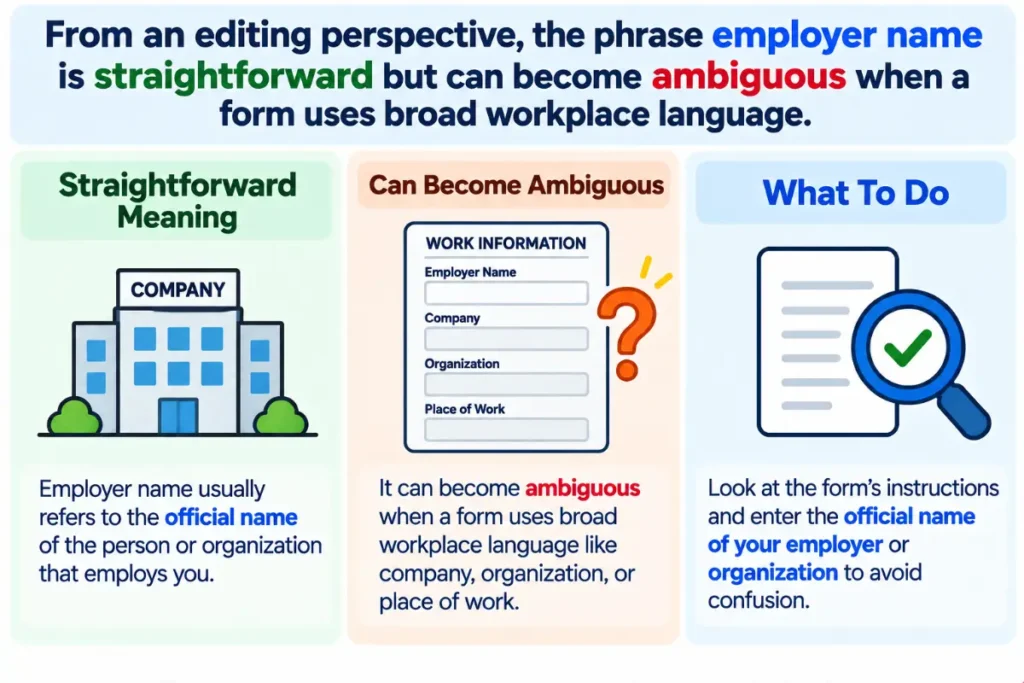
From an editing perspective, the phrase employer name is straightforward but can become ambiguous when a form uses broad workplace language. A careful reader should look at the surrounding fields before entering information. If the form separately asks for company, supervisor, job title, or workplace, each field probably has a specific purpose. Professional editors also watch for inconsistent employer names across resumes and applications. The safest practical habit is to compare the entry with an official pay statement or employment record when the document requires exact information.
Need another quick comparison? Read Choosing or Chosing Meaning, Usage and 20 Examples 2026.
Conclusion
Understanding the employer name meaning is simple. An employer name refers to the person, company, organization, or business that hires you and pays you for your work. You’ll often see this term on job applications, tax forms, employment records, and other official documents.
When a form asks for your employer name, enter the official name of the company or organization you currently work for. If you’re self employed, you may need to enter your business name or indicate that you’re self employed, depending on the form’s instructions. Using the correct name helps keep your employment information accurate and consistent.
Knowing what employer name means can also help you complete forms with confidence. If you’re unsure what name to use, check your pay stub, employment contract, tax document, or company records for the official employer name.
FAQs
What does employer name mean?
Employer name means the name of the person, company, organization, or business that officially employs you. If you work for a company called Bright Star Media, that company name would normally be your employer name. A supervisor’s name, job title, and workplace address are different pieces of information and should only be entered in fields that specifically request them.
What should I put for employer name?
Enter the name of the organization or person that employs you. For a normal employee, this is usually the company listed on your employment or payroll records. If you work through a staffing agency, the agency may be your employer. If you are self employed, use the option or business information requested by the specific form.
Is employer name the same as company name?
Often they are the same, but not always. A company can operate several brands or locations, and a worker may physically work at one brand while being legally employed by another company. For ordinary forms, the company name may be sufficient. For official documents, use the employer name shown in your employment records or the name required by the form.
Is my manager my employer?
Usually, no. A manager or supervisor normally oversees your work but is an employee of the organization that employs you. For example, your manager may be John Smith while your employer is Green Valley Hospital. If a form asks for your employer, enter the organization. If it asks for your manager or supervisor, enter that person’s name.
What should I enter if I am self employed?
If you are self employed, the correct response depends on the form. Some forms provide a self employed option. Others may ask for your business name. If you operate as a sole proprietor under your own name, your personal name may be relevant. Read the form instructions carefully and use the information that matches your business structure.
What should I put if I am unemployed?
If you are currently unemployed, do not invent an employer. If the form provides an unemployed or not applicable option, use it. If the form asks about previous employment, enter a former employer instead. The wording of the question matters because current employer and previous employer refer to different periods of your work his