
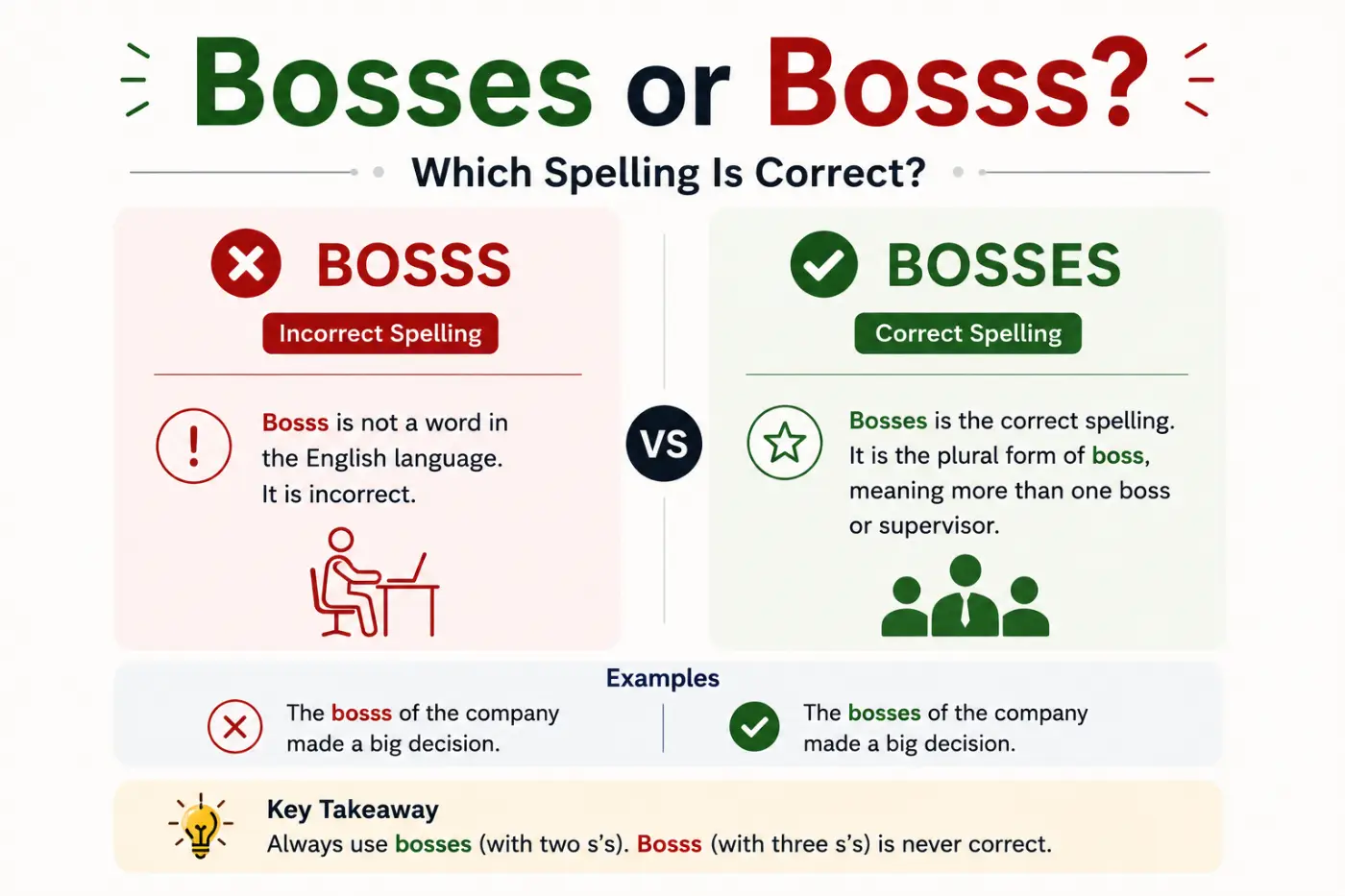
bosses or bosss is an easy spelling question to run into when you need to write the plural form of boss. The correct standard spelling is bosses. The form bosss is a spelling mistake because English does not normally create the plural of boss by simply adding another s to the existing spelling.
The confusion makes sense because boss already ends in two s letters. When you want to show more than one boss, it can feel natural to add another s and produce bosss. English plural spelling does not work that way here. Instead, the word takes the ending es, giving us bosses. The pronunciation also changes slightly because the added ending creates an extra syllable.
Once you know the rule, the pattern becomes easy to remember. This article explains the correct plural form, why the spelling works, how to pronounce it, how it behaves in grammar, and how native English speakers use it in real situations. You’ll also see common mistakes, regional usage, related words, and examples from everyday conversation, school, work, and formal writing.
You may also want to read publically or publicly: Correct Spelling and Usage Guide.
Quick Definition
The standard plural of boss is bosses. Bosses means more than one person who has authority over employees or manages a workplace, team, or organization. Bosss is not the standard plural spelling. The final sound and spelling pattern of boss require the plural ending es rather than simply adding another s.
Quick Answer
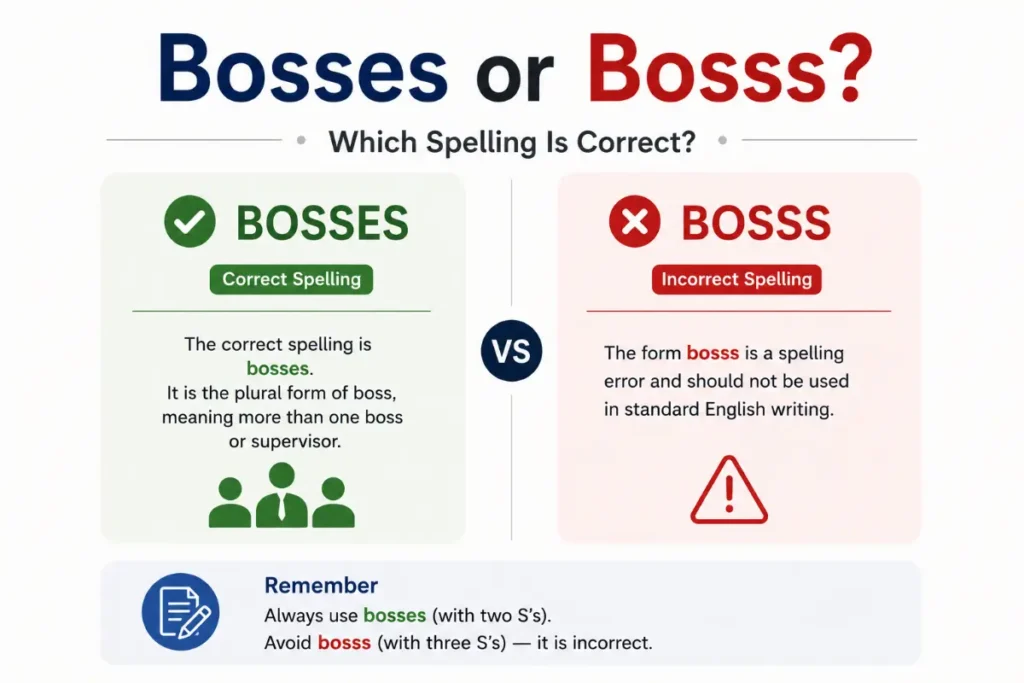
The correct plural form is bosses.
Boss becomes bosses because words ending in a sibilant sound often take es when forming the plural. The final es creates an additional syllable, so boss has one syllable while bosses has two.
For example:
My boss is in a meeting.
My bosses are in a meeting.
The first sentence refers to one person. The second refers to more than one.
Comparison Table bosses or bosss
| Form | Meaning | Part of Speech | Origin | Usage Frequency | Formality | Common Contexts | Example |
|---|---|---|---|---|---|---|---|
| Bosses | More than one boss | Plural noun | From boss through English usage | Common | Neutral | Workplaces, business, conversation, writing | Several bosses attended the meeting. |
| Bosss | Not the standard plural spelling of boss | Nonstandard spelling | Spelling error rather than a standard plural formation | Uncommon | Not standard | Typing mistakes and spelling errors | Bosss should be corrected to bosses. |
The important difference is not meaning. Both forms are usually intended to refer to multiple bosses, but only one follows standard English spelling rules.
Meaning And Definition
Meaning Of Boss
Before looking at the plural form, it helps to understand the singular noun.
A boss is a person who has authority over other workers. Depending on the setting, a boss may supervise employees, assign tasks, make decisions, manage a department, or direct a team.
For example:
My boss asked me to finish the report.
The word can describe a supervisor, manager, employer, or person in charge. Its exact meaning depends on the workplace.
Boss can also appear in informal expressions. Someone might call a person the boss to mean that the person is in charge. In some casual contexts, boss can also be used as a friendly form of address. The plural spelling remains bosses in all of these ordinary uses.
Meaning Of Bosses
Bosses is simply the plural form of boss.
It refers to two or more people who are bosses.
For example:
The company has three bosses.
My bosses approved the new schedule.
The first sentence tells us that three people hold positions of authority. The second tells us that more than one supervisor approved something.
The word is a regular plural noun, but its plural formation follows the spelling pattern used with words ending in sounds such as s, z, sh, ch, and x.
Meaning Of Bosss
Bosss is not the standard plural form of boss.
It usually appears because a writer knows that plural nouns often take s and adds another s directly to the end of boss. That produces three consecutive s letters.
English does contain words with repeated consonants, but the plural of boss is not formed by adding a single s after the existing double s.
If you are writing a message, essay, email, report, resume, application, or business document, use bosses.
Why The Plural Is Bosses
The main spelling rule is simple.
Many English nouns form their plural by adding s.
Book becomes books.
Car becomes cars.
Teacher becomes teachers.
However, some nouns need es instead. This happens with words whose final sounds make a simple s ending difficult or unnatural to pronounce.
Boss ends with the sound /s/. If you simply added another s in pronunciation, the result would be awkward. English instead uses the plural ending es, which creates a separate syllable.
That gives us:
Boss → bosses.
The same general pattern appears in several familiar words.
Bus → buses.
Class → classes.
Glass → glasses.
Dish → dishes.
Box → boxes.
Church → churches.
The spelling changes because the plural ending is not merely an extra written letter. It represents a grammatical ending with a pronunciation that makes the plural easier to say.
Key Differences Explained
- Spelling. Bosses is the standard plural spelling. Bosss is incorrect in ordinary standard English.
- Meaning. Bosses means two or more bosses. Bosss has no separate standard meaning.
- Grammar. Bosses is a plural noun. It can serve as a subject or object in a sentence.
- Pronunciation. Boss is normally one syllable. Bosses is normally two syllables.
- Plural formation. Boss takes es rather than a simple s because of its ending sound.
- Formality. Bosses works in casual speech, professional writing, academic writing, and formal documents.
- Context. Bosses can refer to supervisors, managers, employers, or people in charge.
- Regional usage. Major English varieties use bosses as the standard plural form. There is no major regional spelling difference here.
The most useful point is that the spelling follows pronunciation and established English plural patterns. You are not adding a random extra ending. You are forming the regular plural with es.
Which Form Is Correct?
Bosses is the correct standard plural form.
Bosss is a misspelling caused by adding s directly to a word that already ends in ss. Standard English uses es after boss.
You can think of the pattern this way:
Boss + es = bosses.
The same pattern appears in class and classes. The noun class already ends in ss, but its plural is classes rather than classs.
This is a useful spelling pattern to learn because it applies to many common nouns.
When you see a noun ending in a sound that normally takes an es plural, do not automatically add a single s. Check the established plural pattern instead.
Sentence Examples
The following examples show how bosses works naturally in different situations.
- My bosses are meeting with the new employees this afternoon.
- Several bosses attended the company dinner.
- Some bosses prefer email while others prefer face to face meetings.
- The employees thanked their bosses for supporting the new project.
- Her previous bosses gave her strong professional references.
- The two bosses agreed on the new work schedule.
- Good bosses usually communicate expectations clearly.
- The store has different bosses for each department.
- The managers met with their bosses before announcing the decision.
- His bosses praised him for completing the project early.
Each sentence uses bosses as a plural noun. The word can appear as the subject of a sentence or as an object after another verb.
For example:
The bosses approved the plan.
Here bosses is the subject.
The employees contacted their bosses.
Here bosses is the object of the verb contacted.
The meaning stays the same. The grammatical role changes according to its position in the sentence.
Common Mistakes And Misspellings
Writing Bosss
Incorrect:
The bosss called a meeting.
Correct:
The bosses called a meeting.
This mistake usually happens because the writer adds s to the original spelling without changing the plural ending.
Writing Bosses Incorrectly As Bosses
The standard spelling is bosses with two s letters in the middle followed by es.
A writer may know that es is needed but still lose track of the original spelling.
The correct structure is:
boss + es = bosses.
Writing Boss
Another common mistake is using the singular form when the sentence refers to several people.
Incorrect:
My boss are meeting today.
Correct:
My bosses are meeting today.
The plural subject requires the plural noun and a matching plural verb.
Using Bosses With A Singular Verb
Incorrect:
The bosses is reviewing the report.
Correct:
The bosses are reviewing the report.
Because bosses refers to more than one person, it normally takes the plural verb are.
Confusing Possession With Plurality
Bosses and boss’s do different jobs.
Bosses means more than one boss.
Boss’s usually shows possession by one boss.
For example:
The bosses approved the plan.
The boss’s office is upstairs.
There is also bosses’ for possession by more than one boss.
For example:
The bosses’ offices are on the second floor.
These forms can look similar when typed quickly, so punctuation matters.
Pronunciation Guide
Boss is usually pronounced /bɔːs/ in American English. It has one syllable.
Bosses is commonly pronounced /ˈbɔːsɪz/. It has two syllables.
A simple pronunciation guide is:
BOSS iz.
The stress falls on the first syllable.
The final es is pronounced as an extra syllable rather than simply adding a silent letter.
This gives us:
Boss → one syllable.
Bosses → two syllables.
That pronunciation difference can actually help you remember the spelling. If you are talking about more than one boss, the word sounds longer because the plural ending creates another syllable.
A common pronunciation mistake is trying to pronounce bosses as though it were simply boss plus a hard s sound. Standard pronunciation uses a vowel sound before the final z sound.
The plural ending can sound similar to the ending in other common words such as buses and classes.
Etymology And Word Origin
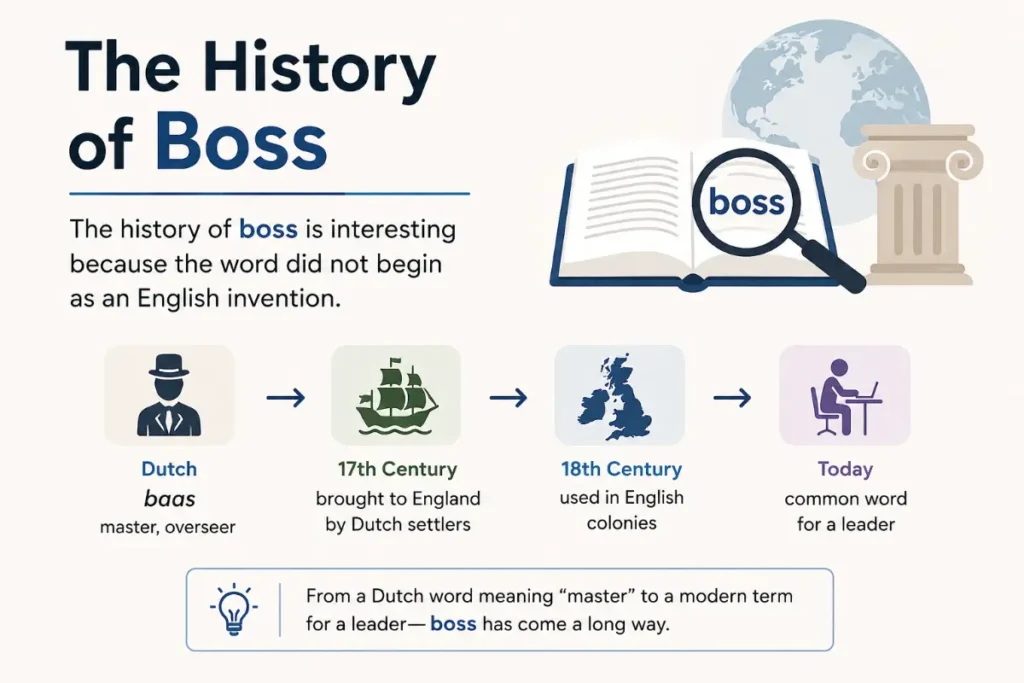
The word boss entered English from Dutch baas, a word meaning master or overseer. It became established in American English and later became a common term for a person who manages or directs workers.
The word has been used in English for centuries and is now widely recognized across major varieties of English.
Its plural form developed according to ordinary English plural patterns. Because the singular noun ends with the /s/ sound, the plural uses es rather than a simple s.
The historical origin explains where the word came from, but you do not need to remember its Dutch history to spell the plural correctly. The practical rule is more useful.
Boss becomes bosses.
Learn the difference in Seing Vs Seeing Which Is Correct In English in 2026.
Regional Usage
American English
Bosses is the standard plural spelling in American English. The word is extremely familiar in workplace conversations and everyday writing.
American speakers may use boss in both formal and informal settings. In professional writing, terms such as manager, supervisor, director, or employer may sometimes sound more specific, but bosses remains grammatically correct.
For example:
The bosses approved the proposal.
The employees spoke with their bosses.
British English
British English also uses bosses as the standard plural form of boss. There is no major spelling difference in this plural.
The word boss is common in British workplace language. Depending on the context, speakers may also use manager, supervisor, or employer.
The plural spelling remains bosses.
Australian English
Australian English follows the same standard plural pattern. Bosses is the normal plural form.
The pronunciation can vary slightly because accents differ, but the spelling does not change.
Canadian English
Canadian English also uses bosses as the standard plural. There is no recognized regional spelling that changes the basic rule.
The word appears naturally in workplace conversations, professional writing, and general communication.
Grammar Rules And Part Of Speech
Bosses is a plural common noun.
A noun names a person, place, thing, or idea. In this case, bosses names people who hold authority or management roles.
Because it is plural, bosses can be used with plural verbs.
The bosses are meeting.
The bosses have approved the plan.
Notice the verbs are, have, and were. Each agrees with a plural subject.
Boss As A Singular Noun
When referring to one person, use boss.
The boss is here.
My boss has approved the request.
Bosses As A Plural Noun
When referring to two or more people, use bosses.
The bosses are here.
My bosses have approved the request.
Boss’s As Singular Possessive
Use boss’s when something belongs to one boss.
The boss’s office is large.
The boss’s decision surprised everyone.
Bosses’ As Plural Possessive
Use bosses’ when something belongs to multiple bosses.
The bosses’ offices are on the second floor.
The bosses’ decisions affected the entire department.
This distinction is worth learning because the apostrophe changes the grammatical meaning.
Plural Formation In English
English plural rules can seem inconsistent because the language contains words from many historical sources. Still, common patterns help.
Many nouns simply take s.
Dog becomes dogs.
Desk becomes desks.
Employee becomes employees.
Nouns ending in certain sounds often take es.
Bus becomes buses.
Class becomes classes.
Box becomes boxes.
Church becomes churches.
Dish becomes dishes.
Boss belongs to this second group.
This does not mean every noun ending in the letter s behaves in exactly the same way. English spelling has exceptions and special cases. The safest approach is to learn common plural patterns together with familiar examples.
Boss and bosses are especially easy to remember because the pronunciation also changes from one syllable to two.
Plural Nouns Ending In Double S
Boss is part of a larger spelling pattern.
Consider these words:
Class → classes.
Glass → glasses.
Pass → passes.
Kiss → kisses.
Cross → crosses.
Address → addresses.
Each plural uses es.
The reason is connected to the sound at the end of the singular word. Adding the plural ending creates an additional syllable.
This pattern gives you a useful spelling shortcut. When a common noun ends in ss and you need the plural, check the es pattern instead of automatically adding another s.
That is why classs and glasss are also incorrect.
Real Life Usage Examples
Daily Conversation
My bosses want to talk to me after lunch.
Both of my bosses are traveling this week.
These sentences sound natural in ordinary conversation. In casual speech, people often use bosses without thinking about the spelling rule because the plural form is already familiar.
Email And Workplace Communication
The department heads and their bosses will review the proposal tomorrow.
I have shared the updated schedule with all the bosses involved in the project.
In workplace writing, the plural form can refer to several managers or supervisors. The exact meaning depends on the organization.
Academic Writing
The study examined how employees communicate with their bosses.
The researchers found that workers may respond differently to different management styles.
In academic writing, boss can sound less formal than supervisor or manager. Still, it remains grammatically correct when the research specifically uses that term.
News And Journalism
The company said its regional bosses would review the new policy.
Several local bosses attended the meeting.
News writing may use boss in direct descriptions of workplace relationships, especially when the context is informal or conversational.
Literature And Storytelling
The workers gathered outside while their bosses discussed the problem inside.
She had worked for several bosses during her career and remembered each one differently.
Storytelling often uses simple words such as boss because they sound natural and familiar.
Formal Alternatives To Bosses
The word bosses is standard English, but you may sometimes want a more specific term.
Managers
Managers supervise teams, departments, or business operations. This is often more precise in professional writing.
Supervisors
Supervisors usually oversee employees and daily work. This term can be useful when describing direct workplace authority.
Employers
Employer refers to a person or organization that employs workers. It does not always mean the person’s direct manager.
Directors
Director is often used for someone with a higher level of organizational responsibility. The exact role varies by organization.
Leaders
Leader is broader than boss. A leader may have authority, but the word can also describe someone who guides a group without being a formal manager.
Administrators
Administrator can describe someone responsible for managing an organization, department, or system.
Executives
Executives usually hold senior management roles. The word is more specific than boss in many corporate contexts.
Heads
Head can refer to the person in charge of a department or group.
Choosing the right term depends on the actual role. Boss is broad and conversational. Manager, supervisor, director, and employer can provide more precise information.
Related And Confused Terms
Boss
Boss is the singular form. Use it for one person in charge.
Bosses
Bosses is the plural form. Use it for two or more bosses.
Boss’s
Boss’s usually shows possession by one boss.
Bosses’
Bosses’ shows possession by multiple bosses.
Manager
Manager often refers to someone who supervises employees or operations.
Supervisor
Supervisor usually describes someone who directly oversees workers or daily tasks.
Employer
Employer refers to the person or organization that employs someone.
Leader
Leader describes someone who guides or directs a group. The role may be formal or informal.
These words overlap, but they are not perfect synonyms. A manager can be a boss, but not every person described as a leader is necessarily a boss.
Bosses In Formal Writing
There is nothing grammatically wrong with using bosses in formal writing. The word is a standard English plural noun.
Still, formal writing often benefits from precise language.
For example:
The study examined how employees interact with their bosses.
This is perfectly understandable.
A more specialized academic version might say:
The study examined how employees interact with their supervisors.
The second sentence is more specific if the people in question are direct supervisors.
The choice should depend on meaning rather than an assumption that boss is always too informal.
In a business email, bosses can be completely natural.
Both bosses approved the schedule.
In a research paper, supervisor may be a better fit if the study specifically concerns supervisory relationships.
Good writing chooses the word that matches the situation.
Common Spelling Patterns To Remember
One useful way to improve spelling is to group words by patterns rather than memorize every word separately.
Words ending in ss often form their plural with es.
Class becomes classes.
Glass becomes glasses.
Kiss becomes kisses.
Pass becomes passes.
Boss becomes bosses.
This pattern gives you a reliable mental framework.
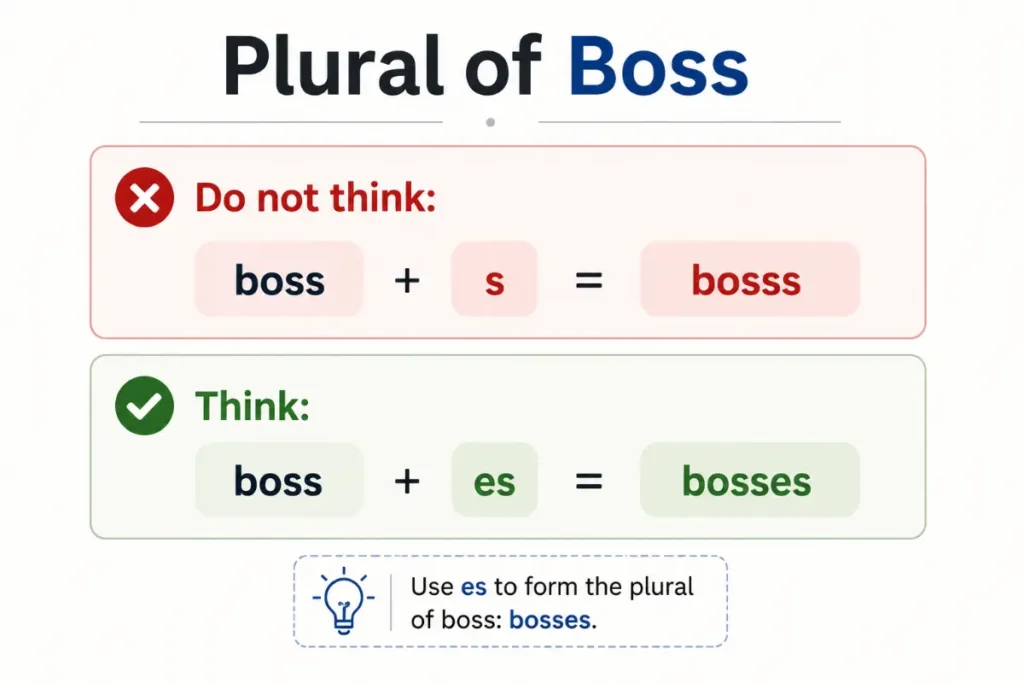
When you see boss, do not think:
boss plus s.
Think:
boss plus es.
That small change prevents the extra s error.
Why Bosss Appears In Typing
The spelling mistake is easy to explain from a language processing perspective.
Writers often learn that plural nouns take s. That rule is useful for many common words. When someone sees boss and wants the plural, the brain may retrieve the general rule and attach s automatically.
The result is bosss.
This is a type of spelling pattern interference. The writer knows the word and knows the plural rule but applies the simpler pattern in the wrong place.
Fast typing can make the problem worse. Repeated letters are easy to overlook during proofreading, especially when the writer is focused on the meaning of the sentence rather than its spelling.
The solution is not complicated. Learn boss as part of the ss plus es pattern.
Expert Editor Insight
An experienced editor would treat bosses as the only standard plural form for ordinary English writing and bosss as a simple spelling error. The mistake usually comes from applying the basic plural s rule without considering the ending sound of the noun. Professional proofreading tools can flag bosss because it does not match the standard word form, but human editing still matters because software cannot always understand the intended meaning or workplace context. A useful editing habit is to check nouns ending in ss separately during proofreading and remember that many of them take es in the plural.
Many readers also check emaculate vs immaculate Correct Spelling Meaning and Usage.
Conclusion
bosses or bosss has a clear answer. Bosses is the correct standard plural form of boss, while bosss is a spelling mistake. The plural uses es because boss ends with the /s/ sound, and the added ending creates a second syllable in pronunciation.
The same pattern appears in familiar words such as classes, glasses, kisses, and passes. Learning this group makes the spelling easier instead of forcing you to memorize each word alone. Also remember the difference between bosses and boss’s because the apostrophe changes the grammatical meaning.
A simple editing trick is to remember boss plus es. If you are referring to more than one boss, write bosses. That small rule will keep the spelling accurate in everyday messages, school assignments, workplace writing, and formal documents.
FAQs
Is bosss a correct word?
Bosss is not the standard plural spelling of boss. It is usually a spelling mistake created by adding another s directly to the singular form. The correct plural is bosses. If you are writing an email, essay, report, application, or other standard English text, use bosses when referring to more than one boss.
Why is the plural of boss bosses?
The plural is bosses because nouns ending in the /s/ sound commonly take the plural ending es. This ending adds another syllable and makes the plural easier to pronounce. The same pattern appears in words such as class, which becomes classes, and bus, which becomes buses. Therefore boss becomes bosses rather than bosss.
How do you pronounce bosses?
Bosses is commonly pronounced /ˈbɔːsɪz/ in American English. It has two syllables and sounds roughly like BOSS iz. The first syllable carries the main stress. The final es is pronounced as an extra syllable. This differs from boss, which normally has only one syllable.
Is bosses singular or plural?
Bosses is plural. It refers to two or more people who are bosses. The singular form is boss. For example, My boss is calling refers to one person, while My bosses are calling refers to more than one. Because bosses is plural, it normally takes plural verbs such as are, were, and have.
What is the difference between boss and bosses?
Boss refers to one person who manages or supervises others. Bosses refers to two or more people who hold that role. For example, My boss approved the request refers to one person. My bosses approved the request refers to multiple people. The spelling changes from boss to bosses when the noun becomes plural.
Is boss’s different from bosses?
Yes. Boss’s normally shows possession by one boss, while bosses is simply the plural form. For example, The boss’s office means the office belonging to one boss. The bosses’ offices means offices belonging to multiple bosses. Bosses without an apostrophe means more than one boss and does not by itself show possession.
Is bosses used in American English?
Yes. Bosses is the standard plural form in American English. It is widely used in everyday speech, workplace communication, journalism, and general writing. There is no special American spelling that replaces bosses. British, Australian, and Canadian English also use bosses as the standard plural form of boss.
Is bosses appropriate in formal writing?
Yes. Bosses is grammatically correct in formal writing. However, a more specific term such as managers or supervisors may be preferable if it describes the person’s actual role more precisely. Bosses is especially natural when the writing uses ordinary workplace language. The key issue is accuracy and context rather than formality alone.