
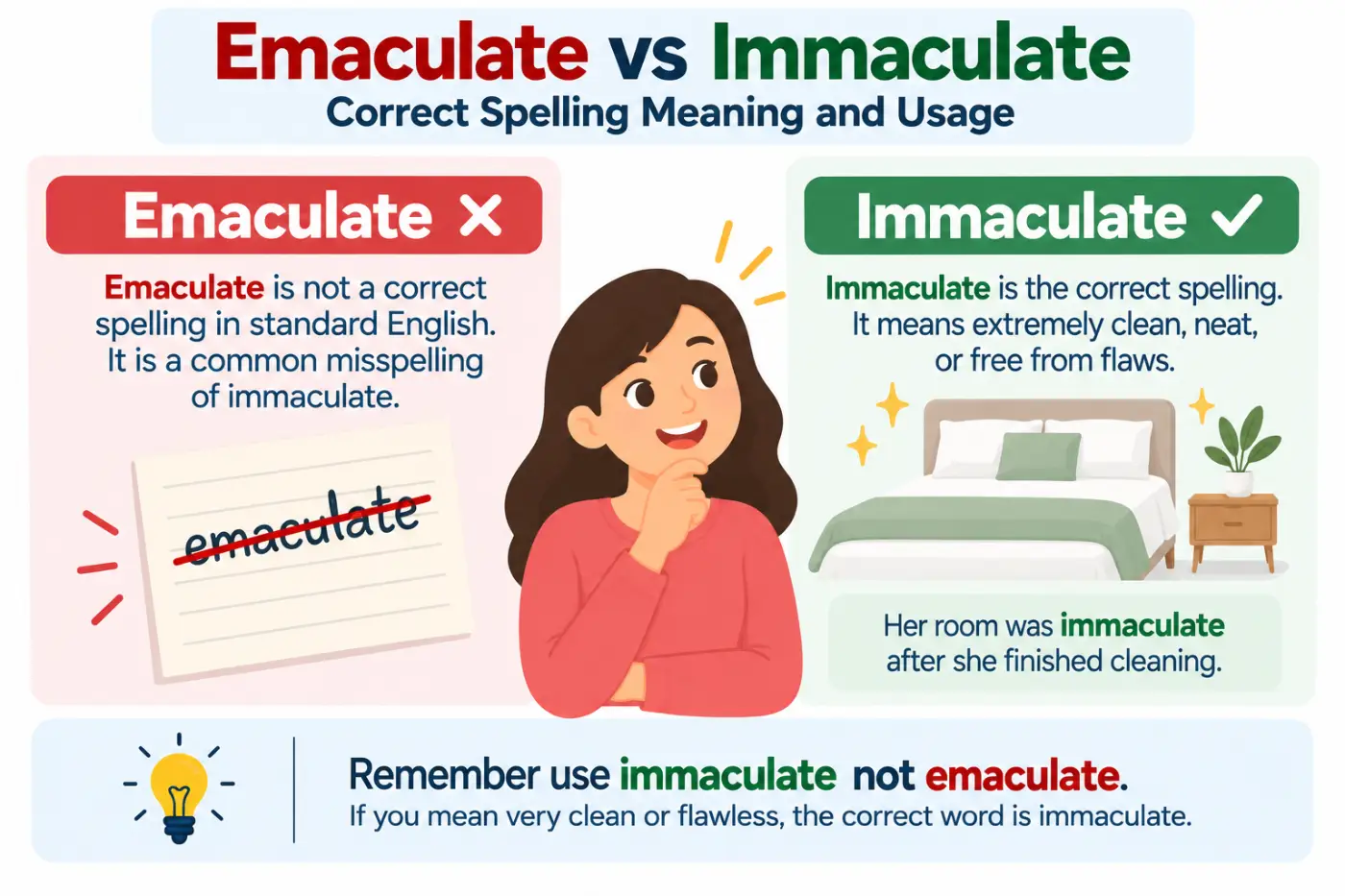
emaculate vs immaculate is a spelling question that can confuse even careful writers. The correct form is immaculate. Emaculate is not the standard spelling of the adjective that means perfectly clean flawless or free from mistakes.
The confusion is understandable because the two forms look almost identical at first glance. The difference comes from the beginning of the word. The correct spelling starts with im and contains two m letters. The incorrect form drops the initial i and changes the established spelling. Because the first syllable is weak in normal speech many people remember the sound without remembering every letter.
If you’re trying to choose the right spelling for an email essay report conversation or professional document this guide gives you the answer clearly. You’ll learn what immaculate means how to pronounce it how it developed and how native speakers use it. You’ll also see common spelling mistakes natural examples related words and simple ways to remember the correct form.
Need another quick comparison? Read Seal Vs Seel Which Is Correct Meaning Differences And Examples.
Quick Definition
Immaculate is the correct English spelling. It is an adjective meaning perfectly clean tidy or free from flaws and mistakes. Emaculate is a common misspelling and isn’t the standard form. You can use immaculate for physical cleanliness as well as excellent appearance condition performance or quality.
Quick Answer
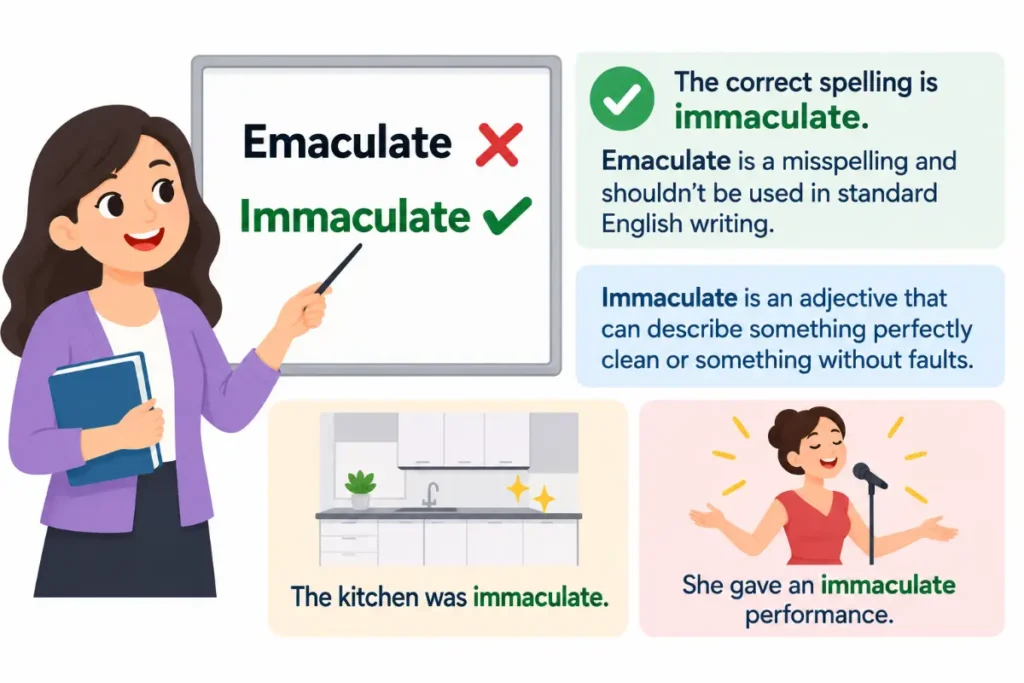
The correct spelling is immaculate. Emaculate is a misspelling and shouldn’t be used in standard English writing. Immaculate is an adjective that can describe something perfectly clean or something without faults. You can say The kitchen was immaculate or She gave an immaculate performance.
Comparison Table
| Correct Form | Meaning | Part of Speech | Origin | Usage Frequency | Formality | Common Contexts | Example |
|---|---|---|---|---|---|---|---|
| Immaculate | Perfectly clean or free from faults | Adjective | Latin through French and English | Common | Neutral to formal | Homes clothing appearance work performance writing | Her office was immaculate. |
| Emaculate | No standard English meaning in this spelling | Misspelling | Not a standard English word form | Uncommon | Nonstandard | Typing errors spelling mistakes learner writing | Emaculate should be corrected to immaculate. |
Meaning and Definition
Meaning of the Incorrect Form
Emaculate is generally a misspelling of immaculate. It doesn’t function as the standard English adjective that describes something spotless flawless or perfect.
You may encounter this spelling in a quick message social media post search query handwritten note or first draft. Its appearance usually means that the writer remembers the general sound or shape of the word but has forgotten part of its spelling.
That distinction matters. A spelling can appear many times online without becoming an accepted English form. English has thousands of recurring spelling mistakes that show up in informal communication. Repetition doesn’t automatically make a spelling correct.
If you’re writing an essay email article application or professional document use immaculate.
Meaning of Immaculate
Immaculate is an adjective with several closely connected uses. Its central idea is something that has no dirt marks flaws or noticeable faults. The first common meaning relates to physical cleanliness. Something immaculate is extremely clean neat and well maintained.
For example:
The kitchen was immaculate.
Her apartment was immaculate.
The car looked immaculate after the detailing.
In each case the word suggests a very high level of cleanliness and care.
Immaculate can also describe quality. A performance can be immaculate if it has no noticeable errors. A technique can be immaculate if it is executed with exceptional precision.
For example:
His performance was immaculate.
Her technique was immaculate.
The report was immaculate.
This broader use gives the word more range than simple terms such as clean or tidy.
Immaculate can therefore describe both physical condition and figurative perfection. The exact meaning comes from the context.
Key Differences Explained
- Spelling. Immaculate is the standard spelling. Emaculate leaves out the initial i and doesn’t match the established form.
- Meaning. Immaculate means perfectly clean or free from faults. Emaculate has no standard English meaning in this context.
- Grammar. Immaculate is an adjective. It describes a noun or pronoun.
- Pronunciation. The first syllable is short and unstressed. That can make the initial i easy to overlook when someone spells the word from sound.
- Formality. Immaculate works in everyday conversation as well as formal writing.
- Context. You can use it for cleanliness appearance condition performance technique writing and other forms of excellence.
- Regional usage. The standard spelling remains the same in American British Canadian and Australian English.
- Standard usage. Emaculate shouldn’t replace immaculate in edited English.
The key point is simple. The initial i belongs in the standard spelling. So do both m letters.
Which Form Is Correct?
Immaculate is correct.
Established English dictionaries recognize immaculate as a standard adjective. The word describes something perfectly clean or tidy and can also describe something that has no mistakes or faults.
The spelling also makes sense from a historical perspective. The English word comes from Latin immaculatus which means unstained. It is connected to macula which means spot or blemish.
That history gives the word a useful internal clue. If something is immaculate it is free from a mark or blemish. The standard English spelling preserves part of that older word structure.
The incorrect spelling emaculate doesn’t have the same status. It normally appears because someone has omitted the initial i while spelling from memory.
Sentence Examples
Here are ten natural examples using the correct form.
- Her apartment was immaculate from the kitchen to the bedroom.
- He arrived at the interview wearing an immaculate suit.
- The hotel keeps its rooms immaculate throughout the year.
- She submitted an immaculate piece of writing for her final assignment.
- The mechanic returned the car in immaculate condition.
- His timing was immaculate during the entire performance.
- We were impressed by how immaculate the restaurant looked.
- The designer presented an immaculate collection at the event.
- The old house looked immaculate after the renovation.
- Her attention to detail produced an immaculate final report.
Now look at examples containing the common misspelling. These examples are included only to show what needs correcting.
- I emaculate the room every morning.
- The house looked emaculate after the cleaning.
- She described the hotel as emaculate.
- His work was emaculate from start to finish.
- The car was emaculate when we picked it up.
In each example the intended word should be immaculate.
Common Mistakes and Misspellings
Emaculate Instead Of Immaculate
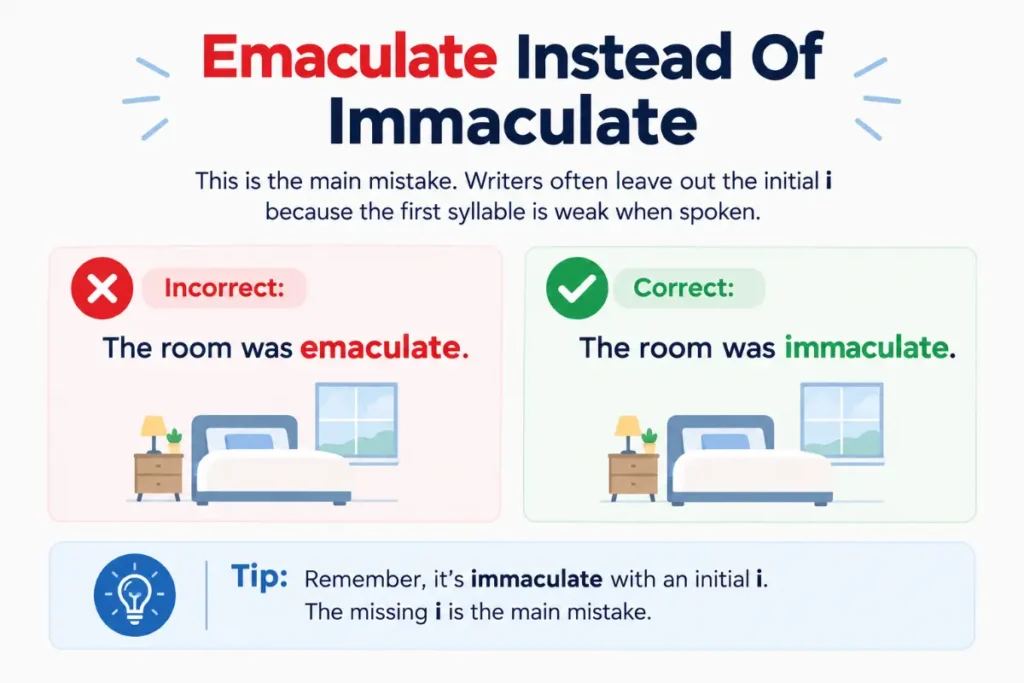
This is the main mistake. Writers often leave out the initial i because the first syllable is weak when spoken.
Incorrect: The room was emaculate.
Correct: The room was immaculate.
Imaculate Instead Of Immaculate
Some writers remember the initial i but use only one m.
Incorrect: The room was imaculate.
Correct: The room was immaculate.
The standard form begins with two m letters.
Immaculant Instead Of Immaculate
The ending can cause confusion because English contains many adjective patterns. Some writers replace ate with ant.
Incorrect: The room was immaculant.
Correct: The room was immaculate.
Immacullate Instead Of Immaculate
This version contains an unnecessary l.
Incorrect: Her appearance was immacullate.
Correct: Her appearance was immaculate.
Immaculately Used As An Adjective
The related adverb immaculately can also cause grammatical confusion.
Incorrect: She looked immaculately.
Correct: She looked immaculate.
However:
She was immaculately dressed.
Here immaculately correctly modifies dressed.
These mistakes show why spelling and grammar work together. Knowing the word alone isn’t enough. You also need to understand how it functions in a sentence.
Pronunciation Guide
The standard pronunciation of immaculate is:
IPA: /ɪˈmæk.jə.lət/
A simple American English pronunciation guide is:
ih MAK yuh luht
The main stress falls on the second syllable.
You can think of the word as four sound groups.
ih
MAK
yuh
luht
The first syllable is short and weak while the second syllable receives the strongest stress.
That weak first syllable partly explains the spelling confusion. When people hear the word in natural conversation they may not clearly notice the initial i. They remember the strong MAK sound and then reconstruct the word incorrectly when writing it.
A good approach is to learn the sound and spelling together. Say immaculate naturally while looking at the written form. After enough exposure the spelling becomes familiar rather than something you have to build from pronunciation.
You may also want to read Oar vs Ore Meaning and Correct Usage.
Etymology and Word Origin
Immaculate has a long history connected with cleanliness and the absence of blemishes.
The word comes from Latin immaculatus which meant unstained or spotless. It is related to the Latin word macula meaning a spot or blemish.
The word later entered English through French influence and appeared in English by the fifteenth century. Its historical sense centered on being free from stains or moral blemishes. Over time its meaning expanded into the modern idea of something perfectly clean or without faults.
This history explains why immaculate and maculate share a recognizable structure.
It also gives you a useful spelling clue. The idea behind immaculate is something without a mark or blemish. The modern spelling reflects the older form rather than the way someone might casually hear the word.
English contains many words whose spelling preserves historical features that aren’t obvious from modern pronunciation. Immaculate is a good example.
Regional Usage
American English
Immaculate is standard American English. It appears naturally in casual speech professional writing journalism education and general conversation.
An American speaker might say:
Your new car looks immaculate.
The office was kept immaculate.
The word can describe both physical cleanliness and exceptional quality.
British English
British English uses the same spelling and essentially the same meanings. There is no major British spelling variant that changes immaculate to another standard form.
A British writer can use immaculate in formal and informal contexts just as an American writer can.
Australian English
Australian English also uses immaculate as the standard spelling. It can describe cleanliness appearance condition and excellent quality.
Emaculate isn’t an established Australian alternative.
Canadian English
Canadian English follows the same standard spelling. Immaculate works naturally in professional communication academic writing journalism and everyday speech.
The important point is that this isn’t a regional spelling difference. The standard form remains the same across these major varieties of English.
Grammar Rules and Part of Speech
Immaculate is an adjective. Its main function is to describe a noun or pronoun.
You can place it before a noun.
She wore an immaculate dress.
They restored the immaculate garden.
You can also place it after a linking verb.
The kitchen was immaculate.
His record remained immaculate.
In the first examples the adjective directly modifies a noun. In the second examples it describes the subject through a linking verb.
Immaculate For Physical Things
The word frequently describes cleanliness or condition.
The floor was immaculate.
His shoes were immaculate.
The office looked immaculate.
These sentences suggest more than ordinary cleanliness. They create an image of something carefully maintained.
Immaculate For Abstract Qualities
The adjective can also describe things that aren’t physically clean.
Her record was immaculate.
His technique was immaculate.
The execution was immaculate.
Here the word means free from faults or errors rather than physically spotless.
Immaculate And Immaculately
Immaculately is the related adverb.
She was immaculately dressed.
The room was immaculately maintained.
The distinction is straightforward.
Immaculate describes.
Immaculately modifies an action or another descriptive element.
Compare these sentences.
Her appearance was immaculate.
She was immaculately dressed.
The first sentence uses an adjective after the linking verb was. The second uses an adverb to modify dressed.
Punctuation
Immaculate itself doesn’t require special punctuation. It follows normal adjective placement rules.
For example:
The immaculate kitchen impressed every visitor.
You don’t add punctuation simply because the word appears before a noun.
The punctuation depends on the overall sentence structure rather than the adjective itself.
Real Life Usage Examples
Daily Conversation
Immaculate sounds natural when someone wants to praise exceptional cleanliness or appearance.
Your living room looks immaculate.
His shoes were absolutely immaculate.
The word can add emphasis without sounding overly formal.
Email And Workplace Communication
Immaculate can work in professional communication when the meaning fits.
The facility was left in immaculate condition after the event.
The final presentation was immaculate and ready for review.
In workplace writing use the word when you genuinely mean an unusually high standard. Using it for every ordinary task can make the language sound exaggerated.
Academic Writing
Academic writers can use immaculate for exceptional quality but should choose it carefully.
The researcher presented an immaculate analysis of the available evidence.
The final manuscript contained immaculate prose.
In academic writing precise language is usually stronger than decorative language. If you mean accurate say accurate. If you mean free from flaws immaculate can be a good choice.
News And Journalism
Journalists may use the word when describing condition appearance or outstanding performance.
The historic building has been restored to immaculate condition.
The athlete delivered an immaculate performance.
The word works especially well when the story emphasizes restoration precision or excellence.
Literature And Storytelling
Immaculate can create a strong visual image in narrative writing.
The old mansion stood immaculate beneath the morning sun.
Her immaculate dress seemed strangely bright against the dusty street.
Writers often use this kind of contrast to make a scene more vivid. A spotless object can stand out sharply in an otherwise messy setting.
Related And Confused Terms
Impeccable
Impeccable means without faults or mistakes. It often describes behavior manners performance or quality.
His manners were impeccable.
Her technique was impeccable.
Immaculate can carry a similar meaning but often has a stronger connection to cleanliness or spotless condition.
Spotless
Spotless focuses strongly on cleanliness.
The kitchen was spotless.
It is usually the most direct choice when you simply mean completely clean.
Flawless
Flawless means without faults or imperfections. It works well for performances results appearance and execution.
She gave a flawless performance.
Perfect
Perfect has a broader meaning. It can describe something that meets an ideal standard in almost any area.
The plan was perfect.
Immaculate is more specific and often suggests cleanliness or freedom from blemishes.
Pristine
Pristine often suggests something clean fresh untouched or in excellent original condition.
The beach remained pristine.
The word can also describe objects that look almost new.
Neat
Neat means tidy or orderly. It is less intense than immaculate.
Her desk was neat.
Calling the desk immaculate suggests an even higher level of care.
Clean
Clean is the basic everyday term for something without dirt.
The room was clean.
The room was immaculate.
The second sentence creates a stronger impression of exceptional cleanliness.
Unblemished
Unblemished means free from marks damage or faults. It can describe physical appearance as well as abstract things such as reputation.
He had an unblemished record.
This word is especially useful when discussing reputation history or records.
Why People Confuse The Two Forms
The main problem is pronunciation.
The first syllable of immaculate is unstressed. In normal speech it can sound quick and soft. Someone who has only heard the word may therefore remember something closer to maculate and then add the beginning from memory.
English spelling patterns create another layer of difficulty. Many words contain im and em beginnings. Their spelling can’t always be predicted perfectly from sound.
Compare words such as imagine improve imperfect and important with words such as emerge embrace and employ. A learner may know the sound pattern without knowing which written form belongs to a particular word.
Visual familiarity helps. The more often you see immaculate in good writing the more natural its spelling becomes.
The word’s history provides another useful clue. Its Latin root relates to being unstained or free from a spot. That meaning connects naturally with the modern sense of spotless or flawless.
A Simple Memory Trick
The easiest way to remember the spelling is to focus on the opening.
imma
Then complete the word.
imma + culate = immaculate
Remember that it starts with imma rather than ema.
You can also connect the word with a spot or blemish. Something immaculate has no stain no mark and no flaw.
Think:
Immaculate means no mark.
That small mental connection can make the spelling easier to recall.
Another helpful strategy is to learn the word family together.
Immaculate.
Immaculately.
Immaculateness.
Once the main spelling becomes familiar the related forms are easier to recognize.
Formal And Informal Usage
Immaculate is acceptable in both formal and informal English.
In casual conversation you might say:
Your new car looks immaculate.
In professional writing you might say:
The facility was maintained in immaculate condition.
Both uses are natural because the word itself isn’t restricted to one level of formality.
Still context matters. Immaculate expresses a strong degree of cleanliness or perfection. If something is simply clean you don’t need to call it immaculate.
Good writing isn’t about choosing the biggest word available. It’s about choosing the word that fits the idea.
For example:
The room was clean.
The room was immaculate.
All three are grammatical. They simply create different levels of emphasis.
Clean is neutral. Spotless suggests no dirt or marks. Immaculate can suggest spotless condition along with exceptional care and perfection.
Expert Editor Insight
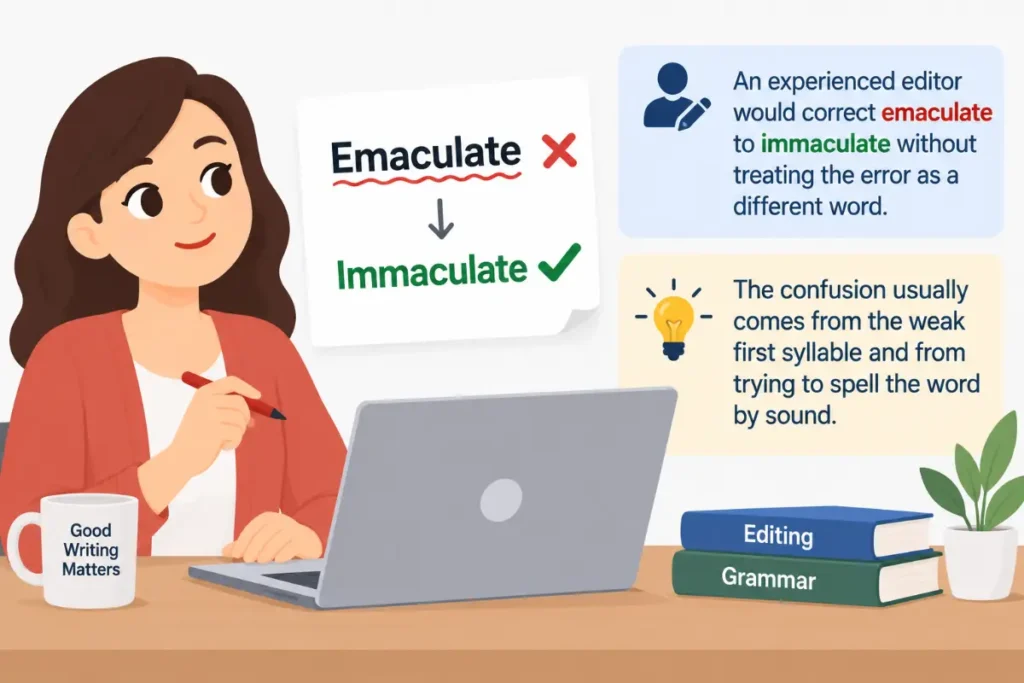
An experienced editor would correct emaculate to immaculate without treating the error as a different word. The confusion usually comes from the weak first syllable and from trying to spell the word by sound. Editors also check the grammatical role because immaculate is an adjective while immaculately is an adverb. Spellcheck software can catch many spelling errors but understanding the word family is more useful in the long run. A strong editing habit is to remember the opening as imma and connect the meaning with something free from spots or flaws.
A related grammar guide is Fare Better Or Fair Better Correct Usage Guide.
Conclusion
emaculate vs immaculate has a clear answer. Immaculate is the correct standard spelling while emaculate is a common misspelling. The correct form is an adjective that can describe something perfectly clean neat or free from faults.
You can use the word for a spotless room a well maintained car an elegant outfit or an exceptional performance. It works naturally in casual conversation professional writing academic work journalism and storytelling. Its meaning can shift slightly with context but the core idea remains perfection or freedom from flaws.
For an easy memory trick remember imma at the beginning. You can also connect immaculate with the idea of something without a spot or blemish. That simple association makes the spelling much easier to remember and can help you catch the error during proofreading.
FAQs
Is emaculate a real English word?
Emaculate isn’t the standard English adjective used to mean perfectly clean or free from faults. It is normally a misspelling of immaculate. You may see it in informal online writing or typing errors but that doesn’t make it an accepted spelling. In edited English use immaculate when you want to describe something spotless flawless exceptionally neat or free from defects.
What does immaculate mean?
Immaculate means perfectly clean neat or free from faults. It can describe physical things such as rooms clothing cars gardens and buildings. It can also describe abstract qualities such as performance technique writing or records. The exact meaning depends on context but the central idea remains the same. Something immaculate has an unusually high level of cleanliness or perfection.
Which is correct between emaculate and immaculate?
Immaculate is correct. Emaculate is a common spelling error caused by leaving out the initial i. The standard word begins with im and contains two m letters. This spelling remains the same in American British Canadian and Australian English. If you’re writing an essay email report article or professional document choose immaculate.
How do you pronounce immaculate?
Immaculate is commonly pronounced /ɪˈmæk.jə.lət/. An easy American English guide is ih MAK yuh luht. The main stress falls on the second syllable. The first sound is short and unstressed which can make it easy to miss when listening. Learning the pronunciation and spelling together can help you avoid writing the word incorrectly.
Can immaculate describe a person?
Yes. Immaculate can describe a person’s appearance clothing or presentation. For example you can say He looked immaculate at the ceremony. The word can also describe qualities associated with a person such as an immaculate record or immaculate manners. It generally suggests an unusually high level of cleanliness neatness polish or freedom from faults.
Is immaculate appropriate in formal writing?
Yes. Immaculate is a standard English adjective and works well in formal writing. You can use it in reports essays professional emails journalism and academic work when its meaning fits the context. It shouldn’t be used simply to make a sentence sound sophisticated. Choose it when you genuinely mean perfectly clean exceptionally neat or free from faults.
What are good synonyms for immaculate?
Useful synonyms include spotless pristine flawless impeccable faultless perfect clean neat and unblemished. The best choice depends on your meaning. Spotless strongly emphasizes cleanliness while flawless focuses on the absence of faults. Impeccable often describes behavior quality or performance. Pristine can suggest something fresh untouched or exceptionally clean. Immaculate can cover both physical cleanliness and figurative perfection.
Why do people spell immaculate incorrectly?
People often make this mistake because the first syllable is weak in natural speech. When someone spells the word from memory they may hear the stronger middle sound and leave out the initial i. The repeated m can also cause uncertainty. Remembering the opening as imma gives you a simple spelling pattern that helps prevent the error.