
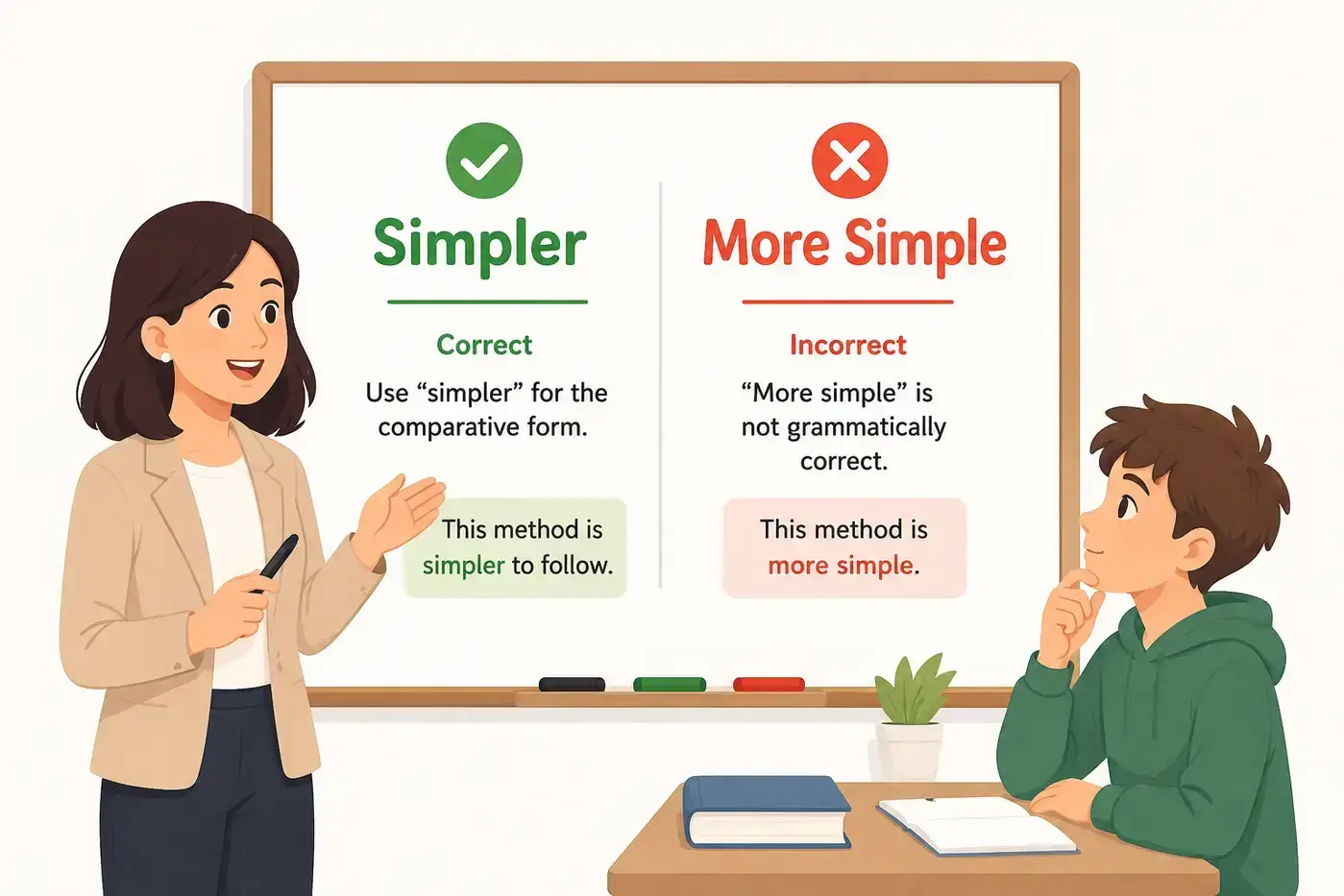
simpler or more simple can make you pause because both forms can appear in English. The short answer is that simpler is the usual and more natural comparative form of simple, but more simple can also be grammatical in certain contexts. The choice often depends on sentence rhythm, emphasis, and the way the writer wants to frame the comparison.
The confusion comes from a basic feature of English adjectives. Some adjectives normally take the comparative ending er, while others use more before the adjective. Simple sits near the boundary because speakers use both patterns. In everyday American English, simpler is usually the form you’ll hear and see most often, especially when the sentence is straightforward.
That doesn’t mean you should treat more simple as an error. It can be useful when simple is being contrasted with another quality or when the writer wants to emphasize the degree of simplicity. This guide explains the grammar behind both forms, shows natural examples, covers pronunciation and regional usage, and gives you a practical editing rule for choosing the form that sounds right.
Many readers also check Fliers vs Flyers Meaning and Difference With Easy Examples 2026.
Quick Definition
Simpler is the standard and more common comparative form of simple. More simple is also grammatically possible, although it is generally less natural in ordinary American English. Use simpler for most direct comparisons. Use more simple when the sentence benefits from emphasis, contrast, or a particular rhythm.
Quick Answer
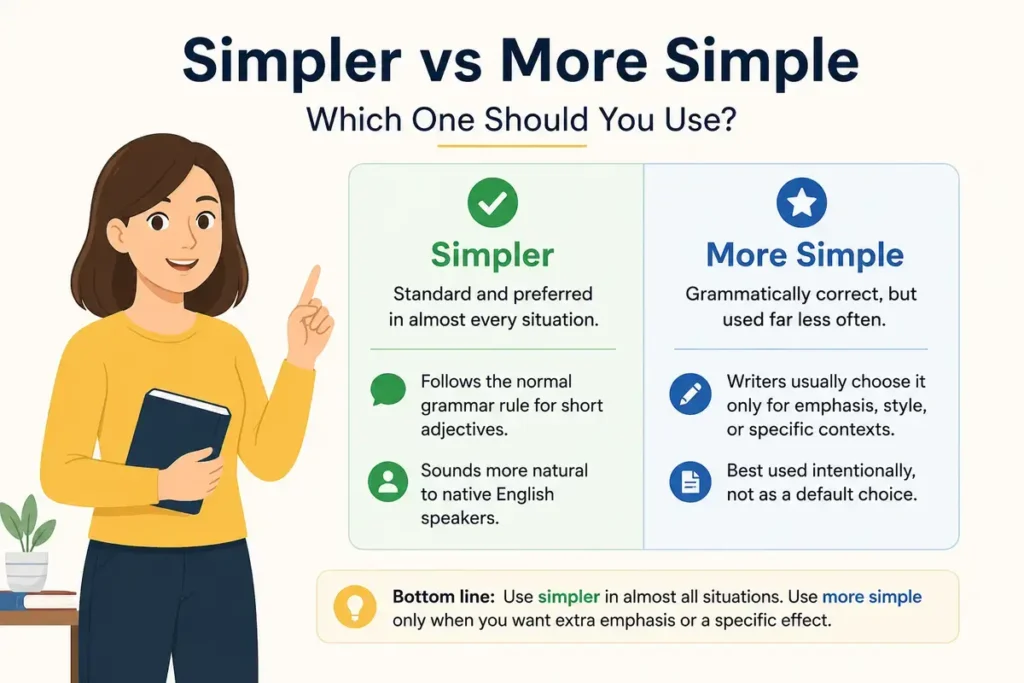
Both simpler and more simple can be grammatical, but simpler is usually the better default.
Simple commonly forms its comparative with er, giving us simpler. More simple can appear when a writer wants a deliberate contrast or extra emphasis, but it may sound less natural in ordinary conversation.
For most sentences, choose simpler.
For example:
This explanation is simpler.
That sentence sounds natural and direct.
Comparison Table Simpler Or More Simple
| Form | Meaning | Part of Speech | Origin | Usage Frequency | Formality | Common Contexts | Example |
|---|---|---|---|---|---|---|---|
| Simpler | More simple or less complicated | Comparative adjective | From simple plus the comparative suffix er | Very common | Neutral | Conversation, school, work, general writing | This method is simpler. |
| More simple | More simple or less complicated | Comparative adjective phrase | More plus simple | Less common as the default form | Neutral to marked | Contrast, emphasis, careful prose | We need a more simple explanation. |
The important point is that the two expressions can carry the same basic comparative meaning. The difference usually lies in naturalness, emphasis, and sentence structure rather than a completely different definition.
Meaning And Definition
Meaning Of Simpler
Simpler is the comparative form of simple.
Simple can describe something that is easy to understand, easy to use, uncomplicated, plain, or not made up of many parts. Simpler compares one thing with another and says that the first requires less complexity.
For example:
This explanation is simpler than the first one.
The sentence compares two explanations. The second explanation is more complex while the first has less complexity.
Simpler can describe many different things.
A simpler design may contain fewer visual elements.
A simpler explanation may use easier language.
A simpler process may involve fewer steps.
A simpler solution may require less effort.
A simpler lifestyle may involve fewer possessions or commitments.
The exact shade of meaning depends on the noun being described.
Meaning Of More Simple
More simple also expresses a comparative idea. It means more simple or less complicated.
For example:
We need a more simple way to explain the process.
This sentence is understandable and grammatically possible. Still, many American English speakers would naturally say:
We need a simpler way to explain the process.
The second version is shorter and more idiomatic in ordinary usage.
More simple can become useful when the writer wants to preserve the adjective as a separate unit or create a specific contrast.
For example:
The goal isn’t to make the system more powerful. It’s to make it more simple.
That wording gives simple extra emphasis. A writer might choose it for rhetorical effect.
The Key Difference
The central difference is not meaning. Both forms can express a higher degree of simplicity.
The real difference is how English normally builds comparisons.
- Simpler uses the comparative suffix er. This is the usual pattern for simple in standard modern English.
- More simple uses the word more. This is another comparative construction that can work grammatically but is less common as the default.
- Simpler usually sounds more natural. Native speakers often choose the shorter form in everyday conversation and ordinary writing.
- More simple can add emphasis. In some sentences, writers deliberately use the longer construction to highlight the quality itself.
- Context matters. A sentence may sound smooth with simpler but awkward with more simple, or occasionally the reverse may happen because of surrounding words.
Think of simpler as the normal road. More simple is another road that can still take you to the same destination.
Why Simple Uses Simpler
English has several ways to create comparative adjectives.
Many short adjectives take er.
Small becomes smaller.
Fast becomes faster.
Bright becomes brighter.
Simple commonly follows this pattern.
Simple becomes simpler.
The spelling also changes slightly. The final e in simple is retained in simpler.
Simple → simpler.
There is no need to add an extra syllable to the comparative phrase. The word already works naturally with er.
This is why the sentence below feels so natural:
The new system is simpler than the old one.
English speakers encounter this pattern constantly, so simpler has become firmly established as the ordinary comparative form.
When More Simple Can Work
More simple is not automatically wrong.
There are situations where writers use the phrase for emphasis or contrast.
Consider:
We don’t need a more complex solution. We need a more simple one.
The parallel structure makes more simple stand out. The writer is deliberately contrasting more complex with more simple.
Another example is:
The instructions should become more simple and easier to follow.
This sentence can be understood, although many editors would prefer simpler and easier to follow.
The choice can also depend on rhythm.
Compare:
The design became simpler.
The design became more simple.
The first is cleaner and more direct. The second places more emphasis on the adjective simple itself.
In professional editing, the first version would usually be the default unless the context gives the longer form a clear purpose.
Is More Simple Grammatically Correct
Yes, more simple can be grammatically acceptable.
However, grammatical possibility and natural preference are not always the same thing.
English contains many expressions that are grammatically possible but less common. Native speakers often choose the construction that feels most established in a particular context.
For example:
This approach is simpler.
This approach is more simple.
Both can communicate the same basic idea. The first normally sounds more natural and efficient.
You should therefore avoid treating more simple as a spelling mistake or a grammatical disaster. It is better described as a less common comparative construction.
That distinction matters for good language advice. Grammar is not always a simple choice between correct and incorrect. Usage, context, emphasis, and style also influence what sounds natural.
Sentence Examples With Simpler
- This explanation is simpler than the one in the textbook.
- We need a simpler way to organize these files.
- The new design is simpler and easier to use.
- Her instructions were much simpler than mine.
- This recipe is simpler than the original version.
- The teacher gave us a simpler example to explain the concept.
- I chose the simpler option because I didn’t need extra features.
- The updated form has a simpler layout.
- A simpler approach may save time and reduce confusion.
- The second method is simpler for beginners.
These examples reflect the most common everyday use. In each sentence, simpler compares a quality between two things or situations.
Examples With More Simple
More simple can also appear naturally in certain contexts.
- The goal is to make the process more simple for new users.
- We need a more simple explanation for younger students.
- The new policy is more simple than the old one.
- The design should become more simple and easier to understand.
- The writer chose a more simple style for the final section.
These sentences are understandable, but many editors would replace more simple with simpler in ordinary prose.
For example:
The goal is to make the process simpler for new users.
That version usually sounds smoother.
Common Mistakes
Treating More Simple As Always Wrong
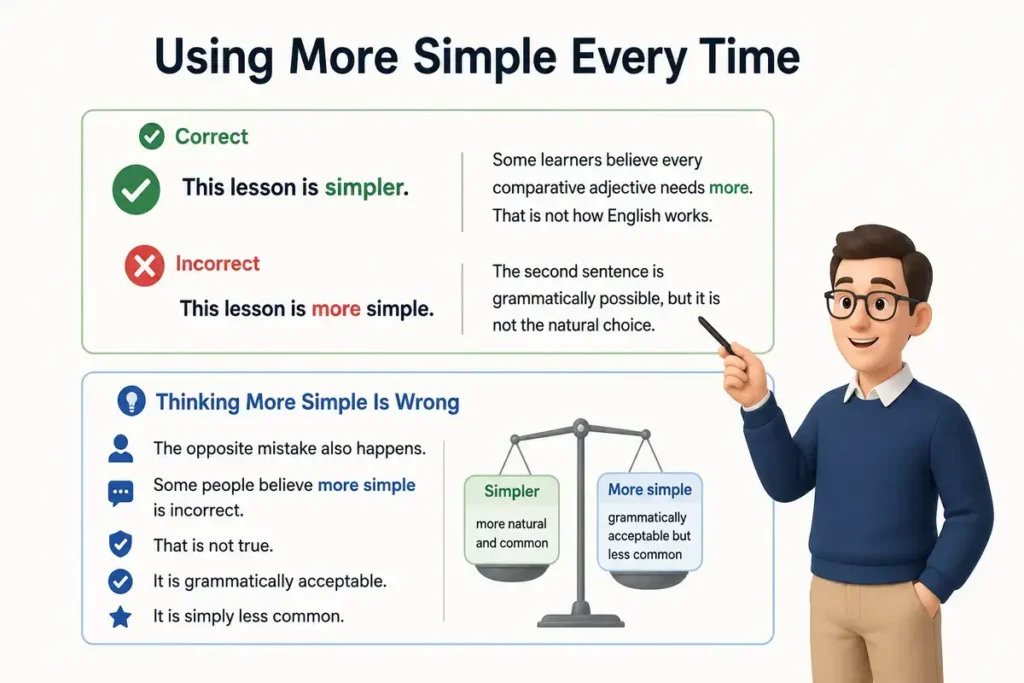
This is one of the biggest mistakes. More simple can be grammatical. It is simply less common as the normal comparative form.
A better rule is to prefer simpler unless the longer construction serves a clear stylistic purpose.
Assuming Every Two Syllable Adjective Uses More
English learners sometimes memorize a rule saying adjectives with two syllables must use more.
That rule is too broad.
English has many two syllable adjectives that commonly take er.
Simple can use simpler.
Narrow can use narrower.
Quiet can use quieter.
Clever can use cleverer.
The pattern depends on the individual adjective and established usage.
Using Both Comparative Markers
Avoid combinations such as:
More simpler.
This construction uses both more and the comparative suffix er. In standard edited English, that is considered a double comparative.
Use:
The new system is simpler.
Or:
The new system is more simple.
Do not combine them.
Adding Than Without A Real Comparison
Comparatives often appear with than.
This method is simpler than the old one.
However, than isn’t always required. Context can provide the comparison.
This method is simpler.
The sentence can still be complete because the listener or reader can understand that the method has a lower level of complexity.
Confusing Simple With Easy
Simple and easy overlap but don’t always mean the same thing.
A simple machine may have few parts.
An easy task may require little effort.
A task can be simple but still difficult because it requires patience or physical skill.
For example:
The instructions are simple but the task is tiring.
That distinction can improve precision in your writing.
Pronunciation Guide
Simpler is commonly pronounced /ˈsɪmplər/ in American English.
A simple pronunciation guide is:
SIM pler.
The main stress falls on the first syllable.
Simple is commonly pronounced /ˈsɪmpəl/.
When the comparative ending is added, the word becomes slightly longer:
simple → simpler.
More simple is pronounced as two separate words:
MORE SIM pul.
The pronunciation itself isn’t the main reason for choosing one form. The decision is mostly about established usage and sentence style.
One common mistake is trying to pronounce every written letter in simple. The final e isn’t pronounced as a separate vowel sound.
Still confused? Compare Oversite vs Oversight Which Is Correct.
Etymology And Word Origin
Simple comes into English through French from Latin simplex.
The Latin word simplex carried the idea of something single, uncomplicated, or not divided into multiple parts. Over time, the word developed through French and entered Middle English before becoming part of modern English vocabulary.
The comparative form simpler developed through the normal English process of adding the comparative suffix er.
This is not unusual. English has used er for comparative adjectives for centuries.
The word simple itself has also developed a wide range of meanings. It can describe something uncomplicated, plain, basic, sincere, or lacking complexity. Context determines which sense is intended.
That history helps explain why simple behaves naturally as an adjective that can form a comparative with er.
Regional Usage
American English
In American English, simpler is the ordinary comparative form and the one most speakers would naturally choose in everyday communication.
You’ll see it in school writing, business communication, general nonfiction, conversation, instructions, and online communication.
More simple is still understandable and can be grammatical. It may sound more deliberate or formal depending on the sentence.
British English
British English also commonly uses simpler.
There is no major regional grammar rule that requires British speakers to use more simple instead. The same general distinction applies. Simpler is the natural default while more simple can occur in particular contexts.
Australian English
Australian English generally follows the same pattern. Simpler is widely used as the ordinary comparative form.
More simple can occur as a stylistic construction, but it isn’t a special Australian alternative.
Canadian English
Canadian English also commonly uses simpler. The general comparative pattern is consistent with both American and British English.
There is no major regional difference that changes the basic recommendation for ordinary writing.
Grammar Rules And Part Of Speech
Simple is an adjective.
Simpler is its comparative adjective form.
The comparative form normally compares two things.
This book is simpler than that one.
The new instructions are simpler than the old instructions.
The comparison can also be understood without using than.
The new system is simpler.
In this sentence, the listener can infer that the new system has a lower level of complexity than another system already known from context.
More can also form comparative phrases.
This explanation is more detailed.
That pattern is common with adjectives that normally don’t take er. With simple, however, simpler is already an established comparative form.
The most important grammar rule is to avoid the double comparative.
Incorrect:
This method is more simpler.
Correct:
This method is simpler.
Also correct in a different style:
This method is more simple.
The first version is the normal choice for most situations.
Comparative And Superlative Forms
Understanding the whole adjective family makes the pattern easier.
The basic adjective is:
Simple.
The comparative form is:
Simpler.
The superlative form is:
Simplest.
For example:
This explanation is simple.
This explanation is simpler than the first one.
This is the simplest explanation in the book.
The superlative compares one item with a larger group or identifies the highest degree of the quality.
You should not write more simplest.
That creates the same type of double comparison problem.
Use simplest.
Simple Versus Simpler Versus Simplest
These three forms have different jobs.
Simple describes the quality without making a comparison.
The instructions are simple.
Simpler compares two things.
These instructions are simpler than the previous ones.
Simplest identifies the highest degree within a group.
These are the simplest instructions in the manual.
The distinction is straightforward once you focus on the number of things being compared.
Two items usually call for the comparative.
Three or more items may call for the superlative when you’re identifying the highest degree.
Real Life Usage Examples
Daily Conversation
I found a simpler way to get there.
The new recipe is simpler than the one we used last week.
In casual speech, simpler is strongly natural because speakers usually favor short and familiar comparative forms.
Email And Workplace Communication
We need a simpler process for handling customer requests.
The revised form is simpler and should reduce confusion.
These examples work well in workplace communication because they are direct and easy to understand.
Academic Writing
The second model provides a simpler explanation of the observed pattern.
A simpler method may be easier to reproduce across different studies.
Academic writing often favors precise comparisons. Simpler works naturally when the writer is comparing complexity between approaches.
News Writing
The city introduced a simpler process for applying for permits.
The updated system is simpler than the previous process.
Journalistic writing generally favors clear and familiar language. Simpler fits that style well.
Literature And Storytelling
He wanted a simpler life away from the noise of the city.
She chose the simpler path and never looked back.
In storytelling, the word can carry more than a technical meaning. Simpler can suggest peace, fewer demands, or a return to basics.
When Simpler Is The Better Choice
For most everyday writing, simpler is the safest choice.
It is concise.
It is familiar.
It follows an established comparative pattern.
It sounds natural in conversation.
It works in formal writing too.
For example:
We need a simpler explanation.
This is simpler than the previous method.
The second option is simpler for beginners.
None of these sentences sounds casual or weak. Simpler works perfectly well in professional and academic contexts.
That is worth remembering because some writers assume that more simple sounds more formal. Usually, adding more does not automatically make a sentence more sophisticated.
Good formal writing often uses the simplest natural construction.
When More Simple May Be Useful
There are situations where more simple can be a deliberate choice.
One is contrast.
We don’t want a more complicated system. We want a more simple system.
Another is parallel structure.
The new approach should be more simple, more direct, and more practical.
A writer may choose this structure because the repeated more creates a rhythm.
There is also a case where another word interrupts the normal comparative pattern.
For example:
The process became much more simple than expected.
Many editors would still prefer much simpler than expected. But the longer form may appear in particular writing styles.
The key point is not that more simple is required. It is that context can make it understandable and stylistically intentional.
Related And Confused Terms
Simpler
The normal comparative form of simple. It means less complicated or easier to understand in comparison with something else.
Simplest
The superlative form. It identifies the item with the lowest level of complexity in a group.
Simple
The base adjective. It describes something without making a comparison.
Easier
Easier means requiring less effort or being less difficult. It overlaps with simpler but does not always mean the same thing.
Clearer
Clearer means easier to understand or less confusing. A simpler explanation may also be clearer, but the words focus on different qualities.
Basic
Basic describes something fundamental or not advanced. A basic system can still be complicated in how it operates.
Straightforward
Straightforward means easy to understand or deal with because there are few hidden complications.
Less Complicated
This is a direct alternative to simpler. It can be especially useful when you want to make the comparison completely explicit.
Simpler And Easier Are Not Always The Same
This distinction deserves attention because writers often use these words as exact synonyms.
Suppose you have a machine with fewer parts. You might call it simpler.
Now imagine a difficult math problem with a very simple formula. The formula may be simple but the problem could still be hard to solve.
Likewise, an activity can be complicated but easy for an expert.
For example:
The software is simpler to use.
The software is easier to use.
These sentences are close, but the first focuses more on the design or complexity of the software. The second focuses more on the user’s effort.
Choosing the right adjective can make your writing more precise.
Expert Editor Insight
An experienced editor would normally choose simpler as the default comparative form because it is concise, familiar, and natural across both casual and formal American English. More simple isn’t something to mark automatically as an error. Instead, the editor would ask why the writer chose it and whether the longer construction improves the sentence. The most useful editing test is to read the sentence aloud. If simpler sounds smooth and nothing is gained by adding more, simpler is usually the cleaner choice.
Key Takeaways
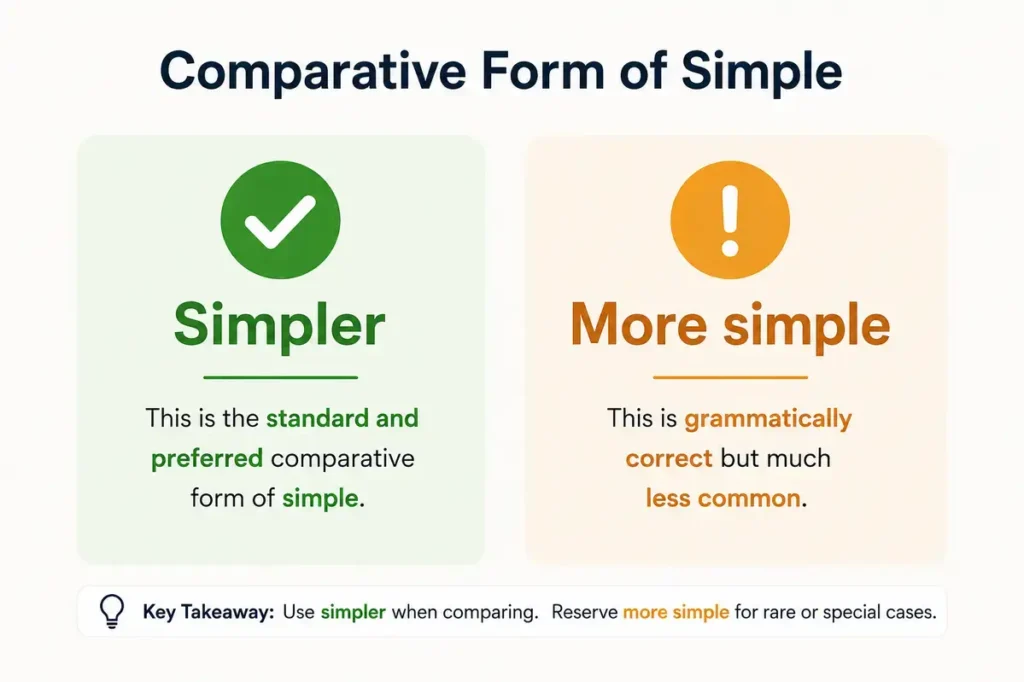
- Simpler is the standard and preferred comparative form of simple.
- More simple is grammatically correct but much less common.
- Native speakers almost always choose simpler in everyday conversation and professional writing.
- American English and British English both favor simpler.
- Never write more simpler because it combines two comparative forms.
- Use more simple only when a specific style, rhythm, or emphasis clearly improves the sentence.
- Choosing simpler usually makes your writing sound smoother, more natural, and more confident.
Learn the difference in totalling or totaling Which Spelling Should You Use.
Conclusion
simpler or more simple is a comparison between two valid grammatical constructions, but simpler is the usual and more natural choice for most American English writing. It works smoothly in conversation, school work, professional communication, academic writing, and everyday explanations. More simple can also be grammatical, especially when a writer wants emphasis, contrast, or a particular rhythm.
The main rule is easy to remember. Simple normally becomes simpler in the comparative form and simplest in the superlative form. Avoid the double comparative more simpler. When you’re editing your own sentence, read it aloud and ask which version sounds direct and natural. In most cases, simpler will give you the cleanest result without changing the meaning.
FAQs
Is simpler grammatically correct?
Yes. Simpler is the standard comparative form of simple and is fully grammatical. You can use it when comparing two things that differ in complexity, clarity, design, or another quality associated with simplicity. For example, This method is simpler than the old one is a natural sentence. Simpler works in casual conversation as well as formal writing.
Is more simple also correct?
Yes. More simple can be grammatically acceptable, although it is less common as the ordinary comparative form. In most straightforward sentences, simpler sounds more natural. More simple may appear for emphasis, contrast, or stylistic rhythm. It shouldn’t be treated as a spelling mistake, but it usually isn’t the first choice for everyday American English.
Which sounds more natural in American English?
Simpler is generally the more natural choice in ordinary American English. Native speakers commonly use it in conversation, school writing, workplace communication, instructions, and general nonfiction. More simple is understandable and can be grammatical, but it may sound more deliberate or marked. If you’re unsure which form to choose, simpler is usually the safest option.
Can I use simpler in formal writing?
Yes. Simpler is completely appropriate for formal writing. You can use it in academic papers, reports, professional emails, technical explanations, and business documents. Formal writing does not require you to replace common comparative forms with longer constructions. In fact, a clear and concise word is often preferable. For example, a simpler method is a natural phrase in a formal research context.
Why do people say more simple?
People use more simple for several reasons. Some speakers follow the general pattern of placing more before adjectives that seem longer. Others may use it for emphasis or because the sentence has a particular rhythm. English allows some flexibility in comparative formation. Even so, simpler is the more established everyday comparative form for most contexts.
Is more simpler correct?
No. More simpler is normally considered a double comparative because it combines two comparative markers. The suffix er already makes simple comparative. Use simpler or use more simple if that construction fits the context. For example, write The new design is simpler than the old one. Don’t write The new design is more simpler than the old one.
What is the comparative form of simple?
The usual comparative form is simpler. The basic adjective is simple, the comparative is simpler, and the superlative is simplest. For example, This task is simple. This task is simpler than the first one. This is the simplest task in the group. These forms follow a familiar comparative pattern in English.
Is simpler better than more simple in every sentence?
Not necessarily. Simpler is the normal choice and will sound natural in most sentences, but context can make more simple useful. A writer might choose the longer construction for emphasis or parallel structure. The important point is to avoid assuming that one form is always grammatical and the other is always wrong. Consider clarity, rhythm, and intended emphasis.