
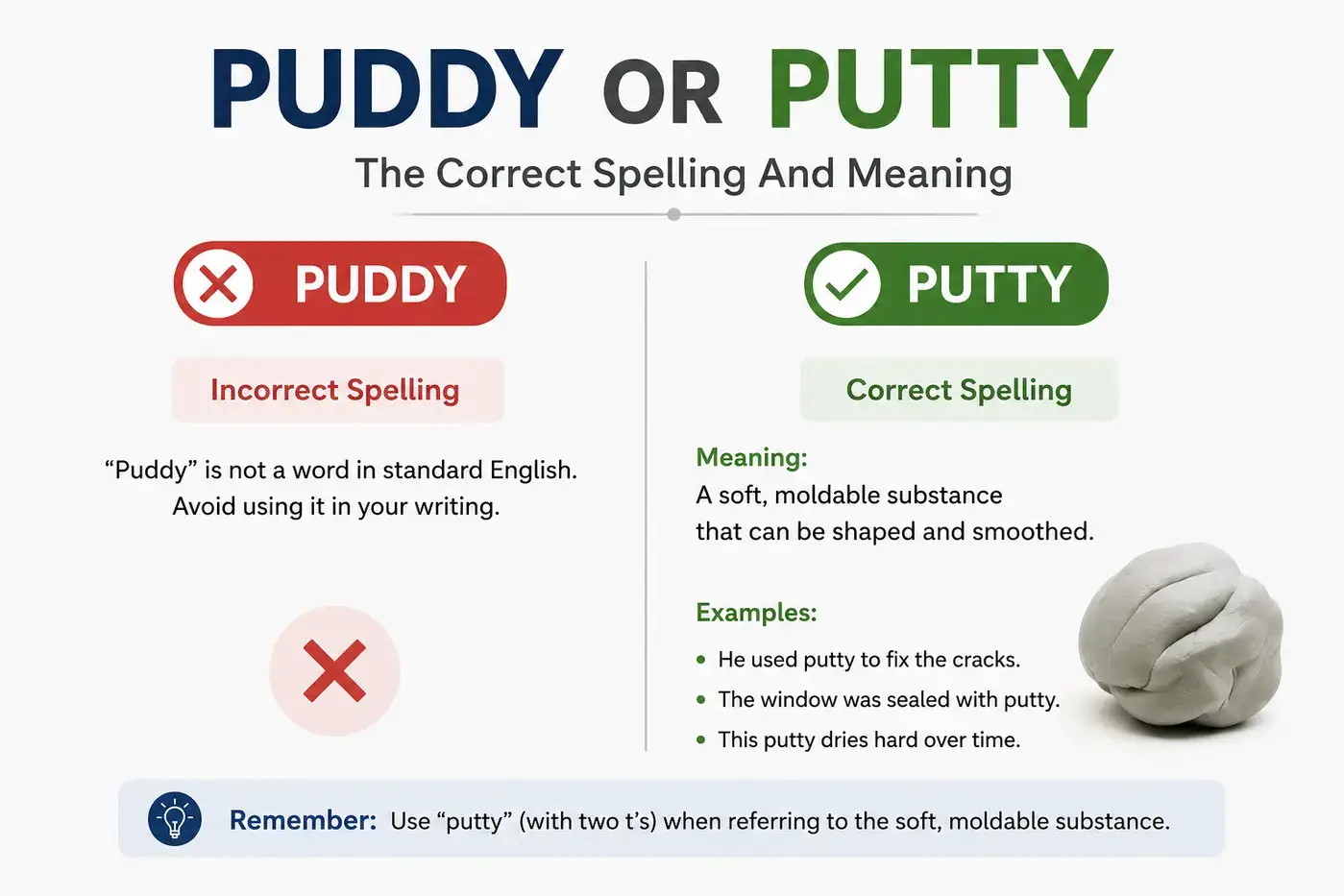
If you’ve come across the words puddy and putty, you might wonder if they are different spellings of the same word or if one is simply a mistake. This confusion is surprisingly common because the two words look similar and sound nearly identical when spoken quickly.
In most situations, putty is the correct English word. It’s a well established noun that refers to a soft, moldable substance used in construction, repairs, crafts, and even therapy exercises. Puddy, on the other hand, is generally not recognized as a standard English word. Most often, it’s a misspelling of putty, though it can occasionally appear as a surname, nickname, or character name.
The confusion grows because English contains many words with double consonants, and people sometimes guess the spelling based on pronunciation alone. Since putty sounds like it could be spelled puddy, mistakes frequently appear in online searches, social media posts, and informal writing. This guide explains the meaning of each term, their origins, pronunciation, grammar rules, usage examples, common mistakes, and the correct spelling to use in professional and everyday communication.
A related grammar guide is Choosing or Chosing Meaning, Usage and 20 Examples 2026.
Quick Definition Puddy Or Putty
Putty is the correct English word and refers to a soft, pliable material used for filling cracks, sealing surfaces, crafting, or therapeutic exercises. Puddy is usually a misspelling of putty and is not considered a standard English word in modern dictionaries.
Puddy Or Putty Quick Answer
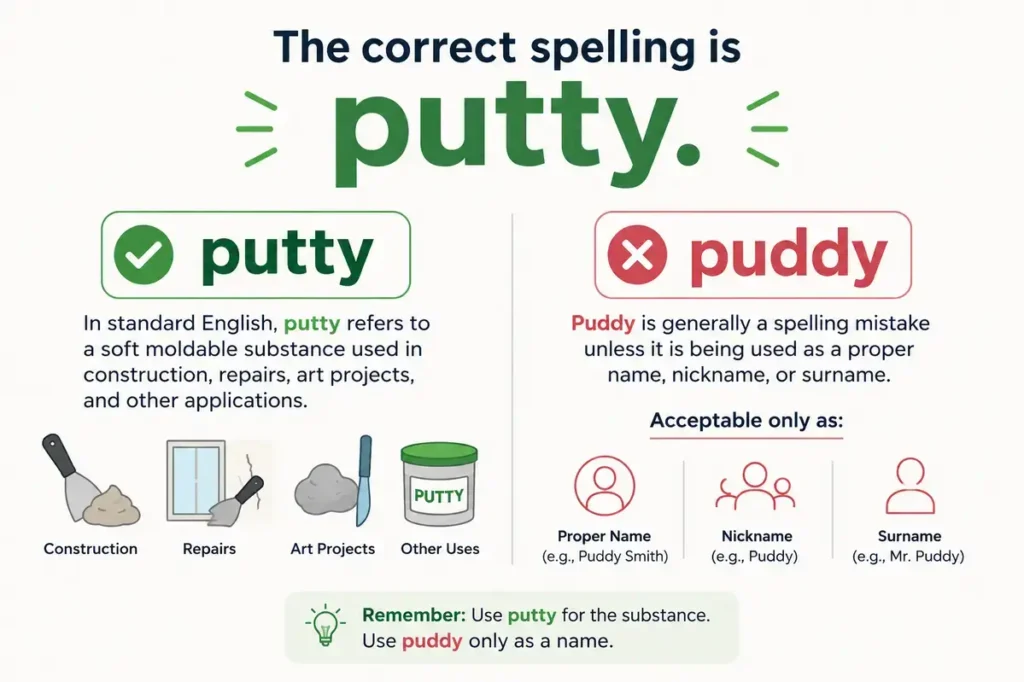
The correct spelling is putty. In standard English, putty refers to a soft moldable substance used in construction, repairs, art projects, and other applications. Puddy is generally a spelling mistake unless it is being used as a proper name, nickname, or surname.
Puddy Or Putty Comparison Table
| Feature | Puddy | Putty |
|---|---|---|
| Standard English Word | No | Yes |
| Dictionary Recognition | Rare | Yes |
| Part Of Speech | Usually proper noun | Noun |
| Primary Meaning | Name or misspelling | Soft sealing or molding material |
| Usage Frequency | Very low | Very high |
| Professional Acceptance | No | Yes |
| Common Contexts | Names and nicknames | Construction, repairs, crafts |
| Formal Writing | Generally avoided | Accepted |
| Pronunciation | Similar to putty | Standard pronunciation |
| Correct Choice For Material | No | Yes |
Meaning Of Puddy
Although many people search for puddy, the term has limited use in standard English.
Definition Of Puddy
Puddy does not have a widely accepted dictionary definition as a common English noun. Most appearances fall into one of these categories:
- A misspelling of putty.
- A surname.
- A fictional character name.
- A personal nickname.
- A brand or business name.
Context Of Puddy
You may occasionally encounter puddy in:
- Character names in television or fiction.
- Family names.
- Online usernames.
- Informal internet content.
Outside those situations, the word rarely appears in edited English writing.
Usage Of Puddy
Examples include:
- Mr. Puddy attended the meeting.
- Puddy became a memorable television character.
- The username included the word Puddy.
In these examples, the term functions as a name rather than a vocabulary word.
Meaning Of Putty
Putty is a common English noun with several practical applications.
Definition Of Putty
Putty is a soft substance that can be shaped by hand and is often used to fill holes, seal gaps, repair surfaces, or create artistic projects.
Common Types Of Putty
Several varieties exist:
- Glazing putty.
- Wood putty.
- Wall putty.
- Epoxy putty.
- Silicone putty.
- Therapy putty.
- Modeling putty.
Each serves a specific purpose, but all share the characteristic of being soft and moldable.
Context Of Putty
The word frequently appears in:
- Home improvement.
- Construction.
- Woodworking.
- Art projects.
- Occupational therapy.
- Manufacturing.
Usage Of Putty
Examples include:
- Apply putty to the crack before painting.
- The carpenter used wood putty to repair the surface.
- The therapist provided putty exercises for hand strength.
Puddy Or Putty Meaning Comparison
The biggest difference is that one term is a recognized English word and the other generally is not.
Puddy Meaning
Primarily functions as a name or misspelling.
Putty Meaning
Refers to a specific material used in construction, repairs, crafts, and therapy.
Why People Confuse Them
Several factors contribute:
- Nearly identical pronunciation.
- Similar spelling patterns.
- Fast typing errors.
- Autocorrect mistakes.
- Limited familiarity with construction terminology.
Puddy Or Putty Key Differences
Understanding the distinctions helps eliminate confusion.
Meaning Differences
Putty has a recognized dictionary meaning. Puddy generally does not.
Usage Differences
Putty appears regularly in professional and everyday writing. Puddy rarely appears outside names.
Grammar Differences
Putty functions as a common noun. Puddy usually functions as a proper noun.
Dictionary Status Differences
Putty appears in major English dictionaries. Puddy typically does not appear as a standard vocabulary entry.
Context Differences
Putty belongs to practical, technical, and creative contexts. Puddy belongs mainly to naming contexts.
Puddy Or Putty Which One Is Correct
The answer depends on what you’re trying to say. If you’re referring to a soft material used for filling, sealing, molding, repairing, or crafting, putty is the correct spelling.
Examples:
- Wall putty.
- Wood putty.
- Therapy putty.
- Glazing putty.
If you’re referring to a person’s surname, nickname, or character name, puddy may be correct. For ordinary English writing, however, putty is almost always the intended word.
Why Putty Is The Standard Spelling
English spelling often preserves historical forms rather than reflecting modern pronunciation. Although some people expect the word to contain a d because of how it sounds, English standardized the spelling as putty centuries ago.
As a result:
- Dictionaries use putty.
- Manufacturers use putty.
- Construction professionals use putty.
- Teachers use putty.
- Editors use putty.
That widespread acceptance makes putty the only correct choice in standard writing.
Puddy Or Putty In Construction And Home Repair
Many searches for this phrase come from homeowners, contractors, and DIY enthusiasts. In construction, putty plays an important role. Common applications include:
- Filling nail holes.
- Repairing cracks.
- Smoothing surfaces.
- Sealing window panes.
- Preparing walls before painting.
- Fixing minor cosmetic damage.
Because the word appears frequently in hardware stores and product labels, learning the correct spelling helps prevent mistakes when shopping or researching repair methods.
Puddy Or Putty In Arts And Crafts
Artists and hobbyists also use putty regularly. Creative applications include:
- Sculpting.
- Modeling.
- Jewelry making.
- School projects.
- Decorative crafts.
- Prototype design.
The material’s flexibility makes it useful for shaping detailed designs before hardening or painting.
Puddy Or Putty In Therapy And Rehabilitation
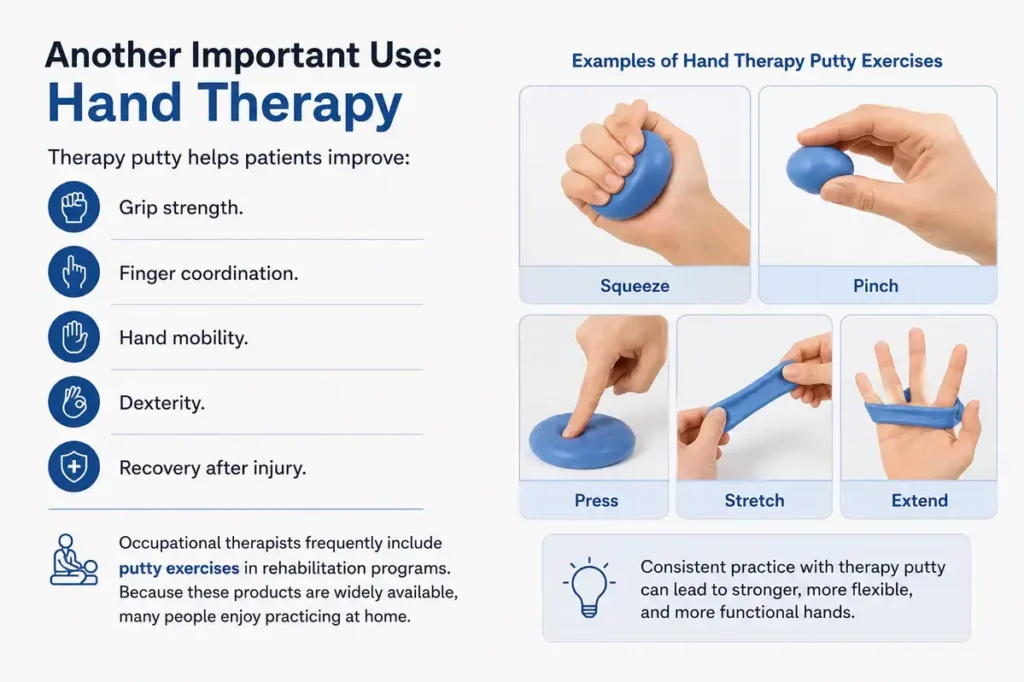
Another important use involves hand therapy. Therapy putty helps patients improve:
- Grip strength.
- Finger coordination.
- Hand mobility.
- Dexterity.
- Recovery after injury.
Occupational therapists frequently include putty exercises in rehabilitation programs. Because these products are widely available, many people encounter the term during recovery or physical therapy sessions.
Puddy Or Putty Examples In Sentences
Examples make it easier to understand how each word functions in real English.
Ten Examples Using Puddy
Since puddy is usually a name rather than a standard vocabulary word, most examples involve people or fictional characters.
- Mr. Puddy arrived early for the conference.
- The author introduced a character named Puddy.
- Coach Puddy led the team to victory.
- Puddy appeared in several scenes during the episode.
- The award was presented to Sarah Puddy.
- Everyone recognized the famous character Puddy.
- Puddy signed copies of the new book.
- The article mentioned a local businessman named Puddy.
- Puddy became a memorable figure in the story.
- The reporter interviewed Mr. Puddy after the event.
Ten Examples Using Putty
These examples show standard English usage.
- The painter applied putty before sanding the wall.
- We used putty to fill the small cracks.
- The carpenter selected wood putty for the repair.
- She molded the putty into a small sculpture.
- The therapist recommended exercises using putty.
- Fresh putty helped seal the window frame.
- The child enjoyed shaping colorful putty during art class.
- The technician repaired the surface with epoxy putty.
- Putty made the damaged area look smooth again.
- He purchased a container of putty from the hardware store.
For another common grammar confusion, see Catalogue or Catalog: Which Spelling Is Correct?.
Puddy Or Putty Common Mistakes
Many spelling errors happen because people write words the way they hear them. The confusion between puddy and putty is a perfect example.
Mistake One
Using puddy when referring to construction materials.
Incorrect:
I bought puddy to repair the wall.
Correct:
I bought putty to repair the wall.
Mistake Two
Assuming both spellings are interchangeable.
They are not.
Putty is the standard English word.
Puddy is generally not.
Mistake Three
Trusting phonetic spelling. English spelling does not always match pronunciation exactly. Many learners assume the sound of a word automatically reveals its spelling. That approach often causes errors.
Mistake Four
Copying misspellings found online. Search engines contain countless spelling mistakes. Just because a word appears online does not mean it is correct.
Mistake Five
Capitalizing putty unnecessarily. Putty is a common noun. It should not be capitalized unless it begins a sentence.
Puddy Or Putty Pronunciation Guide
One reason for confusion is pronunciation.
The two words sound extremely similar.
Puddy Pronunciation
IPA:
/ˈpʌdi/
Syllable breakdown:
Pud dy
Putty Pronunciation
IPA:
/ˈpʌti/
Syllable breakdown:
Put ty
Why They Sound Similar
In casual American speech, the t sound between vowels often becomes softer. As a result, putty may sound close to puddy. This pronunciation pattern appears in many English words.
Examples include:
- Water.
- Better.
- Pretty.
- City.
- Butter.
Because of this natural speech pattern, many people mistakenly assume the spelling should contain a d.
Common Pronunciation Mistakes
- Overemphasizing the t sound.
- Pronouncing the word with a long u sound.
- Adding an extra syllable.
- Stressing the second syllable instead of the first.
Native speakers normally place stress on the first syllable.
Puddy Or Putty Etymology And Word Origin
Word history often explains modern spelling patterns.
Origin Of Putty
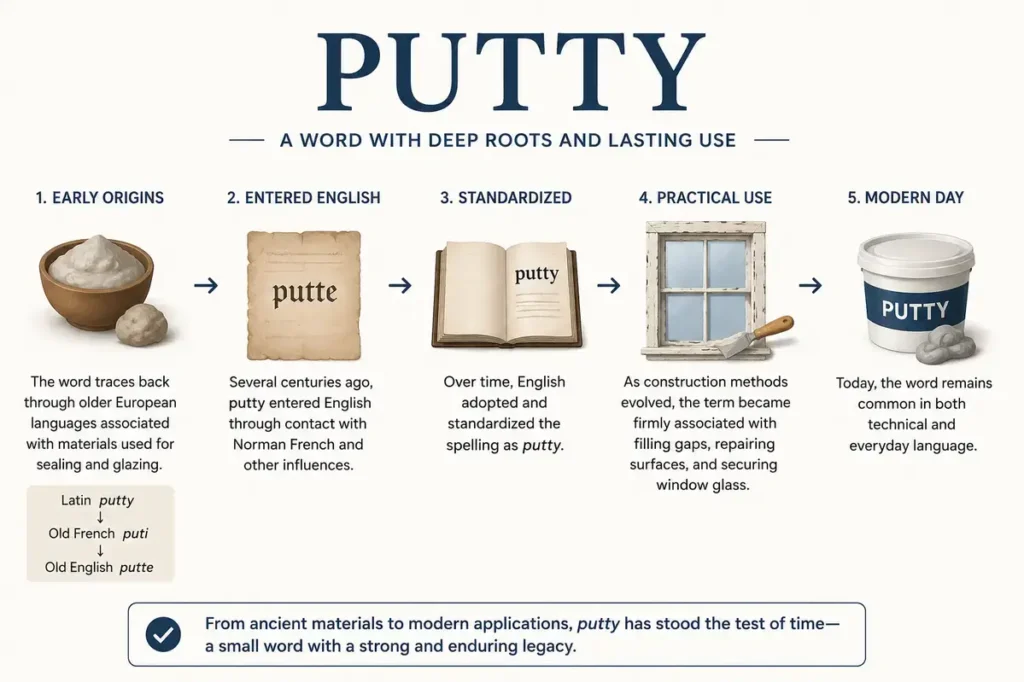
Putty entered English several centuries ago. The word traces back through older European languages associated with materials used for sealing and glazing. Over time, English adopted and standardized the spelling as putty. As construction methods evolved, the term became firmly associated with filling gaps, repairing surfaces, and securing window glass. Today, the word remains common in both technical and everyday language.
Evolution Of Putty In English
The meaning expanded gradually.
Originally linked mainly to glazing work, the term later came to include:
- Wood fillers.
- Repair compounds.
- Craft materials.
- Sculpting compounds.
- Therapy products.
Despite these expanded uses, the spelling remained unchanged.
Origin Of Puddy
Unlike putty, puddy does not share the same history as a standard English noun.
Most appearances involve:
- Personal names.
- Family names.
- Fictional characters.
- Brand identities.
Because it developed through naming conventions rather than vocabulary evolution, it lacks the widespread dictionary recognition of putty.
Puddy Or Putty Regional Usage
The spelling putty remains standard throughout major English speaking countries.
American English
American English overwhelmingly uses putty.
Examples include:
- Wall putty.
- Wood putty.
- Glazing putty.
- Therapy putty.
Puddy appears mainly as a name.
British English
British English follows the same pattern. Putty is the accepted spelling for the material. Construction guides, dictionaries, and educational resources all use putty.
Canadian English
Canadian English also recognizes putty as the standard form. Professional publications consistently use this spelling.
Australian English
Australian English follows the same convention. Hardware stores, construction manuals, and trade publications all use putty.
Global English
Across international English usage, putty remains the recognized spelling. This consistency makes it easy to identify the correct form regardless of region.
Puddy Or Putty Grammar Rules
Grammar helps explain how the word functions within sentences.
Part Of Speech
Putty is primarily a noun.
Examples:
- The putty dried overnight.
- We bought more putty.
- The putty filled the crack.
Countable Or Uncountable
Putty is usually treated as an uncountable noun.
Examples:
Correct:
- We need more putty.
- The putty is drying.
Incorrect:
- We need three putties.
In technical contexts, different products may occasionally be discussed as separate putties, but everyday usage treats the word as uncountable.
Singular And Plural Usage
Most situations use only the singular form.
Examples:
- This putty works well.
- The putty hardened quickly.
When discussing multiple product types, plural usage may appear.
Example:
Several specialty putties were tested.
Articles And Determiners
Putty commonly appears with:
- Some.
- More.
- The.
- This.
- That.
Examples:
- Some putty remained in the container.
- This putty is easier to shape.
- The putty needs more time to dry.
Common Sentence Structures
Writers frequently use patterns such as:
- Apply putty to the surface.
- Fill the crack with putty.
- Allow the putty to dry.
- Shape the putty carefully.
These structures appear in instruction manuals, repair guides, and educational materials.
Puddy Or Putty In Professional Writing
Editors almost always correct puddy when it appears as a misspelling. Professional industries that regularly use the word putty include:
- Construction.
- Manufacturing.
- Architecture.
- Engineering.
- Occupational therapy.
- Education.
- Product development.
Accurate spelling helps maintain credibility and professionalism. A single misspelling can make technical writing appear less reliable.
Puddy Or Putty In Digital Searches
Search behavior reveals just how common this confusion has become.
People frequently search for:
- Puddy meaning.
- Puddy or putty.
- Is puddy a word.
- Correct spelling of putty.
- Putty definition.
- Putty pronunciation.
These searches indicate that users are primarily looking for spelling clarification rather than a comparison of two equally valid words. That makes this topic largely a spelling and usage question rather than a true vocabulary debate.
Puddy Or Putty Real Life Usage Examples
Understanding how native speakers use putty in everyday situations can help eliminate any remaining confusion.
Daily Conversation
People often use putty when discussing home repairs or DIY projects.
Examples:
- I need some putty to fix the crack above the door.
- The old putty around the window needs replacing.
- We bought fresh putty before repainting the room.
Academic Writing
Technical and educational materials frequently mention putty in engineering, construction, and design contexts.
Examples:
- The experiment used epoxy putty to create a sealed surface.
- Students examined the properties of modeling putty.
- The repair process included applying putty before painting.
Professional Communication
Construction professionals, contractors, and maintenance teams use the word regularly.
Examples:
- Apply putty before sanding the damaged area.
- The technician replaced the old glazing putty.
- Additional putty may be required to achieve a smooth finish.
Literature And Creative Writing
Writers sometimes use putty metaphorically.
Examples:
- His plans were as flexible as putty.
- The sculptor shaped the putty with remarkable precision.
- The material felt soft like putty in her hands.
Media And Advertising
The word appears frequently in product descriptions and advertisements.
Examples:
- Premium wood putty for professional repairs.
- Fast drying wall putty for interior surfaces.
- Therapy putty designed to improve hand strength.
Puddy Or Putty Related Words And Confused Terms
Several words commonly appear alongside putty or are confused with it.
Filler
A material used to fill gaps, dents, or imperfections.
Caulk
A sealing material used around windows, doors, and joints.
Mortar
A mixture used in masonry construction.
Plaster
A material used for coating walls and ceilings.
Epoxy
A strong adhesive compound often available in putty form.
Clay
A natural modeling material sometimes confused with putty because both can be shaped by hand.
Spackle
A wall repair compound commonly used before painting.
Sealant
A broad term covering materials used to block air, water, or debris.
Compound
A general term for manufactured repair materials.
Modeling Putty
A specialized type of putty used for artistic and educational projects.
Puddy Or Putty Commonly Confused Search Terms
People searching for puddy or putty also look for related questions.
Examples include:
- Putty meaning.
- Putty definition.
- How to spell putty.
- Putty pronunciation.
- Wood putty vs filler.
- Wall putty uses.
- Is puddy a real word.
- Putty examples in sentences.
- Putty grammar.
- Putty spelling.
These related searches reinforce the fact that users mainly want confirmation of the correct spelling and usage.
Puddy Or Putty Expert Language Insight
As an editor, one pattern appears repeatedly. People often trust pronunciation more than spelling. That works in some languages, but English doesn’t always follow predictable spelling rules. Putty is a good example. Many speakers hear a sound that resembles a d and naturally assume the spelling should be puddy. However, English spelling preserves the traditional form with tt.
Native speakers almost never write puddy when referring to repair materials, construction products, or craft compounds. If you write puddy in professional communication, readers will usually assume it is a typo. The safest approach is simple: Use putty for the material. Use puddy only when referring to a specific person, surname, nickname, or character name. That guideline works in nearly every situation.
Puddy Or Putty In Modern English Usage
Modern English favors consistency. Construction companies, product manufacturers, dictionaries, style guides, educators, and editors all use putty.
The word appears on:
- Product packaging.
- Hardware store websites.
- Repair manuals.
- Educational resources.
- Professional trade publications.
- Home improvement guides.
This widespread consistency leaves little room for spelling variation. Unlike some word pairs that differ by region, putty remains the accepted form across major English speaking countries.
Final Verdict On Puddy Or Putty
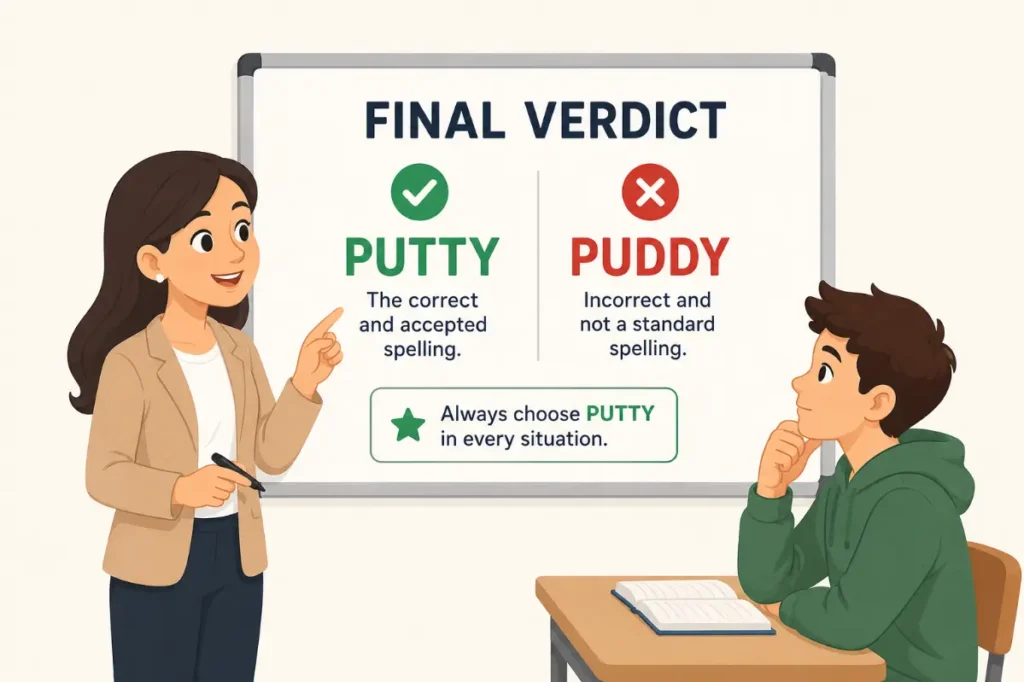
The answer is clear. Putty is the correct spelling in standard English. It refers to a soft material used for repairs, sealing, filling, crafting, and therapeutic exercises. It appears in dictionaries, construction guides, educational resources, and professional writing.
Puddy, by contrast, is usually a spelling mistake when someone intends to write putty. The only common exceptions involve personal names, surnames, nicknames, and fictional characters.If you’re discussing construction materials, home improvement products, craft supplies, or therapy tools, choose putty every time.
Still confused? Compare beginner wiring diagram Step by Step Easy Guide.
Conclusion Puddy Or Putty
The answer to puddy or putty is clear once you understand the correct spelling. Putty is the only standard English word and is widely accepted in dictionaries, professional writing, and everyday communication. Puddy is simply a misspelling that may appear because the two words can sound similar in casual speech.
A simple way to remember the difference is to think about the material used for filling cracks, sealing gaps, repairing surfaces, or shaping objects. In every one of these situations, the correct word is putty. If you write puddy, readers are likely to see it as a spelling mistake rather than a valid alternative.
Using the correct spelling makes your writing clearer, more professional and more credible. Whether you’re writing a DIY guide, a product description, a school assignment, or a business document, choosing putty instead of puddy ensures your English is accurate and polished every time.
Frequently Asked Questions About Puddy Or Putty
Is Puddy A Real Word?
Puddy is not generally recognized as a standard English vocabulary word. In most cases, it is a misspelling of putty. However, it may appear as a surname, nickname, fictional character name, or business name.
Is Putty The Correct Spelling?
Yes. Putty is the correct spelling when referring to a soft moldable substance used in construction, repairs, crafts, or therapy. It is the spelling recognized by dictionaries and professional publications.
Why Do People Spell Putty As Puddy?
The confusion comes from pronunciation. In casual American speech, the t sound often becomes softer and may resemble a d sound. As a result, some people mistakenly assume the spelling should be puddy.
What Does Putty Mean?
Putty is a soft, pliable material used to fill holes, seal gaps, repair surfaces, create crafts, and support therapeutic exercises. Different types include wood putty, wall putty, epoxy putty, and therapy putty.
Is Puddy Ever Correct?
Yes, but only in limited situations. If Puddy is part of a person’s name, surname, nickname, or fictional character name, it can be correct. It is not the correct spelling for the repair material.
How Do You Pronounce Putty?
Putty is commonly pronounced as /ˈpʌti/.
The word contains two syllables:
Put ty.
The stress falls on the first syllable.
Is Putty Used In British And American English?
Yes. Both British English and American English use putty as the standard spelling. The same applies to Canadian English and Australian English.
What Is The Difference Between Puddy And Putty?
Putty is a recognized English noun referring to a soft repair or molding material. Puddy is generally a misspelling or a proper name. The two words are not interchangeable in standard English writing.
1 thought on “Puddy or Putty Which Spelling Is Correct in 2026”