
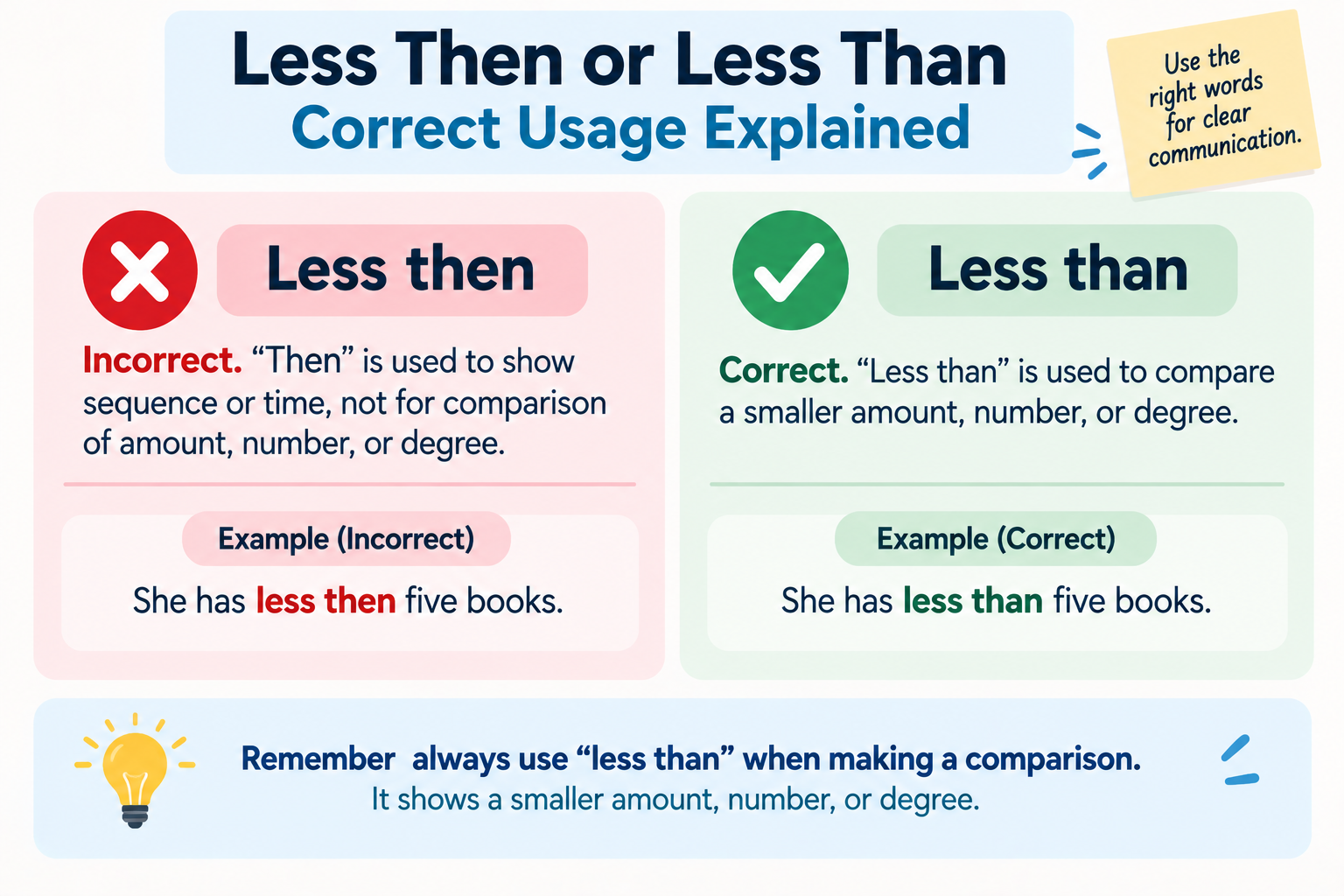
The phrase less then or less than often creates confusion because then and than look and sound very similar. The correct form for a comparison is less than. The word then is used mainly for time sequence or order rather than comparison.
This small difference matters because the two words perform different jobs in English. You might write The box weighs less than five pounds. You would not write The box weighs less then five pounds. In the first sentence than connects two quantities and shows that one is smaller. In the second version then would not fit the grammatical meaning.
The good news is that the rule is simple once you connect each word with its main job. Than belongs to comparisons. Then usually relates to time or sequence. This guide explains the difference in plain English and shows how to use the correct form in everyday conversation academic writing workplace messages formal documents and other common situations.
Still confused? Compare Busyness Vs Business Which Word Should You Use in 2026?.
Quick Definition
Less than is the standard form used to compare a smaller amount number degree distance or value with another amount or standard. Then refers mainly to time sequence or consequence. For comparisons such as less than five minutes or less than $20 use than rather than then.
Quick Answer
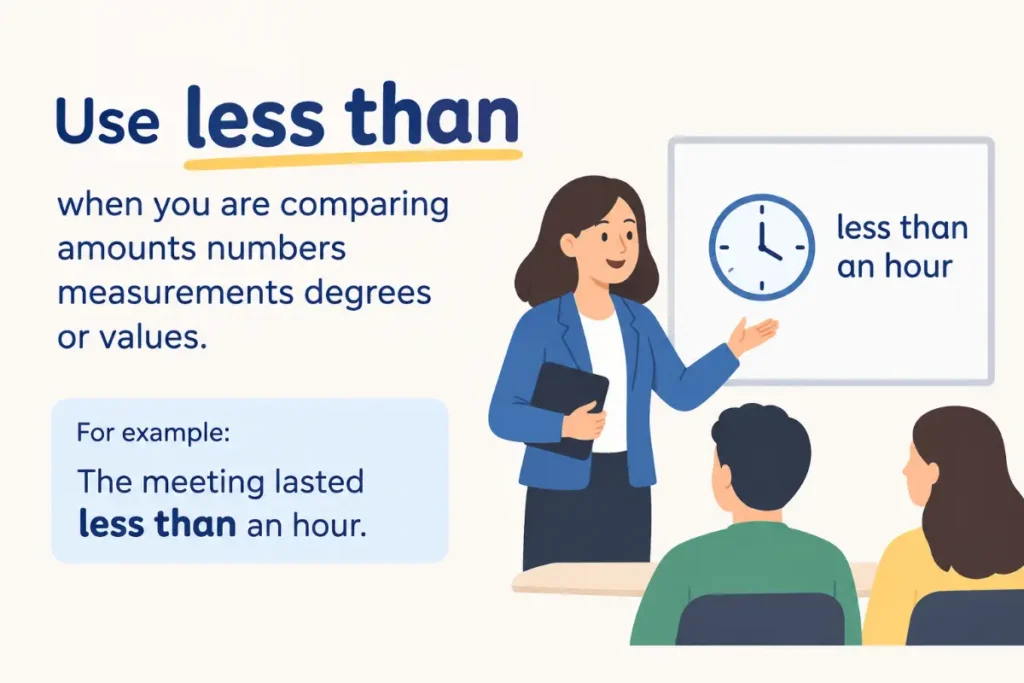
Use less than when you are comparing amounts numbers measurements degrees or values.
For example:
The meeting lasted less than an hour.
The jacket costs less than $50.
She is less than six feet tall.
Then has a different job. It usually refers to a time or sequence.
We ate dinner and then watched a movie.
The simplest memory rule is this: than compares while then usually tells you when or what happens next.
Comparison Table
| Form | Main Meaning | Part of Speech | Main Function | Usage Frequency | Formality | Common Contexts | Example |
|---|---|---|---|---|---|---|---|
| less than | A smaller amount or degree in comparison | Phrase containing a comparative word and a comparison word | Compares quantities or degrees | Very common | Neutral and formal | Numbers money time distance measurements writing speech | The trip took less than two hours. |
| less then | Not the standard form for comparison | Incorrect combination in this context | Usually results from confusing then with than | Common as a spelling or typing error | Nonstandard | Informal typing drafts learner writing | The trip took less then two hours. |
Meaning and Definition
Meaning of the Incorrect Form
Less then is not the standard expression for comparing an amount or degree. In a sentence such as The bag weighs less then ten pounds the problem is the use of then. The sentence needs than because the writer is comparing the weight of the bag with a ten pound amount.
This confusion does not usually come from a lack of understanding of the word less. Most people know what less means. The trouble appears because then and than are short function words with similar sounds and overlapping spelling patterns.
The error can also happen during fast typing. A person may know the correct form but type then automatically because it is a familiar word. Spellcheck tools may catch the mistake in some sentences but grammar software cannot always understand the intended meaning from isolated text.
It is useful to treat this as a word choice problem rather than simply a spelling problem. The letters are different because the words have different grammatical functions.
Meaning of the Correct Form
Less than expresses a comparison involving a smaller amount or degree. Cambridge Dictionary describes less as referring to a smaller amount or degree and identifies than as a word used with more or less to compare numbers or amounts.
You can use the expression with measurements.
The room is less than 20 feet wide.
You can use it with time.
The repair took less than an hour.
You can use it with money.
The book costs less than $15.
You can use it with distance.
The store is less than a mile away.
You can also use it with abstract qualities.
The plan was less than perfect.
Here the meaning changes slightly. The phrase can suggest that something does not fully meet the quality being described. Cambridge gives examples such as less than honest and less than ideal to show this use.
Key Differences Explained
- Spelling. Than contains an a while then contains an e. This small difference changes the word and its grammatical role.
- Meaning. Than commonly introduces a comparison. Then commonly refers to a time or sequence.
- Grammar. Than can function as a preposition or conjunction. Then is commonly an adverb.
- Pronunciation. The two words can sound similar in fast speech. Than often has a reduced pronunciation such as /ðən/ while then is commonly pronounced /ðɛn/ or /ðən/ depending on the speaker and context.
- Context. Use than with comparative expressions such as more than, less than, better than, faster than, and taller than.
- Time. Use then for expressions such as back then, by then, until then, and first this happens then that happens.
- Formality. Both words are standard English. The issue is not formal versus informal language. The issue is choosing the word that matches the meaning.
- Regional usage. American British Canadian and Australian English all use than for comparisons and then for time or sequence. There is no major regional rule that reverses these functions.
Which Form Is Correct?
For comparisons the correct form is less than.
The reason is grammatical. Than is the word that introduces the second part of a comparison. Oxford explains that than introduces the second part of a comparison and is used with more less and fewer to compare amounts numbers distances and related measurements.
Consider this sentence:
The phone costs less than $500.
The amount on one side is the phone price. The amount on the other side is $500. Than connects those two sides of the comparison.
Now compare it with:
I finished my work and then went home.
Here there is no comparison. Then tells us what happened next.
This gives you a reliable editing test. Ask yourself what job the word is doing. If you are comparing two things use than. If you are talking about time order or the next event use then.
How To Remember The Difference
A simple memory trick can save you from this mistake.
Think of than whenever you see a comparison.
More than.
Less than.
Better than.
Faster than.
Older than.
Smaller than.
Think of then whenever you are talking about sequence.
First we studied then we practiced.
I lived there back then.
Finish your work then call me.
There is another useful trick. Replace the word with next or afterward. If the sentence still makes sense then is probably the right choice.
I finished lunch then left.
I finished lunch afterward.
That works.
Now try it with a comparison.
The car costs less than mine.
Replacing than with afterward makes no sense. That tells you the comparison needs than.
Sentence Examples
Here are natural examples that show how the correct form works in different situations.
- The package weighs less than five pounds.
- I finished the assignment in less than an hour.
- This phone costs less than the model I bought last year.
- We have less than ten minutes before the class begins.
- The new route is less than three miles long.
- She spends less than $100 a week on groceries.
- The movie was less than two hours long.
- The repair took less than expected.
- His answer was less than helpful.
- The final result was less than perfect.
Now compare those examples with sentences using then.
I finished my homework and then went outside.
We had dinner and then watched a movie.
She called me then asked another question.
The two words can appear close together in everyday writing but they do different jobs. One belongs to comparison. The other belongs mainly to time and sequence.
Common Mistakes and Misspellings
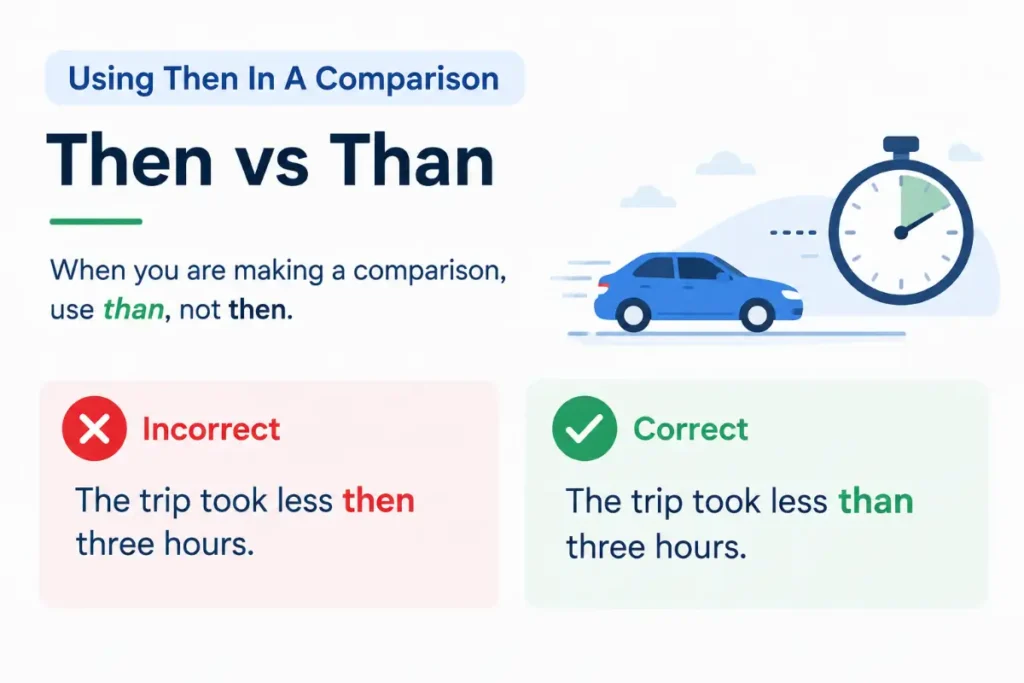
Using Then In A Comparison
Incorrect:
The trip took less then three hours.
Correct:
The trip took less than three hours.
The writer is comparing the length of the trip with three hours. That requires than.
Using Than For Time
Incorrect:
First we went shopping than we went home.
Correct:
First we went shopping then we went home.
The sentence describes two events in sequence. It needs then.
Confusing More Than And More Then
Incorrect:
She has more then enough experience.
Correct:
She has more than enough experience.
The expression more than is a standard comparison and quantity phrase.
Confusing Less Than And Fewer Than
Less and fewer create a separate grammar issue. Traditional standard grammar generally uses less with uncountable quantities and fewer with plural countable nouns. However less than is very common with measurements periods of time money and quantities treated as a single amount. Cambridge specifically notes examples such as less than three weeks and less than five pounds.
For example:
The project took less than three weeks.
The car costs less than $20,000.
The expression works naturally because time and money are being treated as amounts.
Treating Then And Than As Interchangeable
They are not interchangeable in standard writing. Their similar sound can create confusion but meaning and grammar determine the correct choice.
A quick proofread can catch the issue. Look at every use of then and than. Ask if the sentence compares something or describes sequence. That simple check works surprisingly well.
Pronunciation Guide
The word less is pronounced /les/ in standard American English. Cambridge gives /les/ for less.
Than has two common pronunciation patterns. A stronger form is /ðæn/. A weaker form is /ðən/. The weaker form is especially common in natural connected speech. Oxford lists both forms.
Then is commonly pronounced /ðɛn/ in careful speech. In quick conversation the vowel can become less distinct depending on the speaker and surrounding words.
For easy pronunciation:
Less sounds like less.
Than sounds roughly like thun in its weak form.
Then sounds roughly like then with a short e sound.
The pronunciation difference can be subtle. That is one reason learners and native speakers sometimes confuse the words when typing. Written English requires you to rely on meaning and grammar rather than sound alone.
Etymology and Word Origin
The history of these two words is surprisingly interesting because they were once much closer than modern spelling suggests.
Less comes from Old English forms such as lǣs and lǣssa. The word has Germanic roots and has been part of English for many centuries. Historical sources connect it with an old root carrying the idea of being small or diminished.
Than has an equally old history. It developed from Old English forms such as þan and þanne. Historical sources show that than and then were once much closer in form and were not clearly separated by spelling until much later.
That history helps explain why modern speakers can still find the pair confusing. English spelling preserves older patterns while pronunciation continues to change. Two words can end up looking and sounding close even after their grammatical jobs have become distinct.
The important point for modern writers is simple. Historical similarity does not mean modern interchangeability. Standard English now uses than for comparisons and then mainly for time and sequence.
Regional Usage
American English
American English uses than for comparisons and then for time or sequence. You will see than in everyday expressions such as less than a mile, more than ten minutes, and better than expected.
Then appears in expressions such as then I left, back then, and until then. The distinction is standard in American school writing workplace communication journalism and professional documents.
British English
British English follows the same basic distinction. Writers use than to introduce comparisons and then to describe time or sequence.
There is no major British spelling rule that makes then acceptable in standard comparisons. A sentence such as The task took less than an hour follows the same grammatical pattern in British English as it does in American English.
Australian English
Australian English also follows the same standard distinction. Than is used in comparisons involving amounts degrees measurements and values. Then is used for time and sequence.
The difference is therefore not an American versus British issue. It is a basic English grammar distinction shared across major varieties.
Canadian English
Canadian English follows the same pattern as American and British English. Than is the appropriate comparison word while then generally refers to time order or sequence.
Canadian writers may encounter the same confusion in casual typing because the two words can sound similar. The standard written forms remain distinct.
Many readers also check catchup or catch up Which Form Is Correct.
Grammar Rules and Part of Speech
How Than Works
Than introduces the second part of a comparison. It commonly follows comparative words such as less more better faster older smaller and stronger.
For example:
The blue car is faster than the red car.
This sentence compares the speed of two cars.
The same pattern works with amounts.
The bottle holds less water than the larger container.
Here less establishes the smaller amount while than introduces the thing used for comparison.
Than can also introduce a clause.
She is less confident than she was last year.
The comparison is between her confidence now and her confidence in the past.
How Then Works
Then commonly functions as an adverb connected with time sequence or consequence.
For example:
We finished dinner then cleaned the kitchen.
Then tells the reader what happened next.
It can also refer to a particular time.
I lived in Texas back then.
Here then refers to an earlier period.
Then can also appear in conditional structures.
If you finish your work then you can leave.
In this construction it connects an action or condition with a later result.
Sentence Position
Than normally appears directly after a comparative expression.
The room is smaller than I expected.
The service was better than before.
The package arrived earlier than planned.
Then has more flexible placement.
Then we went home.
We then went home.
We went home then.
The exact position depends on the meaning and rhythm of the sentence.
Punctuation
Neither word automatically requires a comma simply because it is then or than.
For example:
The test took less than an hour.
No comma is needed.
Then can sometimes appear after an introductory phrase or between clauses where normal punctuation rules apply.
First we ate then we left.
For clarity in formal writing you might write:
First we ate. Then we left.
The punctuation comes from the sentence structure rather than from the word itself.
Less Than With Numbers
This is one of the most common uses.
You can use the expression before numbers to show that a quantity is below a stated amount.
The temperature dropped to less than 40 degrees.
The store is less than two miles away.
She answered in less than five minutes.
The company has fewer than 50 employees.
That last example also highlights an important distinction. Fewer is traditionally used with countable plural nouns such as employees. Less commonly works with amounts such as money time distance and other quantities treated as a whole. Cambridge discusses this distinction and notes that less than is especially natural with quantities such as periods of time and sums of money.
Less Than With Time
Time expressions are especially common.
I slept for less than six hours.
The meeting lasted less than thirty minutes.
We arrived in less than ten minutes.
The store is less than five minutes from here.
In each case the phrase compares a period or amount of time with a stated limit.
You can also use less than with age.
He is less than eighteen.
The child is less than two years old.
This construction is natural because age is being treated as a measurement.
Less Than With Money
Money is another common context.
The shirt costs less than $30.
We spent less than $200 on dinner.
The repair should cost less than $500.
The ticket was less than expected.
Money is treated as an amount rather than as separate countable objects. That makes this construction natural in everyday speech and formal writing.
Less Than With Qualities
The expression does not always involve numbers.
Sometimes it describes a quality that falls below an expected standard.
His explanation was less than clear.
The response was less than helpful.
The result was less than ideal.
The plan is less than perfect.
In these sentences the meaning is close to not fully or not especially. Cambridge recognizes this use with examples involving qualities such as honest ideal and complimentary.
This use can sound slightly understated. Instead of saying The service was terrible a speaker might say The service was less than impressive. The wording can make criticism sound more measured.
Real Life Usage Examples
Daily Conversation
- I’ll be there in less than ten minutes.
- The restaurant is less than a mile from my house.
These examples sound completely natural in everyday American conversation. People use the expression constantly when discussing time distance money quantities and expectations.
Email And Workplace Communication
- The repair should take less than two business days.
- We received fewer than 100 responses and spent less than the planned budget.
Workplace writing often uses comparison phrases to communicate limits and measurements clearly. The wording is direct and professional without sounding stiff.
Academic Writing
- The study involved less than one hour of observation per participant.
- The final sample contained fewer than 200 participants.
Academic writing benefits from careful distinctions between amount and number. Less generally works with amounts while fewer traditionally works with countable plural nouns.
News Writing
- The storm affected less than one percent of the county.
- Officials said the repairs would take less than a week.
News writing often uses comparison expressions with percentages measurements time and estimates. These forms make numerical information easy to understand.
Literature And Storytelling
- She reached the station in less than an hour.
- He had known the truth for less than a day.
In storytelling the expression can establish pace and create a clear sense of time. A short phrase can tell readers exactly how quickly something happened.
Related And Confused Terms
Several words and expressions are closely connected with this topic.
- More than. This is the opposite comparison pattern and indicates a greater amount or degree.
- Fewer than. This is traditionally used with plural countable nouns.
- Greater than. This often appears in mathematics technical writing and formal comparisons.
- Smaller than. This compares physical size amount or degree.
- Then. This mainly refers to time sequence or what happens next.
- Than. This introduces the second part of a comparison.
- At most. This means no more than a stated amount.
- Under. In informal American English under can sometimes express a quantity below a limit, especially with age price or time. For example The meal cost under $20. Less than and under are not always interchangeable in every context but they often communicate a similar idea.
These related expressions are useful because they show that comparison language is a larger grammar pattern rather than an isolated spelling issue.
Less Than In Formal Writing
The expression is fully acceptable in formal writing. You can use it in academic papers reports business documents applications technical explanations and professional correspondence.
For example:
The survey was completed in less than three weeks.
The final cost was less than the original estimate.
The report contains fewer than 50 pages.
The key is accuracy. Formal writing does not require you to replace ordinary English with complicated language. Clear wording is usually the stronger choice.
In polished writing you should also watch the difference between less and fewer. A sentence such as The company received fewer complaints is traditionally preferred because complaints are countable. A sentence such as The company received less criticism uses less because criticism is treated as an uncountable amount.
There are also established expressions where less appears naturally with plural quantities or measurements. Cambridge notes that usage with amounts such as time and money is well established.
Why The Mistake Happens
The confusion has several causes.
First the words are short. Short function words are often harder to notice during proofreading because the eye tends to focus on larger content words.
Second their pronunciation can overlap. Than has a weak pronunciation that can sound close to then in natural speech. That makes listening alone an unreliable way to decide which spelling belongs on the page.
Third both words are extremely common. Because writers see them constantly they may type the more familiar form automatically without checking the sentence meaning.
Fourth then and than share historical roots. Their histories are connected and their forms were once less distinct than they are today.
Finally fast typing makes small errors more likely. A person may know the grammar perfectly and still type then when they meant than.
This is why the mistake should not automatically be treated as a sign that someone does not understand English. It is often a quick word selection error.
A Simple Editing Test
When you are unsure which word belongs in a sentence use this three step test.
- Look for a comparison.
If the sentence compares amount degree size price speed age distance or another measurable quality use than.
The car is less than five years old.
- Look for time or sequence.
If the sentence tells you what happened next or refers to a particular period use then.
We finished the meeting then went home.
- Try replacing then with afterward.
If afterward fits the meaning then is likely correct.
We ate dinner then watched a movie.
If the sentence compares two things afterward will not make sense.
The movie was less than two hours long.
This test takes only a few seconds and works in most everyday situations.
Expert Editor Insight
An experienced editor usually treats this as a context problem rather than a difficult grammar problem. Native speakers often choose the correct word automatically because the comparison pattern is deeply familiar, but fast typing can still produce mistakes. Professional editors look at the sentence as a whole and ask what relationship the word expresses. Grammar tools may flag the error when the surrounding sentence clearly indicates a comparison, but human review remains useful because software has to infer meaning from context. The best editing habit is to connect than with comparison and then with sequence.
Many readers also check Offered Vs Offerred Meaning Usage And Correct Form.
Conclusion
The phrase less then or less than has a clear answer when you are making a comparison. Use less than. Than connects the smaller amount or degree with the thing being compared. Then belongs mainly to time sequence or the next step in a series.
The difference becomes easy once you focus on function rather than sound. Write less than an hour, less than $50, or less than three miles when you are comparing amounts. Write then when you mean afterward or at that time. The two words may sound close but they do different jobs in a sentence.
For proofreading, remember one simple rule: than compares while then tells you what comes next. That quick mental check can catch the error before you send an email, submit an assignment, or publish your writing.
FAQs
Is less then ever correct in English?
The phrase less then is not the standard choice when you are comparing an amount or degree. In that context use less than. Then is a separate word that usually refers to time or sequence. For example write The task took less than an hour. Use then in a sentence such as We finished the task then went home.
Why do people confuse then and than?
People confuse then and than because the words are short and their pronunciation can sound similar in natural speech. They also have related historical forms. Fast typing can make the problem worse because writers often select a familiar word automatically. The best solution is to focus on meaning. Than introduces comparisons while then usually describes time sequence or what happens next.
How do I remember the correct word?
Use a simple mental rule. Than belongs with comparisons. Think of phrases such as more than less than better than and faster than. Then belongs with sequence and time. Think of first then next or back then. You can also replace then with afterward. If afterward fits the sentence then is probably the word you need.
Is less than grammatically correct with time?
Yes. The expression is completely standard with periods of time. You can write less than an hour, less than three weeks, or less than ten minutes. Time is commonly treated as a quantity or amount in these constructions. Cambridge specifically gives examples involving periods of time and explains that such usage is natural.
Is less than correct with money?
Yes. Less than works naturally with money because money is treated as an amount. You can write The jacket costs less than $50 or We spent less than $100. The same pattern works with prices budgets salaries and other monetary amounts. The phrase can appear in casual conversation as well as formal business and academic writing.
Can less than be used with adjectives?
Yes. Less can combine with an adjective and than can introduce the comparison. For example She is less confident than before compares her confidence across two situations. The phrase can also express a quality that falls below an expected standard. Examples include less than ideal and less than helpful.
What is the difference between less than and fewer than?
Less is traditionally used with uncountable amounts while fewer is traditionally used with plural countable nouns. For example use less water but fewer bottles. With measurements such as time money distance and amounts, less than is very common. You can say less than three weeks or less than $50. Cambridge discusses this distinction in its grammar guidance.
Is less than suitable for formal writing?
Yes. Less than is standard English and works well in formal writing. You can use it in academic papers reports business emails technical documents and professional correspondence. The main concern is accuracy. Use than for comparisons and then for time or sequence. Clear everyday grammar is often more effective than replacing a simple expression with unnecessarily complicated wording.