
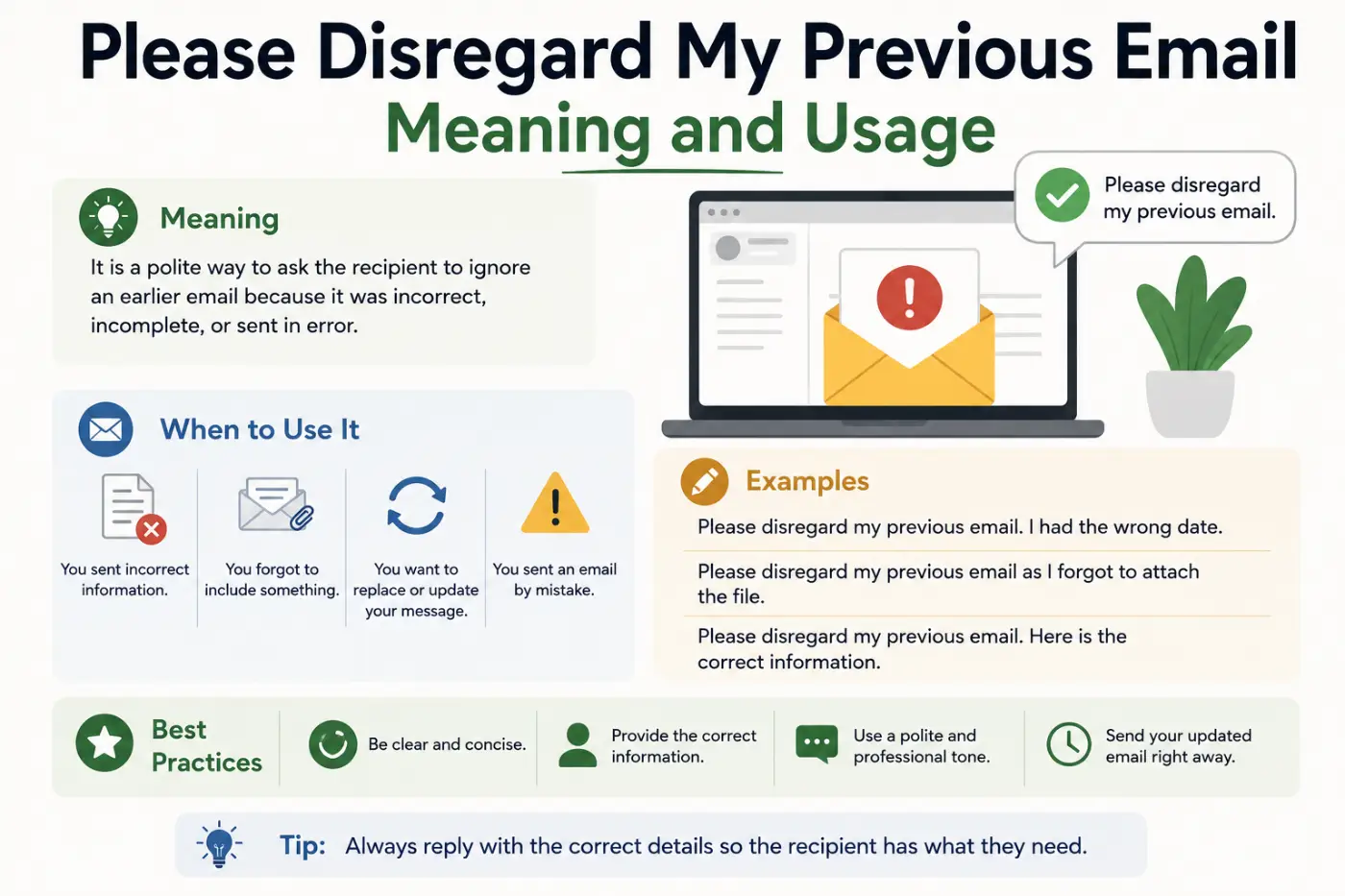
When you send an email and then realize that some information was wrong outdated or no longer relevant you need a clear way to tell the recipient not to rely on it. Please disregard my previous email is a standard professional phrase for that situation. It tells the reader to ignore an earlier message and use the newer information instead.
The phrase is grammatically correct and widely understood in American English. It doesn’t mean that the earlier email should literally disappear. It means the recipient should treat that message as no longer relevant for the current matter.
People often use this wording after sending an email with a mistake a missing attachment an incorrect detail or information that has since changed. In this guide you’ll learn exactly what the phrase means how its tone works where to place it in an email and how to make it sound more natural. You’ll also see practical examples and useful alternatives so you can choose the wording that fits your situation.
Learn the difference in alr meaning in Texting and Online Chat.
Quick Definition
Please disregard my previous email is a polite professional way to tell someone to ignore an earlier email because it contains incorrect outdated or superseded information. The phrase is grammatically correct and common in workplace communication. It usually signals that another email contains the information the recipient should use instead.
Quick Answer
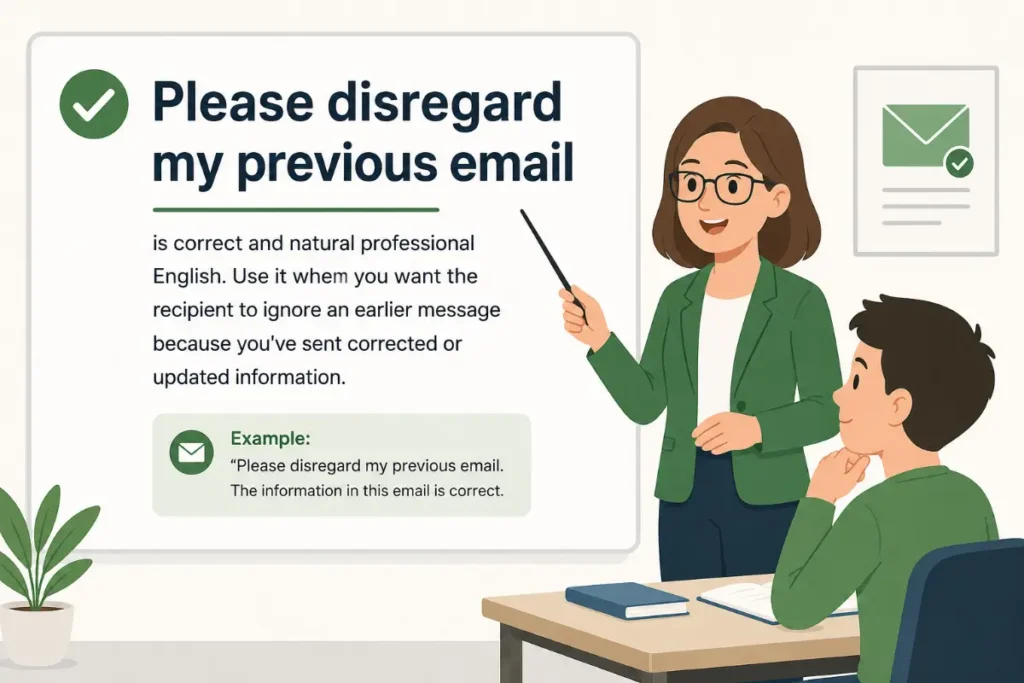
Please disregard my previous email is correct and natural professional English. Use it when you want the recipient to ignore an earlier message because you’ve sent corrected or updated information.
For a warmer tone you can say Please disregard my previous message and use the updated information below. This makes the reason clear and tells the reader what to do next.
Comparison Table: Please Disregard My Previous Email
| Correct Form | Meaning | Part of Speech | Origin | Usage Frequency | Formality | Common Contexts | Example |
|---|---|---|---|---|---|---|---|
| Please disregard my previous email | Ignore the earlier email and use newer information | Polite imperative phrase | Modern English business communication | Very common | Professional | Workplace email and corrections | Please disregard my previous email and use the revised schedule below. |
Meaning and Definition
Meaning of Please Disregard My Previous Email
The phrase please disregard my previous email means that the recipient should ignore an earlier email you sent.
The key word is disregard. As a verb it means to give no attention to something or to treat something as unimportant or not applicable. In this context it doesn’t suggest that the recipient should delete the email from their inbox. It simply means they shouldn’t act on the information contained in it.
The word previous identifies the earlier message. The word email identifies the communication you want the reader to set aside.
For example you might send an email with the wrong meeting time. A few minutes later you discover the mistake and send a corrected message.
You could write:
Please disregard my previous email. The meeting will begin at 3 PM instead of 2 PM. The meaning is immediately clear. The recipient understands that the first email contained information that should no longer be used.
The phrase can also appear when you’ve sent an incomplete message. Maybe you forgot an attachment or accidentally sent a draft. In that case the wording helps you quickly redirect the reader to the corrected version.
Meaning of Disregard
Disregard means to ignore something or to pay no attention to it. It can sound more formal than everyday alternatives such as ignore or don’t worry about. That’s one reason it appears so often in workplace emails official notices and administrative communication.
Consider these examples.
Please disregard the earlier notice.
Please disregard the information in my last message.
Each sentence tells the reader not to rely on something that was previously provided.
Meaning of Previous Email
Previous email simply refers to an email sent earlier in the conversation or email thread.
You can use previous when the reader knows which message you’re referring to. In a long email chain you may want to be more specific.
For example:
Please disregard my previous email sent at 9 AM.
Please disregard the email containing the old pricing information.
Specific wording can prevent confusion when several messages have been exchanged.
Key Differences Explained
- Spelling. The phrase contains ordinary English words that are all spelled separately. Disregard is one word. Previous is one word. Email is one word in modern standard English.
- Grammar role. The expression begins with a polite imperative. The implied subject is you. In other words the full grammatical idea is you please disregard my previous email. English normally leaves the subject unstated in an imperative.
- Meaning. The phrase asks the recipient to ignore the earlier message as a source of information. It doesn’t necessarily ask them to delete the message.
- Tone. The wording sounds professional and slightly formal. It works well in business communication but can sound stiff in a casual conversation with a friend.
- Context. People commonly use it after correcting an error replacing an attachment changing a decision or sending an updated version of information.
Which Wording Is Correct?
Please disregard my previous email is grammatically correct.
The structure follows a normal English imperative pattern. Please softens the command. Disregard functions as the main verb. My previous email functions as the object of the verb.
The sentence is therefore straightforward.
Please + verb + object.
The phrase also follows established professional usage. Major English dictionaries such as Merriam Webster and Oxford Languages define disregard as a verb connected with ignoring or paying no attention to something. That dictionary meaning fits this email expression directly.
A useful editorial point is that disregard doesn’t mean the earlier message was necessarily bad. It only tells the recipient not to consider it for the current purpose.
If you sent an incorrect invoice number you could write:
Please disregard my previous email. The correct invoice number is 45872.
If you sent an old attachment you could write:
Please disregard my previous email and use the attached file instead.
The second version is often stronger because it gives the reader a clear next step.
Sentence Examples
Here are natural examples that show how the phrase works in real communication.
- Please disregard my previous email. I attached the wrong document.
- Please disregard my previous email and use the revised schedule attached here.
- Please disregard my previous email. The meeting time has changed to 10 AM.
- Please disregard my previous email regarding the payment amount. I have confirmed the correct figure.
- Please disregard my previous email and refer to the updated information below.
- Please disregard my previous email. I sent that message before receiving the latest instructions.
- Please disregard my previous email about the application deadline. The deadline has been extended.
- Please disregard my previous email. I accidentally included an outdated version of the report.
- Please disregard my previous email and accept my apologies for the confusion.
- Please disregard my previous email. I’ll send a corrected document shortly.
These examples reveal an important pattern. The phrase works best when you follow it with useful information. Simply telling someone to ignore an email can leave them wondering what they should do next.
Examples With the Common Misspelling
Some writers accidentally type please disregard my previous emial or make other spelling errors while composing quickly. The issue usually comes from typing rather than grammar.
Here are examples of the incorrect form as a learning reference.
- Please disregard my previous email is the correct form.
- A writer may accidentally type please disregard my previous e mail.
- A rushed message may contain a spelling error in previous.
- Some writers may omit please and make the sentence sound more abrupt.
- Others may write ignore my previous email when a more professional tone is preferred.
The goal isn’t to avoid simple wording. The goal is to choose wording that makes your intention unmistakable.
Common Mistakes and Misspellings
Several problems can make this phrase less effective.
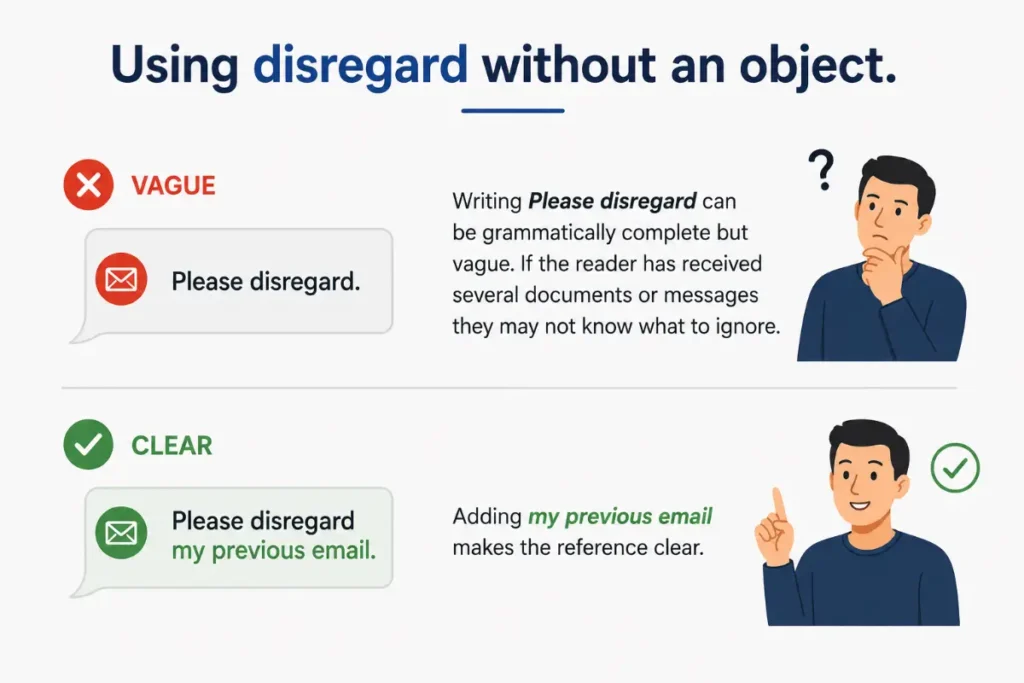
- Using disregard without an object. Writing Please disregard can be grammatically complete but vague. If the reader has received several documents or messages they may not know what to ignore. Adding my previous email makes the reference clear.
- Using previous when the context isn’t obvious. If you’ve sent five emails in the same hour the recipient may not know which message you mean. In that situation mention the subject or approximate time.
- Sounding too abrupt. A sentence such as Disregard my previous email is correct but can sound like a command. Adding please creates a more courteous professional tone.
- Failing to provide the correction. If the earlier message contains an incorrect date don’t stop after telling the reader to ignore it. Give the correct date in the same message.
- Treating email as two words. Modern standard English normally uses email as one word. You may still see e mail in older material but it isn’t the usual form in contemporary US business writing.
Why People Make These Errors
Email language creates a particular kind of NLP confusion because writers often think faster than they type. Several related concepts sit close together in the mind.
A person may be thinking about ignore, cancel, correct, replace, update, retract, withdraw, or supersede at the same time. Those words overlap in meaning but don’t always communicate the same action.
For example ignore my previous email is direct and conversational. Disregard my previous email sounds more formal. Please refer to my updated email focuses on the new information instead of the old information.
That distinction matters in professional writing.
Pronunciation Guide
The pronunciation of disregard is commonly represented in IPA as /ˌdɪsrɪˈɡɑrd/ in American English.
You can think of it as:
dis ri GARD
The strongest stress falls on the final syllable.
Previous is commonly pronounced /ˈpriːviəs/.
You can think of it as:
PREE vee us
Email is commonly pronounced /ˈiːmeɪl/.
You can think of it as:
EE mail
The complete phrase sounds roughly like:
pleez dis ri GARD my PREE vee us EE mail
The most common pronunciation problem isn’t the phrase itself. It’s often the word disregard because the stress can fall in the wrong place for learners of English. In American English the final part receives the strongest stress.
For another common grammar confusion, see ight meaning Explained With Examples and Usage.
Etymology and Word Origin
The phrase is modern but its individual words have much older histories.
Disregard developed from the combination of dis and regard. The prefix dis can express separation or reversal in words of Latin and French origin. Regard entered English through Old French and ultimately traces back to Germanic roots connected with looking at or paying attention to something.
Over time regard developed meanings related to attention consideration respect and concern. Adding dis created the opposite idea of failing to give attention or consideration.
Previous comes through Latin and French linguistic history and developed in English as a word meaning earlier or preceding.
Email is much newer. It formed as a shortened term for electronic mail during the development of computer based communication. It became a standard English noun and verb as electronic messaging became part of everyday life.
Put together these words create a phrase that fits modern business communication:
Please + disregard + my + previous + email.
The expression is not an old fixed idiom. It’s a practical combination of ordinary English words that became especially useful with the rise of professional email.
Regional Usage
US English
American English uses please disregard my previous email frequently in workplaces government communication customer service and formal correspondence. The phrase sounds professional and familiar. American writers also commonly use please ignore my previous email when they want a simpler and more conversational tone.
UK English
British English also uses please disregard my previous email. The expression has no major regional problem in the UK. British professionals may also choose please ignore my previous email or please refer to my earlier email depending on the context.
Australian English
Australian English accepts the phrase naturally in professional settings. It can appear in workplace correspondence administrative communication and formal customer messages. A less formal writer may choose please ignore my earlier email.
Canadian English
Canadian English uses the phrase in much the same way as American English. Email is standard modern spelling and disregard works naturally in professional correspondence. The phrase doesn’t carry a special Canadian meaning.
No major English speaking region uses a different spelling of the phrase as a standard regional variant.
Grammar Rules and Part of Speech
The phrase is built around an imperative verb.
Disregard is a transitive verb. That means it normally takes an object. In this phrase the object is my previous email.
The basic structure is:
Please + verb + object.
That gives us:
Please disregard my previous email.
The word please acts as a politeness marker. It doesn’t change the basic grammatical structure.
Can It Start a Sentence?
Yes. It can start an email sentence naturally.
Please disregard my previous email. I have attached the corrected document.
Starting with please is often the clearest option because the reader immediately understands the action you want them to take.
Can It Stand Alone?
Yes.
Please disregard my previous email.
Grammatically that sentence is complete. However the best professional communication often adds a reason or replacement instruction.
For example:
Please disregard my previous email. I noticed that the attached report contained outdated figures.
That version helps the reader understand why the correction is necessary.
Should You Use a Comma?
Usually no comma is needed between please and disregard.
Write:
Please disregard my previous email.
Don’t insert a comma simply because please appears at the beginning.
A comma may appear elsewhere in a longer sentence for an independent grammatical reason. The presence of please alone doesn’t require one.
Should You Say Previous Email or Previous Message?
Both can work.
Previous email is more specific.
Previous message is broader and can work in email threads or messaging platforms.
If you’re writing a business email previous email usually gives the reader a clear reference.
Real Life Usage Examples
Daily Talk
Although the expression is mainly professional it can appear in everyday communication when someone wants to sound precise.
Please disregard my previous email. I found the receipt I thought I’d lost.
Please disregard my last message. I gave you the wrong address.
In casual conversation you could simply say Ignore my last message. That sounds more relaxed.
This is one of the most natural settings for the phrase.
Please disregard my previous email. I’ve attached the corrected contract.
Please disregard my previous email and use the updated invoice attached to this message.
The phrase works especially well when an earlier email contained information that has been replaced.
Academic Writing
Academic professionals may use the expression in communication with students colleagues editors and administrators.
Please disregard my previous email regarding the submission date. The department has confirmed a new deadline.
Please disregard my previous email. I have now attached the final version of the manuscript.
The wording is suitable for formal academic correspondence because it remains clear without becoming overly elaborate.
News And Media
Editors reporters and communications teams may use similar wording when correcting information sent to a distribution list.
Please disregard my previous email. The press release included an incorrect publication date.
Please disregard my previous email and use the revised statement provided below.
In these contexts accuracy matters more than style. The reader needs to know exactly which information is still valid.
Literature
In ordinary narrative prose the phrase may appear in a story that includes letters or emails.
A character might write:
Please disregard my previous email. I changed my mind about the arrangement.
Another character could use it as part of a formal exchange between colleagues.
The phrase feels more contemporary than literary because it belongs strongly to modern written communication.
Better Alternatives for Different Situations
The best alternative depends on your relationship with the reader and the reason for the correction.
Please ignore my previous email is simpler and more direct. It sounds slightly less formal.
Please ignore my last email sounds natural and conversational.
Please consider my previous email superseded sounds more formal and administrative. It isn’t the best choice for ordinary workplace communication because it can feel stiff.
I apologize for the confusion. Please use the updated information below. This is often a strong choice when your mistake affected the reader.
A good editor chooses the simplest phrase that accurately communicates the situation.
When To Use Disregard
Use disregard when the earlier message should no longer guide the reader’s actions.
For example you sent the wrong meeting time. The first email is now outdated.
Please disregard my previous email. The meeting will begin at 4 PM.
You sent an incorrect attachment.
Please disregard my previous email. The correct file is attached here.
You gave an incorrect price.
Please disregard my previous email regarding the quoted price. The correct amount is $450.
In each case the earlier information has been replaced.
When Not To Use It
You don’t need this phrase every time you send another email.
Suppose you sent a message asking a simple question and then want to add another question. There is no reason to tell the recipient to ignore the first email.
Likewise if you’re simply continuing a conversation you can write:
Just following up on my previous email.
That’s a different situation.
The distinction is simple. Use disregard when the earlier information should not be relied on. Don’t use it merely because you’re sending another message.
Expert Editor Insight
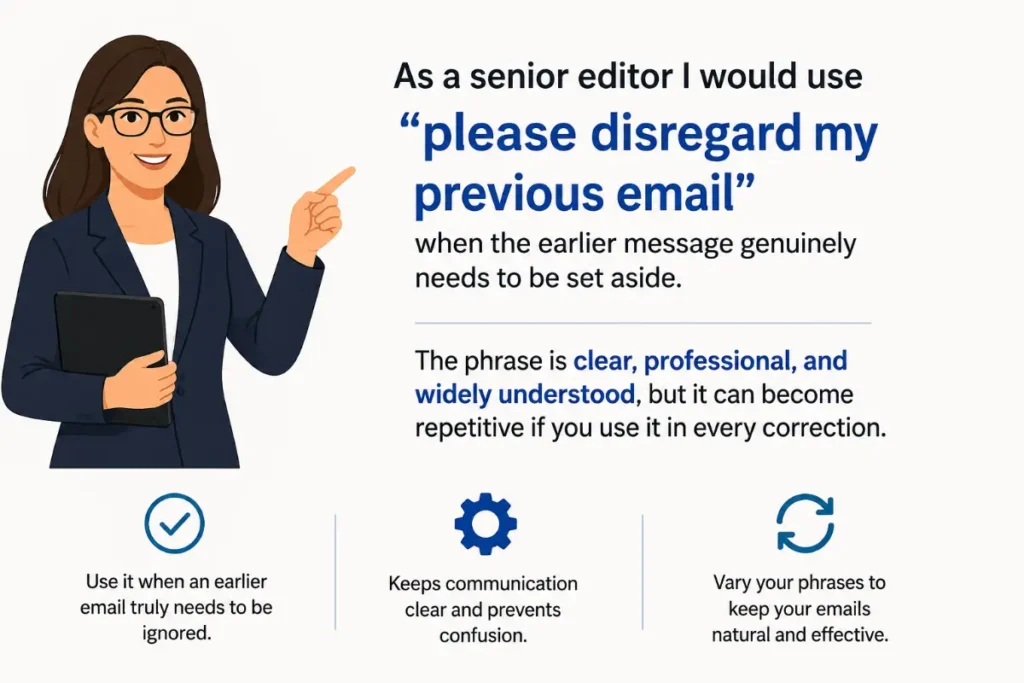
As a senior editor I would use please disregard my previous email when the earlier message genuinely needs to be set aside. The phrase is clear professional and widely understood but it can become repetitive if you use it in every correction. In most business writing the strongest version combines the request with the reason and the replacement information. For example Please disregard my previous email. I noticed an error in the attached figures. Please use the revised report below. Grammar checkers generally accept the structure because it follows a standard polite imperative. Style tools may still suggest a more direct alternative when the context is informal.
Still confused? Compare Eying Or Eyeing: Definition, Pronunciation, and Examples.
Conclusion
Please disregard my previous email is correct professional English and means that the recipient should ignore an earlier email because its information is incorrect outdated or no longer relevant. The phrase uses a polite imperative structure and works especially well in workplace communication.
The key point is that disregard means to pay no attention to something. It doesn’t normally mean that the recipient must delete the earlier message. If the situation matters you should also tell the reader what information to use instead. That small addition can prevent another round of emails and remove unnecessary confusion.
As a practical tip use the phrase when an earlier message truly needs to be replaced. Then give the correction immediately. Clear email writing isn’t about using complicated words. It’s about making the next action obvious to the person reading your message.
FAQs
Is Please Disregard My Previous Email a Real Phrase?
Yes. Please disregard my previous email is a standard English phrase used in professional communication. It means the recipient should ignore the earlier email and avoid relying on its information. The phrase is grammatically correct and widely understood in American English. It works especially well when you need to correct an error or replace outdated information.
What Does Please Disregard My Previous Email Mean?
It means you want the recipient to ignore an earlier email because its information is no longer valid or relevant. The word disregard means to pay no attention to something. The phrase doesn’t normally mean that the recipient must delete the email. It simply asks them not to use the earlier message as the basis for action.
Is Please Disregard My Previous Email Correct?
Yes. Please disregard my previous email is correct standard English. The phrase uses a polite imperative structure with disregard as the main verb and my previous email as its object. You can use it in workplace correspondence customer service messages academic communication and other professional situations where an earlier email needs correction or replacement.
How Do You Pronounce Disregard?
In American English disregard is commonly pronounced /ˌdɪsrɪˈɡɑrd/. The strongest stress falls on the final syllable. You can think of the pronunciation as dis ri GARD. The complete phrase can be spoken naturally as pleez dis ri GARD my PREE vee us EE mail. Clear stress on regard helps the pronunciation sound natural.
Can Please Disregard My Previous Email Start a Sentence?
Yes. It can naturally begin a sentence and often works best that way. Starting with Please immediately tells the reader what action you want. For example you can write Please disregard my previous email. The correct meeting time is 3 PM. This structure is direct polite and easy to understand in professional correspondence.
What Is a Synonym for Disregard?
Common alternatives include ignore overlook dismiss and pay no attention to. In professional email please ignore my previous email is the closest simple alternative. Please refer to my updated email has a slightly different focus because it directs attention toward the new message. Choose the option that matches the action you want the reader to take.
Why Do People Use Please Disregard My Previous Email?
People use the phrase when they need to correct or replace information from an earlier email. Common reasons include sending the wrong attachment giving an incorrect date sharing an outdated price or accidentally sending a draft. The phrase provides a quick signal that the earlier message should no longer guide the recipient’s actions.
Is Please Disregard My Previous Email Suitable for Formal Writing?
Yes. The phrase is well suited to formal and professional writing. It sounds polite and precise without being excessively complicated. Still you can make the message more useful by explaining the reason and giving the corrected information. For example Please disregard my previous email. I attached an outdated report. Please use the revised version attached here.