
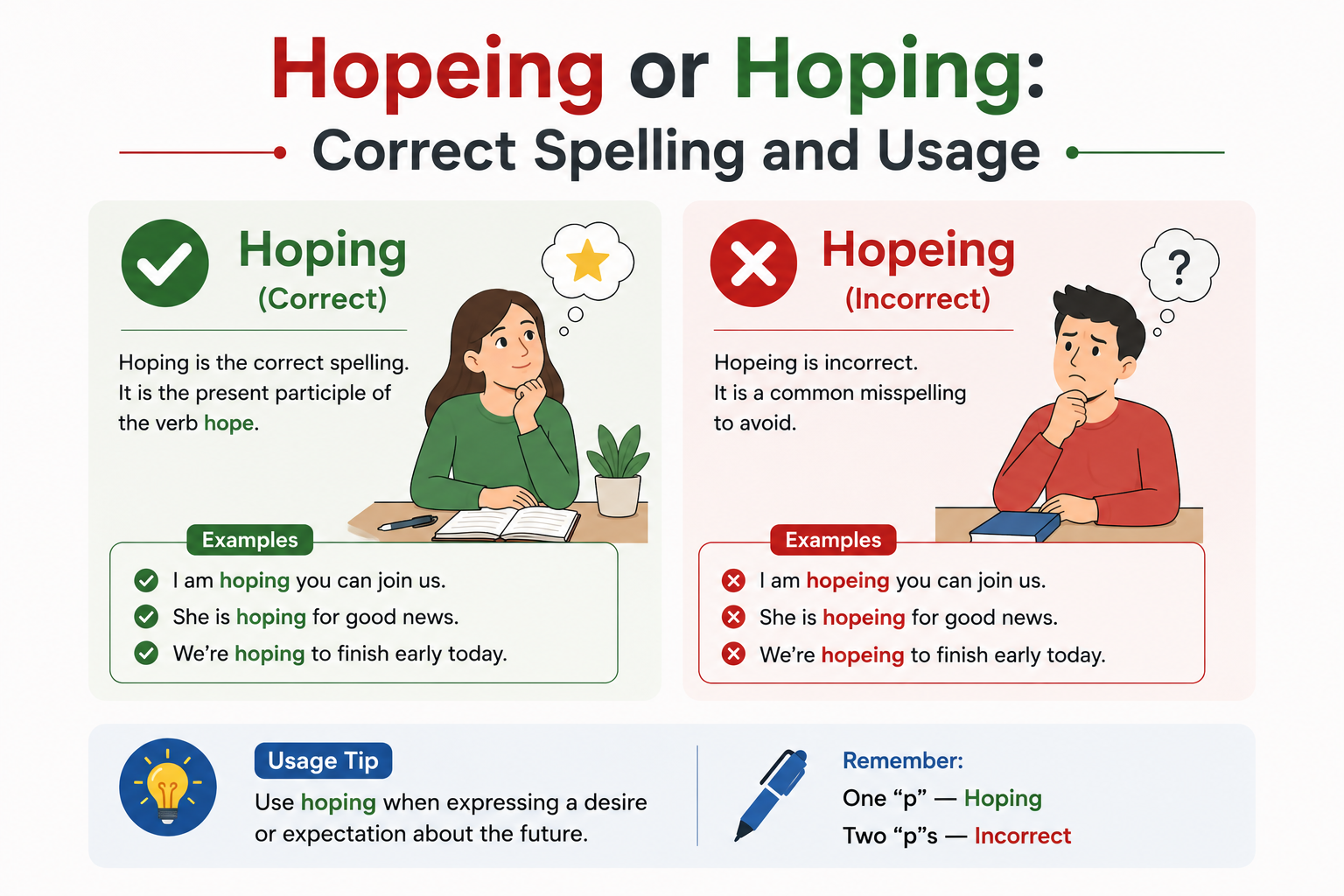
If you’re unsure about hopeing or hoping you’re not alone. This spelling mistake happens because the base word is hope and it can feel natural to keep the final e before adding ing. Standard English does something different.
The correct spelling is hoping. The word hope loses its final silent e before the ending ing is added. So the pattern is hope → hoping rather than hope → hopeing. Cambridge gives the same spelling rule with hope + ing becoming hoping.
This small spelling change follows a common rule in English. Many verbs that end in a silent e drop that e before an ending that starts with a vowel. Once you understand that pattern you can apply it to many other words such as make becoming making and write becoming writing. In this guide you’ll learn why the spelling changes what the word means how to pronounce it how to use it in sentences and which related grammar patterns matter most. You’ll also see the mistakes that often cause confusion and a simple editing trick that makes this spelling easy to remember.
Still confused? Compare Make Do Or Make Due Which Is Correct 2026.
Quick Answer hopeing or hoping
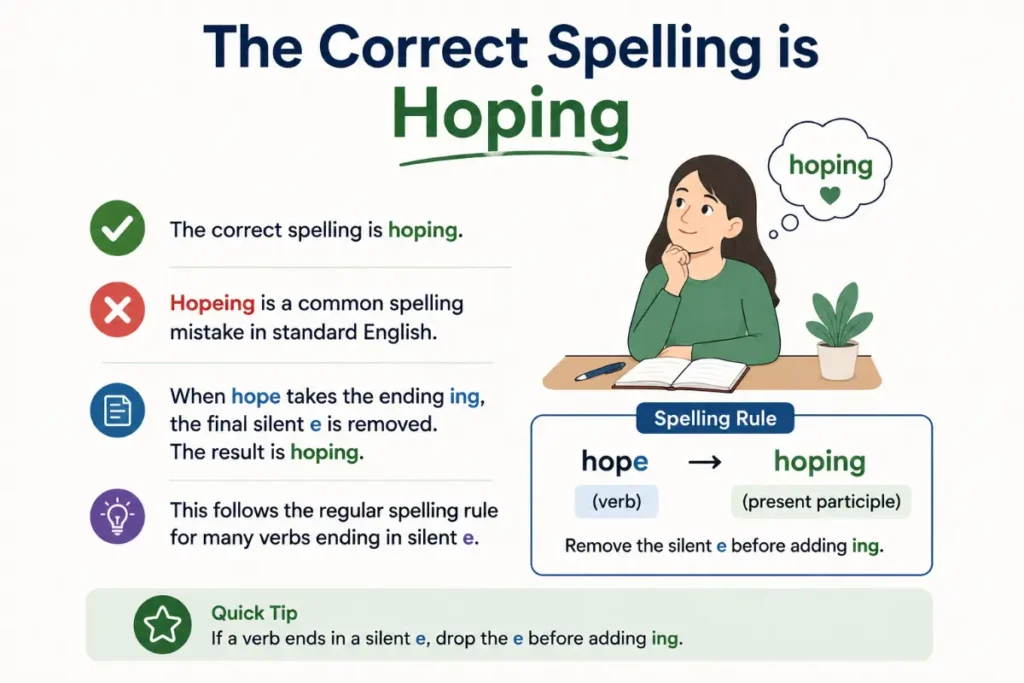
The correct spelling is hoping. Hopeing is a common spelling mistake in standard English. When hope takes the ending ing the final silent e is removed. The result is hoping. This follows the regular spelling rule for many verbs ending in silent e.
The Correct Spelling
The correct form is hoping. The incorrect form is hopeing. The reason is simple. The base verb is hope. Its final e is silent. When you add ing the e normally disappears.
The spelling works like this.
- Hope becomes hoping.
- Make becomes making.
- Take becomes taking.
- Write becomes writing.
- Give becomes giving.
This pattern helps explain the spelling instead of forcing you to memorize a single word. Cambridge specifically identifies hope + ing as an example of dropping the final e before adding an ending that begins with a vowel. You can think of the final e as a temporary letter. It belongs to the base form but steps aside when ing arrives.
Why The Spelling Changes
English spelling can sometimes look unpredictable. This rule is much more regular than it first appears. The verb hope ends in a silent e. That e helps establish the pronunciation of the vowel in the base word. When ing is added the spelling does not need the final e for the same purpose. English therefore removes it.
The pattern is:
hope + ing = hoping.
Not:
hope + ing = hopeing.
The same idea appears in many familiar verbs.
- Bake becomes baking.
- Drive becomes driving.
- Love becomes loving.
- Save becomes saving.
- Move becomes moving.
- Smile becomes smiling.
The spelling change does not alter the basic meaning of the verb. It simply reflects the standard way English forms the present participle and gerund from a verb ending in silent e.
This is one reason spelling rules are more useful than memorizing isolated words. Once you recognize the pattern you can apply it to new words too.
Hopeing Or Hoping Comparison
The difference is spelling rather than meaning. A reader who sees hopeing will usually understand what the writer intended. Still the standard written form is hoping. For school assignments professional emails applications reports and other polished writing use hoping.
Meaning And Definition
Hoping is the present participle form of hope. It can also function as a gerund when the form acts like a noun. The verb hope means to want something to happen and to have some expectation that it may happen. Merriam Webster defines the verb in terms of a desire accompanied by anticipation. It also lists hoping as the present participle form.
For example: I’m hoping for good news. Here hoping describes an ongoing state of expectation. In another sentence it can form part of a continuous verb phrase. She is hoping to get the job.
What Hope Means
Hope works as both a verb and a noun.
As a verb it describes a desire or expectation.
I hope you feel better soon. As a noun it describes a feeling or belief that something desired may happen. There is still hope.
Which Form Is Correct
Use hoping.
Do not use hopeing in standard English.
The spelling rule is the key. When a verb ends in a silent e and you add ing the final e is normally dropped. Cambridge uses hope and hoping as a direct example of this rule.
You don’t need to treat hoping as an unusual exception. It follows a broader spelling pattern.
Compare these forms.
- Hope becomes hoping.
- Hope becomes hoped when ed is added.
- Hope becomes hopes when s is added.
The changes depend on the ending being added and the spelling rules that govern that ending.
A useful editing habit is to identify the base word before adding the ending. If you start with hope and then add ing you can remember that the silent e disappears.
Sentence Examples
Here are natural examples of the correct spelling in different situations.
- I’m hoping the weather improves before the weekend.
- She’s hoping to hear from the university soon.
- We’re hoping for a positive response from the client.
- He was hoping to finish the project before Friday.
- They’re hoping their team wins tonight.
- I’m hoping you can join us for dinner.
- The students are hoping to receive their results today.
- She kept hoping that things would get better.
- The company is hoping to expand its services next year.
- I was hoping to ask you a quick question.
These examples show that hoping can appear in everyday speech professional communication academic contexts and personal conversations.
Notice how the spelling stays the same in every sentence. The word does not become hopeing simply because the sentence becomes more formal or more casual.
Common Mistakes And Misspellings
Several spelling errors can appear around this word. Most come from applying a familiar pattern incorrectly.
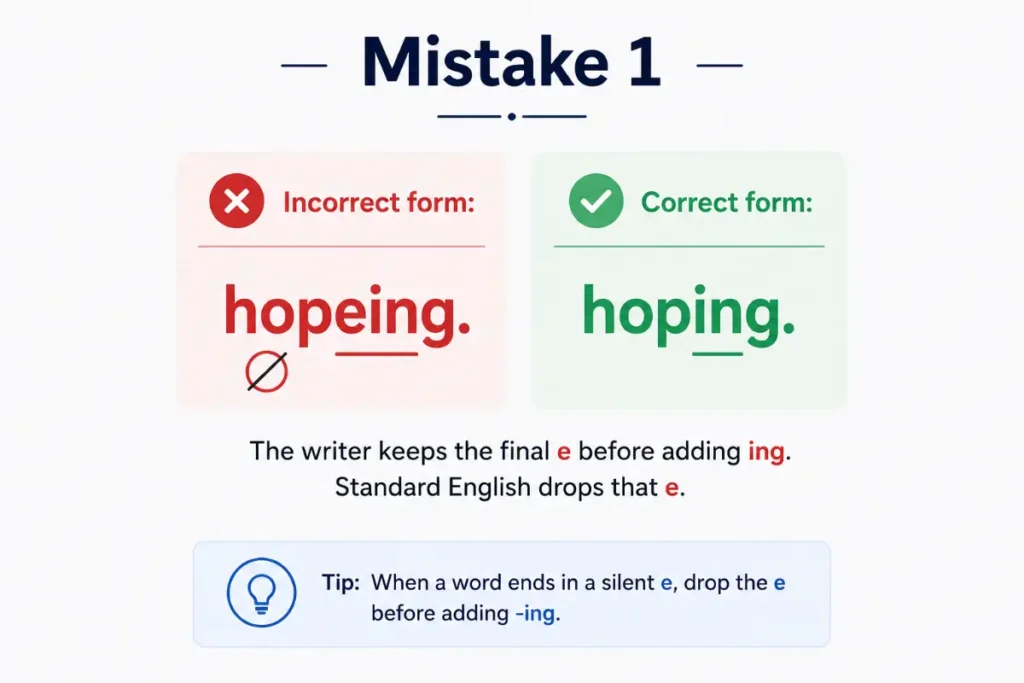
Mistake 1
Incorrect form: hopeing.
Correct form: hoping.
The writer keeps the final e before adding ing. Standard English drops that e.
Mistake 2
Incorrect form: hopeing to get.
Correct form: hoping to get.
The first word needs the present participle form hoping. The phrase then follows the normal pattern of hoping to plus the base verb.
Mistake 3
Incorrect form: I am hopeing.
Correct form: I am hoping.
The continuous form of hope is am hoping. The spelling of the participle remains hoping.
Mistake 4
Incorrect form: hoping too get.
Correct form: hoping to get.
This mistake involves word choice rather than spelling. The word to introduces the infinitive in this pattern.
Mistake 5
Incorrect form: hoping getting.
Correct form: hoping to get.
Cambridge explains that when hope is followed directly by another verb the usual pattern is hope to plus the base verb. For example the standard form is hope to hear rather than hope to hearing.
These mistakes show why spelling and grammar often overlap. Fixing one word is useful but understanding the complete sentence pattern makes your writing stronger.
Pronunciation Guide
Hoping is pronounced with two syllables. IPA: /ˈhoʊpɪŋ/ A simple pronunciation guide is HOH ping.
The main stress falls on the first syllable. The first part sounds like hope. The second part sounds like ping without the initial p sound being emphasized. The final g represents the sound at the end of the ing ending. In relaxed American speech the ending can sound slightly lighter but the standard pronunciation remains easy to recognize.
The pronunciation does not give you a strong clue about the missing e because the e in hope is silent. That is part of the reason spelling mistakes happen. When people hear the word they hear hope followed by an ing sound. They may mentally connect those sounds to the spelling hopeing. Writing requires a different approach. Start with the base word and apply the spelling rule.
Etymology And Word Origin
Hope is an old English word with a long history. Merriam Webster traces the verb and noun to Middle English and ultimately to Old English hopian. The dictionary also connects it with the Middle High German word hoffen. The word has carried the central idea of desire and expectation for centuries. Its modern meanings still revolve around wanting something and believing that it may happen.
That makes hope an interesting example of how a short everyday word can survive across many stages of English. The spelling of hoping is much newer in practical terms because it reflects modern English spelling conventions for adding endings to words. The important point for modern writers is not the historical spelling. It is the current standard rule. The final e in hope is removed before ing is added.
You may also want to read onsite vs on-site: Correct Usage Explained.
Regional Usage
American English
Hoping is the standard spelling in American English. American writers use it in casual speech professional writing school assignments journalism and everyday digital communication.
Examples include:
I’m hoping for good news.
We’re hoping to finish soon.
She was hoping to see you.
The spelling does not change based on the level of formality.
British English
Hoping is also the standard spelling in British English. There is no meaningful regional spelling difference between American and British English for this word. The same final e deletion rule applies. Cambridge uses hope plus ing becoming hoping as an example of standard English spelling.
Australian English
Australian English also uses hoping as the standard form. There is no special Australian spelling that changes this word.
Canadian English
Canadian English likewise uses hoping. The spelling remains consistent across the major English varieties discussed here. This is useful because some English words have genuine regional spelling differences. This one does not create that kind of problem.
Grammar Rules And Part Of Speech
Hoping comes from the verb hope. It can serve several grammatical roles depending on the sentence.
Present Continuous Use
The most common pattern is the present continuous. I am hoping for good news. She is hoping to win. They are hoping that everything works out. In these examples hoping works with a form of be. The structure is: subject + be + hoping. This construction describes an ongoing thought desire expectation or intention.
Past Continuous Use
Hoping can also appear in the past continuous. I was hoping to speak with you. They were hoping to arrive early. Cambridge specifically notes that the past continuous form of hope can make polite statements and requests. For example: I was hoping you could help me. This can sound softer than a direct request such as Can you help me.
Hoping For Something
Use hoping for when the thing desired is a noun or noun phrase. I’m hoping for a promotion. She’s hoping for better results. They’re hoping for good weather. This pattern is natural and common.
Hoping To Do Something
Use hoping to followed by the base form of a verb. I’m hoping to visit Chicago. She’s hoping to start college next year. We’re hoping to finish early.
Hoping That Something Happens
You can also use hoping with a clause beginning with that. I’m hoping that everything goes well. She’s hoping that her application is accepted. They’re hoping that the meeting ends early. In everyday conversation the word that is often left out. I’m hoping everything goes well. Both structures are natural.
Hope And Expect Are Not The Same
Expect focuses more strongly on belief or prediction. Consider these examples. I’m hoping for a promotion. This tells the reader that you want the promotion. I’m expecting a promotion. This suggests that you believe the promotion is likely or anticipated. Cambridge explains that hope expresses a desired outcome while expect is used when someone believes an event will happen. That distinction matters in professional writing. If you say I’m hoping the meeting goes well you express a positive desire. If you say I expect the meeting to go well you sound more confident about the likely result. Neither word is automatically better. The right choice depends on the meaning you want to communicate.
Hope And Wish Are Not The Same
I hope I pass the test. Wish can describe an unreal situation or something contrary to present reality. I wish I had more time. This difference becomes especially useful for learners who use English at school or work. If the event is still possible and you want it to happen use hope naturally. If you’re talking about an unreal present situation use wish in the appropriate structure.
Real Life Usage Examples
Hoping appears everywhere in ordinary English. It sounds natural in casual conversation and can also work in polished professional writing.
Daily Conversation
I’m hoping we can grab lunch tomorrow. She’s hoping to find a new apartment soon. These sentences sound relaxed and natural. Native speakers commonly use the present continuous form to describe a current desire or expectation.
Workplace Communication
I’m hoping to have the report ready by Thursday. We’re hoping for a quick response from the supplier. The form works well in professional communication because it expresses intention without sounding unnecessarily stiff.
Academic Writing
The researchers are hoping to identify patterns in the data. The study was designed with the hope of improving future treatment options. Academic writing may use hope less often than words such as expect or anticipate because academic claims often require careful evidence. Still the word is perfectly valid when the writer is describing a genuine desire or aim.
News And Journalism
A news report might describe officials hoping for progress or families hoping for a safe return. The word works well in reporting because it can describe the emotional expectations of people involved in an event.
Storytelling
She was hoping the letter would arrive before sunset. He kept hoping that someone would come back. In storytelling the word can reveal a character’s inner desire without explaining every emotion directly.
Related And Confused Terms
Understanding nearby words can make the meaning of hope much clearer.
Wish
Wish often describes a desire that is difficult impossible or contrary to present reality. It has grammar patterns that differ from hope.
Expect
Expect usually communicates a stronger belief that something will happen.
Anticipate
Anticipate often suggests that someone expects an event and prepares mentally or practically for it.
Desire
Desire is a more formal word for wanting something.
Want
Want is the everyday word for having a desire for something.
Trust
Trust can overlap with hope in some older or specialized meanings but the modern everyday uses are different.
Optimism
Optimism describes a positive outlook rather than a single desire or expectation.
Look Forward To
Look forward to expresses positive anticipation about something expected or planned. These words belong to the same broad semantic area but they are not perfect substitutes.
For example: I expect you to come. I’m looking forward to seeing you. Each sentence carries a slightly different tone and meaning.
Useful Expressions With Hope
English has many common expressions built around hope.
Hope For The Best
This means to stay hopeful despite uncertainty. We’ve done everything we can so now we’ll hope for the best.
Give Someone Hope
This means to make someone feel that a positive result may be possible. The good news gave the family hope.
Lose Hope
This means to stop believing that a positive result is possible. She refused to lose hope.
Hold Out Hope
This means to continue believing that something good may still happen. Doctors are holding out hope for a full recovery.
Full Of Hope
This describes someone who feels strongly optimistic about the future. The young students were full of hope. These expressions show how deeply the word is woven into everyday English.
Why The Mistake Is So Common
The spelling error makes sense from a learner’s point of view. A person sees hope and then wants to add ing. The natural first thought may be to keep the whole base word intact. That produces hopeing. English spelling rules sometimes work differently from what the eye expects. The final e is silent and disappears before ing. Another reason is that some learners memorize the base word without learning what happens when endings are added. This is why learning word families can help. Look at: hope hoping hoped hopes Once you see the complete family the pattern becomes easier to remember. The same approach works with other verbs. make making made makes write writing wrote writes The spelling change becomes part of the word pattern rather than a random fact.
An Easy Memory Trick
Use this simple rule. When a verb ends in a silent e and you add ing the e usually goes away. Think: hope → hoping. The easiest way to remember it is to imagine that the ing ending pushes the silent e out. You don’t need to memorize a complicated spelling formula. Just check the base word. If the word ends in silent e then ask what happens when ing is added. For hope the answer is clear. Hope loses e. Hoping remains. This trick can save you time during proofreading.
When Spell Check Can Help
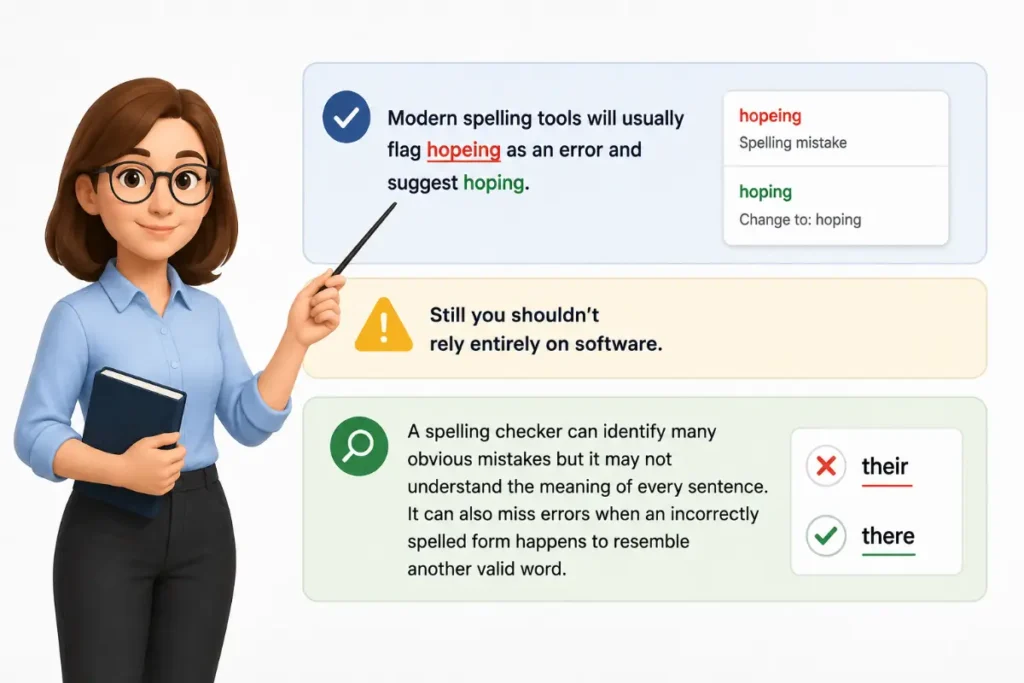
Modern spelling tools will usually flag hopeing as an error and suggest hoping. Still you shouldn’t rely entirely on software. A spelling checker can identify many obvious mistakes but it may not understand the meaning of every sentence. It can also miss errors when an incorrectly spelled form happens to resemble another valid word. The best editors combine tools with language knowledge. If you’re writing an important email or document read the sentence yourself after running spell check.
Ask:
- What is the base verb.
- What ending did I add.
- Does the spelling rule require the final e to disappear.
For this word the answer leads directly to hoping.
Expert Editor Insight
An experienced editor would treat hopeing as a straightforward spelling error rather than a different English word. The useful correction is not simply to replace the letters but to understand the pattern behind the mistake. When a verb ends in silent e and takes ing the e is normally removed. Learning that pattern gives you a reliable editing habit that works far beyond this single word.
For another common grammar confusion, see Holistic or Wholistic Which Spelling Is Correct? 2026.
Final Answer
The correct form is hoping. The form hopeing is a common spelling mistake caused by keeping the final e from hope before adding ing. Standard English drops that silent e so hope becomes hoping.
Remember the simple pattern: hope becomes hoping.
The same rule helps with many other verbs that end in silent e. Once you recognize the pattern you won’t need to guess each time. If you’re proofreading your writing and see hopeing simply return to the base word hope and remove the final e before adding ing. That quick check will give you the correct spelling every time.
FAQs
Is Hopeing A Real Word?
Hopeing is not the standard spelling of the present participle of hope in modern English. In ordinary English writing you should use hoping. The error usually happens because writers keep the final e from the base word when adding ing. Standard spelling removes that e before the ending is added.
Which Is Correct Hopeing Or Hoping?
Hoping is correct. Hopeing is a spelling mistake. The base verb hope ends in a silent e. Before the ending ing is added the final e is removed. This gives the standard form hoping. The same spelling pattern appears in words such as making writing and taking.
Why Do You Drop The E In Hoping?
The final e in hope is silent. English normally drops a final silent e before adding an ending that begins with a vowel. Since ing begins with a vowel the e is removed. Cambridge specifically gives hope plus ing becoming hoping as an example of this spelling rule.
What Does Hoping Mean?
Hoping means wanting something to happen while holding some expectation that it may happen. It can describe a current desire or expectation. For example I’m hoping for good news means I want good news and think it may arrive. Merriam Webster lists hoping as the present participle of hope.
How Do You Pronounce Hoping?
Hoping is pronounced /ˈhoʊpɪŋ/ in American English. It has two syllables with the main stress on the first syllable. An easy guide is HOH ping. The first syllable sounds like hope and the second contains the familiar ing sound.
Can Hoping Start A Sentence?
Yes. Hoping can start a sentence when it functions as a participial phrase. For example: Hoping to avoid traffic we left early. In polished writing you should make sure the phrase clearly connects to the subject of the main clause. This avoids a dangling modifier and keeps the sentence easy to understand.
Is Hoping Appropriate In Formal Writing?
Yes. Hoping is a standard English form and is appropriate in formal writing when the meaning fits. It can appear in professional emails academic contexts reports and other polished writing. The level of formality comes from the complete sentence rather than the spelling of the word itself.
What Is The Difference Between Hoping And Expecting?
Hoping expresses desire for an outcome. Expecting usually expresses a stronger belief that an outcome will happen. For example I’m hoping for a promotion focuses on desire while I’m expecting a promotion suggests confidence that it will happen. Cambridge distinguishes the two based on desire and belief. word hope and remove the final e before adding ing. That quick check will give you the correct spelling every time.