
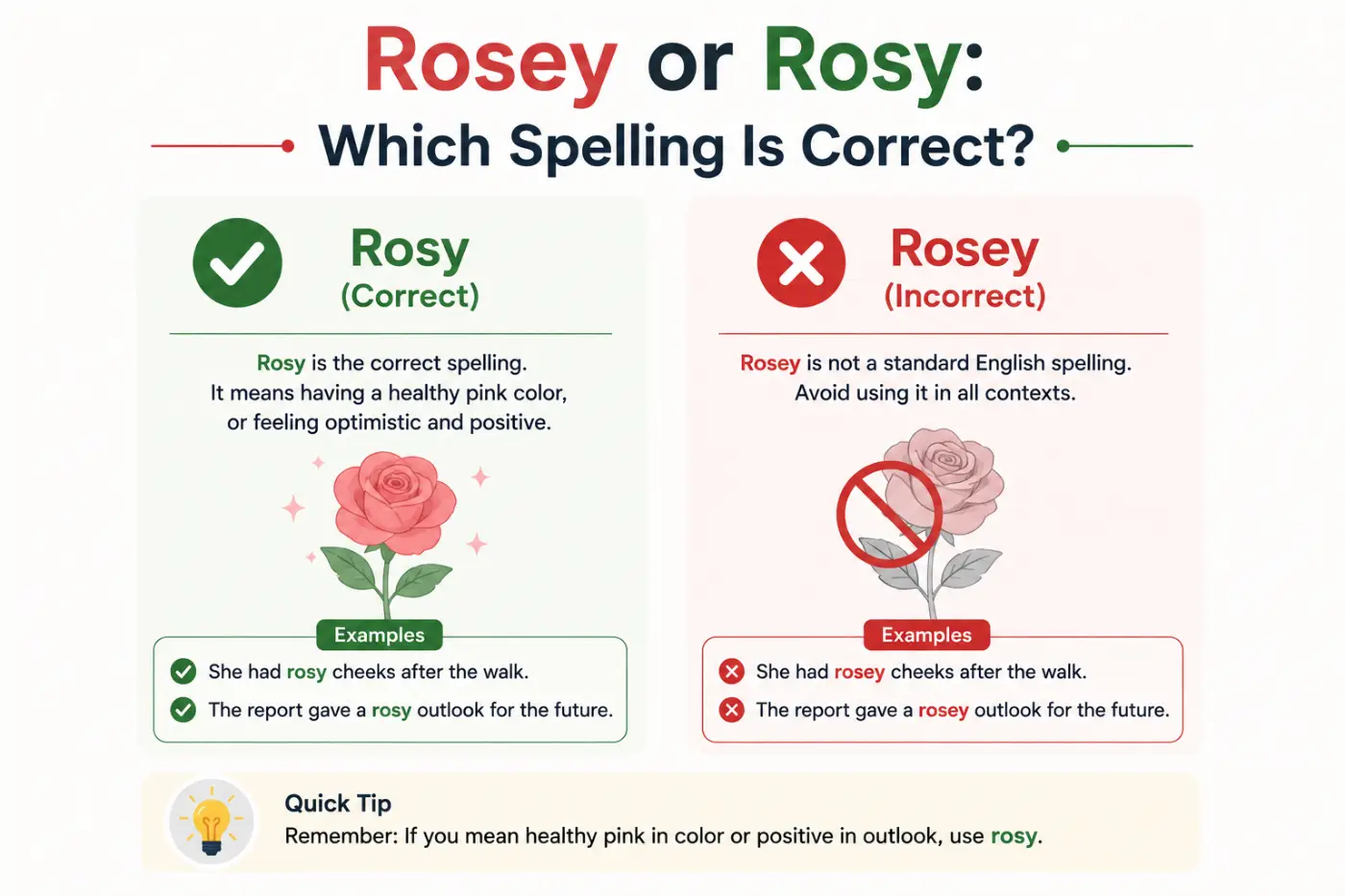
If you’re wondering about rosey or rosy you can settle the spelling question quickly. Rosy is the standard spelling when you mean pink or rose colored or when you mean hopeful and optimistic. Rosey is not the standard spelling of this adjective in modern English.
The confusion makes sense because the noun rose ends with an e. It’s easy to look at that word and assume the adjective should keep the same spelling before adding the final sound. English doesn’t always work that way. In this case the established adjective is formed as rosy.
You’ll see this word in phrases such as rosy cheeks rosy skin a rosy glow a rosy outlook and a rosy future. Dictionaries including Merriam Webster and Cambridge list rosy as the adjective used for color complexion and optimism. Merriam Webster also records its first known use in the 14th century.
You may also want to read Seing Vs Seeing Which Is Correct In English in 2026.
Quick Answer
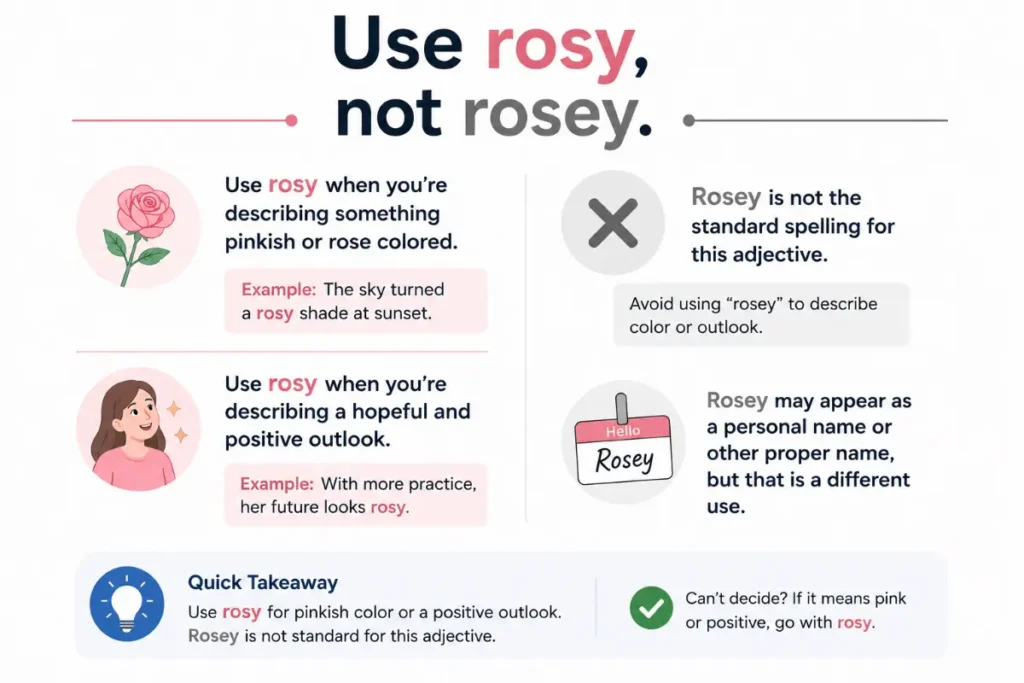
Use rosy when you’re describing something pinkish or rose colored or when you’re describing a hopeful and positive outlook. Rosey is not the standard spelling for this adjective. It may appear as a personal name or other proper name but that is a different use.
What Is The Correct Spelling
The correct standard spelling is rosy. The word functions as an adjective. It can describe a visible color or appearance such as rosy cheeks. It can also describe an attitude or situation that looks hopeful and positive such as a rosy future. The spelling has only one e. That detail is easy to overlook because the related noun rose has an e at the end.
Consider these examples.
- She came inside with rosy cheeks.
- The morning light gave the clouds a rosy glow.
- The company has a rosy outlook for the next year.
- He has a rosy view of what the future will bring.
In each sentence the adjective is spelled rosy.
Comparison Table
| Correct Form | Meaning | Part of Speech | Origin | Usage Frequency | Formality | Common Contexts | Example |
|---|---|---|---|---|---|---|---|
| Rosy | Pink or rose colored or hopeful and optimistic | Adjective | Related to rose and the adjective suffix y | Common | Standard | Appearance color outlook mood writing | She had rosy cheeks |
| Rosey | Not the standard adjective spelling | Usually a name or nonstandard spelling in this context | Often influenced by the spelling of rose | Uncommon as an adjective | Nonstandard for the adjective | Names nicknames or spelling mistakes | Rosey may occur as a personal name |
The table highlights the main point. There is no standard American English spelling choice between the two forms when you are using the adjective. The normal form is rosy.
What Does Rosy Mean
The word has two main meanings. The first meaning relates to color or physical appearance. Something described as rosy has a pink or reddish color that resembles the color associated with a rose. The word often describes cheeks skin light clouds or other surfaces. The second meaning is figurative. Something can be called rosy when it looks hopeful promising or positive. A person can have a rosy outlook. A business can have rosy prospects. A family might believe that its future looks rosy. Cambridge gives both of these major senses. It defines the physical sense in terms of a color between pink and red. It also explains the figurative sense as a situation that gives hope of success or happiness.
That two part meaning explains why the word appears in very different kinds of sentences. You might describe a child as having rosy cheeks. That is a physical description. You might describe a business forecast as rosy. That is an evaluation of a situation. The underlying idea is similar. In both cases the word suggests something pleasant bright or favorable.
What Does Rosey Mean
As a general adjective rosey is not the standard spelling used in modern English. If you want to describe pink cheeks you should write rosy cheeks. If you want to describe an optimistic forecast you should write a rosy outlook. The extra e usually comes from the visual influence of the word rose. A writer sees rose and then naturally expects the adjective to be rose plus y. That seems logical at first glance but established English spelling does not follow that pattern here. This is a useful reminder that spelling often depends on the conventional form of a word rather than on a simple letter by letter transformation. You may still encounter Rosey in names. A personal name can have a spelling chosen by a family even when that spelling differs from a standard dictionary word. The same principle applies to business names character names usernames and other proper names.
Key Differences Explained
The biggest difference is standard usage.
- Rosy is the standard adjective.
- Rosey is not the standard adjective spelling.
- Rosy describes pink or rose colored appearance.
- Rosy can also describe optimism hope or favorable prospects.
- Rosey may appear as a personal name or other proper name.
- The two forms can sound alike when spoken.
- American and British English both use rosy as the standard adjective.
The spelling difference does not create a different adjective meaning. In ordinary writing the extra e does not give the word a special shade of meaning.
That makes this an easy case once you remember the standard form.
Why The Extra E Causes Confusion
English spelling has many words that look as if they should follow a neat pattern but do not. The word rose is a good example. It ends in e and has a strong connection with the adjective rosy. A writer may instinctively build the adjective as rose plus y and produce rosey.
There is another reason for the confusion. Pronunciation does not help much. Cambridge gives the US pronunciation as /ˈroʊ.zi/. The word has two syllables and the stress falls on the first syllable. The sound is close to what many people expect from both spellings. When two spellings sound the same the ear cannot tell you which one belongs on the page. You need to remember the conventional spelling. This is similar to many common English spelling problems. Pronunciation can help in some cases but it cannot solve every spelling question.
Which Form Is Correct
Use rosy in standard English when the word is an adjective. This is the form you should choose in school assignments professional writing articles reports emails and other edited content. The reason is simple. Rosy is the established dictionary form. Both Cambridge and Merriam Webster list it as an adjective and describe its meanings in relation to color complexion optimism and positive expectations. You do not need to invent a spelling rule to remember it. Just treat rosy as the established form. A useful editing habit is to check the word’s grammatical role before correcting it.
Sentence Examples
Here are natural examples that show how the standard form works in real writing.
- Her cheeks looked rosy after the long walk.
- The sunset filled the sky with a soft rosy light.
- The doctor said his complexion looked healthy and rosy.
- She wore a rosy pink dress to the wedding.
- The flowers added a rosy touch to the room.
- Investors have a more rosy outlook after the strong quarterly results.
- The manager sounded optimistic about the company’s future.
- He has a rosy view of what life will look like after graduation.
- The new evidence gives us a more hopeful picture of the situation.
- The morning sun created a rosy glow across the mountains.
Notice that the word works naturally in both literal and figurative contexts. It can describe something you can see. It can also describe an attitude or prediction.
Common Mistakes And Misspellings
Several mistakes tend to appear around this word.
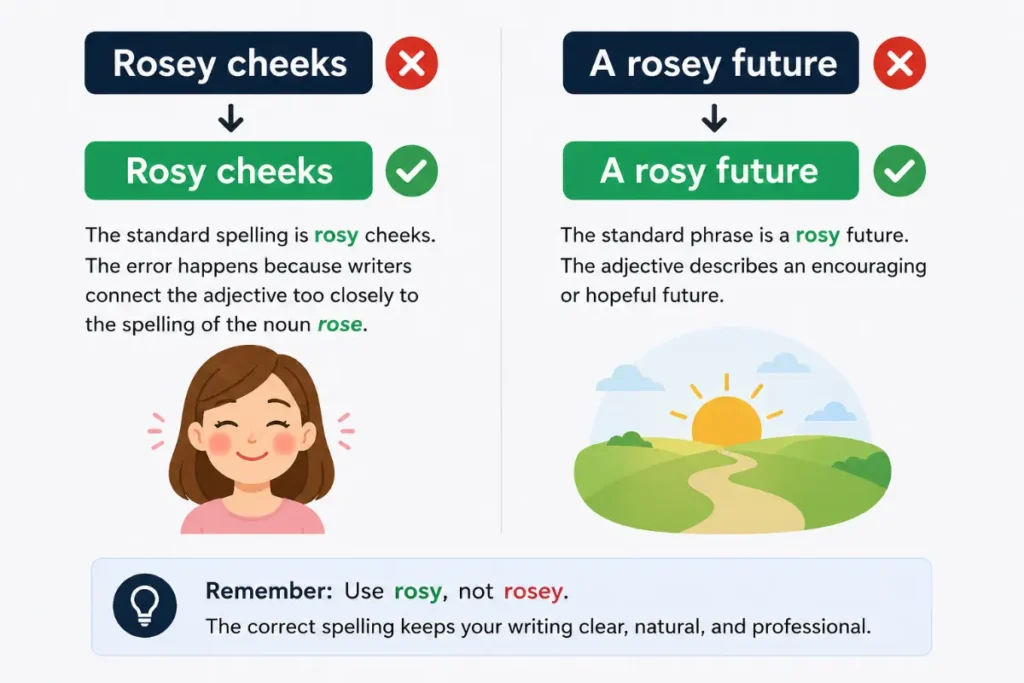
- Rosey cheeks
The standard spelling is rosy cheeks. The error happens because writers connect the adjective too closely to the spelling of the noun rose.
- A rosey future
The standard phrase is a rosy future. The adjective describes an encouraging or hopeful future.
- Rosey outlook
The standard form is rosy outlook. This expression often appears in business journalism and everyday discussion about plans or prospects.
- Rosie when the meaning is descriptive
Rosie is commonly used as a personal name or nickname. It should not replace the adjective when you mean pinkish or optimistic.
- Changing a person’s name
If a person’s actual name is Rosey you should keep that spelling. Proper names belong to the people who use them. You should not change a name simply because it resembles a nonstandard spelling of an adjective.
These mistakes come from different sources. Some involve visual spelling patterns. Others involve confusion between a descriptive word and a personal name.
Pronunciation Guide
The standard adjective has two syllables.
The US pronunciation is /ˈroʊ.zi/. You can think of it as ROH zee. The first syllable receives the main stress. The final sound is similar to the ending sound in words such as easy and busy. Cambridge gives /ˈroʊ.zi/ for US English and /ˈrəʊ.zi/ for UK English. The main vowel differs slightly between the two varieties but the word remains easy to recognize.
Etymology And Word Origin
The history of the word explains why it is closely connected to the noun rose.
Etymology sources trace the adjective back to the word for the rose and the adjective forming suffix y. Etymonline records the adjective as an old English formation connected with rose and notes early meanings related to rose color and later meanings related to healthy complexions and optimism. Merriam Webster records the first known use of the adjective in the 14th century. The history also shows how the meaning expanded. At first the word was strongly connected with color and the appearance of a rose. It later developed uses for healthy looking complexions. From there the word gained a figurative sense connected with cheerfulness and optimism. That development is common in language. Physical images often become metaphors for emotions and ideas. A bright healthy color can suggest health. Health can suggest positive circumstances. Positive circumstances can then become a metaphor for hope. The result is a word that can describe both a person’s cheeks and a person’s expectations.
American English Usage
In American English rosy is the standard adjective. You can use it in casual speech and formal writing. It is not restricted to one type of communication. For example you might say that a child has rosy cheeks. You might also write that economic prospects look rosy. The word is especially natural in expressions connected with outlooks expectations prospects pictures and predictions. American readers will understand phrases such as rosy future and rosy outlook immediately. There is no need to use the extra e for an American audience.
Learn the difference in Bearable vs Bareable Which Is Correct? 2026.
British English Usage
British English also uses rosy as the standard adjective. There is no major British versus American spelling split in this case. Cambridge lists the word for both UK and US English and gives pronunciation information for both varieties. This matters because many English spelling questions involve genuine regional differences. This one does not. A writer in London and a writer in New York would normally choose the same adjective spelling. The difference between UK and US pronunciation is more noticeable than the difference in spelling.
Australian English Usage
Australian English generally follows the same standard spelling. When the adjective describes a pinkish complexion a rosy color or an optimistic situation the normal written form is rosy. There is no useful reason to treat rosey as an Australian alternative. If you encounter that spelling in Australian writing it is more likely to be a personal name a deliberate stylization or a simple spelling error than a regional spelling rule.
Canadian English Usage
Canadian English also uses rosy as the standard adjective and Canadian English shares many features with both American and British English but this word does not create a meaningful spelling difference between those varieties. For general Canadian writing use rosy.
Grammar Rules And Part Of Speech
The word is an adjective. That means it normally modifies a noun or follows a linking verb to describe a subject. Consider these patterns. Adjective before a noun he has rosy cheeks. The phrase rosy cheeks contains an adjective followed by a noun. Adjective after a linking verb Her cheeks became rosy. Here the adjective follows the linking verb became and describes the subject. Figurative use The outlook is rosy. In this sentence the adjective describes the outlook rather than a physical color. The word can also appear in comparative and superlative forms. Merriam Webster lists rosier and rosiest.
For example you can write:
The economic outlook looks rosier this year.
That was the rosiest prediction we had heard.
The same spelling principle remains in place. You do not add an extra e before the ending.
Formal And Informal Usage
The standard adjective works well across levels of formality.
In everyday conversation you might say:
Your cheeks are rosy.
In professional writing you might say:
The latest figures provide a rosier outlook for the company. In journalism you may see phrases such as a rosy forecast or a rosy picture. The word is familiar and natural. It does not sound overly technical. However the figurative meaning can sometimes carry a hint of criticism. If someone has a rosy view of a difficult situation the writer may suggest that the person is too optimistic.
For example:
He has a rosy view of the company’s financial position.
This sentence can sound neutral or slightly skeptical depending on the surrounding context.
The word itself does not always mean that the positive view is accurate. It describes the way the situation appears to someone.
Real Life Usage Examples
Daily Conversation
The first everyday use involves appearance. After spending time outside in cold weather someone may have rosy cheeks. The word creates a quick visual picture without needing a long explanation. A parent might say that a child’s cheeks look rosy after playing outdoors. The second use involves expectations. A friend might say that the future looks rosy after receiving good news. The phrase communicates confidence and optimism in a simple way.
Workplace Communication
The word appears naturally in workplace discussions about results and expectations. A manager might describe the team’s outlook as rosy after strong sales. A financial report might describe a rosier forecast after an improvement in revenue. In these settings the word works best when the evidence supports the positive assessment. If the writer wants a neutral tone then words such as favorable or promising may sometimes be more precise.
Academic Writing
Academic writing usually favors precise language. The adjective can still appear when the subject calls for it. For example a paper about public expectations might discuss an overly rosy prediction. In formal academic prose you should use the standard spelling and make sure the figurative meaning is clear from context.
News And Journalism
Journalists often use this adjective when describing economic conditions political expectations business prospects or public forecasts. Expressions such as rosy outlook and rosy picture are familiar in news writing. The word can also be used critically. A reporter might describe an official forecast as overly optimistic.
Literature And Storytelling
Writers can use the physical sense to create atmosphere. A rosy dawn can suggest warmth and beauty. Rosy cheeks can suggest health youth embarrassment or excitement depending on the scene. The figurative sense can also help characterize someone who sees life through an optimistic lens. That flexibility gives the word more range than its simple color meaning might suggest.
Related And Confused Terms
Several words are closely connected to this adjective but they do not all mean exactly the same thing.
- Pink
Pink is a basic color term. It is broader and more neutral. Rosy often suggests a warmer or more rose like shade.
- Rose colored
Rose colored describes something that resembles the color of a rose. It can also appear in the figurative expression rose colored glasses which suggests an unrealistically positive view.
- Optimistic
Optimistic focuses on a person’s belief that good things are likely to happen. It does not describe physical color.
- Hopeful
Hopeful expresses a positive expectation or desire. It is often more personal than rosy.
- Promising
Promising describes something that appears likely to produce a good result. It works especially well for opportunities prospects and early results.
- Bright
Bright can describe light color intelligence or a positive future. Its meaning is broader than the adjective discussed here.
- Ruddy
Ruddy usually describes a strong reddish complexion. It can suggest healthy color but often has a deeper red quality than rosy.
- Blushing
Blushing describes the visible redness that appears on someone’s face because of emotion heat embarrassment or physical activity. These distinctions help you choose the best word instead of treating every color or optimism related term as interchangeable.
Rosie And Rosey As Names
A separate issue appears when people confuse the adjective with personal names. Rosie is commonly used as a given name or nickname. It is associated with names such as Rose and Rosemary. The spelling Rosey can also occur as a personal name or nickname. A person’s name is a proper noun and follows the spelling chosen for that person. This distinction is important for editors. Suppose a sentence says: Rosey joined the meeting at nine. You should not automatically change the name to Rosy. The writer may be referring to a person whose actual name is Rosey. Now consider: She had rosey cheeks after the run. Here the word is not a name. It is meant to describe her cheeks. The standard adjective is rosy. Context settles the issue.
Is The Extra E Ever Appropriate
The extra e can be appropriate when it belongs to a proper name or deliberate brand spelling. Names do not have to follow the spelling conventions of ordinary vocabulary. A family may choose an unusual spelling and that spelling becomes correct for that individual. The same can happen with a fictional character or a business name. The key point is that such a use does not create a new standard adjective. You should not write rosey cheeks simply because you have seen Rosey used as someone’s name. A proper name and a common adjective belong to different grammatical categories and follow different editorial rules.
How To Remember The Spelling
The easiest memory trick is to connect the adjective with the ending y. Think of the pattern as: rose → rosy The noun ends in e. The adjective does not keep that e. You can also remember a few familiar phrases. Rosy cheeks. Rosy glow. Once these phrases become familiar the spelling starts to feel natural. Another useful trick is to remember the pronunciation. The word has two syllables and ends with the same sound found in many common adjectives. The spelling is not a direct copy of the noun rose. If you are editing quickly and hesitate between the two forms check the grammatical role first. If the word is an adjective describing color appearance or optimism choose the standard form.
Expert Editor Insight
An experienced editor looks at function before appearance. The extra e is tempting because the noun rose contains it but the established adjective does not. In edited American English the normal choice is rosy. A spelling tool may flag rosey when it appears as an adjective because standard dictionaries recognize the adjective in its shorter form. The one exception that deserves attention is a proper name. Editors preserve names exactly as their owners spell them.
Why Spelling Tools Can Be Helpful
Spell checkers can catch many ordinary errors but they cannot always understand context. Imagine a sentence containing Rosey. A tool may flag it because it does not recognize the form as a standard adjective. That could be useful if the writer intended to describe color. But if the sentence contains someone’s name the flag may be wrong for that particular context. This is why human editing still requires judgment. A good editor does not simply replace every unfamiliar spelling. The editor asks what the word means and what role it plays. That approach is especially useful with names brands place names and specialized vocabulary.
Why Pronunciation Does Not Solve The Problem
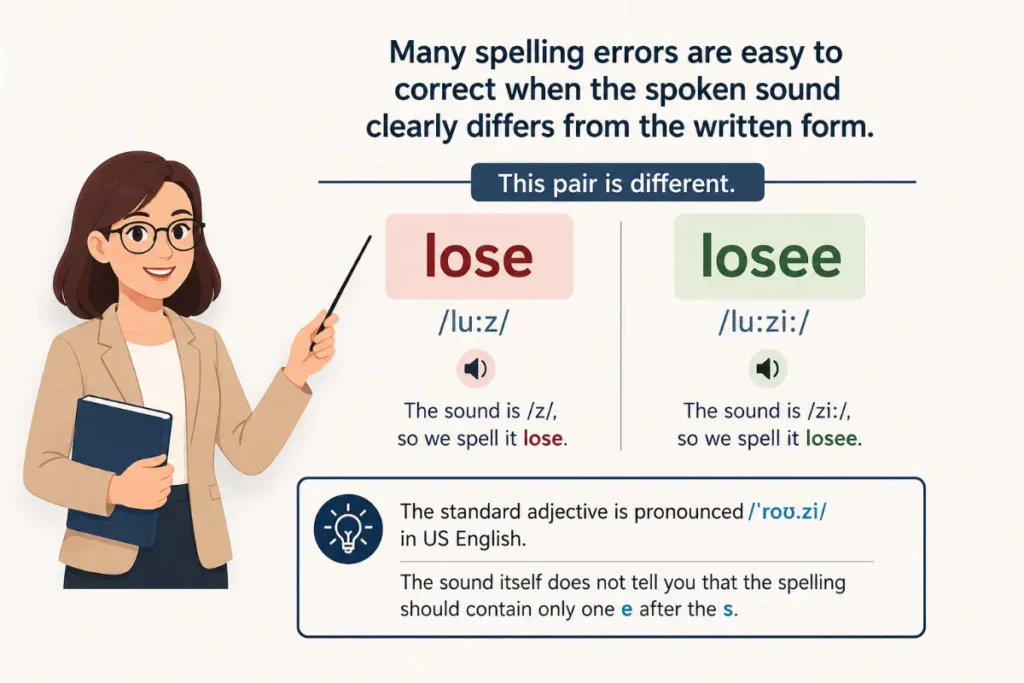
Many spelling errors are easy to correct when the spoken sound clearly differs from the written form. This pair is different. The standard adjective is pronounced /ˈroʊ.zi/ in US English. The sound itself does not tell you that the spelling should contain only one e after the s. This is a classic example of why spelling and pronunciation are related but not identical. English contains many words whose spelling cannot be predicted perfectly from pronunciation. Some forms have to be learned through exposure reading and repeated use. The good news is that this one is easy to memorize once you see it in common phrases.
A related grammar guide is According to Alternatives for Clearer Writing.
Final Takeaway
The answer to rosey or rosy is straightforward. Use rosy when you mean pink or rose colored or when you mean hopeful optimistic or promising. It is the standard adjective in both American and British English.
The extra e usually appears because writers connect the adjective too closely with the spelling of rose. That connection is understandable but it does not change the established spelling. Remember the simple pattern rose becomes rosy.
One final editing tip is worth keeping in mind. Always check the word’s role before correcting it. If it describes cheeks color or an outlook use rosy. If Rosey is someone’s actual name preserve that spelling. That small habit will help you avoid an easy mistake without overthinking it.
FAQs
Is Rosey A Standard English Adjective?
No. Rosey is not the standard spelling for the adjective that describes a pink color or an optimistic situation. Use rosy in normal English writing. A form like Rosey can still appear as a personal name or another proper name. The context matters because proper names can follow their own established spellings.
What Does Rosy Mean?
The adjective has a literal and figurative meaning. Literally it describes something pink or rose colored or a healthy looking complexion. Figuratively it describes something hopeful positive or promising. You might talk about rosy cheeks in one sentence and a rosy future in another. Both uses are standard.
Which Spelling Should I Use In Formal Writing?
Use rosy. It is the standard adjective spelling used in edited English. It works in professional reports academic prose business writing and everyday communication. If the unusual spelling belongs to a person’s name then preserve the name rather than changing it to match the adjective.
Is Rosy An American Spelling?
Yes. Rosy is standard in American English. It is also standard in British English. There is no major regional spelling difference between these varieties for this adjective. Cambridge provides separate US and UK pronunciation information while keeping the same written form.
How Do You Pronounce Rosy?
In US English the pronunciation is /ˈroʊ.zi/. It has two syllables with the main stress on the first syllable. An easy approximation is ROH zee. The UK pronunciation uses a slightly different first vowel but remains a two syllable word.
Can Rosy Describe A Person?
Yes. It can describe a person’s complexion or cheeks. For example you can say that someone has rosy cheeks. It can also describe a person’s outlook or attitude. A person with a rosy view of the future expects good things to happen. The exact meaning depends on the noun or situation being described.
Why Do People Add The Extra E?
The most obvious reason is the spelling of rose. Writers naturally notice that the noun ends with e and may carry that letter into the adjective. The sound also does not reveal the correct spelling. Because the two forms can sound alike the mistake can survive unnoticed until someone sees it in writing.
Is Rosie The Same As Rosy?
No. Rosie is commonly used as a personal name or nickname. Rosy is an adjective that describes color appearance or optimism. They may sound very similar in speech but they serve different grammatical roles. If you are naming a person use the person’s established name. If you are describing cheeks color or an outlook use the adjective.