
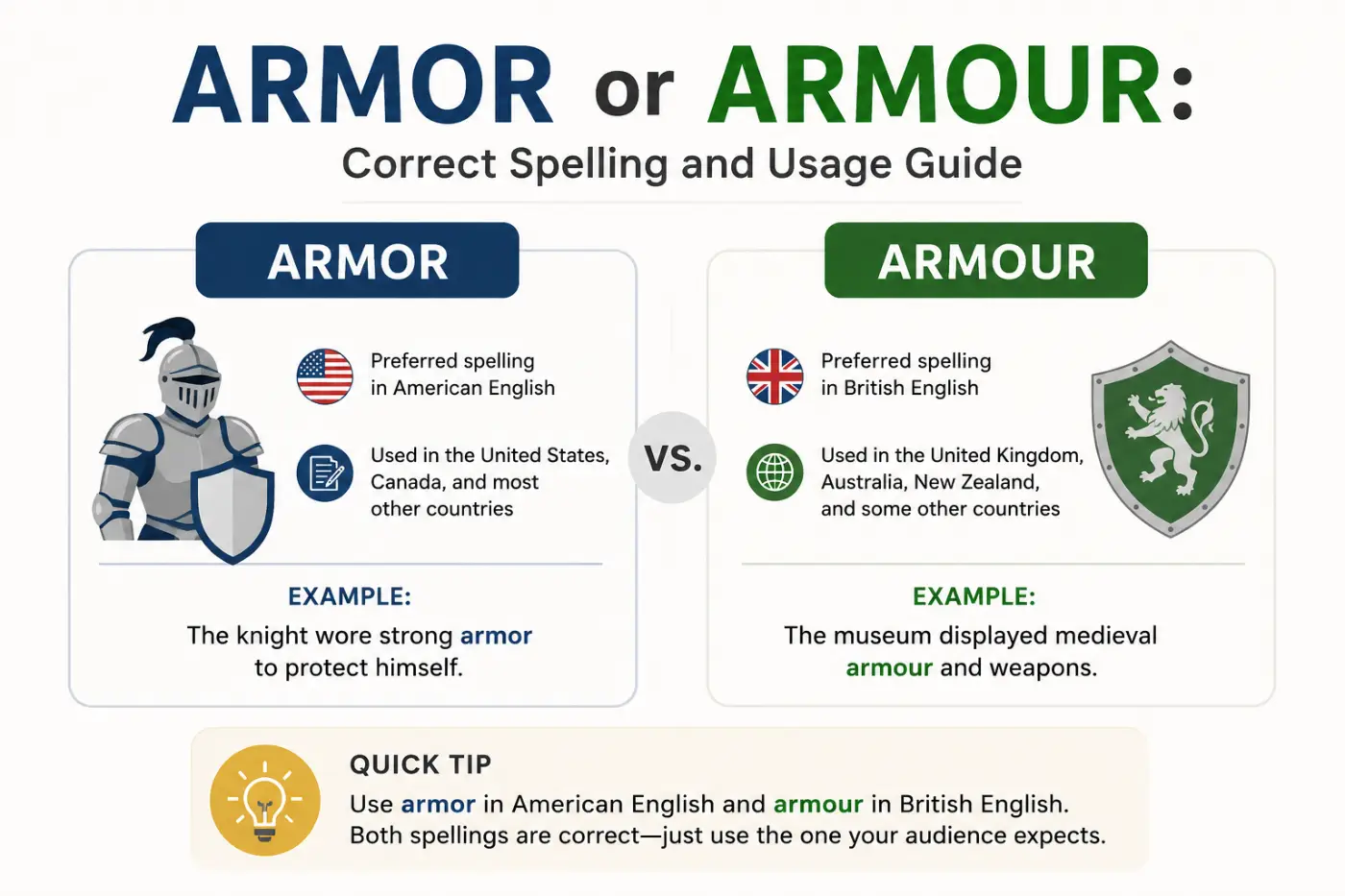
If you’ve ever written about protective clothing military vehicles or medieval knights you may have paused over armor or armour. Which spelling should you use. The answer is straightforward. Armor is the standard spelling in American English while armour is the standard spelling in British English and is also common in several other varieties of English. Both forms refer to the same thing.
The confusion comes from the extra u in the British form. English has many regional spelling differences of this kind. American English often uses shorter spellings while British English retains forms that developed through earlier English and French influences. You can see the same pattern in words such as color and colour or honor and honour.
This guide explains the difference between armor and armour in plain English. You’ll learn what the word means how to pronounce it how the spelling developed where each form is preferred and how to use it naturally in everyday writing. You’ll also see examples from conversation academic writing news military contexts and literature so you can choose the right form with confidence.
A related grammar guide is Nosey or Nosy Which Word Should You Use in 2026?.
Quick Definition
Armor and armour are two regional spellings of the same English noun. Armor is the standard American English form. Armour is the standard British English form and is also used in Canadian English and other varieties. The word refers to protective covering worn by people or used on vehicles and military equipment.
Quick Answer
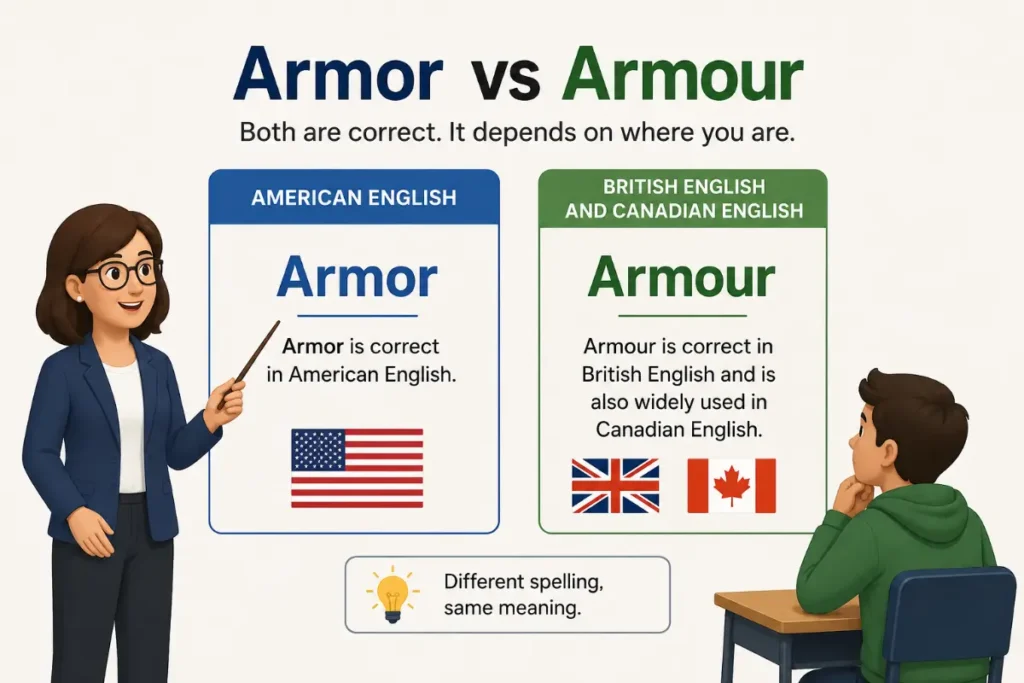
Armor is correct in American English. Armour is correct in British English and is also widely used in Canadian English.
Neither spelling is a mistake. The choice depends mainly on the English variety you are writing for. If your audience is in the United States use armor. If you are following British English conventions use armour.
Comparison Table Armor or Armour
| Correct Form | Meaning | Part of Speech | Origin | Usage Frequency | Formality | Common Contexts | Example |
|---|---|---|---|---|---|---|---|
| armor | Protective covering for a person animal vehicle or military equipment | Noun | Middle English through Old French and Latin roots | Very common in American English | Neutral | US writing military history gaming technology | The soldiers wore body armor. |
| armour | Protective covering for a person animal vehicle or military equipment | Noun | Middle English through Old French and Latin roots | Very common in British English | Neutral | UK writing military history literature Canada | The soldiers wore body armour. |
Cambridge identifies armor as the US spelling of armour and armour as the UK spelling of armor. Oxford likewise lists armor as the American English form and identifies armour as the usual Canadian form.
Meaning and Definition
Meaning of Armor
Armor means a protective covering designed to protect a person animal vehicle or structure from harm. Historically the word often referred to metal clothing worn by soldiers during battle. Today the meaning extends to protective equipment such as body armor and to protective coverings used on tanks and other military vehicles.
The word can also have a figurative meaning. Someone may describe emotional protection as armor. A person who appears calm and difficult to hurt might be said to have built emotional armor.
In American English the spelling is armor. Major dictionaries recognize it as the standard US form. Cambridge defines it as a strong covering that protects something especially the body and also uses the word for heavily protected military vehicles. Oxford gives similar meanings and identifies armor as the American English form.
The word is an uncountable noun in its main physical sense. You normally say body armor or a suit of armor rather than treating armor itself as a countable object.
Meaning of Armour
Armour has the same meaning as armor. The difference is spelling rather than meaning.
British English normally uses armour. You’ll see it in phrases such as body armour suit of armour armoured vehicle and plate armour. Cambridge lists armour as the UK spelling of armor. Oxford also uses armour as its main British form while identifying armor as the American form.
The spelling is especially familiar in British historical writing. A sentence about medieval knights might say that a knight wore a suit of armour. An American writer would normally write that the knight wore a suit of armor.
This difference does not change the pronunciation in any meaningful way. Native speakers understand both forms immediately.
Key Differences Explained
Spelling
The main difference is the letter u.
American English uses armor.
British English uses armour.
The extra letter does not create a new word. It reflects a regional spelling convention.
Grammar Role
Both forms function primarily as nouns. They can refer to physical protective equipment or military vehicles.
The related adjective also changes spelling by region. American English uses armored while British English uses armoured. Cambridge confirms this regional distinction.
Meaning
The meaning stays the same. Both forms describe protection against physical harm and can refer to protective military equipment.
Tone
Neither spelling is more formal or more sophisticated. Armor does not sound less educated than armour. Armour does not sound more formal than armor.
The spelling simply tells readers which regional English convention you are following.
Context
Use the spelling that matches your intended audience and editorial style.
An American newspaper will normally use armor. A British newspaper will normally use armour. A historical novel published for a British audience may use armour throughout while an American edition may use armor.
Which Spelling Is Correct
Both spellings are correct.
For American English use armor.
For British English use armour.
For Canadian English armour is generally preferred although armor also appears in some Canadian contexts. Oxford specifically identifies armor as the American English form and notes that Canadian English usually uses armour.
This is a classic example of regional spelling rather than a right versus wrong spelling problem. A good editor does not change armour to armor simply because one version is more familiar to an American reader. The editor first considers the publication style audience and geographic context.
Dictionary evidence supports this distinction clearly. Cambridge labels armor as US and armour as UK. Oxford follows the same regional pattern.
An expert tip is to choose one regional spelling and stay consistent. Mixing American and British spelling in the same article can make the writing look careless even when every individual word is technically correct.
Sentence Examples
Here are natural examples using the American spelling.
- The soldier wore body armor during the training exercise.
- The museum has an impressive collection of medieval armor.
- The vehicle was fitted with additional armor for protection.
- The knight entered the hall wearing a heavy suit of armor.
- Modern body armor can protect against serious injuries.
- The tank has thick armor around its main compartment.
- The police officer checked his armor before entering the building.
- The game allows players to upgrade their armor as they progress.
- The ancient armor was carefully preserved by museum staff.
- She developed an emotional armor after years of difficult experiences.
The following examples show the British spelling.
- The soldier wore body armour during the operation.
- The museum displays a remarkable suit of armour.
- The vehicle was protected by thick armour.
- The knight carried a shield and wore full armour.
- The police officers were equipped with protective body armour.
The next examples show the common misspelling that can happen when writers are unsure about regional spelling.
- The soldier wore body armur during training.
- The museum displayed a suit of armoure.
- The tank had heavy armur around its exterior.
- He searched for information about medieval armoure.
- The police officer checked his body armur before leaving.
These forms are not accepted regional spellings. They are simply spelling errors. The recognized choices are armor and armour.
Common Mistakes and Misspellings
Using Armor in a British English Text
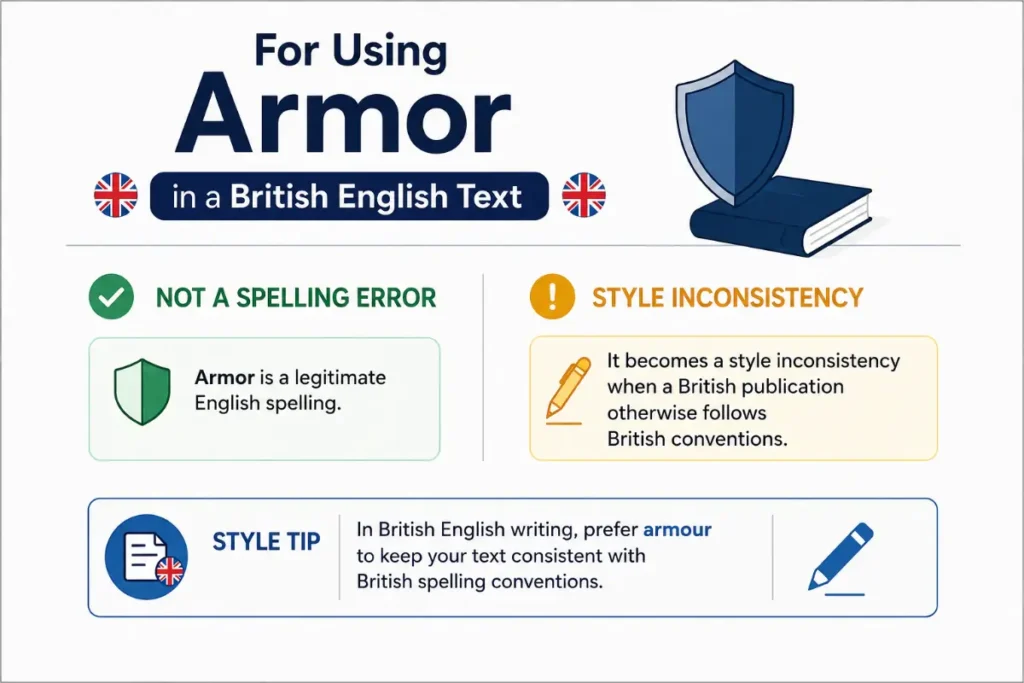
This is not technically a spelling error because armor is a legitimate English spelling. It becomes a style inconsistency when a British publication otherwise follows British conventions.
For example a British article might use colour centre and travelled but suddenly use armor. A copy editor would usually change it to armour to maintain consistency.
Using Armour in American English
Again this is not inherently wrong. American readers understand armour. However American publications normally prefer armor because it follows standard US spelling.
Writing Armored in British English
British English normally uses armoured. The American form is armored. Cambridge explicitly identifies armored as the US spelling of armoured.
Adding an Extra Letter
Some learners produce forms such as armouring or armourr because they try to apply spelling patterns they already know. The standard forms are armoring and armouring depending on the regional system.
Confusing the Word With Armory
Armor and armory are related but they are not interchangeable.
Armor refers to protective covering.
Armory refers to a place where weapons and military equipment are stored or to a collection of weapons. In British English the related form is armoury. Oxford traces armoury to Old French and Latin roots connected with arms and weapons.
Why People Get Confused
English spelling contains many regional pairs. Writers who read both American and British material can naturally encounter armor in one source and armour in another.
This creates a useful NLP clue. The surrounding words usually reveal the intended spelling system. If a document contains color center and organize it probably follows American English. If it contains colour centre and organise it probably follows British English.
Your brain also tends to remember the sound rather than the exact spelling. Since armor and armour are pronounced essentially the same way the extra letter cannot be heard. That makes the spelling difference easy to miss.
For another common grammar confusion, see Investor vs Investee Which Is the Difference? 2026.
Pronunciation Guide
The pronunciation of armor and armour is very similar. Cambridge gives the US pronunciation as approximately /ˈɑːr.mɚ/ and the UK pronunciation as approximately /ˈɑː.mə/.
The American pronunciation can be divided into two syllables.
- AR
- mer
A simple audio style guide is AR mer.
The British pronunciation can also be heard as two syllables.
- AR
- muh
A simple audio style guide is AR muh.
The main difference comes from the pronunciation of the final unstressed sound. American English commonly uses the r sound in the final syllable while standard British pronunciation often has a softer unstressed vowel without a pronounced final r. Cambridge shows these differences in its pronunciation entries.
Do not pronounce the extra u in armour as a separate sound. The u changes the spelling but does not create an additional syllable.
Etymology and Word Origin
The history of armor and armour reaches much further back than modern American and British spelling differences.
Oxford traces armour to Middle English. The word came through Old French armure and ultimately from Latin armatura. Latin armare meant to arm while arma referred to weapons or arms.
The modern spellings developed through the long history of English. Medieval English borrowed many words from French after the Norman Conquest. Armour belongs to that broader group of words that entered English through French influence.
Over time English developed different spelling conventions on both sides of the Atlantic. American English later moved toward a number of simplified spellings. Some of those changes became strongly associated with American written English.
That history explains why armor and armour can look different while remaining the same word. The difference is not a difference in meaning or origin. It is the result of regional spelling development.
The same historical pattern appears in many familiar pairs. American English often prefers forms such as color while British English uses colour. The same general relationship appears in armor and armour.
Understanding the history can make the spelling easier to remember. Think of the extra u as part of the British spelling tradition rather than as a pronunciation clue.
Regional Usage
United States
American English uses armor as the standard spelling. You’ll find it in newspapers textbooks government writing military documents fiction technical material and everyday conversation. Common expressions include body armor suit of armor and armored vehicle. Oxford and Cambridge both identify armor as the American form.
United Kingdom
British English uses armour. It appears in historical writing military reporting literature academic work and everyday descriptions. Common forms include body armour suit of armour and armoured vehicle. Cambridge identifies armour as the UK spelling.
Australia
Australian English generally follows British spelling traditions and commonly uses armour. Writers working for Australian audiences should normally choose armour when following standard Australian editorial conventions.
Canada
Canadian English often uses armour. Oxford specifically identifies armour as the usual Canadian English form in its American English entry for armor.
The practical lesson is simple. Geographic audience matters more than personal preference when you are writing professionally.
Grammar Rules and Part of Speech
Armor and armour are primarily nouns.
The word is usually uncountable when you mean protective material or protective equipment in a general sense.
You can write:
The vehicle has heavy armor.
The police officer wears body armor.
The museum displays ancient armour.
When referring to one complete piece or set you normally use a suitable countable noun.
He wore a suit of armor.
The museum displayed a suit of armour.
Armor can also refer to military vehicles collectively in specialist contexts. Oxford includes military vehicles used in war among its meanings.
The word can appear in compound expressions.
Body armor is common in American English.
Body armour is common in British English.
Armor plate refers to protective metal.
Armour plate is the British spelling.
Armor can also appear in figurative language.
She used humor as emotional armor.
His confidence became a kind of armor.
The punctuation depends on the sentence rather than on the word itself. You do not need special punctuation simply because you are using armor or armour.
Real Life Usage Examples
Daily Talk
- My son loves learning about knights and medieval armor.
- The museum has a full suit of armour on display.
In casual conversation people often use the word when discussing history movies games or protective equipment.
- The report confirms that the vehicle needs additional armor.
- Please review the section about body armour before the document is published.
Professional writing should follow the spelling style used by the organization.
Academic Writing
- Medieval armor changed as weapons and battlefield tactics developed.
- The study examines the development of body armour among European soldiers.
Academic writers should follow the style guide required by their institution or publisher.
News Writing
- Police officers were equipped with body armor before entering the building.
- The army deployed armoured vehicles near the border.
The spelling depends on the publication’s regional English standard.
Literature
- The knight raised his shield and adjusted his armor.
- The knight entered the castle wearing shining armour.
Historical and fantasy writing often uses the word because armor is strongly connected with knights soldiers shields and battle imagery.
Related and Confused Terms
At Last
At last usually describes something that happens after a long wait. It often carries a sense of relief.
After hours of travel we arrived at last.
Eventually
Eventually means after some time or after a sequence of events. It does not always suggest a final moment in the same way as finally.
She eventually found the missing book.
Ultimately
Ultimately refers to the final result or conclusion. It often sounds more analytical than finally.
Ultimately the decision belongs to the committee.
At the End
At the end identifies the final point of something.
At the end of the movie the mystery was solved.
Conclusively
Conclusively means in a way that settles an issue with strong or final evidence.
The evidence did not conclusively prove the claim.
In the End
In the end usually introduces the final result after considering events or choices.
In the end they decided to stay home.
Lastly
Lastly usually introduces the final item in a sequence.
Lastly we need to review the budget.
Suit of Armor
A suit of armor is protective clothing traditionally associated with knights and soldiers. In British English the phrase becomes suit of armour. Oxford lists the expression as a common phrase.
Expert Editor Insight
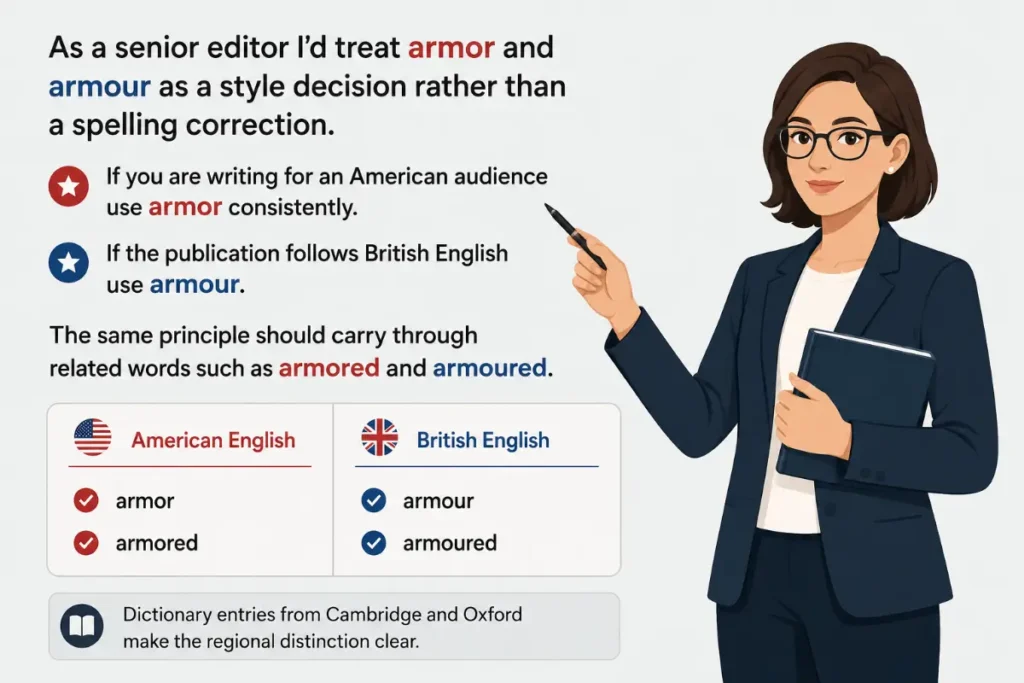
As a senior editor I’d treat armor and armour as a style decision rather than a spelling correction. If you are writing for an American audience use armor consistently. If the publication follows British English use armour. The same principle should carry through related words such as armored and armoured. Dictionary entries from Cambridge and Oxford make the regional distinction clear.
Modern spellcheckers can also create confusion because their dictionaries often depend on the selected language setting. A US English setting may flag armour as unfamiliar while a UK English setting may prefer armour. That does not mean one form is universally correct. It means the software is following a particular regional dictionary.
A useful editorial habit is to check the language setting before changing a word. If the entire document follows American English then armor is the natural choice. If the document follows British English then armour should stay. Consistency is the stronger editorial goal.
A related grammar guide is Transferred or Transfered Which Spelling Is Correct in 2026.
Conclusion
Armor and armour are both correct spellings of the same English word. The main difference is regional. American English uses armor while British English normally uses armour. Canadian English commonly uses armour as well. The word refers to protective covering and can describe everything from medieval suits worn by knights to modern body protection and military vehicles.
The easiest rule to remember is simple. Use armor for American English and armour for British English. Don’t treat the extra u as a sign that one version is wrong. It simply reflects a different spelling tradition. If you’re writing professionally choose the form that matches your audience and keep that spelling consistent throughout the entire document.
FAQs
Is finaly a real word?
The relevant spelling issue here is armor versus armour. Both are legitimate English spellings and the difference is regional. Armor is standard in American English while armour is standard in British English. If you are asking about a misspelling that drops or changes letters the best approach is to compare the form against a reputable dictionary rather than rely only on spellcheck.
What does finally mean?
This question belongs to a different word pair. For this guide the relevant word is armor or armour. It means protective covering used to protect a person animal vehicle or military equipment. The word can describe historical metal clothing worn by soldiers or modern protective equipment such as body armor. It can also have a figurative meaning involving emotional or psychological protection.
finaly or finally which is correct?
For the topic of this guide the correct forms are armor and armour. Armor is the American English spelling. Armour is the British English spelling and is also commonly used in Canada and other varieties influenced by British spelling. Neither form is inherently more correct. Choose the spelling that matches the regional English standard used by your audience.
How to pronounce finally?
For armor the American pronunciation is approximately /ˈɑːr.mɚ/. British pronunciation is approximately /ˈɑː.mə/. The word normally has two syllables. You can remember the American version as AR mer and the British version as AR muh. The extra u in armour does not add another syllable or create a separate sound.
Can finally start a sentence?
For this topic the useful question is whether armor or armour can begin a sentence. Yes. There is no grammatical rule preventing the noun from appearing at the beginning. For example you can write Armor protected the soldier in American English or Armour protected the soldier in British English. The spelling still depends on your chosen regional convention.
What is the synonym of finally?
For armor and armour the closest synonyms depend on the specific context. Protective covering protective equipment body protection plating and protective gear can work in suitable sentences. For historical contexts terms such as plate armor may be more precise. A synonym should preserve the intended meaning rather than simply replace the original word. Oxford lists several related uses involving body protection military vehicles and specialist military terminology.
Why do people misspell finally?
For this topic people often confuse armor and armour because the pronunciation does not clearly reveal the spelling difference. Readers may also encounter both forms online and assume one must be incorrect. Regional English makes the issue more confusing because American writers normally omit the u while British writers normally retain it. Context and language settings can therefore influence the spelling people expect.
Finally in formal writing?
For formal writing the best choice is the spelling required by your publication style. American formal writing normally uses armor. British formal writing normally uses armour. Neither form is informal or slang. The key is consistency. If a report uses American spelling throughout then armor fits naturally. If it follows British conventions then armour is the appropriate form. Dictionary references support this regional distinction.