
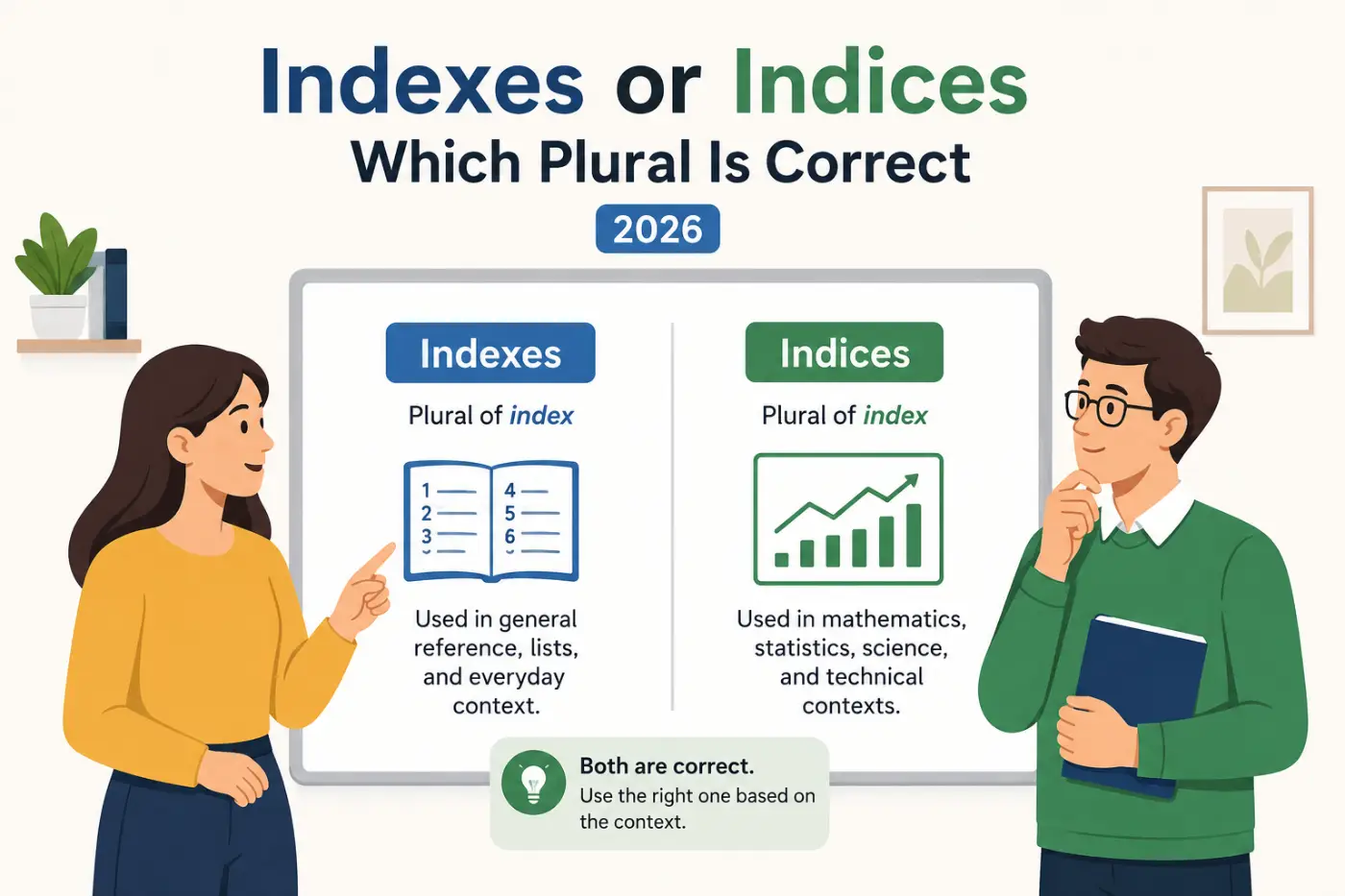
If you’ve ever wondered about Indexes or Indices, you’re not alone. The plural of index can cause more confusion than you’d expect from such a short word. You may see indexes in a book, indices in a mathematics textbook, and both forms in financial writing. That can make a simple grammar question feel surprisingly complicated.
The good news is that both indexes and indices are correct English plurals. The better choice usually depends on the meaning of index, the subject you’re writing about, and the style preferred in your field.
In American English, indexes is especially natural when you’re talking about lists, databases, books, or other organized collections of information. Indices is common in mathematics, science, economics, finance, and other technical fields. Still, the distinction isn’t absolute. Modern dictionaries recognize overlap between the two forms.
Learn the difference in Pail vs Pale Explained With Simple Examples.
Quick Answer
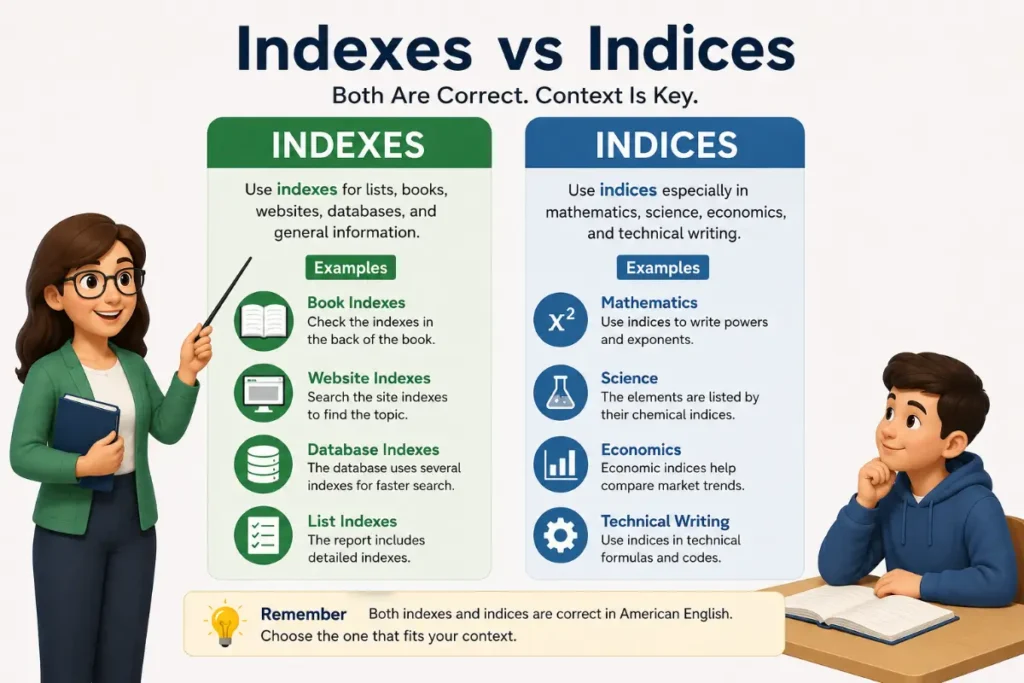
Both indexes and indices are correct plural forms of index. Use indexes for lists, books, websites, databases, and general information. Indices is especially common in mathematics, science, economics, and technical writing. In American English, both forms are accepted, so the context should guide your choice.
Indexes or Indices In Simple Terms
Think of index as the singular form and the two plural forms as different paths that English speakers can take.
Indexes is the more straightforward English plural. It follows a familiar pattern found in many English nouns. If you have one index and then create several more, you can naturally write that you have several indexes.
Indices is an older plural inherited from Latin. It keeps the appearance of a classical form and has remained especially common in technical fields. Mathematics, science, statistics, and finance often favor it.
For example, an editor might write:
- The book contains several detailed indexes.
A mathematician might write:
- The equation uses several different indices.
A financial journalist might write:
- European stock indices fell during the afternoon session.
A researcher might write:
- The study compares several health indexes.
None of these sentences is automatically wrong simply because the writer chose one plural instead of the other.
The important point is context.
Oxford lists both forms for several meanings of the noun. It also shows that some specialized mathematical uses traditionally prefer indices. Cambridge likewise recognizes both forms in American English and gives indices and indexes as accepted plurals.
Comparison Table
| Feature | Indexes | Indices |
|---|---|---|
| Singular | Index | Index |
| Plural | Indexes | Indices |
| Basic meaning | More than one index | More than one index |
| Part of speech | Noun | Noun |
| Origin | English plural formation | Latin plural tradition |
| Pronunciation | IN dek siz | IN duh seez |
| Common contexts | Books, websites, databases, general writing | Mathematics, science, finance, economics |
| Formality | Neutral and widely accessible | Often more formal or technical |
| American English | Common and accepted | Common and accepted |
| British English | Common and accepted | Common and accepted |
| Mathematical writing | Used | Often preferred |
| Scientific writing | Used | Often preferred |
| Book indexes | Very natural | Possible but less usual |
| Financial markets | Used | Very common |
| Database contexts | Very natural | Less common |
| General recommendation | Best default for general readers | Strong choice for technical contexts |
The table shows a useful pattern, but it shouldn’t be treated as an unbreakable grammar rule. Dictionaries describe actual language use rather than forcing every writer into one fixed pattern.
That distinction matters because English often keeps older forms alongside newer regular forms.
Meaning Of Index
The noun index has several related meanings.
At its simplest, an index is something that points you toward information.
In a book, an index is an organized list that helps readers find subjects, names, or topics. You’ll usually find it near the back of the book. Instead of searching through hundreds of pages, you can look up a term and find the relevant page numbers.
For example:
- I found the author’s name in the index.
- The textbook has a useful index at the back.
- Check the index if you can’t find the information in the main chapters.
The word also has a broader meaning. An index can be a number or measurement used to show the level or condition of something.
You see this use in expressions such as price index, air quality index, body mass index, and refractive index.
For example:
- The consumer price index increased this month.
- The air quality index reached an unhealthy level.
- The refractive index of the material affects how light travels through it.
In computing, an index can refer to an organized structure that helps a system locate stored information efficiently. Search engines, databases, and programming systems all use the concept of indexing.
Mathematics gives the word another specialized meaning. An index can refer to a small number or symbol that indicates a particular mathematical relationship. In expressions involving powers or sequences, the term has a precise technical function.
Oxford recognizes these different meanings and records plural forms that vary by sense.
This is one reason the plural question cannot be answered by grammar alone. Meaning and field matter too.
Meaning Of Indexes
Indexes simply means more than one index.
It is the regular English plural form and is particularly natural when index refers to a list, catalog, database structure, or collection of organized information.
Consider these examples:
- The library keeps separate indexes for authors and subjects.
- The website uses several indexes to organize its content.
- The publisher created indexes for each volume.
- The database contains multiple indexes for faster searches.
This form is especially comfortable in everyday American English.
If you’re writing for a general audience and your subject isn’t strongly technical, indexes is often the easiest choice. Readers don’t have to interpret a classical plural form, and the word follows a familiar English pattern.
That doesn’t make it less correct.
There’s sometimes a mistaken idea that indices is the educated form and indexes is somehow informal or inferior. That isn’t a reliable rule. Major dictionaries recognize indexes as a standard plural. Oxford’s American dictionary lists both forms, while its main entry gives indexes as a plural for several common meanings.
In other words, indexes isn’t a mistake you need to avoid.
It’s a normal English plural.
Meaning Of Indices
Indices is also a plural of index.
Its roots are Latin, which explains its different appearance and pronunciation. English has kept many Latin plural forms, especially in academic and technical vocabulary.
Indices is particularly familiar in mathematics, science, economics, and finance.
You might see:
- stock market indices.
- mathematical indices.
- refractive indices.
- economic indices.
- health indices.
- performance indices.
In these contexts, indices can sound more conventional because writers in those disciplines have used the form for generations.
Oxford specifically notes indices as the usual plural in some mathematical usage. Its dictionary also gives indices as a plural for several scientific and measurement related meanings.
Cambridge also lists indices as an accepted plural in American English and identifies it in financial and technical contexts.
There’s an important point here for writers.
Using indices doesn’t automatically make your writing more formal or intelligent. If you’re talking about the indexes at the back of a novel, indices may sound unnecessarily technical. If you’re discussing mathematical variables, indices may sound more natural to readers in that field.
Good word choice isn’t about choosing the fancier word.
It’s about choosing the word that fits the situation.
Key Differences Between Indexes And Indices
The biggest difference isn’t meaning. Both forms refer to multiple indexes.
The real difference lies in usage patterns, register, and subject area.
Meaning Difference
There is usually no basic difference in meaning.
If someone says a company publishes several indexes, they’re referring to multiple indexes.
If another person says a company publishes several indices, the basic meaning is the same.
The surrounding subject may make one form more natural than the other.
Grammar Difference
Both are plural nouns.
The singular is index.
The plural can be indexes or indices.
The verb that follows should agree with the plural noun.
For example:
- The indexes are available online.
- The indices are updated every month.
Using is instead of are would be incorrect because the subject is plural.
You should also avoid creating another plural such as indexs. That form is incorrect.
Tone Difference
Indexes tends to feel more ordinary and accessible.
Indices can feel more technical, academic, or specialized.
That difference is about usage and association rather than a strict grammar rule.
An experienced editor considers the reader before choosing the form.
If the audience consists of general readers, indexes may be the clearer option.
If the audience consists of mathematicians or financial analysts, indices may fit the established terminology better.
Context Difference
Context is probably the most useful guide.
For a book:
- The author added a detailed index.
- The publisher prepared separate indexes for names and subjects.
For mathematics:
- The formula contains several indices.
In finance:
- Asian stock indices moved higher during the session.
For science:
- The researchers compared several biological indices.
The word surrounding the plural often gives you the answer.
Regional Difference
American English accepts both forms.
British English also uses both.
Cambridge lists indices and indexes as plural forms, while Oxford similarly recognizes both.
Some British dictionaries and traditional academic styles may show a stronger preference for indices in technical writing. American technical writing also uses indices extensively.
So this isn’t a simple American versus British spelling issue.
It’s better understood as a question of field and convention.
Which One Is Correct
Both are correct.
That is the most important answer.
Use indexes when you’re writing about books, lists, websites, databases, or general information. Use indices when you’re writing in a technical field where that form is conventional, especially mathematics, science, economics, or finance.
There are exceptions, and individual publications may have their own style guides.
If you’re writing for a general American audience and you’re unsure, indexes is a safe and natural choice for many ordinary contexts.
If you’re writing a mathematics paper and the field consistently uses indices, follow that convention.
Consistency matters too.
If a document uses indices throughout, suddenly switching to indexes without a reason can make the terminology look careless. The same applies in reverse.
Professional editing isn’t only about identifying what is grammatically possible. It’s also about maintaining consistency, respecting audience expectations, and making the prose feel natural.
That’s where style becomes part of correctness.
Examples In Sentences
The following examples show how the two forms work in natural sentences.
Examples With Indexes
- The book contains detailed indexes for names and subjects.
- I checked several online indexes before starting my research.
- The database uses indexes to retrieve records more quickly.
- The publisher updated the indexes before releasing the new edition.
- These indexes make the reference book much easier to use.
- The library maintains separate indexes for newspapers and journals.
- The website has indexes for all of its major topics.
- The editor reviewed the indexes for spelling errors.
- Several indexes were created to organize the historical records.
- The search system relies on multiple indexes to locate information efficiently.
Notice the pattern. In these sentences, the word refers mainly to organized lists or structures that help people or systems locate information.
Examples With Indices
- The researchers compared several economic indices.
- The equation contains two mathematical indices.
- Scientists measured changes in several environmental indices.
- Global stock indices ended the day higher.
- The study examined several health related indices.
- The researchers calculated the refractive indices of the materials.
- The model uses different indices to represent the variables.
- Several financial indices showed similar movement during the quarter.
- The paper compares performance indices across different systems.
- The mathematician explained how the indices change throughout the equation.
Here the technical context makes indices feel especially natural.
That said, you may still encounter indexes in some of these fields. English does not draw a hard grammatical line between the two forms.
Common Mistakes With These Plurals
The confusion around these words produces several recurring mistakes.
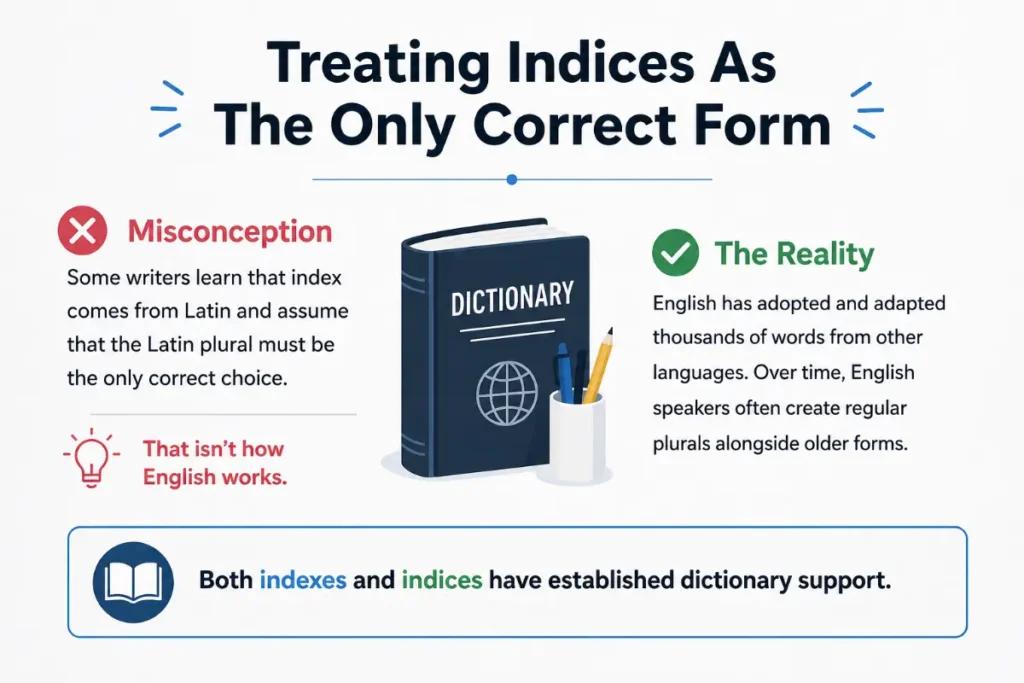
Treating Indices As The Only Correct Form
This is probably the most common misconception.
Some writers learn that index comes from Latin and assume that the Latin plural must be the only correct choice.
That isn’t how English works.
English has adopted and adapted thousands of words from other languages. Over time, English speakers often create regular plurals alongside older forms.
Both indexes and indices have established dictionary support.
Treating Indexes As Wrong
The opposite mistake is just as unhelpful.
Indexes is not a misspelling of indices.
It is a standard English plural.
If you write that a book contains several indexes, you’re using a perfectly legitimate form.
Using Indexs
Indexs is incorrect.
The standard plural forms are indexes and indices.
The spelling indexes follows normal English plural formation.
Mixing Singular And Plural Grammar
Writers sometimes focus so much on the spelling that they overlook subject verb agreement.
Incorrect:
The indices is changing rapidly.
Correct:
The indices are changing rapidly.
The same rule applies to indexes.
Incorrect:
The indexes is stored in the database.
Correct:
The indexes are stored in the database.
The plural noun requires a plural verb.
Switching Forms Randomly
Using both forms in the same document isn’t automatically grammatically wrong.
But random switching can make your writing look inconsistent.
Imagine a financial report that uses indices on one page and indexes on the next without any difference in meaning. A reader may wonder if the writer intended a distinction.
Choose the form that fits your field and keep it consistent unless there’s a clear reason to change.
Pronunciation Guide
The singular index is pronounced approximately like IN deks.
The two plural forms sound noticeably different.
Indexes is pronounced approximately like IN dek siz.
Indices is pronounced approximately like IN duh seez in American English.
Cambridge gives American pronunciations close to IN duh seez for indices and IN deks for index. Oxford also records indices with a pronunciation corresponding to IN duh seez in American English.
A simple breakdown is:
- Index: IN deks.
- Indexes: IN dek siz.
- Indices: IN duh seez.
One common mistake is pronouncing indices as if it were spelled indexes.
That usually happens because the eye expects the familiar pronunciation of index plus a plural ending.
The pronunciation of indices comes from its traditional plural form, so the middle sound changes.
You don’t need to force the pronunciation in ordinary conversation. The important thing is to recognize the two forms when you hear them.
Etymology And Word Origin
The history of index explains why English ended up with two plural forms.
The word entered English from Latin index. Its earliest English sense referred to the forefinger. That connection makes sense because the forefinger is the finger used for pointing.
The Latin word carried the broader idea of someone or something that points something out. From that basic concept, the meaning developed into ideas such as a pointer, sign, indicator, title, inscription, and eventually a list that points readers toward information.
The book related meaning developed later. By the late sixteenth century, English was using index for an alphabetical list that helped readers locate information in a book.
The scientific meaning appeared much later. Etymological records place scientific uses such as refractive index in the nineteenth century. Economic uses followed as the word became associated with measurements that indicate changes in prices, wages, and other values.
The plural indices preserves the classical Latin connection.
The plural indexes reflects the normal English tendency to form plurals with an ending.
Both forms survived because English doesn’t always force older and newer forms to compete until one disappears. Sometimes they settle into different areas of use.
That’s exactly what happened here.
The history also explains why indices appears so often in mathematics and science. Technical disciplines have traditionally preserved many Latin and Greek forms. Over time, those forms became part of the normal vocabulary of those subjects.
So the difference you see today isn’t random.
It has a linguistic history behind it.
The Practical Rule For American Writers
For most American writers, the easiest rule is simple.
Use indexes for ordinary lists and information systems.
Use indices when your subject is strongly mathematical, scientific, economic, or technical and that form is standard in your field.
If your audience is broad, prioritize clarity.
If your audience is specialized, prioritize established terminology.
And if a publication has a style guide, follow it.
Good English gives you choices. Good editing tells you which choice fits the reader.
The safest approach isn’t to memorize a rigid rule that says one plural belongs to one country and the other belongs to another. That rule would be too simplistic.
Instead, pay attention to meaning, discipline, audience, and consistency.
That will serve you well far beyond this one word.
For another common grammar confusion, see Occured or occurred: Correct Spelling and Usage.
Regional Usage In English
The choice between the two plurals isn’t simply a matter of American English versus British English. Both forms appear across major varieties of English. The stronger distinction usually comes from subject area, publication style, and audience.
American English
American English commonly uses indexes in general writing. This includes books, databases, websites, catalogs, and many business contexts.
For example:
- The publisher prepared detailed indexes for the new editions.
- The database uses several indexes to improve search speed.
- Several market indexes ended the week higher.
Interestingly, financial writing in the United States uses both forms. You’ll find indexes in mainstream reporting and indices in specialized financial terminology. Cambridge gives indexes as a standard plural and its American English entry also recognizes indices.
Microsoft’s style guidance takes a stricter editorial approach. It recommends indexes as the general plural and reserves indices for mathematical expressions. That’s a style decision rather than proof that the other form is grammatically wrong.
For general American content, indexes is often the safest choice.
British English
British English also accepts both forms.
Indices has a particularly strong presence in academic, mathematical, scientific, and financial writing. Indexes remains perfectly possible in general contexts.
Collins lists indices as a plural form in British English and records the pronunciation separately from its American English pronunciation.
So a British mathematics textbook may comfortably use indices while a general reference work may use indexes.
The difference is better described as a matter of convention than correctness.
Australian English
Australian English follows the broader English pattern and uses both forms.
Technical and academic writing can favor indices, especially in mathematics, science, economics, and statistics. General writing can use indexes.
The same editorial principle works well in Australia as it does in the United States.
Choose the form your readers expect from the field.
Canadian English
Canadian English also permits both forms. General writing commonly follows the regular English plural pattern, while specialized writing can preserve indices.
For Canadian publishers, universities, businesses, and websites, the house style may settle the issue.
This is a useful reminder that English spelling and grammar aren’t controlled by a single worldwide rulebook. Different communities develop preferences while still sharing the same underlying language.
Grammar Rules For Both Forms
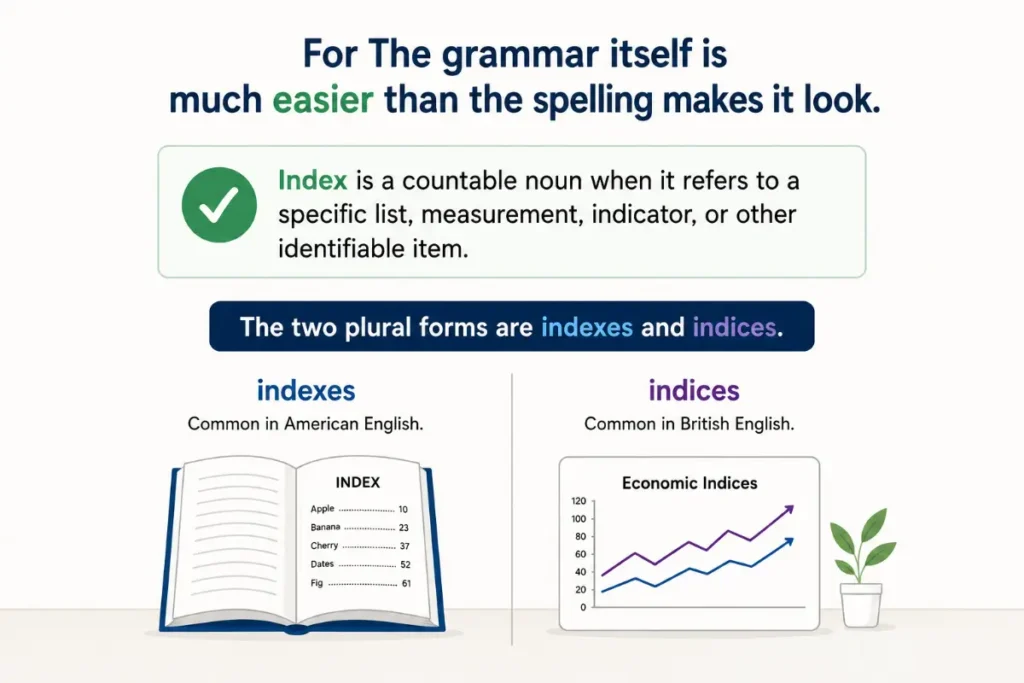
The grammar itself is much easier than the spelling makes it look.
Index is a countable noun when it refers to a specific list, measurement, indicator, or other identifiable item.
The two plural forms are indexes and indices.
Both take plural verbs.
For example:
- The indexes are available online.
- The indices are updated every quarter.
- These indexes provide useful information.
- The indices show significant changes.
Don’t write:
The indexes is available.
The plural noun requires are rather than is.
The same rule applies to indices.
Singular Structures
When you have one item, use index.
Examples include:
- This index measures consumer prices.
- The index appears at the back of the book.
- The database has one primary index.
Plural Structures
When you have more than one, use indexes or indices.
Examples include:
- These indexes cover different subjects.
- The indices represent different variables.
The important point is that changing the plural form doesn’t change the underlying grammar.
Possessive Forms
Possessive forms follow normal English rules.
For one index:
The index’s purpose is to help readers find information.
For multiple indexes:
The indexes’ structure varies by publisher.
For multiple indices:
The indices’ values changed during the experiment.
In formal technical writing, you may often avoid awkward possessive constructions by rewriting the sentence.
For example:
The values of the indices changed during the experiment.
That version is often cleaner.
The Word Can Also Be A Verb
Index isn’t only a noun.
It can also function as a verb meaning to organize information or create an index.
For example:
- The librarian indexes historical documents.
- The search engine indexes new pages.
- The database indexes frequently searched fields.
This creates an interesting source of confusion.
Indexes can be a plural noun or the third person singular form of the verb index.
Compare these sentences:
- The indexes are updated every month.
- The software indexes the files every night.
The first sentence uses indexes as a plural noun.
The second uses indexes as a verb.
Indices doesn’t have this ambiguity because it functions as the plural noun.
That distinction can matter in technical documentation.
Real Life Usage Examples
The best way to understand these forms is to see them working in different settings.
Daily Conversation
In everyday conversation, most people don’t discuss indexes very often. When they do, the regular plural can sound more natural.
For example:
- The book has several indexes.
- I couldn’t find the term in any of the indexes.
- The website has indexes for different categories.
A speaker doesn’t normally need a classical plural simply because the word has Latin roots.
Natural speech tends to favor familiar patterns.
Academic Writing
Academic writing is more varied.
A historian discussing books might write:
- The indexes at the end of the volumes contain useful references.
A statistician might write:
- The study compares several social indices.
A mathematics professor might write:
- The indices identify the position of each variable.
The subject determines the preferred vocabulary.
Academic writing rewards precision, but precision doesn’t always mean choosing the less familiar form.
Professional Communication
Business writing can use either form.
For example:
- The company tracks several performance indexes.
- The report compares regional market indices.
- The analytics team maintains separate database indexes.
- The financial department monitors major stock indices.
If you’re writing a report for executives, clarity should usually come before traditional terminology.
If your industry consistently uses indices, follow that convention.
Financial Writing
Finance is one of the fields where both forms appear frequently.
You may encounter:
- stock market indexes.
- stock market indices.
- price indexes.
- price indices.
- market indexes.
- market indices.
The choice can depend on the publication, institution, or regional style.
Cambridge’s dictionary examples show indexes being used naturally in financial reporting.
At the same time, indices is deeply established in financial terminology. Collins provides examples involving financial indices and records the plural as a standard form.
So don’t assume that finance automatically requires one spelling.
Mathematical Writing
Mathematics is different.
Indices has a particularly established role in mathematical notation. Microsoft recommends reserving this form for mathematical expressions in its style guide.
For example:
- The indices identify the position of each element.
- The equation contains several indices.
- The values depend on the selected indices.
In this environment, using the conventional technical form helps readers recognize the terminology immediately.
That is less about grammar and more about disciplinary language.
Scientific Writing
Scientific writing often uses indices for measurements and calculated indicators.
Examples include:
- The researchers compared several biological indices.
- The study measured multiple environmental indices.
- The refractive indices differed across the samples.
Still, indexes can appear in scientific contexts too.
The right choice depends on the specific terminology used in the discipline.
Literature And Publishing
Book publishing provides one of the clearest cases for indexes.
Examples include:
- The author prepared separate indexes for names and subjects.
- The publisher checked the indexes before printing.
- The revised edition includes updated indexes.
Here, indexes is highly natural for a general American readership.
There is no need to make the language sound more academic than the subject requires.
Related Words And Confused Terms
Understanding nearby words can help prevent mistakes.
Index
Index is the singular noun.
It can refer to a list, indicator, measurement, database structure, or mathematical element.
Indexes
Indexes is a plural noun and can also be a verb.
As a noun:
The indexes are useful.
As a verb:
The system indexes the records.
Indices
Indices is a plural noun.
It doesn’t function as the ordinary third person singular form of the verb index.
Indicator
An indicator is something that shows a condition, trend, or change.
An index can function as an indicator, but the words aren’t always interchangeable.
For example, a price index is a specific statistical measure. Calling every indicator an index would be too broad.
Indicator Versus Index
An indicator can be a sign or measure that provides information.
An index usually combines or represents information according to a defined system.
That distinction matters in technical writing.
Index Number
An index number is a statistical measure designed to show relative change.
For example, an index number can show how prices changed compared with a base period.
The plural can be index numbers.
This is often clearer than forcing a plural form when the meaning isn’t actually about multiple indexes as standalone objects.
Indexing
Indexing is the process of organizing or recording information so it can be found or analyzed.
In computing, indexing can improve the efficiency of data retrieval.
In publishing, indexing creates a structured guide to subjects, names, and concepts.
Expert Language Insight
An experienced editor doesn’t choose between these forms by memorizing one simplistic rule.
The better question is:
What does the reader expect in this context?
That’s the question that separates technically possible English from natural English.
Suppose you’re editing a general nonfiction book. The author writes:
The book contains three indices.
That sentence isn’t automatically grammatically wrong. But indexes may be more natural for a broad American readership.
Now suppose you’re editing a mathematics paper. The author writes:
The formula contains three indexes.
That may be understandable, but indices could fit the disciplinary convention better.
The editor’s job isn’t to make every sentence follow one universal preference.
It’s to make the language fit its purpose.
This is especially important for SEO content.
Searchers often type simple phrases such as which is correct, indexes or indices, plural of index, or difference between indexes and indices.
They aren’t looking for a history lecture before getting the answer.
They want the answer first.
Then they want enough explanation to trust it.
That’s why a strong language article should give the direct answer early and then add context.
Another useful editorial principle is consistency.
If you select indexes for general usage, don’t switch randomly to indices three paragraphs later. Readers may assume the change has a special meaning.
Technical writers should be even more careful.
If a field has an established terminology, follow it unless your publication’s style guide says otherwise.
Microsoft’s style guide demonstrates this clearly by choosing indexes as its general editorial preference and limiting indices to mathematical expressions.
That doesn’t erase the broader dictionary evidence. It simply shows how a professional style guide can establish a narrower house rule.
In other words, dictionary correctness and style guide preference aren’t the same thing.
A dictionary tells you what English recognizes.
A style guide tells you what a particular publication wants you to use.
That distinction is worth remembering.
When Indexes Sounds Better
Indexes usually works well when you’re talking about:
- Books.
- Websites.
- Databases.
- Catalogs.
- Search systems.
- General information.
- Popular writing.
- Consumer content.
- Mainstream American publications.
For example:
The database contains several indexes.
That sentence sounds completely natural.
So does:
The textbook contains two detailed indexes.
There is no need to replace indexes with indices simply to sound formal.
When Indices Sounds Better
Indices is especially comfortable in:
- Mathematics.
- Statistics.
- Physics.
- Scientific research.
- Economics.
- Financial analysis.
- Technical documentation.
- Academic terminology.
For example:
The researchers compared several economic indices.
The term fits the subject naturally.
This doesn’t mean indexes would always be wrong in those contexts. It means indices has a strong established association with technical language.
Is Indices More Formal
Often it sounds more formal, but that’s a matter of perception and context rather than a grammatical rule.
Words with classical endings can feel more academic because they’re common in specialized fields.
Consider mathematics.
A student who sees indices in a textbook may immediately recognize the technical setting.
In ordinary conversation, however, the same form can feel more specialized.
That’s why experienced writers don’t use complicated words simply to sound educated.
Clarity wins.
A general reader should never need a dictionary to understand a sentence that could have been written more simply.
Is Indexes More American
Indexes is strongly established in American English and is often the natural choice for general American writing.
But saying that indices isn’t American would be incorrect.
American dictionaries recognize indices as a plural form, and American financial, scientific, and mathematical writing uses it regularly. Collins explicitly records both forms in its American English entries.
So the better statement is this:
Indexes is very comfortable in general American English, while indices remains fully established in specialized and technical usage.
That distinction is much more accurate than calling one form American and the other British.
Is Indeces Correct
No.
Indeces is a common spelling mistake.
The correct forms are:
- Indexes.
- Indices.
If you remember the classical plural, remember that the spelling contains c followed by e and s:
indices.
Not indeces.
A spell checker may catch the mistake, but learning the correct spelling is better than relying entirely on software.
Is Indexes A Verb
Yes.
Indexes can function as the third person singular present tense of index.
For example:
The search engine indexes new pages.
It can also be a plural noun.
For example:
The search engine stores several indexes.
Context tells you which role the word has.
This is a useful detail for editors and technical writers because the same spelling can represent two different grammatical functions.
Which Form Should You Use In SEO Content
For a general American audience, indexes is often the clearest default when the subject involves lists, books, websites, databases, or general information.
Use indices when the surrounding subject naturally calls for technical terminology.
For example:
- Book indexes.
- Database indexes.
- Search indexes.
- Mathematical indices.
- Economic indices.
- Scientific indices.
Don’t force one form across every context just to satisfy a supposed grammar rule.
Search engines are good at understanding related forms and context. Strong content should therefore focus on answering the reader’s actual question rather than repeating the same phrase again and again.
Natural terminology is more useful than mechanical repetition.
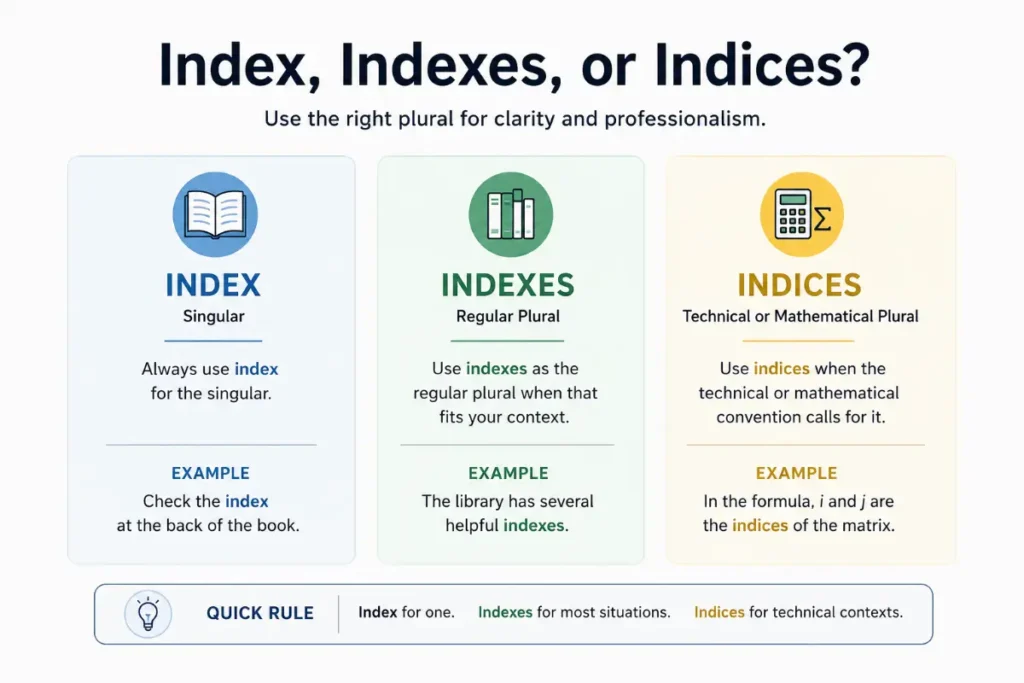
Final Grammar Check
Before publishing content that uses these forms, check five things.
- Make sure the singular is index.
- Use indexes as the regular plural when that fits your context.
- Use indices when the technical or mathematical convention calls for it.
- Don’t spell the plural as indeces or indexs.
- Keep your chosen form consistent within the same context.
These five checks will eliminate most errors.
Many readers also check all-time vs all time Meaning and Correct Usage.
Conclusion
Both indexes and indices are correct. The choice depends mainly on context. Use indexes when you’re talking about books, websites, databases, catalogs, or general information. It’s a natural choice for many American readers and follows the regular English plural pattern.
Use indices when you’re working in mathematics or another technical field where the classical form is well established. Science, economics, statistics, and finance frequently use it. Don’t fall into the trap of thinking that one form is educated English and the other is incorrect English. That’s not how the language works.
The same word can develop more than one accepted plural over time. English is full of examples like this because it grows through contact with other languages while also creating its own patterns.
FAQs
Is indexes or indices correct?
Both are correct plural forms of index. Indexes is especially common in general English and American usage. Indices is strongly established in mathematics, science, economics, and other technical fields. The best choice depends on context and the style preferred by your publication or profession.
What is the plural of index in American English?
American English accepts both indexes and indices. Indexes is a common choice in general writing, including books, databases, and mainstream business content. Indices remains standard in specialized fields such as mathematics and science. American dictionaries recognize both forms.
Is indices more correct than indexes?
No. Indices isn’t more grammatically correct than indexes. Both are established plurals. Indices is an older Latin based form that remains common in technical language. Indexes is the regular English plural and is widely accepted.
Should I use indexes or indices in mathematics?
Indices is often the better choice in mathematical writing because it is an established technical convention. Some style guides specifically reserve indices for mathematical expressions. Follow the terminology used by your textbook, institution, journal, or field.
Is indexes a proper word?
Yes. Indexes is a standard English word. It can be the plural noun form of index or the third person singular present tense of the verb index. For example, a book can contain several indexes, while a search engine indexes webpages.
Why does index have two plural forms?
English inherited index from Latin but also developed a regular English plural. The Latin based form became indices, while English speakers formed indexes using a normal plural ending. Both forms survived and developed different preferences across various fields.
Is indices used in British English?
Yes. Indices is widely used in British English, especially in academic and technical contexts. British English also uses indexes. The difference isn’t simply a British versus American spelling rule. Subject area and editorial convention often matter more.
How do you pronounce indices?
In American English, indices is commonly pronounced approximately like IN duh seez. British pronunciation can sound closer to IN dih seez. The plural indexes is pronounced approximately like IN dek siz. The two forms therefore differ in both spelling and pronunciation.