
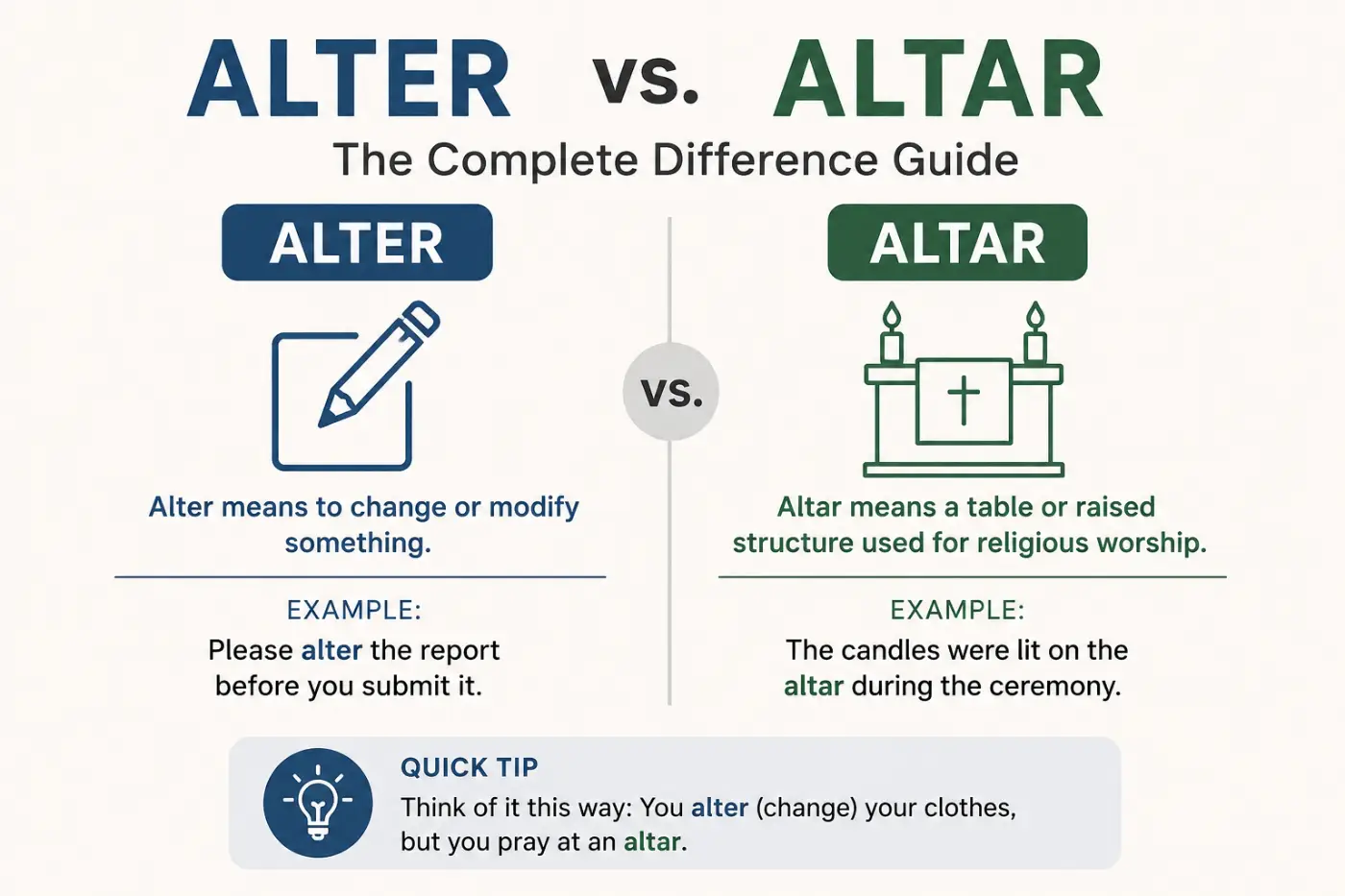
Have you ever written a sentence and suddenly wondered if you need alter vs altar? These two words sound almost identical, but their meanings have nothing to do with each other. One is mainly connected with changing something, while the other refers to a sacred table or structure used in religious worship.
The confusion is understandable because both words contain the same letters in a slightly different order, and they are pronounced almost the same in many varieties of English. A small spelling mistake can completely change the meaning of a sentence. Saying that someone needs to “altar” a plan, for example, creates a word choice problem because the intended verb is alter.
The good news is that the distinction is simple once you connect each spelling with its meaning. This guide explains the definitions, pronunciation, grammar, word origins, regional usage, common mistakes, and real world examples. You’ll also learn a few practical memory tricks that can help you choose the right word without stopping to think about it.
Need another quick comparison? Read Holistic or Wholistic Which Spelling Is Correct? 2026.
Quick Definition
Alter means to change, modify, adjust, or make something different. It is usually a verb. Altar is a noun that refers to a raised structure or table used in religious ceremonies and worship. Although the words sound similar, they have different spellings, meanings, grammatical roles, and contexts.
Short Answer
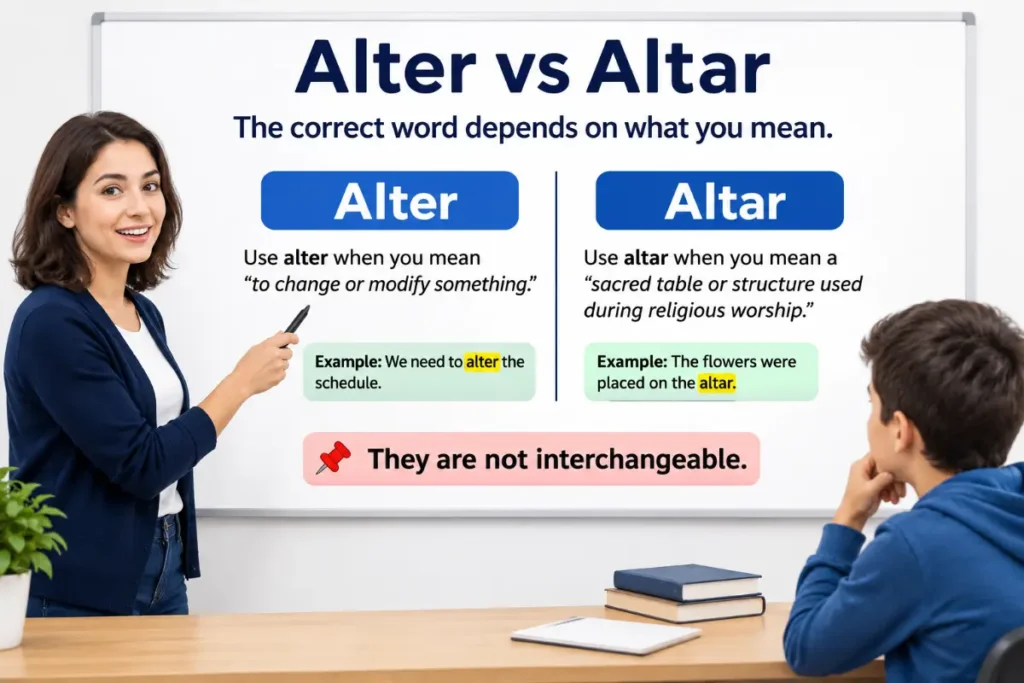
The correct word depends on what you mean. Use alter when you mean “to change or modify something,” as in “We need to alter the schedule.” Use altar when you mean a sacred table or structure used during religious worship, as in “The flowers were placed on the altar.” They are not interchangeable.
Comparison Table
| Feature | Alter | Altar |
|---|---|---|
| Correct form | Alter | Altar |
| Main meaning | To change or modify | A sacred table or structure |
| Part of speech | Usually a verb | Noun |
| Origin | Latin through French | Latin through Old English and French influences |
| Usage frequency | Common | Less common |
| Formality | Neutral and widely used | Neutral but often religious |
| Common contexts | Plans, clothing, behavior, designs, conditions | Churches, temples, weddings, religious ceremonies |
| Example | “She altered the dress.” | “The priest stood near the altar.” |
| Related idea | Change or modification | Worship or sacrifice |
| Pronunciation | Usually pronounced like “awl ter” | Usually pronounced like “awl ter” |
The table reveals the central point. Alter describes an action or change, while altar names a physical or symbolic place associated with worship.
Meaning of Alter
Alter is primarily a verb meaning to change something without necessarily replacing it completely. The change can be small or significant.
For example, if you alter a plan, you make changes to that plan. If a tailor alters a jacket, the tailor changes its fit or shape. If a company alters its policy, the company modifies the policy.
The word can also describe a change in condition, appearance, character, or behavior.
- “The designer altered the original pattern.”
- “We had to alter our plans because of the weather.”
- “The experience altered his view of the situation.”
The important idea is change.
Alter does not automatically mean destroy, replace, or completely transform. A thing can remain recognizable after it has been altered. That difference shows up in everyday English. A sentence can be revised by changing a few words. A recipe can be modified by adjusting its ingredients. A schedule can also be changed when an appointment needs to be moved.
Alter as a Verb
The most common grammatical use of alter is as a transitive verb. That means it can take a direct object.
- “They altered the contract.”
- “She altered her dress.”
- “The company altered its policy.”
The object receives the change.
You can also use alter in passive constructions.
- “The schedule was altered.”
- “The original design was altered.”
- “The agreement was altered after the meeting.”
Alter as a Noun
In ordinary modern English, alter is overwhelmingly used as a verb. It does have specialized noun uses in certain fields, especially when discussing an alternate personality or identity in some psychological, literary, or fictional contexts. That use is uncommon in everyday writing and should not distract learners from the primary meaning.
For most readers, the safest association is simple:
Alter means change.
Meaning of Altar
Altar is a noun. It refers to a raised structure, table, platform, or designated place used for religious worship, offerings, ceremonies, or sacrifice.
The exact appearance and purpose of an altar can vary between religions and traditions. In Christian churches, an altar may serve as an important focal point during worship. In other religious traditions, an altar can hold offerings, sacred objects, candles, flowers, or other ceremonial items.
The word also appears in nonreligious expressions and figurative language.
For example, the phrase “sacrifice something on the altar of ambition” uses altar metaphorically. It suggests giving up something valuable in pursuit of another goal.
The central idea remains connected to worship, sacrifice, ceremony, or sacred devotion.
Altar in Religious Contexts
Altar commonly appears in discussions about churches, weddings, funerals, religious ceremonies, sacred spaces, and worship.
- “The couple stood before the altar.”
- “Candles were placed on the altar.”
- “The congregation gathered near the altar.”
The meaning is very different from alter even though the pronunciation may be nearly identical.
Key Differences Between Alter and Altar
The easiest way to understand the distinction is to focus on the concepts behind the spellings.
Meaning Difference
Alter means to change.
Altar means a sacred structure or place.
Compare these sentences:
- “We need to alter the design.”
- “The flowers were placed on the altar.”
In the first sentence, someone is changing something. In the second, someone is referring to a religious object or location.
Grammar Difference
Alter is generally a verb.
Altar is a noun.
This grammatical difference gives you another useful test. If the sentence needs an action meaning “change,” you almost certainly need alter.
If the sentence needs the name of a sacred table or structure, you need altar.
Context Difference
Alter appears in many everyday contexts.
- Clothing.
- Plans.
- Designs.
- Documents.
- Policies.
- Behavior.
- Conditions.
- Opinions.
Altar is much more closely connected with religious or ceremonial contexts.
- Worship.
- Churches.
- Religious ceremonies.
- Offerings.
- Weddings.
- Sacrifice.
- Sacred spaces.
Tone Difference
Alter is neutral. You can use it in casual conversation, professional writing, academic work, and technical discussions. Altar is also grammatically neutral, but its context often gives it a religious, ceremonial, historical, or literary tone.
Regional Difference
There is no major spelling difference between American and British English for these two words. American English uses alter and altar. British English uses the same spellings. Canadian and Australian English also maintain the distinction.
The main source of confusion is pronunciation rather than regional spelling.
Which One Is Correct
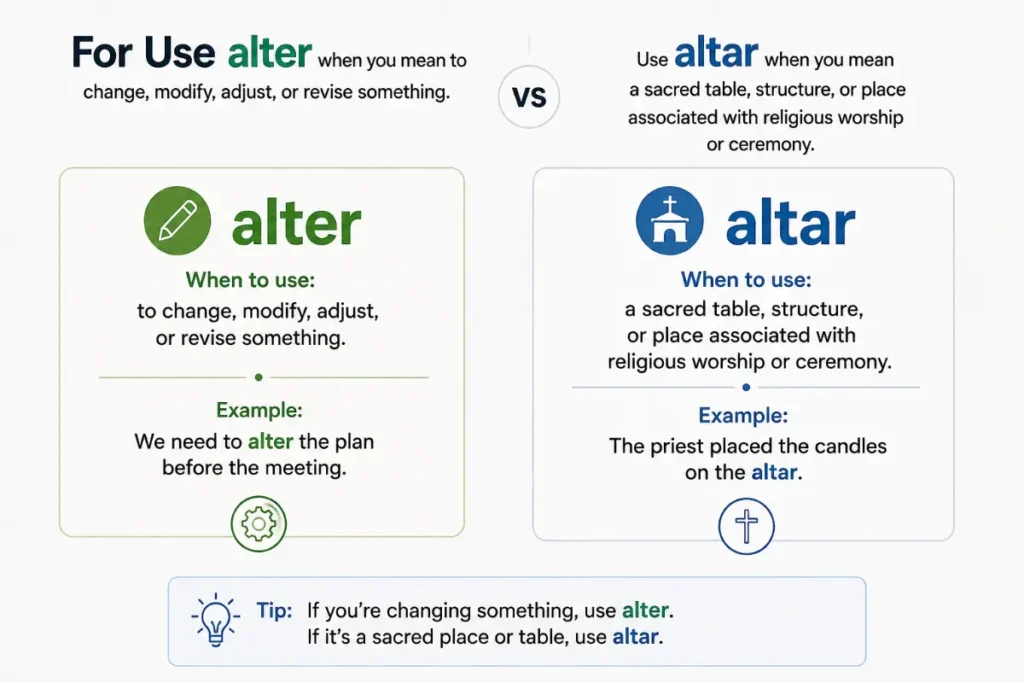
Both words are correct, but they are correct in different situations. Use alter when you mean to change, modify, adjust, or revise something. Use altar when you mean a sacred table, structure, or place associated with religious worship or ceremony.
Consider this quick test.
If you can replace the word with change, choose alter.
If you can replace it with sacred table or place of worship, choose altar.
For example:
“The tailor will alter the jacket.”
You can replace alter with “change,” so the spelling is correct.
“The priest approached the altar.”
You can replace altar with “sacred table,” so the spelling is correct.
Examples of Alter in Sentences
Here are natural examples showing how native speakers commonly use alter.
- “The tailor can alter the sleeves to make the jacket fit better.”
- “We had to alter the schedule after the meeting was delayed.”
- “The company plans to alter its pricing strategy.”
- “She altered the recipe by adding less sugar.”
- “The architect altered the design before construction began.”
- “A change in weather can alter the travel plans.”
- “He refused to alter his original statement.”
- “The teacher altered the assignment to make it easier to understand.”
- “The new evidence may alter the outcome of the case.”
- “You can alter the document before submitting the final version.”
Notice the shared meaning in every example. Something is being changed, adjusted, modified, or revised.
Examples of Altar in Sentences
These examples show how altar works as a noun.
- “The bride walked slowly toward the altar.”
- “The priest stood beside the altar.”
- “Fresh flowers decorated the altar.”
- “The church has a beautifully carved wooden altar.”
- “The couple exchanged vows near the altar.”
- “Candles were arranged around the altar.”
- “The painting behind the altar attracted many visitors.”
- “The family placed flowers on the altar during the ceremony.”
- “The ancient temple contained a stone altar.”
- “The worshippers gathered around the altar.”
In every example, altar refers to a physical structure, location, or symbolic religious setting.
Common Mistakes
Because the two words sound similar, spelling errors are common.
Writing Altar When You Mean Change
One of the most frequent mistakes is using altar as a verb.
Incorrect:
“We need to altar the plan.”
Correct:
“We need to alter the plan.”
The sentence needs a verb meaning “change,” so alter is required.
Writing Alter When You Mean a Sacred Structure
The reverse mistake also occurs.
Incorrect:
“The priest walked toward the alter.”
Correct:
“The priest walked toward the altar.”
Here the sentence refers to a sacred structure, so altar is correct.
Assuming Similar Sound Means Similar Meaning
English contains many homophones and near homophones. Similar pronunciation does not mean similar meaning.
The same principle applies to other confusing pairs such as:
- Their and there.
- Principal and principle.
- Stationary and stationery.
- Complement and compliment.
- Affect and effect.
The spelling carries important information.
Treating Altar as a Verb
Altar is normally a noun in standard modern English. If your sentence requires an ordinary verb meaning “modify,” use alter.
Pronunciation Guide
In many varieties of English, alter and altar are pronounced the same or almost the same.
Alter
IPA: /ˈɔːltər/ in many British pronunciations.
IPA: /ˈɔːltɚ/ in many American pronunciations.
Syllables: al ter
Altar
IPA: /ˈɔːltər/ in many British pronunciations.
IPA: /ˈɔːltɚ/ in many American pronunciations.
Syllables: al tar
The exact vowel quality can vary by accent. In some American accents, the first vowel may sound closer to the vowel in “all.”
The important lesson for learners is that pronunciation alone may not help you distinguish the words. You need to use the meaning and grammatical context.
Many readers also check Busyness Vs Business Which Word Should You Use in 2026?.
Etymology and Word Origin
The histories of the two words are different, which helps explain why their spellings differ.
Origin of Alter
Alter ultimately traces back to Latin alter, meaning “other” or “another.” The word entered English through French influence and developed into the modern verb meaning to make something different or change its form.
The connection with “other” is useful from a historical perspective. When you alter something, you make it somewhat different from what it was before.
Over centuries, English developed the modern verb alter with meanings connected to modification, adjustment, and change.
Origin of Altar
Altar has a different history. It is related to Latin altare, referring to a raised place or structure used for religious offerings. The word passed through Old English and French forms before developing into modern English altar.
Its long association with worship, offerings, and sacrifice remained strong throughout its history.
The different origins explain why the words should not be treated as spelling variants of the same term.
Regional Usage
The distinction remains stable across major English varieties.
American English
American English uses alter for the verb meaning “change” and altar for the religious noun.
- “Can you alter the schedule?”
- “They stood near the altar.”
British English
they also follow the same distinction.
- “The plans were altered.”
- “The church altar was decorated with flowers.”
British pronunciation may differ from American pronunciation, but the spelling and core meanings remain separate.
Australian English
Australian English also maintains the standard distinction.
Alter is used for modification, while altar refers to the religious structure.
Canadian English
Canadian English follows the same pattern as American and British English.
There is no major regional preference that changes the fundamental rule. If you mean “change,” write alter. If you mean a sacred structure, write altar.
Grammar Rules
Understanding the grammar makes the difference easier to remember.
Alter as a Verb
Alter can be used in several common verb forms.
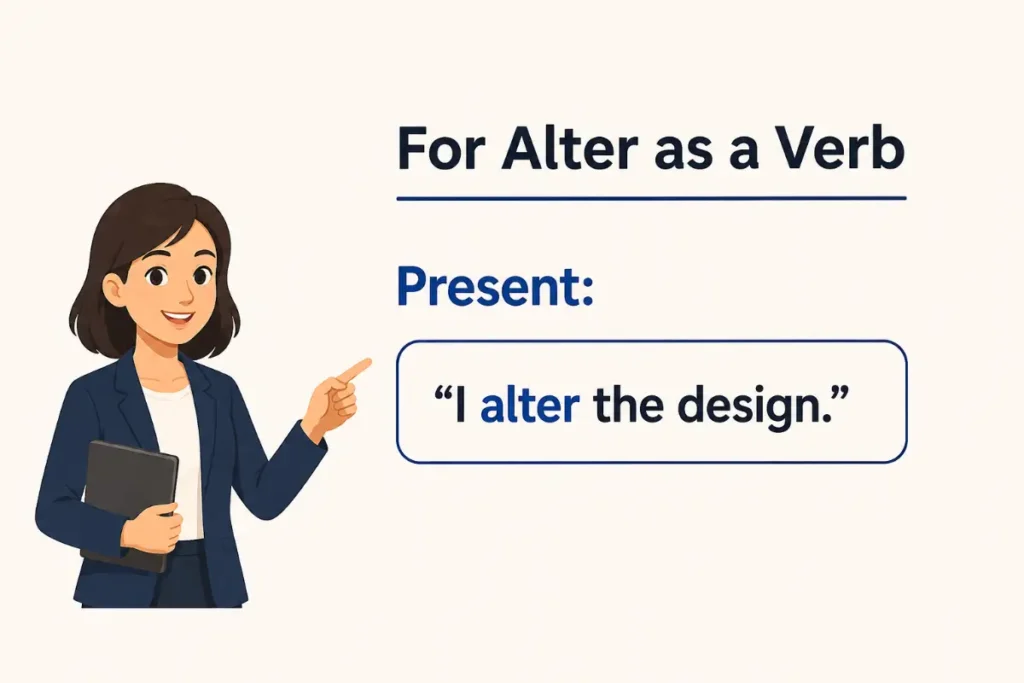
Present:
“I alter the design.”
Third person singular:
“She alters the design.”
Past:
“She altered the design.”
Present participle:
“She is altering the design.”
Past participle:
“The design has been altered.”
The spelling remains based on alter.
Altar as a Noun
Altar is countable when referring to individual structures.
Singular:
“an altar”
Plural:
“altars”
Examples include:
- “The church has an altar.”
- “Several altars were decorated for the festival.”
The plural form is altars, not “alters.”
That creates another potential spelling trap because “alters” is also a valid word. It is the third person singular form of the verb alter.
Compare:
“The priest decorated the altars.”
“The artist alters the designs.”
The first sentence contains the plural noun altar. The second contains a verb form of alter.
Common Structures With Alter
Alter frequently appears with an object.
- “alter the plan”
- “alter the design”
- “alter the agreement”
- “alter the schedule”
- “alter the appearance”
- “alter the conditions”
It can also appear in passive structures.
“The agreement was altered.”
“The schedule was altered.”
These patterns are extremely common in professional and academic writing.
Real Life Usage Examples
The difference becomes easier to remember when you see the words in different settings.
Daily Conversation
In everyday speech, alter often appears when people talk about plans or practical changes.
“I might have to alter my plans.”
“Can you alter this shirt for me?”
Altar is more likely to appear when discussing a wedding, religious service, or place of worship.
“The flowers looked beautiful near the altar.”
Academic Writing
Alter is common in academic discussions involving research, behavior, systems, conditions, or interpretation.
“Environmental changes can alter animal behavior.”
“The researchers altered the experimental conditions.”
Altar can appear in history, archaeology, religious studies, anthropology, and literature.
“The excavation revealed an ancient stone altar.”
Professional Communication
Business writing frequently uses alter.
“The team decided to alter the project timeline.”
“We may need to alter the contract.”
“We should not alter the approved specifications without permission.”
Altar is less common in ordinary business communication unless the subject involves religion, architecture, event planning, or cultural institutions.
Literature
Both words can appear in literary writing.
Alter may describe emotional or physical transformation.
“The experience altered her understanding of home.”
Altar may be used literally or metaphorically.
“He placed his ambitions upon the altar of success.”
The metaphorical use of altar is especially important because it can appear outside religious writing.
Media
News reports, documentaries, wedding coverage, historical programs, and religious programming may all use altar.
Articles about business, science, fashion, technology, and policy are much more likely to use alter.
Related Words and Confused Terms
The semantic relationship around alter includes words such as:
- Change.
- Modify.
- Adjust.
- Revise.
- Adapt.
- Transform.
- Amend.
- Vary.
- Rearrange.
- Reshape.
These words are related but not always interchangeable.
For example, modify often means making specific changes. Amend is especially common for laws, contracts, and formal documents. Revise often involves improving or changing written material. Transform suggests a much more substantial change.
Words associated with altar include:
- Worship.
- Sanctuary.
- Church.
- Temple.
- Offering.
- Sacrifice.
- Ceremony.
- Ritual.
- Shrine.
- Sacred space.
The distinction between these semantic fields is useful for memory. Alter belongs to the language of change. Altar belongs mainly to the language of worship and ceremony.
Other confusing word pairs deserve similar attention because English spelling often preserves differences that pronunciation does not make obvious.
Expert Language Insight
From an editing perspective, the fastest way to catch this mistake is to stop listening to the word and examine its role in the sentence.
Ask one question:
Is the sentence describing a change or naming a sacred structure?
If it describes an action involving modification, choose alter.
If it names a religious structure or ceremonial place, choose altar.
This method works better than trying to memorize two isolated spellings.
Another useful editorial trick is substitution. Replace the questionable word mentally with change.
If the sentence still makes sense, alter is probably the correct choice.
“We need to change the schedule.”
“We need to alter the schedule.”
The relationship is clear.
Now try the same test with a religious sentence.
“The couple stood near the change.”
That does not make sense. The intended word is altar.
Experienced editors also pay attention to grammatical position. If the word follows “to,” it may be a verb.
“To alter the agreement.”
If it follows an article such as “the,” “an,” or “a,” it may be a noun.
“The altar.”
“An altar.”
This is not an absolute rule because English grammar contains many exceptions, but it provides a useful clue.
The best approach combines grammar, meaning, and context rather than relying on pronunciation.
Memory Trick for Alter and Altar
A simple memory trick can make the distinction stick.
Think of alter as containing the idea of alteration.
Alter means to make a change.
Think of altar as the word connected with a religious ceremony.
An altar is something you might see in a church, temple, or other sacred setting.
You can also remember this contrast:
Alter changes something.
Altar holds something sacred.
The spelling difference is only one letter, but the meaning difference is enormous.
Why These Words Are So Easy to Confuse
English spelling does not always follow pronunciation perfectly. That creates problems for learners and native speakers alike.
Alter and altar are especially confusing because they are pronounced identically in many accents. When people hear the word rather than see it written, context must determine the spelling.
For example, if someone says:
“We need to alter the plan.”
You understand the meaning from “the plan.” A listener does not need to see the spelling.
If someone says:
“They decorated the altar.”
The religious context tells you which word is intended.
Problems arise when writing because the writer must select the correct spelling independently.
This is why proofreading matters. Spellcheckers can sometimes miss these errors because both alter and altar are legitimate English words. A standard spellchecker may recognize either spelling as valid without understanding what the writer intended.
Contextual editing is therefore more reliable than spelling correction alone.
A Simple Test You Can Use
When you’re unsure, follow these steps.
- Identify the meaning you want.
- Ask if the word means “change.”
- If it does, use alter.
- Ask if the word refers to a sacred table, structure, or ceremonial place.
- If it does, use altar.
- Check the grammar of the sentence.
- Read the sentence again to make sure the meaning fits.
For example:
“She decided to ___ the dress.”
The intended meaning is “change the dress.”
Correct answer: alter.
Now consider:
“She placed flowers on the ___.”
The sentence needs a noun referring to a sacred structure.
Correct answer: altar.
Once you use this test several times, the distinction becomes almost automatic.
Alter vs Altar in One Minute
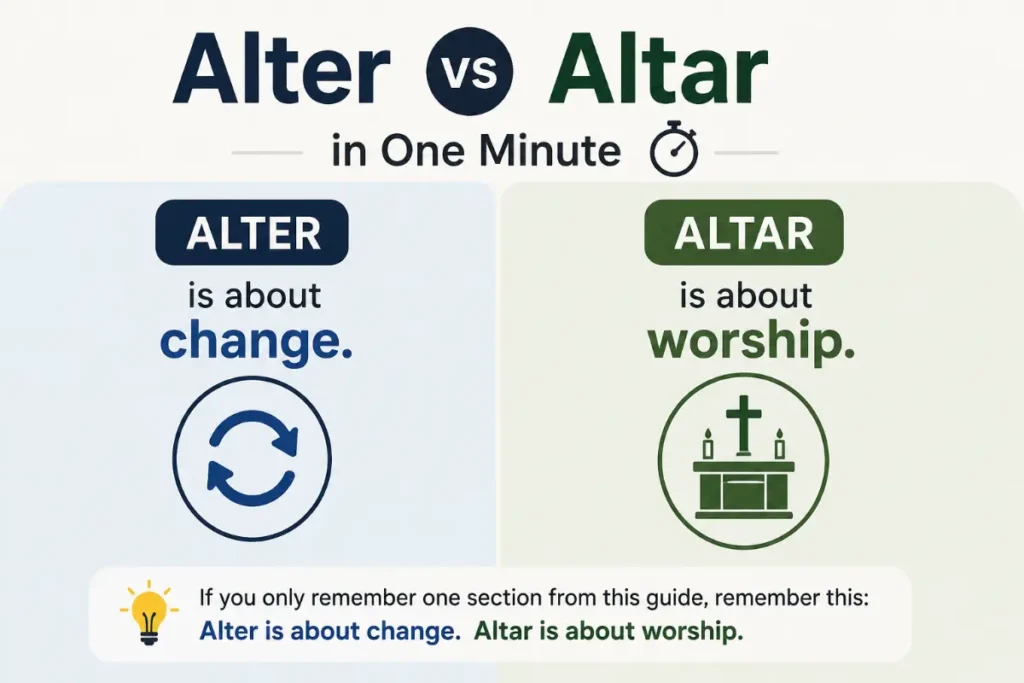
If you only remember one section from this guide, remember this:
Alter is about change.
Altar is about worship.
Alter is generally a verb.
Altar is a noun.
You alter a plan.
You alter a dress.
Ahmad approach an altar.
You place flowers on an altar.
The pronunciation may be the same, but the meanings are completely different.
Need another quick comparison? Read Troubleshooted or Troubleshot Correct Usage Guide.
Conclusion
The difference between alter vs altar becomes simple once you connect each word with its core meaning. Alter means to change, modify, adjust, or revise something, and it normally functions as a verb. Altar is a noun referring to a sacred structure or place used for worship, ceremony, offerings, or sacrifice.
The two words can sound identical in many English accents, so pronunciation cannot always help. Context and grammar provide the better clues. If you mean “change,” choose alter. If you mean a sacred table or ceremonial structure, choose altar.
The most useful memory trick is short enough to remember anytime: alter changes something, while an altar is connected with worship. Keep that distinction in mind and this commonly confused pair becomes much easier to spell and use correctly.
FAQs
What is the difference between alter and altar?
Alter is a verb meaning to change, modify, or adjust something. Altar is a noun referring to a sacred table, structure, or place used for religious worship or ceremony. The words can sound the same in many English accents, but their meanings and grammatical roles are different.
Is altar a form of alter?
No. Altar is not a form of alter. They are separate words with different origins and meanings. Alter means to change or modify something, while altar refers to a sacred structure or ceremonial place. Their similar pronunciation is the main reason they are often confused.
Is alter a verb or a noun?
Alter is primarily used as a verb in modern English. It means to change, modify, adjust, or revise something. Common examples include “alter a plan,” “alter a dress,” and “alter a document.” Specialized noun uses exist, but the verb is by far the most important everyday use.
Is altar always related to religion?
Altar is strongly associated with religion, worship, sacrifice, and ceremony. It can also appear metaphorically in phrases describing something being sacrificed for another purpose. Even in figurative use, the word usually retains its underlying association with sacrifice or devotion.
Are alter and altar pronounced the same?
In many varieties of American, British, Canadian, and Australian English, alter and altar have the same or nearly the same pronunciation. Because pronunciation may not reveal the difference, writers must rely on spelling, grammar, and context to choose the correct word.
How do I remember the spelling of alter?
Connect alter with the idea of alteration. An alteration is a change, so alter means to change or modify something. If you can replace the word with “change,” alter is usually the correct spelling. This association is more reliable than trying to remember the letters separately.
What is the plural of altar?
The plural of altar is altars. For example, “The church contains several altars.” Do not confuse altars with alters. Alters is the third person singular form of the verb alter, as in “She alters the design.”
Which word should I use for a wedding ceremony?
Use altar when referring to the sacred structure or place associated with the ceremony. For example, “The couple stood at the altar.” Use alter only when you mean to change something, as in “They altered the wedding schedule.”