
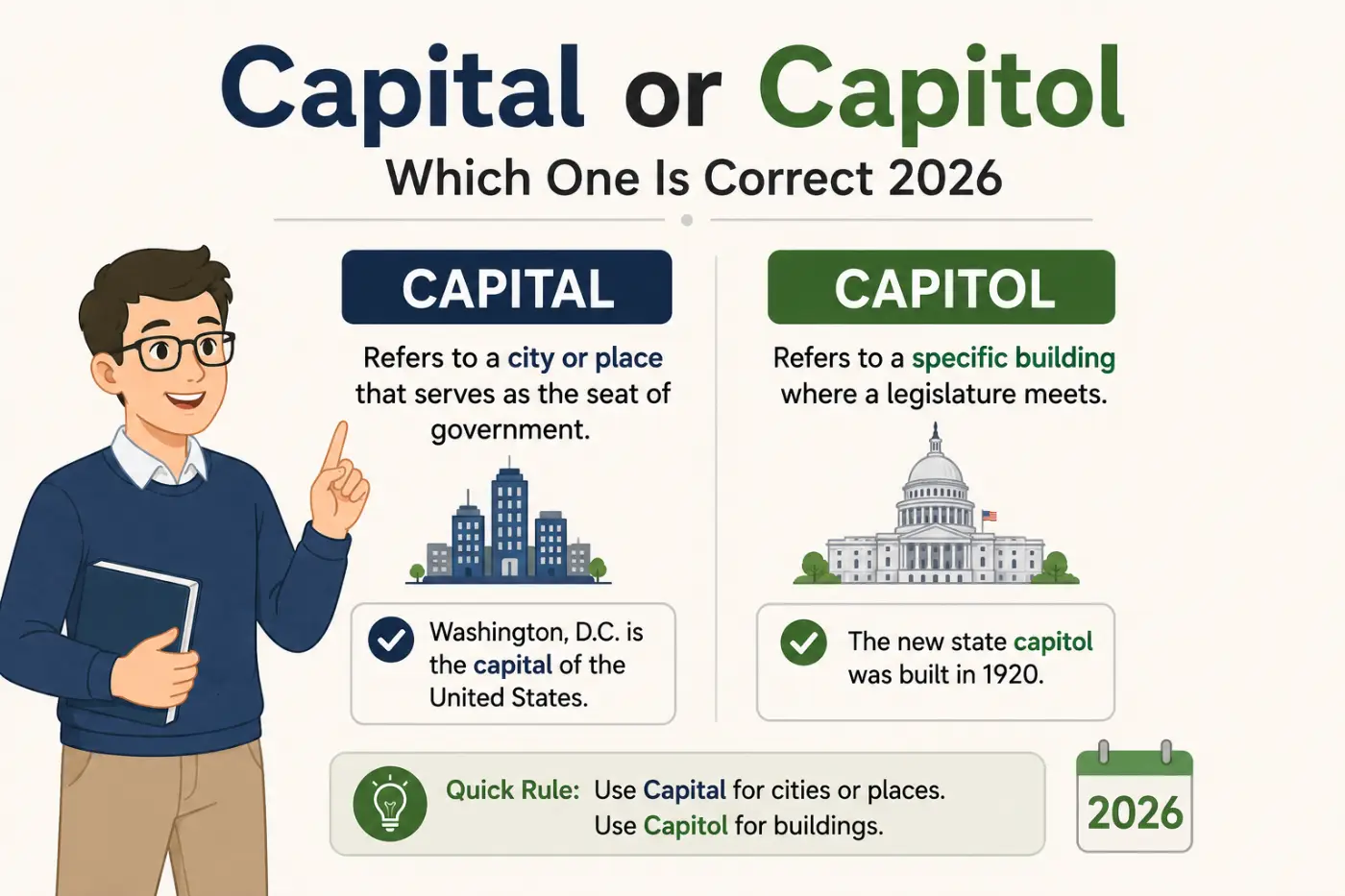
IIf you’ve ever paused while writing a sentence about government and wondered about capital or capitol, you’re not alone. These two words look almost identical and sound nearly the same in American English. Yet they refer to very different things. The simple answer is this. Capital can mean a city that serves as the seat of government, money used for investment, or an uppercase letter. Capitol refers to a government building, especially one where a legislature meets.
That small spelling difference can change the meaning of an entire sentence. For example, Sacramento is the capital of California, while the California State Capitol is the building where the state legislature meets. The confusion comes from their shared history and similar pronunciation. Both words trace back to Latin roots connected with the idea of a head or chief position. Over time, their meanings developed in different directions.
This guide explains capital or capitol in plain American English. You’ll learn what each word means, how to use it correctly, how to pronounce it, why people confuse them, and an easy way to remember the difference without relying on a complicated rule.
Need another quick comparison? Read Wether or Whether Which Spelling Is Correct.
Quick Definition
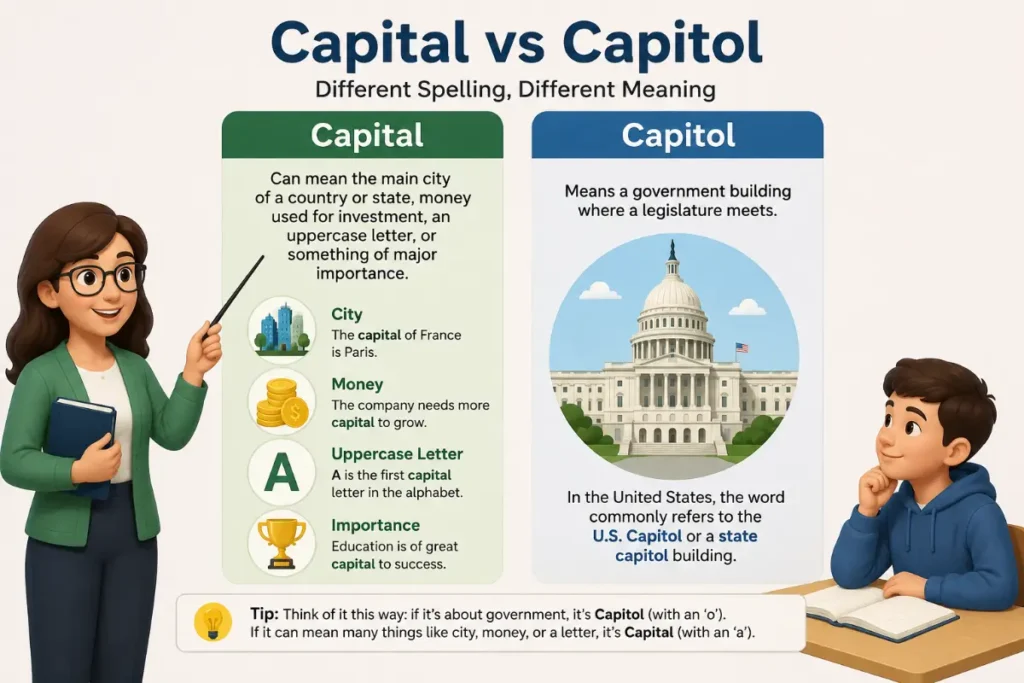
Capital can mean the main city of a country or state, money used for investment, an uppercase letter, or something of major importance. Capitol means a government building where a legislature meets. In the United States, the word commonly refers to the U.S. Capitol or a state capitol building.
Capital or Capitol At A Glance
| Feature | Capital | Capitol |
|---|---|---|
| Correct form | Capital | Capitol |
| Main meaning | Government city, money, uppercase letter, or something important | Government building |
| Part of speech | Noun and adjective | Noun |
| Main origin | Latin capitalis from caput meaning head | Latin Capitolium |
| Usage frequency | Very common | Less common |
| Formality | Everyday and formal | Formal and institutional |
| Common context | Cities, finance, writing, government, importance | Legislatures and government buildings |
| Example | Denver is the capital of Colorado. | The Colorado State Capitol is in Denver. |
| Common phrase | capital city | state capitol |
| Memory clue | Think city, money, or letter | Think building |
The easiest distinction is based on the physical location involved.
A capital is generally a city or another important thing.
A capitol is a building.
That distinction covers the most common government related use of the two words.
Meaning Of Capital
Capital has several meanings in modern English. This is one reason the word appears much more often than capitol.
The most familiar government meaning is the city where a national, state, or regional government is based. Washington, D.C. is the capital of the United States. Austin is the capital of Texas. Phoenix is the capital of Arizona.
Cambridge defines a capital as a city that serves as the center of government for a country or smaller political area.
Capital also has an important financial meaning. In business and economics, capital refers to money or other wealth used to operate a business, invest, or produce additional wealth. A company might raise capital to open a new location. An entrepreneur might need more capital to expand a business.
There’s another everyday meaning in writing. A capital is an uppercase letter. In the sentence, My name is Sarah, the M and S are capital letters.
The word can also work as an adjective. You might see phrases such as capital importance or capital offense. In these uses, the word carries a sense of importance, seriousness, or principal status.
So capital has a surprisingly wide range of meanings.
- A city that serves as a government center.
- Money or wealth used for investment or business.
- An uppercase letter.
- Something important or principal.
- A term connected with serious crimes in expressions such as capital offense.
These meanings may look unrelated at first. They actually share a historical idea of something being at the head or in a leading position.
Meaning Of Capitol
Capitol has a much narrower meaning.
It refers to a building where a legislature meets. In American English, this often means a building occupied by a state legislature or the national legislature.
The U.S. Capitol is the building in Washington, D.C. where the United States Congress meets. A state may also have a capitol building where its legislature conducts official business. Cambridge specifically defines capitol as the building where the U.S. Congress meets or a building where a U.S. state government meets.
For example:
- The senator returned to the Capitol after lunch.
- Tourists gathered outside the state capitol.
- The legislature met inside the Capitol.
- Security around the Capitol was increased.
Notice the difference between the city and the building.
Washington, D.C. is the capital of the United States.
The U.S. Capitol is a building in Washington, D.C.
The same relationship appears at the state level.
Austin is the capital of Texas.
The Texas State Capitol is the capitol building in Austin.
Once you see that relationship, the spelling becomes much easier to remember.
Capital Or Capitol In Government Writing
Government writing is where this confusion causes the most trouble.
A sentence about a city normally calls for capital.
A sentence about a legislative building normally calls for capitol.
Consider these examples:
- Albany is the capital of New York.
- The governor spoke at the state capitol.
- Sacramento is the capital of California.
- The California State Capitol attracts visitors.
- Washington, D.C. is the capital of the United States.
- Congress meets at the U.S. Capitol.
The pattern is consistent. The city gets capital. The building gets capitol.
A useful test is to replace the word with city or building.
If city makes sense, use capital.
If building makes sense, use capitol.
For example:
Boston is the capital of Massachusetts.
You can think, Boston is the government city of Massachusetts.
The Massachusetts State Capitol is in Boston.
You can think, the Massachusetts government building is in Boston.
That simple substitution test works surprisingly well when you’re writing quickly.
Key Differences Between The Two Words
The main difference is meaning rather than pronunciation.
Capital has several meanings. Capitol has one main modern meaning in American English.
Meaning Difference
Capital can identify a city, financial resources, an uppercase letter, or something important.
Capitol identifies a government building.
This makes capital the broader word.
Grammar Difference
Capital can function as a noun and an adjective.
Examples include:
- The capital is crowded.
- The company needs more capital.
- Please use a capital letter.
- That was a capital offense.
Capitol functions as a noun.
Examples include:
- The Capitol opened for visitors.
- Lawmakers returned to the Capitol.
- The state Capitol needs repairs.
You won’t normally use capitol as an adjective in standard modern English.
Context Difference
Capital appears in many areas of communication. Newspapers, school assignments, business reports, government documents, and casual conversations all use it.
Capitol appears mainly in government and political contexts.
You’re far more likely to encounter capital in ordinary writing because its meanings cover several unrelated subjects.
Scope Difference
Capital has a broad semantic range.
Capitol has a specific institutional meaning.
That difference is important for writers. If the subject is government, don’t automatically choose capitol. First ask what you’re actually describing.
If you’re naming the city, use capital.
If you’re naming the legislative building, use capitol.
Which One Is Correct
Both spellings are correct.
The correct choice depends entirely on meaning.
Use capital when you mean a government city, financial resources, an uppercase letter, or something important.
Use capitol when you mean a government building where lawmakers meet.
For example:
Correct: Washington, D.C. is the capital of the United States.
Correct: The U.S. Capitol is located in Washington, D.C.
Neither spelling replaces the other. They are separate words with different jobs.
A common mistake is to assume that capitol is simply a special spelling of capital used for politics. That isn’t quite right.
The distinction is more specific. Capitol refers to the building itself.
This is why a news report might say:
The governor traveled to the state capital.
The sentence refers to the city.
It might then say:
The governor spoke at the state Capitol.
Now it refers to the government building.
That one letter tells the reader exactly what place you mean.
Capital Examples In Sentences
Here are natural examples showing the most common uses of capital.
- Washington, D.C. is the capital of the United States.
- Austin is the capital of Texas.
- Paris is the capital of France.
- The capital has grown rapidly over the past decade.
- The company needs additional capital to expand.
- Investors provided enough capital to launch the project.
- Begin the sentence with a capital letter.
- Every proper name should begin with a capital letter.
- The country moved its capital to a new city.
- The organization invested its capital in new equipment.
These examples show why capital is such a versatile word. Its meaning changes with the surrounding context.
In the first four examples, it relates to a government city.
In examples seven and eight, it refers to uppercase letters.
The final examples return to government and finance.
Capitol Examples In Sentences
Capitol is much more focused. These examples all refer to government buildings.
- The governor arrived at the state Capitol early in the morning.
- Visitors toured the Capitol during the afternoon.
- Protesters gathered outside the Capitol.
- The senator walked across the Capitol grounds.
- The legislature returned to the Capitol after the holiday.
- Security officers monitored the Capitol entrance.
- The Capitol dome is visible from several blocks away.
- The committee held a meeting inside the Capitol.
- Tourists took photographs of the historic Capitol building.
- Lawmakers gathered at the Capitol to discuss the proposal.
The word points to a building or the institutional setting associated with that building.
In American political writing, you’ll often see the Capitol capitalized when the writer is referring to a specific government building such as the U.S. Capitol. State names can also appear with the term, as in the Texas State Capitol or the California State Capitol.
Common Mistakes With Capital And Capitol
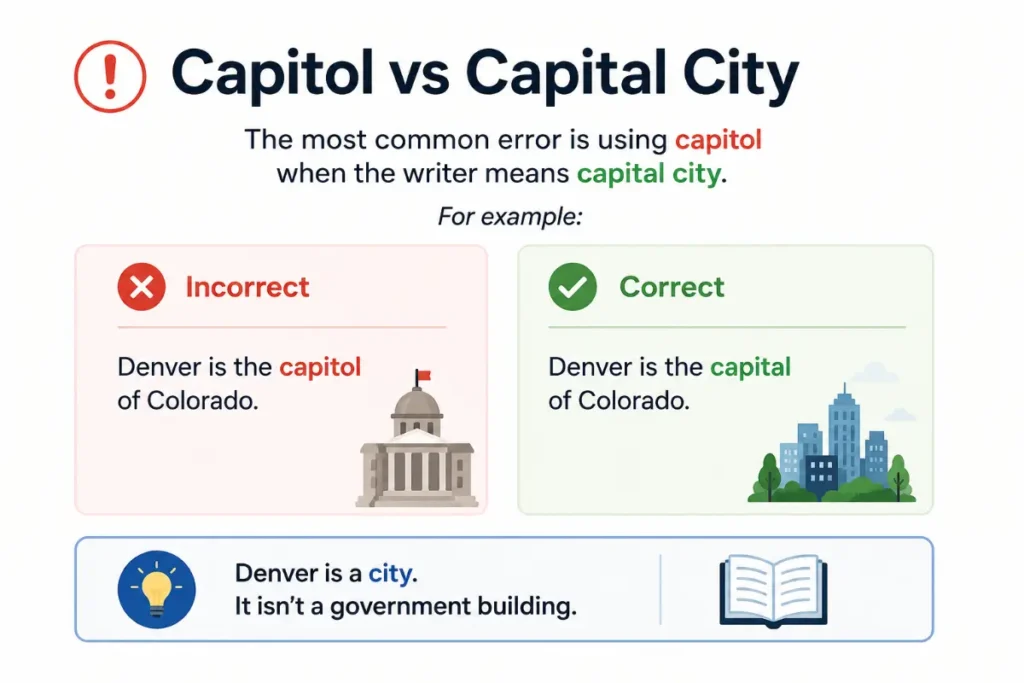
The most common error is using capitol when the writer means capital city.
For example:
Incorrect: Denver is the capitol of Colorado.
Correct: Denver is the capital of Colorado.
Denver is a city. It isn’t a government building.
Another common error goes in the opposite direction.
Incorrect: The Texas capital is a beautiful historic building.
Better: The Texas Capitol is a beautiful historic building.
The sentence is describing the legislative building, so capitol is the precise choice.
There are also cases where context makes the intended meaning obvious but the spelling still matters.
Consider this sentence:
The president traveled to the capital for the meeting.
The reader understands that the president traveled to the government center.
Now compare it with:
The president traveled to the Capitol for the meeting.
This version identifies the legislative building.
The distinction can become especially important in journalism, academic writing, government documents, and educational material. A single letter can tell readers if you mean an entire city or one particular building.
Many readers also check Focussing or Focusing Which Spelling Is Correct 2026.
Pronunciation Guide
The pronunciation difference is much smaller than the spelling difference.
Cambridge lists the American pronunciation of capital as /ˈkæp.ə.t̬əl/ and the British pronunciation as /ˈkæp.ɪ.təl/. It gives essentially the same pronunciation pattern for Capitol.
Capital
American English: /ˈkæp.ə.t̬əl/
Syllables: cap • i • tal
The first syllable carries the main stress.
In American speech, the middle sound can be very light, and the t may sound similar to the quick sound heard in words such as water in many American accents.
Capitol
American English: /ˈkæp.ə.t̬əl/
Syllables: cap • i • tol
The two words can sound almost identical in ordinary American conversation.
That’s why listening alone may not tell you which spelling a speaker intends.
Context usually does the work.
If someone says, The governor went to the Capitol, you need the surrounding meaning to understand that the speaker means the government building.
If someone says, Denver is the capital, the city meaning is clear from the sentence.
Common Pronunciation Mistakes
One mistake is placing too much stress on the final syllable.
Another is trying to create a strong audible difference between capital and capitol. In many American accents, there isn’t a useful pronunciation difference to rely on. specific publications and government documents. The underlying meaning stays the same.
British English
British English uses capital for the main city or seat of government.
London is the capital of the United Kingdom.
The word also carries its other established meanings involving money, uppercase letters, importance, and related concepts. Collins lists capital as a noun and adjective with these broad meanings in British English.
British English also recognizes capitol, but the word has a more specialized association. It can refer to the U.S. Capitol or to the historical Roman Capitol. The term isn’t the normal everyday choice for a British legislative building.
In British writing, terms such as Parliament, Houses of Parliament, Parliament building, or government building are generally more natural for British institutions.
So an American writer might naturally say:
Lawmakers returned to the state Capitol.
A British writer discussing Westminster would not normally substitute capitol for the name of the institution or building.
Canadian English
Canadian English generally follows the broader English distinction.
Ottawa is the capital of Canada.
The Parliament Buildings are in Ottawa.
Canadian government terminology doesn’t normally require capitol as the standard word for the federal legislative buildings.
The important point for Canadian readers is that capital remains the normal word for a government city. Capitol is not a general replacement for it.
Australian English
Australian English also uses capital for the principal city of a political region.
Canberra is the capital of Australia.
Sydney is the capital of New South Wales.
Melbourne is the capital of Victoria.
The word capitol is much less central to ordinary Australian government vocabulary. Writers usually identify a legislative building by its proper name or use a term such as parliament house.
For international content, capital is therefore the safer and more widely understood term for a government city.
Grammar Rules For Capital And Capitol
The grammar behind these words is straightforward once their meanings are separated.
Capital can function as both a noun and an adjective. Capitol is primarily a noun.
That difference becomes important when you build sentences.
Capital As A Noun
Capital can name a government city.
Austin is the capital of Texas.
It can also refer to financial resources.
The company needs more capital.
It can refer to an uppercase letter.
Start the sentence with a capital.
It can also describe something regarded as the center of a particular activity.
New York is often called a fashion capital.
The surrounding words tell you which meaning applies.
Capital As An Adjective
Capital can modify another noun.
Examples include:
- Capital city.
- Capital letter.
- Capital investment.
- Capital expenditure.
- Capital punishment.
- Capital offense.
- Capital importance.
The meaning changes according to the noun that follows it.
In capital city, the word identifies a city associated with government.
In capital punishment, it relates to a serious legal penalty.
Capitol As A Noun
Capitol normally appears as a noun.
You can write:
The Capitol is closed to visitors.
You can also write:
The legislature met inside the capitol.
The plural is capitols.
For example:
Several historic capitols have been preserved as landmarks.
You don’t normally need a special verb form or unusual grammatical structure. The challenge is choosing the word with the right meaning.
Capital As A Countable Noun
When capital means a government city, it can be countable.
You can say:
The country has several major cities but only one national capital.
When capital refers to financial resources, its grammar changes with context. In financial writing, capital is often treated as an uncountable noun.
The business needs additional capital.
You generally wouldn’t write:
The business needs three capitals.
That would sound wrong if you mean money.
Capitol And Articles
Because capitol is a noun, normal articles can appear before it.
The Capitol was surrounded by security.
A capitol building can become an important historic landmark.
When referring to a specific official building by its established name, capitalization depends on the proper name and the relevant style guide.
The U.S. Capitol is a proper name.
Capitalization Rules For Capitol
There is another source of confusion hiding inside the spelling issue.
Writers sometimes know that Capitol refers to a government building but aren’t sure when to capitalize it.
The general principle is simple.
Capitalize Capitol when it forms part of a proper name or refers to a specific named institution or building according to the applicable style.
Examples include:
- U.S. Capitol.
- United States Capitol.
- California State Capitol.
- Texas State Capitol.
In a general reference, lowercase can be appropriate.
The state capitol was renovated.
Specific government terminology can also follow an organization’s official naming convention. If you’re writing for a government agency, newspaper, school, or publication, its style guide should take priority.
The distinction between capital and Capitol therefore involves two separate questions.
First, what does the word mean?
Second, does the specific reference require capitalization?
Meaning comes first.
Real Life Usage In Daily Conversation
Most people don’t spend much time thinking about the distinction in casual speech because the two words sound so similar.
The difference becomes visible when people write.
Imagine someone saying:
I’m going to the capital tomorrow.
The listener may understand that the person is traveling to the government city.
Now imagine:
I’m going to the Capitol tomorrow.
The context suggests a specific government building.
In everyday conversation, speakers often rely on context instead of pronunciation.
A teacher might say:
What’s the capital of California?
A student answers:
Sacramento.
A tour guide might say:
The California State Capitol is just a short walk from here.
The city and building are connected, so the meaning is easy to understand.
Usage In Academic Writing
Academic writing demands greater precision because readers cannot rely on conversational context.
A history paper might say:
Washington, D.C. became the capital of the United States under the federal government’s established system.
A paper about architecture might say:
The U.S. Capitol has become one of the most recognizable government buildings in the country.
A political science paper could mention both in the same paragraph.
For example:
The capital attracts federal institutions, while the Capitol serves as the principal meeting place of the national legislature.
That sentence makes the relationship between the terms especially clear.
When you’re writing an academic assignment, don’t choose capitol simply because your subject involves politics.
Politics can involve cities, institutions, buildings, officials, laws, and governments.
The physical object you’re describing determines the word.
Usage In Professional Communication
Professional writing rewards the same precision.
A government employee might write:
The meeting will take place at the State Capitol at 10 a.m.
A financial analyst might write:
The company plans to raise additional capital.
A communications manager might write:
Please use a capital letter at the beginning of each heading.
These three sentences involve completely different meanings of capital and capitol.
This is why context matters more than visual similarity.
The words belong to different semantic fields even though they share much of their spelling.
Usage In Literature And Media
Writers often use capital in figurative expressions.
You may see phrases such as:
the cultural capital
the financial capital
political capital
social capital
capital city
These expressions extend the core idea of something important, central, or valuable.
Capitol tends to stay more literal.
A novel, newspaper article, documentary, or political report may mention a capitol building as a physical location.
Media writing also uses Capitol Hill as a familiar political expression in American English. Capitol Hill refers to the area in Washington, D.C. associated with the U.S. Capitol and Congress. It can also refer more broadly to the political community surrounding Congress.
This creates another useful distinction.
Capital identifies a city.
Capitol identifies a building.
Capitol Hill identifies a place and can also work as shorthand for the U.S. legislative establishment.
Semantic Relationships Between The Words
From an NLP and semantic perspective, capital and capitol are a classic example of closely related forms that have diverged in meaning.
They share historical roots and strong phonological similarity.
Their modern semantic fields are different.
Capital connects with concepts such as:
- Government.
- City.
- Finance.
- Investment.
- Wealth.
- Uppercase letters.
- Importance.
- Principal status.
- Economics.
- Business.
Capitol connects with concepts such as:
- Legislature.
- Congress.
- Government building.
- State government.
- Political institutions.
- Public architecture.
- U.S. government.
- Statehouse.
- Capitol Hill.
- Legislative meetings.
Expert Language Insight
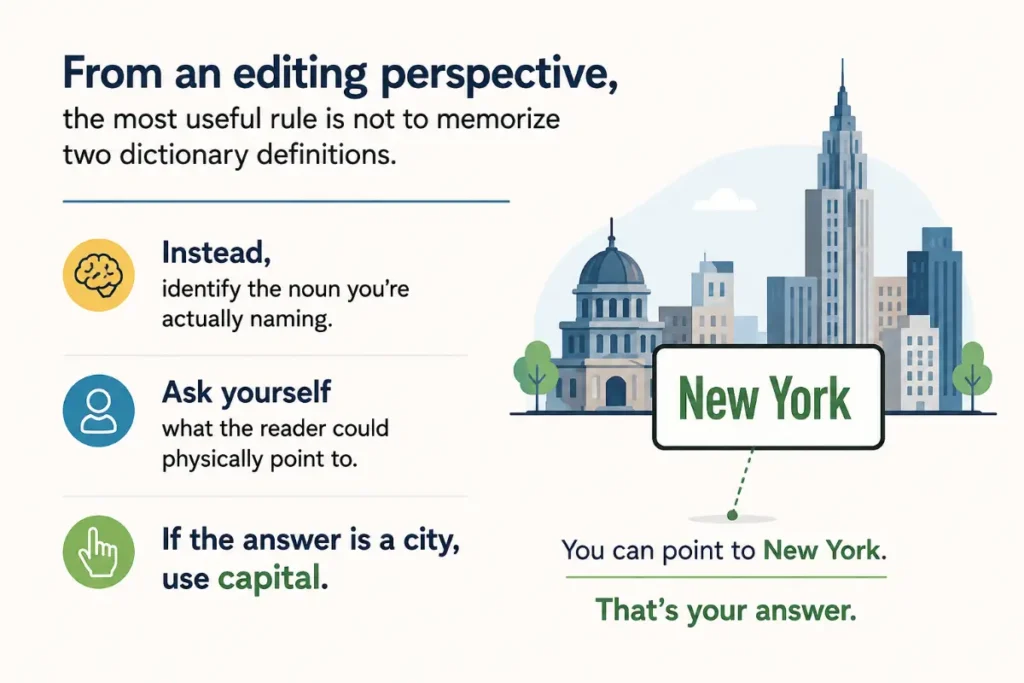
From an editing perspective, the most useful rule is not to memorize two dictionary definitions.
Instead, identify the noun you’re actually naming.
Ask yourself what the reader could physically point to.
If the answer is a city, use capital.
A Practical Editing Test
When proofreading your work, search for every occurrence of capital and capitol.
Then classify each one.
- Government city means capital.
- Financial resources means capital.
- Uppercase letter means capital.
- Something principal or highly important can mean capital.
- Legislative building means capitol.
This quick check catches most errors.
It works especially well in articles about politics, geography, history, government, and American institutions.
For another common grammar confusion, see Wholey Vs Wholly Which Spelling Is Correct in 2026?.
Conclusion
The difference between capital or capitol becomes much easier once you connect each word with what it describes. Capital is the broader word and can refer to a government city, financial resources, an uppercase letter, or something of major importance. Capitol specifically refers to a government building where lawmakers meet.
For the government related meaning, remember this simple distinction. A capital is a city, while a capitol is a building. When you’re writing or editing, focus on the thing you’re describing rather than how the words sound. If you mean the city where a government is based, use capital. If you mean the legislative building, use Capitol in a proper name or capitol when you’re using the word generally. Once you connect each spelling with its meaning, this commonly confused pair becomes much easier to use correctly.
Common Search Questions
Is capital or capitol correct for a city?
Capital is correct for a city that serves as the official seat of government. For example, Sacramento is the capital of California, and Washington, D.C. is the capital of the United States. Capitol refers to a government building rather than the city itself.
Is capital or capitol correct for a government building?
Capitol is the correct word when you mean a building where a legislature meets. The U.S. Capitol is the federal example, while state capitols house state legislatures. Capital is not the standard spelling for this specific building meaning.
What is the difference between capital and capitol?
Capital has several meanings. It can refer to a government city, financial resources, an uppercase letter, or something important. Capitol has a narrower meaning and refers mainly to a legislative government building. The words are closely related in spelling and pronunciation but aren’t interchangeable.
Is Washington DC the capital or capitol?
Washington, D.C. is the capital of the United States. The U.S. Capitol is the government building in Washington, D.C. where Congress meets. So the city is the capital, while the building is the Capitol. Using these terms correctly tells readers exactly what location you’re describing.
Why is Capitol spelled with an O?
Capitol comes from the Latin Capitolium, the name associated with the ancient Roman temple of Jupiter on Capitoline Hill. The American use developed as a term for important legislative buildings. Its spelling therefore has a different historical path from the modern government city meaning of capital.
Do capital and capitol sound the same?
In American English, they are pronounced almost identically and are commonly treated as homophones. That similarity explains why spelling mistakes are common. Context usually tells listeners which meaning is intended. Writers need to rely on meaning rather than pronunciation when choosing the spelling.
Should Capitol always be capitalized?
No. Capitalization depends on the specific reference and the style being followed. U.S. Capitol is a proper name and is capitalized. A general reference to a capitol building can use lowercase. When writing for an organization or publication, follow its established style guide for specific names.
How can I remember capital and capitol?
Use the city versus building test. Capital means the government city and also has several other meanings. Capitol means the legislative building. If you’re talking about Austin, you’re talking about a capital. If you’re talking about the Texas State Capitol building, you’re talking about a capitol.