
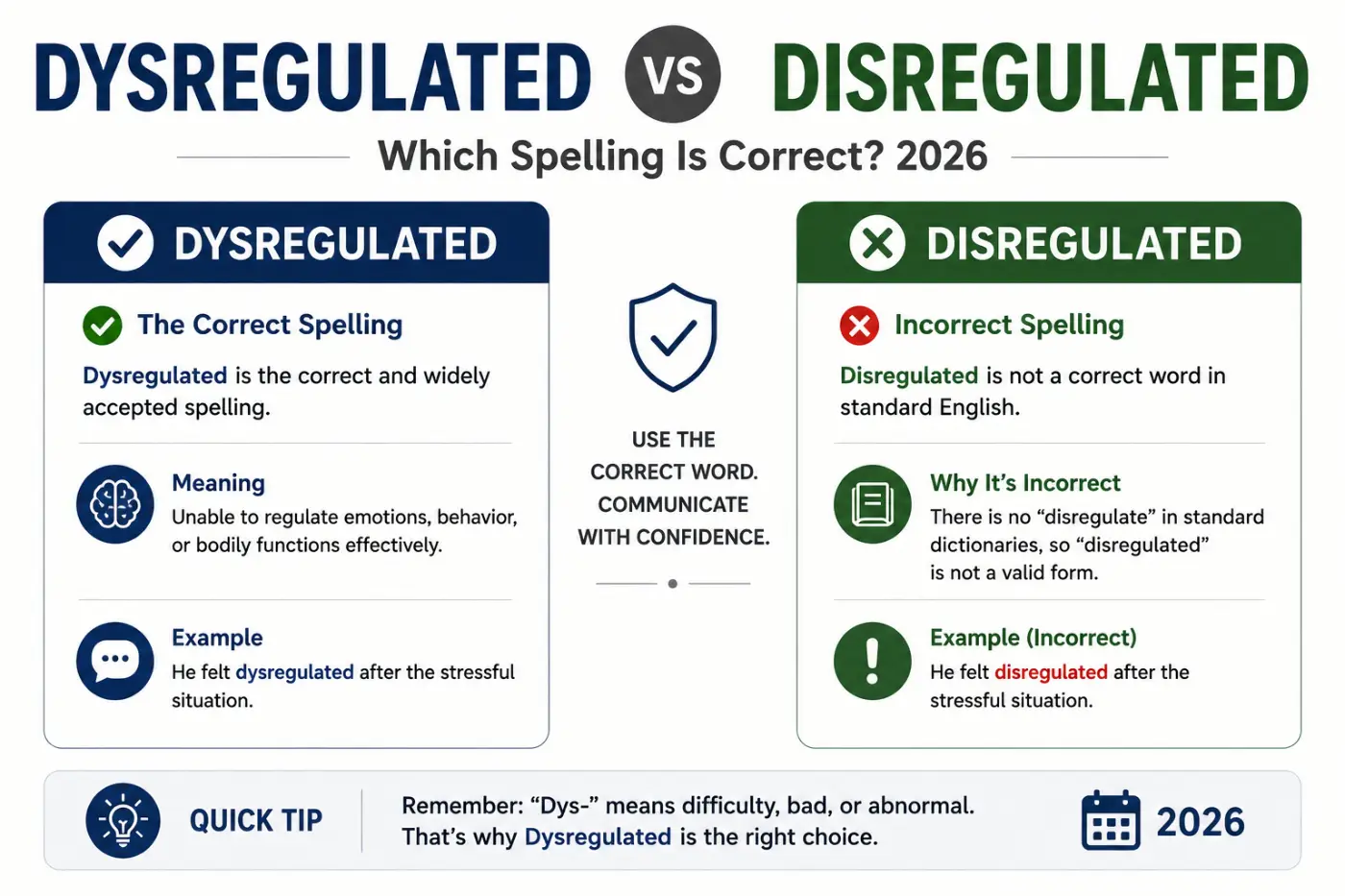
Many people search for dysregulated vs disregulated after seeing both spellings online. It is an easy mistake to make because the prefixes dys- and dis- look similar, sound somewhat alike, and both appear in many English words. Even experienced writers sometimes pause to check which version is correct.
The short answer is simple. Dysregulated is the correct spelling. Disregulated is a misspelling that does not appear as a standard English word in major dictionaries or professional style guides. The correct form is widely used in medicine, psychology, neuroscience, education, and everyday discussions about emotional regulation and body systems.
Understanding why dysregulated is correct can help you avoid a common spelling error and use the word confidently in both formal and informal writing. In this guide, you’ll learn the meaning of the word, its history, pronunciation, grammar, real-world examples, common mistakes, and practical tips that professional editors use when checking this term.
Many readers also check Grately vs Greatly Which Is Correct and Why It Matters in 2026.
Quick Definition
Dysregulated is the correct spelling. It describes something that is functioning abnormally or is not properly regulated, such as emotions, hormones, the immune system, or body temperature. Disregulated is a common misspelling and should be replaced with dysregulated in standard English writing.
Quick Answer
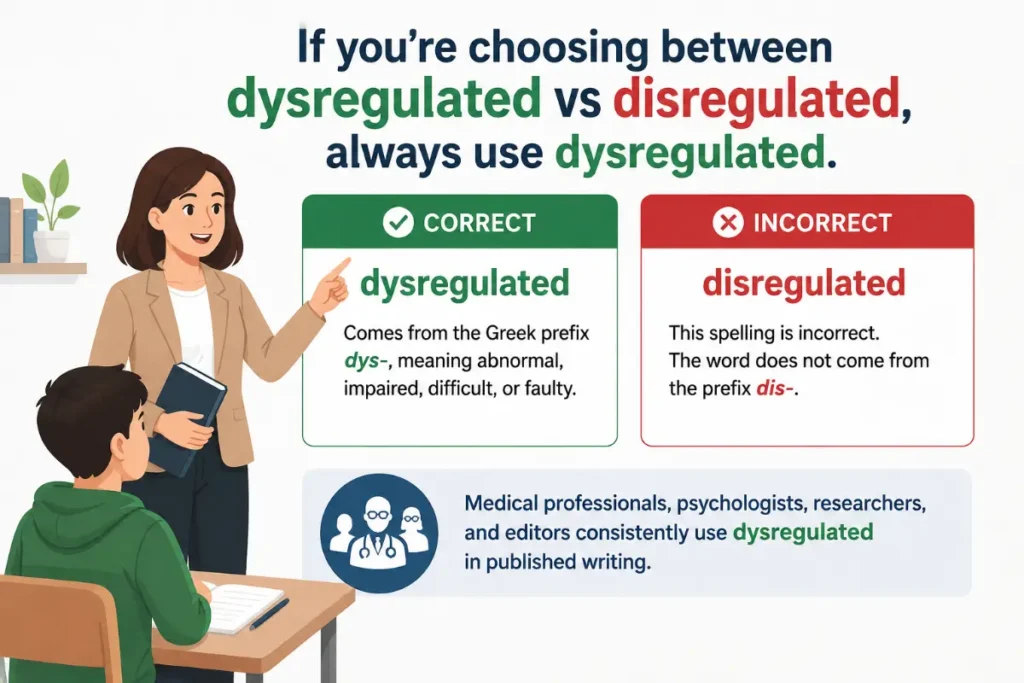
If you’re choosing between dysregulated vs disregulated, always use dysregulated. The spelling disregulated is incorrect because the word comes from the Greek prefix dys-, meaning abnormal, impaired, difficult, or faulty. Medical professionals, psychologists, researchers, and editors consistently use dysregulated in published writing.
Dysregulated vs Disregulated Comparison Table
| Feature | Dysregulated | Disregulated |
|---|---|---|
| Correct spelling | Yes | No |
| Dictionary status | Standard English word | Misspelling |
| Part of speech | Adjective | Not recognized as a standard word |
| Meaning | Functioning abnormally or poorly regulated | Intended misspelling of dysregulated |
| Prefix | dys- meaning abnormal or impaired | dis- meaning not or opposite, used incorrectly here |
| Origin | Greek prefix plus English regulate | Misspelled variation |
| Usage frequency | Common in medicine, psychology, neuroscience, education | Rare and usually appears as an error |
| Formality | Appropriate in formal and informal writing | Not recommended |
| Common contexts | Emotional regulation, immune system, hormones, nervous system | Typographical mistake |
| Example | The patient showed dysregulated emotional responses. | The patient showed disregulated emotional responses. ❌ |
Meaning of Dysregulated
Dysregulated is an adjective describing a system, process, emotion, behavior, or biological function that is not operating in its normal or healthy way. The word appears most often in health care, psychology, psychiatry, neuroscience, biology, and education. However, it has also become common in everyday conversations about emotional well-being.
Examples include:
- Dysregulated emotions.
- Dysregulated immune response.
- Dysregulated nervous system.
- Dysregulated sleep cycle.
- Dysregulated hormones.
- Dysregulated appetite.
- Dysregulated behavior.
- Dysregulated stress response.
- Dysregulated metabolism.
- Dysregulated attention.
In each example, the idea is the same. Something that normally stays balanced or controlled has become impaired or abnormal.
Definition
A concise definition is:
Dysregulated means operating outside normal control, balance, or healthy regulation.
Context
Healthcare professionals often use the word when discussing conditions that interfere with the body’s normal regulatory systems .Psychologists use it to describe difficulties managing emotions, thoughts, or behaviors. Researchers use it when explaining abnormal biological processes. Teachers and therapists may use it when discussing emotional self-regulation in children and adults.
Etymology
The word combines two elements.
- Dys-, a Greek prefix meaning bad, abnormal, impaired, difficult, or faulty.
- Regulated, from the Latin root regula, meaning rule or standard.
Together, they describe something that is regulated improperly or functioning abnormally.
Meaning of Disregulated
Unlike dysregulated, disregulated is not recognized as a standard English word. Most instances of disregulated occur because someone mistakenly substitutes the common English prefix dis- for dys-. Although readers may understand the intended meaning from context, editors almost always correct it to dysregulated.
Why People Write Disregulated
Several factors contribute to this mistake.
- The prefixes dis- and dys- look similar.
- English contains thousands of words beginning with dis-, making it feel familiar.
- Spell-check tools may not immediately explain why the spelling is wrong.
- People often type quickly and rely on memory rather than checking a dictionary.
- The pronunciation can make the prefixes sound similar in casual speech.
Because of these reasons, the error appears regularly in blogs, discussion forums, and social media posts.
Dysregulated vs Disregulated Key Differences
Although these spellings differ by only one letter, they are not equally correct.
Meaning
Dysregulated has an accepted meaning in English. Disregulated has no recognized dictionary definition.
Spelling
Dysregulated follows the established medical and linguistic form. Disregulated does not.
Grammar
Dysregulated functions as an adjective.
Example:
The child appeared dysregulated after the stressful event.
Because disregulated is not a standard word, it has no accepted grammatical role.
Professional Usage
Doctors, psychologists, therapists, neuroscientists, researchers, and academic writers consistently use dysregulated. Professional publications do not intentionally use disregulated except when discussing spelling errors.
Dictionary Recognition
Major dictionaries recognize dysregulated or its base form dysregulation. Standard dictionaries do not list disregulated as an accepted alternative spelling.
Which One Is Correct
The correct spelling is dysregulated. This spelling reflects the Greek prefix dys-, which indicates abnormal or impaired functioning. The same prefix appears in many familiar English words.
Examples include:
- Dysfunction.
- Dyslexia.
- Dysgraphia.
- Dysphagia.
- Dysplasia.
- Dyspepsia.
- Dyskinesia.
- Dysarthria.
- Dysphoria.
- Dysbiosis.
Notice that all these medical and scientific terms begin with dys-, not dis-. Because dysregulated belongs to this same family of words, replacing the prefix with dis- creates an incorrect spelling. Professional editors, academic publishers, and healthcare organizations consistently correct disregulated to dysregulated.
Why the Prefix Dys Matters
One of the easiest ways to remember the correct spelling is to understand the meaning of the prefix itself. The Greek prefix dys- expresses ideas such as:
- Impaired.
- Abnormal.
- Difficult.
- Faulty.
- Poorly functioning.
Examples include:
- Dysfunction means impaired function.
- Dyslexia refers to difficulty with reading.
- Dysphagia means difficulty swallowing.
- Dysregulation means abnormal regulation.
The prefix dis-, by contrast, usually means:
- Opposite.
- Not.
- Remove.
- Reverse.
- Apart.
Examples include:
- Disconnect.
- Disagree.
- Disappear.
- Disapprove.
- Discontinue.
Since dysregulated refers to abnormal regulation rather than the opposite of regulation, the dys- prefix is the correct linguistic choice.
Why the Confusion Is So Common
Many spelling errors happen because English borrows words from multiple languages. The word dysregulated combines a Greek prefix with a Latin root. That mixture is not obvious to most readers. Several additional factors make the confusion understandable.
- The prefixes share similar sounds.
- The words differ by only one letter.
- Both prefixes appear frequently in English.
- Many people first encounter the word in online discussions rather than textbooks.
- AutoCorrect tools sometimes fail to explain the difference.
- Search engines often display pages containing user-generated spelling mistakes.
- The error spreads when copied into blogs or social media posts.
As a result, searches for dysregulated vs disregulated continue to grow, even though only one spelling is correct.
Expert Editorial Insight
Professional copy editors rarely rely on intuition when checking specialized vocabulary. Instead, they examine the word’s linguistic origin. Because dysregulated belongs to a family of Greek-derived medical terms, its spelling follows a consistent pattern used throughout medicine, psychology, neuroscience, and biology. When editing academic papers, journal articles, health websites, or educational content, experienced editors automatically flag disregulated as a spelling mistake. The correction is straightforward because there is no recognized alternative spelling in standard English.
For another common grammar confusion, see Passtime or Pastime Which Is Correct? 2026.
Examples of Dysregulated in Sentences
Here are natural examples showing how dysregulated is correctly used in different contexts.
Emotional Regulation
- After the argument, she became emotionally dysregulated and struggled to calm herself.
- The therapist explained that trauma can leave a person feeling dysregulated for hours or even days.
- He recognized the signs that he was becoming dysregulated and took a short break.
- Children sometimes become dysregulated when they are overwhelmed by noise or change.
- Learning coping skills helped her feel less dysregulated during stressful situations.
Medical and Scientific Contexts
- Researchers observed a dysregulated immune response in some patients.
- The condition is associated with a dysregulated nervous system.
- Doctors monitored the patient’s dysregulated hormone levels throughout treatment.
- Scientists discovered a dysregulated inflammatory pathway linked to the disease.
- Sleep deprivation can contribute to a dysregulated stress response.
Examples of Disregulated in Sentences
The following examples illustrate the common mistake. Each sentence should use dysregulated instead.
- The child appeared disregulated after recess. ❌
- Her disregulated emotions made concentration difficult. ❌
- The doctor described a disregulated immune system. ❌
- He felt disregulated after the stressful meeting. ❌
- The report mentioned disregulated hormone levels. ❌
- Researchers studied disregulated brain activity. ❌
- The nervous system became disregulated. ❌
- Trauma can leave people disregulated for long periods. ❌
- The therapist discussed disregulated emotional responses. ❌
- Chronic stress may lead to disregulated behavior. ❌
Each sentence should replace disregulated with dysregulated.
Common Mistakes
Although the correct spelling is straightforward once you know its origin, several mistakes appear regularly online.
Misspelling the Prefix
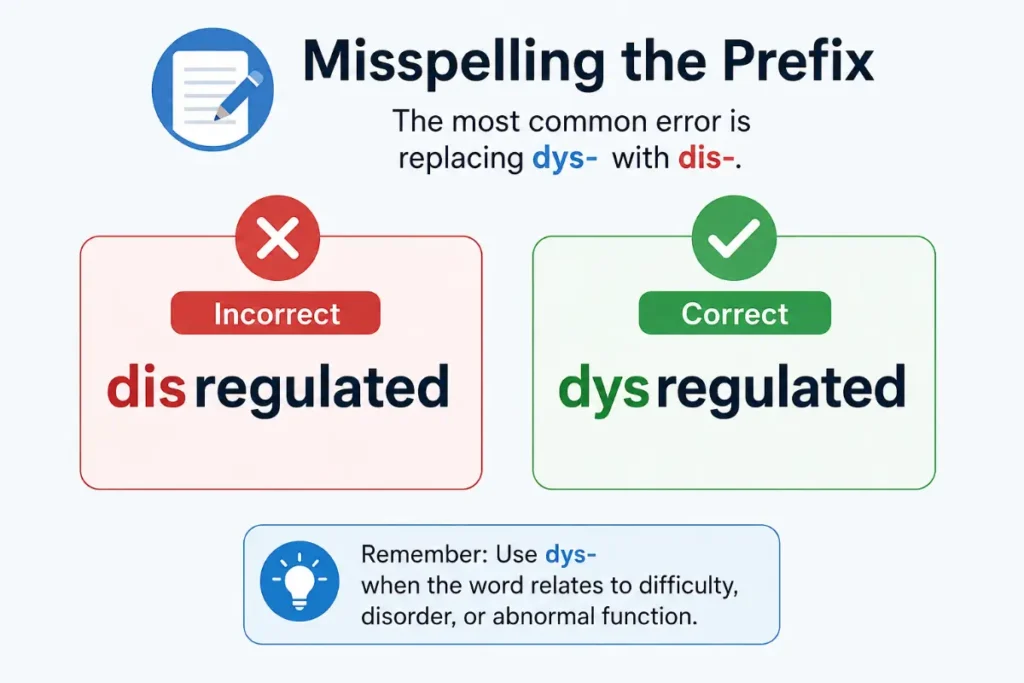
The most common error is replacing dys- with dis-.
Incorrect:
- disregulated
Correct:
- dysregulated
Assuming Both Spellings Are Acceptable
Some writers believe one spelling is American English while the other is British English. This is incorrect. Standard English uses dysregulated in both varieties.
Confusing Dysregulated with Unregulated
These words are not interchangeable. Dysregulated means functioning abnormally. Unregulated means not controlled or not governed by rules.
For example:
The patient’s nervous system was dysregulated.
The industry remained largely unregulated.
Confusing Dysregulated with Dysregulation
People also mix up the adjective and the noun.
Correct:
The patient became dysregulated.
The patient experienced dysregulation.
The first describes the person’s condition. The second names the condition itself.
Pronunciation Guide
IPA Pronunciation
dysregulated
/dɪsˈrɛɡjəˌleɪtɪd/
Syllable Breakdown
dys • reg • u • lat • ed
Simple Pronunciation
dis REG yoo lay tid Although the word begins with dys, it is commonly pronounced much like dis in everyday speech. This similarity in pronunciation is one reason people mistakenly spell it with the more familiar dis- prefix.
Common Pronunciation Mistakes
- Stressing the first syllable instead of REG.
- Omitting the yoo sound.
- Pronouncing every syllable too quickly.
- Assuming pronunciation determines spelling.
Remember that English spelling often reflects a word’s origin rather than its exact pronunciation.
Etymology and Word Origin
Understanding the history of the word makes the spelling much easier to remember.
The prefix dys- comes from Ancient Greek and means:
- Bad.
- Difficult.
- Impaired.
- Abnormal.
- Faulty.
The verb regulate comes from the Latin word regula, meaning rule or standard.
Together, these elements create the idea of something that is regulated improperly or functioning outside its normal balance. The concept of dysregulation became especially important during the twentieth century as psychology, neuroscience, immunology, endocrinology, and psychiatry expanded. Researchers needed a precise term for systems that continued to function but no longer operated normally. Today, dysregulated appears in thousands of scientific papers discussing emotional regulation, hormone activity, immune responses, metabolism, brain function, and child development.
Regional Usage
One advantage of this word is its consistency across major English-speaking countries.
| Region | Preferred Form |
|---|---|
| American English | Dysregulated |
| British English | Dysregulated |
| Canadian English | Dysregulated |
| Australian English | Dysregulated |
Unlike words such as color and colour or organize and organise, there is no accepted regional spelling variation. Editors throughout the English-speaking world use the same spelling.
Grammar Rules
Understanding the grammar behind dysregulated helps you use it naturally.
Part of Speech
The word is primarily an adjective.
Examples:
The child became dysregulated.
Her emotions remained dysregulated.
Related Verb
The related verb is dysregulate, although it appears less frequently.
Example:
Chronic stress can dysregulate the nervous system.
Related Noun
The noun is dysregulation.
Example:
Emotional dysregulation affects daily functioning.
Common Sentence Patterns
Subject + be + dysregulated.
The patient is dysregulated.
Subject + become + dysregulated.
She became dysregulated after the accident.
Dysregulated + noun.
Dysregulated emotional state.
Plural Forms
Because dysregulated is an adjective, it has no plural form.
The noun dysregulations is technically possible but extremely uncommon. Most writing uses the singular noun dysregulation.
Real Life Usage Examples
Daily Conversation
I’m feeling dysregulated today after getting very little sleep.
Academic Writing
Participants demonstrated dysregulated emotional responses following repeated exposure to stress.
Professional Communication
The therapist noted several episodes of dysregulated behavior during the assessment.
Literature
Modern novels dealing with trauma and mental health increasingly use dysregulated to describe emotional states realistically.
Media
Articles discussing anxiety, PTSD, ADHD, autism, childhood development, and chronic stress frequently use dysregulated when explaining emotional or neurological functioning.
Related Words and Confused Terms
Learning related vocabulary strengthens your understanding of dysregulated.
| Word | Meaning |
|---|---|
| Dysregulation | The condition of abnormal regulation |
| Dysregulate | To disrupt normal regulation |
| Regulation | Normal control or balance |
| Regulated | Properly controlled |
| Unregulated | Not controlled by rules or authority |
| Dysfunction | Impaired function |
| Homeostasis | Stable internal balance |
| Emotional regulation | Managing emotions effectively |
| Self regulation | Controlling thoughts, feelings, and behavior |
| Neuroregulation | Regulation within the nervous system |
These related terms often appear together in medical journals, psychology textbooks, and educational resources.
Expert Language Insight
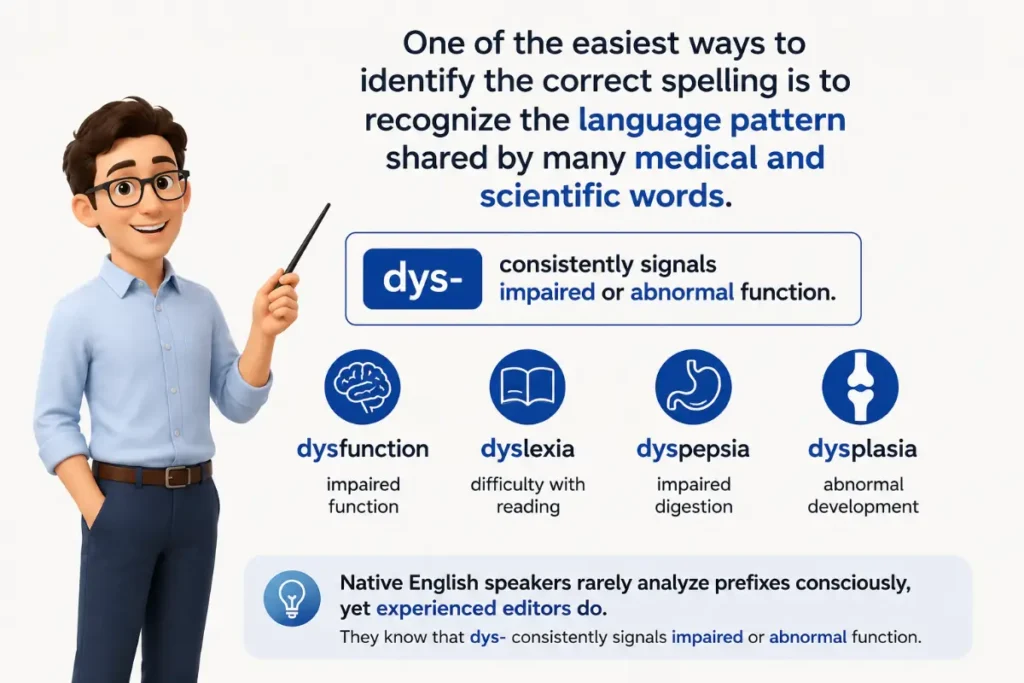
One of the easiest ways to identify the correct spelling is to recognize the language pattern shared by many medical and scientific words.Native English speakers rarely analyze prefixes consciously, yet experienced editors do. They know that dys- consistently signals impaired or abnormal function.
Compare these familiar examples:
- Dysfunction.
- Dyslexia.
- Dysgraphia.
- Dysphagia.
- Dysplasia.
- Dysphoria.
Notice that none of these words use dis-. The same principle applies to dysregulated. Another useful editing tip is to think about meaning rather than sound. Spoken English often reduces the distinction between dys- and dis-, but written English preserves the correct Greek-derived spelling. When proofreading professional documents, academic papers, healthcare materials, or educational content, always verify specialized terminology instead of relying on pronunciation alone.
Need another quick comparison? Read enrol or enroll: The Truth About These Two Spellings (2026).
Conclusion
When comparing dysregulated vs disregulated, the answer is clear. Dysregulated is the only correct spelling in standard English. It comes from the Greek prefix dys-, meaning abnormal or impaired, and is widely used in medicine, psychology, neuroscience, education, and everyday discussions about emotional and biological regulation.
Disregulated is simply a misspelling. Although readers may understand the intended meaning from context, using it can reduce the credibility of your writing, especially in academic, professional, or healthcare settings.
Whenever you describe emotions, hormones, the nervous system, immune function, or any process operating outside its normal balance, choose dysregulated. Understanding the word’s origin and recognizing the dys- prefix will help you avoid this common error and write with greater confidence and precision.
Frequently Asked Questions
Is dysregulated or disregulated correct?
Dysregulated is correct. Disregulated is a misspelling and is not recognized as standard English. Medical, psychological, and academic writing consistently uses dysregulated to describe abnormal regulation of emotions, biological systems, or behavior.
Why do people spell dysregulated as disregulated?
The mistake happens because the prefixes dys- and dis- look and sound similar. Since dis- appears in many common English words, writers sometimes substitute it incorrectly even though the correct prefix is dys-.
What does dysregulated mean?
Dysregulated describes something that is not functioning normally or is poorly regulated. It often refers to emotions, hormones, the nervous system, immune responses, metabolism, or other biological processes that have lost their normal balance.
Is disregulated in the dictionary?
No. Standard English dictionaries do not recognize disregulated as a correct spelling. If you see it, it is almost always a typographical or spelling error intended to mean dysregulated.
Is dysregulated a medical term?
Yes. Dysregulated is widely used in medicine, psychology, psychiatry, neuroscience, endocrinology, immunology, and related fields. It accurately describes abnormal regulation within biological or psychological systems.
Can dysregulated describe emotions?
Yes. Mental health professionals commonly use dysregulated to describe emotional states that become difficult to manage. Emotional dysregulation may occur during periods of stress, trauma, anxiety, or certain mental health conditions.
Is there a British spelling of dysregulated?
No. American English, British English, Canadian English, and Australian English all use the same spelling: dysregulated. There is no accepted regional variation using disregulated.
How can I remember the correct spelling?
Remember the word dysfunction. Both dysfunction and dysregulated begin with the Greek prefix dys-, which means abnormal or impaired. If you can spell dysfunction, you can remember dysregulated.