
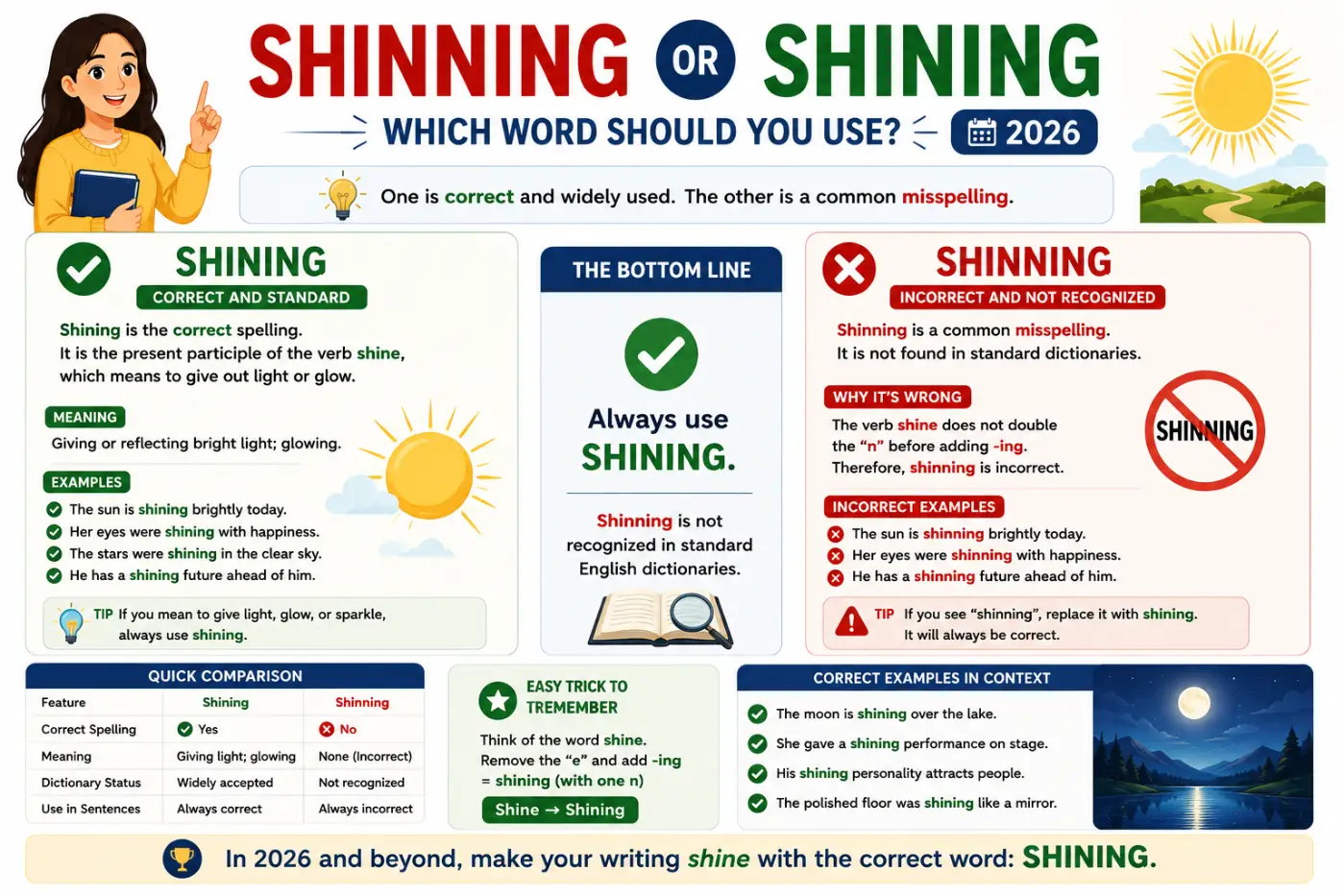
If you’re searching for shinning or shining, you may be wondering which spelling is correct. The answer depends on what you mean. Shining is the standard word for giving off light, reflecting brightness, looking bright, standing out, or performing exceptionally well. Shinning is also a correct English word, but it has a completely different meaning. It describes climbing a tree, pole, rope, or another vertical object by gripping it with your arms and legs.
These words are easy to confuse because their spellings are almost identical. The key is to look at the base verb. Shining comes from shine, while shinning comes from shin.
In this guide, you’ll learn the meanings, pronunciation, grammar rules, origins, sentence examples, common mistakes, regional usage, and practical differences between shining and shinning. By the end, you’ll know exactly which spelling to use in your writing.
Many readers also check inhouse or in-house Correct Spelling and Usage.
Quick Definition
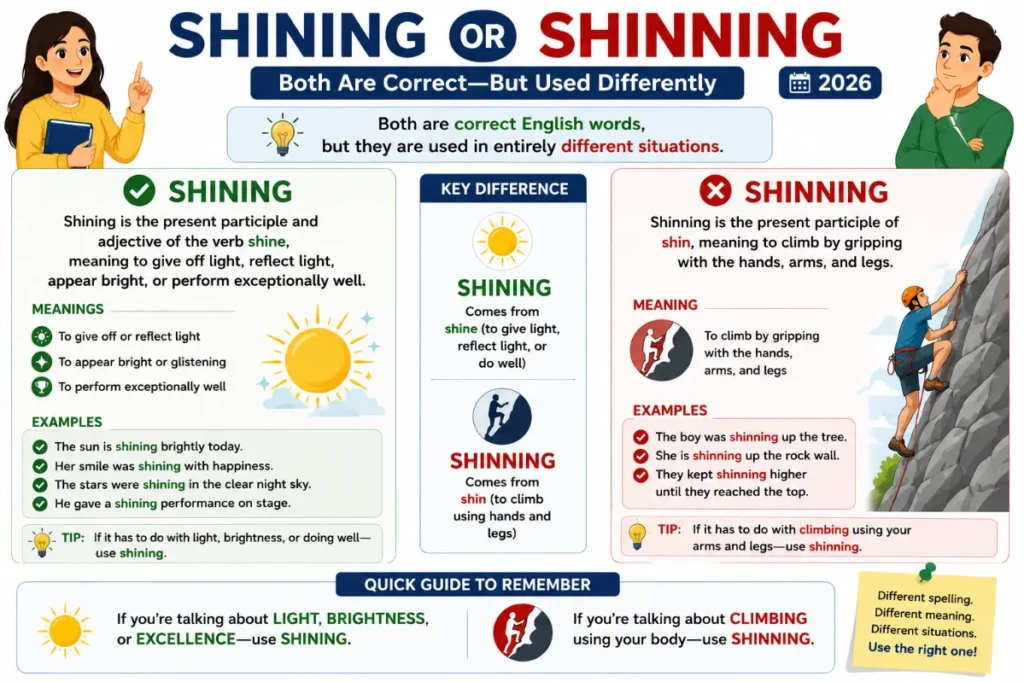
Shining is the present participle and adjective of the verb shine, meaning to give off light, reflect light, appear bright, or perform exceptionally well. Shinning is the present participle of shin, meaning to climb by gripping with the hands, arms, and legs. Both are correct English words, but they are used in entirely different situations.
Quick Answer
If you’re writing about light, brightness, polished surfaces, success, or excellence, use shining. Use shinning only when referring to climbing a tree, pole, rope, fence, or another vertical object by gripping it with your arms and legs. In modern English, shining is far more common. Most people will never need to use shinning unless they are describing climbing.
Shinning or Shining Comparison Table
| Feature | Shining | Shinning |
|---|---|---|
| Correct spelling | Yes | Yes |
| Main meaning | Giving off or reflecting light, standing out, polished | Climbing using arms and legs |
| Part of speech | Present participle and adjective | Present participle |
| Base verb | Shine | Shin |
| Common usage | Extremely common | Rare |
| Formality | Used in all writing styles | Mostly descriptive writing |
| Typical contexts | Sun, stars, smiles, success, polished objects | Trees, poles, ropes, fences |
| Figurative meaning | Success, excellence, hope | Usually none |
| Frequency | Very high | Very low |
| Common learner mistake | None | Mistakenly used instead of shining |
Meaning of Shining
Shining comes from the verb shine. It describes something that gives off light, reflects light, appears bright, or stands out because of excellence or beauty. It can function as both a verb form and an adjective. The word appears in everyday conversation, journalism, literature, academic writing, advertising, and professional communication. It also has many figurative meanings that extend beyond physical light.
For example:
- A shining moon illuminated the lake.
- Her shining smile welcomed every visitor.
- The athlete delivered a shining performance.
- The polished silver looked shining under the lights.
Native speakers often use shining metaphorically to describe someone who performs exceptionally well.
Examples include:
- a shining example
- a shining achievement
- a shining success
- a shining moment
- a shining reputation
These expressions have become standard English and appear frequently in books, newspapers, speeches, and business writing.
Etymology of Shining
The verb shine comes from Old English scīnan, meaning “to emit light” or “to glow.” Its roots go back to the Proto-Germanic language family and even further to the Proto-Indo-European root associated with brightness and radiance. For centuries, English speakers have used shine to describe natural light, polished surfaces, intelligence, beauty, happiness, and excellence. The participle shining developed naturally from this long history and remains one of the most frequently used descriptive words in English.
Meaning of Shinning
Although many people think shinning is simply a spelling mistake, it is actually the present participle of the verb shin. In this sense, shin does not refer to the front part of your lower leg. Instead, it means to climb by wrapping your arms and legs around an object while pulling yourself upward. This usage has existed in English for centuries, although it has become relatively uncommon in everyday speech.
Examples include:
- The child was shinning up the tree.
- The firefighter practiced shinning up the training pole.
- The monkey kept shinning along the tall trunk.
- He escaped by shinning over the fence.
Modern English speakers usually prefer verbs such as:
- climbing
- scrambling
- scaling
- ascending
Because these alternatives are more familiar, many people rarely encounter shinning outside novels, adventure stories, historical writing, or dictionaries.
Etymology of Shinning
The climbing verb shin has existed since Middle English. Linguists believe it developed because climbers often grip an object with their shins while pulling themselves upward. Over time, the verb produced forms such as:
- shin
- shinned
- shinning
Although the verb survives in modern dictionaries, it is much less common than it once was.
Shinning or Shining Meaning Differences
Understanding the difference becomes easy once you recognize that the words come from different verbs.
Shining describes brightness
Use shining whenever something emits, reflects, or symbolizes light.
Examples include:
- shining stars
- shining armor
- shining windows
- shining smile
- shining future
The word can also describe excellence.
Examples include:
- a shining career
- a shining victory
- a shining achievement
- a shining recommendation
- a shining example
Shinning describes climbing
Use shinning only when someone climbs a vertical object using both arms and legs.
Typical examples include:
- shinning up a tree
- shinning up a rope
- shinning up a utility pole
- shinning over a fence
Unlike shining, shinning almost never carries figurative meanings.
Shinning or Shining Which One Is Correct?
The answer depends entirely on what you want to say. If you’re talking about light, brightness, reflection, cleanliness, beauty, success, or excellence, shining is correct.
Examples include:
- The stars were shining brightly.
- She has a shining personality.
- His shoes are shining.
- The trophy is shining after being polished.
If you’re talking about climbing by gripping with your hands and legs, shinning is correct.
Examples include:
- The boy was shinning up the coconut tree.
- The rescue worker practiced shinning up the pole.
For almost every everyday sentence, shining is the word you need. This explains why people often believe shinning is incorrect. In reality, it is simply a rare verb that most English learners never encounter.
Grammar Rule Behind Shining
Many learners expect the present participle of shine to be shinning because English often doubles the final consonant before adding -ing.
For example:
- run → running
- sit → sitting
- swim → swimming
- win → winning
However, shine follows a different pattern because the silent e is simply removed before adding -ing.
The pattern looks like this:
| Base Verb | Present Participle |
|---|---|
| shine | shining |
| smile | smiling |
| arrive | arriving |
| dance | dancing |
| move | moving |
This is why shine becomes shining, not shinning. The double n belongs only to the separate verb shin, meaning “to climb.”
Shinning or Shining Pronunciation Guide
Although shining and shinning look very similar, they are pronounced differently because they come from different base words.
| Word | IPA | Syllable Breakdown | Pronunciation |
|---|---|---|---|
| Shining | /ˈʃaɪ.nɪŋ/ | shin ing | SHY ning |
| Shinning | /ˈʃɪn.ɪŋ/ | shin ning | SHIN ing |
Notice the important vowel difference.
- Shining begins with the long i sound, just like shine, fine, and line.
- Shinning begins with the short i sound, just like shin, pin, and win.
Common Pronunciation Mistakes
Many English learners accidentally pronounce shining as if it came from shin. This usually happens because they focus on the spelling instead of the base verb.
A simple trick is to remember the original word.
- Shine → Shining uses the long i sound.
- Shin → Shinning uses the short i sound.
If you remember the pronunciation of the original verb, you’ll almost always pronounce the participle correctly.
Grammar Rules for Shinning or Shining
Understanding the grammar behind these words helps prevent spelling mistakes.
Shining Comes From Shine
The verb shine follows the standard rule for verbs ending in a silent e. Remove the e, then add ing.
Examples include:
| Base Verb | Present Participle |
|---|---|
| Shine | Shining |
| Smile | Smiling |
| Live | Living |
| Arrive | Arriving |
| Hope | Hoping |
This explains why shinning is not the -ing form of shine.
Shinning Comes From Shin
The verb shin, meaning “to climb,” ends with a consonant. Its present participle is formed by adding -ning after doubling the final consonant according to English spelling rules.
Examples include:
| Base Verb | Present Participle |
|---|---|
| Shin | Shinning |
| Run | Running |
| Sit | Sitting |
| Swim | Swimming |
Although both words end with -ing, they belong to different verbs and follow different spelling patterns.
Parts of Speech
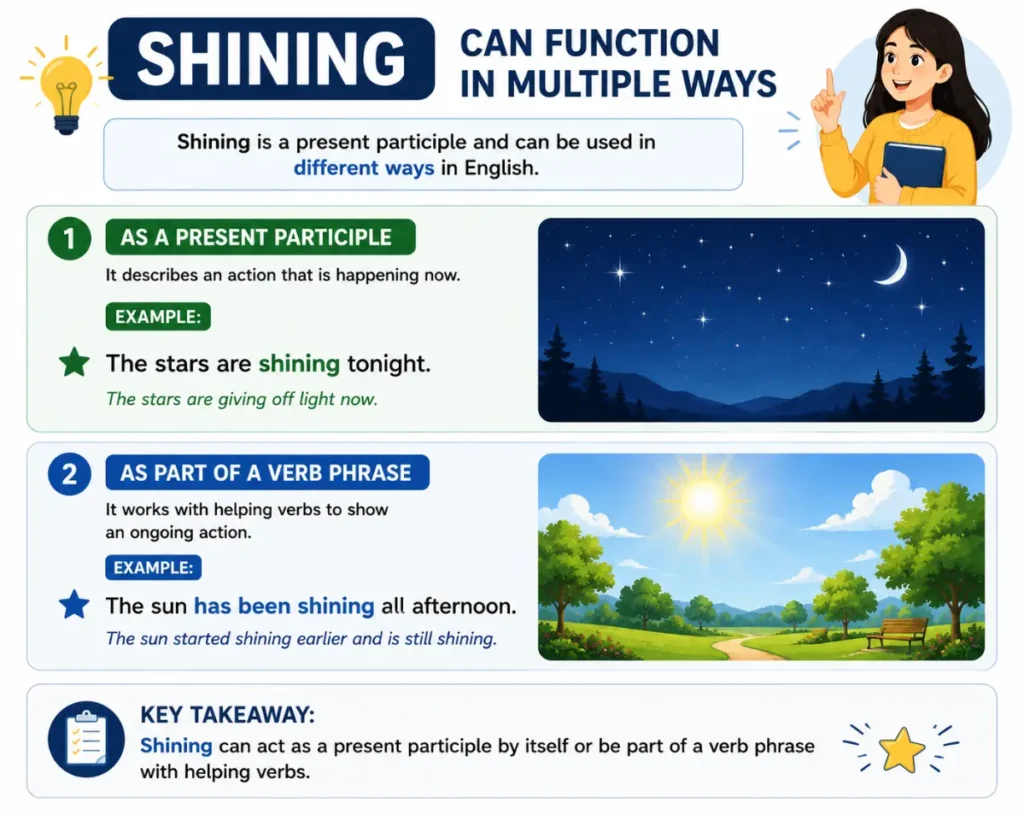
Shining can function in multiple ways.
As a present participle:
- The stars are shining tonight.
As part of a verb phrase:
- The sun has been shining all afternoon.
Shinning functions mainly as a present participle.
Examples include:
- The children were shinning up the tree.
- He spent the afternoon shinning up poles during training.
Unlike shining, it is rarely used as an adjective.
Still confused? Compare Investor vs Investee Which Is the Difference? 2026.
Regional Usage of Shinning or Shining
The meanings of these words remain consistent across major English-speaking countries. However, their frequency of use varies.
American English
American English overwhelmingly uses shining.
Examples include:
- shining stars
- shining example
- shining future
- shining smile
The climbing verb shin appears occasionally in outdoor writing, military training, and historical texts but is uncommon in everyday conversation.
British English
British English also uses shining for brightness and excellence. The verb shin survives slightly more often in British dictionaries and older literature, although modern speakers usually prefer climb.
Australian English
Australian English follows the same pattern. Shining is common in everyday speech, while shinning appears mainly in descriptive writing or discussions of climbing.
Canadian English
Canadian English closely matches American English. Most Canadians will recognize shining immediately, while relatively few people regularly use shinning. Overall, there is no significant regional disagreement. The distinction is based on meaning rather than geography.
Shinning or Shining Examples in Sentences
Ten Examples Using Shining
- The sun was shining through the clouds.
- Her shoes were shining after being polished.
- The students left with shining faces full of excitement.
- His talent became the shining highlight of the performance.
- The lake looked beautiful with the moon shining above it.
- She gave a shining presentation during the conference.
- The freshly cleaned windows were shining in the morning light.
- The medal kept shining under the stadium lights.
- Their company has become a shining example of innovation.
- The lighthouse remained shining throughout the storm.
Ten Examples Using Shinning
- The boy was shinning up the tall oak tree.
- The firefighter practiced shinning up the training pole.
- The monkey kept shinning along the tree trunk.
- The children enjoyed shinning over the wooden fence.
- He escaped by shinning down the drainpipe.
- The explorer began shinning up the rocky ledge.
- She learned shinning techniques during survival training.
- The sailor was shinning up the mast.
- The worker spent the afternoon shinning up utility poles.
- The rescue team practiced shinning ropes before the exercise.
These examples clearly show that the two words are never interchangeable.
Common Mistakes People Make
Many online searches for shinning or shining come from misunderstandings about English spelling rules. Here are the most common errors.
Mistake 1 Using Shinning for Brightness
Incorrect:
- The stars were shinning brightly.
Correct:
- The stars were shining brightly.
Since the sentence refers to light, shining is the correct choice.
Mistake 2 Assuming Shinning Is Always Wrong
Many learners automatically mark shinning as incorrect. In reality, it is a legitimate dictionary word.
Correct:
- The child was shinning up the tree.
Mistake 3 Forgetting the Base Verb
The easiest way to avoid confusion is to identify the original verb. If the base word is shine, write shining. If the base word is shin, write shinning.
Mistake 4 Trusting Spell Check Alone
Some writing tools automatically flag shinning because it is uncommon. That does not make it incorrect. Always consider the meaning of the sentence before changing the spelling.
Real Life Usage Examples
Daily Conversation
Most conversations use shining.
Examples include:
- Your smile is shining today.
- The sun is shining again.
- Your future looks bright and shining.
Using shinning in everyday conversation is rare unless someone is literally climbing something.
Academic Writing
Academic writing often uses shining figuratively.
Examples include:
- This research is a shining example of collaboration.
- The discovery became the shining achievement of the project.
The climbing sense of shinning appears mainly in studies involving sports, survival training, or historical activities.
Professional Communication
Business professionals frequently use shining to praise performance.
Examples include:
- She delivered a shining presentation.
- His report remains a shining example of clear writing.
- The company enjoyed another shining year.
The word shinning is almost never used in workplace communication.
Literature
Novelists often use shining to create vivid imagery.
Examples include descriptions of:
- shining rivers
- shining armor
- shining stars
- shining eyes
Adventure stories occasionally use shinning when describing characters climbing trees, ropes, cliffs, or poles.
Related Words and Commonly Confused Terms
English contains several words that learners confuse with shining because of similar spelling or pronunciation.
| Word | Meaning | Common Confusion |
|---|---|---|
| Shine | Base verb | Gives off light |
| Shiny | Bright or polished | Adjective |
| Shiney | Nonstandard spelling | Should be shiny |
| Shone | Past tense of shine | Often confused with shined |
| Shined | Accepted past tense in some contexts | Common in American English for polishing |
| Shin | Front of the lower leg or the verb meaning climb | Source of shinning |
| Glittering | Sparkling brightly | Similar meaning |
| Glowing | Giving off soft light | Similar meaning |
| Sparkling | Reflecting light brilliantly | Similar meaning |
| Radiant | Bright and glowing | Similar meaning |
These related words help expand your vocabulary while making it easier to choose the right word in different contexts.
Etymology and Word Origin
Understanding the history of these words makes the difference much easier to remember.
The Origin of Shine
The verb shine comes from the Old English word scīnan, meaning “to emit light,” “to glow,” or “to be bright.” It belongs to a family of Germanic words associated with brightness and radiance. Linguists trace it back to the Proto-Germanic root skīnan, which carried the same idea of producing or reflecting light. Over hundreds of years, shine expanded beyond its literal meaning. Today, it can describe not only physical light but also excellence, beauty, intelligence, optimism, and success.
For example:
- The stars shine at night.
- Her kindness shines through every conversation.
- He finally had a chance to shine during the interview.
This figurative use explains why shining appears so frequently in books, speeches, journalism, and everyday English.
The Origin of Shin Meaning “Climb”
The verb shin, meaning “to climb by gripping with the arms and legs,” has a different history. It developed during Middle English and is thought to be connected to the noun shin, the front part of the lower leg. Climbers often pressed their shins against trees, poles, or ropes while moving upward, so the body part eventually gave its name to the action.
From this verb came the forms:
- shin
- shinned
- shinning
Although the word still appears in modern dictionaries, it has become much less common than it was in earlier centuries.
Expert Language Insight
Professional editors rarely think about shinning because it appears so infrequently in modern writing. In fact, if an editor sees shinning, the first instinct is often to check if the writer intended shining. The key is to focus on meaning instead of spelling. Ask yourself one simple question. Is the sentence about light or about climbing? If it is about light, brightness, reflection, success, beauty, or excellence, shining is almost certainly the correct choice.
Examples include:
- The sun was shining.
- She has a shining personality.
- It was a shining achievement.
- His shoes were shining after polishing.
If the sentence describes climbing a tree, pole, mast, rope, or similar object by wrapping the arms and legs around it, shinning is correct.
Examples include:
- The child was shinning up the tree.
- The sailor practiced shinning up the mast.
Experienced writers also consider their audience. Since many readers are unfamiliar with the climbing verb shin, replacing shinning with climbing often improves clarity without changing the meaning.
For example:
Less familiar:
- The boy was shinning up the tree.
More familiar:
- The boy was climbing the tree.
Both are correct, but the second sentence is immediately understood by a wider audience.
Practical Writing Tips
If you’re still unsure which word to choose, these simple tips can help.
- Think about the action first. If something produces or reflects light, choose shining.
- If someone climbs using both arms and legs, shinning is appropriate.
- Remember the base verb.
- shine → shining
- shin → shinning
- Don’t assume a double n always makes a word incorrect. English contains many words with doubled consonants formed from different verbs.
- If your readers may not recognize the climbing verb, consider using climbing instead of shinning for greater clarity.
Quick Memory Trick
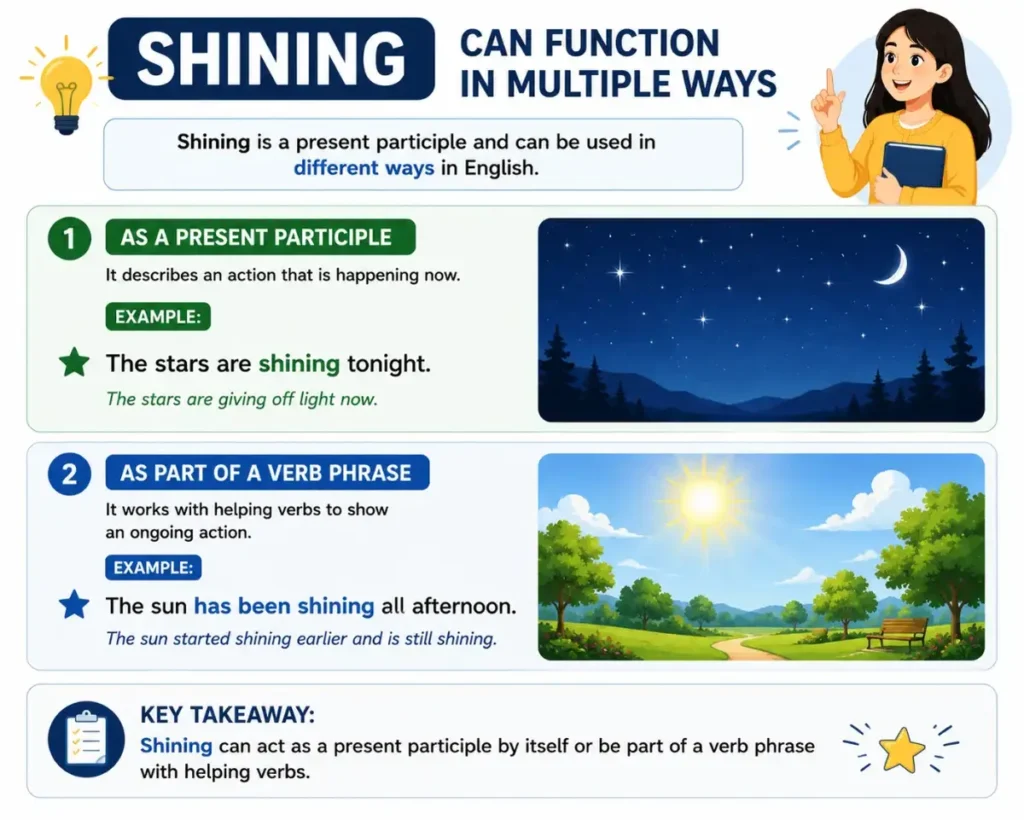
A simple memory trick can prevent future confusion. Shining contains shine, and shine means light. Shinning contains shin, which can remind you of using your shins while climbing a tree or pole. Once you connect each word to its original verb, choosing the correct spelling becomes much easier.
A related grammar guide is phenix vs phoenix Which Spelling Is Correct.
Conclusion
When comparing shinning or shining, remember that both are correct English words, but they come from different verbs and have different meanings.
Use shining when you’re talking about light, brightness, polished objects, beauty, success, or excellence. It’s the standard form you’ll see in everyday English and most general writing.
Use shinning only when describing the action of climbing by gripping a vertical object with your arms and legs. This meaning is correct but uncommon in modern English.
The easiest way to remember the difference is to check the base verb. Shine becomes shining, while shin becomes shinning. Once you connect each spelling with its base verb, choosing the right word becomes much easier.
Frequently Asked Question
Is Shinning a Real English Word?
Yes. Shinning is a real English word. It is the present participle of shin, a verb that means to climb by gripping something with your arms and legs. Although grammatically correct, shinning is much less common than shining.
Is Shining the Correct Spelling for Light?
Yes. Shining is the correct spelling when you’re talking about light, brightness, something that reflects light, or something that looks bright or impressive. It is the present participle of shine and is the form you’ll normally use in everyday English.
Why Do People Confuse Shinning and Shining?
The two words look and sound similar, which can make them easy to mix up. The main difference is their base verbs. Shining comes from shine, while shinning comes from shin, which means to climb.
Can I Use Shinning Instead of Shining?
No. Shinning and shining have different meanings, so they aren’t interchangeable. Use shining for light, brightness, or excellence. Use shinning only when referring to the action of climbing with your arms and legs.
Which Word Is More Common in Modern English?
Shining is far more common in modern English. You’ll see it frequently in everyday speech and writing when people talk about light, appearance, success, or excellence. Shinning is much rarer and is mainly used when describing a specific type of climbing.
Is Shinning Used in American English?
Yes. Shinning is recognized in American English as the present participle of shin. However, it’s uncommon in everyday conversation. Many speakers would use words such as climbing, scaling, or scrambling instead.
What Is the Past Tense of Shine?
The past tense can be shone or shined, depending on the meaning and variety of English. Shone is commonly used when shine means to give off or reflect light. Shined is especially common in American English when shine means to polish something, as in “He shined his shoes.”
How Can I Remember the Difference Between Shinning and Shining?
Focus on the base verb. If the word comes from shine, use shining. If it comes from shin, meaning to climb, use shinning. Remembering the base word makes the difference much easier to spot.