
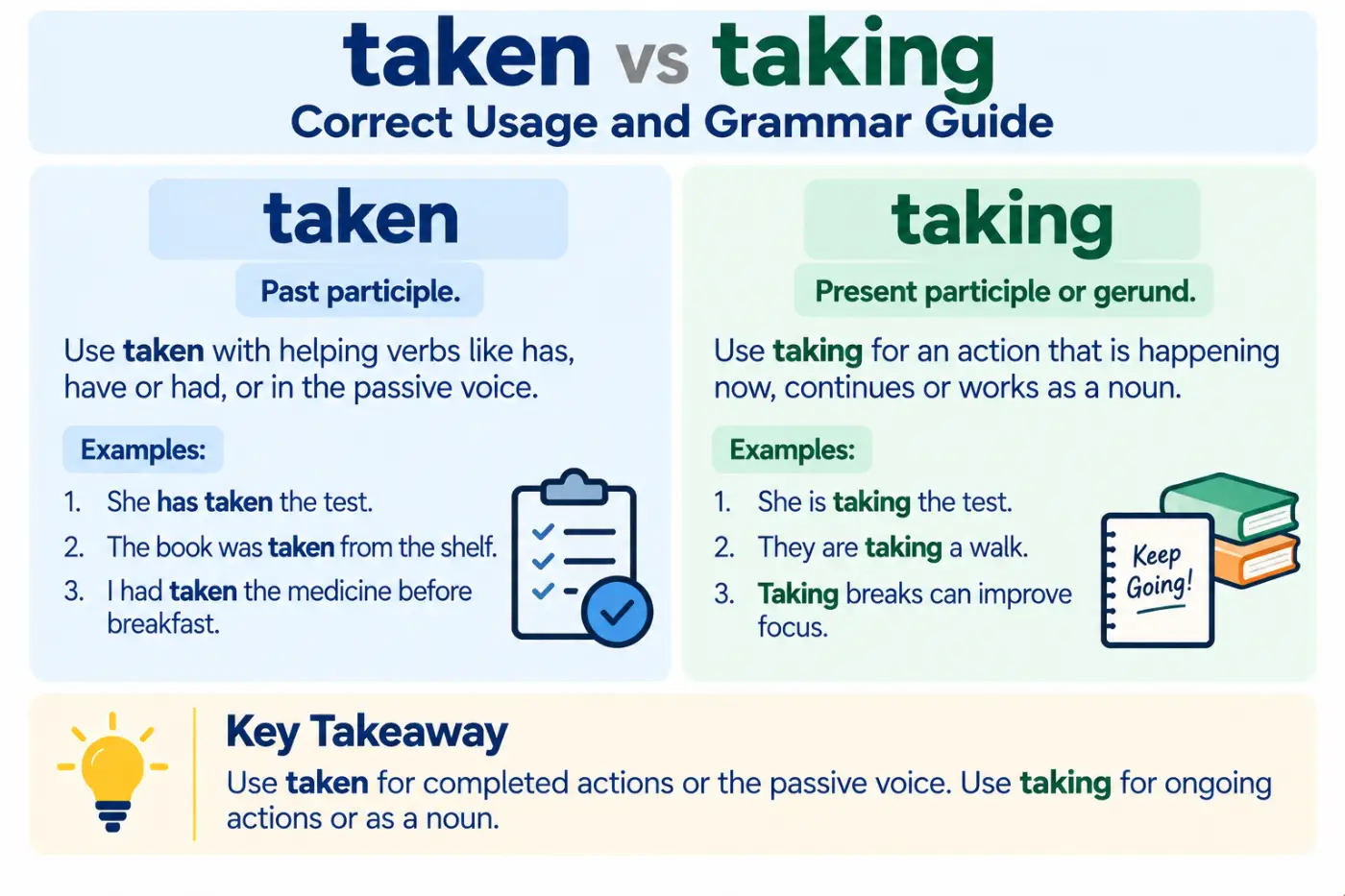
Choosing between taken vs taking can be confusing because both forms come from the verb take, but they perform different jobs in a sentence. The main difference is grammatical: taken is the past participle, while taking is the present participle and gerund form. Neither is incorrect. You need to choose the form that matches the tense, structure, and meaning of your sentence.
For example, you can say that someone has taken your book, but you would say that someone is taking your book if the action is happening now. You can also say that taking regular breaks helps you work better. In each sentence, the word has a different grammatical role.
The confusion often comes from irregular verb forms and the way English uses helping verbs such as have, has, had, and be. Once you understand these patterns, the choice becomes much easier. This guide explains the meanings, grammar rules, common mistakes, pronunciation, and practical examples so you can use both forms naturally in conversation and writing.
A related grammar guide is discreet vs discrete Explained With Examples.
Quick Answer
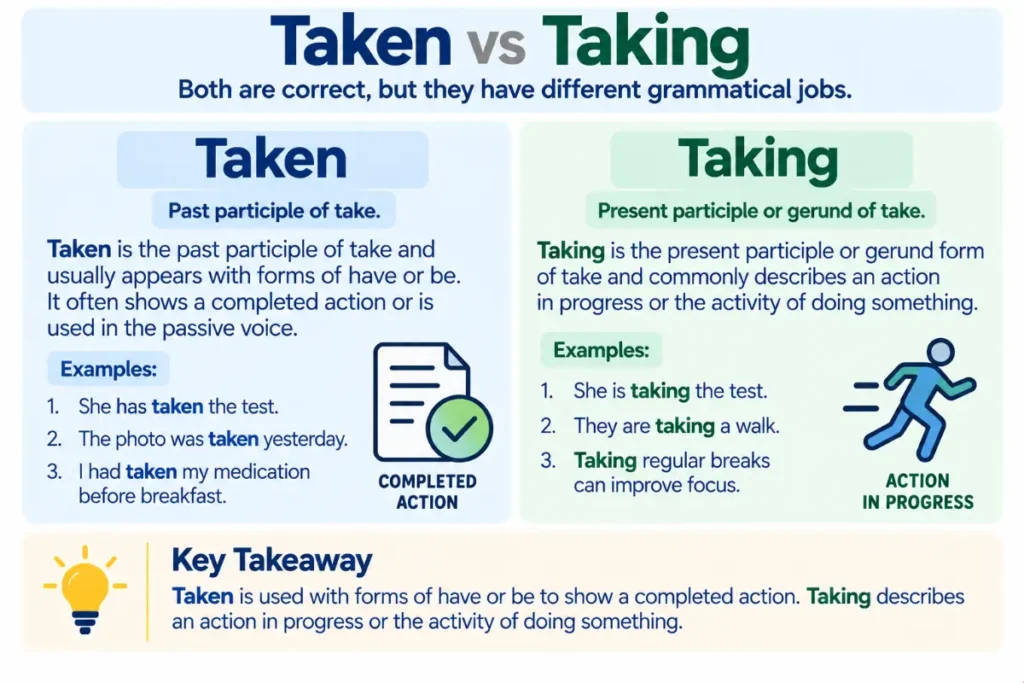
Taken is the past participle of take. It usually appears with have, has, or had, and it also appears in passive constructions with forms of be. Taking is the present participle and gerund form. Use it for ongoing actions with forms of be or as a noun like verb that names an activity.
Comparison Table
| Feature | Taken | Taking |
|---|---|---|
| Base verb | Take | Take |
| Verb form | Past participle | Present participle and gerund |
| Main function | Forms perfect tenses and passive constructions | Forms continuous tenses and acts as a gerund |
| Typical helping verbs | Have, has, had, be | Am, is, are, was, were, be |
| Common meaning | An action completed or something received, carried, or accepted | An action in progress or the activity of taking |
| Grammar pattern | Have taken, was taken, had taken | Is taking, was taking, taking notes |
| Example | She has taken my keys. | She is taking my keys. |
| Common context | Completed actions, experiences, passive voice | Ongoing actions, activities, descriptions |
| Spelling | Standard English | Standard English |
Meaning and Definition
What Does Taken Mean?
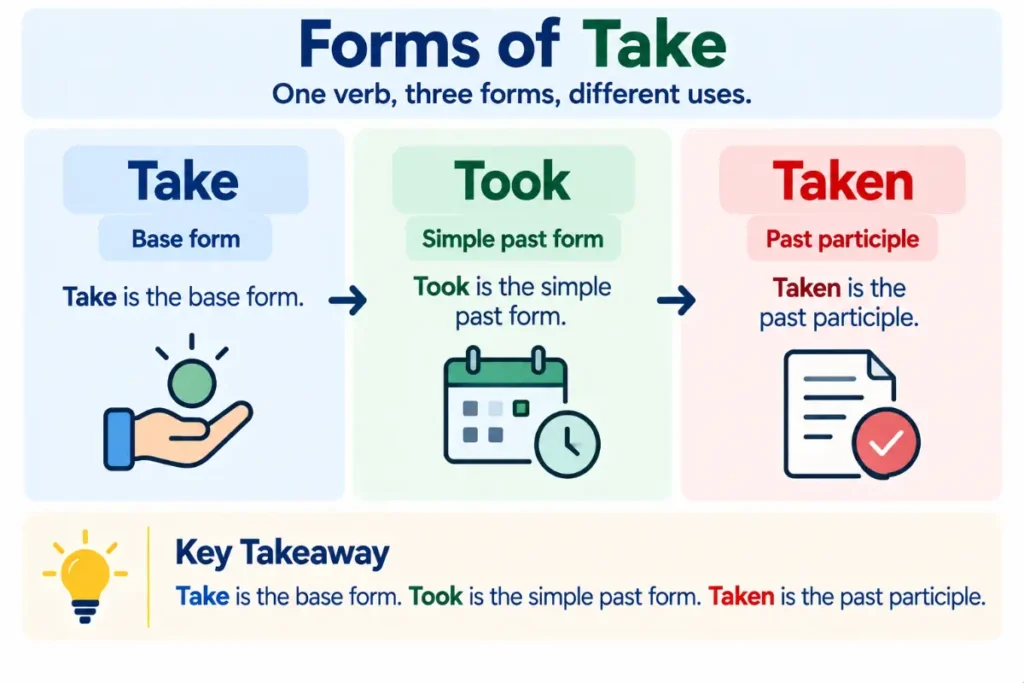
Taken is the past participle of the verb take. It is an irregular verb form, which means you cannot create it by simply adding ed to the base verb. The three main forms are take, took, and taken.
- Base form: take.
- Simple past: took.
- Past participle: taken.
The past participle usually works with a helping verb. It appears in perfect tenses, such as has taken, have taken, and had taken. It also appears in passive constructions, such as was taken, were taken, and is taken.
For example:
- She has taken the last piece of cake.
- They had taken the wrong road before they noticed the mistake.
- The package was taken to the front office.
- I have taken three photographs today.
In these sentences, the form helps show that an action has happened, was completed before another event, or was performed on the subject.
The word can also appear as an adjective in some expressions. For example, a taken seat may mean a seat that is already occupied, although occupied is often the more natural choice in everyday American English.
What Does Taking Mean?
Taking is the present participle and gerund form of take. It is created by adding ing to the base verb. It can describe an action in progress or function as a noun that names an activity.
As a present participle, it commonly appears with forms of be to create continuous tenses.
For example:
- She is taking a photography class.
- They were taking notes during the lecture.
- I am taking the bus to work today.
- He will be taking the final exam next week.
In these sentences, the action is ongoing at the time described or is part of a continuous activity.
The same form can function as a gerund. A gerund acts like a noun even though it comes from a verb.
For example:
- Taking short breaks can improve concentration.
- She enjoys taking photographs.
- Taking responsibility is part of being a good leader.
- He dislikes taking unnecessary risks.
Here, the word names an activity rather than serving as the main action in a continuous verb phrase.
Why Are These Forms Different?
The difference comes from the way English forms irregular verbs and uses participles. The past participle does not always look like the simple past form. With take, the simple past is took, while the past participle is taken.
The ing form follows a different pattern. English adds ing to the base verb, with a spelling change that removes the final silent e. That is why take becomes taking rather than takeing.
These forms have separate grammatical jobs. You cannot switch them freely just because both refer to the same action.
Key Differences Explained
1. Verb Form
The first difference is the form of the verb. Taken is a past participle, while taking is a present participle and gerund.
A past participle usually needs a helping verb to form a perfect tense or passive construction. The ing form can work with a form of be to create a continuous tense or act as a noun.
Compare:
- She has taken the documents.
- She is taking the documents.
The first sentence uses a perfect tense. The second uses a continuous tense. The verb form changes the way the reader understands the action.
2. Time and Completion
Taken often appears in sentences about completed actions or actions connected to a later point in time. For example, I have taken my medicine means the action has already happened and is relevant now.
Taking often describes an action that is happening at a particular time. I am taking my medicine describes an action in progress.
However, the difference is not simply past versus present. A past participle can appear in a present perfect sentence, while an ing form can describe a future activity.
For example:
- I had taken the test before the teacher arrived.
- I will be taking another test tomorrow.
The first describes an earlier completed action. The second describes a future activity in progress at a planned time.
3. Helping Verbs
The helping verb often tells you which form belongs in the sentence.
Use taken with forms of have when creating perfect tenses:
- I have taken the keys.
- She has taken the course.
- They had taken their seats.
Use taking with forms of be when creating continuous tenses:
- I am taking a break.
- She is taking a call.
- They were taking pictures.
These patterns provide a useful editing clue. If you see have, has, or had, the past participle is often needed. If you see am, is, are, was, or were and the sentence describes an ongoing action, the ing form is usually needed.
There are other uses of both forms, so always check the full sentence rather than relying on one word alone.
4. Active and Passive Voice
Taken often appears in passive voice. In a passive sentence, the subject receives the action rather than performing it.
For example:
- Active: Someone took my bag.
- Passive: My bag was taken.
The subject my bag does not perform the action. It receives it.
Taking usually appears in active continuous sentences when the subject performs the action.
For example:
- Active: The employee is taking the boxes upstairs.
- Passive continuous: The boxes are being taken upstairs.
Notice that the passive continuous construction uses both being and the past participle taken. The ing ending belongs to being, not to the main verb take.
This distinction is especially useful when writing reports, instructions, and formal descriptions.
5. Grammar and Sentence Function
Taken usually functions as part of a verb phrase. It can also appear as an adjective in certain contexts.
Taking has two major grammatical uses. It can be a present participle in a continuous verb phrase, or it can be a gerund that acts as a noun.
Compare:
- The teacher has taken attendance.
- The teacher is taking attendance.
- Taking attendance is part of the teacher’s routine.
The first sentence uses a perfect tense. The second describes an ongoing action. The third uses the activity as the subject of the sentence.
6. Pronunciation
The words sound different because they have different endings.
Taken is pronounced /ˈteɪkən/ in common American English. It has two syllables, with stress on the first syllable.
Taking is pronounced /ˈteɪkɪŋ/. It also has two syllables, with stress on the first syllable. The ending sounds like the ing in walking or reading.
The difference is easy to hear when you focus on the final syllable. Taken ends with an unstressed en sound, while taking ends with the ng sound.
7. Formality and Context
Both forms are standard in formal and informal English. Neither is more professional or more correct by itself.
Taken appears in formal writing about completed actions, results, and passive events. For example, The measurements were taken at regular intervals.
Taking appears in descriptions of ongoing work and activities. For example, The team is taking steps to improve safety.
The choice depends on grammar and meaning, not on how formal the sentence sounds.
Which Form Is Correct?
Both forms are correct. Taken and taking are standard forms of the verb take, but they cannot normally replace each other because they perform different grammatical functions.
Use taken when the sentence requires a past participle. This commonly happens after have, has, or had, and in passive constructions with be.
Use taking when the sentence requires a present participle or gerund. This commonly happens in continuous verb phrases and when an activity acts as a noun.
Consider these examples:
- Correct: I have taken the medicine.
- Incorrect: I have taking the medicine.
- Correct: She is taking a cooking class.
- Incorrect: She is taken a cooking class.
- Correct: Taking care of plants is relaxing.
The incorrect examples use the wrong verb form after the helping verb. Have requires a past participle in a perfect tense, while is requires an ing form in a present continuous sentence.
A helpful rule is to identify the helping verb first. Then check the sentence structure and decide which form it needs.
Sentence Examples
Ten Natural Examples Using Taken and Taking
- Everyday conversation: I have taken my wallet out of the car.
- Text message: Have you taken your lunch from the refrigerator?
- Workplace communication: The manager has taken the necessary steps to fix the issue.
- School: The students are taking their science test this morning.
- Academic writing: The researchers have taken several measurements to compare the results.
- Formal writing: The photographs were taken during the official inspection.
- Social situations: We are taking our friends to dinner tonight.
- Online communication: I have taken a screenshot of the error message.
- Travel: She had taken the wrong train before she checked the station sign.
- Daily routine: Taking a short walk after lunch helps me feel refreshed.
These sentences show that the two forms can appear in many settings. The correct choice depends on the tense, sentence structure, and role of the word.
Five Examples Showing Common Errors
1. Incorrect: I have taking the wrong bag.
Correct: I have taken the wrong bag.
2. Incorrect: She is taken a photograph.
Correct: She is taking a photograph.
3. Incorrect: They had taking the wrong road.
Correct: They had taken the wrong road.
4. Incorrect: We are taken notes during the meeting.
Correct: We are taking notes during the meeting.
5. Incorrect: Taking the keys has already taken place yesterday.
Better: Taking the keys happened yesterday.
The first four mistakes involve choosing the wrong form after a helping verb. The last example shows how unnecessary repetition can make a sentence confusing. Good editing involves checking both grammar and meaning.
Common Mistakes and Usage Problems
1. Using Taking After Have
Incorrect: She has taking the new job.
Correct: She has taken the new job.
The helping verb has forms the present perfect tense, which requires a past participle. Since taken is the past participle of take, it is the correct form here.
Remember this pattern:
- I have taken.
- She has taken.
- They have taken.
Do not use the ing form after have when you intend to create the present perfect tense.
2. Using Taken After Is for an Ongoing Action
Incorrect: He is taken the children to school.
Correct: He is taking the children to school.
The present continuous tense uses a form of be followed by an ing form. Since is is the helping verb, taking is needed to show that the action is in progress.
Compare:
- He is taking the children to school.
- The children are being taken to school.
The second sentence is passive. It uses being and taken because the children receive the action.
3. Confusing Took and Taken
Incorrect: I have took the wrong turn.
Correct: I have taken the wrong turn.
Took is the simple past form, while taken is the past participle. Both are correct forms, but they belong in different grammatical patterns.
Use took without a perfect tense helping verb:
– I took the wrong turn.
Use taken after have, has, or had:
– I have taken the wrong turn.
This is a common irregular verb mistake. Learning the three forms together helps prevent it.
4. Adding an Extra E in Taking
Incorrect: She is takeing a course.
Correct: She is taking a course.
The base verb take ends in a silent e. When you add ing, you remove that final e. This is a regular English spelling pattern that also appears in words such as make becoming making and write becoming writing.
The correct spelling is taking, not takeing.
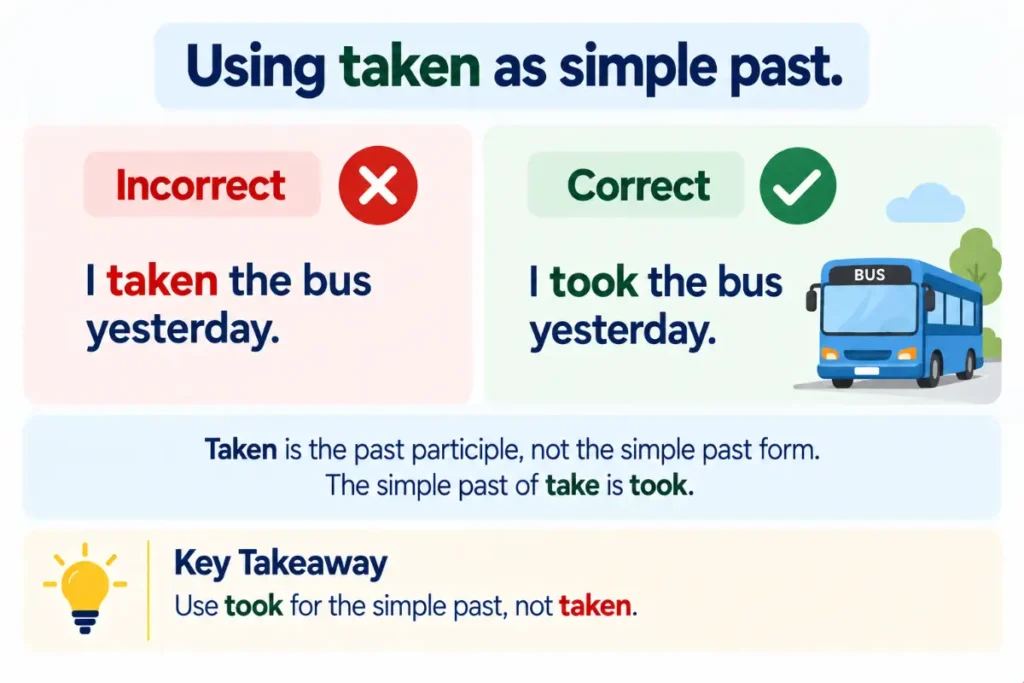
5. Using Taken as the Main Verb Without a Helping Verb
Incorrect: She taken my notebook yesterday.
Correct: She took my notebook yesterday.
In a standard statement about a completed past action, use the simple past form took. Taken usually needs a helping verb, as in She has taken my notebook or My notebook was taken.
There are some informal dialects and speech patterns that use different verb constructions, but standard written English follows the patterns shown above.
A Quick Way to Avoid These Mistakes
Before choosing the form, look at the words around it.
- If the sentence uses have, has, or had to form a perfect tense, use taken.
- If the sentence uses am, is, are, was, or were to describe an ongoing action, use taking.
- If the sentence describes a completed action in the simple past, use took.
- If the word names an activity, taking may function as a gerund.
- If you see the base verb take followed by ing, remove the final e before adding the ending.
These checks cover the most common situations and make proofreading much easier.
Pronunciation Guide
How Do You Pronounce Taken?
Taken is pronounced /ˈteɪkən/ in common American English. It has two syllables: tay and kuhn. The stress falls on the first syllable, so the word sounds like TAY-kuhn.
The first syllable rhymes with day. The second syllable is short and unstressed. Avoid pronouncing every letter as a separate sound. The final en is reduced in natural speech.
How Do You Pronounce Taking?
Taking is pronounced /ˈteɪkɪŋ/. It has two syllables: tay and king. The first syllable carries the stress, while the second contains the ing sound.
The ending is similar to the one in walking, talking, and reading. The final ng is produced at the back of the mouth rather than as a clear separate g sound.
Common Pronunciation Confusion
Both forms begin with the same sound, so the ending is the easiest way to distinguish them. Taken ends with an unstressed en sound, while taking ends with the ing sound.
Some speakers may reduce the final syllable in fast conversation. That is normal in connected speech, but clear pronunciation helps listeners understand the intended verb form.
A related grammar guide is Moral vs Morale Meaning and Usage Explained.
Etymology and Word Origin
The History of Take
The verb take has a long history in English. It entered English from Old Norse, related to the Old Norse verb taka, which meant to take or grasp. It became part of Middle English and developed into the modern verb used today.
Over time, take gained many meanings. It can describe picking something up, accepting an offer, carrying someone somewhere, choosing a route, or receiving medicine. These meanings explain why the verb appears in so many common expressions.
The Development of Taken
Taken developed as the past participle form of take. English has several irregular verbs whose past participles do not follow the usual ed pattern. For example, write becomes written, break becomes broken, and take becomes taken.
The ending in taken is part of the verb’s established form. It is not created by adding a regular past tense ending to take.
The Development of Taking
Taking follows the regular ing pattern used to form present participles and gerunds. Because take ends in a silent e, that letter is removed before ing is added.
The spelling process is:
- Start with take.
- Remove the final e.
- Add ing.
- The result is taking.
The same spelling pattern appears in make becoming making and drive becoming driving.
Regional Usage
American English
In American English, both forms are standard. Speakers use taken in perfect tenses and passive constructions, while taking appears in continuous tenses and as a gerund.
Examples include:
- I have taken the wrong exit.
- She is taking a break.
- The photos were taken last weekend.
- Taking notes helps me remember information.
There is no special American spelling rule that changes either form.
British English
British English follows the same basic grammar. The past participle of take is taken, and the ing form is taking. Both appear in everyday conversation, academic writing, and professional documents.
There is no meaningful spelling difference between the two forms in British and American English.
Australian English
Australian English also uses taken and taking according to the same standard verb patterns. The forms appear in the same types of perfect, continuous, passive, and gerund constructions.
Regional accent differences may affect pronunciation, but the spelling and basic grammar remain the same.
Canadian English
Canadian English follows the same standard patterns. Writers use taken after have, has, and had in perfect constructions, and taking in continuous verb phrases or as a gerund.
The distinction is grammatical rather than regional. You can apply the same rule across these major varieties of English.
Grammar Rules and Part of Speech
Both forms come from the verb take, but their grammatical roles are different. Understanding those roles helps you build correct sentences and avoid mixing the forms.
Taken as a Past Participle
Taken is the past participle form. It commonly appears in perfect tenses and passive constructions.
The perfect tense patterns include:
- Present perfect: I have taken the test.
- Present perfect: She has taken the medicine.
- Past perfect: They had taken their seats before the show began.
- Future perfect: By Friday, we will have taken the final measurements.
The helping verb changes according to the tense and subject, but taken stays the same.
Taken in Passive Voice
The past participle also appears in passive constructions. The subject receives the action instead of performing it.
Examples:
- The package was taken to the office.
- The photographs were taken at the event.
- The documents have been taken for review.
- The medicine should be taken with food.
In these sentences, the subject does not perform the action. The package, photographs, documents, and medicine receive the action.
Taking as a Present Participle
Taking is a present participle when it forms part of a continuous verb phrase. It usually follows a form of be.
Examples:
- I am taking a language class.
- She is taking the train home.
- They are taking photographs.
- We were taking a break when the phone rang.
The continuous form emphasizes an action in progress during a particular time.
Taking as a Gerund
A gerund is an ing form that functions like a noun. It can act as the subject or object of a sentence.
Examples:
- Taking care of a pet requires time.
- He enjoys taking long walks.
- She is interested in taking a cooking class.
- Taking responsibility can help build trust.
In the first example, the activity is the subject. In the second, it is the object of enjoys. This is different from a continuous verb phrase, even though the spelling is the same.
Adjectival and Other Uses
Taken can sometimes describe a state or condition. For example, the phrase taken aback means surprised or shocked. In this expression, taken is part of a fixed phrase rather than a simple description of an action.
Taking can also appear before a noun in certain expressions, such as a taking point in a discussion, but such uses are less common. Most readers will encounter it as a continuous verb form or gerund.
Sentence Position
Taken usually follows a helping verb in a verb phrase. It may also appear after a noun or pronoun in a passive construction.
Taking can appear after a helping verb, at the start of a sentence as a gerund, or after another verb that takes a gerund as its object.
Compare:
- She has taken the course.
- She is taking the course.
- Taking the course improved her skills.
The same base verb appears in all three sentences, but the grammatical structure changes.
Common Grammar Errors
Avoid these patterns:
- Incorrect: I have took the bus. Correct: I have taken the bus.
- Incorrect: He is taken notes. Correct: He is taking notes.
- Incorrect: They had taking the test. Correct: They had taken the test.
- Incorrect: Taking the keys was happened yesterday. Correct: Taking the keys happened yesterday.
The best way to avoid these errors is to identify the tense and the role of the verb before writing the sentence.
Real Life Usage Examples
Daily Conversation
In everyday conversation, these forms help people talk about completed actions and activities in progress.
- I have taken the dog outside, so you can close the door.
- I am taking my younger brother to practice after school.
The first sentence reports a completed action. The second describes an activity happening now or around the present time.
Email and Workplace Communication
Professional writing often uses the past participle to report completed tasks and the ing form to describe ongoing work.
- I have taken the requested steps to update the account.
- Our team is taking additional measures to improve the process.
The first sentence reports work already completed. The second describes action currently underway.
Academic Writing
In academic work, the past participle often appears when researchers describe methods and completed procedures. The ing form can describe an activity or process.
- Measurements were taken at the beginning and end of the study.
- Taking detailed notes helped the students compare their results.
The first example uses passive voice. The second uses a gerund as the subject of the sentence.
News and Journalism
News reports often use the past participle to describe completed events or actions performed on someone or something. The ing form can describe ongoing activity.
- The photographs were taken shortly after the storm.
- Officials are taking steps to improve road safety.
The first sentence reports a completed event. The second describes an action in progress.
Literature and Storytelling
In storytelling, the two forms help writers control the timing and flow of events.
- By the time Emma reached the station, the passengers had taken their seats.
- He watched the children taking turns on the old wooden swing.
The first sentence uses the past perfect to show that one action happened before another. The second uses the ing form to describe an ongoing activity.
Related and Confused Terms
These eight related words and forms can help you understand the verb take and avoid common grammar mistakes.
1. Take
Take is the base form of the verb. Use it after modal verbs such as can, should, and must, and in the simple present with subjects that require the base form.
Example: You should take your umbrella.
Do not use taken or taking after a modal verb in a basic sentence. The modal is followed by the base verb.
2. Took
Took is the simple past form of take. Use it for a completed action in the past without a perfect tense helping verb.
Example: She took the bus to work yesterday.
Do not confuse took with taken. Write I took the bus, but I have taken the bus.
3. Taking
Taking is the present participle and gerund form. It describes an ongoing action or names an activity.
Example: He is taking a shower.
It can also function as a noun: Taking regular breaks is helpful.
4. Taken
Taken is the past participle. It appears in perfect tenses and passive constructions.
Example: They have taken the necessary precautions.
It can also appear in expressions such as taken aback, meaning surprised.
5. Take Up
Take up is a phrasal verb with several meanings. It can mean to begin a hobby, occupy space, or accept an offer or challenge.
Example: She decided to take up painting.
The past participle is taken up, as in She has taken up painting.
6. Take Over
Take over means to gain control or responsibility for something.
Example: The new manager will take over the department next month.
Its past participle form is taken over, as in The company has been taken over by a larger business.
7. Taking Part
Taking part means participating in an activity or event.
Example: Taking part in the school play helped him build confidence.
Here, taking is part of a gerund phrase that describes participation.
8. Taken Away
Taken away means removed or carried from a place. It often appears in passive constructions.
Example: The broken furniture was taken away yesterday.
This phrase uses the past participle to describe something that received the action.
Expert Editor Insight
A careful editor checks the helping verb and sentence structure before choosing between these forms. Native speakers use taken in phrases such as have taken and was taken, while taking appears in expressions such as is taking and taking notes. The confusion often comes from the irregular past forms take, took, and taken. Grammar tools may flag an incorrect combination, but they may not explain why it is wrong. A useful editing habit is to read the entire verb phrase aloud and check that the helping verb matches the form that follows it.
Key Takeaways
- Take is the base form.
- Took is the simple past form.
- Taken is the past participle.
- Taking is the present participle and gerund form.
- Have, has, and had commonly appear with taken in perfect constructions.
- Am, is, are, was, and were commonly appear with taking in progressive constructions.
- Taken can also appear in passive sentences.
- Taking can function as a noun when it acts as a gerund.
- Neither form is more formal or informal by itself.
- The surrounding grammar should guide your choice.
For another common grammar confusion, see Impatient or Inpatient Which Word Do You Need.
Conclusion
The difference between taken vs taking is based on grammar, not spelling preference. Taken is the past participle of take, while taking is the present participle and gerund form. Use taken after have, has, or had and in passive constructions. Use taking for ongoing actions or when naming an activity.
Remember the three main verb forms: take, took, and taken. Then check the helping verb before choosing the form. If the sentence uses a continuous tense, taking is usually the right choice. This simple habit will help you write more accurate and natural English.
FAQs
Is Taken or Taking Correct?
Both forms are correct, but they have different grammatical functions. Taken is the past participle of take and appears in perfect tenses and passive constructions. Taking is the present participle and gerund form. Use taken in She has taken the keys and taking in She is taking the keys. The sentence structure determines the correct choice.
What Is the Difference Between Took and Taken?
Took is the simple past form of take, while taken is its past participle. Use took for a completed past action, as in I took the train yesterday. Use taken after have, has, or had, as in I have taken the train many times. They both describe the same base action but follow different grammar patterns.
Can I Say I Have Taking?
No. In standard English, I have taking is incorrect when you intend to use the present perfect tense. The correct sentence is I have taken. The present perfect uses have or has followed by a past participle. Since taken is the past participle of take, it belongs after the helping verb in this construction.
Can I Say I Am Taken?
Yes, but the meaning depends on the context. I am taken can mean that someone has already taken or chosen you, or it can describe a person who is in a relationship in informal speech. For an action happening now, use I am taking. For example, I am taking the bus to work.
What Is the Past Participle of Take?
The past participle of take is taken. The three main forms are take, took, and taken. Use take as the base form, took for the simple past, and taken in perfect tenses and passive constructions. For example, I take the bus, I took the bus yesterday, and I have taken the bus many times.
Is Taking a Gerund or a Verb?
Taking can be both a present participle and a gerund. It is a present participle in a continuous phrase such as She is taking a class. It is a gerund when it functions like a noun, as in Taking classes can improve your skills. Its role depends on the sentence structure.
Why Is Take Changed to Taking Instead of Takeing?
The final e in take is dropped before adding ing. This is a common English spelling pattern for verbs that end in a silent e. For example, make becomes making and write becomes writing. The correct spelling is taking, not takeing. The change affects spelling but does not change the basic meaning of the verb.
How Do You Use Taken in a Sentence?
Use taken after have, has, or had in perfect tenses, or after a form of be in passive constructions. Examples include She has taken the exam, They had taken their seats, and The package was taken to the office. In each sentence, taken works as the past participle rather than the simple past form.