
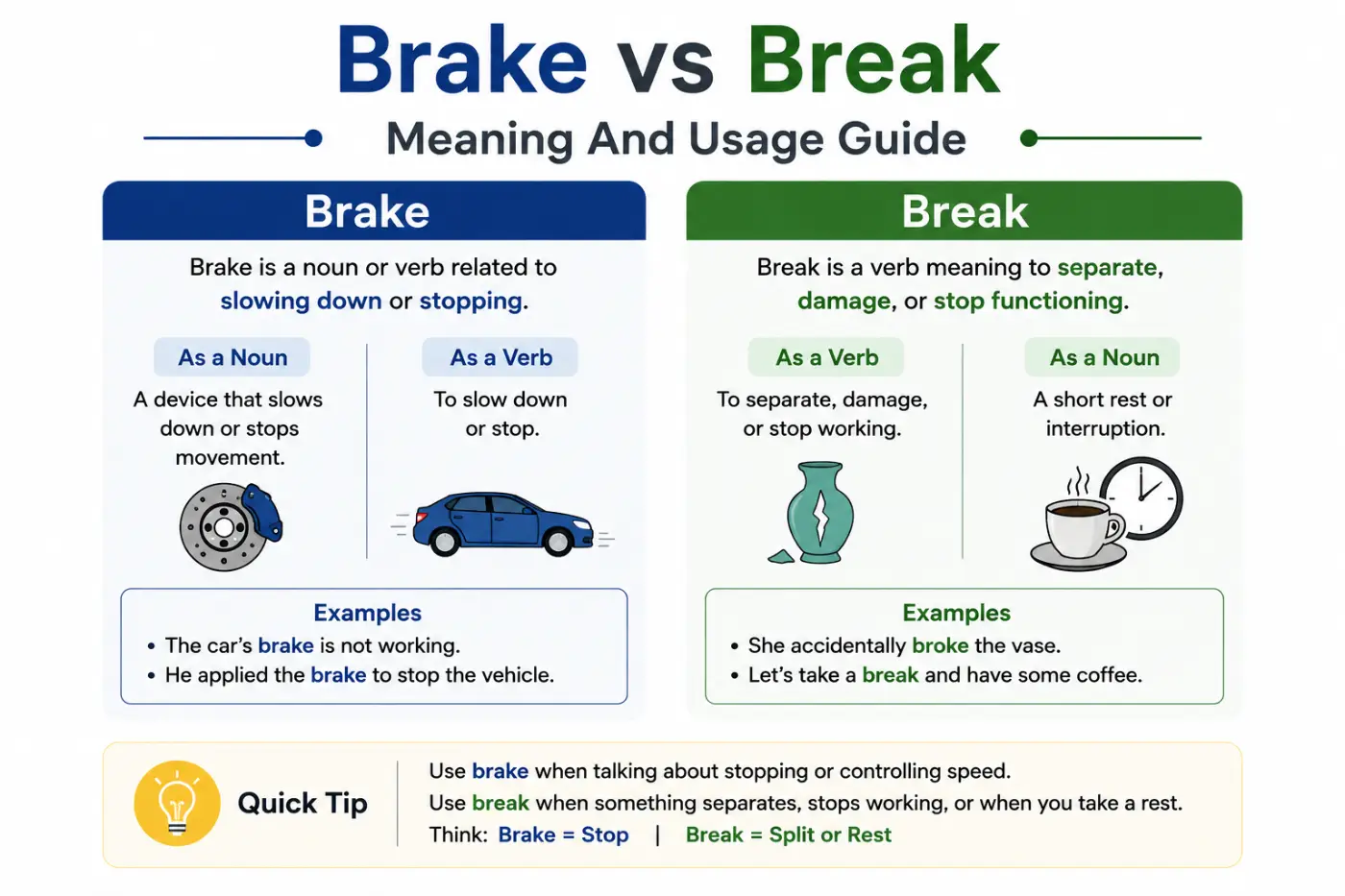
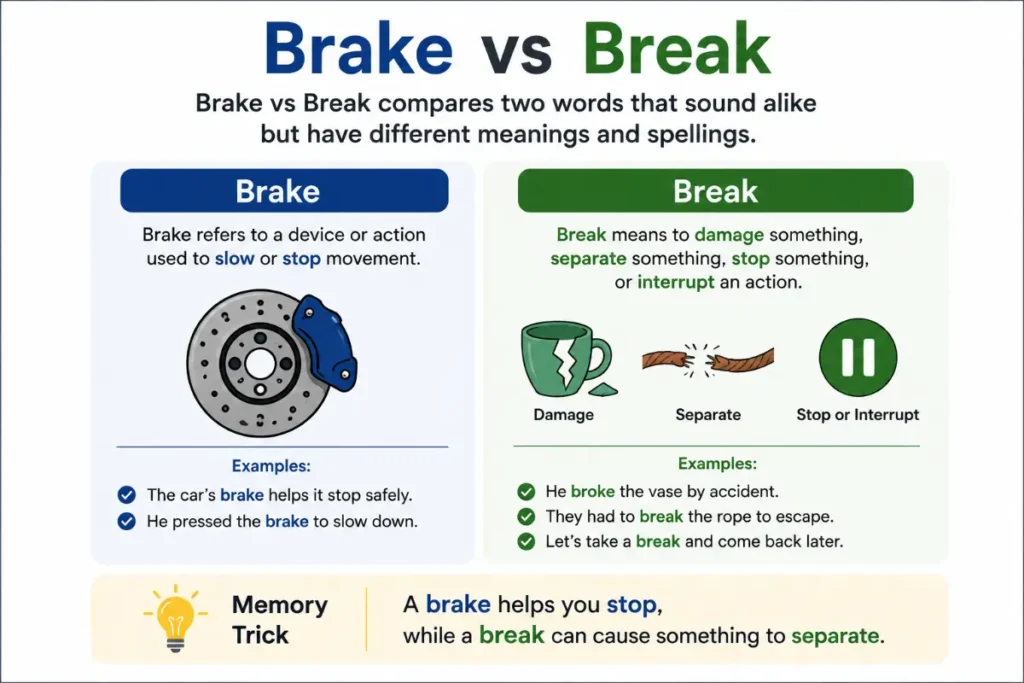
Choosing between brake vs break can be confusing because the two words sound exactly alike in standard English. However, they have different meanings and cannot usually replace each other. Brake refers to a device or action used to slow down or stop a vehicle, while break can mean to damage something, separate it into pieces, take a rest, or interrupt an activity.
This spelling confusion often happens because both words are pronounced the same way. You might write about pressing the brake in your car, taking a short break at work, or trying not to break a glass. The sound alone cannot tell you which spelling belongs in your sentence. You need to understand the meaning and grammar.
Learning the difference will help you avoid mistakes in emails, school assignments, workplace documents, text messages, and everyday writing. This guide explains both words with simple definitions, practical examples, pronunciation details, common expressions, and easy memory tips. You will also learn how to recognize the correct spelling quickly when editing your work.
For another common grammar confusion, see Flew or Flown Which One Is Correct?.
Quick Answer
Brake refers to a device that slows or stops a vehicle, or the action of using that device. Break means to damage, separate, interrupt, or take a rest. Both words are correct, but they have different meanings. Use brake for stopping and break for damage, pauses, or interruptions.
Comparison Table
| Feature | Brake | Break |
|---|---|---|
| Main meaning | A device or action used to slow or stop movement | To damage, separate, interrupt, or rest |
| Part of speech | Noun and verb | Noun and verb |
| Pronunciation | /breɪk/ | /breɪk/ |
| Sound | Same as break | Same as brake |
| Common noun phrases | Car brake, hand brake, brake pedal | Lunch break, short break, broken glass |
| Common verb phrases | Apply the brake, brake suddenly | Break a window, break a promise, break a rule |
| Formality | Standard in all types of writing | Standard in all types of writing |
| Main context | Vehicles, machinery, stopping movement | Damage, rest, interruption, separation |
| Example | Press the brake before the turn. | Be careful not to break the glass. |
Meaning and Definition
What Does Brake Mean?
Brake is a noun and a verb connected with slowing down or stopping movement. As a noun, it refers to a device that reduces the speed of a moving vehicle or machine. As a verb, it means to use that device or reduce speed.
The word is most familiar in the context of cars, trucks, motorcycles, bicycles, and other vehicles. For example, when you press the brake pedal in a car, the braking system helps slow the vehicle or bring it to a stop.
You can also use the word in a wider sense when talking about machinery or movement. A bicycle has brakes, a train uses a braking system, and a driver may brake suddenly to avoid an accident.
Common expressions include:
- Apply the brakes.
- Press the brake pedal.
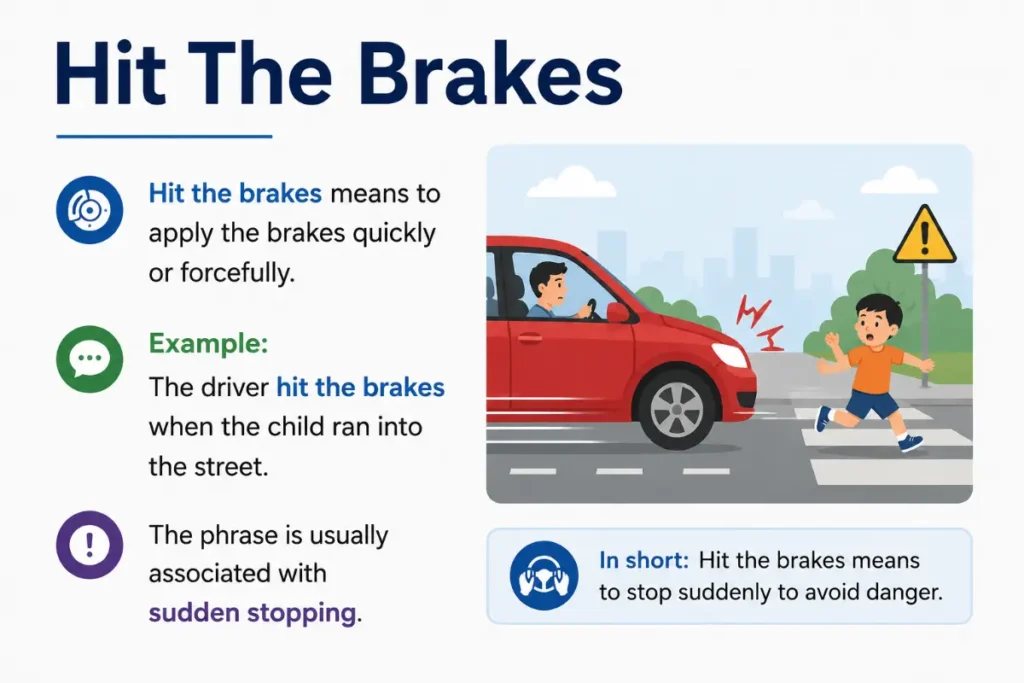
- Hit the brakes.
- Pump the brakes.
- Brake suddenly.
- Brake safely.
- Emergency brake.
- Parking brake.
The word can also appear in figurative expressions. For example, a company might put the brakes on a costly project. This means the company slows down or stops the plan. The expression uses the idea of a vehicle stopping to describe a delay or reduction in activity.
Brake as a Noun
As a noun, brake names the equipment used to slow or stop a moving object. Most people know the term through car brakes, but braking systems are also used in bicycles, motorcycles, trains, and industrial machines.
Examples:
- The mechanic checked the front brake.
- My car needs new brake pads.
- The bicycle brake stopped working.
- The driver tested the emergency brake before leaving.
The noun can be singular or plural. A vehicle may have a brake system with several components, and people often use the plural word brakes when referring to the system as a whole.
For example, you might say, The brakes on my car need attention. You could also say, The rear brake needs repair, when referring to one specific part.
Brake as a Verb
As a verb, brake describes the action of slowing down or stopping by using a braking device. It is commonly used when talking about driving, cycling, or operating machinery.
Examples:
- Brake gently on wet roads.
- The driver braked when a dog crossed the street.
- She had to brake suddenly to avoid hitting the car ahead.
- The cyclist braked before entering the sharp turn.
The verb has regular forms:
| Verb Form | Example |
|---|---|
| Base form | Brake |
| Third person singular | Brakes |
| Past tense | Braked |
| Present participle | Braking |
| Past participle | Braked |
Notice the spelling of the past tense. Braked ends with the letter d, not the letter t. This is a common point of confusion because the final sound can be less obvious in fast speech.
What Does Break Mean?
Break is a much broader word with several meanings. As a verb, it can mean to damage something, separate it into pieces, interrupt an activity, stop following a rule, or cause something to stop working.
As a noun, it can refer to a short rest, an interruption, a gap, or an opportunity. You might break a glass, take a lunch break, break a promise, or enjoy a break from work.
Common expressions include:
- Break a glass.
- Break a promise.
- Break a rule.
- Take a break.
- Break the news.
- Break a record.
- Break the silence.
- Break down.
- Break up.
- Break away.
The meaning depends on the words around it. In one sentence, it can describe physical damage. In another, it can describe a pause or a change in a situation.
Break as a Verb
As a verb, break often means to damage something so that it becomes separated, cracked, or unusable. It can also describe ending an activity, interrupting a process, or failing to follow a rule.
Examples:
- Be careful not to break the plate.
- The storm broke several tree branches.
- He broke his phone screen.
- The teacher asked the students not to break the classroom rules.
- We need to break the news gently.
The word has several forms:
| Verb Form | Example |
|---|---|
| Base form | Break |
| Third person singular | Breaks |
| Past tense | Broke |
| Present participle | Breaking |
| Past participle | Broken |
These forms are irregular. You say broke for the simple past and broken for the past participle. For example, She broke the cup yesterday, but The cup has broken into pieces.
Break as a Noun
As a noun, break often refers to a short period of rest or a pause in an activity. Students take breaks between classes, workers take lunch breaks, and drivers may stop for a rest during a long journey.
The noun also has other meanings. A break in a wall can be an opening, a break in a conversation can be a pause, and a lucky break can mean an unexpected opportunity.
Examples:
- I need a short break after this meeting.
- The students went outside during their lunch break.
- There was a brief break in the rain.
- Getting that job was a lucky break for him.
Because the noun has several meanings, context is especially important. The surrounding words usually make the intended meaning clear.
Key Differences Explained
1. Meaning
The most important difference is what each word describes. Brake is connected with slowing or stopping movement. Break is connected with damage, separation, rest, interruption, or change.
Compare these sentences:
- The driver pressed the brake to stop the car.
- The driver had to take a break after a long journey.
The first sentence refers to a vehicle control. The second refers to a period of rest. The words sound alike, but their meanings are unrelated in these examples.
2. Spelling
The two words differ by one letter.
- Brake has the letters b, r, a, k, and e.
- Break has the letters b, r, e, a, and k.
The difference is in the order of the middle vowels. Brake contains a before k, while break contains ea before k.
This small spelling difference can be easy to miss when typing quickly. It is especially common in sentences where both choices seem possible until you check the meaning.
3. Pronunciation
Both words are homophones. This means they have the same pronunciation but different spellings and meanings.
In standard American English, both are pronounced /breɪk/. They rhyme with words such as cake, lake, and make.
Because they sound the same, pronunciation alone cannot help you choose the correct spelling. You must look at the meaning of the sentence.
4. Grammar
Both words can function as nouns and verbs, but they do not share the same grammatical meaning.
As a noun, brake names a stopping device. As a verb, it describes slowing down or stopping. Break can be a noun meaning a rest or interruption, or a verb meaning to damage, separate, or interrupt something.
For example:
- The mechanic repaired the brake. Here, brake is a noun.
- The driver braked before the crossing. Here, brake is a verb.
- We took a break after lunch. Here, break is a noun.
- Do not break the handle. Here, break is a verb.
5. Formality
Both words are standard English and are suitable for formal and informal writing. Neither is more professional simply because of its spelling.
You can use brake in a technical report about vehicle safety or in a casual conversation about driving. You can use break in an academic paper about interruptions, a business email about a lunch break, or a text message about a broken phone.
The key is accuracy. Choosing the wrong word can change the meaning of your sentence, even when the grammar looks correct.
6. Context
The context usually makes the intended word clear.
If the sentence talks about a car, bicycle, train, stopping, or slowing down, brake is probably the right choice. If it talks about damage, rest, a pause, a broken object, or an interruption, break is usually correct.
Consider the sentence, I need to ___ before the meeting. The correct choice is break because the speaker wants a short rest. In the sentence, I need to ___ before the red light, the correct word is brake because the driver must slow down or stop.
7. Regional Usage
There is no major spelling difference between American and British English for these two words. The spellings brake and break are standard in the United States, United Kingdom, Canada, and Australia.
Some driving terms may differ by region. For example, people may use different names for certain vehicle controls, but the word brake itself keeps the same spelling and meaning.
8. Standard Versus Incorrect Usage
Both spellings are legitimate words. The mistake happens when a writer uses one in place of the other.
Incorrect: Please take a brake before continuing.
Correct: Please take a break before continuing.
Incorrect: Press the break when approaching the stop sign.
Correct: Press the brake when approaching the stop sign.
These are not spelling errors caused by an invalid word. They are word choice errors caused by selecting the wrong homophone.
Which Spelling Is Correct?
Both spellings are correct, but they are correct in different situations. Use brake when you mean a device or action that slows or stops a vehicle. Use break when you mean damage, separation, interruption, rest, or a pause.
English dictionaries recognize both words as separate entries because they have distinct meanings and histories. Their shared pronunciation does not make them interchangeable.
Use these examples as a guide:
| Sentence | Correct Word | Reason |
|---|---|---|
| Press the ___ before the turn. | Brake | Refers to stopping a vehicle |
| I need a short ___ from work. | Break | Refers to rest |
| The mechanic repaired the front ___. | Brake | Names a vehicle part |
| Do not ___ the glass. | Break | Means damage or shatter |
| We took a lunch ___. | Break | Names a rest period |
| The driver had to ___ quickly. | Brake | Means slow down or stop |
| She did not want to ___ her promise. | Break | Means fail to keep a promise |
| The train’s emergency ___ failed. | Brake | Refers to stopping equipment |
A useful rule is to connect brake with a vehicle stopping and break with something being damaged or interrupted. This simple distinction covers most everyday uses.
Sentence Examples
Here are ten natural examples showing how each word works in common situations.
Examples Using Brake
- Everyday conversation: My car makes a strange noise when I press the brake.
- Text message: I may be late because my brakes need to be checked.
- Workplace communication: The delivery driver had to brake suddenly to avoid a collision.
- School: The science teacher explained how a bicycle brake works.
- Academic writing: The report examined how braking distance changes with road conditions.
Examples Using Break
- Everyday conversation: I need a short break before we start cooking.
- Text message: Let’s take a break and talk again in ten minutes.
- Workplace communication: Employees can take a lunch break during the scheduled shift.
- School: Be careful not to break the glass equipment in the laboratory.
- Social situation: I promised not to break my friend’s trust.
These examples show why context matters. The vehicle related examples use brake, while the sentences about rest, damage, and trust use break.
Common Mistakes and Misspellings
Because these words sound the same, people often select the wrong spelling while writing. The following mistakes are common in everyday communication.
1. Writing Brake Instead of Break for Rest
Incorrect: I need a coffee brake.
Correct: I need a coffee break.
A coffee break is a short period of rest during work or another activity. The word refers to a pause, not a vehicle part. Remember that you take a break when you want to rest.
2. Writing Break Instead of Brake for a Vehicle
Incorrect: The mechanic replaced my car breaks.
Correct: The mechanic replaced my car brakes.
A car uses brakes to slow down or stop. The word break does not name a vehicle’s stopping system. If the sentence refers to brake pads, brake fluid, or a brake pedal, use the spelling with a.
3. Confusing Brake and Break in Driving Instructions
Incorrect: Break slowly before reaching the corner.
Correct: Brake slowly before reaching the corner.
The sentence gives a driving instruction. The intended action is to slow the vehicle, so brake is correct. Break would suggest damaging or separating something, which does not fit the meaning.
4. Using Brake in Common Expressions
Incorrect: Do not brake the rules.
Correct: Do not break the rules.
The phrase break the rules means to fail to follow them. The word brake does not express that idea. Similar expressions include break a promise, break the law, and break a habit.
5. Misspelling the Past Tense
Incorrect: He breaked suddenly when the light turned red.
Correct: He braked suddenly when the light turned red.
The verb brake is regular, so its past tense is braked. By contrast, break is irregular: its past tense is broke. For example, He broke the handle yesterday.
Other Commonly Confused Expressions
Some phrases are especially easy to mix up. Learning them as complete expressions can help you avoid mistakes.
| Incorrect Expression | Correct Expression |
|---|---|
| Take a brake | Take a break |
| Coffee brake | Coffee break |
| Lunch brake | Lunch break |
| Car breaks | Car brakes |
| Emergency break | Emergency brake |
| Break pedal | Brake pedal |
| Brake a promise | Break a promise |
| Break suddenly to stop the car | Brake suddenly to stop the car |
The best way to avoid these mistakes is to read the sentence for meaning before checking the spelling. A spellchecker may accept both words because both are real English words, even when one does not fit the sentence.
You may also want to read Coachs or Coaches Which Spelling Is Correct.
Pronunciation Guide
How Do You Pronounce Brake?
Brake is pronounced /breɪk/ in standard American English. It has one syllable and rhymes with cake, make, and lake. The sound begins with the consonant blend /br/, followed by the long a sound and a final /k/.
You can break the sound into three parts:
- /b/ as in book.
- /r/ as in road.
- /eɪk/ as in cake.
Blend the sounds together smoothly to say brake. The word has one syllable, so it does not need a separate stress pattern.
How Do You Pronounce Break?
Break is also pronounced /breɪk/. It has the same consonant sounds, vowel sound, and final /k/ sound as brake.
The spelling is different, but the pronunciation is identical in standard American English. Both words rhyme with steak, take, and wake.
Why Are They Pronounced the Same?
English contains many words with different spellings but identical pronunciation. These words are called homophones. Brake and break are a common example because they share the same spoken form while keeping separate meanings.
The vowel combination ea in break represents the same long a sound heard in brake. This is why you cannot rely on pronunciation to identify the correct spelling.
Common Pronunciation Mistakes
Most speakers pronounce both words correctly without thinking about the spelling. However, learners may try to give break a short e sound because of the letters ea. That pronunciation is incorrect in this word.
Remember that break rhymes with cake, not with deck. Brake and break sound alike, so the distinction belongs in spelling and meaning rather than speech.
Etymology and Word Origin
The Origin of Brake
The word brake has historical roots in older Germanic languages and earlier forms connected with breaking, crushing, or restraining movement. Its modern use for a device that slows or stops a vehicle developed over time as braking mechanisms became part of machinery and transportation.
The exact development of the mechanical sense belongs to the history of tools and vehicle technology. Today, the word is firmly established in everyday language, especially in phrases related to cars, bicycles, trains, and other moving equipment.
The Origin of Break
Break also has Germanic roots and can be traced through Old English forms related to breaking, dividing, or damaging something. Its history connects with the idea of causing something to separate or lose its original condition.
Over time, the word developed a wide range of meanings. It can describe physical damage, an interruption, a pause, a change in routine, or a failure to follow an agreement. Expressions such as break a promise and take a break show how far its uses extend beyond physical objects.
Why Their Histories Are Useful
The two words have related historical backgrounds, but their modern meanings are different. Brake developed a specialized meaning connected with controlling movement, while break retained a broad range of meanings involving separation, damage, and interruption.
You do not need to memorize their origins to spell them correctly. Their modern uses provide the most practical guide.
Regional Usage
American English
In American English, both spellings are standard. Drivers use brake when talking about vehicle controls, slowing down, and stopping. People use break when referring to rest periods, damaged objects, interruptions, and changes in routine.
Common American expressions include:
- Hit the brakes.
- Take a lunch break.
- Break the news.
- Brake suddenly.
- Break a record.
There is no special American spelling rule that changes either word.
British English
British English uses the same spellings and basic meanings. A British driver applies the brakes, while a worker may take a tea break. The words sound the same and follow the same general grammar rules as in American English.
Some vehicle terms differ between British and American English, but brake and break do not have a major regional spelling difference.
Australian English
Australian English also uses both words in the same standard forms. People use brake for vehicle stopping systems and break for rest periods, damage, and interruptions.
Expressions such as school break, lunch break, and brake pedal are understood in the same way as they are in the United States.
Canadian English
Canadian English follows the same spelling distinction. A Canadian driver checks the brakes on a car, while a student may take a break between classes. The meanings remain the same, and neither spelling is considered a regional variation of the other.
Across these English varieties, the main challenge is choosing the correct meaning, not following a regional spelling rule.
Grammar Rules and Part of Speech
Both words can be used as nouns and verbs. The grammar depends on the role the word plays in the sentence.
Using Brake as a Noun
When used as a noun, brake names a stopping device or part of a braking system.
Examples:
- The brake needs repair.
- The car has new brakes.
- The driver checked the parking brake.
- The bicycle’s front brake was loose.
A noun can appear as the subject or object of a sentence. In The brake failed, it is the subject. In The mechanic repaired the brake, it is the object.
Using Brake as a Verb
When used as a verb, brake describes slowing or stopping a moving vehicle or machine.
Examples:
- Always brake before the sharp turn.
- She braked when the traffic light changed.
- The driver is braking carefully.
- You should have braked sooner.
The verb is regular, so its past tense and past participle use the ending ed. The correct forms are braked and braked.
Using Break as a Noun
As a noun, break can mean a rest, pause, interruption, opening, or opportunity.
Examples:
- We took a break after lunch.
- There was a break in the conversation.
- The team enjoyed a short break.
- Winning the contract was a lucky break.
It can be used with different modifiers, such as short break, lunch break, winter break, and coffee break. The meaning usually becomes clear from the surrounding words.
Using Break as a Verb
As a verb, break can describe damage, separation, interruption, or failure to follow a rule.
Examples:
- Do not break the glass.
- He broke the window by accident.
- The machine has broken again.
- She is breaking an old habit.
Unlike brake, break is irregular. Its simple past is broke, and its past participle is broken. You should write He broke the plate, not He breaked the plate.
Sentence Position and Agreement
Both words follow normal English sentence patterns. A singular subject takes the correct singular verb form, while a plural subject takes the base form in the present tense.
Examples:
- The brake works well.
- The brakes work well.
- She takes a break at noon.
- They take breaks after long shifts.
The verb form must agree with the subject. Do not confuse the spelling difference with subject agreement.
Common Expressions and Punctuation
Neither word needs special punctuation. Use ordinary sentence punctuation based on the sentence type.
For example, Press the brake before the crossing is an instruction and ends with a period. Did you take a break? is a direct question and ends with a question mark.
Some expressions use one spelling as a fixed combination. Examples include brake pedal, emergency brake, lunch break, break time, and break a promise. Learning these phrases as complete units can prevent word choice mistakes.
Real Life Usage Examples
Daily Conversation
People use both words in everyday speech, but the situation tells you which spelling to choose.
- I need a break before we go shopping.
- My car makes a noise when I press the brake.
The first sentence describes rest. The second refers to a vehicle part.
Email and Workplace Communication
Workplace writing often includes both meanings. Employees may discuss rest periods, equipment safety, or vehicle use.
- Please take your scheduled lunch break before the afternoon shift.
- The delivery team reported a problem with the truck’s rear brakes.
The first sentence concerns a rest period. The second describes equipment that needs attention.
Academic Writing
Students may encounter these words in science, engineering, and ordinary school assignments.
- The experiment measured how quickly the bicycle could brake on different surfaces.
- The researchers examined how short breaks affected attention during study sessions.
The first example concerns slowing movement. The second concerns rest periods.
News and Journalism
News reports use both words in different contexts. One may appear in a report about traffic safety, while the other may appear in stories about work, education, or social events.
- Police said the driver failed to brake before reaching the intersection.
- The school announced a longer winter break for students.
The words help describe two different situations, even though their pronunciation is the same.
Literature and Storytelling
Writers use these words to describe action, emotion, and changes in a scene.
- He slammed on the brake as the deer ran across the road.
- She needed a break from the noise and pressure of the city.
In storytelling, the right word helps readers picture the action or understand the character’s situation. A wrong spelling can distract readers or change the intended meaning.
Related and Confused Terms
These eight words and expressions are useful to understand alongside the two main terms.
1. Brake Pedal
A brake pedal is the foot control used by a driver to activate a vehicle’s braking system. It is part of the system that slows or stops the vehicle. The spelling always uses brake because it refers to stopping movement.
2. Brake Pad
A brake pad is a component used in many vehicle braking systems. It presses against another surface to create friction and help slow the vehicle. Brake pad is a common technical term in vehicle maintenance and repair.
3. Break Time
Break time is a scheduled or informal period when people stop working, studying, or doing another activity to rest. Students may have break time between lessons, and employees may have a break during a work shift.
4. Broken
Broken is the past participle of break. It describes something damaged, separated, or no longer working correctly. For example, The phone is broken means the phone has been damaged or stopped working.
5. Brake Light
A brake light is a light at the rear of a vehicle that signals when the driver applies the brakes. It helps other drivers recognize that the vehicle is slowing down or stopping.
6. Breakthrough
A breakthrough is an important discovery, advance, or achievement. It often appears in science, medicine, technology, and business. For example, The researchers made a major breakthrough in their work.
7. Braking Distance
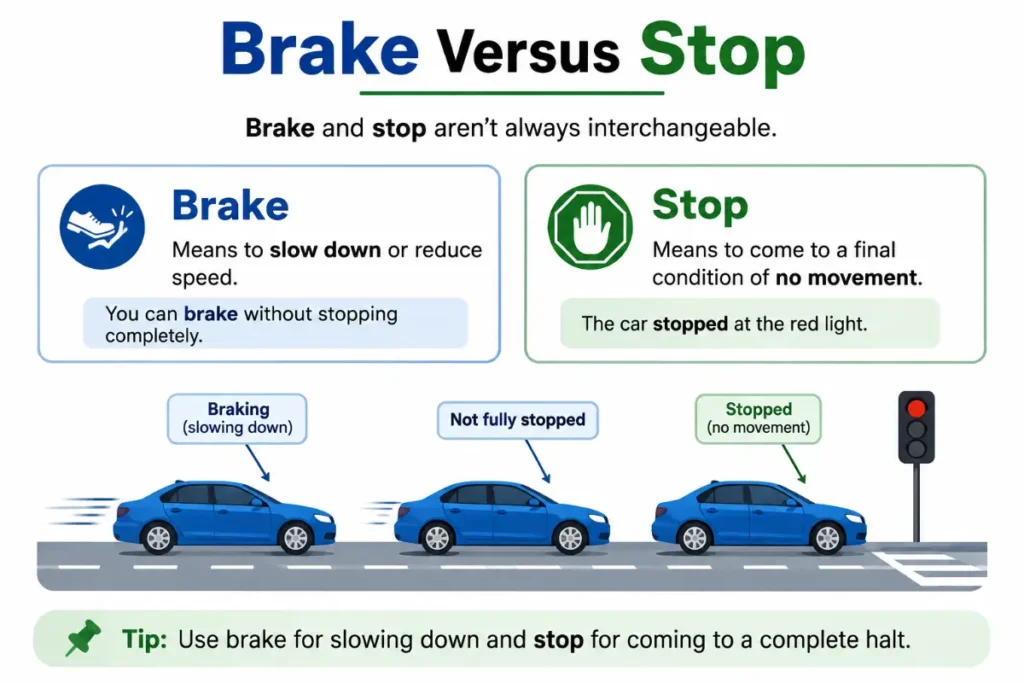
Braking distance is the distance a vehicle travels after the driver applies the brakes until the vehicle stops. It is a useful term in driving safety and road education. It differs from stopping distance, which also includes the distance traveled before the brakes are applied.
8. Break Down
Break down is a phrasal verb with several meanings. A vehicle or machine can break down when it stops working. A person can break down emotionally, and someone can break down a difficult topic into smaller parts to explain it more clearly.
Expert Editor Insight
An experienced editor checks the meaning of the full sentence rather than relying on sound. Native English speakers usually recognize these words in speech because the context makes the intended meaning clear, but the spelling can still cause mistakes in fast writing. Grammar tools may accept both forms because both are valid words, so a spelling checker alone may not catch the error. A useful editing tip is to replace the word mentally with its meaning: if you mean a stopping device, use brake; if you mean rest, damage, or interruption, use break. This quick test catches most errors.
You may also want to read Disloyal or Unloyal Which Word Is Correct.
Conclusion
The difference between brake and break is simple once you connect each spelling with its meaning. Brake refers to a vehicle’s stopping system or the action of slowing down. Break refers to damage, rest, separation, or interruption. Both are correct English words, but they cannot replace each other in ordinary sentences.
A helpful memory tip is to associate the a in brake with automobile, while break is the word you use for a rest or something damaged. Before sending an email or finishing an assignment, read the sentence once for meaning. That small habit can prevent a common writing mistake.
FAQs
What Is the Main Difference Between Brake and Break?
Brake refers to a device or action used to slow down or stop a moving vehicle. Break means to damage, separate, interrupt, or take a rest. Both words sound the same, but their meanings and spellings are different. Use the surrounding sentence to decide which form fits your intended meaning.
Is It Take a Brake or Take a Break?
The correct expression is take a break. It means to stop working or doing an activity for a short time so you can rest. Brake refers to a vehicle’s stopping system, so take a brake is incorrect when you mean a rest period. For example, I need a short break after this meeting.
Is It Car Brake or Car Break?
The correct phrase is car brake when you are talking about the equipment used to slow or stop a vehicle. You may also say car brakes when referring to the braking system. Car break does not describe this equipment, although break may appear in a different sentence about damage to a car.
Are Brake and Break Homophones?
Yes. Brake and break are homophones because they have the same pronunciation but different spellings and meanings. Both are pronounced /breɪk/ in standard American English. Their identical sound makes them easy to confuse in writing, so you need to use context and meaning rather than pronunciation to select the correct spelling.
What Is the Past Tense of Brake?
The past tense of brake is braked. It is a regular verb, so you add ed to form the past tense. For example, The driver braked suddenly when the traffic light changed. Do not write breaked or broke when you mean that someone used a vehicle’s stopping system.
What Is the Past Tense of Break?
The past tense of break is broke, and its past participle is broken. For example, She broke the glass yesterday uses the simple past, while She has broken the glass uses the past participle. Break is an irregular verb, so it does not follow the usual pattern of adding ed.
Why Do People Confuse Brake and Break?
People confuse these words because they sound exactly alike in standard English. Their spellings differ by the order of the middle vowels, and both are common in everyday writing. A spellchecker may not flag the wrong choice because both words are correctly spelled on their own. Checking the sentence meaning is the best way to avoid the error.
Is Brake or Break Used in Formal Writing?
Both words are suitable for formal writing when used with the correct meaning. Use brake in technical documents, driving instructions, and reports about vehicle safety. Use break in writing about rest periods, damaged objects, interruptions, or broken agreements. Neither spelling is informal or incorrect by itself; the sentence determines the right choice.