
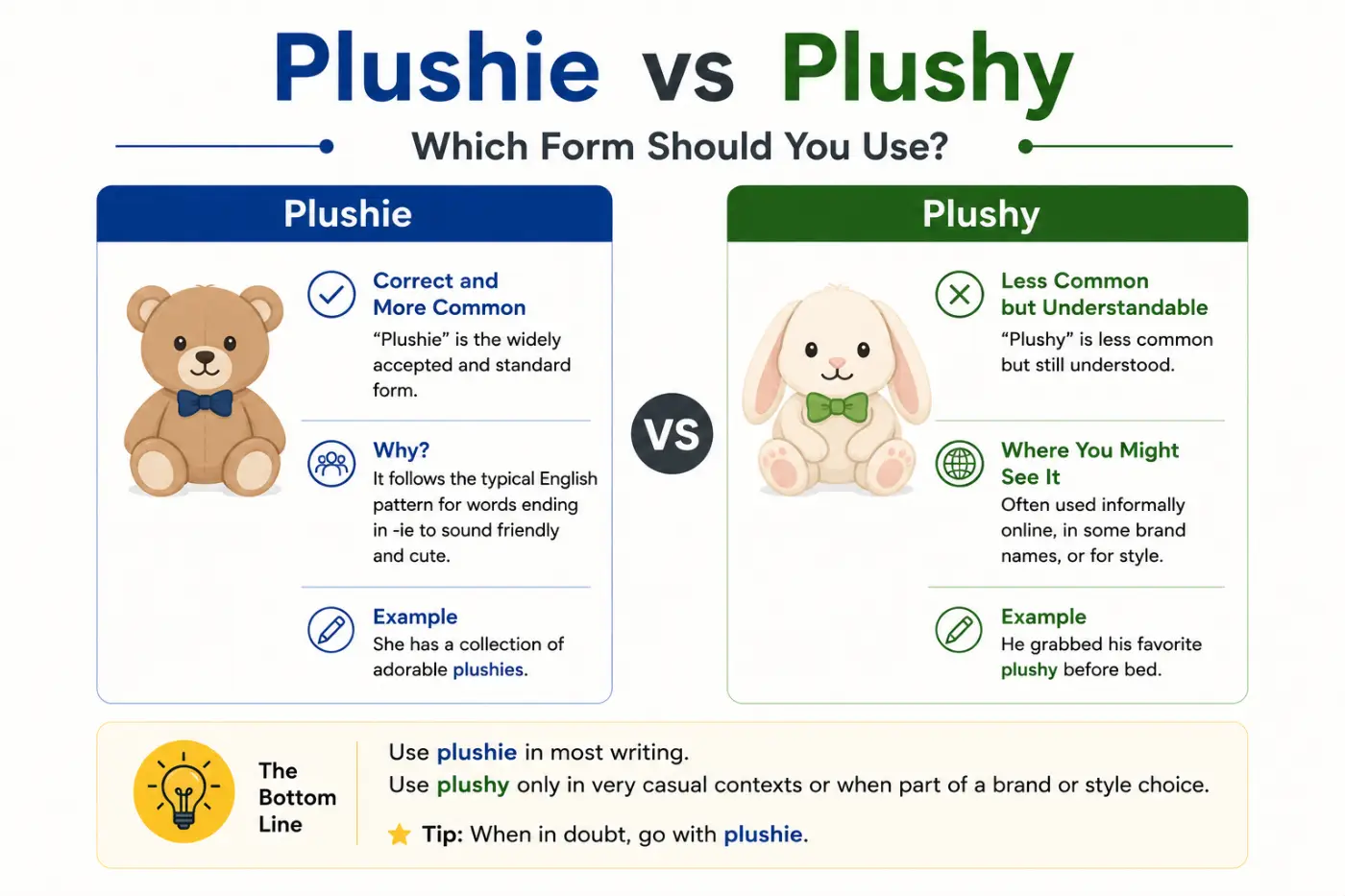
If you’re talking about a soft stuffed toy, you may have seen both plushie vs plushy and wondered which spelling is right. The confusion makes sense because the two forms look almost identical and sound the same in ordinary speech. The difference becomes much clearer once you look at how each word functions in a sentence.
Plushie is the clearest and most established choice when you mean a soft stuffed toy. Cambridge Dictionary defines it as a noun for a toy made from cloth and filled with soft material. Plushy has a broader history. It is mainly an adjective meaning like plush or notably luxurious. Merriam Webster also records it as a less common noun variant of plushie.
That small grammatical difference explains most of the confusion. If you’re naming the toy itself you’ll usually want plushie or plush toy. If you’re describing a soft texture or a luxurious setting plushy can fit naturally. This guide explains the distinction with clear examples so you can choose the right form without second guessing yourself.
For another common grammar confusion, see Drier Vs Dryer Meaning And Usage Guide2026.
Quick Answer
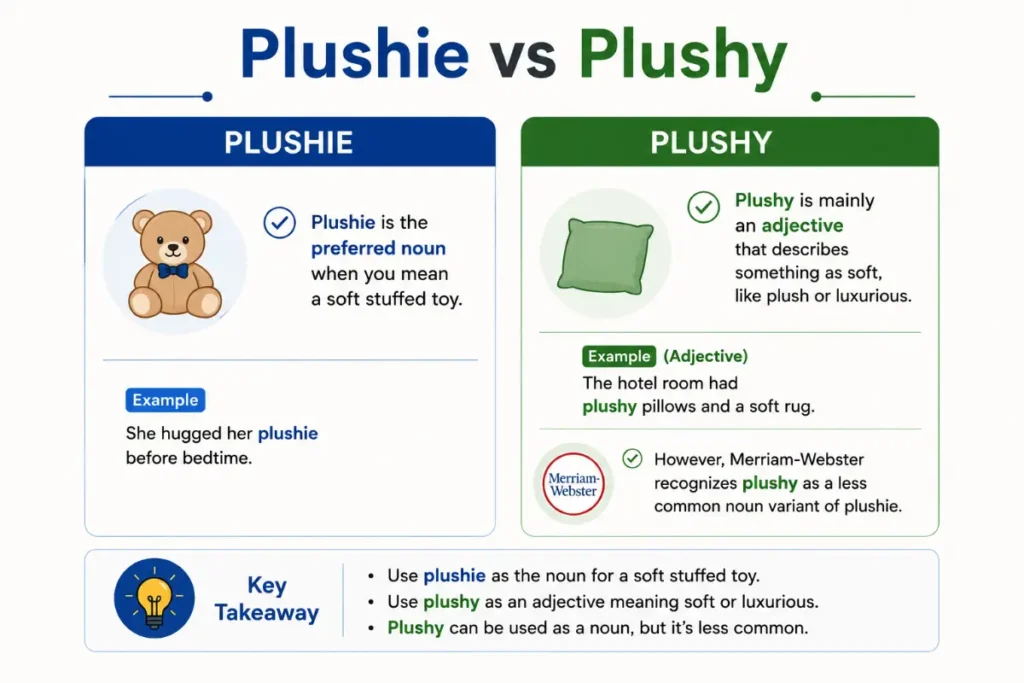
Plushie is the preferred noun when you mean a soft stuffed toy. Plushy is mainly an adjective that describes something as soft like plush or luxurious. However Merriam Webster recognizes plushy as a less common noun variant of plushie.
Quick Answer For Everyday Writing
If you’re writing about a stuffed animal or collectible soft toy use plushie.
For example:
- My daughter sleeps with her favorite plushie.
- I bought a new plushie at the toy store.
- That cat plushie is adorable.
Use plushy when you’re describing texture or comfort.
For example:
- This blanket feels plushy.
- The sofa has a plushy surface.
- We stayed in a plushy hotel with large comfortable rooms.
There’s one useful wrinkle. Plushy can also work as a noun because Merriam Webster lists it as a less common variant of plushie. So calling it simply wrong would be too strong. The better explanation is that plushie is the clearer choice for the toy while plushy has a more established adjective role.
Comparison Table
The table shows why the two spellings shouldn’t be treated as simple competing spellings. They have overlapping meanings but different grammatical strengths.
What Does Plushie Mean
Plushie is a noun. It refers to a soft toy made from cloth and filled with a soft material. The toy is often shaped like an animal or character but it can take many forms.
Collins also defines it as a toy usually shaped like an animal and made from smooth cloth filled with a soft material. The word has a warm and casual feel. People often use it when talking about cute stuffed animals character toys collectibles and comforting objects. You might hear someone say that they bought a plushie at a convention. A child might call a stuffed rabbit their favorite plushie. A collector might have dozens displayed on a shelf.
The word works because it names the object directly.
Consider this sentence.
I found a tiny fox plushie at the gift shop.
The noun tells us exactly what the object is.
The plural is plushies. The spelling changes from the final ie to ies because the word follows a familiar English plural pattern for nouns ending in a consonant sound followed by y in related forms. In everyday usage you’ll often see phrases such as plushies collection or favorite plushies.
What Does Plushy Mean
Plushy is primarily an adjective. It describes something that resembles plush or has a soft rich texture. It can also describe something luxurious or comfortable and It also gives a second sense meaning notably luxurious. Collins gives similar meanings and records the word as informal in some uses. That means you can describe a blanket as plushy. You can describe a couch as plushy. You can even describe a hotel or resort as plushy when you mean luxurious.
For example:
The new blanket feels plushy and warm.
Here the word describes the blanket. It doesn’t name the blanket. This distinction is useful because adjectives and nouns perform different jobs. A noun names something. An adjective describes something. That simple grammar rule clears up most of the confusion.
Is Plushy A Real Word
Yes. Plushy is a real English word. The important point is that its main dictionary role is not simply another spelling for the soft toy. Major dictionaries recognize plushy as an adjective. Merriam Webster also records a noun sense as a less common variant of plushie.
So there are two legitimate uses.
- Plushy as an adjective means soft like plush or luxurious.
- Plushy as a noun can mean a soft toy but this use is less common.
This is a good example of why spelling questions sometimes have more than a simple right or wrong answer. English develops through actual usage. A form can have more than one grammatical role and still have one role that feels much more natural to most readers. If your goal is clarity choose the form that makes the intended meaning obvious. For the toy itself plushie is usually the safest casual choice. For texture or luxury plushy is a natural adjective.
Is Plushie A Real Word
Yes. Plushie is a recognized English noun. Cambridge Dictionary includes it as a noun and defines it as a soft toy made from cloth and filled with soft material. Collins also includes the noun. The word is especially useful in casual conversation. It has a friendly sound and often carries a sense of affection.
Compare these two sentences.
I bought a plush toy.
I bought a plushie.
Both are clear. The first sounds neutral and product focused. The second sounds more personal and casual.
That difference matters in real writing. A product catalog may prefer plush toy. A social media post may naturally use plushie. A child may simply call it a plushie because the word feels shorter and friendlier.
The Main Difference Explained
The easiest way to remember the distinction is to ask what job the word is doing.
- If the word names the soft toy use plushie.
- If the word describes softness use plushy.
- If you need a neutral product term use plush toy.
- If you need a traditional American term for an animal shaped toy use stuffed animal.
The difference is similar to other noun and adjective pairs in English. A noun identifies the thing while an adjective gives information about the thing. For instance a beauty can be a noun while beautiful is an adjective. A cloud is a noun while cloudy is an adjective. In the same broad way plushie names the toy while plushy commonly describes a quality. There’s overlap because English isn’t built from perfectly sealed boxes. Some words move between grammatical categories over time. That’s exactly what happens with plushy.
Spelling Differences
The spelling difference is only two letters but those letters matter because they can signal a different grammatical role.
Plushie ends with ie.
Plushy ends with y.
That shared pronunciation creates a natural spelling trap. You hear the word before you see it. When you type it later you may choose the spelling that looks familiar. If you’ve mostly seen plushy as an adjective you may automatically write plushy when talking about the toy. The reverse can happen too. Someone familiar with plushie may use it when they actually need an adjective. The safest approach is to think about meaning first and spelling second.
Grammar And Part Of Speech
The grammatical difference is one of the strongest clues.
Plushie As A Noun
A noun can act as the subject or object of a sentence.
For example:
The plushie sits on my desk.
Here plushie is the subject.
I washed the plushie.
Here plushie is the object.
Her favorite plushie is a rabbit.
Again the word names a thing.
The plural form is plushies.
The store sells handmade plushies.
That plural form is another strong signal that the word functions naturally as a noun.
Plushy As An Adjective
An adjective describes a noun.
For example:
She bought a plushy blanket.
The word describes the blanket.
The sofa feels plushy.
The word describes the sofa.
You can also use plushy after linking verbs such as feel or look.
The fabric feels plushy.
The room looked plushy and comfortable.
The exact choice depends on the meaning you want. In many cases soft or plush will sound more natural than plushy. That brings us to another useful point. A word can be grammatically possible and still not be the most natural choice.
Plushy Compared With Plush
Plush is the more established and flexible word. Cambridge lists plush as both a noun and an adjective. As a noun it can refer to a thick soft fabric. As an adjective it can mean soft to the touch or expensive and comfortable.
So you can say:
The hotel has plush furniture.
She bought a plush blanket.
The toy has a plush exterior.
In many situations plush sounds more natural than plushy.
Why? Because plush has been part of English for centuries and has developed several established meanings. Plushy is formed from plush with the suffix y and often feels more descriptive or informal. Think of plush as the standard workhorse and plushy as the more playful cousin. Neither is automatically wrong. They simply have different strengths.
Plushie Compared With Plush Toy
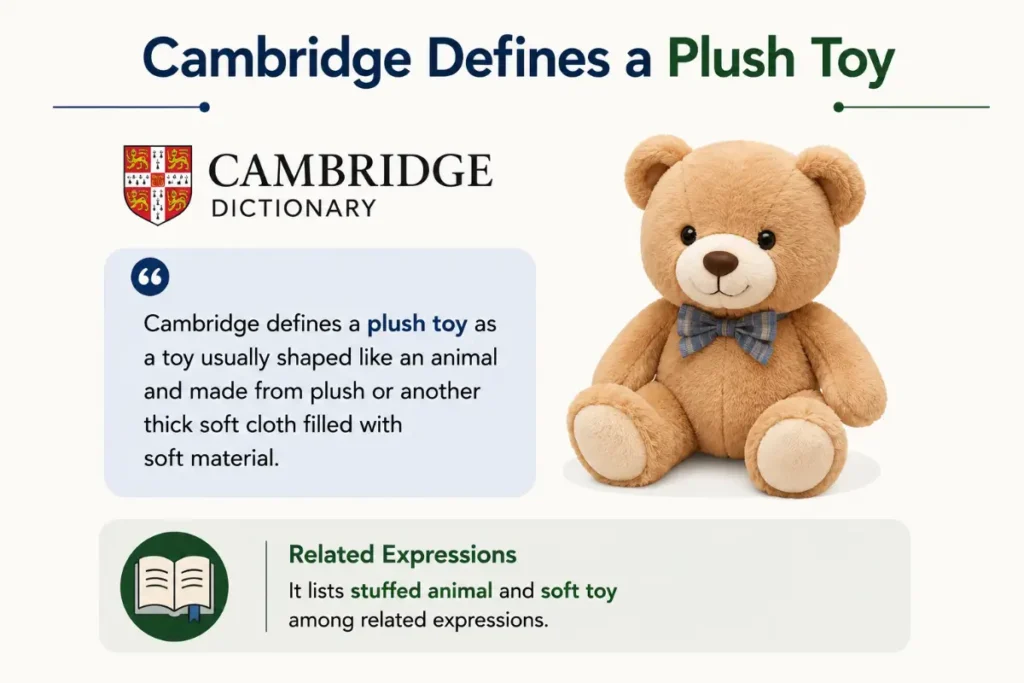
For formal or neutral writing plush toy is often the clearest phrase. Cambridge defines a plush toy as a toy usually shaped like an animal and made from plush or another thick soft cloth filled with soft material. It lists stuffed animal and soft toy among related expressions.
This phrase works well in product descriptions.
The package includes one plush toy.
It also works well in retail writing.
Choose from our collection of plush toys.
The phrase is easy for almost any reader to understand.
Plushie has a more casual personality.
This plushie is my favorite.
That sentence feels friendly and personal. So the choice often depends on tone. Use plush toy for neutral clarity. Use plushie for casual and affectionate language.
Pronunciation Guide
The two forms are pronounced essentially the same in common English usage. Plushie IPA: /ˈplʌʃ.i/ Easy guide: PLUSH ee. The stress falls on the first syllable. Plushy IPA: /ˈplʌʃ.i/ in common pronunciation. Easy guide: PLUSH ee. Again the first syllable carries the main stress. The first part sounds like the word plush. The second part sounds like the long e sound in words such as happy and candy. Because the pronunciation is so similar there is no reliable listening trick that will tell you which spelling someone means. Context does the heavy lifting. If someone says I bought a new plushie you know they mean the toy. If someone says the blanket is plushy you know they are describing the blanket.
Etymology And Word Origin
The history starts with plush. Collins traces plush to French pluche and further back through Old French to a Latin root connected with hair or pile. The modern English word developed around the idea of a soft fabric with a raised surface. Plushy developed from plush with the suffix y. That pattern is common in English. The suffix can turn a noun or base word into an adjective describing a quality. Merriam Webster gives the first known use of plushy as an adjective in 1611. That is significant because it shows that the adjective is not a recent internet invention. The noun plushie is much more closely tied to the modern idea of a soft stuffed toy. Dictionaries now recognize it as an established noun. This history helps explain the modern distinction. Plush began as a material and texture word. Plushy developed as a descriptive adjective. Plushie became a noun for the soft toy itself.
American English Usage
For American readers plushie is a clear casual noun for a soft stuffed toy. You may see it in conversations about character toys collectibles gifts and stuffed animals. Plush toy is also very natural and often sounds more neutral or professional. Stuffed animal is especially common when the toy represents an animal.
For example:
My son carries his stuffed animal everywhere.
That sounds completely natural in American English.
You could also say:
My son carries his plushie everywhere.
That sounds more casual and modern.
Plushy is familiar as an adjective but it isn’t the first choice for most Americans when naming the toy.
That’s why the sentence below can feel awkward.
I bought a plushy yesterday.
It isn’t necessarily impossible. The noun use exists. But many readers will find this clearer.
I bought a plushie yesterday.
The second version immediately identifies the object.
British English Usage
British English often uses soft toy where American English commonly uses stuffed animal. Cambridge identifies soft toy as a British term and notes stuffed animal as the American equivalent. It also includes plush toy and plushie among related toy vocabulary. That doesn’t mean British speakers cannot use plushie. They can. It simply means regional vocabulary can influence which expression feels most natural.
A British speaker might say:
She sleeps with her favorite soft toy.
An American speaker might say:
She sleeps with her favorite stuffed animal.
Both sentences communicate the same basic idea. Plushie remains understandable across English varieties.
Learn the difference in labour or labor Which Spelling Is Correct in 2026.
Australian And Canadian Usage
Australian and Canadian English also share much of the same vocabulary found in American and British English. You may encounter terms such as plush toy soft toy stuffed animal and plushie. The important point is that there isn’t a major spelling rule that makes plushie correct in one country and plushy correct in another. The difference is mainly about grammar and preference. Regional vocabulary can affect the surrounding noun phrase. A Canadian writer may comfortably use stuffed animal while an Australian writer may prefer soft toy in some situations. That does not turn plushy into a regional spelling of plushie.
Formal And Informal Usage
Neither plushie nor plushy is especially formal.
If you’re writing a casual message the choice is easy.
I found the cutest plushie today.
That sounds friendly and natural.
If you’re writing a formal product specification you may want plush toy instead.
The product is a plush toy made from polyester fabric.
That wording sounds more neutral.
If you’re describing texture in product copy plush may also be better.
The toy features a soft plush exterior.
You can use plushy in informal descriptive writing but it has a more conversational feel.
For professional writing clarity usually wins over cuteness.
Ten Natural Sentence Examples
Here are ten examples showing how the preferred noun works in ordinary writing.
- My niece picked a pink bunny plushie from the shelf.
- I bought a small bear plushie for my nephew.
- Her favorite plushie has a little blue scarf.
- The gift shop sells character plushies from several popular shows.
- He keeps his childhood plushie beside his bed.
- We found a handmade plushie at the local craft market.
- She takes her favorite plushie with her on long trips.
- The collector displayed every plushie in a glass cabinet.
- My daughter gave her old plushie a tiny sweater.
- That penguin plushie would make a great birthday gift.
These examples show why the noun form is so useful. It fits naturally into sentences as the name of an object.
Examples With Plushy As An Adjective
The adjective has a different job.
- The new blanket feels plushy and warm.
- The sofa has a plushy texture.
- We sank into the plushy hotel chairs.
- The rug felt plushy under our feet.
- She chose a pillow with a plushy surface.
These sentences sound natural because plushy describes a quality. You could replace plushy with soft or plush in several of them. That’s a useful editing test. If the sentence still makes sense after replacing the word with soft then you’re probably using an adjective. If you’re naming the actual toy you probably need a noun such as plushie or plush toy.
Common Mistakes And Misspellings
Small spelling questions often come from understandable patterns rather than careless writing.
- Using plushy as the default noun
A writer may type I bought a plushy because the word sounds right. The noun exists but it is less common. Plushie is usually clearer.
- Using plushie as an adjective
Someone might write plushie blanket when they mean a blanket with a soft plush texture. That can sound as if the blanket itself is a stuffed toy. Plushy or plush is clearer.
- Writing plushy toy when plush toy is intended
Plushy toy may be understandable but plush toy is the established product phrase. It sounds cleaner in neutral writing.
- Confusing plush with plushie
Plush can describe material or texture. Plushie names the soft toy. Saying the toy is made of plush is different from calling the toy a plushie.
- Treating plushy as an outright misspelling
This is the biggest mistake in the other direction. Plushy is a legitimate English adjective and dictionaries also recognize its less common noun use. Calling it simply incorrect ignores established usage.
Real Life Usage
The best word can change with the situation.
Daily Conversation
Casual conversation favors words that feel quick and personal.
I left my plushie in the car.
Look at this tiny plushie.
These sentences sound relaxed.
Workplace Communication
A workplace message may need a little more precision.
The promotional package includes a branded plush toy.
That sounds clearer than using a highly casual noun.
If you’re describing the material you could write:
The toy has a soft plush exterior.
Academic Writing
Academic writing usually benefits from neutral vocabulary.
The study examines the role of stuffed animals in childhood play.
There’s no need to use plushie unless the term itself is the subject of the discussion.
News And Journalism
News writing generally favors terms that a broad audience understands.
The event featured a large collection of plush toys.
A journalist might use plushie if the word appears in a quote or if the story focuses on a specific collector community.
Storytelling
Creative writing gives you more freedom.
Mia hugged her old plushie and smiled.
That sounds warmer than plush toy.
The word carries a little emotional weight. It feels personal and affectionate.
Related And Confused Terms
Several words overlap with this vocabulary but they aren’t exact substitutes in every situation.
- Plush toy means a soft toy and is a clear neutral expression.
- Stuffed animal usually refers to an animal shaped toy filled with soft material.
- Soft toy is especially common in British English and other varieties influenced by British usage.
- Stuffie is an informal term for a stuffed toy and has a similarly friendly tone.
- Plush can refer to the soft material itself or describe something soft luxurious or richly comfortable.
- Plushy usually describes something that resembles plush or feels soft and can also describe luxury.
- Cuddly toy emphasizes the idea that the object is pleasant to hug or cuddle.
- Teddy bear refers specifically to a bear shaped stuffed toy rather than every kind of soft toy.
These terms overlap like circles on a Venn diagram. They share some meaning but each has its own center.
Why The Confusion Happens
The confusion comes from several sources. First the two forms sound almost identical. Second they share the same base word. Third both can appear in discussions about soft toys. Fourth English uses the suffix y to create many adjectives. Words such as cloudy sleepy and messy train readers to expect a y ending to describe a quality.
Expert Editor Insight
An experienced editor would usually choose the word based on its grammatical job rather than treating the issue as a spelling contest. If the sentence names the soft toy use plushie or plush toy. If the sentence describes texture use plush or plushy. A useful editing trick is to underline the noun being described and ask if your chosen word names the object or describes it. That one question catches most mistakes quickly. Editors also pay attention to audience and tone. Plushie works naturally in a casual blog post social conversation product community or personal story. Plush toy is safer in a formal product description. Plush often works best in material descriptions. Plushy can add a cozy informal feel but it shouldn’t replace the more precise term when precision matters.
When To Choose Plushie
Choose plushie when you mean the actual soft toy.
It works especially well for:
- Stuffed animal collections.
- Character merchandise.
- Cute gifts.
- Toy store conversations.
- Collector communities.
- Casual social posts.
- Personal stories.
- Informal product descriptions.
If you want a warm and friendly word for the object itself this is usually the best choice.
When To Choose Plushy
Choose plushy when you’re describing a soft texture or luxurious quality.
It works well with nouns such as:
- Blanket.
- Cushion.
- Sofa.
- Carpet.
- Fabric.
- Chair.
- Interior.
- Hotel.
For example:
The hotel has plushy chairs and thick carpets.
Here the word describes comfort and luxury.
You can also use the noun form when you’re intentionally using the less common variant.
The child carried a plushy in her backpack.
That sentence is grammatically possible because dictionaries recognize the noun sense. Still plushie would be the more immediately familiar choice for many readers.
Which Form Is Best For Formal Writing
For formal writing neither word should be your automatic choice.
If you mean the product use plush toy.
If you mean the material use plush fabric.
This approach removes ambiguity.
For example:
The company manufactures plush toys for children.
That sentence is clear and professional.
Compare it with:
The company manufactures plushies for children.
The second sentence is understandable but more casual.
Now compare:
The company manufactures plushy toys for children.
That wording sounds less natural because plushy is being used as a descriptive adjective where the established phrase plush toy would usually do the job better.
Can Plushie Start A Sentence
Yes. Plushie can start a sentence because it is a noun.
For example:
Plushie collecting has become a popular hobby for some fans.
There is no grammar problem with starting a sentence with the word.
You can also begin with the plural form.
Plushies can range from tiny keychain toys to large display pieces.
The important thing is not where the word appears but how it functions.
If you start a sentence with plushy the word will normally need to modify a noun.
For example:
Plushy fabric feels soft against the skin.
That is a normal adjective use.
Is Plushie Appropriate In Formal Writing
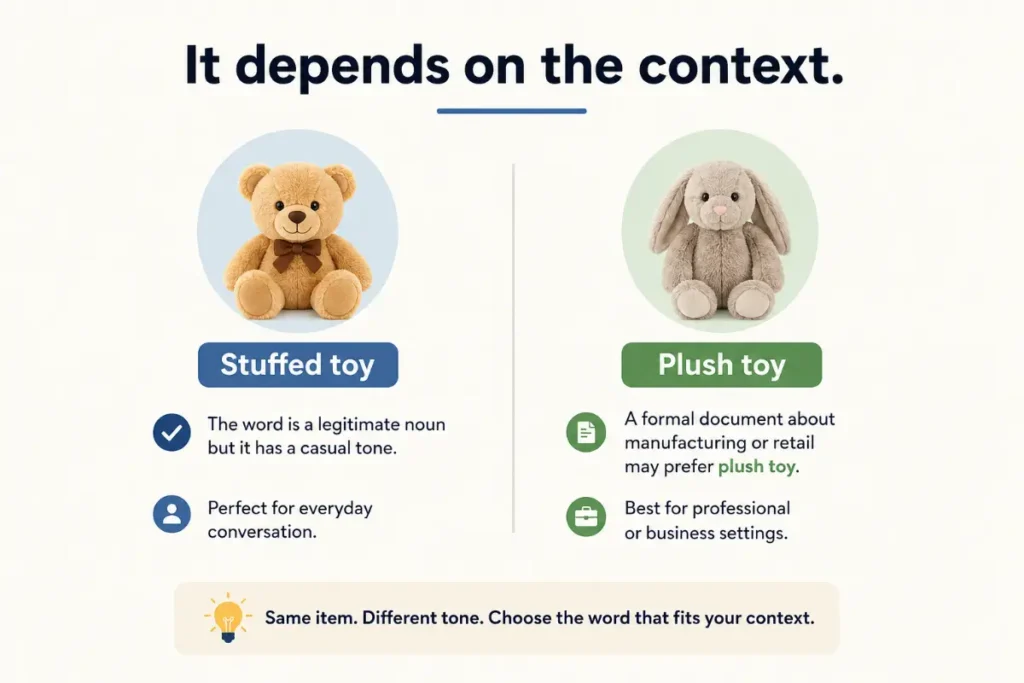
It depends on the context. The word is a legitimate noun but it has a casual tone. A formal document about manufacturing or retail may prefer plush toy. A personal essay about childhood could comfortably use plushie if the tone is conversational. A research paper might use stuffed animal or plush toy unless the word plushie itself is relevant to the research. Good writing isn’t about avoiding informal words at all costs. It’s about matching vocabulary to purpose. If the audience expects friendly language plushie can work beautifully. If the audience expects technical precision plush toy is usually the better choice.
What Is The Best Memory Trick
Use this simple mental picture. Plushie is the thing. Plushy is the feeling. Imagine a stuffed rabbit sitting on your bed. The rabbit is a plushie. The rabbit feels plushy. That gives you a quick way to choose the form. You can also remember the grammatical pattern.
Noun means the object.
Adjective means the quality.
So:
I hugged my plushie.
The word names the object.
I hugged a plushy toy.
The word describes the toy. The second sentence is possible but plush toy is usually cleaner.
Many readers also check Filed vs Filled Correct Usage in Everyday English 2026.
Final Verdict
The clearest choice for a soft stuffed toy is plushie. It is a recognized noun and is especially natural in casual American English and online conversation. Plushy is also a legitimate word but its main role is as an adjective describing something soft like plush or luxurious. Dictionaries also recognize its less common noun use.
The easiest memory trick is simple. Plushie is the thing. Plushy describes the quality. If you’re writing formal product copy then plush toy is often even clearer. When you remember the grammatical job each word performs you’ll rarely have to stop and wonder which spelling belongs in your sentence.
FAQs
Is plushy a real word?
Yes. Plushy is a legitimate English word. It is mainly an adjective meaning like plush or luxurious. Merriam Webster also records plushy as a less common noun variant of plushie. So it isn’t accurate to call plushy simply a misspelling.
What does plushie mean?
Plushie is a noun for a soft stuffed toy made from cloth and filled with soft material. It often refers to animal shaped toys or character collectibles. Cambridge and Collins both recognize the word as a noun. The term has a friendly informal tone and is especially natural in casual conversation and online communities.
Which word should I use for a stuffed animal?
Use plushie or stuffed animal. Plushie is a casual modern choice while stuffed animal is a familiar neutral American English term. If you’re writing product copy or formal material then plush toy may be the clearest option. The best choice depends mainly on tone and audience.
How do you pronounce plushie?
Plushie is commonly pronounced /ˈplʌʃ.i/. An easy pronunciation guide is PLUSH ee. The first syllable receives the main stress. Plushy is normally pronounced the same way. Because the words sound alike you need to rely on context and spelling rather than pronunciation to distinguish them.
Can plushy be a noun?
Yes. Merriam Webster lists plushy as a noun meaning a toy covered in plush fabric and filled with soft material. It labels this noun use as less common and identifies it as a variant of plushie. In normal casual writing plushie is usually the clearer noun choice.
Is plushy an adjective?
Yes. This is its main grammatical role. Plushy can describe something that resembles plush or has a soft rich texture. It can also describe something luxurious. For example you can describe a blanket as plushy or a resort as plushy when emphasizing comfort and luxury.
What is a synonym for plushie?
Useful alternatives include plush toy stuffed animal soft toy stuffed toy stuffie and cuddly toy. The best synonym depends on the object and regional variety of English. Stuffed animal is especially familiar in the United States while soft toy is common in British English.
Why do people confuse plushie and plushy?
The confusion is mainly caused by similar spelling and pronunciation. Both words come from the same base word and both can appear in conversations about soft toys. The difference becomes clearer when you focus on grammar. Plushie normally names the toy while plushy usually describes softness texture or luxury.