
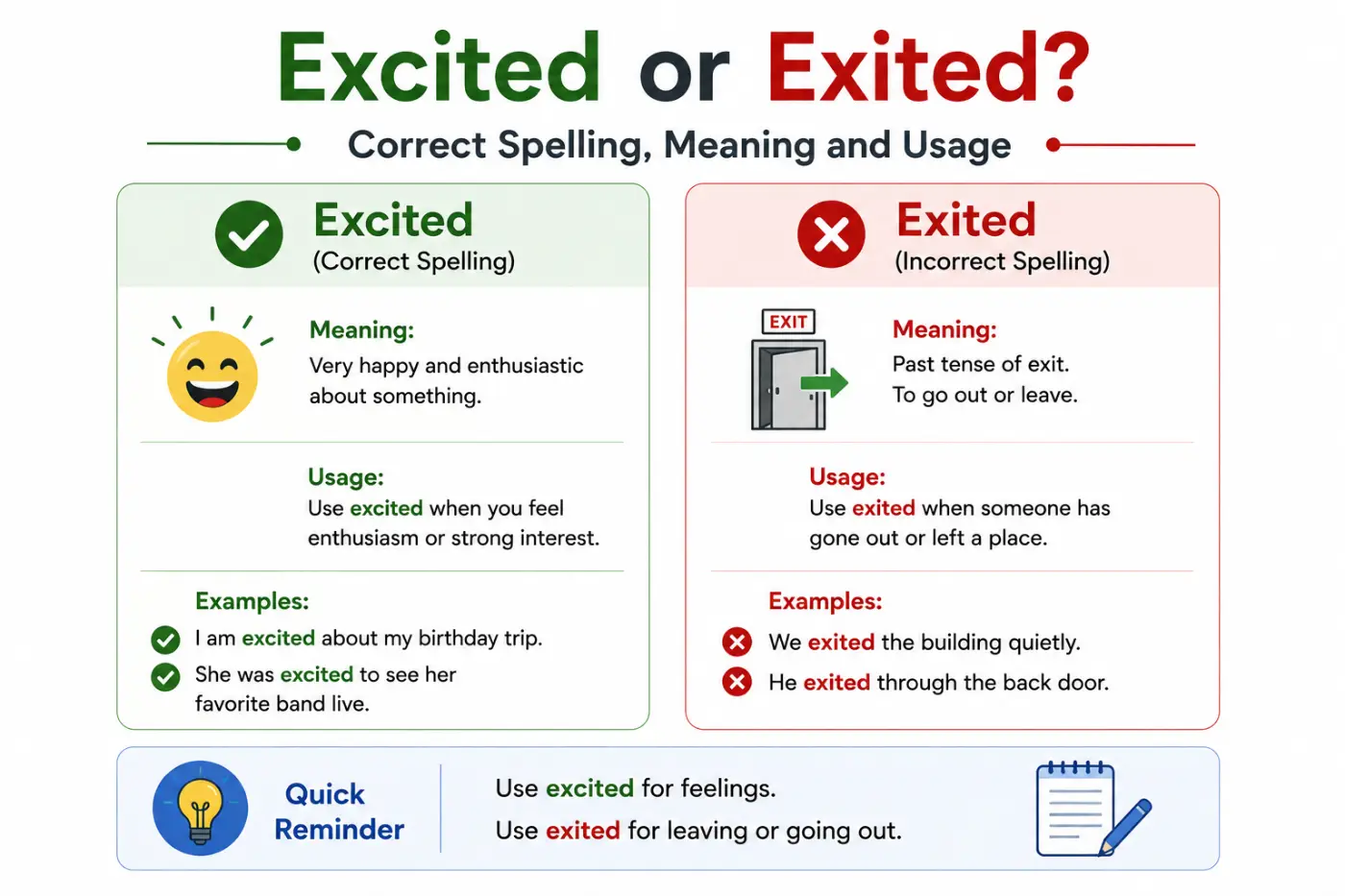
If you’ve ever paused before typing excited or exited you’re not alone. These words look almost identical and sound very similar in some forms. Yet they describe completely different ideas. Excited describes a feeling of enthusiasm or strong interest. Exited means someone left a place.
The difference becomes much easier once you connect each word with its root. Excited comes from the verb excite and relates to emotion or enthusiasm. Exited comes from the verb exit and relates to leaving. One describes how someone feels. The other describes an action.
This distinction matters in everyday writing because one letter can change the entire meaning of a sentence. If you write that someone was exited about a vacation you’ve accidentally changed an emotional reaction into an action of leaving. This guide explains the difference clearly so you can choose the right word without second guessing yourself.
A related grammar guide is Shinning or Shining Which Is Correct in 2026?.
Quick Answer
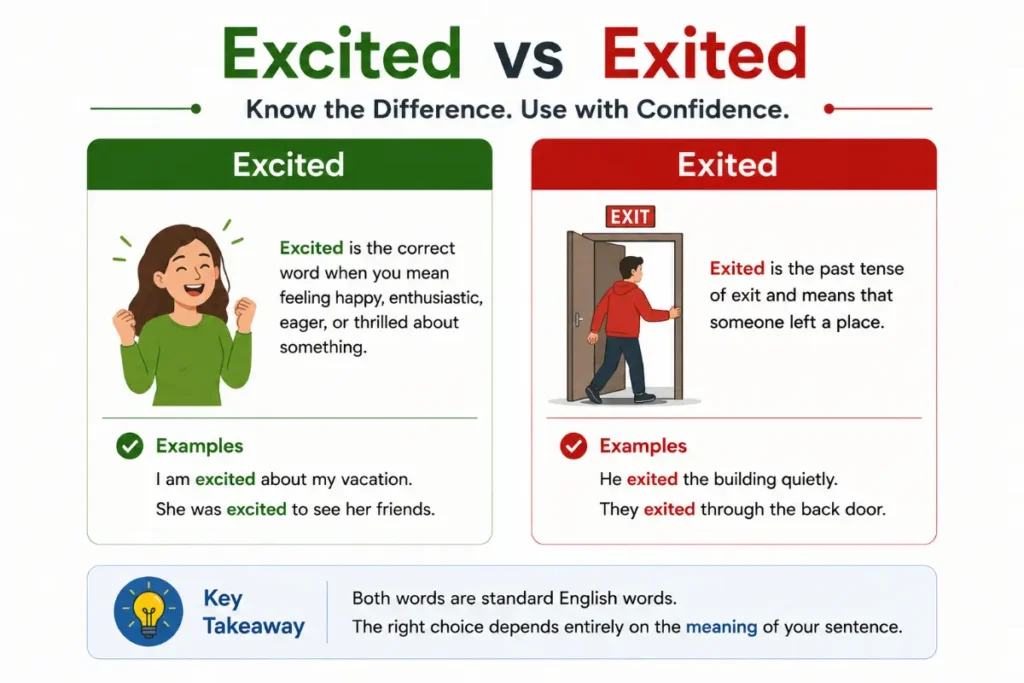
Excited is the correct word when you mean feeling happy enthusiastic eager or thrilled about something. Exited is the past tense of exit and means that someone left a place. Both are standard English words. The right choice depends entirely on the meaning of your sentence.
Comparison Table
| Form | Meaning | Part of Speech | Origin | Usage Frequency | Formality | Common Contexts | Example |
|---|---|---|---|---|---|---|---|
| Excited | Feeling enthusiastic eager or thrilled | Adjective and past participle | Latin through French | Very common | Neutral | Feelings plans events anticipation | She was excited about the trip. |
| Exited | Left a place or situation | Past tense and past participle of exit | Latin through English | Common | Neutral | Leaving buildings meetings vehicles or situations | He exited the building at noon. |
Meaning and Definition
Meaning of Excited
Excited describes a strong feeling of enthusiasm anticipation or happiness.
It usually appears when someone looks forward to something. You might feel excited about a vacation a birthday a new job a sports game a family visit or an upcoming event.
For example:
She’s excited about her new job.
The children were excited to see the animals.
I’m excited about the weekend.
In these sentences the word describes an emotional state. Nobody is necessarily moving from one place to another. The people simply feel eager or enthusiastic.
The word can also describe something that produces strong activity or energy in technical contexts. For example scientists may use the term excited state in physics or chemistry. That specialized meaning is different from ordinary conversational use.
In everyday American English the emotional meaning is by far the one most people encounter.
Meaning of Exited
Exited is the past tense and past participle of the verb exit.
It means that someone or something left a place or situation.
For example:
She exited the room quietly.
The passengers exited the bus.
He exited the building through the rear door.
Here the word describes an action. Someone was inside a place and then left it.
You’ll often see this word in formal instructions workplace writing public notices and descriptions of movement. In casual conversation people often choose the simpler verb left.
For example:
He exited the office at five.
He left the office at five.
Both sentences are grammatically correct. The second sounds more natural in many everyday conversations.
Why The Two Words Cause Confusion
The spelling difference is tiny. Both words contain the same basic letters and share a similar ending.
Their roots also make the distinction clearer.
Excited connects to excite.
Exited connects to exit.
Think about the final letter before the ending. The letter c belongs to excite and carries the meaning of producing enthusiasm. The letter i belongs to exit and carries the meaning of leaving.
That small spelling difference acts like a road sign. Once you learn to notice it you can usually identify the intended word immediately.
Key Differences Explained
Spelling
The first major difference is spelling.
Excited contains the root excite.
Exited contains the root exit.
The spelling reflects the different base words rather than a simple variation of the same word.
This gives you a useful editing trick. Remove the ending mentally and look at the root.
Excited becomes excite.
Exited becomes exit.
If the sentence describes a feeling you need the first root. If it describes leaving you need the second.
Meaning
The meanings have no close relationship in ordinary English.
Excited means enthusiastic eager thrilled or emotionally stimulated.
Exited means left.
Compare these sentences:
Maria was excited about the concert.
Maria exited the concert hall after the show.
The first sentence describes Maria’s feeling. The second describes her movement.
That contrast is worth remembering because it solves most spelling questions immediately.
Grammar
Excited commonly works as an adjective.
For example:
I’m excited about the results.
They’re excited to visit us.
She felt excited before the interview.
Exited functions as a verb form.
For example:
She exited the room.
They exited through the main door.
The audience exited after the performance.
This grammatical difference provides another quick test. If the word describes how someone feels then excited is probably the right choice. If the word describes an action involving departure then exited is probably correct.
Pronunciation
The two words are also easy to confuse because their pronunciation can sound similar.
Excited is commonly pronounced /ɪkˈsaɪtɪd/.
Exited is commonly pronounced /ˈɛɡzaɪtɪd/ or /ˈɛɡzɪtɪd/ depending on pronunciation pattern and speech context.
The spelling difference becomes more noticeable when you say the words carefully. Still pronunciation alone isn’t the best way to choose between them. Meaning and grammar give you a much more reliable test.
Formality
Both words are standard English.
Excited is common in casual speech professional communication academic writing and personal writing.
Exited is also standard but often sounds more formal than left in everyday conversation.
A workplace report might say:
The employee exited the meeting.
A coworker might simply say:
The employee left the meeting.
Neither is wrong. The choice depends on tone and context.
Context
Excited normally appears with things that create anticipation or enthusiasm.
Common patterns include:
excited about something.
excited to do something.
Exited normally appears with places or situations that someone leaves.
Common patterns include:
exited the room.
exited the program.
These patterns make the difference easier to spot during proofreading.
Which Form Is Correct?
Both forms are correct. The important question is what you mean.
Use excited when you’re describing enthusiasm or anticipation.
Use exited when you mean left.
Consider this sentence:
I’m exited about my vacation.
The spelling is wrong because the sentence describes anticipation. The correct sentence is:
I’m excited about my vacation.
Now consider:
She exited the theater after the movie.
That sentence is correct because she left the theater.
An experienced editor doesn’t simply look at the spelling pattern. The editor checks the meaning of the sentence first. That approach catches mistakes that a basic spelling check can sometimes miss.
Sentence Examples
Here are natural examples that show how the correct forms work in real situations.
- I’m excited about my birthday next month.
- She was excited to start her new job.
- The students were excited about the science experiment.
- We’re excited to visit our relatives this summer.
- He felt excited when he received the good news.
- The manager exited the conference room after the meeting.
- The passengers exited the train at the final station.
- She exited the building through the front entrance.
- Several customers exited the store before closing time.
- The driver exited the highway at the next interchange.
Notice how the meaning changes completely. The first group focuses on feelings and anticipation. The second group focuses on leaving.
Common Mistakes and Misspellings
Writing Exited When You Mean Excited
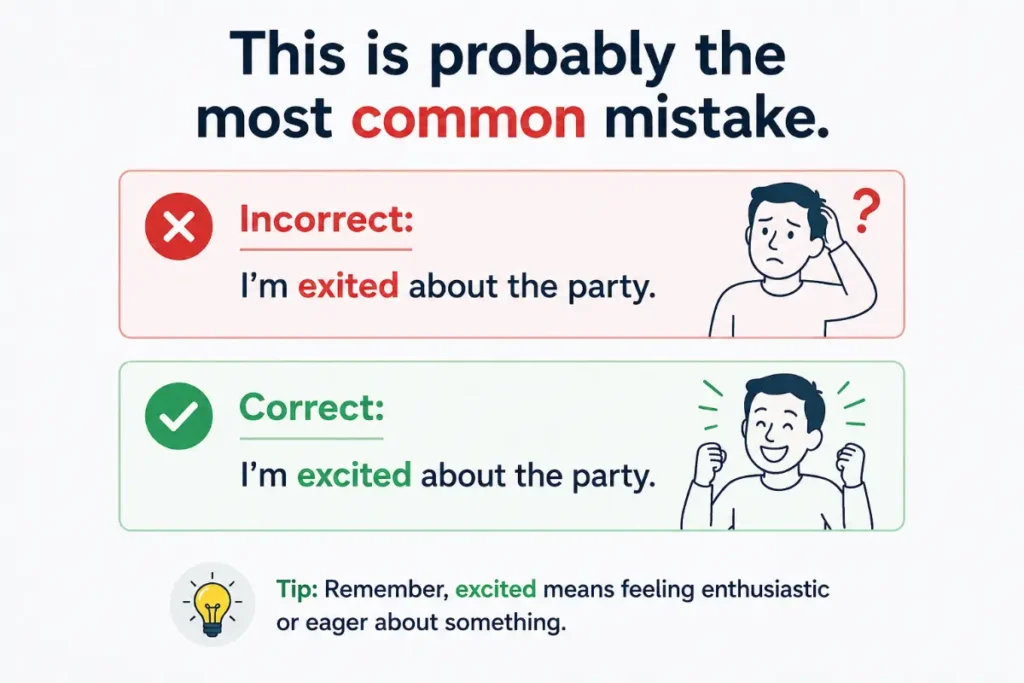
This is probably the most common mistake.
Incorrect:
I’m exited about the party.
Correct:
I’m excited about the party.
The mistake happens because the two forms look so similar. The sentence itself gives you the answer. A party can make you enthusiastic. It doesn’t make sense to say you left the party when you’re trying to describe anticipation.
Writing Excited When You Mean Exited
The reverse mistake can also happen.
Incorrect:
The guests excited the building.
Correct:
The guests exited the building.
The sentence needs a verb meaning left. Excited cannot perform that function.
Confusing Excited With Exciting
These words are related but they don’t have the same job.
Excited describes the person or thing experiencing the feeling.
Exciting describes something that creates the feeling.
Compare:
I’m excited about the game.
The game is exciting.
A person can be excited. An event can be exciting.
Using Excited About Incorrectly
Excited about is very common in American English.
For example:
She’s excited about her new project.
You can also use excited to before a verb.
For example:
I’m excited to meet the team.
The structure changes slightly but the meaning stays connected to enthusiasm.
Treating Exited As A Synonym For Left In Every Situation
Exited does mean left but it isn’t always the most natural choice.
For example:
I exited my house at seven.
This is grammatically possible but sounds formal and somewhat stiff in ordinary conversation.
I left my house at seven.
That sentence sounds more natural for most casual situations.
The word exited works especially well when the act of leaving is relevant to the context.
Pronunciation Guide
Excited
The common pronunciation is /ɪkˈsaɪtɪd/.
It has three syllables:
ik
SAI
tid
The main stress falls on the middle syllable.
The first part sounds like the beginning of the word excite. The ending changes because excited contains the past participle ending.
Exited
Exited is commonly pronounced with three syllables as well.
A useful pronunciation guide is:
EG
ZAI
tid
The first syllable often sounds like eg followed by a sound similar to the beginning of exit.
Because pronunciation can vary slightly in natural speech it’s better to use meaning and grammar as your main test.
If you’re proofreading quickly don’t rely on sound alone. Look at the word’s role in the sentence.
Etymology and Word Origin
The history of these words explains why they look related even though their modern meanings differ.
Excite ultimately traces back to Latin excitare which carried the idea of stirring up or rousing. The word developed through French before entering English. Over time English speakers used excite for producing strong emotional or mental activity.
The adjective excited developed from this verb. Its modern everyday meaning centers on enthusiasm anticipation or strong emotional interest.
Exit has a different historical path. It comes from Latin exire meaning to go out. The Latin expression entered English through later language development and eventually became the English noun and verb exit.
Exited is simply the past tense and past participle of exit.
The shared beginning ex has historical importance. In Latin it often carried the idea of out or outward movement. But the rest of each root gives the words their distinct meanings.
That history explains why the words look somewhat similar without suggesting that they mean the same thing.
Many readers also check lieing or lying Correct Spelling And Usage.
Regional Usage
American English
Both words are standard in American English.
Excited is extremely common in everyday speech and writing. Americans regularly use it to describe enthusiasm anticipation and happiness.
For example:
I’m excited about the trip.
Exited is also correct but often sounds more formal than left.
For example:
The visitors exited the building.
In casual American conversation many people would say:
The visitors left the building.
British English
British English also uses both words with the same basic meanings.
Excited describes enthusiasm or anticipation.
Exited means left.
There is no major British American difference that changes the central distinction between these two words.
Australian English
Australian English follows the same basic distinction.
Excited describes a feeling.
Exited describes an act of leaving.
The everyday choice between exited and left can depend on the situation and tone rather than a different definition.
Canadian English
Canadian English also uses both forms in the standard meanings described above.
A Canadian speaker can say:
I’m excited about the concert.
A Canadian writer can also say:
The guests exited the building.
The central distinction remains consistent across these major varieties of English.
Grammar Rules and Part of Speech
Excited has two closely related grammatical functions.
First it can work as an adjective.
For example:
She looks excited.
They seem excited.
I’m excited about the opportunity.
In these sentences excited describes a state or feeling.
It can also function as the past participle of excite.
For example:
The news excited the crowd.
The crowd was excited by the news.
Exited has a different grammatical role. It is the past tense and past participle of exit.
For example:
He exited the room.
She has exited the building.
The guests had exited before the doors closed.
The tense can help you identify the word.
If you can replace the word with left and the sentence still makes sense then exited may be the right choice.
For example:
He exited the room.
He left the room.
The meaning remains close.
Now try that test here:
He was excited about the room.
He was left about the room.
The second sentence makes no sense. That tells you the intended meaning is emotional rather than physical.
Common Grammar Patterns With Excited
One common structure is:
excited about + noun.
For example:
She’s excited about the new course.
Another is:
excited to + verb.
For example:
They’re excited to begin.
You can also use:
excited that + clause.
For example:
I’m excited that you can join us.
These structures appear frequently in natural English.
Common Grammar Patterns With Exited
Exited usually takes a place or situation as its object.
For example:
He exited the office.
The passengers exited the vehicle.
The audience exited the theater.
It can also appear with a phrase explaining how or where someone left.
For example:
She exited through the rear door.
They exited from the north entrance.
The word is often more formal than left so context matters.
Real Life Usage Examples
Daily Conversation
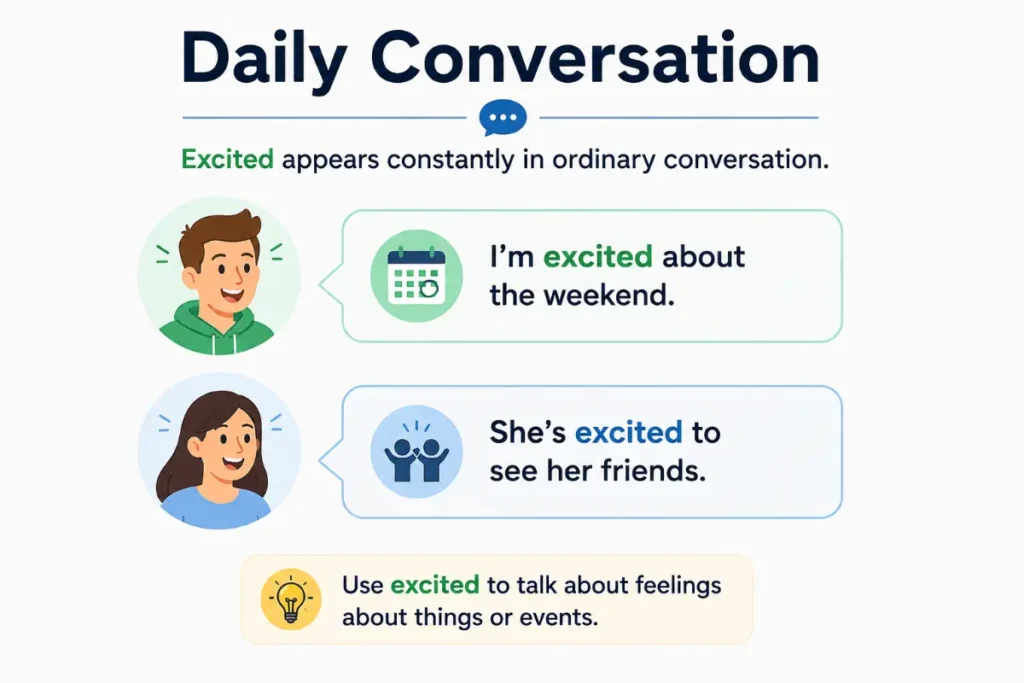
Excited appears constantly in ordinary conversation.
I’m excited about the weekend.
She’s excited to see her friends.
They’re excited about their new house.
Exited appears less often in casual speech because people usually say left.
Still you might hear:
He exited through the back door.
The phrase works naturally when the manner or location of departure matters.
Workplace Communication
Both words can appear in professional writing.
For example:
The team is excited about the upcoming launch.
The visitors exited the conference room at noon.
The first sentence describes enthusiasm. The second records an action.
In formal workplace writing exited can sometimes sound more precise than left when describing movement through a particular space.
Academic Writing
Academic writing may use excited in scientific contexts.
For example:
The excited atom moved to a higher energy state.
Here excited has a technical meaning rather than simply meaning happy.
Exited can also appear in academic descriptions of movement.
For example:
The participants exited the testing area after completing the task.
The context makes the intended meaning clear.
News And Journalism
News writing may use exited when describing people leaving a location.
For example:
The passengers exited the station after the service resumed.
Excited can appear when reporting reactions.
For example:
Fans were excited about the team’s return.
Good writing uses the word that matches the action or emotion being described.
Literature And Storytelling
Writers often use excited to reveal a character’s emotional state.
For example:
Anna was excited to open the letter.
Exited can help describe physical movement.
For example:
He exited the room without saying another word.
The contrast is simple. One shows what a character feels. The other shows what a character does.
Related And Confused Terms
Exciting
Exciting means causing enthusiasm or interest.
The movie was exciting.
Excited describes the person experiencing that reaction.
I was excited by the movie.
Eager
Eager means strongly interested or ready to do something.
She was eager to begin.
Eager and excited can overlap but they aren’t always interchangeable.
Enthusiastic
Enthusiastic means showing strong interest or approval.
He’s enthusiastic about the project.
It often sounds slightly more formal than excited.
Thrilled
Thrilled means extremely pleased or excited.
She was thrilled to receive the award.
It expresses stronger emotion than ordinary excited in many contexts.
Nervous
Nervous describes worry or unease.
I’m nervous about the interview.
A person can feel nervous and excited at the same time.
Leave
Leave is one of the most common everyday alternatives to exit.
She left the office at five.
It usually sounds more natural than exited in casual conversation.
Depart
Depart means leave and often sounds more formal.
The train departed at six.
It’s common in travel announcements and formal writing.
Enter
Enter is related to movement into a place rather than out of it.
She entered the room quietly.
Exit and enter form a useful opposite pair.
A Simple Memory Trick
Use the root word as your shortcut.
Excited comes from excite.
Exited comes from exit.
If you can replace the word with enthusiastic then excited is probably right.
For example:
She was enthusiastic about the trip.
She was excited about the trip.
The meanings work.
If you can replace the word with left then exited is probably right.
For example:
He exited the building.
He left the building.
Again the meanings work.
This simple substitution test is faster than trying to remember a complicated spelling rule.
Another useful trick is to connect the c in excited with cheer or celebration. That isn’t an official linguistic rule but it can help you remember the spelling.
For exited think of exit signs. An exit tells you where to go when you’re leaving.
How To Catch The Mistake While Proofreading
Professional proofreading starts with meaning rather than appearance.
When you see excited or exited in a sentence ask one simple question.
Is this sentence talking about a feeling or leaving?
If it describes enthusiasm anticipation or strong interest use excited.
If it describes departure use exited.
This method works especially well because spelling tools don’t always catch correctly spelled words used in the wrong context. Both excited and exited are legitimate English words. A spell checker may accept either one even when the sentence needs the other.
For example:
I’m exited for the holiday.
Every word in that sentence may look familiar to a spell checker. Yet the sentence contains the wrong word for the intended meaning.
A human editor notices the meaning.
That’s why context remains one of the most useful tools in proofreading.
Expert Editor Insight
An experienced editor usually resolves this confusion by checking the root and the sentence function. If the word describes a person’s emotional response then excited fits. If it describes movement away from a location then exited fits. The strongest editing habit is to read the entire sentence for meaning rather than relying only on a spelling checker. Context catches errors that a dictionary based spell checker can miss because both forms are legitimate words.
Why Spelling Tools May Not Catch The Error
This confusion shows why grammar and spelling software has limits.
A spelling checker generally looks for words that are absent from its accepted vocabulary or incorrectly formed. Since excited and exited are both real English words the software may not flag the wrong one.
Some advanced writing tools use context to identify word choice problems. Even then automated suggestions can miss subtle meaning differences.
Consider:
I’m exited to meet you.
The intended word is clearly excited. Yet exited is a correctly spelled English word. A basic spelling checker has little reason to reject it.
This is known as a contextual word choice problem. The issue isn’t that the word itself is spelled incorrectly. The issue is that it doesn’t fit the meaning of the sentence.
That distinction matters far beyond these two words. English contains many pairs where both forms are legitimate but only one fits the context.
Why Native Speakers Still Mix Them Up
The confusion is easy to understand.
Both words are short.
Both can appear in sentences about people.
The eye can move quickly across the spelling and miss the difference.
Typing makes the problem even easier to create. When people write quickly they often remember the overall shape of a word rather than every individual letter.
That’s why a careful meaning check is more useful than simply staring at the spelling.
The good news is that this is a small mistake with a simple solution. Once you connect excited with emotion and exited with leaving the distinction becomes much easier to remember.
Many readers also check gizmo vs gismo: Which Spelling Is Correct?.
Conclusion
The difference between excited or exited comes down to meaning. Excited describes enthusiasm anticipation or strong interest. Exited is the past tense of exit and means left. Both are correct English words so the issue isn’t choosing a universally correct spelling. It’s choosing the word that matches your sentence.
The easiest way to remember the distinction is to look at the root. Excited comes from excite and connects with emotion. Exited comes from exit and connects with leaving. If you can replace the word with enthusiastic use excited. If you can replace it with left use exited.
When proofreading take a second to read for meaning instead of relying only on a spelling checker. That small habit can catch contextual mistakes that automated tools may overlook. Once you connect each word with its root the confusion becomes much easier to avoid.
FAQs
Is Exited A Real Word?
Yes. Exited is a standard English word. It is the past tense and past participle of the verb exit. It means that someone or something left a place or situation. For example: The passengers exited the bus. The word is completely correct when the sentence describes departure.
What Does Excited Mean?
Excited means feeling enthusiastic eager thrilled or strongly interested in something. For example: She was excited about her vacation. It can also appear in technical contexts such as physics where it can describe an atom or particle in a higher energy state.
Which Word Should I Use For Happiness Or Anticipation?
Use excited when you describe happiness enthusiasm anticipation or strong interest. For example: I’m excited about the concert. You can also say I’m excited to see you. The word describes an emotional response rather than physical movement.
Which Word Means Someone Left?
Exited means someone left a place or situation. For example: He exited the building after the meeting. In casual conversation left often sounds more natural. Exited can sound more formal or precise when the location or manner of departure matters.
How Do You Pronounce Excited?
Excited is commonly pronounced /ɪkˈsaɪtɪd/. It has three syllables and the main stress falls on the middle syllable. A simple pronunciation guide is ik SAI tid. The exact sound can vary slightly in connected speech.
Can Excited Be Used In Formal Writing?
Yes. Excited is completely standard in formal writing. Its suitability depends on context. In professional writing you might say employees were excited about a new opportunity. In scientific writing excited can also have a specialized meaning related to energy states.
Why Do People Confuse These Two Words?
People confuse them because the spelling and pronunciation are similar. They also share several letters and the same ending. The easiest solution is to check the root word. Excite relates to enthusiasm. Exit relates to leaving. The meaning of the sentence usually makes the correct choice clear.
Is Excited Better Than Exited In Everyday English?
Neither word is better in every situation. Excited is correct for feelings and anticipation. Exited is correct for leaving. In casual American English people often use left instead of exited because it sounds more natural. The choice should depend on the meaning and tone of the sentence.