
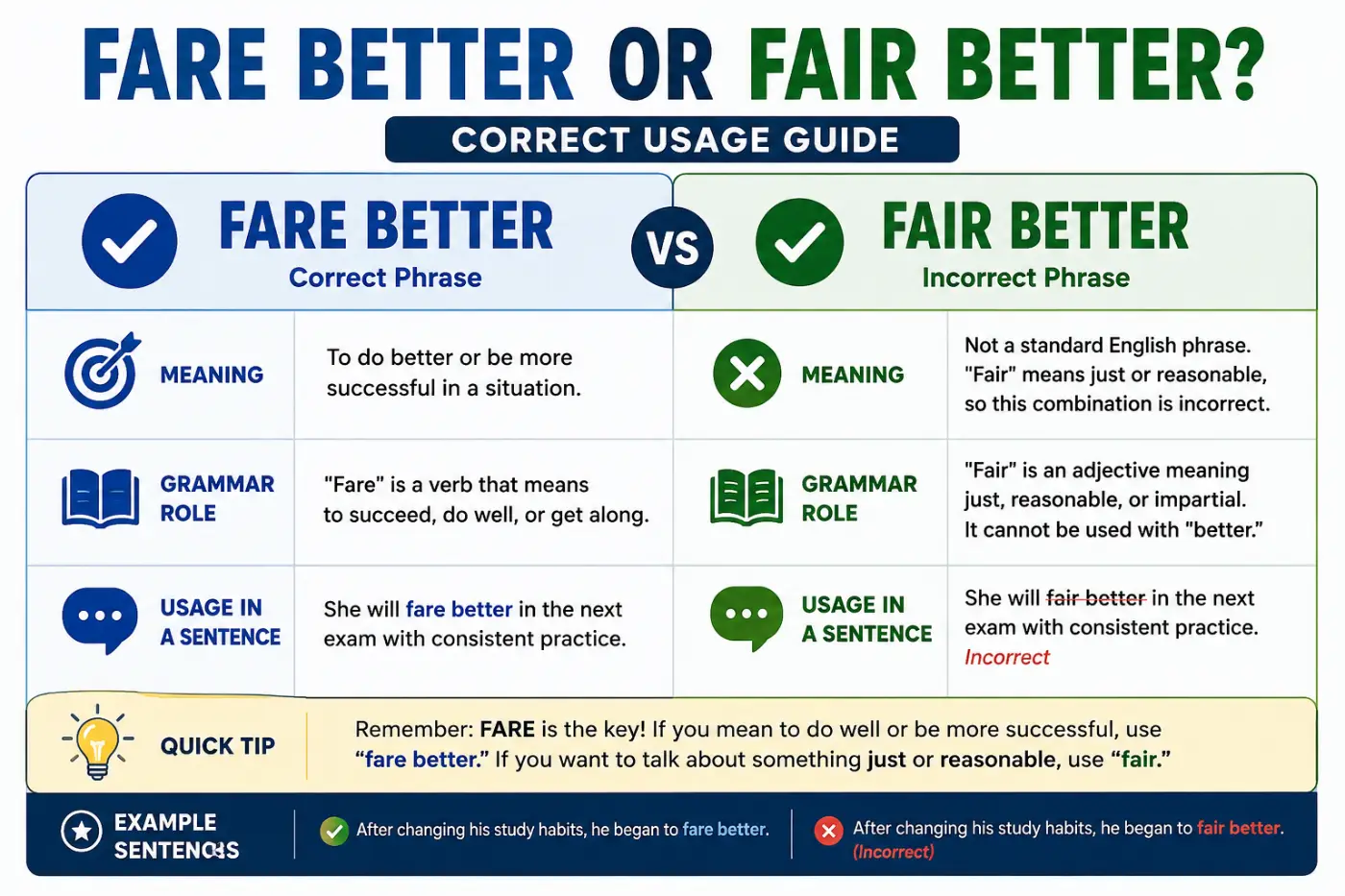
Have you ever written a sentence about someone doing better next time and wondered if the correct phrase is fare better or fair better? These two words sound the same, but they have different meanings and grammatical uses.
The correct expression is fare better. It means to perform better, make better progress, or achieve a better result in a particular situation. Fair better isn’t the standard phrase for this meaning.
The confusion happens because fare and fair are homophones. In most varieties of English, they have the same pronunciation but different meanings. Fare can work as a verb meaning to progress or succeed, while fair is commonly used as an adjective meaning reasonable, just, or acceptable. Fair can also function as a noun or adverb in certain contexts.
In this guide, you’ll learn the meaning, pronunciation, grammar, examples, and proper usage of fare better and fair. You’ll also see why fair better is incorrect in this context and learn a simple way to remember which word to use in everyday, academic, and professional writing.
Many readers also check training or trainning Correct Spelling Meaning and Usage.
Quick Definition
Fare better is the correct phrase when you mean to perform better progress more successfully or achieve a better result. Fair better is normally incorrect in this context. The verb fare can be followed by words such as better worse well or badly to describe how someone or something performs in a situation.
Quick Answer
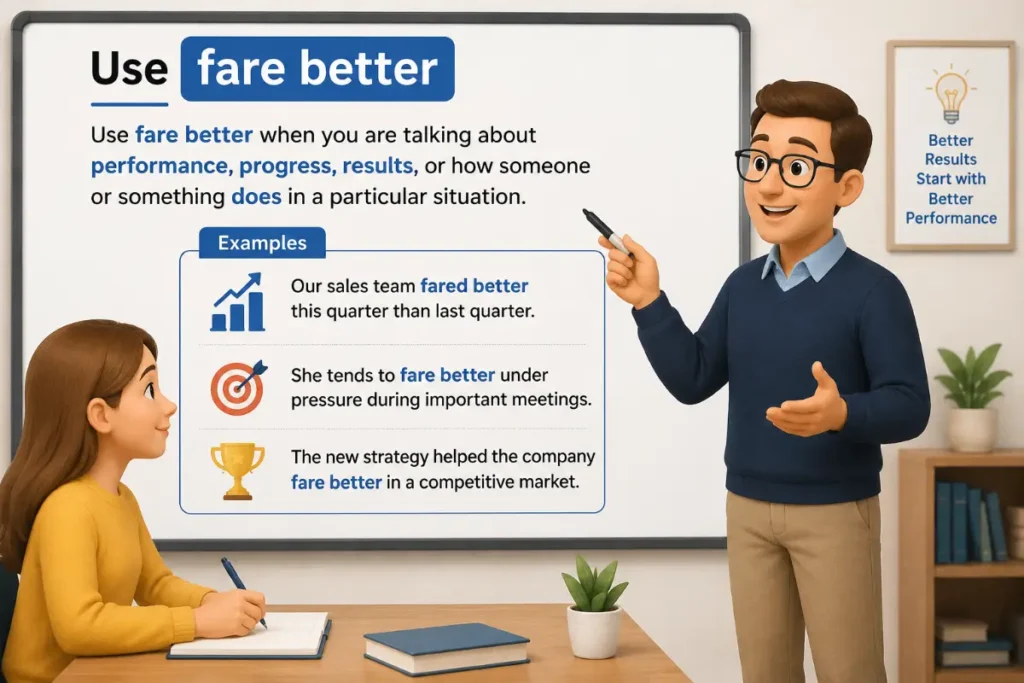
Use fare better when you are talking about performance progress results or how someone or something does in a particular situation.
For example you can write Students who prepare early tend to fare better on exams. The word fare works as the verb. The word better modifies the degree of performance.
Comparison Table For Fare Better Or Fair Better
| Correct Form | Meaning | Part of Speech | Origin | Usage Frequency | Formality | Common Contexts | Example |
|---|---|---|---|---|---|---|---|
| Fare better | Perform or progress more successfully | Verb phrase | Old English | Common | Neutral to formal | Exams work competition health business results | Students who prepare carefully often fare better. |
| Fair better | Not the standard form for this meaning | Not a standard verb phrase for this use | Fair has separate Old English roots | Uncommon as this phrase | Not recommended | Usually a spelling error for fare better | The correct sentence is Students will fare better with practice. |
Meaning And Definition
Meaning Of Fair
Fair is a real English word. The problem isn’t the word itself. The problem appears when writers use it in place of fare.
Fair has several established meanings. It can describe something that is just reasonable or impartial. You can receive a fair price receive a fair chance or expect fair treatment. Cambridge also lists fair as an adjective meaning reasonable or equal in treatment.
Fair can also describe something that is neither very good nor very bad. For example a student might receive a fair result or give a fair performance. It can describe light hair or skin. It can refer to pleasant weather. It can also refer to an event such as a county fair book fair or trade fair.
Fair also has legitimate adverb and verb uses. Oxford lists the adverb fair in expressions such as play fair. Merriam Webster lists a verb fair with specialized meanings connected with weather and the joining of surfaces.
None of those standard meanings gives us the ordinary expression fair better when we mean perform better.
Meaning Of Fare
Fare has several meanings too. As a noun it can mean the money paid for transportation. You might pay a bus fare train fare or taxi fare. It can also refer to food or something offered to the public.
The meaning that matters here is the verb fare.
As a verb fare means to perform to progress or to succeed in a particular situation. Cambridge gives examples such as how did you fare in your exams and the party fared well in recent elections.
Oxford gives the same core idea. Its entry explains that fare well badly better and similar combinations describe being successful or unsuccessful in a particular situation.
That is exactly why fare better works.
When you say a student will fare better with more preparation you mean the student is likely to perform better.
When you say a business may fare better under new management you mean its performance or results may improve.
The verb fits the meaning.
Key Differences Explained
Spelling
The words have different spellings even though they sound alike. Fare contains an a before the r. Fair contains ai.
That small spelling difference carries a completely different meaning.
Grammar Role
In fare better the word fare is the main verb. The word better is an adverb describing the degree of performance.
In most uses fair functions as an adjective or noun. It can also function as an adverb in established expressions and as a verb in specialized meanings. It doesn’t normally function as the verb meaning perform in the phrase under discussion.
Meaning
Fare better means perform better or achieve a better outcome.
Fair usually relates to justice equality reasonableness appearance weather events or other established meanings.
The two words aren’t interchangeable simply because they sound identical.
Tone
Fare better has a neutral and professional tone. You can use it in casual conversation as well as formal writing.
For example a teacher might say that students who practice regularly fare better. A researcher might write that participants with additional training fared better.
Context
Use fare better when discussing performance progress outcomes or results.
Use fair when discussing fairness equality reasonableness or one of its other dictionary meanings.
This context test is often enough to settle the question in seconds.
Which Spelling Is Correct
Fare better is the correct form when the intended meaning is perform better or achieve a better result.
The linguistic reason is straightforward. Fare is an established intransitive verb that can combine with adverbs such as well badly better and worse. Oxford specifically lists fare better as a standard verb pattern and provides examples involving competition and social conditions.
Cambridge also gives the pattern fare better in its American Dictionary. Its example explains that middle income families may fare better or worse under new tax laws.
That dictionary evidence gives us a reliable editorial rule.
If you can replace the phrase with perform better or do better and the sentence still makes sense then fare is the word you need.
For example:
Students will perform better with regular practice.
Students will fare better with regular practice.
Both sentences express the same basic idea.
The second version is concise and natural.
Sentence Examples
Here are natural examples that show how fare better works.
- Students who review their notes regularly usually fare better on exams.
- Small businesses may fare better when they understand their local customers.
- You’ll probably fare better if you arrive early and avoid the rush.
- Athletes who follow a consistent training plan often fare better during long competitions.
- New employees tend to fare better when they receive clear instructions.
- Some plants fare better in indirect sunlight than in direct afternoon heat.
- The team fared better after changing its defensive strategy.
- People often fare better in interviews when they prepare specific examples.
- The company could fare better next year if it controls unnecessary costs.
- Children may fare better when teachers give them clear and practical feedback.
Notice the pattern. The subject performs or progresses in some way. The verb fare carries that idea. The word better tells us that the result is more successful than another result or an earlier situation.
Now compare those sentences with the common spelling mistake.
- Students who review their notes regularly usually fair better on exams.
- Small businesses may fair better when they understand their customers.
- You’ll probably fair better if you arrive early.
- The team fair better after changing its strategy.
- Children may fair better with clear instructions.
These examples should use fare instead.
The mistake doesn’t change the intended meaning for most readers. They can usually understand what the writer meant. Still the spelling is incorrect for standard English and can make polished writing look careless.
Common Mistakes And Misspellings
The most common mistake is writing fair because the speaker hears the sound and chooses the more familiar spelling.
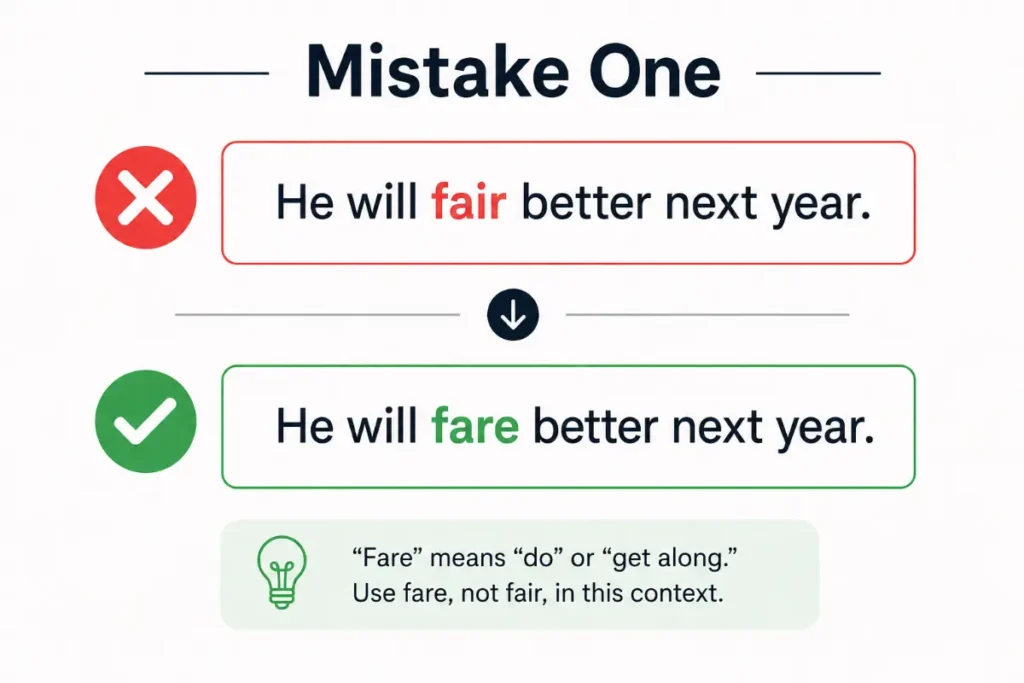
Mistake One
He will fair better next year.
Correct form:
He will fare better next year.
The sentence describes future performance. That requires the verb fare.
Mistake Two
She fared well in the competition.
This one is correct.
Some writers mistakenly change fared to faired because they know the spelling of fair. The correct past tense of fare is fared. Cambridge identifies fared as the past simple and past participle of fare.
Mistake Three
The new policy should fair better for workers.
This sentence needs revision because the intended meaning isn’t expressed by fair. You might write:
The new policy should work better for workers.
Or:
Workers should fare better under the new policy.
The second sentence uses the traditional verb correctly.
Mistake Four
The team may fair worse without additional training.
Write:
The team may fare worse without additional training.
The same rule applies to worse. The verb can combine with better worse well and badly.
Mistake Five
People who prepare often fair well.
Write:
People who prepare often fare well.
This is a classic homophone error.
The NLP reason behind the confusion is simple. When people process spoken English they often identify words through sound before they consider spelling. Since fare and fair are homophones in common pronunciation the brain has to use context to select the correct written form. Familiarity also plays a role because fair appears frequently in everyday English.
You may also want to read According to Alternatives for Clearer Writing.
Pronunciation Guide
Fare and fair are normally pronounced alike.
In American English the pronunciation is commonly represented as /fer/. Cambridge gives this pronunciation for the American form of fare. Oxford gives the American pronunciation as /fer/ as well.
The word has one syllable.
You can think of the sound as:
fair
That identical sound is the main reason the spelling error happens.
The pronunciation doesn’t tell you which spelling to choose. Context does.
If the sentence means perform or progress use fare.
If the sentence means just reasonable or impartial use fair.
For example:
How did you fare in the interview?
Here fare means perform or do.
The interviewer gave every candidate a fair chance.
Here fair means reasonable and equal.
The sounds are alike but the meanings are miles apart.
Etymology And Word Origin
The history of fare helps explain why the modern verb has a connection with progress and performance.
Oxford traces the verb to Old English fær and faru meaning traveling a journey or expedition. It also connects the word with the Old English verb faran meaning to travel. Related Germanic forms include Dutch varen and German fahren.
The idea of traveling eventually developed into broader meanings connected with how someone gets along or proceeds. That historical development helps explain modern expressions such as fare well and fare badly.
The noun fare also developed from the idea of a journey for which a price is paid. That gives us the modern transportation meaning of fare.
The history of fair is separate.
Merriam Webster traces the adjective fair to Old English fæger meaning pleasing to the eye or mind. Its noun meaning developed through Middle English from Old French and Latin roots connected with a gathering or market.
So the two words aren’t different spellings of the same word. They have different histories and developed into different words.
That is one reason you shouldn’t try to remember them as interchangeable forms.
Regional Usage
United States
In American English fare better is standard and widely understood. Cambridge’s American Dictionary specifically uses fare better to describe progress or performance.
American readers will generally understand fair better as a spelling mistake when the sentence discusses results or performance.
United Kingdom
British English also uses fare better in the same sense. Oxford and Cambridge both give the verb pattern with better well badly and worse.
British English has many established expressions with fair such as fair play and fair enough. Those uses don’t make fair better correct for the meaning of perform better.
Australia
Australian English follows the same broad standard English distinction. A writer discussing results progress or performance should use fare better.
The pronunciation may vary slightly across speakers and regions but the spelling distinction remains.
Canada
Canadian English also follows the standard distinction. Fare better is the appropriate phrase when discussing improved performance or outcomes.
There is no standard Canadian spelling variant that changes the phrase to fair better.
Grammar Rules And Part Of Speech
The most useful grammar rule is simple.
Fare is an intransitive verb in this construction. That means it doesn’t take a direct object in the normal way.
You can say:
The students fared better.
You can also say:
The students fared better on the final exam.
The phrase tells us how the students performed.
You can change the tense without changing the basic rule.
Present: Students fare better with practice.
Past: Students fared better with practice.
Future: Students will fare better with practice.
Perfect: Students have fared better with additional support.
You can also use different adverbs.
fare well
fare badly
fare better
fare worse
fare best
fare poorly
Oxford explicitly lists these adverb combinations under the verb fare.
Where To Place Fare Better
The phrase often appears after the subject.
Students fare better with regular practice.
It can also appear after a modal or auxiliary verb.
Students may fare better with regular practice.
Students will fare better with regular practice.
Students have fared better this year.
You can also place it after a subject followed by a comparison.
Students who receive early feedback tend to fare better than students who receive feedback at the end.
Punctuation
There is no special punctuation rule for fare better.
Use normal sentence punctuation.
You may fare better if you leave early.
The company fared better than expected.
If the phrase appears in a longer sentence use commas only when the broader sentence structure requires them. The phrase itself doesn’t need commas.

Real Life Usage Examples
Daily Talk
In everyday conversation you might say:
You’ll fare better if you take the earlier train.
This means the person is likely to have a better experience or result.
Another natural example is:
I think she’ll fare better at the new school.
The phrase sounds slightly more polished than simply saying she will do better but it remains completely natural.
Professional emails often use fare better when discussing results.
The team may fare better if we move the deadline.
Another example is:
Our clients tend to fare better when they receive the information in advance.
The expression works well in professional writing because it communicates an expected outcome without sounding overly dramatic.
Academic Writing
Academic writers often use the phrase when comparing groups or outcomes.
Students who receive targeted feedback may fare better in later assessments.
Another example is:
Participants who completed the preparation session fared better on the final task.
The phrase is useful because it describes comparative performance without forcing the writer to repeat words such as perform or succeed.
News Writing
News writing frequently discusses how political parties markets teams businesses or communities perform.
The incumbent candidate may fare better in urban districts.
Another example is:
Smaller companies fared better than expected during the downturn.
The phrase is concise and works naturally in analytical reporting.
Literature
In literary writing fare can sound slightly more traditional than simply saying do. That quality fits narrative prose especially when the writer wants a formal or reflective tone.
For example:
Only time would tell how he would fare in the unfamiliar city.
Another example is:
She wondered how her old friend had fared after leaving home.
These examples show why the verb remains useful beyond straightforward business or academic contexts.
Related And Confused Terms
Several expressions overlap with the meaning of fare better but aren’t identical.
At Last
At last usually means something happens after a long wait.
At last the train arrived.
It doesn’t normally mean perform better.
Eventually
Eventually means after some time or after a series of events.
She eventually found a better solution.
The word focuses on time rather than performance.
Ultimately
Ultimately points to the final result or conclusion.
Ultimately the decision benefited the entire team.
It can overlap with discussions of outcomes but it isn’t a direct synonym for fare better.
At The End
At the end identifies a final point in time or position.
At the end of the course students received their certificates.
It doesn’t mean perform better.
Conclusively
Conclusively means in a decisive or final way.
The evidence conclusively established the cause.
It relates to certainty rather than performance.
In The End
In the end refers to the final outcome.
In the end the smaller team won.
It can introduce a result but doesn’t replace fare better.
Lastly
Lastly is mainly used to introduce the final item in a sequence.
Lastly we reviewed the budget.
It doesn’t express improved performance.
These terms may appear in the same article or conversation but their functions differ. Treating them as exact synonyms can make writing less precise.
Expert Editor Insight
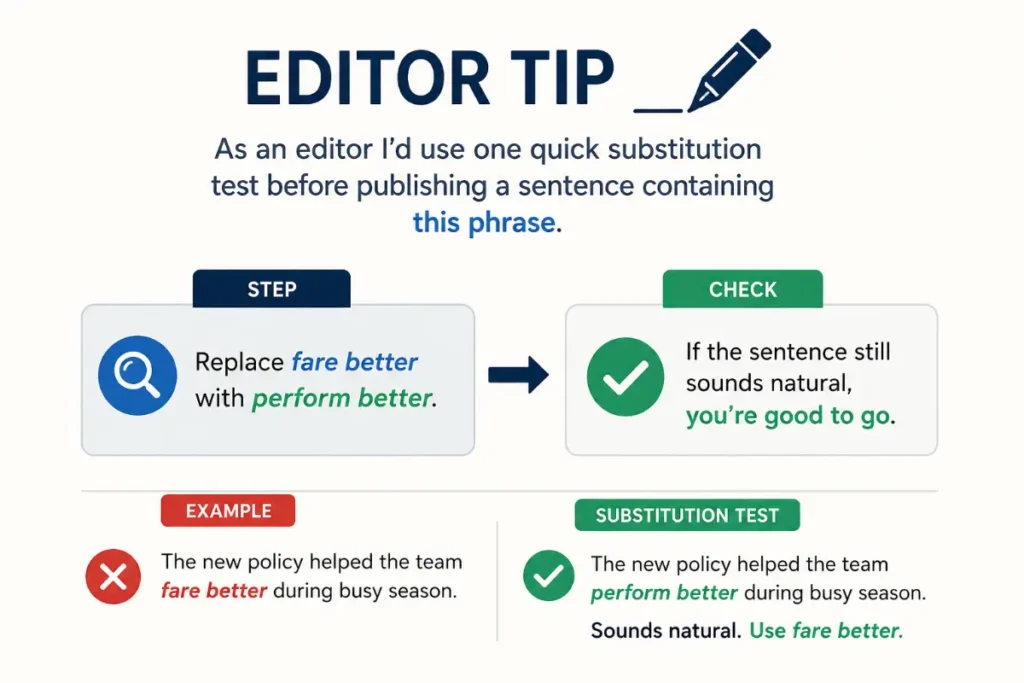
As an editor I’d use one quick substitution test before publishing a sentence containing this phrase. Replace fare better with perform better. If the meaning stays intact then fare is almost certainly the form you need. Dictionary entries from Oxford and Cambridge support this pattern by explicitly listing fare with better as a standard verb combination.
A useful editing check is to look at the word after the subject. If you’re describing how a person team company plant candidate or group performs in a situation then fare is the natural choice. If you’re talking about justice equality reasonableness appearance weather or a public event then you’re probably dealing with fair instead.
Grammar and spelling tools may flag fair better as an incorrect word choice because the surrounding context signals performance. Still automated tools shouldn’t replace human judgment. A dictionary and the sentence’s intended meaning provide stronger evidence than a spell checker alone.
My practical tip is easy to remember:
Fare means perform.
If you can say perform better then you can usually say fare better.
That tiny mental shortcut can save you from one of the most common homophone errors in this area of English.
For another common grammar confusion, see Suing or Sueing: Correct Word, Pronunciation and Usage(2026).
Final Conclusion
The correct phrase is fare better when you mean to perform better, make more progress, or achieve a better result. Fair better is not the standard expression for this meaning. The confusion usually comes from the fact that fare and fair sound the same in most varieties of English.
A simple rule can help you remember the difference. Fare is the verb used to describe how someone or something performs or progresses. Fair has different meanings and is commonly used to describe something reasonable, just, acceptable, or balanced.
When you’re unsure, try replacing fare better with perform better. If the sentence keeps the same meaning, fare is the word you need. Once you connect fare with performance and progress, choosing the correct spelling becomes much easier.
FAQs
Is Fair Better A Real Word?
Fair better isn’t the standard phrase for saying that someone performs better or gets a better result. The correct expression is fare better.
Fair is a real English word with meanings related to justice, reasonableness, appearance, weather, and events. It can also work as an adverb and has some specialized verb uses. However, these meanings don’t create the standard expression fair better.
What Does Fare Better Mean?
Fare better means to perform better, make more progress, or achieve a better result in a particular situation.
For example:
Students who practice regularly fare better on exams.
This means that students who practice regularly generally perform better on exams. Cambridge and Oxford both recognize fare as a verb that can describe how well someone or something performs, including in the expression fare better.
Fare Better Or Fair Better Which Is Correct?
Fare better is correct when you mean perform better or get a better result.
Fair better is normally a spelling mistake in this context. The difference comes from meaning and grammar, not pronunciation. Fare works as the verb that describes performance or progress. Fair has different meanings and doesn’t normally serve this purpose.
Compare these examples:
Correct: Students who prepare early tend to fare better.
Incorrect: Students who prepare early tend to fair better.
How Do You Pronounce Fare Better?
In American English, fare is pronounced /fer/. It has one syllable and sounds the same as fair in standard American pronunciation.
Because fare and fair are homophones, you can’t choose the correct spelling from pronunciation alone. You need to look at the meaning and grammatical role of the word.
When you mean perform better or achieve better results, use fare.
Can Fare Better Start A Sentence?
Yes. Fare better can appear at the beginning of a sentence when the sentence structure supports it.
For example:
Fare better by preparing early.
This works as an instruction or headline style expression. More commonly, you’ll see fare better after a subject.
Students fare better with regular practice.
The key point is that fare remains the verb that expresses performance or progress.
What Is A Synonym Of Fare Better?
Several expressions can replace fare better, depending on the context. Common alternatives include:
Perform better.
Do better.
Make more progress.
Achieve better results.
Succeed more often.
Perform better is especially useful when you want a direct and clear expression. Fare better has a slightly more polished tone and works naturally in academic, professional, news, and analytical writing.
Why Do People Misspell Fare Better?
People often write fair better instead of fare better because the two words are homophones. They sound alike but have different spellings and meanings.
Fair also appears frequently in everyday English. You might see it in phrases such as fair price, fair treatment, and fair chance. Because the word is so familiar, writers may choose fair when they hear the phrase fare better.
The easiest way to avoid the mistake is to remember the meaning. If you mean perform better, use fare better.
Is Fare Better Suitable For Formal Writing?
Yes. Fare better is fully acceptable in formal writing when you’re talking about performance, progress, or results. You can use it in academic writing, professional communication, news reporting, and analytical writing. Oxford and Cambridge recognize fare as a verb used to describe how someone or something performs. If you want a simpler alternative, you can use perform better or do better. Both are clear and appropriate in formal writing.