
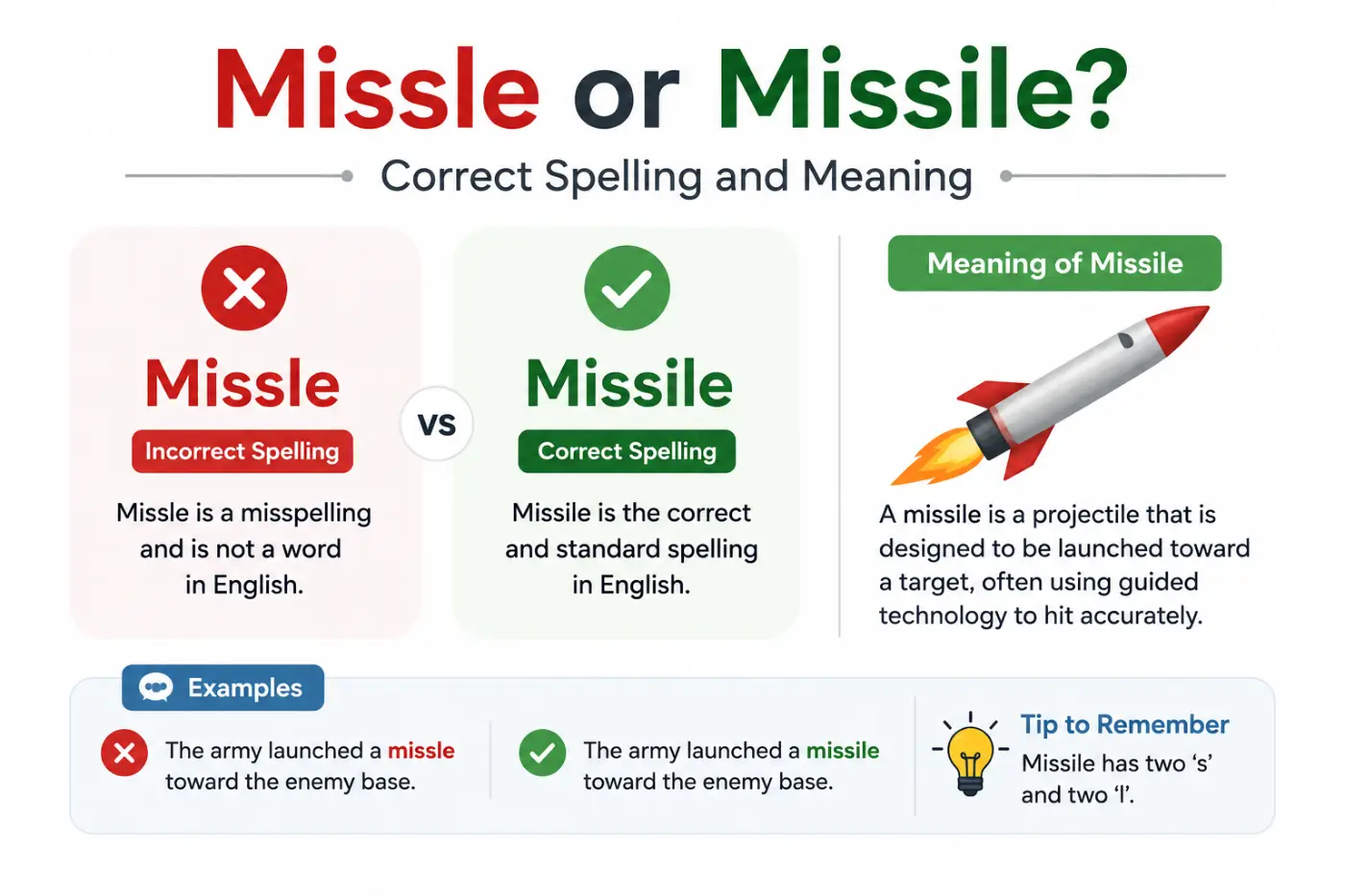
Have you ever typed a word that looks right only to discover that one letter is missing? That’s exactly what happens with missle or missile. The two forms look almost identical at a glance. Yet only one is accepted as the standard English spelling.
The correct spelling is missile. The spelling missle is a common misspelling and doesn’t appear as a standard English dictionary entry for the word. The confusion usually comes from pronunciation. In American English the word is commonly pronounced something like MIS uhl. The middle vowel can sound weak or almost disappear in normal speech. That makes it easy to forget the second i when you write the word.
This guide explains the difference between missle or missile in plain English. You’ll learn the correct spelling meaning pronunciation grammar role word origin regional pronunciation common mistakes and natural examples. You’ll also see why the extra i matters and how to remember the spelling without having to second guess yourself.
Still confused? Compare Encorporate vs Incorporate Meaning and Usage 2026.
Quick Definition
Missile is the correct spelling. It is a noun that usually refers to a weapon designed to travel through the air toward a target. The word can also describe an object thrown through the air with the intention of causing injury or damage. Missle is a common spelling mistake.
Quick Answer
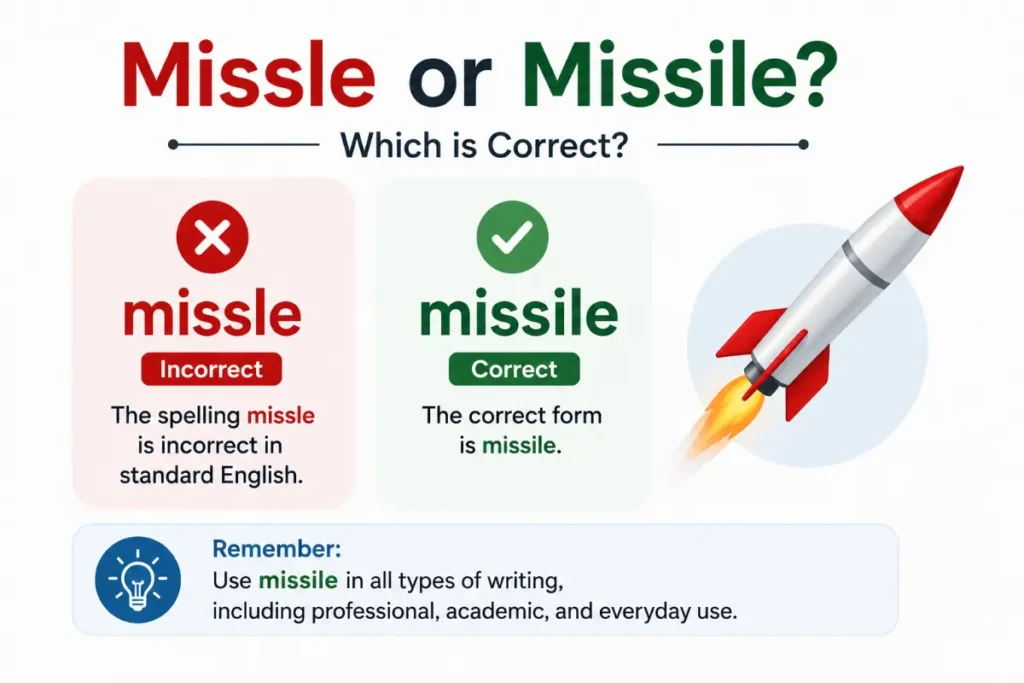
The correct form is missile.
The spelling missle is incorrect in standard English. The correct word contains two i letters in its written form: missile. It usually refers to a weapon that travels through the air toward a target. Dictionaries such as Cambridge Oxford and Merriam Webster recognize missile as the standard English form.
Comparison Table
| Correct Form | Meaning | Part of Speech | Origin | Usage Frequency | Formality | Common Contexts | Example |
|---|---|---|---|---|---|---|---|
| Missile | A weapon or object sent through the air toward a target | Noun | Latin through French | Very common | Standard and formal | News military writing history general English | The missile traveled toward its target. |
| Missle | No standard dictionary meaning as the intended word | None as a standard form | Spelling error based on missile | Uncommon as a correct form | Incorrect | Typing schoolwork informal writing search queries | I accidentally typed missle instead of missile. |
Meaning and Definition
Meaning of Missle
Missle is not the standard spelling of the English word missile. If you type missle into a document or search box while intending to refer to the weapon or projectile then you have most likely left out the second i.
It isn’t normally treated as a slang form. It isn’t an accepted regional spelling either. It is simply a common spelling error.
That distinction matters because some unusual spellings really do have legitimate uses. A word can have a dialect form an older spelling a technical meaning or a proper name. Missle doesn’t function that way in standard modern English.
The mistake is easy to understand. When people pronounce missile quickly the middle vowel can become weak. Your brain recognizes the sound before it processes every letter. During fast typing the second i can disappear from the written form.
Meaning of Missile
Missile is a noun with two closely related meanings.
The most familiar meaning refers to a weapon that travels through the air toward a target. Cambridge defines it as a flying weapon with its own engine that can travel a long distance before exploding at its intended destination.
The word can also have a broader meaning. An object thrown through the air with the intention of causing injury or damage can be called a missile. Cambridge gives this broader formal sense alongside the weapon meaning.
For example you could read about a military missile in a news report. In a historical account you might also find the word used for a stone or another object thrown at someone.
Oxford similarly defines missile as a weapon sent through the air that explodes when it reaches its target. It also recognizes the broader sense of an object thrown at someone to cause harm.
The modern military meaning is now much more familiar than the older general sense. When most people hear missile they think about a guided weapon or another projectile used in military contexts.
Key Differences Explained
- Spelling
Missile is the correct spelling. Missle leaves out the second i. That missing letter is the entire spelling difference.
- Grammar role
Missile is a noun. It names a thing rather than describing an action. You can say a missile was launched or several missiles were detected.
- Meaning
Missile refers to a projectile or weapon that travels toward a target. Missle has no standard meaning as a separate English word.
- Tone
Missile works naturally in everyday conversation as well as formal writing. It frequently appears in journalism academic writing history military discussions and technical contexts.
- Context
You can use missile when discussing weapons military history defense technology or objects thrown at people. Missle should not be used in edited English when you intend the standard word.
The difference may look small on the page but it can make your writing look careless. One missing letter is enough to turn a correct dictionary word into a spelling error.
Which Spelling Is Correct?
Missile is the correct spelling.
The linguistic reason is simple. The standard English word contains the sequence m i s s i l e. The second i belongs to the established spelling and cannot be removed without creating an error.
Major dictionaries support this form. Merriam Webster lists missile as a noun and traces its history to Latin missilis from mittere meaning to throw or send. Its entry also records the word’s first known English use in the early seventeenth century.
Cambridge lists missile as a noun and gives American and British pronunciation information. Oxford also lists missile as the standard noun and provides its pronunciation meaning examples and word origin.
This is useful editorial evidence. When several major dictionaries agree on the same spelling and grammatical category there is no reason to treat the shorter form as an acceptable variant.
An easy memory trick is to think of the word as having a small pair of i letters surrounding the middle sound:
missile
If you remember the second i then the spelling becomes much easier.
Sentence Examples
Here are natural examples showing how native English speakers use missile.
- The military reported that the missile had been intercepted.
- The news report described the missile as a long range weapon.
- The country tested a new missile system during the exercise.
- Officials said the missile was aimed at a military facility.
- The documentary explains how missile technology developed over several decades.
- The radar detected an incoming missile.
- Researchers studied the history of missile development.
- The newspaper published a detailed report about the missile attack.
- The defense system was designed to detect incoming missiles.
- The museum displays historical information about early missiles.
Now look at examples where missle appears as an error.
- I accidentally typed missle in my report.
- The student wrote missle instead of missile.
- My spell checker corrected missle to missile.
- I searched for missle because I couldn’t remember the spelling.
- The editor noticed that missle was missing an i.
These examples show an important point. Missle can appear in real writing because people make mistakes. Its appearance in a sentence doesn’t make it a correct spelling.
Common Mistakes and Misspellings
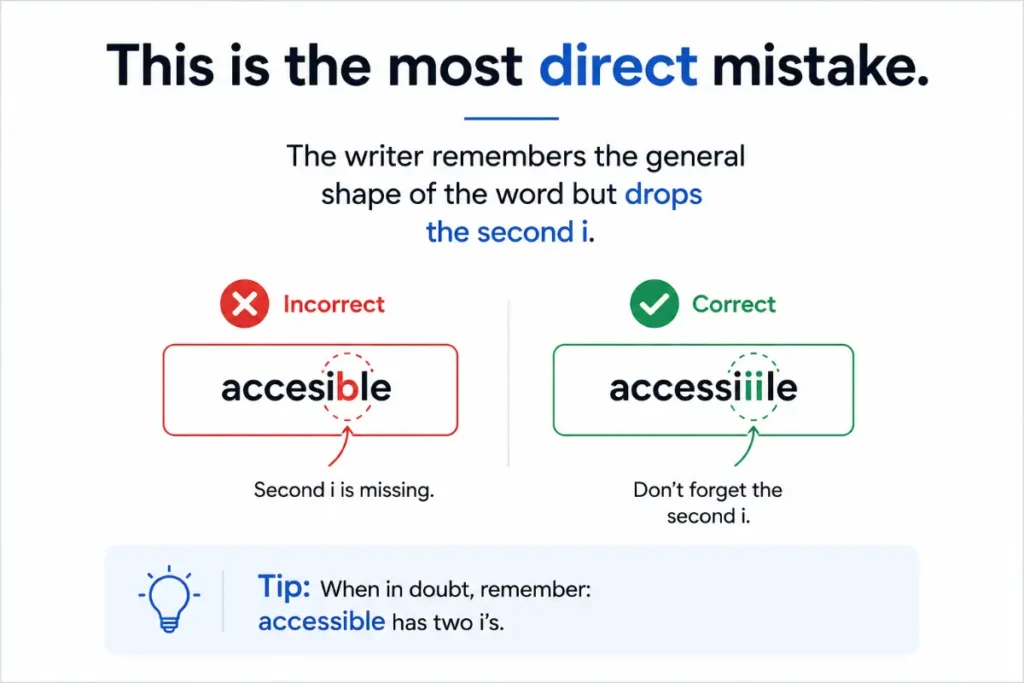
- Writing missle
This is the most direct mistake. The writer remembers the general shape of the word but drops the second i.
- Writing misile
Some writers remove one of the s letters instead. The correct spelling contains two s letters and two i letters.
- Writing misile
This version combines two common spelling problems by losing one s and one i. It can happen when someone relies heavily on pronunciation.
- Writing missil
This error removes the final e. English spelling often makes people unsure about silent letters. In this case the final e belongs to the established spelling.
- Writing missel
This form replaces the second i with e. The pronunciation can encourage this mistake because the unstressed vowel in American English can sound like a weak vowel.
Why do people type missle?
The main reason is the relationship between English spelling and pronunciation. English does not always give you a perfect one letter to one sound relationship. The spoken form of missile can make the second i difficult to hear clearly.
There is also a useful NLP perspective here. People often store familiar words as patterns rather than as individual letters. When a word is recognized quickly the brain can fill in its general shape without consciously checking every character. If the spelling pattern is not strongly memorized then a letter can disappear during typing.
Missile is especially vulnerable to this because its pronunciation doesn’t make every written vowel equally obvious.
That’s why spelling practice should focus on the complete visual pattern rather than sound alone.
Pronunciation Guide
Missile has more than one accepted pronunciation in English.
Cambridge gives the US pronunciation as approximately /ˈmɪsəl/ and the UK pronunciation as /ˈmɪsaɪl/. Oxford also gives pronunciation information that reflects these major patterns.
The American pronunciation can sound like:
MIS uhl
The British pronunciation can sound closer to:
MIS eye uhl
The word has two syllables in the common American pronunciation.
The first syllable sounds like mis.
The second syllable has a weak vowel sound followed by l.
In British pronunciation the second syllable is often more clearly pronounced with the sound found in words such as aisle.
The pronunciation difference explains part of the spelling confusion. In American speech the middle vowel may not sound like a clear i. That makes it tempting to write missle.
Try saying the word slowly while looking at the spelling:
mis sile
Then say it naturally:
missile
The goal isn’t to pronounce every written letter separately. Instead you’re building a visual connection between the sound and the correct spelling.
Etymology and Word Origin
Missile has a long history that reaches back to Latin.
Merriam Webster traces the word to Latin missilis from mittere meaning to throw or send. Oxford gives a similar origin and explains that the English word came from the Latin form associated with something suitable for throwing.
The Online Etymology Dictionary explains that the English adjective appeared in the early seventeenth century with the sense of something capable of being thrown. The noun followed in the seventeenth century.
The older meaning was broader than the modern military meaning. A missile could refer to something thrown or projected toward a target. Over time the word became strongly associated with weapons.
The modern sense of a self propelled rocket or bomb developed later. Etymonline records this sense from the eighteenth century and notes the later development of the word in connection with modern rocket propelled and remotely guided projectiles.
The history gives the spelling some useful context. The word was borrowed into English through a history involving Latin and French forms. Its spelling was not created from modern English pronunciation. That helps explain why the written form may not feel completely intuitive to a modern speaker.
In other words the spelling has history behind it. You don’t have to invent a pronunciation based spelling. The established form is simply missile.
Regional Usage in the US
American English commonly uses missile in military reporting general news academic writing and everyday discussion. Cambridge gives the US pronunciation as /ˈmɪsəl/.
The American pronunciation is one reason the spelling can be confusing. The second syllable is weak and may sound like a simple unstressed vowel. Still the written form remains missile.
Regional Usage in the UK
British English also uses missile as the standard spelling. The pronunciation is commonly represented as /ˈmɪsaɪl/. Cambridge lists this British form alongside the American pronunciation.
The clearer second syllable can make the spelling easier to connect with the written word. British speakers still spell it missile.
Many readers also check counselor vs councilor: Meaning and Correct Usage.
Regional Usage in Australia
Australian English follows the standard international spelling missile. The word appears in the same general military news academic and historical contexts found in other major varieties of English.
Pronunciation can vary by speaker and accent. The spelling does not change to missle.
Regional Usage in Canada
Canadian English also uses missile as the standard spelling. Dictionary sources recognize an American style pronunciation alongside other accepted English pronunciation patterns. The spelling remains stable even when individual speakers pronounce the second syllable differently.
This is a useful lesson for English learners. Pronunciation can vary across regions while spelling stays the same.
Grammar Rules and Part of Speech
Missile is primarily a noun.
A noun names a person place thing or idea. In this case missile names an object or weapon.
You can use it as a singular noun:
The missile was detected.
You can also use its plural form:
Several missiles were detected.
The plural is formed by adding s:
missile → missiles
The word commonly appears after verbs such as launch detect intercept fire track and destroy.
For example:
The system detected the missile.
The country launched a missile.
The radar tracked several missiles.
It also appears before other nouns in compound expressions. Common examples include missile defense missile system missile attack missile site missile test and missile technology.
When missile appears in a sentence it doesn’t normally need special punctuation. It follows the ordinary grammar rules for nouns.
The word can also be used in a broader sense for something thrown through the air. That use is more formal.
For example:
The crowd threw stones as missiles.
In modern writing that meaning is less common than the military sense. Still it remains part of the word’s dictionary history.
Real Life Usage Examples
Daily Talk
- My brother asked how to spell missile because he kept leaving out the second i.
- We watched a documentary about how missiles work.
The word can appear in ordinary conversation even though many people encounter it most often through news or history.
- The report contains information about missile testing in the region.
- Please check the spelling of missile before sending the document.
In professional email the correct spelling matters because spelling errors can distract readers from the actual information.
Academic Writing
- The paper examines the development of missile technology during the twentieth century.
- Historians have studied the role of missiles in modern military strategy.
Academic writing benefits from precise terminology. Using the standard spelling is part of that precision.
News
- Officials reported that a missile was detected near the border.
- The government released a statement following the missile launch.
News writing often uses missile alongside terms such as launch attack defense system target and interception.
Literature
- The poet described the arrow as a missile moving through the night.
- The historical novel used missile in its older sense for an object thrown toward an enemy.
Literary writing can use the broader meaning because authors often draw on older vocabulary.
Related and Confused Terms
- At last
At last usually describes something that happens after a long wait. It often carries a sense of relief.
Example: At last the train arrived.
- Eventually
Eventually refers to something that happens after some time or after a series of events.
Example: She eventually found the correct spelling.
- Ultimately
Ultimately refers to the final result or final conclusion of a situation.
Example: Ultimately the decision depended on the evidence.
- At the end
At the end points to the final part of a period event or sequence.
Example: At the end of the lesson we reviewed the spelling rule.
- Conclusively
Conclusively means in a way that settles an issue with clear evidence.
Example: The evidence conclusively established the correct spelling.
- In the end
In the end refers to the final outcome of a situation.
Example: In the end she remembered the spelling.
- Lastly
Lastly introduces the final point in a series.
Example: Lastly check the spelling before publishing the article.
- Projectile
Projectile is closely related to missile in meaning because both can refer to something projected through the air. Oxford lists projectile as a synonym for the broader sense of missile involving an object thrown at someone.
These terms are useful for vocabulary building but they don’t replace missile in every sentence. Context determines the best choice.
Expert Editor Insight
As a senior editor I’d treat missle as a straightforward spelling error rather than a meaningful alternative form. The safest approach is to memorize the visual structure of missile and connect it with the pronunciation you normally use. Dictionary evidence is especially useful here because Cambridge Oxford and Merriam Webster all recognize missile as the standard form.
A practical editing trick is to search your document for missle before publication. Spell checkers will often catch it but you shouldn’t rely on software alone. A dictionary check confirms the word and its meaning while context tells you if missile is actually the term you intended.
An Easy Way to Remember the Spelling
If you keep writing missle then use a visual memory trick.
Think of the spelling as four important parts:
miss + ile
The word begins with miss and ends with ile.
That gives you:
miss + ile = missile
You can also remember that the word has two i letters.
m i s s i l e
The first i appears near the beginning. The second i appears after the two s letters.
When you write the word slowly once or twice you’ll usually notice the pattern becomes easier to recognize.
Another useful trick is to connect the spelling with the phrase missile launch. Seeing the word in a familiar expression strengthens the correct visual pattern.
Why Missle Looks So Convincing
Spelling errors survive because the incorrect form often looks believable.
Missle is only one letter shorter than missile. The letters are arranged almost exactly the same way. If you read quickly you may not notice the missing i.
This happens with many English words. A person may know what a word means and recognize it immediately while still struggling to reproduce every letter correctly.
Pronunciation adds another layer. The American pronunciation of missile often reduces the second syllable to a weak sound. Cambridge records the US pronunciation as /ˈmɪsəl/.
That means the spelling cannot always be reconstructed reliably from sound.
The best solution is simple. Learn the written pattern as its own piece of information.
Is Missle Ever Acceptable?
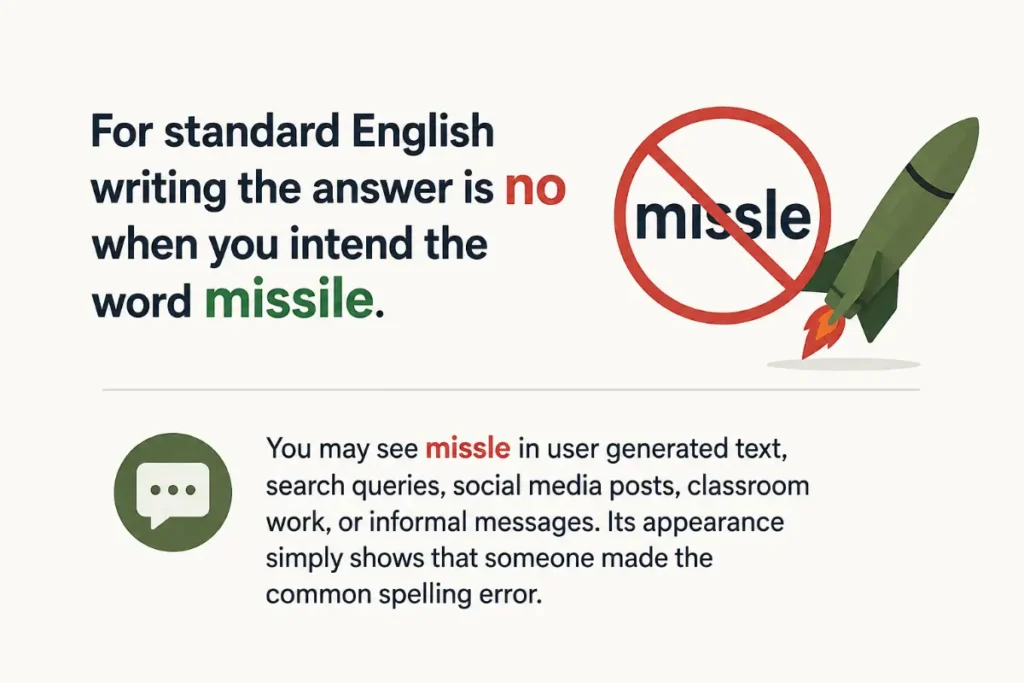
For standard English writing the answer is no when you intend the word missile. You may see missle in user generated text search queries social media posts classroom work or informal messages. Its appearance simply shows that someone made the common spelling error.
It can also appear as part of a username a business name a fictional name or another proper name created by an individual. A proper name can follow its own spelling conventions. That doesn’t make missle a standard spelling of the English noun. If you are writing an essay article report email academic paper or professional document then use missile.
Final Spelling Check
Before you publish your writing remember these three points.
- Missile is correct.
- Missle is a common misspelling.
- The correct word contains two i letters.
The spelling is:
M I S S I L E
The pronunciation can vary by region but the spelling stays the same. Cambridge records a common US pronunciation and a common UK pronunciation while major dictionaries agree on the written form.
Conclusion
The correct spelling is missile. The form missle is a common spelling mistake caused largely by the way the word sounds in natural speech and by the tendency to drop an unstressed vowel while typing.
Missile is a standard noun used for a weapon or projectile that travels through the air toward a target. It can also have a broader meaning involving something thrown through the air.
The easiest memory trick is to remember the two i letters in m i s s i l e. If you’re unsure while writing then slow down for a second and check the middle of the word. That small habit can save you from one of the most common spelling errors involving missile.
Need another quick comparison? Read Contractor vs Contracter Which Spelling Is Correct?.
FAQs
Is Missle a Real Word?
Missle is not the standard spelling of the English word missile. It commonly appears when someone accidentally leaves out the second i. Dictionaries such as Cambridge Oxford and Merriam Webster list missile as the established word. If you’re writing an article email essay report or other edited text then use missile instead of missle.
What Does Missile Mean?
Missile is a noun that usually refers to a weapon designed to travel through the air toward a target. The word can also describe an object thrown through the air with the intention of causing injury or damage. The military meaning is now much more common. The word has historical roots connected with the idea of throwing or sending something toward a target.
Missle or Missile Which Is Correct?
Missile is correct. Missle is a spelling error caused mainly by leaving out the second i. The correct spelling is m i s s i l e. Major English dictionaries recognize missile as the standard form. If a spell checker highlights missle then it is pointing to a genuine spelling problem rather than an optional spelling variation.
How Do You Pronounce Missile?
In American English missile is commonly pronounced /ˈmɪsəl/ which can sound like MIS uhl. British English commonly uses /ˈmɪsaɪl/ which sounds closer to MIS eye uhl. Cambridge lists both forms. The difference in pronunciation can help explain the spelling mistake because the second i may not sound obvious in American speech.
Can Missile Start a Sentence?
Yes. Missile can appear at the beginning of a sentence when it functions as the subject. For example you can write Missile defense has changed over time. The word follows normal capitalization rules at the beginning of a sentence. Starting with missile does not require special punctuation or a special grammatical construction.
What Is a Synonym for Missile?
The best synonym depends on the context. Projectile is a close alternative when you mean an object sent through the air toward a target. Weapon can work in some military contexts but it is broader than missile. Rocket may describe a related type of device but it isn’t always interchangeable with missile. Context should guide your choice.
Why Do People Misspell Missile?
People often misspell missile because the American pronunciation can make the second i difficult to hear. The word is commonly pronounced with a weak second syllable. Fast typing can also cause writers to reproduce the general visual shape of the word while accidentally leaving out a letter. The simple fix is to memorize the complete spelling pattern m i s s i l e.
Is Missile Used in Formal Writing?
Yes. Missile is completely appropriate in formal writing. You’ll find it in journalism academic research history books government documents technical discussions and professional reports. It is a standard dictionary word rather than slang or informal vocabulary. The main concern is using the word accurately and spelling it correctly. In edited writing always choose missile rather than the misspelled form missle.