
If you’ve searched for contractor vs contracter, you’re probably trying to figure out which spelling is correct before sending an email, writing a resume, signing a business document, or publishing content online. The confusion is understandable because both words look plausible, and English contains many nouns ending in or and er. Even experienced writers occasionally pause before typing this word.
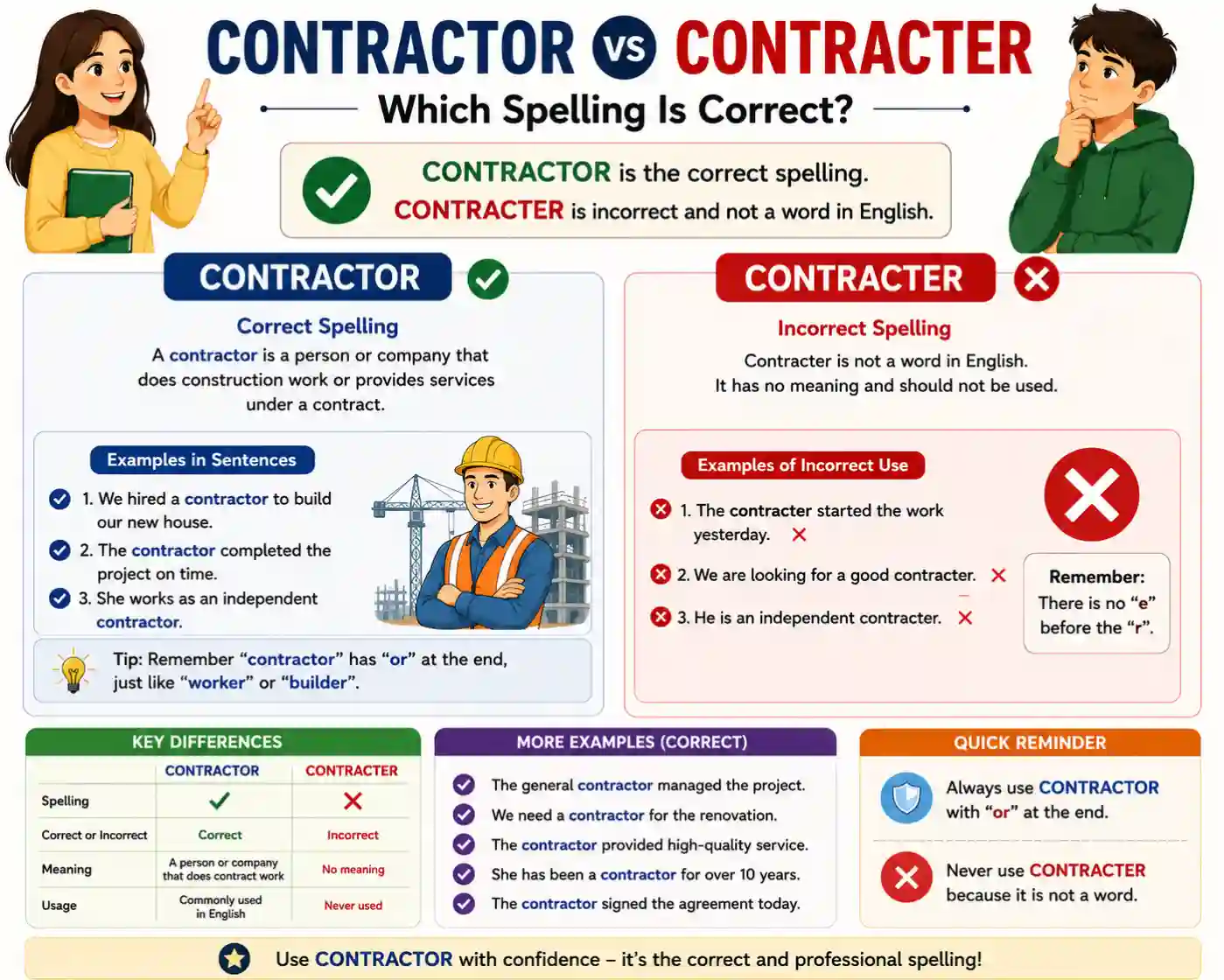
The short answer is simple. Contractor is the correct English spelling. Contracter is considered a misspelling in modern English and does not appear as the standard spelling in reputable dictionaries. If you use contracter in professional writing, it will usually be treated as a spelling error.
This confusion often happens because English has many similar word pairs. For example, advisor and adviser are both accepted spellings, while actor ends with or and writer ends with er. These patterns make it easy to assume that contracter could also be correct. It is not.
Need another quick comparison? Read Afterward or Afterwards Correct Usage Guide.
Quick Definition
Contractor vs contracter: Contractor is the correct spelling. It refers to a person or company hired to perform work under a contract. Contracter is a misspelling and should not be used in formal, academic, business, or everyday writing.
Quick Answer
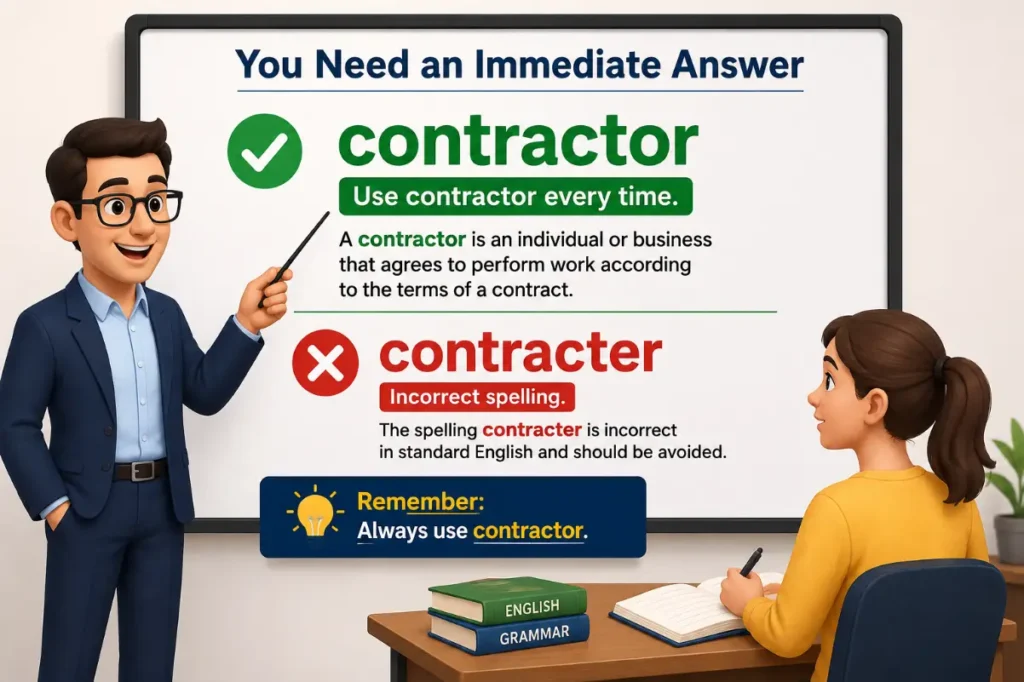
If you need an immediate answer, use contractor every time. A contractor is an individual or business that agrees to perform work according to the terms of a contract. The spelling contracter is incorrect in standard English and should be avoided.
Contractor vs Contracter Comparison Table
| Feature | Contractor | Contracter |
|---|---|---|
| Correct spelling | Yes | No |
| Meaning | Person or company working under a contract | Misspelling |
| Part of speech | Noun | Not a standard English word |
| Origin | Derived from contract + Latin suffix | Not recognized |
| Dictionary status | Accepted | Not accepted |
| Usage frequency | Extremely common | Rare and usually accidental |
| Formal writing | Correct | Incorrect |
| Business documents | Correct | Incorrect |
| Academic writing | Correct | Incorrect |
| Professional communication | Correct | Incorrect |
| Recommended spelling | Always use | Never use |
Meaning of Contractor
A contractor is a person, organization, or business hired to complete work according to a legal agreement or contract. The word appears across many industries, including construction, engineering, information technology, healthcare, transportation, government services, and consulting.
Common examples include:
- Building contractor.
- Electrical contractor.
- Roofing contractor.
- Plumbing contractor.
- Software contractor.
- Government contractor.
- Independent contractor.
- General contractor.
Although construction is the first industry many people think of, the word applies to almost any professional who performs work under a contractual agreement.
Definition
A contractor is someone who agrees to perform services or supply materials under specific contractual terms.
Typical Contexts
- Construction projects.
- Home renovations.
- Government contracts.
- Information technology consulting.
- Engineering projects.
- Freelance professional services.
- Infrastructure development.
- Commercial maintenance.
Meaning of Contracter
Contracter has no accepted meaning in modern English dictionaries because it is not the standard spelling of the word.
Most appearances of contracter result from:
- Typing mistakes.
- Autocorrect failures.
- Spelling confusion.
- Non-native English writing.
- Optical character recognition errors in scanned documents.
If readers encounter contracter, they almost always assume the writer intended to write contractor.
Contractor vs Contracter Key Differences
Although the comparison looks like two legitimate words, only one belongs in standard English.
Spelling
Contractor follows the accepted dictionary spelling.
Contracter does not.
Dictionary Recognition
Major English dictionaries recognize contractor. They do not recognize contracter as the standard noun.
Professional Credibility
Using contractor strengthens professional writing. Using contracter can reduce credibility because readers immediately notice the spelling mistake.
Search Visibility
Search engines recognize contractor as the standard keyword. Content using contracter may perform poorly because it contains a misspelling rather than the established search term.
Which One Is Correct
The correct spelling is contractor. There is no modern English situation where contracter should replace contractor. Professional editors automatically correct contracter to contractor during proofreading because it is considered a spelling error rather than a regional variation.
If you are writing:
- Contracts.
- Business emails.
- Job descriptions.
- Legal documents.
- Construction estimates.
- Academic papers.
- Website content.
- Marketing materials.
Always choose contractor.
Contractor in Sentences
Here are natural examples showing correct usage.
- The contractor finished the office renovation ahead of schedule.
- Our contractor submitted the final proposal yesterday.
- The homeowner hired a licensed contractor for the kitchen remodel.
- Every contractor on the project attended the safety meeting.
- The contractor inspected the building before construction began.
- She works as an independent contractor for several companies.
- The city selected a contractor through a competitive bidding process.
- The contractor completed every task listed in the agreement.
- We interviewed three contractors before making a decision.
- The contractor guaranteed the workmanship for five years.
Contracter in Sentences
The following examples demonstrate incorrect spelling.
- The contracter completed the repairs. ✗
- We hired a local contracter. ✗
- Every contracter submitted a proposal. ✗
- The contracter missed the deadline. ✗
- She works as a software contracter. ✗
- The government approved the contracter. ✗
- Our contracter arrived early. ✗
- The contracter signed the agreement. ✗
- The contracter ordered the supplies. ✗
- The contracter inspected the property. ✗
Each sentence becomes correct by replacing contracter with contractor.
Common Mistakes
Writers commonly make several errors involving this word.
- Assuming contracter is a British spelling.
It is not. British English also uses contractor.
- Assuming both spellings are acceptable.
Unlike pairs such as advisor and adviser, this pair does not have two accepted forms.
- Mixing spellings in one document.
Consistency matters in professional writing.
- Confusing the noun with the verb.
The noun is contractor.
The verb is contract.
- Trusting outdated or unofficial websites.
Always verify spelling with reputable dictionaries and professional style guides.
Contractor vs Contracter Pronunciation Guide
Contractor
IPA (American English): /kənˈtræk.tɚ/
IPA (British English): /kənˈtræk.tə/
Syllable Breakdown
con • trac • tor
Three syllables.
Common Pronunciation Mistakes
- Stressing the first syllable too heavily.
- Dropping the middle consonant.
- Pronouncing the ending as if it were ter instead of tor.
- Confusing it with the verb contract.
Need another quick comparison? Read whiny vs whiney: Avoid This Common Spelling Mistake in 2026.
Contractor vs Contracter Etymology and Word Origin
The word contractor comes from contract, which ultimately traces back to the Latin verb contrahere, meaning “to draw together” or “to make an agreement.”
As English evolved, the suffix or became attached to many nouns identifying a person who performs an action or fulfills a role.
Examples include:
- Creator.
- Director.
- Inspector.
- Operator.
- Contractor.
The spelling became standardized centuries ago and has remained consistent in modern English.
The spelling contracter never became part of standard English and has no historical standing as an accepted alternative.
Regional Usage
One common question is if different English-speaking countries use different spellings.
The answer is no.
| Region | Preferred spelling |
|---|---|
| American English | Contractor |
| British English | Contractor |
| Canadian English | Contractor |
| Australian English | Contractor |
Unlike some spelling differences between American and British English, there is no regional variation here. Every major variety of English uses contractor.
Contractor vs Contracter Grammar Rules
Understanding the grammar behind contractor vs contracter makes it much easier to remember the correct spelling. Since contractor is a noun, it follows the normal grammar rules for countable nouns in English. Contracter, on the other hand, is simply a misspelling and has no grammatical role in standard English.
Part of Speech
Contractor is a countable noun.
It refers to a person, company, or organization hired to complete work under a contract.
Examples:
- The contractor inspected the foundation before construction began.
- Every contractor must follow local building codes.
- Our contractor finished the renovation ahead of schedule.
Singular and Plural Forms
| Form | Example |
|---|---|
| Singular | The contractor arrived early. |
| Plural | The contractors submitted their bids. |
The plural is formed by adding s, just like most regular nouns.
Possessive Forms
| Form | Example |
|---|---|
| Contractor’s | The contractor’s invoice arrived today. |
| Contractors’ | The contractors’ equipment filled the parking lot. |
Common Sentence Structures
Contractor frequently appears after articles and adjectives.
Examples:
- The contractor completed the work.
- A reliable contractor is worth the investment.
- Every licensed contractor must carry insurance.
- Their contractor recommended replacing the roof.
- An experienced contractor can prevent costly mistakes.
Verb Agreement
Because contractor is a noun, the verb must agree with its number.
Correct:
- The contractor is available tomorrow.
- The contractors are meeting today.
Incorrect:
- The contractor are available.
- The contractors is meeting.
Articles
Use articles naturally before the noun.
Examples:
- A contractor called this morning.
- The contractor submitted a revised estimate.
- An independent contractor often works for multiple clients.
Adjectives That Commonly Modify Contractor
Some of the most common adjective combinations include:
- General contractor.
- Licensed contractor.
- Independent contractor.
- Local contractor.
- Professional contractor.
- Commercial contractor.
- Residential contractor.
- Government contractor.
- Electrical contractor.
- Roofing contractor.
These combinations appear regularly in business writing, legal documents, and everyday conversation.
Contractor vs Contracter in Real Life
The word contractor appears far beyond the construction industry. Many professionals work as contractors because they provide services under contractual agreements instead of working as permanent employees.
Daily Conversation
People use the word naturally when discussing home repairs or professional services.
Examples:
- We’re hiring a contractor to remodel the kitchen.
- The contractor will arrive after lunch.
- Ask the contractor for another estimate.
- Our contractor suggested using stronger materials.
Professional Communication
Businesses frequently use the word in emails, reports, and contracts.
Examples:
- The contractor submitted the final invoice.
- Please contact the contractor before approving the purchase.
- Every contractor must meet the project requirements.
- The contractor completed all milestones on schedule.
Academic Writing
Business, engineering, architecture, and law textbooks regularly use the word.
Example:
Independent contractors often differ from employees in taxation, benefits, and legal responsibilities.
Legal Documents
Contracts frequently distinguish between an employer and a contractor.
Example:
The contractor agrees to complete the services described in this agreement.
Media Usage
News reports commonly use contractor when covering public projects.
Examples include:
- Government contractor wins bridge project.
- Local contractor receives community award.
- Defense contractor announces new hiring initiative.
- Contractor fined for safety violations.
Notice that reputable newspapers and magazines consistently use contractor, never contracter.
Contractor vs Contracter Common Internet Confusion
Many spelling mistakes begin with logical assumptions. People often believe contracter should exist because English contains many words ending in er.
For example:
- Teacher.
- Writer.
- Builder.
- Painter.
- Designer.
Since these occupations end with er, some writers naturally extend the same pattern to contract.
However, English spelling is influenced by history rather than perfect consistency.
Many occupation nouns end in or instead.
Examples include:
- Actor.
- Creator.
- Editor.
- Governor.
- Inspector.
- Instructor.
- Operator.
- Professor.
- Senator.
- Contractor.
This explains why contractor follows the accepted spelling pattern.
Related Words and Commonly Confused Terms
Understanding similar words helps build a stronger vocabulary and prevents additional spelling mistakes.
Contract
A legally binding agreement between two or more parties.
Example:
They signed the contract yesterday.
Contracting
The process of obtaining or performing work through contracts.
Example:
She specializes in government contracting.
Contractual
Relating to a contract.
Example:
Both companies fulfilled their contractual obligations.
Independent Contractor
A self employed professional who provides services without becoming an employee.
Example:
The company hired an independent contractor for the software project.
Subcontractor
A contractor hired by another contractor to perform part of a project.
Example:
The electrical subcontractor completed the wiring.
General Contractor
The person or company responsible for managing an entire construction project.
Example:
The general contractor coordinated every trade on the site.
Consultant
A consultant provides expert advice. A consultant may also work as an independent contractor, although the two terms are not always interchangeable.
Freelancer
Many freelancers legally operate as independent contractors. However, freelancer describes a style of work, while contractor describes the legal relationship.
Contractor vs Contracter and Search Intent
Most people searching contractor vs contracter want answers to one of these questions.
- Which spelling is correct?
- Is contracter ever acceptable?
- Is contracter British English?
- Why does spell check reject contracter?
- Which spelling belongs on a resume?
- Which version should appear in legal documents?
- Which spelling improves professional credibility?
The answer to each question is consistent.
Always use contractor.
Expert Language Insight
Professional editors rarely hesitate when they encounter contracter. The correction is immediate because every respected English dictionary recognizes contractor as the standard spelling. Native English speakers almost never write contracter intentionally. When it appears, readers usually assume it resulted from typing too quickly rather than a genuine vocabulary choice. From an editorial perspective, spelling errors like this can influence credibility more than many writers realize.
Imagine these examples.
Resume
“I worked as a building contracter for five years.” Most hiring managers would immediately notice the misspelling.
Memory Tips
Simple memory tricks make the correct spelling easier to remember.
Think About the Ending
Many professional titles end in or.
Examples:
- Inspector.
- Creator.
- Operator.
- Director.
- Contractor.
Grouping these words together reinforces the correct pattern.
Connect It to Contract
Start with the word contract.
Add or to identify the person performing work under the contract.
Contract + or = contractor.
Read More Professional Writing
Exposure matters.
Construction companies, legal agreements, government websites, and business publications consistently use contractor. The more often you see the correct spelling, the easier it becomes to remember.
Quick Editing Checklist
Before publishing any document, check these points.
- Replace every instance of contracter with contractor.
- Verify plural forms use contractors.
- Check possessive forms carefully.
- Confirm consistency throughout the document.
- Proofread headings, image text, and file names.
- Double check resumes and LinkedIn profiles.
- Review contracts before signing or sending them.
- Use spell check, but perform a final manual review as well.
Common Proofreading Tips
Professional proofreaders use several techniques to catch spelling mistakes that software sometimes misses.
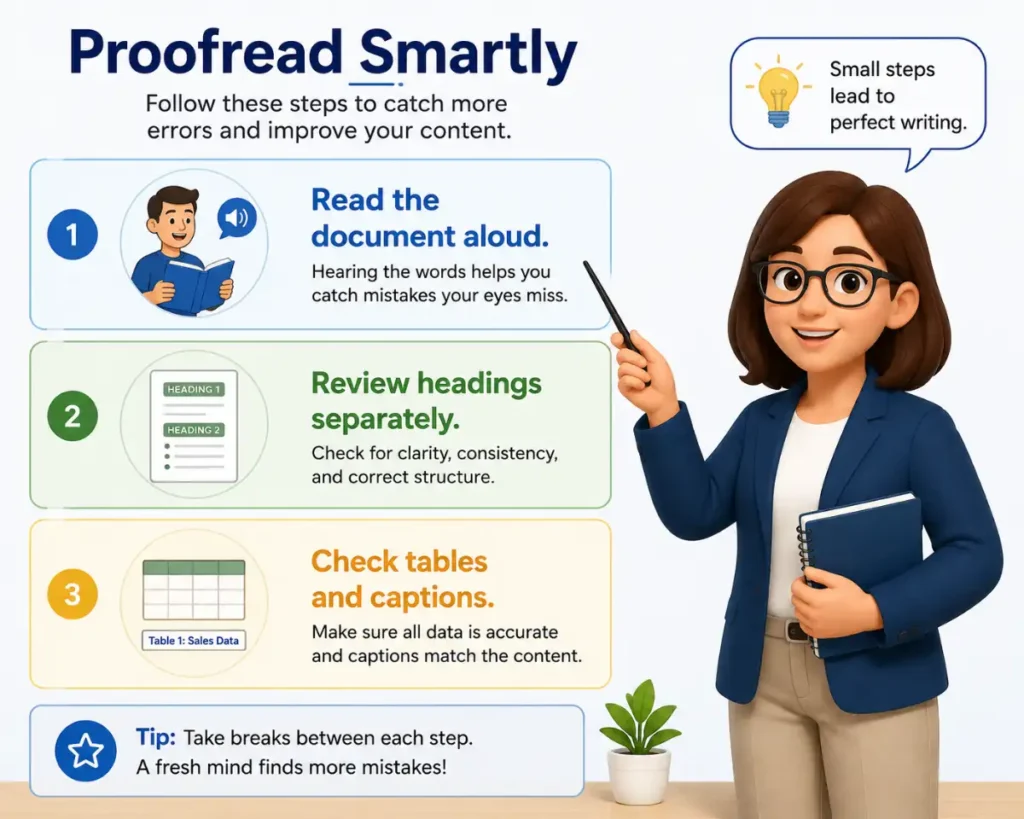
- Read the document aloud.
- Review headings separately.
- Check tables and captions.
- Proofread after taking a short break.
- Search specifically for “contracter” before publishing.
- Ask another person to review important documents.
- Use reputable dictionaries when uncertain.
- Maintain consistent terminology throughout long documents.
Following these habits significantly reduces spelling errors in professional writing.
Many readers also check good luck in future endeavors Meaning and Usage.
Conclusion
The answer to contractor vs contracter is straightforward. Contractor is the only correct spelling in standard English. It refers to a person or company that performs work under a contract and is accepted in dictionaries, style guides, legal writing, business communication, and everyday usage around the world.
Contracter is simply a misspelling. It is not recognized as a standard English word, nor is it a British, American, Canadian, or Australian variant. If it appears in your writing, it should be corrected to contractor.
When in doubt, remember that every major English-speaking region uses the same spelling. Choosing contractor will keep your writing accurate, professional, and credible, whether you are drafting a contract, updating a resume, writing a business email, or publishing content online.
Frequently Asked Questions
Is contractor or contracter correct?
Contractor is the correct spelling. It refers to a person or company hired to complete work under a contract. Contracter is a misspelling and should not be used in business writing, academic papers, legal documents, resumes, or everyday English.
Is contracter a real English word?
No. Contracter is not recognized as the standard spelling in modern English dictionaries. If you see it, it is almost always a typographical or spelling error. Professional editors and spell-checking tools automatically replace it with contractor.
Why do people spell contractor as contracter?
Many writers assume the word should end in er because English includes occupations such as teacher, builder, and writer. However, English spelling is shaped by historical development rather than a single rule. The accepted spelling has always been contractor.
Is contracter the British spelling?
No. British English, American English, Canadian English, Australian English, and other major varieties of English all use contractor. There is no recognized regional spelling difference between these two forms.
What is the plural of contractor?
The plural is contractors.
Examples:
- The contractors submitted their proposals.
- Several contractors competed for the project.
- The contractors completed the work on schedule.
The form contracters is also incorrect because it is based on a misspelling.
Does contractor only refer to construction workers?
No. Although the word is strongly associated with construction, a contractor can work in many industries.
Examples include:
- Software contractor.
- Government contractor.
- Defense contractor.
- Marketing contractor.
- Engineering contractor.
- IT contractor.
- Consulting contractor.
The defining feature is that the work is performed under a contract, not the industry itself.
How do I remember the correct spelling?
One easy memory trick is to group contractor with other familiar words ending in or, such as director, editor, creator, operator, and inspector. Seeing these words together reinforces the correct spelling pattern and makes it easier to avoid writing contracter.
Should I correct contracter in professional documents?
Yes. Always correct contracter before publishing or sending any professional document. A simple spelling mistake can reduce credibility in resumes, proposals, contracts, websites, emails, and marketing materials. Using the correct spelling demonstrates attention to detail and professionalism.
Key Takeaways
- Contractor is the correct spelling in standard English.
- Contracter is a misspelling and should not be used.
- All major English varieties use contractor.
- A contractor is a person or company hired under a contract.
- The plural form is contractors.