
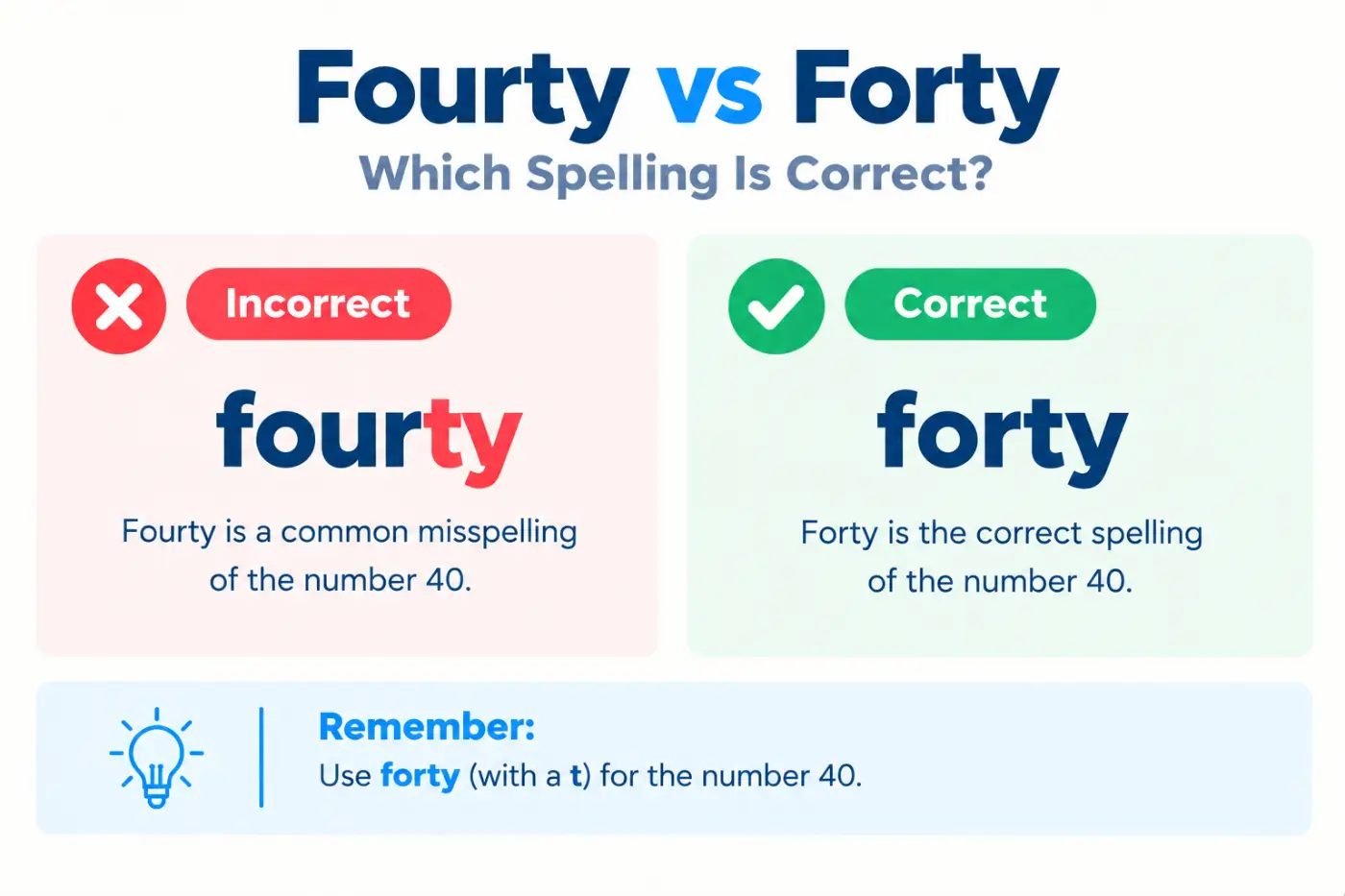
If you have ever written the number 40 and paused to check its spelling, you are not alone. The correct spelling is forty, not fourty. Although the number four contains the letters our, that spelling does not carry over when you write the number that comes after thirty nine. The extra letter u is not part of the standard spelling of forty.
This small difference causes confusion because the words four and forty look as if they should share the same spelling pattern. The pronunciation can also make the correct form less obvious, especially when you are writing quickly or spelling a number from memory. However, English has a few number spellings that do not follow the pattern people expect.
Knowing the correct form helps you avoid mistakes in emails, school assignments, checks, invoices, reports, and other documents. This guide explains the spelling rule, meaning, pronunciation, word history, common mistakes, and practical examples. You will also learn how to remember the correct form without having to look it up every time.
Learn the difference in flaunt vs flout: Meaning and Correct Usage.
Quick Answer
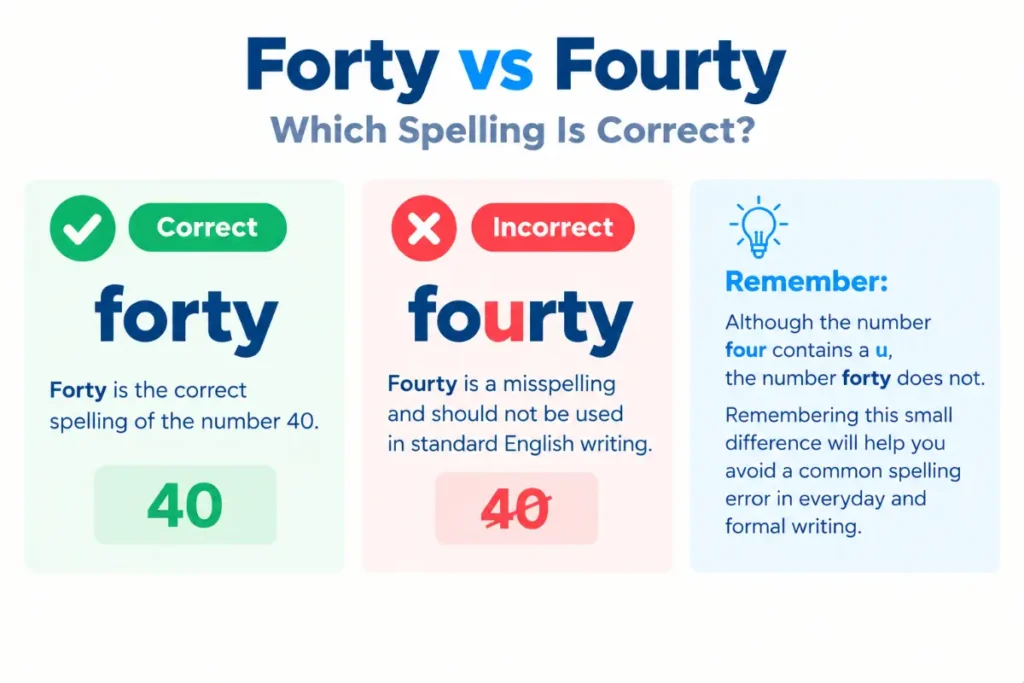
Forty is the correct spelling of the number 40 in standard English. Fourty is a common misspelling and should not be used in ordinary writing. Although the word four contains a u, the standard spelling of the number forty drops that letter.
Comparison Table
| Feature | Forty | Fourty |
|---|---|---|
| Spelling status | Correct standard spelling | Incorrect spelling in ordinary English |
| Meaning | The number 40 | Intended as the number 40 |
| Part of speech | Number word | Nonstandard misspelling |
| Number value | 40 | Intended value is 40 |
| Pronunciation | /ˈfɔːrti/ in many American accents | Usually intended to sound like forty |
| Formality | Accepted in all standard writing | Not appropriate in standard writing |
| Common contexts | Money, ages, dates, quantities, measurements | Typing and spelling errors |
| Example | She is forty years old. | She is fourty years old. |
Meaning and Definition
What Does Forty Mean?
Forty is the standard English word for the number 40. It comes after thirty nine and before forty one. It represents four groups of ten and is used to describe quantities, ages, prices, measurements, dates, scores, and many other numerical values.
For example, if a classroom has 40 students, you can write that it has forty students. If a person celebrates their fortieth birthday, they are reaching the age of 40. The word can appear in ordinary conversation, business records, academic writing, and formal documents.
Forty is a cardinal number. Cardinal numbers tell us how many people, objects, or things there are. It can also appear in ordinal form as fortieth, which identifies position or order.
Here are some common uses:
- She saved forty dollars for the trip.
- The school has forty classrooms.
- My grandfather worked there for forty years.
- The temperature reached forty degrees.
- The team scored forty points.
- He finished in fortieth place.
The word is used in both American and British English. Its spelling does not change based on location, and the standard form always leaves out the letter u.
What Does Fourty Mean?
Fourty is generally a misspelling of forty. It is not the standard English spelling of the number 40, and it does not have a separate numerical meaning in ordinary modern English.
The mistake usually happens because people connect the number with the word four. Since four contains the letters our, writers may assume that the longer number should keep the same spelling. That seems logical, but English number words do not always follow a predictable pattern.
For example, fourteen contains the letters four in its spelling, but forty does not. The correct form developed through a different historical spelling pattern. As a result, adding a u creates an error rather than an accepted variation.
You may still see fourty in online posts, handwritten notes, search queries, or informal messages. Its appearance does not make it an accepted spelling. In edited writing, schoolwork, professional documents, and published material, use forty.
Is Fourty Ever a Real Word?
In ordinary English, fourty is not an accepted alternative spelling of the number 40. It may appear as a personal name, username, business name, or deliberately stylized term, but those special uses do not change the standard spelling rule.
For example, a company might choose Fourty as part of its brand name. In that case, the spelling belongs to the name itself. You should preserve it when referring to that specific company, but you should still write forty when describing the number.
The same principle applies to fictional names and creative writing. A writer can invent a name using almost any spelling, but that does not make the form correct for ordinary numerical use.
Key Differences Explained
1. Spelling
The main difference is the presence or absence of the letter u. The correct form is forty, with no u between the r and t. The incorrect form adds an extra letter and becomes fourty.
Compare the two forms:
- Correct: forty.
- Incorrect: fourty.
This is a spelling difference, not a difference in meaning. Most people who write the incorrect form intend to refer to the number 40.
2. Meaning
Forty means the number 40. Fourty usually has no separate meaning in standard English and is understood as an attempt to spell that same number.
For example, if someone writes fourty books, readers will probably understand the intended quantity. However, the spelling remains incorrect and should be corrected in polished writing.
3. Grammar and Part of Speech
Forty is a number word. It can function as a determiner, pronoun, or noun depending on the sentence.
Examples include:
- Forty people attended the event.
- Forty were selected for the next round.
- The number forty appeared on the screen.
The misspelled form does not have a separate grammatical role. It is simply an incorrect written version of the number word.
4. Pronunciation
The standard pronunciation of forty is usually /ˈfɔːrti/ in American English. It has two syllables, with the main stress on the first syllable. The incorrect spelling fourty is generally intended to represent the same sound.
Because the two forms are usually pronounced alike, hearing the word does not help you decide which spelling is correct. You need to remember the written form.
5. Formality
Forty is suitable for every type of standard English writing. You can use it in a school essay, a business report, a legal document, a personal letter, or a casual text message.
Fourty is not appropriate in formal or edited writing. A spellchecker may flag it, but you should still learn the correct spelling rather than relying only on software.
6. Context
The correct form appears in almost every context involving the number 40. It can describe age, money, distance, time, quantity, temperature, and position.
For example, you might write forty miles, forty dollars, forty minutes, or fortieth anniversary. The incorrect form does not become acceptable in any of these contexts simply because the writing is informal.
7. Regional Usage
American English, British English, Australian English, and Canadian English all use forty. There is no standard regional spelling difference that adds a u.
The pronunciation may vary slightly between accents, but the spelling remains the same. Writers in all these English varieties should use the same form.
8. Standard and Nonstandard Usage
Forty is the accepted spelling found in standard dictionaries and normal edited English. Fourty is a spelling error when used to represent the number 40.
This distinction is important because some English words have more than one accepted spelling. In this case, however, fourty is not a recognized regional alternative. The standard form is consistent across major English varieties.
Which Form Is Correct?
Forty is the correct spelling of the number 40. Fourty is incorrect in standard English because it includes an unnecessary u. The spelling has been established through the historical development of English number words, and modern dictionaries use forty as the standard form.
The confusion is understandable. The number four has a u, and fourteen also contains the sequence four. A writer may naturally expect forty to follow the same pattern. However, English spelling is shaped by history, not just by combining smaller words.
You can see this in the way number words developed. Forty comes from an older form that did not retain the u found in four. The spelling became established over time and remains standard today.
Use these forms:
| Number | Correct spelling |
|---|---|
| 4 | Four |
| 14 | Fourteen |
| 40 | Forty |
| 44 | Forty four |
| 400 | Four hundred |
| 40th | Fortieth |
Notice that forty and fortieth both leave out the u. This is a useful detail to remember when writing ages, dates, rankings, and anniversaries.
If you are preparing a formal document, use the correct form in both the main text and any written number field. This is especially useful for financial records, invoices, contracts, and forms where a spelling error can make a document look careless.
Sentence Examples
The following examples show how to use the correct spelling naturally in different situations.
Ten Natural Examples Using Forty
- Everyday conversation: My parents have lived in this town for forty years.
- Text message: I will be there in about forty minutes.
- Workplace communication: The company plans to hire forty new employees this year.
- School: Forty students took part in the science competition.
- Academic writing: The research team interviewed forty participants for the study.
- Formal writing: The applicant must have at least forty hours of relevant training.
- Social situations: We invited forty guests to the birthday celebration.
- Online communication: The video received forty thousand views in its first week.
- Shopping: The jacket costs forty dollars after the discount.
- Travel: The hotel is about forty miles from the airport.
Each sentence uses the same standard number word. The surrounding words change, but the spelling does not.
Five Examples of the Common Misspelling
These examples show how the error may appear. They are not recommended forms.
- Incorrect: She waited fourty minutes for the bus.
- Incorrect: The building has fourty floors.
- Incorrect: My uncle is fourty years old.
- Incorrect: We need fourty copies of the report.
- Incorrect: The trip will cost fourty dollars.
In each sentence, replace fourty with forty. The intended meaning stays the same, but the corrected sentence follows standard English spelling.
Common Mistakes and Misspellings
The extra u is the main error, but other number spelling mistakes can appear alongside it. Learning the correct forms together can help you write numbers more accurately.
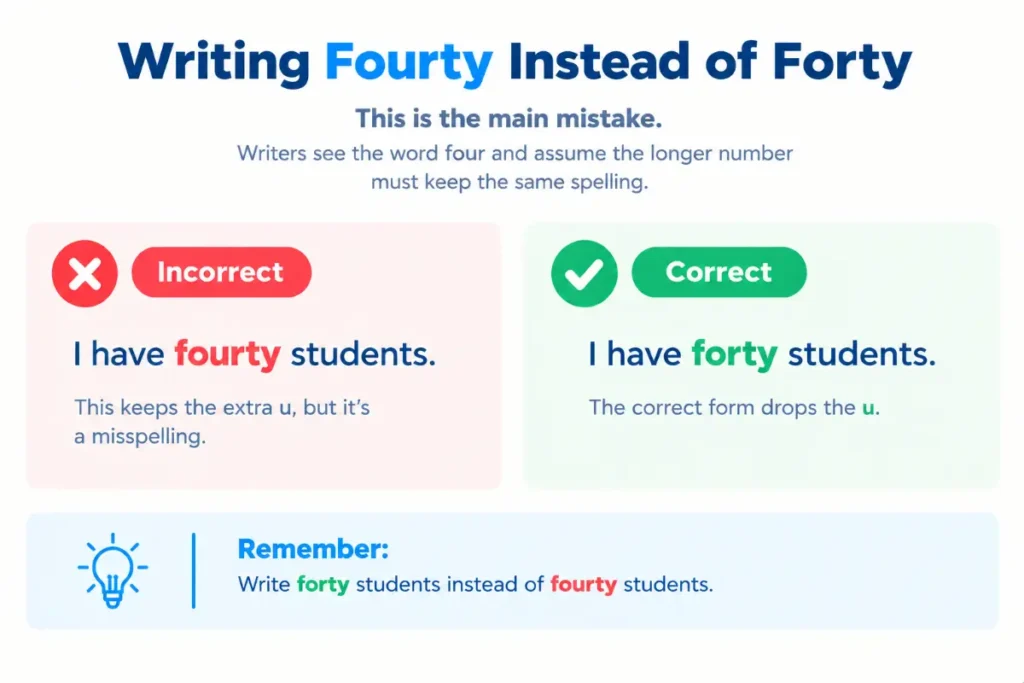
1. Writing Fourty Instead of Forty
Incorrect: fourty.
Correct: forty.
This is the most common mistake related to the number. Writers often add the u because they connect the word to four. Remember that the number 40 drops that letter.
Example: The company has forty employees.
2. Writing Fourtieth Instead of Fortieth
Incorrect: fourtieth.
Correct: fortieth.
The ordinal form follows the same spelling rule as the cardinal number. It does not keep the u from four. Use fortieth when describing the position or anniversary associated with number 40.
Example: They celebrated their fortieth wedding anniversary.
3. Writing Fourty First Instead of Forty First
Incorrect: fourty first.
Correct: forty first.
The number 41 is written as forty one, and its ordinal form is forty first. The first part keeps the standard spelling of forty. Adding a u creates the same error found in the base number.
Example: She finished forty first in the race.
4. Confusing Forty With Fourteen
Incorrect: Using fourteen when you mean forty.
Correct: Use forty for 40 and fourteen for 14.
These words look similar, but they represent different values. Fourteen is the number after thirteen, while forty comes after thirty nine. Check the number carefully when writing prices, dates, ages, or quantities.
Example: The box contains forty pencils, not fourteen.
5. Writing Forty With an Extra Letter in Compound Numbers
Incorrect: fourty two.
Correct: forty two.
Compound numbers use the standard spelling of each part. When writing 42 in words, use forty two. The same rule applies to forty three, forty four, and the other numbers between 40 and 49.
Example: The library received forty two new books.
Other Number Spelling Errors Worth Knowing
A few other English number words can cause confusion because their spellings do not always match what writers expect.
| Incorrect form | Correct form |
|---|---|
| Ninty | Ninety |
| Eigthy | Eighty |
| Fourty | Forty |
| Fourtieth | Fortieth |
| Twelveth | Twelfth |
| Fiveteen | Fifteen |
These mistakes have different causes, so do not assume they all follow the same rule. The best approach is to learn common number spellings as complete words and check them when accuracy matters.
Need another quick comparison? Read Eying Or Eyeing: Definition, Pronunciation, and Examples.
Pronunciation Guide
How Do You Pronounce Forty?
In American English, forty is commonly pronounced /ˈfɔːrti/. It has two syllables: for and ty. The stress falls on the first syllable, so the word sounds like FOR tee.
The pronunciation is similar to the first part of the word forty in phrases such as forty dollars or forty years. The final syllable has a short, unstressed sound. You do not pronounce an extra syllable for the missing u.
Syllable Breakdown
| Detail | Pronunciation |
|---|---|
| Word | Forty |
| IPA | /ˈfɔːrti/ |
| Syllables | For ty |
| Number of syllables | 2 |
| Main stress | First syllable |
| Easy guide | FOR tee |
The exact vowel sound may vary slightly by accent. In some American accents, the r is clearly heard. In many British accents, the pronunciation is non rhotic, so the r after the vowel is not pronounced in the same way.
Is Fourty Pronounced Differently?
Usually, no. People who write fourty generally intend to pronounce it exactly like forty. The spelling mistake does not create a separate standard pronunciation.
This is why pronunciation alone cannot help you choose the correct written form. You may hear the number spoken clearly, but you still need to remember that the standard spelling has no u.
Common Pronunciation Confusion
Some learners may confuse forty with fourteen because the words share several sounds and letters. The difference is easier to hear when you focus on the stress and ending.
- Fourteen: /ˌfɔːrˈtiːn/.
- Forty: /ˈfɔːrti/.
Fourteen has the main stress near the end and finishes with the long ee sound followed by n. Forty has the main stress at the beginning and ends with an unstressed ee sound.
Etymology and Word Origin
The spelling of forty makes more sense when you look at its history. The modern word developed from Old English forms related to the number 40. One earlier form was feowertig, built from an old word for four and a term connected with a group of ten.
Over time, English spelling changed. The word passed through Middle English forms, including spelling variations that eventually developed into the modern forty. The u found in the modern word four was not retained in the standard form of the number 40.
This historical change explains why the two words do not match perfectly. English spelling often preserves older forms, and number words are not always created by simply attaching one familiar word to another.
Why Forty Lost the U
The modern spelling reflects a long process of sound and spelling changes. The word developed through historical forms in which the vowel and letter patterns were not identical to those in modern four.
As English changed, the spelling of forty became shorter. The form without u became established and continued into modern English. Today, writers use forty in all standard varieties of English.
Does the Word Four Have the Same History?
Four and forty are related through their number meaning and historical roots, but their modern spellings developed differently. Four retained its u, while forty did not. This is why copying the spelling of one word into the other creates an error.
You do not need to remember the full historical development to spell the number correctly. Still, knowing that the difference comes from the history of English can make the spelling easier to accept.
Regional Usage
American English
In the United States, forty is the standard spelling of the number 40. It is used in school assignments, business writing, government documents, newspapers, books, and everyday messages.
Fourty is considered a spelling error when used to represent the number. American English does not recognize it as an alternative spelling. Spellcheckers will often flag it, although a final human review is still useful.
British English
British English also uses forty. There is no accepted British spelling that adds a u. The number follows the same spelling rule as it does in American English.
The pronunciation may differ because many British accents do not pronounce the r after a vowel in the same way as American accents. However, this difference in speech does not affect the written form.
Australian English
Australian English follows the same standard spelling. Writers use forty for the number 40 in personal, academic, business, and official documents.
The incorrect form may appear in casual online writing, but it is not a recognized Australian spelling variation.
Canadian English
Canadian English also uses forty. The spelling is consistent with both American and British standard usage, so Canadian writers do not need a separate regional rule.
Is There Any Regional Difference?
No major regional difference affects the spelling of this number. The correct form remains forty in the main English varieties. Differences in accent or pronunciation do not justify adding a u.
If you are writing for an international audience, use forty and you will follow the standard spelling used across these regions.
Grammar Rules and Number Usage
Forty is a number word, but it can perform different jobs in a sentence. Understanding how it works with nouns, verbs, and ordinal forms will help you use it correctly.
Forty as a Cardinal Number
A cardinal number tells you how many people or things are present. Forty works as a cardinal number when it describes a quantity.
Examples:
- Forty people attended the meeting.
- She bought forty apples.
- The school received forty applications.
In these examples, the number comes before a plural noun. The noun remains plural because the quantity is greater than one.
Forty as a Determiner
A number can act as a determiner when it appears before a noun and tells the reader how many items there are.
Example: We need forty chairs for the event.
Here, forty tells us the number of chairs required. It does not need an article such as a or an before it.
Forty as a Noun
The word can also function as a noun when it refers to the number itself.
Example: Forty is the answer to the final question.
In this sentence, the number is the subject. Another example is “The score was forty.” The word names a numerical value rather than describing a separate noun.
The Ordinal Form Fortieth
Fortieth is the ordinal form of forty. Ordinal numbers show position, order, or sequence rather than quantity.
Examples:
- She finished in fortieth place.
- Today is the fortieth day of the year.
- They are celebrating their fortieth anniversary.
The spelling still leaves out the u. Do not write fourtieth when you mean the ordinal form of 40.
Writing Forty in Compound Numbers
When writing numbers from 41 to 49 in words, use forty followed by the second number.
| Number | Written form |
|---|---|
| 41 | Forty one |
| 42 | Forty two |
| 43 | Forty three |
| 44 | Forty four |
| 45 | Forty five |
| 46 | Forty six |
| 47 | Forty seven |
| 48 | Forty eight |
| 49 | Forty nine |
In standard American English, compound numbers from twenty one through ninety nine are generally hyphenated when written as words. Therefore, the usual written forms are forty one only in informal displays or where a style guide permits it, and forty one is more commonly written as forty one with a hyphen in running text: forty one is not the standard formatted form. The correct standard forms are forty one? No. They are forty one with a hyphen: forty one should be written as forty one only when a specific format omits punctuation. In ordinary edited prose, write forty one as forty one?
For clarity, use these standard forms in sentences: forty one should be written as forty one with a hyphen, forty two as forty two with a hyphen, and so on. The hyphen joins the two parts of the compound number. It does not change the spelling of forty.
Writing Forty With Currency
When writing money, you can use numerals or words depending on the document.
- The ticket costs $40.
- The ticket costs forty dollars.
- Please pay forty dollars by Friday.
In checks and other financial documents, follow the instructions on the form. Some forms ask you to write the amount in words as well as numerals. In those cases, use forty and check the full amount carefully before signing.
Writing Ages and Measurements
Use forty when writing ages, distances, temperatures, or measurements.
Examples include “He is forty years old,” “The road is forty miles long,” and “The temperature reached forty degrees.” If you use a numeral instead, write 40. Both styles can be correct depending on the document and its style guide.
Punctuation and Hyphenation
The number itself does not need special punctuation. However, compound numbers between twenty one and ninety nine are generally hyphenated in standard American prose when written out.
Examples:
- Forty two students attended.
- She is forty five years old.
- The fortieth anniversary takes place next month.
The hyphen joins the parts of a compound number. It does not mean that forty should be spelled with a u.
Real Life Usage Examples
Daily Conversation
People use the number in everyday speech to describe time, age, money, and quantity.
- I need about forty minutes to get ready.
- My parents have been married for forty years.
In both cases, the written form stays the same. You do not need a different spelling for casual conversation.
Email and Workplace Communication
In business messages, the number may describe a deadline, budget, staff count, or quantity.
- We expect forty orders to arrive by Thursday.
- The team completed forty hours of training last month.
For professional communication, correct number spelling helps your message look polished. It is especially useful in documents that may be shared with clients, managers, or external partners.
Academic Writing
Students and researchers often use numbers to report participants, results, measurements, and findings.
- Forty participants completed the first stage of the survey.
- The experiment lasted forty days.
Academic style guides may have rules about when to spell out numbers and when to use numerals. Those rules can differ by publication or institution, but the spelling of the word remains forty.
News and Journalism
News reports use number words in headlines, quotations, and narrative passages, depending on the publication’s style.
- Forty homes were damaged by the storm.
- The city plans to spend forty million dollars on road repairs.
A newsroom may prefer numerals for many figures, but if the number is written in words, the correct spelling is still forty.
Literature and Storytelling
Writers use number words to describe characters, time periods, distances, and important events.
- The old man had waited forty years to return to his hometown.
- She counted forty steps before reaching the hidden door.
In stories, spelling should remain consistent even when the writing style is creative. A fictional character or brand can have an unusual name, but the ordinary number still follows standard spelling.
Related and Confused Terms
These eight number words and expressions are useful to know because they can cause similar spelling or usage questions.
Four
Four is the number 4. It is spelled with a u, unlike forty. The two words are related in meaning, but they do not share the same modern spelling pattern.
Example: There are four chairs in the room.
Fourteen
Fourteen is the number 14. It contains the sequence four in its spelling, which may be one reason people expect forty to contain the same letters.
Example: The child turned fourteen last week.
Fortieth
Fortieth is the ordinal form of forty. It describes the position or anniversary associated with the number 40.
Example: The school celebrated its fortieth year.
Forty One
Forty one is the number 41. In standard American prose, write it with a hyphen as forty one? The correct form is forty one with the hyphen joining the two number words.
Example: Forty one students joined the club.
Fifty
Fifty is the number 50. It is another number word with a spelling that should be learned as a complete form rather than guessed from its pronunciation.
Example: The package weighs fifty pounds.
Ninety
Ninety is the number 90. It is often misspelled as ninty because writers may leave out a letter. The correct form contains the e after n.
Example: The library has ninety new books.
Eighty
Eighty is the number 80. It can be confused with spellings such as eigthy, where the letters are placed in the wrong order.
Example: The bus can carry eighty passengers.
Forty Thousand
Forty thousand means 40,000. The spelling of forty remains unchanged when it appears before a larger number word.
Example: The charity raised forty thousand dollars.
Expert Editor Insight
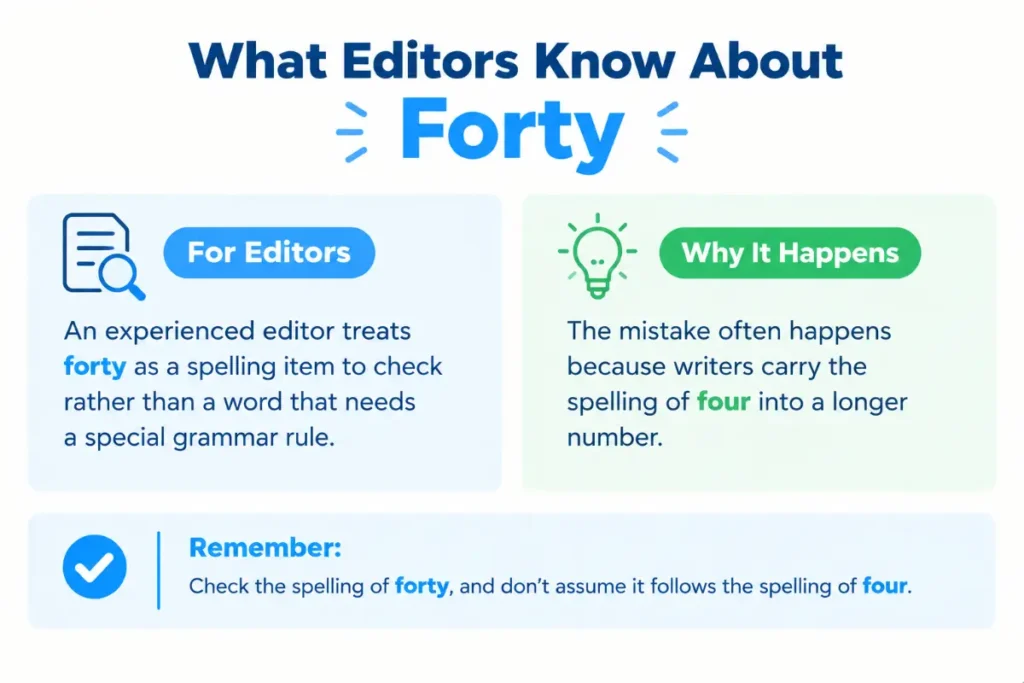
An experienced editor treats forty as a fixed spelling rather than trying to build it from the spelling of four. The confusion is common because the words are closely related in meaning, and fourteen reinforces the expectation that forty should contain the same letters. A spelling checker may flag fourty, but writers should still learn the correct form because software can miss errors in names or unusual contexts. A useful editing habit is to search for fourty in any document containing numbers, then replace it with forty when the intended meaning is 40. Check fortieth at the same time.
Need another quick comparison? Read connector or connecter Which Word Should You Use?.
Conclusion
The correct spelling in fourty vs forty is forty. The version with a u is a common spelling mistake, not a standard alternative for the number 40. The same spelling rule applies in American, British, Canadian, and Australian English, and the ordinal form is fortieth. Although the word four contains a u, the number forty developed a different spelling through the history of English.
A simple way to remember it is to learn forty as one complete word rather than building it from four. Before submitting a document, search for fourty and correct any unintended uses.
FAQs
Is Fourty a Real Word?
Fourty is not the standard spelling of the number 40 in modern English. It is generally treated as a misspelling of forty. It may appear as a personal name, username, or brand name, but those special uses do not make it an accepted alternative for the number. In ordinary writing, use forty.
Why Is Forty Spelled Without a U?
The spelling comes from the historical development of the word. Older English forms changed over time, and the modern number word became forty rather than fourty. Although four contains a u, the spelling of forty developed differently. The standard form has been established for centuries and is used across major English varieties.
Is Forty or Fourty Correct in American English?
Forty is correct in American English. Fourty is a spelling error when used to represent the number 40. American dictionaries and standard writing follow the form without the u. The same spelling is used in British, Canadian, and Australian English, so there is no regional reason to choose the longer form.
How Do You Spell the Number 40 in Words?
The number 40 is spelled forty. Write it without a u between the r and t. For example, you can write forty dollars, forty people, or forty years. If you are writing the ordinal form, use fortieth. Both forms leave out the u found in the word four.
How Do You Spell the 40th Anniversary?
The correct spelling is fortieth anniversary. Fortieth is the ordinal form of forty and describes a position or milestone. Do not write fourtieth, because that form adds an unnecessary u. For example, “The company celebrated its fortieth anniversary” is correct in standard English.
Why Do People Spell Forty as Fourty?
People often make this mistake because they connect the number with four, which contains a u. They may also think of fourteen, which includes the same sequence of letters. This spelling guess seems reasonable, but English number words do not always follow the same pattern. Remembering forty as a complete word helps prevent the error.
Is Forty the Same in British and American English?
Yes. Both British and American English use forty as the standard spelling. There is no regional spelling difference that adds a u. Pronunciation can vary because of accent differences, especially the way speakers pronounce the letter r, but the written form remains the same.
What Is the Ordinal Form of Forty?
The ordinal form is fortieth. It describes the position or order associated with number 40, as in fortieth place or fortieth anniversary. The spelling does not include a u. For example, “She finished in fortieth place” is correct, while fourtieth is a misspelling.