
Have you ever paused while writing a sentence because you weren’t sure if you should use may or might? Both words express possibility, and they often appear in similar sentences. However, they don’t always communicate the same level of certainty or intention. The difference can be small, but choosing the right one helps your message sound clear and natural.
The main distinction is that may often expresses a possibility that seems realistic or a request for permission, while might commonly suggests a more uncertain possibility or a hypothetical situation. Still, these meanings can overlap. Context, tense, tone, and the speaker’s intention all matter.
Understanding may vs might makes it easier to write emails, complete school assignments, speak confidently, and avoid common grammar mistakes. You’ll learn what each word means, how they work in sentences, when they can replace one another, and why some grammar rules are more flexible than they first appear.
Still confused? Compare Brite vs Bright Which Spelling Should You Use in 2026.
Quick Answer
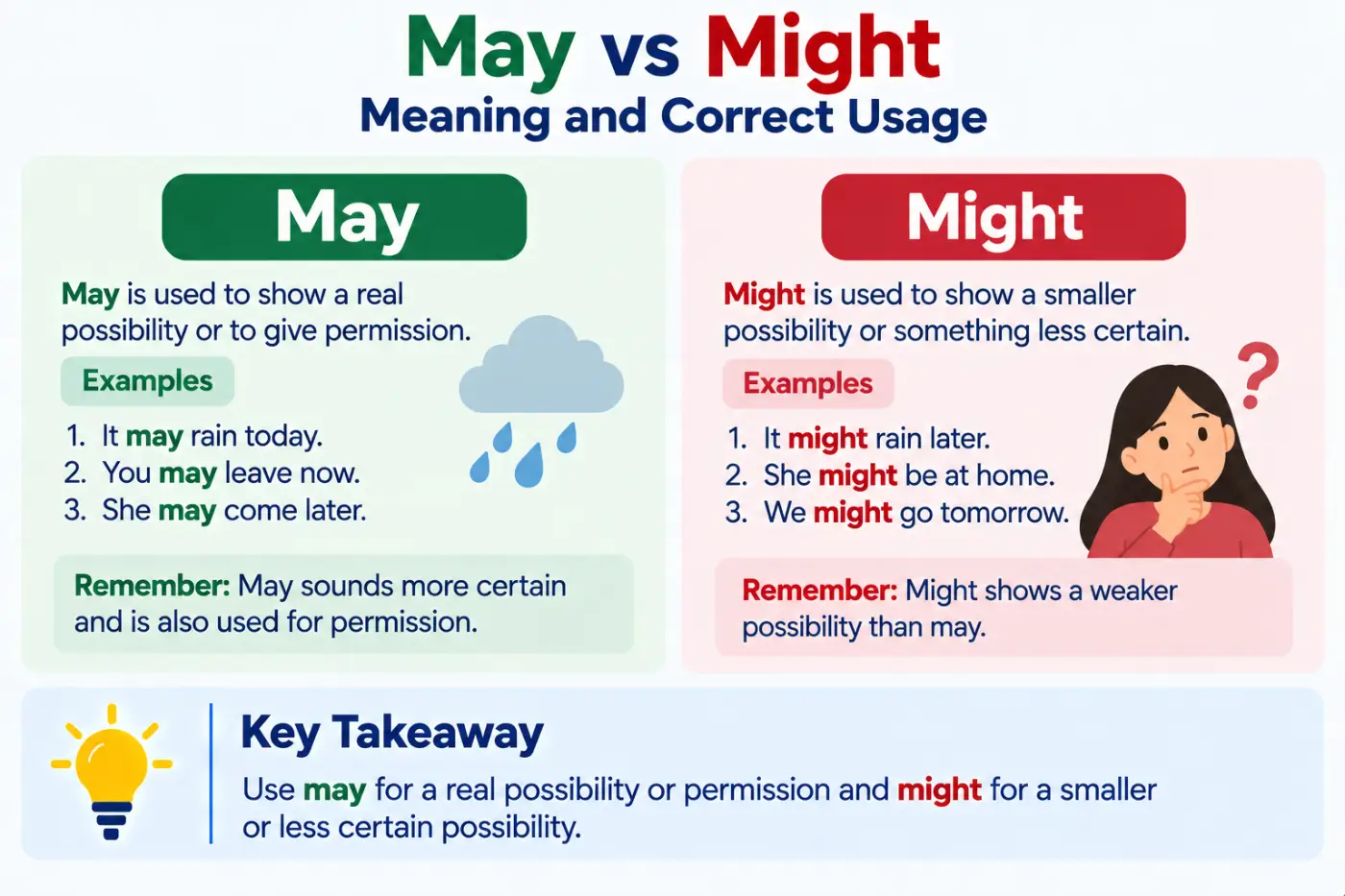
May and might are both modal verbs that express possibility, but they can suggest different levels of certainty. May often presents something as a reasonable possibility or asks for permission. Might commonly expresses a less certain possibility, a hypothetical situation, or a cautious suggestion. Both are correct, and the best choice depends on context.
Comparison Table
| Feature | May | Might |
|---|---|---|
| Part of speech | Modal verb | Modal verb |
| Main meaning | Possibility or permission | Possibility or uncertainty |
| Typical tone | Neutral or slightly more confident | More tentative or cautious |
| Certainty | Can suggest a stronger possibility | Can suggest a weaker possibility |
| Permission | Commonly used | Less common and more formal or tentative |
| Past reference | May have | Might have |
| Hypothetical use | Possible in some contexts | Very common |
| Negative form | May not | Might not |
| Pronunciation | /meɪ/ | /maɪt/ |
| Formality | Standard in formal and informal English | Standard in formal and informal English |
| Common context | Requests, rules, predictions, possibilities | Uncertain outcomes, suggestions, imagined situations |
| Example | It may rain tonight. | It might rain tonight. |
The table shows their general patterns. It doesn’t mean one word always expresses more certainty than the other. Speakers sometimes use them interchangeably, especially when discussing future possibilities.
Meaning and Definition
What Does May Mean?
May is a modal auxiliary verb. It mainly expresses possibility, permission, and sometimes a wish or hope. It helps the main verb communicate how likely an event seems or if someone has permission to do something.
Consider these examples.
- It may snow this weekend.
- You may leave the room after the test.
- The package may arrive tomorrow.
- May your day be filled with happiness.
This verb doesn’t change according to the subject. You use may with I, you, he, she, it, we, and they.
- I may visit my parents.
- She may call later.
- They may need extra time.
You don’t add an s to the verb after it. The correct sentence is She may leave, not She mays leave.
What Does Might Mean?
Might is also a modal auxiliary verb. It expresses possibility, uncertainty, hypothetical situations, and cautious suggestions. It often makes a statement sound less definite.
For example:
- I might visit my parents this weekend.
- She might call after work.
- We might need another meeting.
- You might want to check your answer.
The first three examples describe possibilities. The fourth offers a suggestion in a polite, indirect way.
Like may, this verb stays the same with every subject.
- I might go.
- He might agree.
- We might win.
It doesn’t take an s or an infinitive marker such as to before the main verb. Say He might come, not He might comes or He might to come.
Are Both Words Real English Words?
Yes. Both are standard English words with established grammatical functions. Neither is a misspelling of the other, and neither should be treated as incorrect simply because it appears in a different type of sentence.
The confusion comes from their overlapping meanings. In many everyday situations, both can describe the same possible event. The difference often comes from how strongly the speaker presents that possibility.
Key Differences Explained
1. Level of Possibility
One common difference is the degree of confidence a speaker communicates.
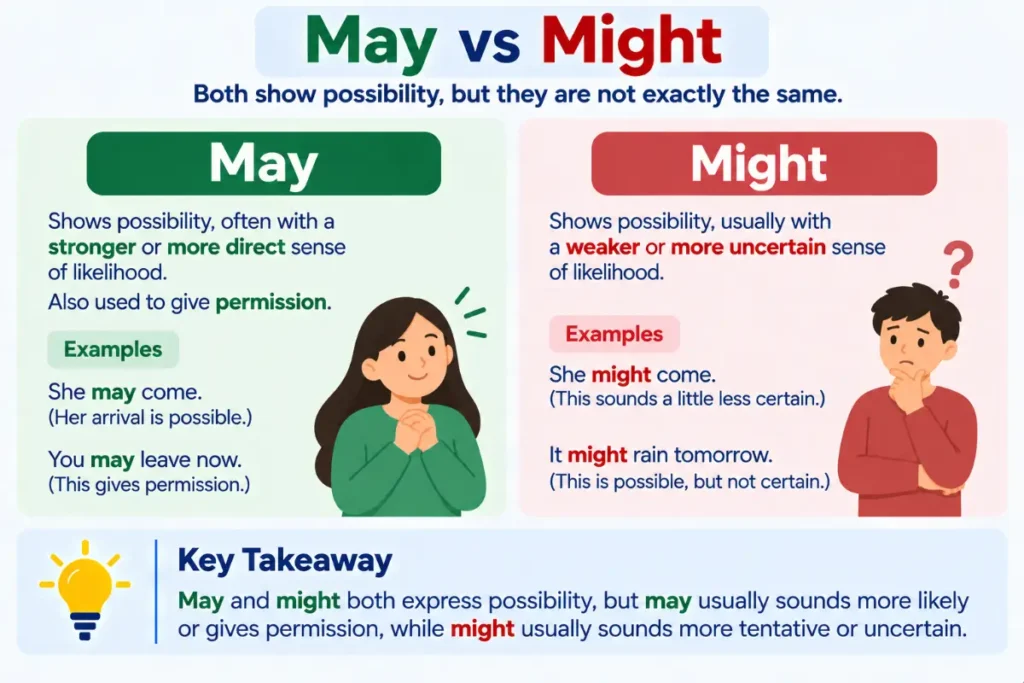
May can make a possibility sound reasonably likely. Might can make the same possibility sound more uncertain.
Compare these sentences.
- The manager may approve your request.
- The manager might approve your request.
The first sentence presents approval as a realistic possibility. The second sounds more cautious. The speaker may have less confidence in the outcome.
However, this is a general tendency, not a strict mathematical rule. You can’t assign a fixed percentage of probability to either word. A speaker’s tone and the surrounding information can change the meaning.
2. Permission
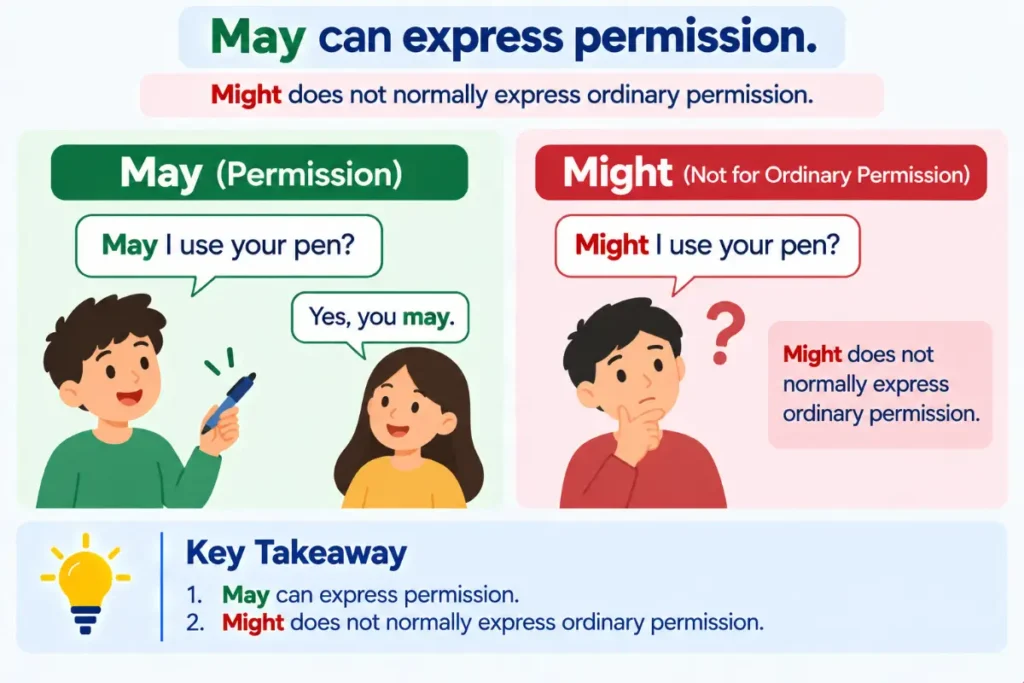
May is commonly used to ask for or give permission, especially in formal and polite situations.
Examples:
- May I use your phone?
- You may enter the building.
- Students may bring a calculator.
Might can also appear in polite requests, but it is less common in ordinary permission questions.
For example, Might I ask you a question? sounds very formal and careful. Most people would say May I ask you a question? or Can I ask you a question?
Remember that might is not simply a more polite version of may in every situation.
3. Hypothetical Situations
Might is especially useful when discussing imagined situations, uncertain outcomes, or possible actions that depend on another event.
Examples:
- If I had more time, I might learn another language.
- We might travel abroad if we save enough money.
- She might accept the offer if the salary improves.
These sentences describe possibilities rather than confirmed plans.
May can also appear in conditional sentences, but might is often a natural choice when the situation feels more distant or hypothetical.
4. Present and Future Possibility
Both verbs can describe something that may happen now or in the future.
Compare:
- The store may close early today.
- The store might close early today.
Both sentences are grammatically correct. The first sounds like the speaker considers early closing a reasonable possibility. The second can sound more uncertain.
The time reference comes from the context and the main verb. Neither modal verb automatically means present or future.
5. Past Possibility
The two forms can also refer to possibilities connected to the past, but their grammar deserves special attention.
Use may have followed by a past participle to suggest that something possibly happened.
- She may have forgotten the appointment.
- They may have taken the wrong road.
Use might have in a similar way.
- She might have forgotten the appointment.
- They might have taken the wrong road.
Both forms can express uncertainty about a past event. The second often sounds more tentative, but the difference can be subtle.
6. Negative Meaning
To make a negative statement, place not after the modal verb.
- He may not attend the meeting.
- He might not attend the meeting.
The first can communicate that his attendance is uncertain. The second often sounds more hesitant or less confident.
Be careful with may not because it can also communicate that someone does not have permission.
For example, You may not enter this room means entry is not allowed. Context tells the reader which meaning applies.
7. Formality and Tone
Both words work in professional, academic, and everyday English.
May is common in formal notices, official instructions, and polite permission requests. Might often appears in careful suggestions, cautious statements, and discussions of hypothetical situations.
For example:
- Formal notice: Visitors may enter through the main gate.
- Workplace suggestion: You might want to review the report.
- Academic writing: The results may indicate a connection.
- Cautious analysis: The findings might suggest another explanation.
Neither word is automatically more professional. Choose the one that matches the meaning you intend.
Which Form Is Correct?
Both forms are correct. The right choice depends on what you want to communicate.
Use may when you want to express a possibility, give permission, or make a polite request. Use might when you want to express a possibility in a more tentative way, describe a hypothetical situation, or make a cautious suggestion.
For example, both of these sentences are correct:
- I may attend the conference.
- I might attend the conference.
The first can suggest that attending is a realistic possibility. The second may sound less certain.
Established English grammar treats both as modal auxiliary verbs. They follow similar sentence patterns and take the base form of the main verb.
A useful rule is to focus on your intended meaning rather than trying to follow a strict certainty scale. If the difference isn’t important in the context, either word may work.
Sentence Examples
Here are 10 natural examples showing how these verbs work in different situations.
- Everyday conversation: I may stop by the grocery store after work.
- Text message: I might be a few minutes late, so please start without me.
- Workplace communication: The director may announce the new schedule tomorrow.
- School: Students may use their notes during the review session.
- Academic writing: These results may point to a link between sleep and memory.
- Formal writing: The committee might request additional documents before making its decision.
- Social situations: We might invite a few friends over for dinner this weekend.
- Travel planning: Our flight may arrive earlier than expected.
- Customer service: You may contact our support team for further assistance.
- Personal suggestion: You might feel better after taking a short break.
Notice that the choice changes the tone and purpose of each sentence. Some examples express permission, while others describe possible events or offer suggestions.
Common Grammar Mistakes
The words themselves are easy to use once you understand their role. Most errors happen when writers change the verb form after them, use an incorrect tense pattern, or confuse possibility with permission.
1. Adding an s to the Main Verb
Incorrect: She may goes to school tomorrow.
Correct: She may go to school tomorrow.
Modal verbs take the base form of the main verb. Don’t add s, es, or another ending.
2. Adding to Before the Main Verb
Incorrect: He might to visit us tonight.
Correct: He might visit us tonight.
The main verb follows directly after the modal. The same rule applies to both forms.
3. Using the Wrong Past Form
Incorrect: They might went home early.
Correct: They might have gone home early.
To express a possible past event, use the modal followed by have and the past participle. Went is a simple past form, while gone is the past participle needed in this construction.
4. Treating Might as Always More Uncertain
Incorrect assumption: Might always means something is extremely unlikely.
Better understanding: It often sounds more tentative, but context matters.
For example, I might see you tomorrow can simply be a casual way to describe a possible plan. It doesn’t automatically mean the speaker thinks the meeting is unlikely.
5. Confusing Permission With Possibility
Incorrect interpretation: You may not enter means you probably won’t enter.
Correct interpretation: In many notices, it means you are not allowed to enter.
The word may can express both possibility and permission. Look at the sentence and situation to understand the intended meaning.
Pronunciation Guide
Both words have one syllable, but their vowel sounds are different.
| Word | IPA | Easy Pronunciation | Syllables |
|---|---|---|---|
| May | /meɪ/ | May | One |
| Might | /maɪt/ | Mाइट, rhyming with light | One |
How to Pronounce May
The word may sounds like the name of the month May. Start with the m sound, then glide from the vowel in bed toward the vowel in see.
The word has one syllable, and its vowel sound is /eɪ/.
How to Pronounce Might
Might rhymes with light, night, and right. Start with the m sound, then use the /aɪ/ vowel sound. Finish with a clear t sound.
It also has one syllable.
Common Pronunciation Mistakes
- Pronouncing may like the word me. The correct vowel is a long /eɪ/ sound.
- Pronouncing might without the final t. The final consonant should be heard in careful speech.
- Giving either word an extra syllable. Both are single syllable words.
Many readers also check well-known vs well known Which Form Is Correct.
Etymology and Word Origin
The history of these two modal verbs helps explain why they look different but share related meanings.
Origin of May
May developed from Old English mæg, a form connected with the verb magan, meaning to be able or have power. Its earlier meanings were closely tied to ability and strength.
Over time, its use expanded to include permission and possibility. Modern English uses it in statements about uncertain events, polite requests, and formal permission.
Origin of Might
Might developed from Old English meahte, the past tense of magan. Its historical connection to may explains their shared meaning.
In modern English, might has developed a wider role in expressing uncertainty, hypothetical situations, and cautious suggestions. It can still refer to past possibility when followed by have and a past participle.
The historical relationship explains why the two words are closely connected, but their modern grammatical uses are not identical.
Regional Usage
There is no major spelling difference between American and British English for these words. Both forms are standard across major English varieties, including American, British, Canadian, and Australian English.
American English
In the United States, both forms are common in speech and writing. May frequently appears in permission questions, public notices, and formal communication.
Examples:
- May I sit here?
- It might rain this afternoon.
In everyday American conversation, people also use can for many permission requests. However, may remains a standard and polite choice.
British English
British English follows the same basic grammar. May and might both express possibility, and may is common in formal permission requests.
For example:
- You may leave your bags here.
- We might visit London next month.
There is no special British spelling rule that changes one word into the other.
Australian English
Australian English also uses both forms in the same general way. Speakers may use can in casual permission requests, while may remains common in formal contexts.
For example:
- You may enter after registration.
- I might call you later.
Canadian English
Canadian English follows the same standard usage. Both words express possibility, and may commonly appears in polite requests and official instructions.
Regional differences mostly involve conversational style and personal preference, not the basic grammar of these modal verbs.
Grammar Rules and Part of Speech
Both words belong to a group called modal auxiliary verbs. These verbs work with a main verb to express ideas such as possibility, permission, ability, obligation, or advice.
They don’t usually describe an action on their own. Instead, they change the meaning of the main verb.
1. Use the Base Form of the Main Verb
After either modal, use the plain form of the main verb.
Correct:
- I may travel.
- She might agree.
- They may arrive.
- He might call.
Incorrect:
- I may travels.
- She might agrees.
- They may to arrive.
- He might called.
This rule applies regardless of the subject.
2. Form Negative Sentences
Place not immediately after the modal.
- I may not attend.
- She might not understand.
- We may not finish today.
- They might not accept the offer.
The contractions mayn’t and mightn’t exist in some varieties or older usage, but they are uncommon in modern American English. Writers usually use may not and might not.
3. Form Questions
For a question, place the modal before the subject.
Examples:
- May I come in?
- May we begin?
- Might I suggest another option?
- Might they arrive earlier?
This structure is called subject and auxiliary inversion. It is common in polite questions and formal requests.
4. Use Have for Past Possibility
When you want to discuss something that possibly happened before now, use this pattern:
Modal + have + past participle.
Examples:
- She may have missed the bus.
- He might have left his keys at home.
- They may have misunderstood the instructions.
- We might have chosen the wrong route.
Don’t use the simple past form directly after the modal when you mean a possible completed event.
5. Use Be for Ongoing or Passive Situations
You can follow either word with be.
Examples:
- The office may be closed.
- The children might be sleeping.
- The documents may be reviewed tomorrow.
- The road might be blocked.
In these examples, be introduces a state, an ongoing action, or a passive construction.
6. Use Them in Conditional Sentences
Might is especially common in hypothetical statements.
- If I had a car, I might drive to work.
- If she studied more, she might pass the exam.
- If we left earlier, we might avoid traffic.
May can also appear in conditional sentences, especially when the condition leaves open a real possibility.
- If you finish early, you may leave.
- If it rains, the event may move indoors.
The choice depends on how the speaker presents the condition and result.
7. Understand Punctuation
Neither modal requires special punctuation. Use the normal rules for statements, questions, and clauses.
Examples:
- It may rain, so take an umbrella.
- I might come if I finish my work.
- May I ask one more question?
Use a comma after an introductory conditional clause when it comes before the main clause.
For example, If the weather improves, we may go outside.

Real Life Usage Examples
Seeing the words in everyday situations makes their differences easier to understand.
Daily Conversation
People often use these verbs when discussing plans, uncertain events, and possible decisions.
- I may go to the gym after dinner, but I haven’t decided yet.
- We might order pizza tonight if nobody feels like cooking.
The first presents a possible plan. The second sounds more tentative and depends on a condition.
Email and Workplace Communication
Both forms are useful in professional messages. May works well for formal permission and possible outcomes. Might can make a suggestion sound less direct.
- You may submit the completed form by Friday.
- We might need to move the meeting to next week.
The first communicates an allowed action. The second describes a possible change.
Academic Writing
Academic writers use modal verbs to avoid making claims that go beyond the available evidence.
- These findings may indicate a relationship between exercise and better sleep.
- The difference might result from variations in the study design.
Both examples express caution. This is useful in academic writing because evidence often supports a possibility without proving a final conclusion.
News and Journalism
News reports often use these words when information is developing or an outcome remains uncertain.
- The city may introduce new parking rules next month.
- Officials said the delay might affect several planned projects.
The first describes a possible policy change. The second reports an uncertain consequence.
Literature and Storytelling
Writers use these forms to build suspense, show uncertainty, and reveal a character’s thoughts.
- She knew the letter may contain the answer she had been searching for.
- He wondered if the old house might hide something valuable.
In storytelling, the choice can help create a cautious or reflective tone. Might is especially useful when a character imagines possible events rather than stating facts.
Related and Confused Terms
Several other English words express possibility, permission, or uncertainty. Understanding their differences can help you choose more precise language.
1. Can
Can expresses ability, possibility, or informal permission.
Example: I can swim.
It usually communicates ability more directly than either modal discussed here. In casual American English, can is also common in permission questions.
2. Could
Could can express past ability, polite requests, and possible situations.
Example: We could visit the museum tomorrow.
It often presents an option rather than a firm plan. It can also sound more tentative than can.
3. Must
Must expresses strong obligation or a logical conclusion.
Example: You must wear a seat belt.
Compare that with You may wear a seat belt, which suggests permission rather than obligation. The difference is significant.
4. Should
Should expresses advice, expectation, or a recommended action.
Example: You should get some rest.
It doesn’t usually communicate the same kind of open possibility as the two main modal verbs.
5. Will
Will commonly expresses future actions, decisions, and predictions.
Example: She will arrive at noon.
This sounds more definite than She might arrive at noon. Will is often used when the speaker expects the event to happen.
6. Would
Would is useful for hypothetical situations, polite requests, and repeated past actions.
Example: I would travel more if I had extra money.
It often appears in conditional sentences alongside might and could, but its function is different.
7. Perhaps
Perhaps is an adverb meaning possibly or maybe.
Example: Perhaps we should wait.
It can replace a phrase that expresses uncertainty, but it doesn’t function as a modal auxiliary verb.
8. Maybe
Maybe is an informal adverb meaning perhaps.
Example: Maybe I’ll call her later.
Don’t confuse maybe with may be. Maybe is one word, while may be contains a modal verb followed by the verb be.
Compare:
- Maybe she is at home.
- She may be at home.
Both express uncertainty, but their sentence structures are different.
Expert Editor Insight
Professional editors don’t treat these two forms as interchangeable in every sentence, but they also avoid forcing a strict difference in certainty where the context doesn’t support one. They check the writer’s intended meaning first. If the sentence describes permission, may is often the natural choice. If it expresses a hypothetical situation or cautious suggestion, might may fit better. Grammar tools can identify incorrect verb patterns, such as might goes, but they may not understand every difference in tone. Reading the sentence aloud and checking its meaning usually helps more than relying on an automatic suggestion.
Key Takeaways
- May and might are modal auxiliary verbs.
- Both can express possibility.
- May often sounds more direct or neutral when expressing possibility.
- Might often sounds more tentative.
- May can express permission.
- Might does not normally express ordinary permission.
- May I ask a question? is a standard polite request.
- Might can appear in reported speech.
- Might can describe present and future possibilities.
- May have and might have can describe possible past events.
- Both may and might can appear in conditional sentences.
- Modal verbs take the base form of the following verb.
- Do not write she may comes or he might goes.
- May not can express either possible absence or denied permission depending on context.
- Do not treat may and might as exact percentage markers.
- Choose the modal that best reflects your intended level of certainty.
Still confused? Compare stoped or stopped Correct Spelling And Usage.
Conclusion
May vs might comes down to meaning, tone, and context. Both are correct modal verbs that express possibility, but may commonly communicates permission or a realistic possibility, while might often sounds more tentative and works naturally in hypothetical situations. Their meanings can overlap, so don’t rely on a strict rule about certainty.
Instead, ask what your sentence needs to express. If you’re giving permission, consider may. If you’re making a cautious suggestion or describing an imagined outcome, might may be the better fit. A simple editing tip is to check the main verb after either word and keep it in its base form.
FAQs
Is might more uncertain than may?
Might often sounds more tentative than may, but this isn’t a fixed rule. Both words express possibility, and their meanings can overlap. The surrounding sentence, the speaker’s tone, and the situation all influence how certain the statement sounds. Don’t treat either word as a precise measure of probability.
Can I use may and might in the same sentence?
Yes, you can use both in one sentence if each has a clear grammatical role. For example, You may leave now, but you might want to wait for your ride. The first clause gives permission, while the second offers a cautious suggestion. Using both is natural when the meanings fit.
Is might the past tense of may?
Might developed historically as the past tense form related to may. However, modern English also uses it for present and future possibilities. For example, I might visit tomorrow refers to a possible future event, not a past action. Its meaning depends on the sentence rather than its historical form alone.
Can may be used to ask for permission?
Yes. May is a standard and polite way to ask for permission, especially in formal or respectful situations. For example, May I leave early today? is grammatically correct. In casual American conversation, many people use can instead, but may remains a suitable choice for professional and formal settings.
How do you pronounce may and might?
May is pronounced /meɪ/ and rhymes with day. Might is pronounced /maɪt/ and rhymes with light. Both words have one syllable. The main difference is their vowel sound: may uses /eɪ/, while might uses /aɪ/. Pronouncing the final t in might clearly helps distinguish the two.
Can might be used for future events?
Yes. Might often describes something that could happen in the future. For example, We might visit our grandparents next weekend describes a possible plan. It doesn’t mean the event belongs to the past. Context and time expressions such as tomorrow, next week, or later help establish the time reference.
Is may more formal than might?
Neither word is limited to formal or informal English. Both are accepted in professional writing, academic work, and everyday conversation. May is especially common in formal permission requests and official instructions. Might is often useful for cautious suggestions and hypothetical statements. The best choice depends on the meaning you want to express.
What is the difference between maybe and may be?
Maybe is one word and functions as an adverb meaning perhaps. May be is two words, with may acting as a modal verb and be serving as the main verb. For example, Maybe he is tired and He may be tired communicate similar ideas, but their grammar is different.