
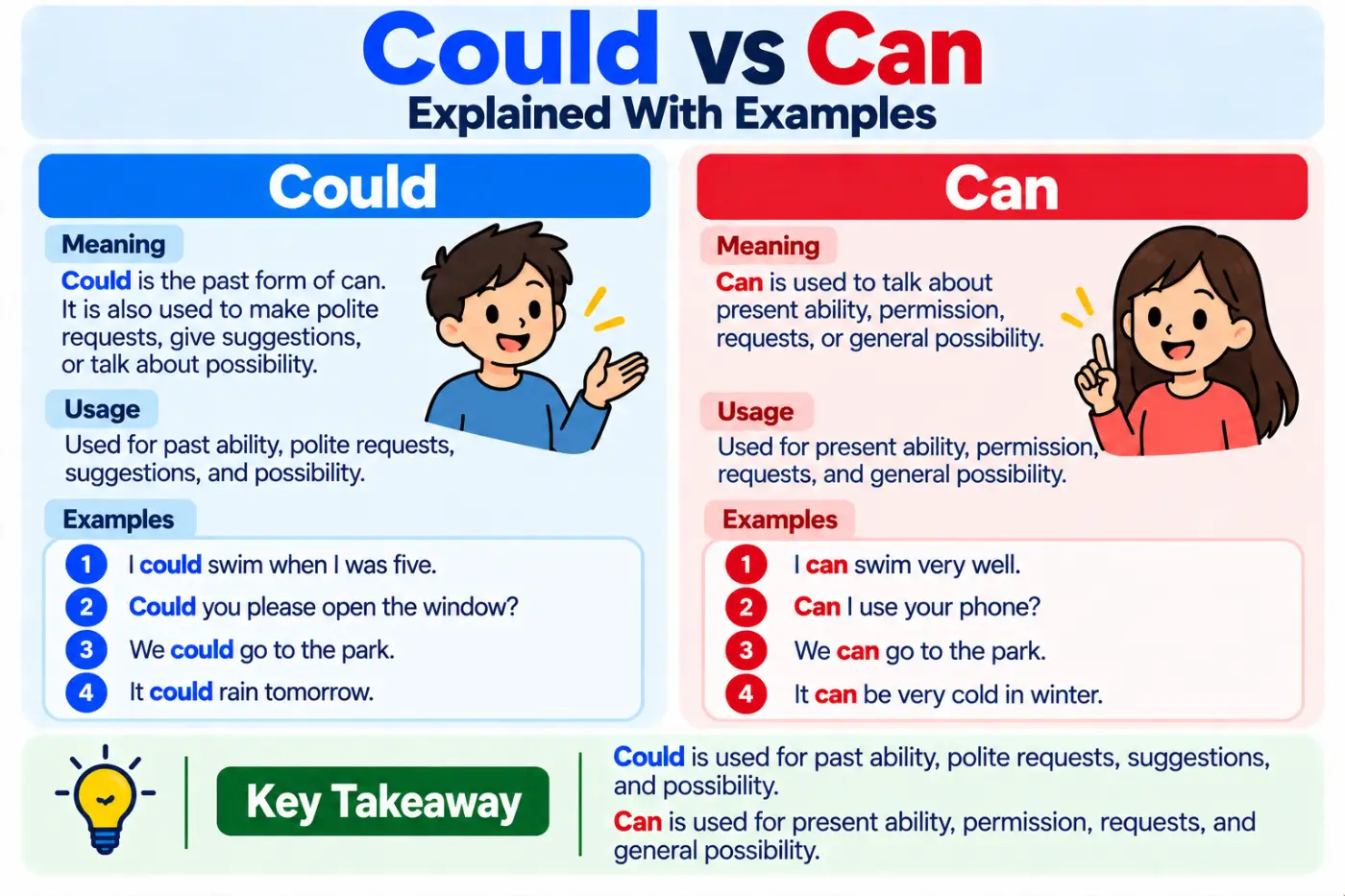
Could vs can is a common grammar question because both words express ability, possibility, and permission. They often appear in similar sentences, but they do not always mean the same thing. The main difference is that can usually describes present ability, current possibility, or direct permission, while could often describes past ability, a possible situation, or a more polite request.
For example, you might say, “I can swim” to describe a skill you have now. You might say, “I could swim when I was younger” to describe an ability you had in the past. You can also use could to sound more polite when asking someone for help.
The right choice depends on your meaning, the time frame, and the tone you want to create. Understanding these differences will help you write clearer sentences, make natural requests, and avoid common grammar mistakes.
For another common grammar confusion, see Nonresponsive vs Unresponsive Which Is Correct in 2026?.
Quick Answer
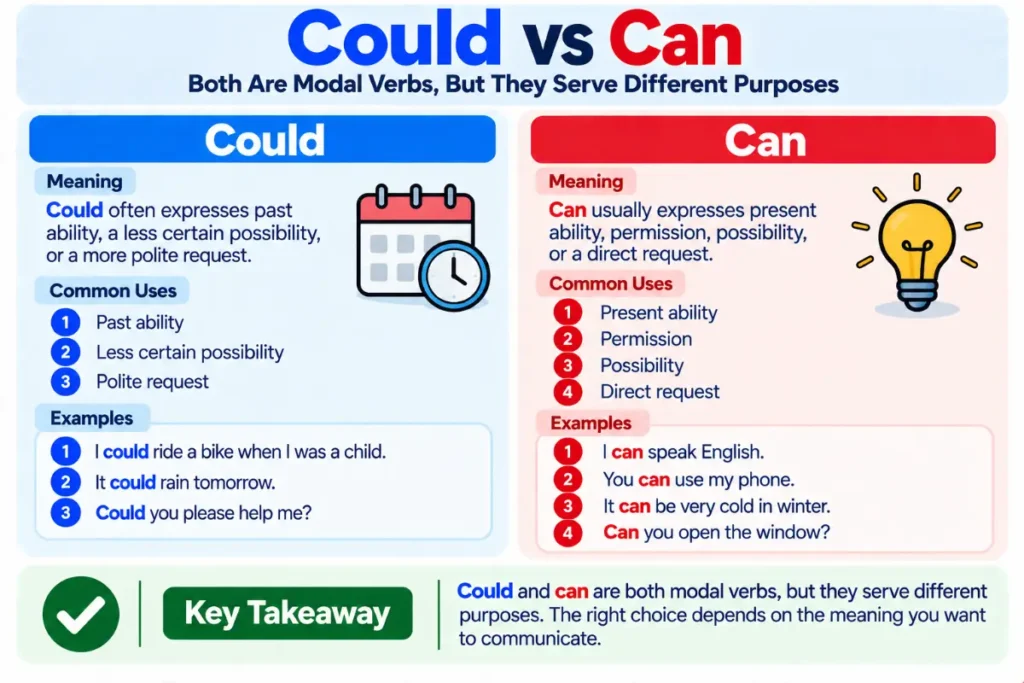
Can usually expresses present ability, possibility, or permission. Could can describe past ability, a possible situation, or a polite request. Both are correct English words, but they serve different purposes. Use can for direct and current statements, and use could when discussing past situations, uncertain possibilities, or more courteous requests.
Quick Comparison Table
| Feature | Can | Could |
|---|---|---|
| Main meaning | Present ability or possibility | Past ability or possible situation |
| Part of speech | Modal auxiliary verb | Modal auxiliary verb |
| Present ability | Yes | Sometimes, for conditional meaning |
| Past ability | Not usually | Yes |
| Possibility | Current or general possibility | Less certain or hypothetical possibility |
| Permission | Direct or informal permission | More polite permission request |
| Requests | Direct and friendly | More polite and less demanding |
| Formality | Neutral | Often softer and more courteous |
| Pronunciation | /kæn/ or /kən/ | /kʊd/ |
| Example | I can help you today. | I could help you tomorrow. |
Meaning and Definition
Both words belong to the group of English modal auxiliary verbs. Modal verbs work with a main verb to express ideas such as ability, possibility, permission, necessity, and willingness.
They do not behave like ordinary verbs. For example, they do not take an additional ending to agree with a third person singular subject. You say “She can drive,” not “She cans drive.” You also use the base form of the main verb after both forms.
What Does Can Mean?
Can is a modal verb that commonly expresses the ability to do something, permission to do something, or the possibility that something can happen.
It usually refers to the present or to general situations.
1. Present ability
Use this word to describe a skill or something a person is able to do.
Examples:
- I can speak Spanish.
- My brother can repair computers.
- She can play the piano.
- They can finish the assignment today.
These sentences describe abilities that exist now.
2. General possibility
It can also describe something that is possible under certain conditions or something that sometimes happens.
Examples:
- Heavy traffic can cause delays.
- Too much sunlight can damage some plants.
- Mistakes can happen when people rush.
Here, the word describes general possibilities rather than one specific event.
3. Permission
In everyday English, this form can ask for or give permission.
Examples:
- Can I use your phone?
- You can leave early today.
- Can we sit here?
This use is common in casual conversations, classrooms, and workplaces. It sounds natural and direct.
4. Requests
You can use it to ask someone to do something.
Examples:
- Can you open the window?
- Can you send me the document?
- Can you help me with this task?
These requests are friendly and straightforward. They are suitable for many everyday situations.
What Does Could Mean?
Could is a modal verb with several uses. It commonly expresses past ability, possibility, polite requests, and hypothetical situations.
It is also traditionally described as the past form of can. However, its meaning is not limited to the past. Context determines how people understand it.
1. Past ability
Use it to describe something someone was able to do in the past.
Examples:
- I could read before I started school.
- She could run very fast as a child.
- My grandfather could speak four languages.
These sentences describe abilities that existed at an earlier time.
2. Present or future possibility
It can describe something that may happen, even if the speaker is not certain.
Examples:
- It could rain this evening.
- We could miss the train if we leave late.
- The new policy could improve customer service.
The speaker sees these events as possible, not guaranteed.
3. Polite requests
It often makes a request sound softer and more respectful.
Examples:
- Could you help me with this report?
- Could you please close the door?
- Could I ask you a question?
These sentences are useful in professional settings and conversations with people you do not know well.
4. Suggestions and options
It can introduce an idea or suggest a possible action.
Examples:
- We could visit the museum tomorrow.
- You could try restarting your computer.
- They could discuss the issue after lunch.
The speaker presents an option without insisting that someone follow it.
5. Hypothetical situations
It also appears in sentences about imagined or conditional situations.
Examples:
- I could buy a house if I saved enough money.
- She could win the competition if she practiced more.
- We could travel next year if our budget allowed it.
These statements describe outcomes that depend on certain conditions.
Key Differences Explained
The distinction becomes easier when you look at the purpose of each sentence. The words can sometimes appear in similar structures, but they create different meanings or tones.
1. Present Ability Versus Past Ability
The most basic difference involves time.
Use can to describe an ability someone has now.
- I can drive a car.
- He can cook Italian food.
- They can speak English.
Use could to describe an ability someone had in the past.
- I could drive when I was seventeen.
- He could cook before he changed jobs.
- They could speak English when they lived abroad.
One useful detail is that could often describes general past ability. When talking about one specific successful action, English speakers may prefer was able to or managed to.
For example:
- I was able to open the locked door.
- She managed to solve the problem.
These expressions often sound more natural than could when describing one particular achievement.
2. Direct Possibility Versus Uncertain Possibility
Can often describes a real or general possibility.
- This road can become slippery in winter.
- A small mistake can cause a serious problem.
Could usually suggests that something is possible but uncertain.
- This road could become slippery tonight.
- A small mistake could cause a serious problem.
The difference is subtle. The first form can describe a known general fact, while the second often presents a possible outcome in a particular situation.
3. Direct Requests Versus Polite Requests
Both forms can appear in questions asking someone to do something.
However, could often sounds more polite.
- Can you check this email?
- Could you check this email?
The first request is direct and friendly. The second sounds softer and gives the other person a little more room to respond.
Neither sentence is automatically rude. Your relationship with the listener, tone of voice, and situation all affect how a request sounds.
4. Permission and Formality
Can is common when asking for permission in everyday situations.
- Can I borrow your charger?
- Can we start the meeting now?
Could often sounds more courteous.
- Could I borrow your charger?
- Could we start the meeting now?
In formal settings, may is another option for asking permission.
- May I enter the room?
- May we begin the presentation?
May can sound more formal than either of the two main forms.
5. Suggestions and Hypothetical Ideas
Could is particularly useful when offering choices or imagining possible outcomes.
- We could order dinner.
- You could ask your teacher for help.
- I could move to another city next year.
Can can describe available options too, but it often sounds more direct or practical.
- We can order dinner now.
- You can ask your teacher for help.
- I can move to another city next year.
The difference depends on the situation. The first group often presents possibilities, while the second may communicate an available action or ability.
6. Pronunciation
The two words have different vowel sounds.
- Can: /kæn/ in its strong form.
- Could: /kʊd/.
In natural speech, can is often reduced to /kən/, especially when it is unstressed. Could generally keeps its short vowel sound, although connected speech may make it less prominent.
7. Grammar
Both words follow the same basic modal verb structure:
Subject + modal verb + base form of the main verb.
Examples:
- She can dance.
- She could dance.
- They can arrive early.
- They could arrive early.
Do not add to after either modal when another verb follows.
Incorrect: She can to drive.
Correct: She can drive.
Incorrect: He could went home.
Correct: He could go home.
8. Standard Usage
Both forms are standard English. Neither is a misspelling, slang expression, or incorrect version of the other.
The choice depends on the meaning you want to express. English speakers use both in American, British, Canadian, and Australian English.
Which Form Is Correct?
Both are correct. Can and could are established English modal verbs, and each has its own grammatical functions.
The key is to choose the form that matches your intended meaning.
Use can when you want to describe:
- A present skill or ability.
- A general possibility.
- Current permission.
- A direct request.
- An action that is available now.
Use could when you want to describe:
- A past ability.
- An uncertain possibility.
- A polite request.
- A suggestion or alternative.
- A hypothetical situation.
Consider these examples:
- I can attend the meeting. This means attending is possible for me now.
- I could attend the meeting. This presents attendance as a possible option, often depending on other circumstances.
The second sentence does not always refer to the past. It may describe a current or future possibility.
A good editor looks at the full sentence instead of treating one word as universally better than the other.
Sentence Examples
Here are ten natural examples showing how people use both modal verbs in different situations.
Everyday Conversation
- I can meet you at the coffee shop after work.
- We could watch a movie tonight if everyone is free.
The first sentence describes an available plan. The second suggests an option.
Text Messages
- Can you send me the address?
- Could you call me when you get home?
Both are natural messages. The second sounds a little more polite.
Workplace Communication
- I can finish the presentation before Friday.
- Could you review the attached report before the meeting?
The first communicates ability and availability. The second makes a courteous workplace request.
School and Academic Writing
- Students can improve their writing by reading regularly.
- Additional research could help explain the results.
The first describes a general ability or opportunity. The second introduces a possible research outcome.
Formal and Social Situations
- Could I speak with the manager for a moment?
- You can contact our office during regular business hours.
The first is a polite request. The second gives direct information about an available action.
Common Grammar Mistakes
Although both forms are simple modal verbs, learners sometimes use them incorrectly. Most errors involve verb forms, sentence structure, or confusion about time and meaning.
1. Adding To After the Modal
Incorrect: I can to swim.
Correct: I can swim.
A modal verb takes the base form of the main verb directly. You do not need to add to between the two verbs.
2. Using the Past Form After Could
Incorrect: She could went to the store.
Correct: She could go to the store.
Could already carries the modal meaning. The next verb stays in its base form, even when the sentence refers to a past situation.
3. Adding S to the Main Verb
Incorrect: He can speaks French.
Correct: He can speak French.
Modal verbs do not require the main verb to agree with the subject. Use the base form with every subject.
4. Using Can for Every Polite Request
Less courteous: Can you explain this again?
More courteous: Could you explain this again?
The first sentence is grammatically correct, but the second may sound more respectful in a formal or unfamiliar setting. The choice is about tone, not basic correctness.
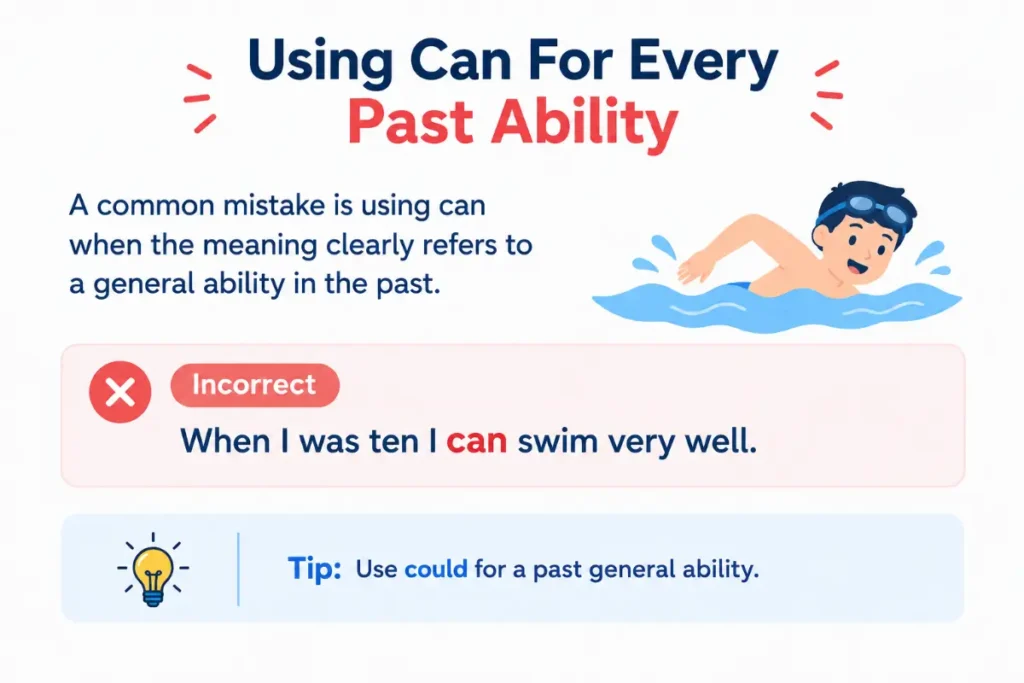
5. Confusing Past Ability With a Single Past Achievement
Potentially unclear: Yesterday, I could fix the computer.
Clearer: Yesterday, I was able to fix the computer.
Could is often suitable for general past ability. Was able to or managed to may be clearer when you mean that someone successfully completed one specific action.
Pronunciation Guide
Correct pronunciation helps you understand the difference when speaking and listening.
Pronunciation of Can
- IPA: /kæn/.
- Syllables: One.
- Easy guide: kan.
- Main vowel sound: Similar to the vowel in man.
- Stress: A single syllable, usually unstressed in a normal sentence.
In everyday conversation, can often becomes /kən/. This reduced form is common when the word does not receive emphasis.
For example, “I can do it” may sound like “I kən do it.”
Pronunciation of Could
- IPA: /kʊd/.
- Syllables: One.
- Easy guide: kud.
- Main vowel sound: Similar to the vowel in good.
- Final sound: A clear d sound.
Do not pronounce could as if it rhymes with cold. The vowel is shorter, and the final consonant is different.
Common Pronunciation Problems
- Pronouncing the l in could. The letter l is silent.
- Using the vowel sound from can when saying could.
- Making can too strong in every sentence. Native speakers often reduce it in ordinary conversation.
- Confusing could with would. Both end in a similar sound, but their first consonants and meanings differ.
You may also want to read Analyze or Analyse Which Spelling Is Correct..
Etymology and Word Origin
The two modal verbs have long histories in English. Their relationship helps explain why they share some meanings but function differently in modern grammar.
Origin of Can
Can comes from Old English can, a form of the verb cunnan. This historical verb meant to know or understand, and it later developed the sense of knowing how to do something.
Over time, the meaning expanded from knowledge to ability and possibility. Modern English uses it for skills, permission, and situations that are possible.
The older connection to knowledge still makes sense when you consider sentences such as “I can speak French.” The sentence communicates that the speaker knows how to perform an action.
Origin of Could
Could developed as the past form associated with can. Its spelling includes an l that does not represent a sound in modern pronunciation.
The letter became part of the spelling through historical changes and influence from the written form of should and would. It remains silent today.
Although the word originally had a strong connection to past ability, its modern uses expanded. It now also expresses politeness, uncertainty, suggestions, and hypothetical possibilities.
Regional Usage
The basic meanings of both words remain consistent across major English varieties. There is no standard regional spelling difference.
American English
In the United States, both forms are used in everyday conversation, business communication, education, and formal writing.
Can is common for direct requests and statements about present ability.
Examples:
- Can you help me with these boxes?
- I can finish the work today.
Could is common for polite requests and uncertain situations.
Examples:
- Could you send me the details?
- It could snow tomorrow.
American speakers often reduce can in connected speech.
British English
British English follows the same main grammar rules. Both forms are standard, and the distinction between direct and polite requests is familiar.
Examples:
- Can I have a glass of water?
- Could you tell me the way to the station?
May is also used in formal permission requests, particularly in careful or traditional language.
Australian English
Australian English uses both forms in much the same way as American and British English.
Can commonly describes ability and permission. Could appears in polite requests, suggestions, and possible situations.
There is no special Australian spelling rule that changes the choice.
Canadian English
Canadian English also follows the standard distinction.
Examples:
- I can drive you to the airport.
- We could leave earlier to avoid traffic.
The words have the same basic meanings and grammatical patterns as in other major English varieties.
Grammar Rules and Part of Speech
Both words are modal auxiliary verbs. They help the main verb communicate ideas beyond the action itself.
Unlike regular verbs, they do not change according to the subject. Their sentence patterns are also more limited than those of ordinary verbs.
1. Affirmative Sentences
Use this structure:
Subject + can or could + base verb + rest of sentence.
Examples:
- I can swim.
- She can sing.
- We could travel tomorrow.
- They could solve the problem.
Notice that the main verb stays in its base form.
2. Negative Sentences
Add not directly after the modal.
Examples:
- I cannot attend the meeting.
- She can’t drive.
- He could not understand the instructions.
- We couldn’t find the address.
The common contractions are can’t and couldn’t.
Cannot is usually written as one word. Can’t is common in conversation and informal writing. Cannot may be more suitable when you want a formal or emphatic tone.
3. Questions
Move the modal verb before the subject.
Examples:
- Can you help me?
- Can she speak German?
- Could they arrive earlier?
- Could I ask something?
Do not use do or does to form questions with these modal verbs.
Incorrect: Do you can swim?
Correct: Can you swim?
4. Questions With Question Words
Place the question word before the modal.
Examples:
- How can I improve my writing?
- Where can we park?
- Why could this happen?
- What could you do differently?
This structure is common in everyday speech, instructions, interviews, and written communication.
5. Passive Voice
Both modal verbs can appear in passive constructions.
Use this pattern:
Subject + modal + be + past participle.
Examples:
- The problem can be solved.
- The package could be delivered tomorrow.
- The rules can be changed.
- The mistake could be corrected.
The passive voice places more attention on the action or result than on the person performing it.
6. Perfect Modal Structures
Could can also appear with have and a past participle.
This structure has several uses, including discussing past possibilities or unrealized opportunities.
Examples:
- She could have won the race.
- I could have called you earlier.
- They could have misunderstood the message.
These sentences describe something that was possible in the past. Depending on context, they may suggest regret, criticism, or uncertainty.
Can does not normally replace could in this particular perfect modal structure.
7. Conditional Sentences
Could often appears in conditional sentences.
Examples:
- If I had more time, I could learn another language.
- If we left earlier, we could catch the train.
- If she practiced daily, she could improve quickly.
These sentences describe possible results that depend on a condition.
8. Punctuation
Neither modal verb requires special punctuation. Use ordinary sentence punctuation based on the sentence type.
- Statement: I can help you.
- Question: Could you help me?
- Negative statement: I cannot attend today.
A question mark belongs at the end of a direct question, not simply because a sentence contains could.
Real Life Usage Examples
The following examples show how these words work in different settings.
Daily Conversation
People use both forms naturally when talking about plans, abilities, and requests.
- “I can pick you up at six.” This communicates that the speaker is available.
- “We could get lunch after the appointment.” This suggests a possible plan.
Email and Workplace Communication
In professional messages, the choice can affect the tone.
- “I can prepare the revised document by Thursday.” This communicates availability and ability.
- “Could you review the latest version before sending it to the client?” This makes a polite request.
For a workplace email, could is often a useful choice when asking a colleague or client to take action. Can remains perfectly acceptable when the relationship is familiar and the request is straightforward.
Academic Writing
Both words can appear in academic discussions, but their meanings should remain precise.
- “Regular feedback can improve student performance.” This describes a general possibility.
- “These findings could support further investigation.” This suggests a possible interpretation or future research direction.
Academic writers should avoid using could when they mean that a result is proven or certain. It signals possibility rather than confirmation.
News and Journalism
Journalists use these forms to distinguish established facts from possible developments.
- “The new transport plan can reduce travel times during peak hours.” This describes a potential benefit.
- “The proposed changes could affect thousands of commuters.” This communicates an uncertain future impact.
Careful wording matters in news writing because readers need to understand the difference between a confirmed outcome and a possible one.
Literature and Storytelling
Writers use these words to show character ability, uncertainty, and imagined possibilities.
- “As a child, Daniel could climb the tallest tree in the village.” This describes a past skill.
- “Perhaps we could find a way out before sunrise,” she whispered. This introduces a possible plan and creates a softer tone.
These examples show how modal verbs can communicate more than simple action. They can also reveal a character’s attitude and level of confidence.
Related and Confused Terms
Several other English words have meanings close to these modal verbs. Understanding their differences can help you choose more precise language.
1. May
May expresses possibility or permission.
Examples:
- It may rain tomorrow.
- May I come in?
It often sounds more formal than can when asking permission. It can also express uncertainty without suggesting a hypothetical situation as strongly as could sometimes does.
2. Might
Might expresses possibility, often with a sense of uncertainty.
Example:
– She might arrive late.
It is close in meaning to could in many contexts, although the exact level of certainty depends on the speaker and situation.
3. Would
Would commonly expresses hypothetical results, polite requests, habits in the past, and future situations viewed from a past point.
Examples:
- Would you like some coffee?
- I would travel more if I had the money.
Unlike could, it often focuses on willingness, preference, or an imagined result.
4. Should
Should expresses advice, expectation, or a recommendation.
Examples:
- You should get more rest.
- The package should arrive tomorrow.
It is not simply another way to express ability. It often communicates what is advisable or expected.
5. Must
Must expresses strong necessity or obligation. It can also communicate a logical conclusion.
Examples:
- You must wear a seat belt.
- She must be tired after the long trip.
It is stronger than can and could when used for obligation.
6. Able To
Able to expresses ability and can sometimes replace can or could.
Examples:
- I am able to drive.
- She was able to complete the task.
This phrase is especially useful when you need a verb form that modal verbs cannot provide, such as after another modal.
Example:
– I will be able to attend tomorrow.
7. Be Allowed To
This expression communicates permission.
Examples:
- Students are allowed to use calculators.
- We are not allowed to park here.
It can be more precise than can when rules or official permission are involved.
8. Would Be Able To
This phrase describes ability under a condition or in a possible future situation.
Example:
– I would be able to help if I finished my work early.
It often works as a longer alternative to could when the sentence needs a clearer conditional meaning.
Expert Editor Insight
Experienced English editors do not automatically replace one modal verb with the other. They first identify the writer’s intended meaning, then check the time frame, level of certainty, and tone. A direct request may need can, while a more courteous request may benefit from could. Grammar tools can flag incorrect structures such as “could went” or “can to go,” but they cannot always judge the intended tone. The best editing tip is to ask what the sentence communicates before changing the verb. A grammatically correct sentence can still be unclear if the modal does not match the intended message.
Key Takeaways
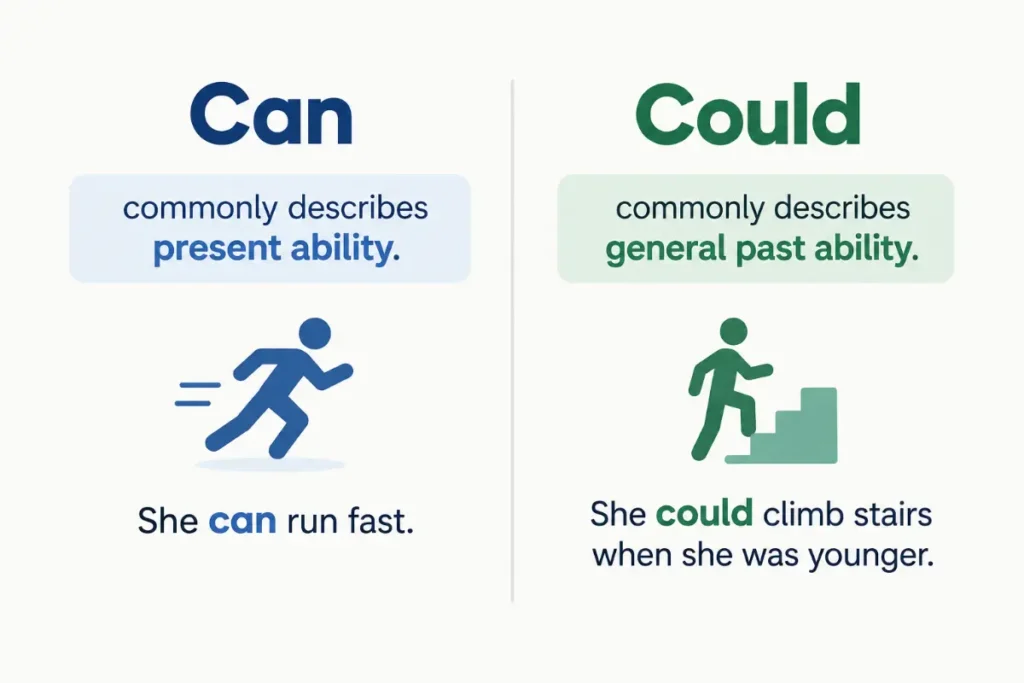
- Can commonly describes present ability.
- Could commonly describes general past ability.
- Can is common for direct requests.
- Could often makes a request softer and more polite.
- Can can describe general possibility.
- Could can describe a specific or less certain possibility.
- Could often introduces a suggestion.
- Both words are followed by the base form of the main verb.
- Neither word takes an s after he, she, or it.
- Could doesn’t always refer to the past.
- Can is common for everyday permission.
- Context determines the exact meaning.
You may also want to read Appendices vs Appendixes Which Spelling Is Correct.
Conclusion
Understanding could vs can becomes much easier when you focus on meaning instead of memorizing isolated rules. Use can for present ability, general possibility, direct permission, and straightforward requests. Use could for past ability, uncertain situations, hypothetical ideas, and more polite requests. Both forms are correct, and neither should replace the other in every situation.
A simple editing tip can help: check the time frame first, then consider how certain or polite you want the sentence to sound. With that habit, you can choose the right modal naturally in conversations, emails, academic work, and everyday writing.
FAQs
Is Could the Past Tense of Can?
Could is traditionally the past form of can, especially when describing an ability someone had earlier in life. For example, “I can swim” describes a current ability, while “I could swim when I was six” describes a past one. However, could also expresses present or future possibility, polite requests, and hypothetical situations.
Can Could Be Used for Present Situations?
Yes. Could does not always refer to the past. You can use it to describe a possible present or future situation, such as “We could take a taxi” or “It could rain later.” In these examples, the speaker presents an option or possibility rather than describing a past ability.
Is Could More Polite Than Can?
Could often sounds more polite because it makes a request feel less direct. For example, “Can you help me?” is friendly and straightforward, while “Could you help me?” sounds softer. Both sentences are correct. The best choice depends on your relationship with the listener and the level of formality you want.
Can I Use Could in Formal Writing?
Yes. Could is standard English and works well in formal writing. It can express uncertainty, possible outcomes, polite requests, and conditional situations. Academic writers often use it to avoid presenting an uncertain result as a proven fact. For example, “These findings could suggest a link” communicates a possible interpretation rather than a definite conclusion.
What Is the Difference Between Can and Could for Permission?
Can is common in everyday permission requests, such as “Can I leave early?” Could makes the request more courteous, as in “Could I leave early?” Both are grammatically correct. In more formal situations, may is another option. The difference mainly involves tone and social context, not basic grammar.
Can Could and Can Be Used in the Same Sentence?
Yes, both can appear in one sentence when they serve different grammatical purposes. For example, “You can ask for help, or you could try solving the problem yourself.” The first clause describes an available action, while the second suggests another possible option. Each word contributes a different meaning.
Why Do English Learners Confuse These Two Words?
Learners often confuse them because both express ability and possibility. Their meanings also overlap in requests and suggestions. The past form of could adds another layer of difficulty because it can describe present or future possibilities too. Learning the main sentence patterns and practicing examples in context makes the distinction easier.
Is Can or Could Better for Professional Emails?
Could is often a good choice for requests in professional emails because it sounds courteous and respectful. For example, “Could you review the attached file?” is a natural workplace request. Can is also appropriate when asking a familiar colleague or discussing your own availability. Choose the form that matches the relationship and purpose of the message.