
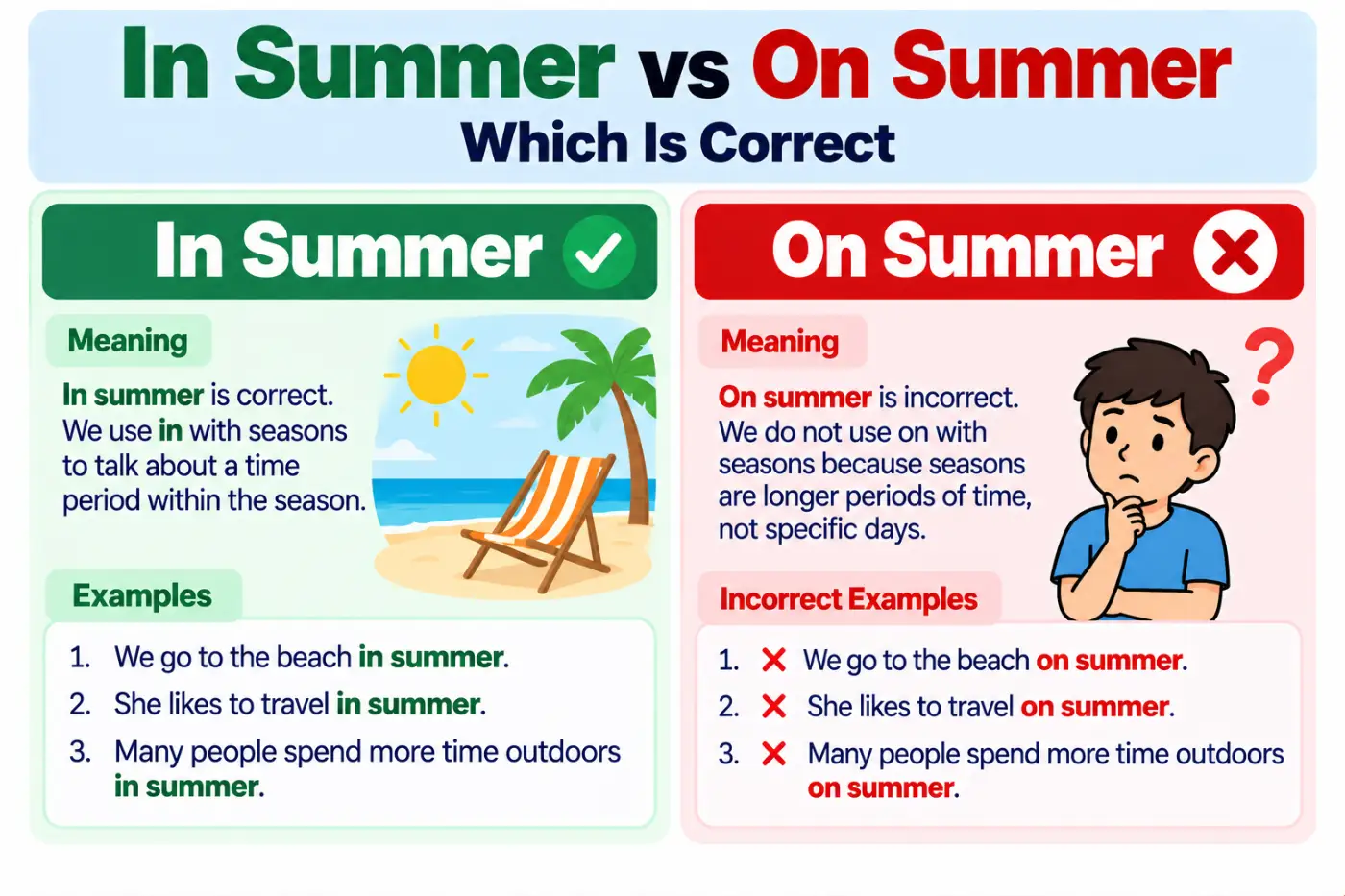
The correct expression is in summer when you mean the summer season in general. You can also say in the summer, which is very common in American English. On summer is not normally correct when the season itself is the object of the preposition.
The confusion happens because English uses different prepositions for different kinds of time expressions. We say in summer, in July, and in 2026, but we say on Monday, on June 15, and on a summer morning. The choice depends on what kind of time expression follows the preposition.
This guide explains the grammar behind these forms, shows natural examples, and explains when on can appear near the word summer. You’ll also learn how American and British usage compare, which related expressions are worth remembering, and how to avoid common mistakes in everyday and formal writing.
A related grammar guide is Fact Or Fiction Meaning Difference And Correct Usage 2026.
Quick Answer
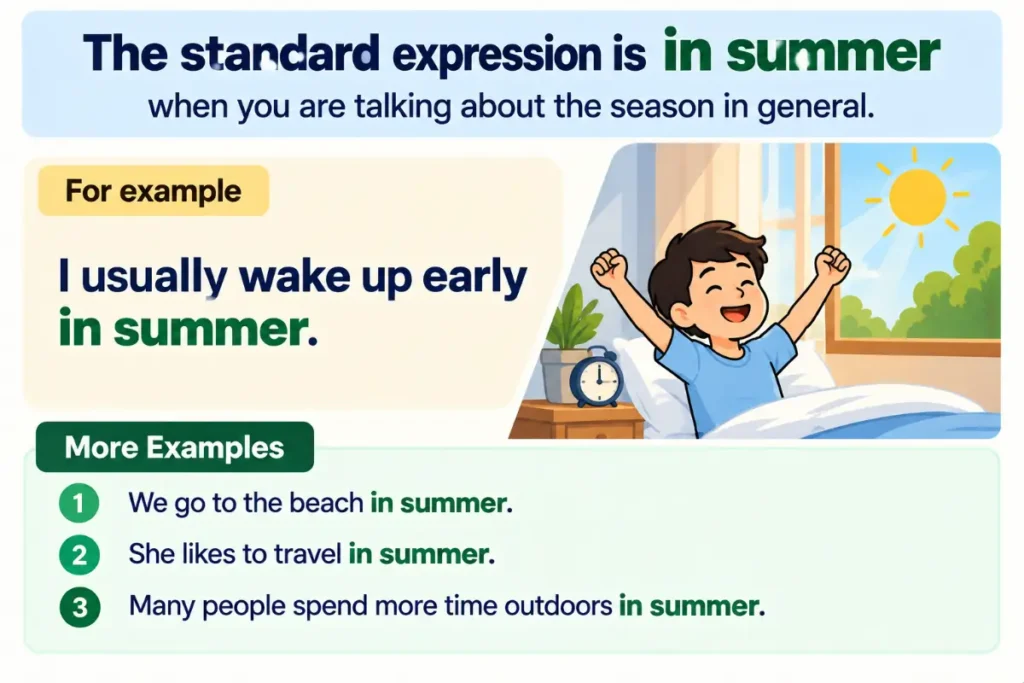
Use in summer when you are talking about the summer season in general. In the summer is also correct and especially common in American English. On summer is generally incorrect when summer itself names the season, but on can be correct before a specific summer day, date, or occasion, as in on a summer morning.
What does the expression mean?
The phrase in summer means during the summer season. It describes something that happens, happens regularly, or is true during that part of the year.
For example:
Many people spend more time outdoors in summer.
The sentence refers to summer as a general period. It doesn’t identify one particular day or date.
American English also commonly uses in the summer:
Many people spend more time outdoors in the summer.
Both sentences are grammatical. The version without the can sound slightly more general or concise, while in the summer is extremely natural in ordinary American conversation.
The key point is that summer is treated as a period of time. English normally uses in for broad periods such as seasons, months, years, and parts of the day.
Compare these examples:
- We travel in summer.
- We travel in July.
- We traveled in 2025.
- We exercise in the morning.
- We usually stay home on Sundays.
- We left on July 10.
The preposition changes because the type of time expression changes.
In summer or on summer
The main difference is the preposition.
| Form | Meaning | Part of Speech | Usage | Formality | Common Contexts | Example |
|---|---|---|---|---|---|---|
| in summer | During the summer season | Prepositional phrase | Standard | Neutral | General seasonal statements | We swim more often in summer. |
| in the summer | During the summer season | Prepositional phrase | Very common | Neutral | Everyday and formal writing | We usually visit family in the summer. |
| on summer | Normally no standard seasonal meaning | Prepositional phrase | Generally nonstandard in this use | Not recommended | Usually a preposition mistake | Do not write: We travel on summer. |
| on a summer day | During a particular summer day | Prepositional phrase | Standard | Neutral | Specific days or descriptive writing | We met on a summer day. |
| on summer mornings | During particular summer mornings | Prepositional phrase | Standard | Neutral | Repeated specific occasions | I jog on summer mornings. |
This table shows why simply memorizing in and on isn’t enough. The noun or phrase that follows the preposition matters.
Why in is used with seasons
English commonly treats seasons as periods rather than individual points in time. That is why in works naturally with them.
You can say:
- in spring
- in summer
- in fall
- in winter
You can also use the article the:
- in the spring
- in the summer
- in the fall
- in the winter
Both patterns are established English usage.
The choice often depends on style and context. American speakers frequently use the article in ordinary conversation, especially with in the summer and in the winter. Shorter forms such as in summer are also completely grammatical and are especially common in general statements.
The same basic idea applies to other broad time periods:
Flowers bloom in spring.
School starts in fall.
Snow is common in winter.
Days are longer in summer.
These sentences describe a season as a period during which something happens.
Why on summer sounds wrong
The preposition on is commonly used for particular days and dates.
For example:
I called her on Monday.
We met on June 15.
The event takes place on Saturday.
I went hiking on a summer morning.
In the last example, on doesn’t modify the season by itself. It introduces a summer morning, which is a particular type of day or time occasion.
That is very different from saying:
We go hiking on summer.
The second sentence treats summer as if it were a specific day or date. That doesn’t match the normal time pattern in English.
This is why on summer often sounds unnatural to native speakers when someone is trying to say during summer.
When on can appear with summer
There is an important distinction here. Saying on summer is generally wrong for the meaning during the summer season, but the word summer can appear after on in longer expressions.
For example:
We went hiking on a beautiful summer morning.
She got married on a warm summer afternoon.
I read the book on one summer evening.
They met on the first day of summer.
In these sentences, on is connected to a particular day, morning, afternoon, evening, or date.
The structure is not simply:
on + summer
Instead, it is:
on + a specific day or occasion associated with summer
This distinction helps explain many apparent exceptions.
The grammar rule behind the difference
A useful way to remember the rule is to group time expressions into three broad categories.
Use in for longer periods
Use in with seasons, months, years, centuries, and many broad periods.
Examples include:
- in summer
- in September
- in 2026
- in the 1990s
- in the morning
- in the winter
These expressions describe a period rather than a specific day.
Use on for days and dates
Use on with specific days, dates, and certain day based expressions.
Examples include:
- on Monday
- on Friday morning
- on July 4
- on my birthday
- on Christmas Day
- on a summer evening
The last example contains summer, but the main time expression is a summer evening, which functions as a specific type of day based occasion.
Use at for specific points
Use at for many precise points in time.
Examples include:
- at noon
- at midnight
- at 6 p.m.
- at sunrise
- at sunset
- at night
These patterns aren’t absolute for every English expression, but they provide a strong practical foundation.
The difference between in summer and in the summer
Both forms are correct, so this is not a spelling contest between a correct and incorrect expression.
In summer is a general seasonal expression.
Birds are especially active in summer.
In the summer also means during the summer season.
Birds are especially active in the summer.
For an American audience, in the summer often feels more conversational. In summer is also natural and may sound more concise or general.
Consider this pair:
I like to swim in summer.
I like to swim in the summer.
There is no major difference in basic meaning. You don’t need to treat one as an error.
The same pattern appears with other seasons:
We ski in winter.
We ski in the winter.
Leaves change color in fall.
Leaves change color in the fall.
Both versions can be used in American English.
Which form is correct?
If you are choosing between in summer and on summer, use in summer when you mean during the summer season.
The reason is grammatical. Summer names a season, which is a broad period of time. English normally uses in for this kind of time period.
Use on when the time expression refers to a particular day, date, or day based occasion.
For example:
We usually travel in summer.
But:
We left on a summer morning.
The first sentence describes a season. The second identifies a particular kind of morning.
Sentence examples
Here are natural examples using the standard seasonal expression.
- We usually visit the beach in summer.
- The days are much longer in the summer.
- I like to read outside in summer.
- Many families take vacations in the summer.
- The park gets crowded in summer.
- She works part time in the summer.
- Fresh berries are easy to find in summer.
- We usually eat dinner outside in the summer.
- The town hosts several outdoor events in summer.
- I sleep better in the summer when the days are longer.
These examples cover everyday speech, general statements, work related contexts, and ordinary written English.
Need another quick comparison? Read Ladder vs Latter Correct Meaning and Usage Guide.
Examples with on and summer
The word on can correctly appear with summer when another word creates a specific day or occasion.
- We met on a warm summer evening.
- She arrived on a sunny summer morning.
- They got married on the first day of summer.
- I found the old photo on one summer afternoon.
- The storm arrived on a hot summer night.
Notice that none of these examples uses on summer as a complete seasonal time expression.
That small difference is the key to the entire question.
Common mistakes
Several mistakes can appear because English has many different prepositions for time.
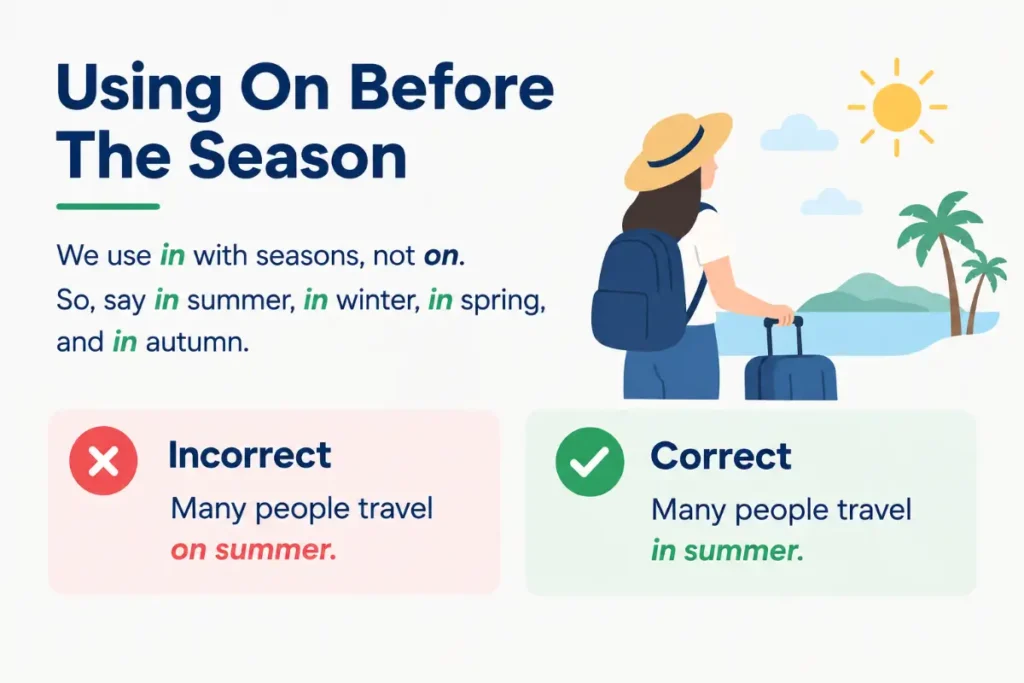
Mistake 1: Using on before the season
Incorrect:
We usually travel on summer.
Correct:
We usually travel in summer.
The mistake comes from treating a season like a specific day. Use in for the broad seasonal period.
Mistake 2: Assuming in the summer is the only correct form
Some learners are taught in the summer and later assume that removing the makes the sentence incorrect.
That isn’t true. In summer is also standard English.
We often go camping in summer.
We often go camping in the summer.
Both are grammatical.
Mistake 3: Using on because the sentence describes a specific event
A sentence can describe a specific event that happens during summer without requiring on.
Incorrect:
We visited the museum on summer.
Correct:
We visited the museum in summer.
If the sentence identifies the actual day, then on may become appropriate:
We visited the museum on a summer Saturday.
Mistake 4: Confusing season and date expressions
Compare:
The festival happens in summer.
The festival happens on July 20.
The first expression identifies a broad period. The second identifies a particular date.
The preposition changes because the time expression changes.
Mistake 5: Translating directly from another language
Learners sometimes choose a preposition based on a similar expression in their first language. This can lead to combinations that sound logical but aren’t standard English.
English time prepositions often need to be learned as patterns. Learning in summer, in July, on Monday, and at noon as common units can help prevent these errors.
Pronunciation guide
The word summer is pronounced approximately:
/ˈsʌmər/ in American English.
It has two syllables:
SUM er
The stress falls on the first syllable.
The first vowel has the same general sound found in words such as sun and under. The second syllable is usually weak in natural American speech.
The full phrase in summer sounds approximately like:
in SUM er
The word in is normally unstressed when the phrase appears naturally in a sentence.
For example:
We travel in summer.
A native speaker usually says the phrase smoothly rather than giving equal stress to every word.
A common pronunciation issue isn’t the word itself but the rhythm. Learners may pronounce every word too strongly, making the sentence sound less natural.
Etymology and word origin
The word summer has a long history in English and other Germanic languages. It comes from Old English sumor, meaning the warm season of the year.
The word is related to forms found in other Germanic languages, reflecting an old shared vocabulary for the seasons.
Modern summer has kept the basic meaning of the older word. Its spelling and pronunciation developed over centuries as English changed from Old English into Middle English and then modern English.
The preposition in also has a long history in English. Its use with periods of time reflects the idea of being within a period or span. This gives us familiar patterns such as in summer, in July, and in 2026.
You don’t need to know the history to use the expression correctly, but the idea of a season as a period helps make the grammar easier to remember.
Regional usage
American English
In American English, both in summer and in the summer are standard.
In the summer is particularly common in everyday conversation:
We usually travel in the summer.
The shorter form is also natural:
We usually travel in summer.
American English commonly uses fall for the season that comes before winter, but that difference doesn’t affect the basic preposition rule.
British English
British English also uses in summer and in the summer.
The shorter form in summer is especially familiar in British usage, but the version with the is also grammatical.
The important point is that British and American English don’t have a major disagreement about the basic rule. On summer is not the normal way to refer to the season itself in either variety.
Australian English
Australian English follows the same general time pattern. Speakers can use in summer and in the summer when referring to the season.
Specific days or occasions can still take on:
We went swimming on a summer afternoon.
No special Australian rule changes the basic distinction.
Canadian English
Canadian English also uses in summer and in the summer. As in American English, on is used with particular days, dates, and day based expressions rather than with the season by itself.
Grammar and part of speech
The expression is a prepositional phrase.
In in summer, the preposition is in, and summer functions as the noun that follows it.
The entire phrase can work as an adverbial expression because it tells the reader when something happens.
For example:
We travel in summer.
The phrase in summer answers the question When do we travel?
It can appear at the beginning or end of a sentence.
In summer, we spend more time outdoors.
We spend more time outdoors in summer.
A comma is commonly used after the phrase when it begins a sentence and functions as an introductory time expression:
In summer, the park opens earlier.
The comma isn’t normally needed when the phrase comes at the end:
The park opens earlier in summer.
Real life usage
Daily conversation
In ordinary conversation, people often use in the summer.
I usually wake up early in the summer.
We spend most weekends outside in the summer.
The shorter version also works naturally:
I love hiking in summer.
We get a lot of visitors in summer.
Workplace communication
Seasonal references can appear in emails, schedules, reports, and planning documents.
We expect higher demand in the summer.
The office will be busier in summer because of increased tourism.
For workplace writing, choose the form that fits the tone of the document. Both are grammatical.
Academic writing
Academic writing often uses concise seasonal expressions when discussing patterns across the year.
Water consumption tends to increase in summer.
The study examined changes in temperature during the summer.
Academic writers may also choose during the summer when they want to emphasize the duration.
News and journalism
News writing often uses compact time expressions.
Temperatures are expected to rise in summer.
The city plans to increase public transportation service during the summer.
The choice depends on the sentence and the publication’s style, not on a different grammar rule.
Literature and storytelling
Narrative writing may use seasonal phrases to establish time or atmosphere.
They first met in summer, when the town was full of visitors.
On a quiet summer evening, they sat together beside the lake.
The second example shows the important contrast. On works because a quiet summer evening identifies a particular type of occasion.
Related expressions you should know
Several expressions are closely related to the same grammar rule.
In the summer
This is a standard alternative to in summer and is very common in American English.
We usually travel in the summer.
During the summer
This expression emphasizes the time period during which something occurs.
I worked at the library during the summer.
It is often useful when you want to make the duration especially clear.
Over the summer
This usually refers to something that happens throughout or across the summer period.
I read five books over the summer.
It can also suggest gradual change:
She improved her writing over the summer.
Throughout the summer
This emphasizes that something continues across the entire season or much of it.
The garden remains open throughout the summer.
This summer
Use this summer when referring to the current or upcoming summer in the relevant context.
We’re planning a road trip this summer.
No preposition is needed.
Last summer
Use last summer for the previous summer.
We visited California last summer.
Again, no preposition is needed.
Next summer
Use next summer for the following summer.
We’re hoping to move next summer.
On a summer day
This is a correct use of on because a summer day refers to a particular day or type of day.
I found the letter on a summer day many years ago.
A simple way to remember the rule
Think of in as placing an event inside a period.
You can imagine the season as a large container of time:
in summer
The event happens somewhere within that seasonal period.
For on, think of a particular day:
on Monday
on July 12
on a summer morning
This mental picture isn’t a complete grammar rule, but it is a useful memory aid.
Another easy test is to ask what kind of time you are naming.
- If you’re naming a season, month, year, or broad period, in is often appropriate.
- If you’re naming a particular day or date, on is often appropriate.
- If you’re naming a precise point such as noon or a clock time, at is often appropriate.
For example:
in summer
on Saturday
at noon
This three part pattern makes many time preposition questions easier.
Expert editor insight
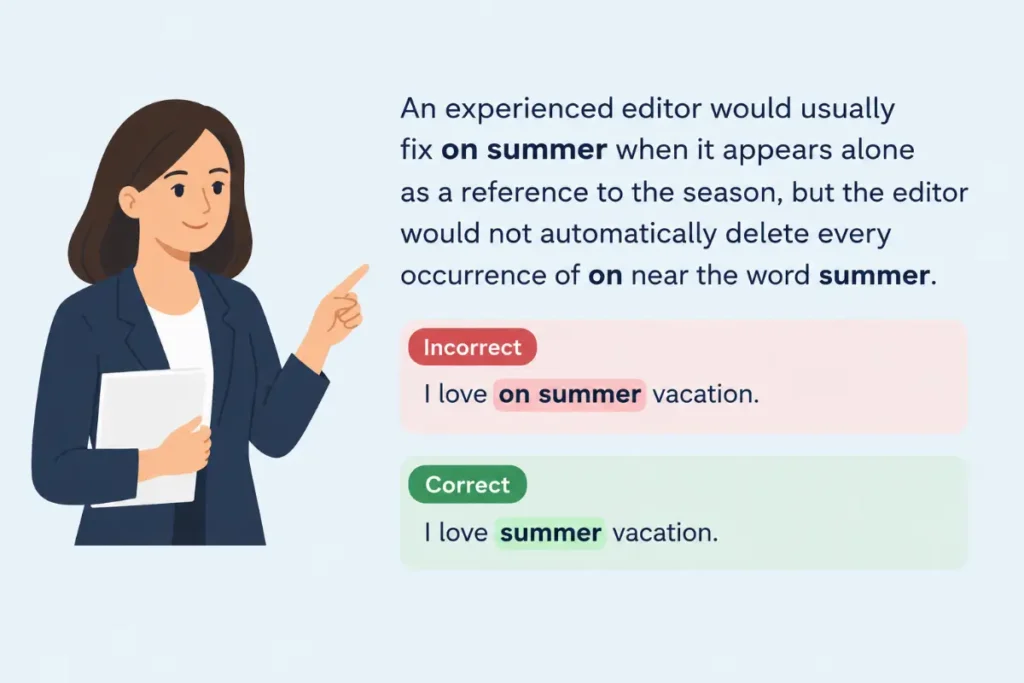
An experienced editor would usually treat in summer as the natural choice for a general seasonal statement and would not change it simply because in the summer is more familiar to some American readers. The bigger problem is on summer, which usually signals that the writer has confused a season with a specific day. Editing tools may flag unusual preposition patterns, but context still matters. A human editor checks the complete time expression rather than correcting every unusual phrase automatically.
A related grammar guide is Bellies vs Bellys Which Spelling Is Correct in 2026?.
Final takeaway
In summer is correct when you mean during the summer season. American English also commonly uses in the summer, and both forms are standard. On summer is generally incorrect when summer itself names the season.
The easiest rule is to match the preposition to the type of time expression. Use in for broad periods such as seasons, months, and years. Use on for specific days and dates, including expressions such as on a summer morning.
When editing your own writing, ask whether you mean a whole season or a particular day. If you mean the season, choose in summer or in the summer. That simple check will prevent most mistakes.
FAQs
Is on summer a correct English expression?
Not normally when you mean during the summer season. The standard choices are in summer, in the summer, or during the summer. The preposition on becomes appropriate when summer modifies a specific day or occasion, such as on a summer morning or on a summer evening.
Is in summer grammatically correct?
Yes. In summer is a grammatically correct prepositional phrase meaning during the summer season. It can be used in everyday speech, professional writing, and formal prose. American English also commonly uses in the summer, so you don’t need to replace the shorter form simply because the version with the sounds more familiar.
Which is correct: in summer or on summer?
Use in summer when referring to the season in general. On summer is not the normal standard expression for this meaning. Use on when the expression refers to a particular day, date, or occasion connected with summer, such as on a summer day or on July 4.
Is in the summer better than in summer?
Neither is universally better. Both are correct. In the summer is very common in American English and often sounds natural in conversation. In summer is shorter and works well for general statements. Choose the version that fits the sentence and your preferred style rather than treating one as an error.
Can in summer start a sentence?
Yes. A seasonal time phrase can begin a sentence naturally.
In summer, we spend more time outdoors.
A comma is commonly used after the introductory phrase. You can also place the phrase at the end:
We spend more time outdoors in summer.
Both sentence positions are grammatical.
What is another way to say in summer?
Common alternatives include in the summer, during the summer, over the summer, and throughout the summer. The best choice depends on the intended meaning. During focuses on the period, over can suggest something happening across the season, and throughout emphasizes continuation across the season.
Why do people confuse in summer and on summer?
The confusion usually comes from the different rules for time prepositions. English uses in for many broad periods and on for many specific days and dates. Since summer can be associated with particular days, learners may extend on to the season itself. The expression on a summer day is correct, but on summer is not normally correct for the season.
Is in summer appropriate in formal writing?
Yes. In summer is grammatically standard and can be used in formal writing. It may appear in reports, academic prose, professional documents, and general informational writing. During the summer is another formal and clear option. The phrase doesn’t need to be replaced simply to make writing sound more professional.