
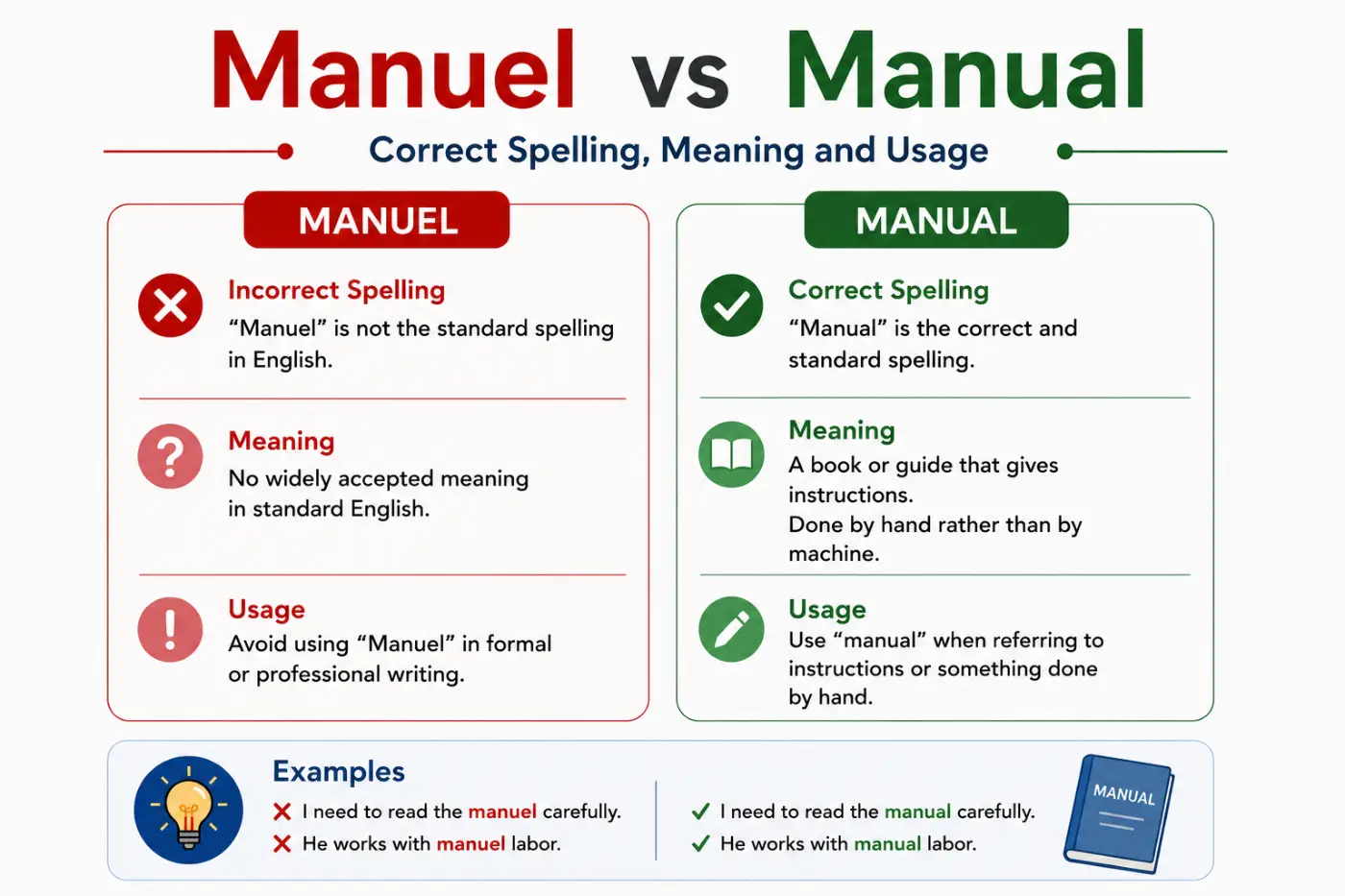
If you’re confused about manuel vs manual you’re not alone. The two forms look almost identical and they can sound very similar when spoken quickly. However, they don’t serve the same purpose in English. Manual is a standard English word with several meanings. Manuel is primarily a male given name. It can also appear as part of a person’s full name or in names from Spanish and Portuguese speaking cultures.
The difference matters because using one form in place of the other can change the meaning of a sentence completely. If you want to describe something done by hand, a book of instructions, or a vehicle that requires gear changes, manual is the word you need. If you’re referring to a person named Manuel, the capitalized name is appropriate.
The easiest way to remember the distinction is to connect manual with the word hand. A manual task is done by hand. A manual can also be an instruction book that tells you how to use something. Manuel, by contrast, normally identifies a person. Once you see that difference, the spelling becomes much easier to choose.
A related grammar guide is does anybody or do anybody Correct Grammar and Usage.
Quick Answer
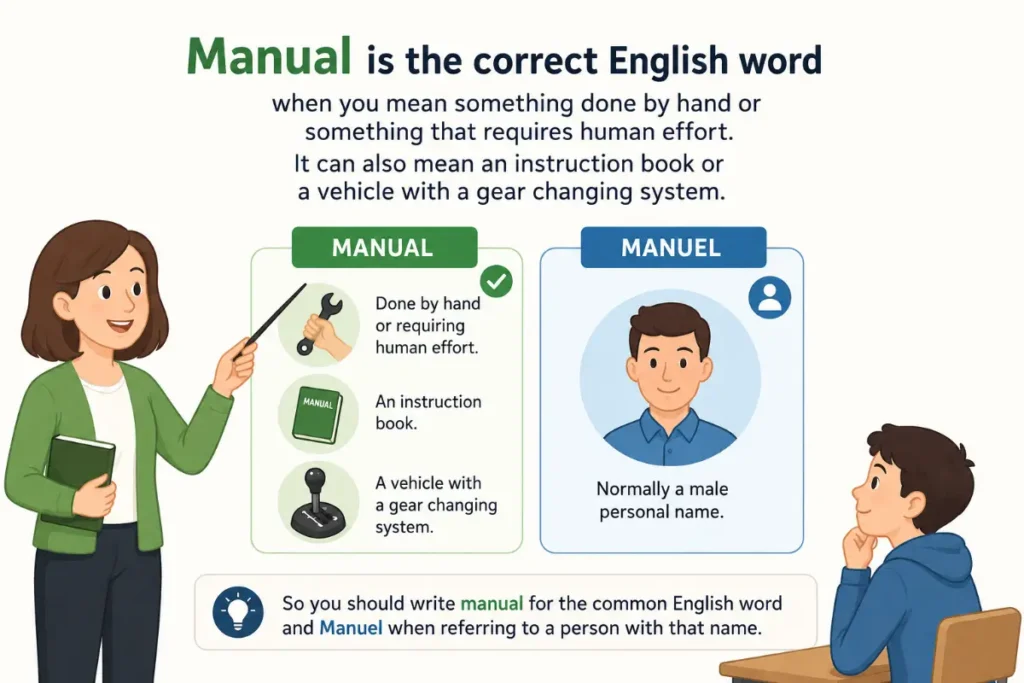
Manual is the correct English word when you mean something done by hand or something that requires human effort. It can also mean an instruction book or a vehicle with a gear changing system. Manuel is normally a male personal name. So you should write manual for the common English word and Manuel when referring to a person with that name.
Comparison Table
| Correct Form | Meaning | Part of Speech | Origin | Usage Frequency | Formality | Common Contexts | Example |
|---|---|---|---|---|---|---|---|
| Manual | Done by hand or operated by hand | Adjective | Latin | Common | Neutral | Work machines writing vehicles | The machine has a manual control. |
| Manual | A book of instructions | Noun | Latin | Common | Neutral | Technology work equipment | Read the manual before using the device. |
| Manual | A vehicle with a gear changing system | Noun | Latin | Common | Neutral | Cars driving | He learned to drive a manual. |
| Manuel | A male given name | Proper noun | Spanish Portuguese and related naming traditions | Common as a name | Neutral | Personal names | Manuel arrived before lunch. |
Meaning and Definition
The easiest way to understand these two forms is to separate the common English word from the personal name. Manual has several meanings in modern English. As an adjective it describes something done with the hands or operated by hand. Cambridge gives examples involving manual sorting and manual pressure. It also uses the word for physical work and for vehicles that require the driver to change gears. Manual can also function as a noun. One common meaning is a book that gives practical instructions for using a machine or completing a task.
An instruction manual might explain how to install equipment. A training manual might explain workplace procedures. A service manual might provide technical information about maintaining a machine. The word also appears in everyday speech about cars. In American English a person may say that a car is a manual when the driver has to change gears rather than relying on an automatic transmission. Cambridge records this noun use as well. Manuel has a completely different role. Dictionary.com identifies it as a male given name. It is therefore treated as a proper noun when it identifies a specific person. Proper names normally begin with a capital letter.
For example, Manuel might be the first name of a student, teacher, athlete, writer, neighbor, or public figure. In a sentence such as Manuel called me yesterday, the word doesn’t describe an action or object. It identifies the person who called.
That distinction is the heart of the issue.
Meaning of the Incorrect Form
Calling Manuel an incorrect spelling would be misleading. Manuel is not simply a misspelled version of manual. It is a legitimate personal name. The problem occurs when someone intends to use the English word manual but types Manuel instead. In that situation, Manuel is the wrong form for the intended meaning.
The spelling error often happens because the two words contain the same basic letters except for the final vowel pattern. Consider these two sentences. The technician read the manual. Manuel read the instructions. Both sentences are grammatically correct. They simply use different words with different functions. The first sentence refers to an instruction book. The second refers to a person.
Meaning of the Correct Form
Manual has a broad range of uses because its central idea involves the hands or human control. As an adjective, it can describe a process that people perform by hand instead of using an automated system. Manual data entry requires a person to enter information. Manual control means that a person operates something directly. It can also describe physical work. Manual labor refers to work that involves physical effort.
The expression is common in American English and appears in workplace and employment contexts. Cambridge includes manual labor and manual worker among its established uses. As a noun, manual can refer to an instruction book. It can also refer to a vehicle with a gear changing system. In specialized musical language, the word can describe a keyboard played with the hands on an organ. Cambridge records this specialized noun meaning too.
Key Differences Explained
The spelling difference is small but the meaning difference is large. You can think of these forms as two doors that look similar but lead to different rooms.
- Manual is a standard English word. Manuel is primarily a personal name.
- Manual can function as an adjective or noun. Manuel functions as a proper noun when it identifies a person.
- Manual is used for ideas involving hand operation, physical work, instructions, or certain types of vehicles. Manuel normally identifies an individual.
- Manual is usually lowercase unless it begins a sentence or appears in a title. Manuel is capitalized because personal names are proper nouns.
- Manual is pronounced as a common English vocabulary word. Cambridge gives the US and UK pronunciation as /ˈmæn.ju.əl/.
- Manuel can have a similar sounding pattern in English but its role as a name makes the context different. Dictionary.com gives the American pronunciation as /ˈmæn ju əl/.
- Manual is common in technical writing, workplace communication, school writing, driving discussions, and everyday conversation.
- Manuel appears mainly in sentences that refer to someone who has that name.
Which Form Is Correct?
Both forms are correct words or names. The correct choice depends on what you mean. Use manual when you mean something done by hand, something operated by hand, an instruction book, or a vehicle that requires gear changes. Use Manuel when you mean a person whose name is Manuel. This is a meaning based spelling decision rather than a simple case of one spelling being right and the other being wrong. Professional editors often look at the sentence before they decide if a word is correct. That approach works especially well here. If the sentence refers to a person, Manuel may be correct. If the sentence refers to instructions, physical work, hand operation, or a car transmission, manual is probably the intended word.
Context acts like a compass. It points you toward the correct spelling.
Sentence Examples
The following examples show how manual works in natural American English.
- Please read the manual before operating the machine.
- The technician performed a manual inspection of the equipment.
- She prefers a manual transmission because she enjoys controlling the gears.
- The office still uses a manual system for recording certain transactions.
- He had years of experience in manual labor.
- I had to enter all the information manually after the software failed.
- The teacher gave the students a manual explaining the new procedure.
- My father taught me how to drive a manual when I was seventeen.
- The workers completed the manual sorting process before the shipment left.
- The engineer switched the system to manual control during the test.
Now compare those examples with sentences using Manuel.
Manuel works at the local school.
I spoke with Manuel after the meeting.
Manuel sent the report this morning.
Our new neighbor is named Manuel.
The coach asked Manuel to join the team.
These examples make the distinction clear. Manual describes or names something. Manuel identifies a person.
Common Mistakes and Misspellings
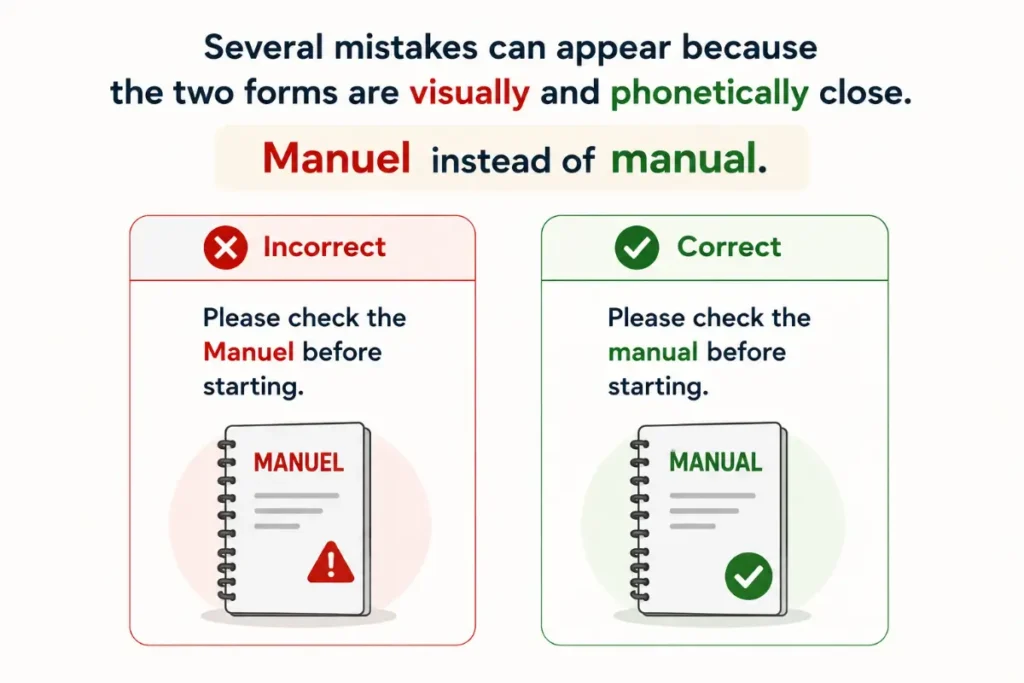
Several mistakes can appear because the two forms are visually and phonetically close.
- Manuel instead of manual.
Incorrect: Please check the Manuel before starting.
Correct: Please check the manual before starting.
The writer intended to refer to an instruction book. The personal name doesn’t fit the meaning.
- Manual instead of Manuel.
Incorrect: Manuel will meet us at noon.
Correct: Manuel will meet us at noon.
Here the intended meaning is a person’s name. The common English word doesn’t belong in that position.
- Confusing manual with manually.
Manual is generally an adjective or noun. Manually is an adverb.
For example, The system requires manual approval uses manual to describe the type of approval. The employee entered the information manually uses manually to explain how the employee entered it.
- Treating Manuel as a common noun.
A personal name needs capitalization. Writing manuel when referring to a person is normally incorrect because the name should begin with a capital letter.
- Assuming pronunciation determines spelling.
Sound can help but it isn’t always enough. Names can cross languages and spelling traditions. Context gives you a much stronger clue.
Pronunciation Guide
Manual is pronounced approximately as MAN yoo uhl. Cambridge gives the US pronunciation as /ˈmæn.ju.əl/ and the same phonetic form for UK English on its pronunciation page.
The word has three main syllables.
MAN
yoo
uhl
The first syllable carries the main stress. The opening sound resembles the vowel in man. The middle sound contains the y sound found in words such as yes before the oo sound.
Manuel can be pronounced in more than one way depending on the language and the person who bears the name. Dictionary.com lists an American pronunciation of /ˈmæn ju əl/.
The important point for spelling is that similar pronunciation doesn’t make the two forms interchangeable. English contains many words and names that sound alike or nearly alike while serving different grammatical roles.
That is why spelling should follow meaning rather than sound alone.
You may also want to read focussed or focused Correct Spelling and Usage.
Etymology and Word Origin
Manual has a long history connected with the idea of the hand. Its deeper origin goes back to Latin manus meaning hand. The same historical root is connected with other English words involving the hand and physical control.
That origin explains why the modern meanings fit together. Something manual can involve the hands. A manual task is performed by hand. A manual control is operated by hand. The meaning then developed into related uses such as physical work and instruction books. The instruction book sense may seem less obvious at first. Historically the idea connects with a guide that is held or used by hand and with practical directions for carrying out a task. Modern English has expanded the word far beyond that original physical connection. Manuel has a different history because it is a personal name rather than the ordinary English vocabulary item. It is associated with forms of the name Manuel used in languages such as Spanish and Portuguese. English speakers also encounter the name through people from many different cultural backgrounds.
The distinction is useful because it explains why the two forms look related even though they don’t perform the same job in English.
Regional Usage
American English
In American English, manual is a standard and widely recognized word. It appears in everyday speech as well as technical and professional writing.
Americans commonly talk about a manual car, a manual transmission, a manual process, manual labor, and an instruction manual. Cambridge’s American Dictionary entries confirm these uses.
Manuel is used in American English mainly as a personal name. It can appear in names of people from Spanish speaking families and in many other contexts because names travel easily across languages and cultures.
British English
British English also uses manual as a standard English word. The major meanings remain the same. It can describe work done by hand, a process that isn’t automated, an instruction book, or a car with a manual transmission.
British English therefore doesn’t create a spelling rule that changes manual into Manuel.
Australian English
Australian English also uses manual as an established English word. The basic distinction remains unchanged. A manual process is performed by people rather than through an automated system, while Manuel remains a personal name.
There is no standard Australian spelling rule that makes Manuel an alternative spelling of the common English word.
Canadian English
Canadian English follows the same broad distinction. Manual is used for hand operated systems, instruction books, physical work, and vehicles with gear changing systems.
Manuel remains a personal name. The context tells the reader which meaning applies.
Grammar Rules and Part of Speech
Manual is flexible because it can serve more than one grammatical role. As an adjective, it modifies a noun. The company uses a manual process. The machine has a manual control. She prefers a manual transmission. In each sentence, manual describes something. As a noun, it can identify an instruction book. I lost the manual. The manual explains how to install the software. The mechanic checked the manual before beginning the repair. It can also function as a noun when referring to a vehicle with a manual transmission. He drives a manual. She learned to drive a manual. Manuel is different because it is a proper noun when used as a person’s name. Manuel lives nearby. I called Manuel yesterday. Manuel joined the project last week. The capitalization matters because proper names normally begin with capital letters. Another useful distinction involves manually. This is the adverbial form of manual. Dictionary.com defines manually as something done by hand or through human effort.
Real Life Usage Examples
Daily Conversation
Manual appears naturally in ordinary conversations.
I need the manual for this coffee machine.
He bought a manual car last year.
These uses don’t sound formal. They are part of everyday English.
Workplace Communication
Manual is common in workplace writing. The team still uses a manual approval process. Please review the training manual before Friday. The technician completed a manual inspection. These examples show how the word works in practical professional contexts. A person’s name can appear in the same setting. Manuel will review the document. Please send the report to Manuel. Again, the grammatical function tells you which form belongs.
Academic Writing
Academic writing can use manual when discussing methods or human activity. The researchers used a manual coding process. The samples were sorted through a manual procedure. The study examined the effects of manual labor. Manuel may appear in academic writing only when the name is relevant to the subject. For example, a paper about a researcher named Manuel might contain several references to him.
News and Journalism
News writing frequently uses personal names and the word manual for different reasons. A journalist may write about a person named Manuel. A technology report may discuss a product manual. A business article may describe a manual process. The same article could even contain both forms. Manuel reviewed the technical manual before the demonstration. That sentence shows how context keeps the meanings separate.
Literature and Storytelling
Authors also use both forms naturally. Manuel opened the door and looked across the room. She searched through the old manual for an answer. The name identifies a character while manual identifies a book or object.
Related and Confused Terms
Several words connect naturally with manual and can help you understand its meaning more fully.
- Manually means by hand or through human effort. It is the adverb related to manual.
- Automatic describes something that operates by itself or through an automated system. It often contrasts with manual.
- Automatically is the adverb that describes something happening without direct human control.
- Handbook refers to a practical reference book. It can overlap with one meaning of manual but isn’t always interchangeable.
- Guide refers broadly to something that helps a person understand or complete a task.
- Instruction means information that tells someone how to do something. An instruction manual contains many instructions.
- Mechanical relates to machines and physical mechanisms. It can appear in contexts where manual operation is also discussed.
- Labor refers to work or physical effort. Manual labor specifically emphasizes physical work.
These terms belong to related semantic groups but they don’t all mean the same thing. Good writing depends on choosing the word that fits the exact situation.
Why People Confuse These Forms
The confusion usually comes from visual similarity. Manual and Manuel share the same first five letters. The final letters are also close in appearance. A person typing quickly can easily choose the wrong form without noticing. Pronunciation can add another layer of confusion. The words can sound close in casual speech. That makes it tempting to rely on sound rather than meaning. Names create another challenge. English writers regularly encounter names from other languages. A name such as Manuel can appear in an otherwise ordinary English sentence.
Spellcheckers and readers then need to use context to interpret it correctly. There is also a familiar English spelling pattern behind the confusion. Many words contain the sequence ual, while personal names may use similar letter combinations. The eye can recognize the shared pattern before the brain fully processes the meaning. This is why proofreading should happen at the sentence level rather than only at the word level.
A Simple Memory Trick
Connect manual with your hands. Manual means something connected with hand operation, physical effort, or a practical instruction book. Think of a manual car. You control the gears. Think of a manual process. A person performs the task. Think of a manual. You use it to learn how to operate something. Then reserve Manuel for a person. You can picture a person named Manuel standing beside a manual.
That simple mental image creates a clear separation between the two forms. Another useful trick is to ask one question. Am I naming a person. If the answer is yes, Manuel may be the right form. If you’re talking about an instruction book, hand operation, physical work, or a gear changing vehicle, manual is the form you want.
Expert Editor Insight
An experienced editor doesn’t correct these forms by looking at spelling alone. The editor first checks the sentence meaning and grammatical role. If the word refers to a person, capitalization and context may point to Manuel. If it describes hand operation or names an instruction book, manual fits. Spelling tools can help catch obvious mistakes but they don’t always understand the writer’s intended meaning. A good final check is to read the complete sentence and ask what the word is doing there.
Many readers also check alot or a lot: Correct Spelling Meaning and Usage.
Final Takeaway
Manuel vs manual becomes easy once you focus on meaning instead of appearance. Manual is the standard English word for something done by hand, something operated by hand, an instruction book, or a vehicle with a gear changing system. Manuel is primarily a male personal name.
The two forms can look and sound similar, but they don’t belong to the same grammatical category. Manual can work as an adjective or noun. Manuel works as a proper noun when it identifies a person. That difference is enough to guide your spelling in most sentences.
For a quick editing trick, ask what the word refers to before you check its spelling. If you’re talking about a person, Manuel may be right. If you’re talking about hand operation, physical work, instructions, or a gear changing car, choose manual. Once you connect manual with the idea of hands, the distinction sticks.
FAQs
Is Manuel a real word?
Yes. Manuel is a legitimate personal name. Dictionary.com lists Manuel as a male given name. It isn’t simply a misspelling of manual. When you use the name of a person called Manuel, the capitalized form is correct.
Which spelling is correct for an instruction book?
Manual is correct. An instruction manual is a book that provides practical information about how to use something or complete a task. Cambridge lists manual as a noun with this meaning and gives instruction manual as a common expression.
Is Manuel a misspelling of manual?
It can be a spelling mistake if the writer intended the common English word manual. However, Manuel itself isn’t an incorrect word. It is a legitimate male given name. The surrounding sentence tells you which meaning the writer intended.
How do you pronounce manual?
Manual is commonly pronounced /ˈmæn.ju.əl/ in both US and UK English according to Cambridge. You can think of it roughly as MAN yoo uhl. The first syllable receives the main stress.
What does manual mean?
Manual can mean done by hand or operated by hand. It can also describe physical work. As a noun, it can mean an instruction book or a vehicle with a gear changing system. The exact meaning depends on the context.
Can manual be a noun?
Yes. Manual commonly functions as a noun when it means an instruction book. It can also refer to a vehicle with a manual transmission. For example, someone might say that they drive a manual. Cambridge records both noun uses.
What is the difference between manual and manually?
Manual is commonly an adjective or noun. Manually is an adverb. Manual describes something connected with hand operation or human effort. Manually explains how an action happens. For example, The process is manual describes the process. The worker completed it manually describes how the worker completed it.
Is manual appropriate in formal writing?
Yes. Manual is a standard English word and is completely appropriate in formal writing when its meaning fits the sentence. It appears in technical writing, workplace documents, academic contexts, and professional communication. The main concern isn’t formality. It’s choosing the correct grammatical form and meaning.