
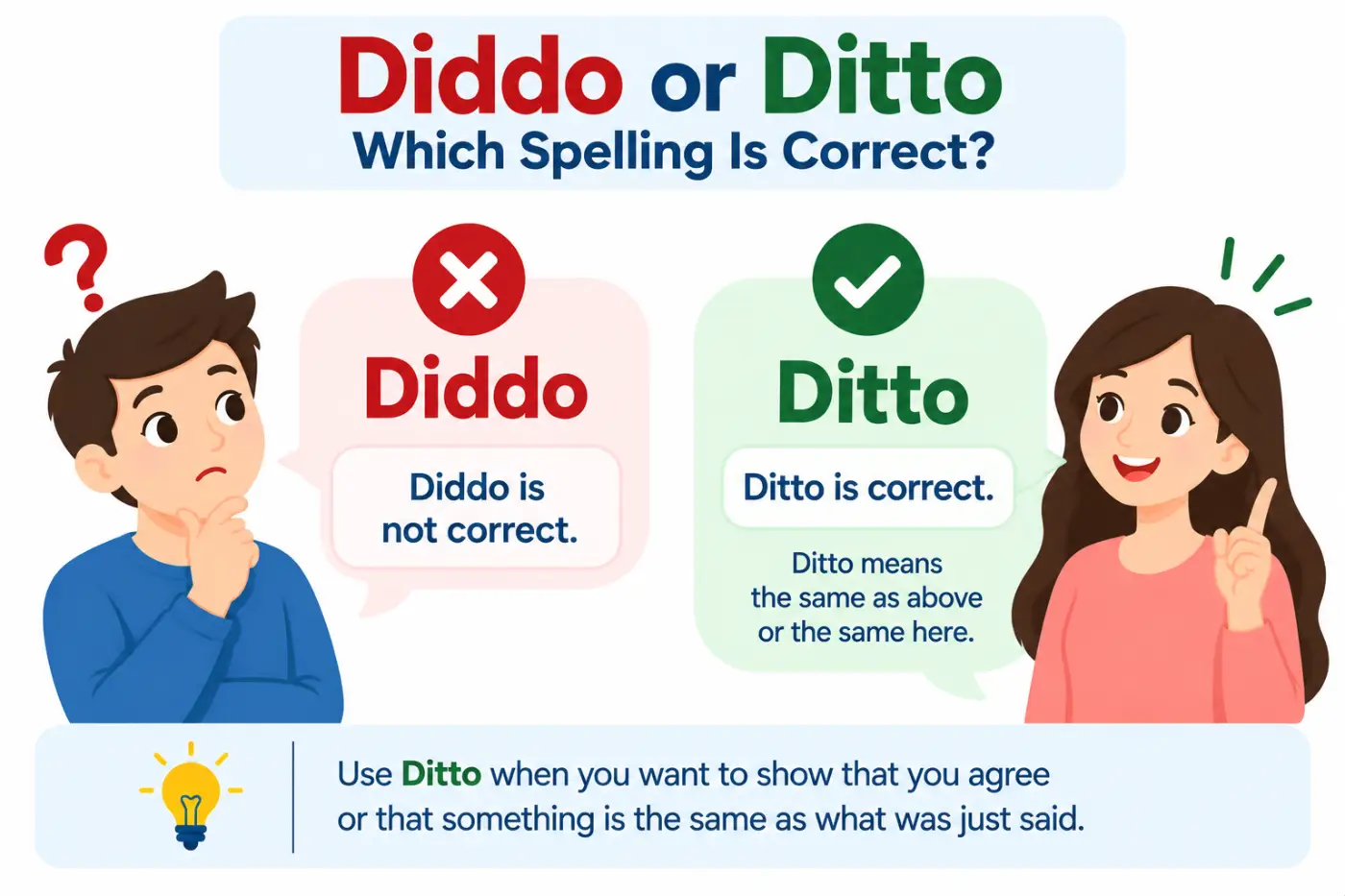
Diddo or ditto can be confusing because the two forms look and sound very similar. The correct standard spelling is ditto. The spelling diddo is generally an error that happens when people hear the word and reproduce its sound instead of remembering its established spelling.
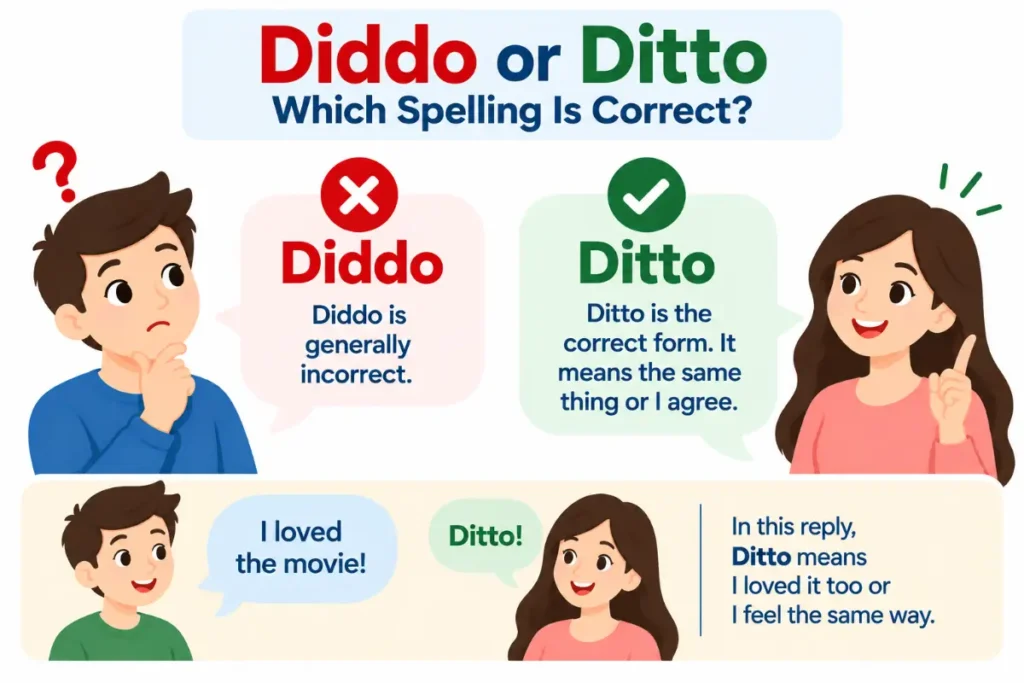
Ditto has a few useful meanings. In everyday conversation, it can mean that you agree with what someone just said. For example, if a friend says, I love this restaurant, you can simply reply, Ditto. In writing, ditto can also mean the same as something already stated or an exact copy of something.
The word has an interesting history too. It comes from Italian and entered English through the language of commerce and record keeping. Today, it remains a standard English word, although its use varies by context. You’ll see it in casual conversation, informal messages, lists, records, and expressions that refer back to something already mentioned.
Many readers also check According to Alternatives for Clearer Writing.
Quick Answer
Ditto is the correct standard English spelling. It means the same as what was just mentioned or written and can also mean an exact copy. Diddo is generally a misspelling of ditto. If you mean the common English word used to express agreement or repetition, use ditto.
Which Form Is Correct
Use ditto when you mean the same thing as something already stated.
Do not use diddo in standard English for this meaning. It is usually just a spelling mistake.
Compare these examples.
- I agree with you. Ditto.
- She chose the same answer as the student above. Ditto.
- The report uses the same figures as the previous report. Ditto.
- He wrote ditto in the next column to show that the information was unchanged.
The spelling may look small, but it matters in polished writing. If you are writing an email, school assignment, report, article, or professional document, ditto is the form to use.
Comparison Table
| Form | Meaning | Part of Speech | Origin | Usage Frequency | Formality | Common Contexts | Example |
|---|---|---|---|---|---|---|---|
| Ditto | The same as something previously stated or an exact copy | Noun adverb and interjection | Italian | Common and established | Informal to neutral depending on use | Conversation lists records and writing | Ditto for me. |
| Diddo | Usually an incorrect spelling of ditto | Nonstandard spelling | Not a standard English form for this meaning | Uncommon | Not appropriate in standard formal writing | Typing mistakes and spelling errors | Diddo is normally corrected to ditto. |
The important point is that diddo does not function as the standard spelling of the ordinary English word. If your intended meaning is the same, use ditto.
What Ditto Means
Ditto has several closely related uses. The central idea is always sameness or repetition.
The most common meaning is the same as what was just said.
For example:
I think the movie was excellent.
Ditto.
The second speaker means, I think the same thing.
Ditto can also mean an exact copy or a duplicate.
For example:
The manager asked for a copy of the original form and a ditto of the attached page.
This use is less common in everyday conversation, but it is part of the word’s established meaning.
Another traditional use appears in lists, tables, records, and documents. Ditto can indicate that the entry above should be repeated.
Imagine a table listing employees and their departments. If several people work in the same department, a writer might historically use ditto marks or the word ditto to avoid writing the same information repeatedly.
The basic idea remains simple.
Something has already been stated, and ditto tells the reader that the same information applies again.
How Ditto Works In Conversation
One of the easiest ways to understand the word is to hear it in ordinary conversation.
Suppose someone says:
I really need a vacation.
You could respond:
Ditto.
That means:
I really need a vacation too.
It is short, casual, and easy to understand.
Here are some other examples.
- I can’t wait for the weekend.
Ditto.
- This is my favorite part of the book.
Ditto.
- I’m exhausted after that meeting.
Ditto.
- I don’t understand why they changed the schedule.
Ditto.
In each case, the speaker uses the word to avoid repeating the entire statement.
This is why ditto often appears in friendly conversation and informal messages. It saves words while making the speaker’s agreement clear.
Ditto As An Expression Of Agreement
Ditto can work almost like a short response meaning me too or I agree.
For example:
A: I love this song.
B: Ditto.
The second person does not need to repeat the first person’s entire sentence.
However, context matters. Ditto usually refers directly to something that has just been said or written. It is not a general replacement for agree in every sentence.
For example, this sounds natural:
I feel the same way. Ditto.
This sounds less natural:
I ditto with your opinion.
The second sentence incorrectly treats ditto as a normal verb meaning agree.
A better version would be:
I agree with your opinion.
Or:
Ditto.
Ditto As A Noun
Ditto can function as a noun when it refers to something that is the same as something previously mentioned.
For example:
The second entry is a ditto of the first.
Here ditto refers to a copy or repetition.
This noun use is grammatically different from the conversational response.
Compare these sentences.
- Ditto.
Here it functions as an expression meaning the same.
- The second page is a ditto of the first.
Here it functions as a noun referring to a copy or duplicate.
The surrounding sentence tells you how the word is working.
Ditto As An Adverb
Ditto can also work adverbially to mean the same or likewise.
For example:
The first team performed well, and the second team did ditto.
This construction is grammatical in some contexts but sounds less natural than simpler alternatives in modern American English.
A more natural sentence would often be:
The second team did the same.
Or:
The second team performed equally well.
This is a useful lesson in word choice. A word can be grammatically possible without being the best choice for every sentence.
Ditto As An Interjection
In everyday conversation, ditto can function as an interjection.
An interjection is a word or expression that can stand alone to communicate a reaction, feeling, or response.
For example:
A: I want pizza tonight.
B: Ditto.
Here the word stands alone as the response.
It communicates agreement without repeating the original statement.
This use is especially common in informal speech and writing.
Why People Spell It Incorrectly
The spelling mistake is easy to understand.
When people hear ditto in conversation, the final sound can be perceived incorrectly. Someone who is unfamiliar with the written form may assume the word contains a doubled d sound or may simply reproduce the sound using a spelling that feels logical.
English spelling often creates this problem. Pronunciation alone does not always tell you exactly how a word is spelled.
The same issue happens with many other English words. People may spell a word according to how they think it sounds rather than according to its established spelling.
With this word, the standard form has one d at the beginning and one t before the final o.
Remember:
Ditto.
Not:
Diddo.
Common Misspellings
The main error is straightforward, but a few variations can appear when people type the word from memory.
- Diddo instead of ditto.
This is the most direct spelling error.
- Dittoh instead of ditto.
This adds an unnecessary final letter and is not the standard spelling.
- Dito instead of ditto.
This removes one of the two t letters.
- Ditto used as a verb.
The spelling may be correct, but the grammar can still be wrong if the writer uses the word as though it were a regular verb meaning agree.
- Diddo used as though it were an accepted alternative spelling.
It is generally not an appropriate alternative in standard English.
The best correction is simple. If you mean the same or likewise, write ditto.
Sentence Examples
Here are natural examples showing how the standard word works in different settings.
- I love the new design.
Ditto.
The second speaker agrees with the first speaker.
- She said she was tired, and I felt ditto.
This sentence uses the word to refer back to the same state.
- The second entry was marked ditto because it contained the same information as the entry above.
Here the word refers to repeated information in a record.
- If you feel the same way, just say ditto.
This example shows the conversational use.
- He wrote ditto in the next space instead of copying the entire entry.
Here ditto avoids unnecessary repetition.
- The first report was detailed, and the second was ditto.
This use is understandable but somewhat less natural than saying the second report was the same.
- I don’t want to go out tonight.
Ditto.
This is a natural informal response.
- The same rule applies to the next section. Ditto for the final section.
Here the word indicates that the same rule applies again.
- Her concerns were similar to mine. In other words, ditto.
This sentence uses the word to reinforce the idea of sameness.
- The editor removed the repeated sentence and replaced it with ditto in the working notes.
Here the word helps avoid repeating information in notes.
Examples In Everyday Communication
In casual conversation, ditto is usually short and direct.
Imagine two friends discussing their plans.
I don’t feel like cooking tonight.
Ditto.
The response is natural because the second speaker shares the same feeling.
It can also appear in text messages.
I’m so ready for the weekend.
Ditto.
This use is informal, so it fits naturally in texts, chats, and friendly conversations.
In a professional email, the word can still be used, but context matters. If the message is formal, a clearer phrase such as the same applies or I agree may be better.
For example:
I agree with the recommendation.
That sounds more formal than:
Ditto.
The choice depends on the tone of the communication.
Examples In Workplace Writing
Workplace writing often needs precision. Ditto can be useful in notes, internal documents, tables, or informal exchanges, but it should not replace a clear statement when the information is important.
For example:
The same deadline applies to the second team. Ditto for the third team.
This is understandable, but a formal report might be clearer if it states the deadline directly for each group.
In an informal workplace message, however, you might write:
The marketing team approved the plan. Ditto for sales.
This is concise and conversational.
Professional editors usually consider the audience before keeping a word like ditto. It is standard English, but clarity comes first.
Examples In School And Academic Writing
Students may encounter ditto in older records, notes, or examples of traditional writing.
For example:
The teacher wrote the same answer beside several names and used ditto marks for repeated entries.
In modern academic prose, it is usually better to state the information clearly rather than relying heavily on ditto.
For example:
The results were similar in both groups.
This is often clearer than:
The results were ditto in both groups.
The word is not wrong simply because it is less common in formal academic writing. It is a matter of style and clarity.
For another common grammar confusion, see Prefer Or Perfer Which Spelling Is Correct.
Examples In Lists And Records
One of the traditional uses of ditto is to avoid repeating information.
Imagine a list like this:
| Name | City |
|---|---|
| Anna | Boston |
| Mark | Ditto |
| Sarah | Ditto |
The word tells the reader that Mark and Sarah have the same city listed for Anna.
This style can be useful in handwritten records or repetitive tables.
Modern digital documents usually make it just as easy to repeat the actual information. As a result, ditto is less necessary in many professional records.
Still, the meaning remains clear.
Ditto means the same as the information immediately connected to it.
Pronunciation Guide
Ditto is pronounced with two syllables.
The standard American pronunciation is commonly represented in IPA as /ˈdɪtoʊ/.
The first syllable carries the main stress.
An easy way to think about the rhythm is:
DIT oh.
The first part sounds like the vowel in words such as sit or bit. The second syllable has the long o sound heard in words such as go.
A common mistake is to let the pronunciation influence the spelling too strongly. English speakers sometimes hear a sound and then create a spelling that seems logical. That can help explain why the incorrect form appears.
The pronunciation itself does not justify changing the spelling.
Write:
Ditto.
Etymology And Word Origin
Ditto has an interesting origin. It comes from Italian, where detto means said or stated. The Italian form is related to dire, meaning to say.
The word entered English through commercial and bookkeeping language. It was used to indicate that an item should be repeated or that the same information applied again.
That historical meaning connects directly with its modern use.
If one entry has already been written and the next entry is the same, ditto can tell the reader not to repeat all the information.
Over time, the word also developed a conversational use meaning the same or likewise.
That gives the modern word two closely connected ideas.
One is repetition of information.
The other is agreement with a previous statement.
Both come back to the same basic concept.
Regional Usage
American English
Ditto is a standard English word in American English. It can appear in casual conversation, informal messages, lists, records, and other contexts where the meaning is the same or repeated.
Americans are also likely to use simpler expressions such as me too, same, likewise, or I agree in everyday speech.
British English
Ditto is also standard in British English. The basic meaning and spelling remain the same.
There is no major British spelling variation that changes ditto into diddo.
Australian English
Australian English also uses the standard form ditto. The basic meaning does not change.
Canadian English
Canadian English follows the same standard spelling. Ditto remains the established form for this meaning.
The main regional difference is not spelling. It is simply how often speakers choose ditto instead of alternatives such as same, me too, or likewise.
Grammar Rules
Ditto is a flexible word, but it does not work like an ordinary verb.
It can function as a noun.
For example:
That entry is a ditto of the previous one.
It can work as an adverb or response meaning the same.
For example:
I feel ditto.
This is possible but less common than simply saying:
I feel the same.
It can also function as an interjection.
For example:
I love this movie.
Ditto.
The biggest grammatical mistake is treating it as a normal verb.
Avoid constructions such as:
I ditto your opinion.
Instead, say:
I agree with your opinion.
Or simply:
Ditto.
In modern English, the shortest use is often the most natural.
Formal And Informal Usage
Ditto is not inherently incorrect or unprofessional. Its suitability depends on the context.
In casual conversation, it can sound natural.
For example:
I’m ready to leave.
Ditto.
In a formal report, a direct statement is usually clearer.
Instead of:
Ditto applies to the remaining cases.
You might write:
The same rule applies to the remaining cases.
This does not mean the shorter word is grammatically wrong. It means formal writing often benefits from explicit wording.
In professional editing, clarity usually matters more than saving two or three words.
Common Mistakes and Misspellings
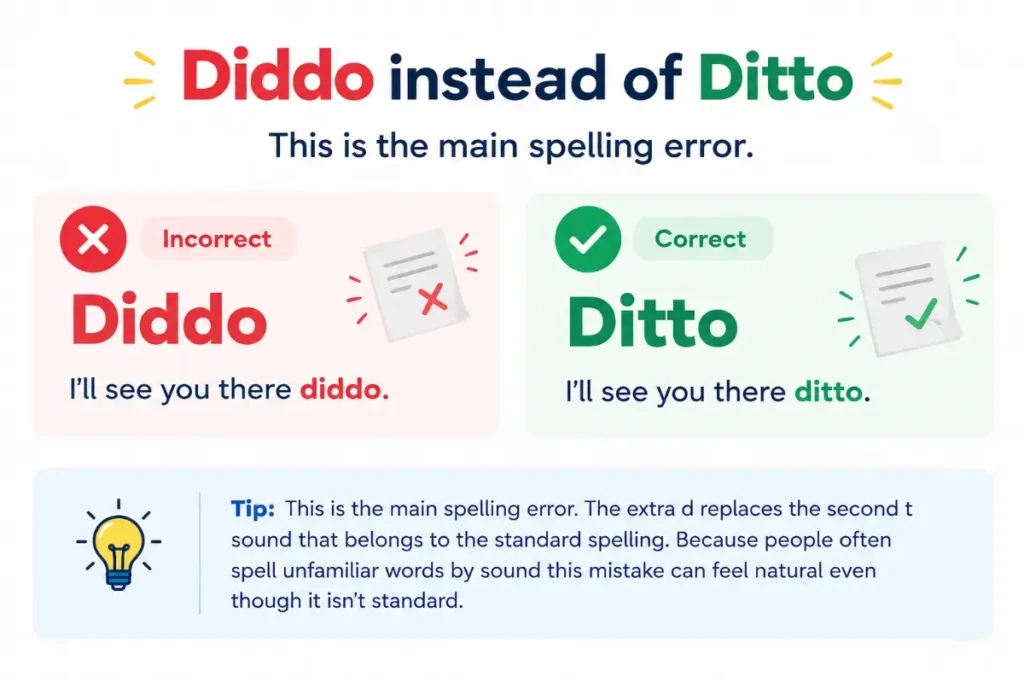
Mistake One
Incorrect:
Diddo.
Correct:
Ditto.
The writer has added an extra d because the spoken form may sound as though it contains that sound.
Mistake Two
Incorrect:
Dito.
Correct:
Ditto.
The standard spelling contains two t letters.
Mistake Three
Incorrect:
I ditto your idea.
Correct:
I agree with your idea.
Ditto can express agreement on its own, but it is not normally used as a regular verb in this structure.
Mistake Four
Incorrect:
Ditto means only copy.
Correct:
Ditto can mean the same thing, likewise, or an exact copy depending on context.
The word has both conversational and traditional record keeping uses.
Mistake Five
Incorrect:
Diddo is the casual spelling of ditto.
Correct:
Diddo is generally a misspelling when the intended word is ditto.
There is no need to create a second spelling when the standard form already exists.
Related And Confused Terms
Several words and expressions are close in meaning to ditto. They are not always interchangeable.
Same
Same can mean identical or similar. In casual speech, someone may simply say same to express agreement.
Likewise
Likewise means in the same way or similarly. It can also be used as a response to return a greeting or sentiment.
Me Too
Me too means that the speaker shares the same feeling, opinion, or experience.
I Agree
I agree directly expresses agreement. It is usually clearer than ditto in formal communication.
The Same
The same can refer directly to something previously mentioned.
Identical
Identical means exactly alike. It is stronger and more precise than ditto in many contexts.
Copy
A copy is something made to be the same as an original. This connects with one of the traditional meanings of ditto.
Duplicate
Duplicate can mean an exact copy or something that repeats another item. It is common in technical and administrative contexts.
These alternatives help you choose the most natural word for your sentence. Ditto is useful, but it is not always the clearest option.
How To Remember The Correct Spelling
The easiest memory trick is to focus on the middle letters.
Ditto has a t in the middle.
Think:
D I T T O.
The two t letters are important.
You can also connect the word with its meaning.
Ditto means the same.
Both ideas involve repetition. If someone says the same thing again, you are repeating it. The word ditto has its own fixed spelling, so it is better to memorize the whole word instead of trying to build the spelling from its sound.
Another useful trick is to remember that the word does not contain a second d.
D I T T O.
Not D I D D O.
If you often type the word, adding it to your personal spelling memory can help your keyboard or writing software recognize your intended form.
How Editors Handle The Spelling
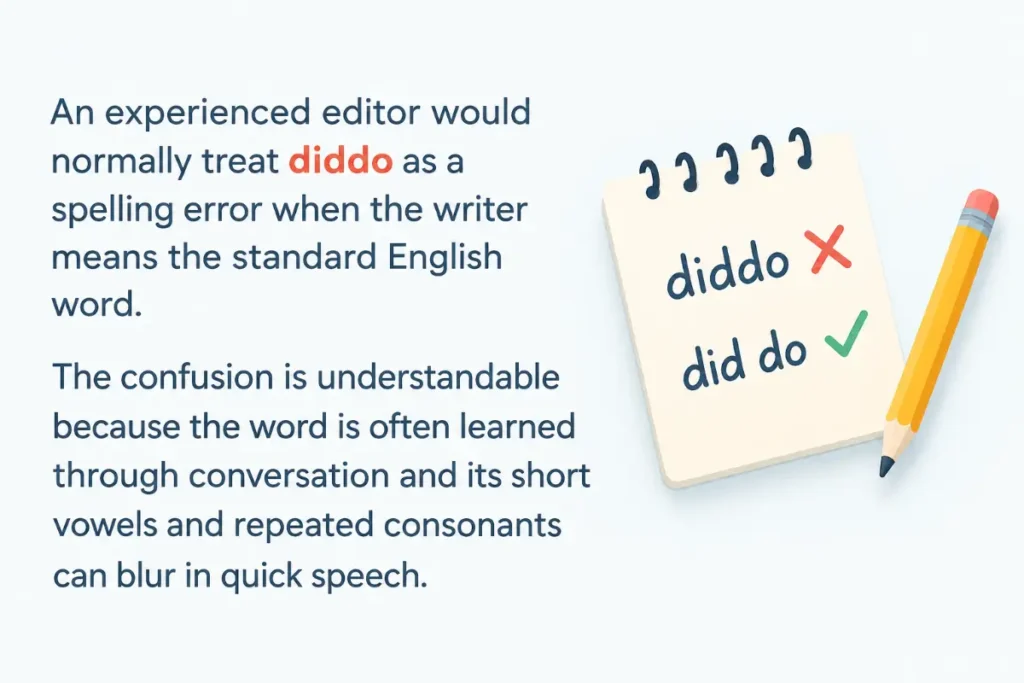
An experienced editor will normally treat diddo as a spelling error when the writer clearly intends ditto.
The correction is straightforward because the context usually makes the intended word obvious.
For example:
I feel diddo.
An editor can reasonably infer that the writer means:
I feel ditto.
Still, the sentence itself may need improvement. A more natural version could be:
I feel the same way.
This is an important editing point. Correct spelling is only one part of good writing. A professional editor also considers tone, clarity, audience, and natural usage.
In casual conversation, Ditto may be exactly right. In a formal report, I agree or the same applies may communicate the idea more clearly.
When To Use Ditto
Use the word when you want to refer back to something already stated.
It works especially well in these situations.
- You want to agree with someone in casual conversation.
- You want to indicate that the same information applies to another entry.
- You are referring to an exact copy or repetition.
- You are writing informal notes where repeating information would be unnecessary.
- You want a short response that means the same.
For formal writing, consider the audience before using it. A more direct expression may be clearer.
When Not To Use It
Avoid using ditto as a general substitute for every form of agreement.
For example:
I ditto what you said.
This may be understood, but it is not the most natural standard construction.
Use:
I agree with what you said.
Or:
I feel the same way.
Also avoid relying on ditto when the reader could misunderstand what information you are repeating. Clear writing should never make the reader guess what a short reference points to.
Expert Editor Insight
A native English speaker will usually recognize ditto immediately, especially in informal conversation. The main spelling problem comes from the close relationship between sound and spelling in the reader’s mind. An editor will correct diddo to ditto, but may also replace ditto with the same, likewise, or I agree if the surrounding writing is formal. The strongest choice is not always the shortest word. Good editing considers meaning, audience, tone, and clarity together.
Key Takeaways
- Ditto is the standard spelling.
- Diddo is generally a misspelling of ditto.
- Ditto can mean the same as something already stated.
- It can express agreement in casual conversation.
- It can also refer to a copy or repeated entry.
- The word has two syllables and main stress on the first syllable.
- The standard American pronunciation is commonly represented as /ˈdɪtoʊ/.
- Ditto comes from Italian and has a history connected with repeated information in records.
- The word is standard in American British Canadian and Australian English.
- In formal writing, expressions such as the same or I agree may sometimes be clearer.
- Do not normally use ditto as a regular verb.
- The easiest spelling memory is D I T T O with two t letters and no second d.
For another common grammar confusion, see Encode Vs Incode Which Word Should You Use 2026.
Conclusion
Diddo or ditto has a simple answer. Ditto is the standard English spelling, while diddo is generally a misspelling. The word can mean the same, likewise, or an exact copy depending on the context.
You can use ditto as a short conversational response when you agree with something someone has just said. It also appears in records and lists when information is repeated. For formal writing, a clearer phrase such as the same or I agree may sometimes work better.
The easiest way to remember the spelling is to focus on the two t letters in D I T T O. If you see an extra d, stop and check it. That small habit will keep this common spelling mistake out of your writing.
FAQs
Is diddo a correct English word?
Diddo is generally not the standard spelling of the English word meaning the same or likewise. If you intend the common word used to express agreement or repeated information, the standard spelling is ditto. The extra d is a common spelling mistake rather than an accepted alternative form in ordinary standard English.
What does ditto mean?
Ditto means the same as something previously stated or written. In conversation, it can express agreement with another person’s statement. It can also refer to a copy or repeated entry. For example, if someone says I love this song and you reply ditto, you mean that you feel the same way.
Which spelling should I use in formal writing?
Use ditto if you need the word at all. However, formal writing often benefits from clearer expressions such as the same, likewise, or the same applies. The best choice depends on the sentence and audience. The spelling diddo should not be used as the standard form.
How do you pronounce ditto?
Ditto has two syllables and is commonly pronounced /ˈdɪtoʊ/ in American English. The main stress falls on the first syllable. The first vowel has the sound found in sit, while the second syllable has the long o sound found in go.
Can ditto start a sentence?
Yes. Ditto can stand alone as a response at the beginning of a conversational exchange. For example, someone might say I need a vacation, and another person can respond Ditto. In formal writing, however, a fuller expression may provide more clarity.
Is ditto informal?
Ditto can be informal when it is used as a short response meaning the same or I agree. It also has established uses in records and lists. The word itself is standard English, but the conversational use is more casual than direct phrases such as I agree or the same applies.
Why do people spell ditto as diddo?
The mistake probably comes from the relationship between pronunciation and spelling. Someone who has mostly heard the word spoken may reproduce what they think they hear. The two forms look similar, so an extra d can seem plausible to an unfamiliar writer. Standard English uses ditto.
Is ditto the same as likewise?
The meanings overlap, but they are not identical in every context. Ditto often means the same thing as something just stated. Likewise means in the same way or similarly and can also be used to return a sentiment. Both can express agreement, but their sentence patterns differ.