
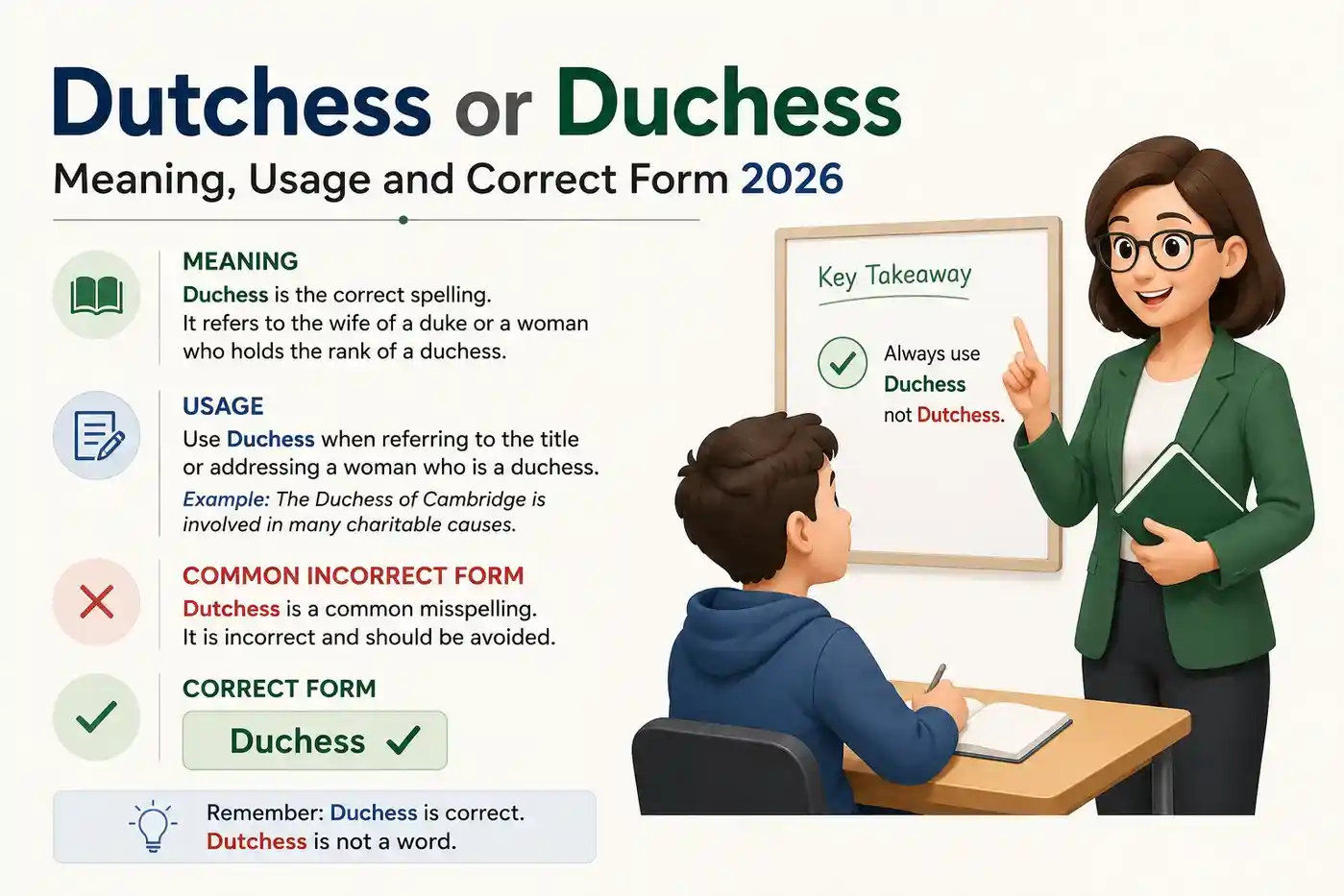
Dutchess vs duchess is a surprisingly common spelling question. At first glance, both words look legitimate. They sound almost identical when spoken, and the extra “t” in Dutchess seems harmless. That’s exactly why so many people get confused.The short answer is simple. Duchess is the correct spelling when referring to a woman who holds the rank of duke’s wife or a woman who holds a duchy in her own right. Dutchess is generally considered a misspelling in this context.
The confusion exists because English contains many words that begin with “Dutch.” People naturally assume the word may be connected to the Netherlands or Dutch culture. In reality, duchess has a completely different origin and meaning.If you’ve seen both spellings online, in social media posts, blog articles, or even professional documents, you’re not alone. Misspellings often spread quickly across the internet.
This guide explains the meaning, spelling, pronunciation, grammar, history, and proper usage of duchess. You’ll also learn why dutchess appears so often and how to avoid this mistake in your own writing.
For another common grammar confusion, see Missle or Missile Correct Spelling and Meaning.
Quick Definition
In the comparison of these words, duchess is the correct English word. A duchess is a female noble of ducal rank or the wife of a duke. Dutchess is usually a spelling mistake unless it appears as part of a proper name, business name, location, or brand.
Dutchess and Duchess Quick Answer
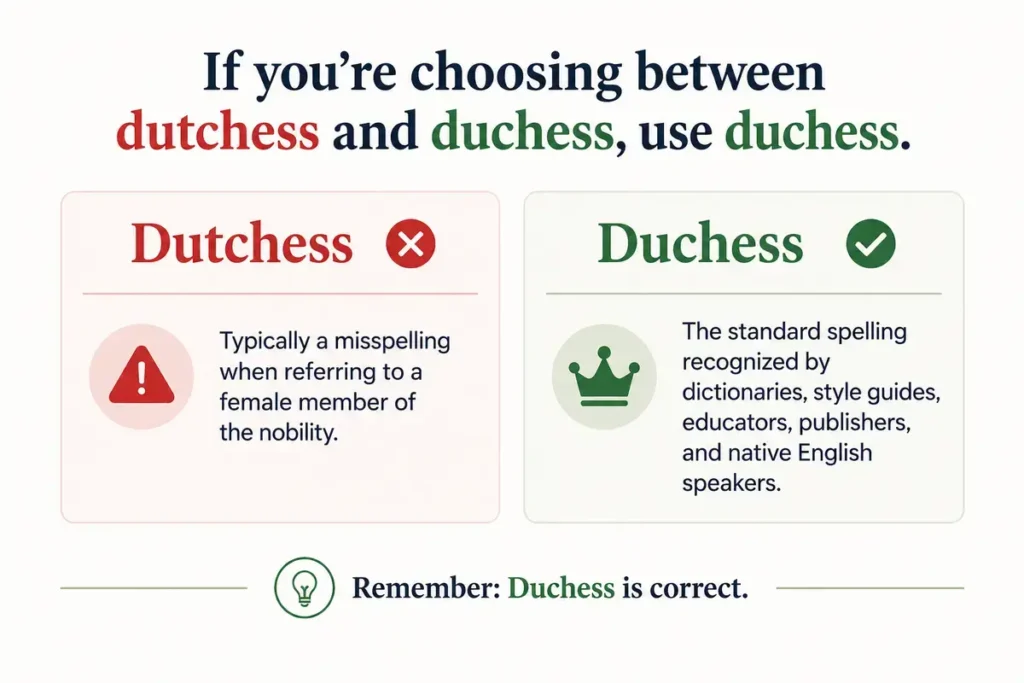
If you’re choosing between dutchess and duchess, use duchess.Duchess is the standard spelling recognized by dictionaries, style guides, educators, publishers, and native English speakers.Dutchess is typically a misspelling when referring to a female member of the nobility.
Dutchess Vs Duchess Comparison Table
| Feature | Duchess | Dutchess |
|---|---|---|
| Correct English Spelling | Yes | No in most contexts |
| Meaning | Female duke or wife of a duke | Usually a misspelling |
| Part Of Speech | Noun | Not a standard noun |
| Origin | Old French and Latin roots | Derived from spelling confusion |
| Dictionary Recognition | Yes | Generally no |
| Usage Frequency | Very common | Rare outside names |
| Formality Level | Formal and standard | Incorrect in standard writing |
| Academic Acceptance | Yes | No |
| Professional Usage | Yes | Usually avoided |
| Example | The duchess attended the ceremony. | Incorrect in most contexts |
Meaning Of Dutchess and Duchess
What Does Duchess Mean
A duchess is a female noble who holds a rank associated with a duke.The term can refer to:
- The wife of a duke.
- A woman who inherits and holds a duchy.
- A female member of aristocracy with ducal status.
The word has been used in English for centuries and remains common in discussions of royalty, nobility, history, and modern royal families.Examples include members of European royal houses and aristocratic families.
What Does Dutchess Mean
In standard English, dutchess does not have a recognized dictionary definition related to nobility.Most of the time, it appears because someone mistakenly inserts a “t” after the first syllable.There are a few exceptions.
Dutchess may appear in:
- Place names.
- Business names.
- Product names.
- Brand identities.
- Personal usernames.
For example, Dutchess County in New York uses the spelling Dutchess as part of its official name.Outside proper names like that, duchess remains the correct choice.
Dutchess and Duchess Meaning Differences
The most important distinction is that one word has an established meaning and the other usually does not.
Meaning Difference
Duchess has a clear definition recognized worldwide. Dutchess generally has no meaning when used as a common noun.
Usage Difference
Duchess appears in:
- Books.
- Newspapers.
- Academic writing.
- Historical records.
- Royal reporting.
Dutchess appears primarily in:
- Typographical errors.
- Proper names.
- Business branding.
Recognition Difference
Every major English dictionary recognizes duchess.Dutchess typically appears only when referencing a specific proper noun.
Reader Perception Difference
When readers see duchess, they immediately recognize the word.When readers see dutchess, many assume a spelling mistake has occurred.
Dutchess or Duchess Which One Is Correct
The correct spelling is duchess.If you’re writing about nobility, aristocracy, royal titles, or the wife of a duke, use duchess every time.
Examples:
- The duchess attended the royal wedding.
- The duchess supported several charitable organizations.
- The young duchess became popular among the public.
Using dutchess in these sentences would be incorrect.The only time Dutchess is correct is when it’s part of an official name.
Examples:
- Dutchess County is located in New York.
- A business may legally include Dutchess in its name.
The context determines the correct spelling.
Pronunciation Guide
One reason people misspell duchess is pronunciation.The spoken forms don’t clearly reveal the correct spelling.
Duchess Pronunciation
IPA:
/ˈdʌtʃəs/
Syllable Breakdown:
Duch ess
Pronunciation:
DUCH ess
The first syllable sounds similar to the beginning of “Dutch.”That’s one reason many writers mistakenly add the letter “t.”
Dutchess Pronunciation
If pronounced literally, Dutchess would usually sound almost identical to duchess.
IPA:
/ˈdʌtʃəs/
Because the pronunciation is virtually the same, people often rely on sound rather than spelling. That’s where the error begins.
Common Pronunciation Related Spelling Mistakes
- Adding an unnecessary “t.”
- Assuming the word relates to Dutch nationality.
- Writing the word exactly as it sounds.
- Confusing phonetic spelling with standard spelling.
English contains many examples where pronunciation doesn’t perfectly match spelling.Duchess is one of them.
Dutchess Vs Duchess Etymology And Word Origin
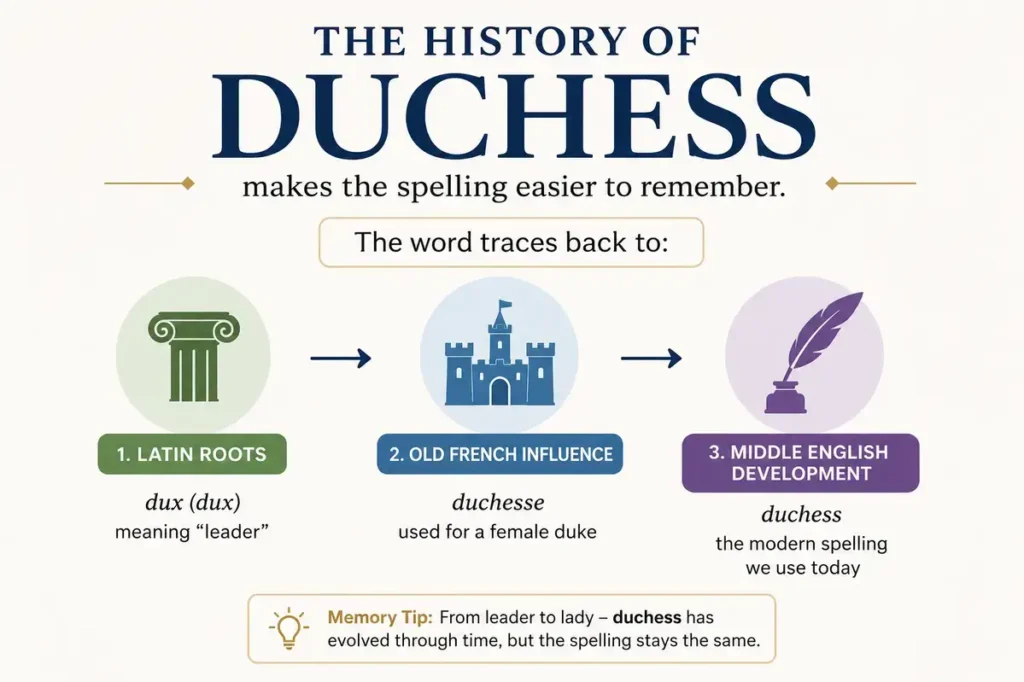
The history of duchess makes the spelling easier to remember.The word traces back to:
- Latin roots.
- Old French influence.
- Middle English development.
The Latin word dux meant leader or commander. From that root came duke, which eventually entered English through French influence. Duchess developed as the feminine form associated with duke. The spelling evolved through centuries of usage and became standardized long before modern English dictionaries existed.
Notably, the word has no connection to Dutch nationality or the Netherlands.That similarity in sound is purely coincidental.Understanding this origin helps explain why duchess lacks the extra “t” many people expect to see.
Why Dutchess or Duchess Creates So Much Confusion
As an editor, I’ve reviewed thousands of spelling questions. This issue appears regularly because several factors work against the writer.
The Word Sounds Like Dutch
Most people first learn words through speech rather than spelling.When they hear duchess, their brain often connects the sound to Dutch.
The Misspelling Looks Reasonable
Some spelling errors look obviously wrong.Dutchess doesn’t.That’s why many writers don’t notice the mistake.
Search Engines Display Both Versions
Because so many people misspell the word, both spellings appear online.This creates the false impression that both are acceptable.
Proper Names Add More Confusion
Names such as Dutchess County reinforce the idea that Dutchess might be a valid alternative spelling.In reality, that’s a unique proper noun rather than a replacement for duchess.
Dutchess and Duchess In Modern English
Modern English overwhelmingly favors duchess.
You’ll see it in:
- Royal family coverage.
- Historical biographies.
- Academic journals.
- Literature.
- News reporting.
- Educational materials.
- Dictionaries.
- Style manuals.
When professional editors encounter dutchess used as a common noun, they almost always correct it to duchess.That’s the standard expected in American English, British English, Canadian English, and Australian English.
You may also want to read Definately or Definitely Which Spelling Is Correct (2026).
Dutchess and Duchess Examples In Sentences
One of the easiest ways to understand the difference between dutchess or duchess is to see both words in context.
Duchess Examples In Sentences
These examples show the correct usage.
- The duchess attended the charity gala on Saturday evening.
- The duchess greeted guests before the ceremony began.
- Historians studied the life of the duchess in great detail.
- The young duchess became known for her humanitarian work.
- Every duchess in the royal family had specific ceremonial duties.
- The duchess opened the new museum to the public.
- Many people admired the duchess for her dedication to education.
- The duchess traveled across the country to support local communities.
- A portrait of the duchess hung in the palace library.
- The duchess played an important role in the historical narrative.
Dutchess Examples In Sentences
These examples demonstrate situations where Dutchess may be appropriate as a proper noun.
- She recently moved to Dutchess County.
- The event took place in Dutchess County during the summer.
- Local officials from Dutchess County attended the meeting.
- The business incorporated Dutchess into its official brand name.
- Dutchess appeared in the company logo.
- The organization serves residents throughout Dutchess County.
- Several schools in Dutchess County participated in the competition.
- Visitors explored historical landmarks across Dutchess County.
- The report focused on economic growth within Dutchess County.
- Dutchess was retained because it formed part of the official title.
These examples highlight an important point. Duchess functions as a common noun. Dutchess generally appears only within names and titles.
Dutchess Vs Duchess Common Mistakes
The confusion surrounding these words creates several recurring mistakes.
Adding An Extra Letter
The most common error is inserting a “t.”
Incorrect:
- The dutchess attended the ceremony.
Correct:
- The duchess attended the ceremony.
Assuming The Word Relates To Dutch Nationality
Many writers connect duchess to Dutch because of the pronunciation.The words are unrelated.Duchess refers to aristocratic rank.Dutch refers to the Netherlands or its people.
Trusting Search Results Without Verification
A spelling appearing online doesn’t automatically make it correct.Misspellings spread rapidly and often rank in search results.Professional writers verify spelling through trusted references rather than popularity alone.
Confusing Proper Nouns With Common Nouns
This mistake appears frequently.
Correct:
- The duchess visited the city.
- She lives in Dutchess County.
The first sentence uses a common noun.The second uses an official place name.
Capitalization Errors
Writers often capitalize duchess unnecessarily.
Correct:
- The duchess attended the event.
- Duchess Sarah attended the event.
Capitalization depends on how the title is used.
Regional Usage
One reason this spelling question generates so much attention is that people wonder if one version belongs to a specific English dialect.The answer is no.
Dutchess or Duchess British English
British English uses duchess.Given Britain’s long history with aristocratic titles, the word appears frequently in historical records, royal coverage, biographies, and news reporting.Dutchess is not accepted as an alternative spelling.
Dutchess or Duchess American English
American English also uses duchess.The only major exception occurs when referencing specific names such as Dutchess County.Outside proper nouns, duchess remains the standard form.
Dutchess or Duchess Canadian English
Canadian English follows the same pattern.Duchess is recognized as the correct spelling.Dutchess is generally treated as an error unless it forms part of a proper name.
Dutchess or Duchess Australian English
Australian publications, dictionaries, and style guides also use duchess.The spelling remains consistent across major English speaking countries.
Regional Usage Verdict
Unlike some spelling debates that vary by region, dutchess or duchess has a clear answer. Duchess is the accepted spelling throughout the English speaking world.
Grammar Rules
Understanding grammar makes the distinction even clearer.
Part Of Speech
Duchess functions as a noun.
Examples:
- The duchess arrived early.
- The duchess hosted the reception.
Dutchess is not recognized as a standard common noun.
Singular Form
Singular:
- Duchess.
Example:
- The duchess spoke to reporters.
Plural Form
Plural:
- Duchesses.
Example:
- Several duchesses attended the royal gathering.
Many writers mistakenly write duchesses incorrectly.The proper plural is duchesses.
Possessive Form
Singular possessive:
- Duchess’s.
Example:
- The duchess’s speech received widespread praise.
Plural possessive:
- Duchesses’.
Example:
- The duchesses’ contributions were recognized publicly.
Article Usage
The word commonly appears with articles.
Examples:
- A duchess.
- The duchess.
- That duchess.
- This duchess.
These structures follow standard noun rules.
Dutchess Vs Duchess Real Life Usage Examples
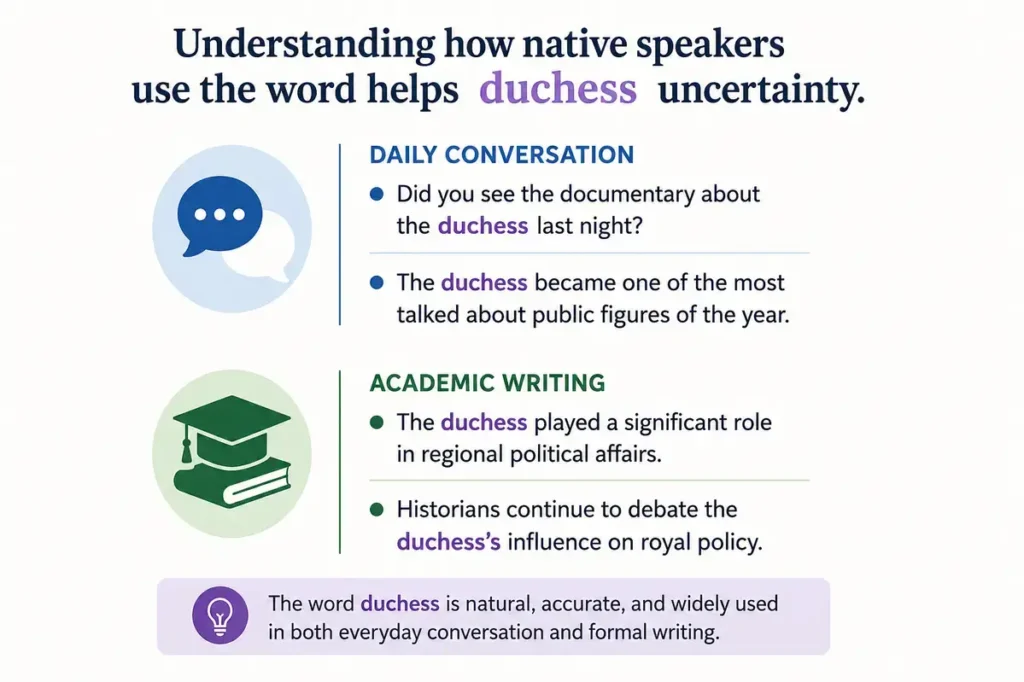
Understanding how native speakers use the word helps eliminate uncertainty.
Daily Conversation
- Did you see the documentary about the duchess last night?
- The duchess became one of the most talked about public figures of the year.
Academic Writing
- The duchess played a significant role in regional political affairs.
- Historians continue to debate the duchess’s influence on royal policy.
Professional Communication
- The exhibition features personal letters written by the duchess.
- The museum acquired several portraits of the duchess.
Literature
Writers frequently use duchess in novels, biographies, and historical fiction.
Example:
- The duchess stood quietly as the court awaited her decision.
Media Coverage
Modern news outlets regularly use duchess when covering royal families.Examples often involve members of European royal households and aristocratic families.
Related Words And Confused Terms
This question belongs to a larger group of commonly confused words.
Related Noble Titles
- Duke.
- Duchess.
- Prince.
- Princess.
- Earl.
- Countess.
- Baron.
- Baroness.
- Marquis.
- Marchioness.
Related Language Concepts
- Spelling.
- Pronunciation.
- Word origin.
- Etymology.
- Grammar.
- Usage.
- Common mistakes.
- Homophones.
- Near homophones.
- Orthography.
Frequently Confused Words
- Principal and principle.
- Compliment and complement.
- Affect and effect.
- Stationary and stationery.
- Adviser and advisor.
- Council and counsel.
These pairs demonstrate how a single letter can completely change meaning and correctness.
Dutchess Vs Duchess Expert Language Insight
As an editor, I’ve seen this spelling mistake appear in blog posts, student papers, social media content, marketing materials, and even professionally published articles. The reason is simple. Writers trust their ears. English often rewards that approach, but not always. Duchess is one of those words where pronunciation creates a trap. People hear the beginning sound and instinctively insert the letter “t.”
The mistake feels logical. That’s exactly why it survives. Native speakers almost never view dutchess as an acceptable alternative spelling when referring to nobility. Most immediately recognize it as a typo. If your goal is polished and credible writing, choosing duchess is the safest and most professional option every time.
Advanced Linguistic Analysis Of Dutchess Vs Duchess
Language experts don’t determine correctness based on opinion.They look at evidence.When evaluating competing spellings, linguists typically examine:
- Historical usage.
- Dictionary recognition.
- Corpus frequency.
- Published literature.
- Editorial standards.
- Native speaker expectations.
Duchess consistently passes all of these tests.Dutchess does not.
Corpus Evidence
Large language databases help researchers understand how words are used in real life.When examining books, newspapers, academic journals, magazines, and professional publications, duchess appears overwhelmingly more often than dutchess.This pattern isn’t even close.The dominance of duchess across centuries of English writing confirms its status as the accepted form.
Dictionary Evidence
Leading dictionaries recognize duchess as a standard English noun.The spelling has maintained stability for generations.Dutchess appears primarily when referring to specific names rather than the noble title itself.
Editorial Standards
Professional editors follow established style guides.In publishing, journalism, education, business communication, and academic writing, duchess is the accepted spelling.If an editor encounters dutchess used as a title, it will almost certainly be corrected.
Native Speaker Expectations
Language works best when readers instantly understand what they see.Native speakers expect the spelling duchess.Using dutchess often interrupts reading flow because readers pause to determine if the spelling is intentional.That small moment of confusion matters more than many writers realize.
Why Correct Spelling Matters
Some people dismiss spelling differences as minor.In reality, spelling influences credibility.Readers use spelling accuracy as a quick signal of expertise and attention to detail.
In Professional Writing
Correct spelling helps establish trust.A misspelled title can weaken an otherwise strong piece of content.
In Academic Writing
Accuracy is essential.Professors, researchers, and editors expect standard spelling conventions.
In Business Communication
Clear language reduces misunderstandings.Small mistakes can create larger credibility issues.
In SEO Content
Search engines understand misspellings, but users still prefer accurate information.
Articles that consistently use correct spelling tend to create a better reading experience.
Learn The Context
Always determine what the word represents before choosing a spelling.
Verify Unusual Spellings
If a word looks unfamiliar, check a trusted dictionary or style guide.
Watch For Phonetic Traps
English contains many words that don’t spell exactly as they sound.Duchess is one example.
Be Consistent
Consistency strengthens professionalism and readability.
Edit With Fresh Eyes
Many spelling mistakes survive because writers read what they intended to write rather than what actually appears on the page.A careful review often catches these errors.
Dutchess Vs Duchess Final Verdict
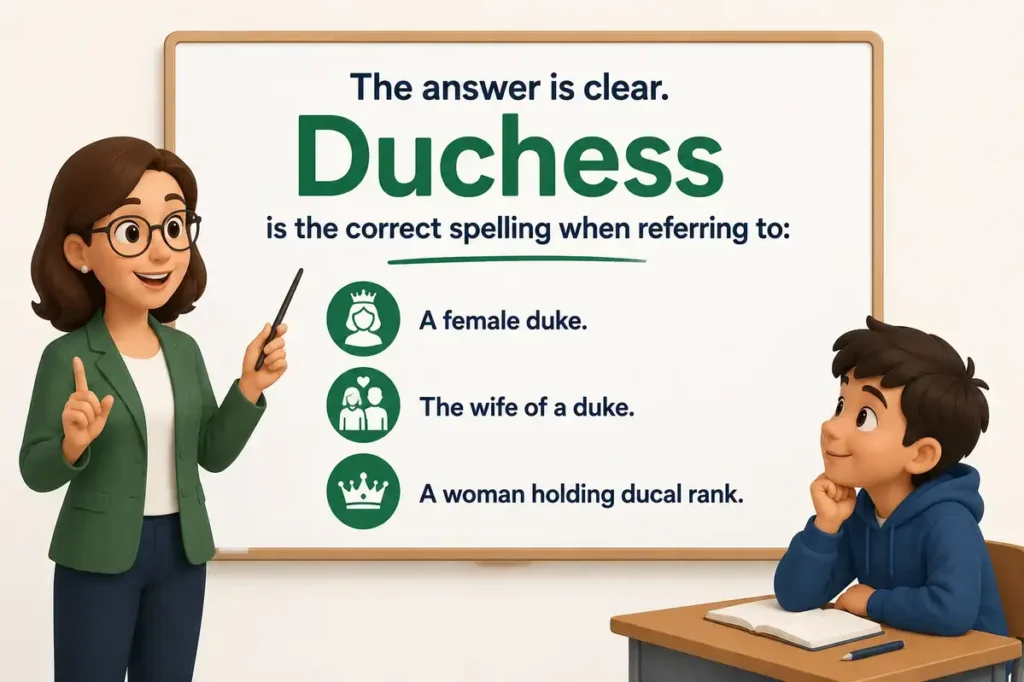
The answer is clear. Duchess is the correct spelling when referring to:
- A female duke.
- The wife of a duke.
- A woman holding ducal rank.
Dutchess is generally incorrect in this context.The only significant exception occurs when Dutchess forms part of an official name, location, organization, or brand.For standard English writing, the choice should always be duchess.
Still confused? Compare success or sucess Correct Spelling Meaning And Usage.
Conclusion
The debate around dutchess vs duchess isn’t really a debate at all once you look at the evidence. Duchess is the accepted spelling across American English, British English, Canadian English, and Australian English. It appears in dictionaries, style guides, historical records, academic publications, literature, and modern media.
Dutchess usually enters the conversation because the pronunciation makes the extra “t” seem reasonable. While the mistake is understandable, it remains a mistake in standard English when referring to a female noble title.The key difference is simple. Duchess is the recognized word. Dutchess is generally a misspelling unless it appears within an official proper name.
If you’re writing for school, work, publishing, SEO content, journalism, or professional communication, use duchess with confidence. One correct letter choice can make the difference between writing that looks polished and writing that looks unedited. In this case, the winning spelling is duchess.
Dutchess Vs Duchess FAQs
Is Duchess The Correct Spelling?
Yes. Duchess is the correct spelling when referring to a female noble of ducal rank or the wife of a duke. Dictionaries, style guides, educators, and publishers all recognize duchess as the standard English form.
Is Dutchess Ever Correct?
Yes, but only in limited situations. Dutchess may appear as part of an official name, location, company, organization, or brand. It is not the correct spelling for a female member of the nobility.
Why Do People Spell Duchess As Dutchess?
The pronunciation causes confusion. The beginning of duchess sounds similar to Dutch, leading many writers to add an extra “t” even though it doesn’t belong in the standard spelling.
Is Dutchess A Word In The Dictionary?
Major English dictionaries generally do not recognize Dutchess as a standard common noun. It mainly appears within proper nouns and official names.
Do British And American English Use Different Spellings?
No. British English and American English both use duchess. This isn’t a regional spelling difference. The accepted spelling remains the same across major English speaking countries
Is Duchess A Noun Or A Title?
Duchess functions as both a noun and a title. As a noun, it refers to a female noble of ducal rank. As a title, it can appear before or alongside a person’s name depending on the naming convention being used.
What Is The Plural Of Duchess?
The correct plural form is duchesses.
Example:
- Several duchesses attended the royal celebration.
- Historians studied the lives of influential duchesses across Europe.
Writers sometimes hesitate because of the double “s,” but duchesses follows standard English pluralization rules.
How Do You Pronounce Duchess Correctly?
Duchess is pronounced:
IPA:
/ˈdʌtʃəs/
Syllable breakdown:
Duch ess
The first syllable rhymes with words like much and touch. The second syllable has a soft unstressed sound.