
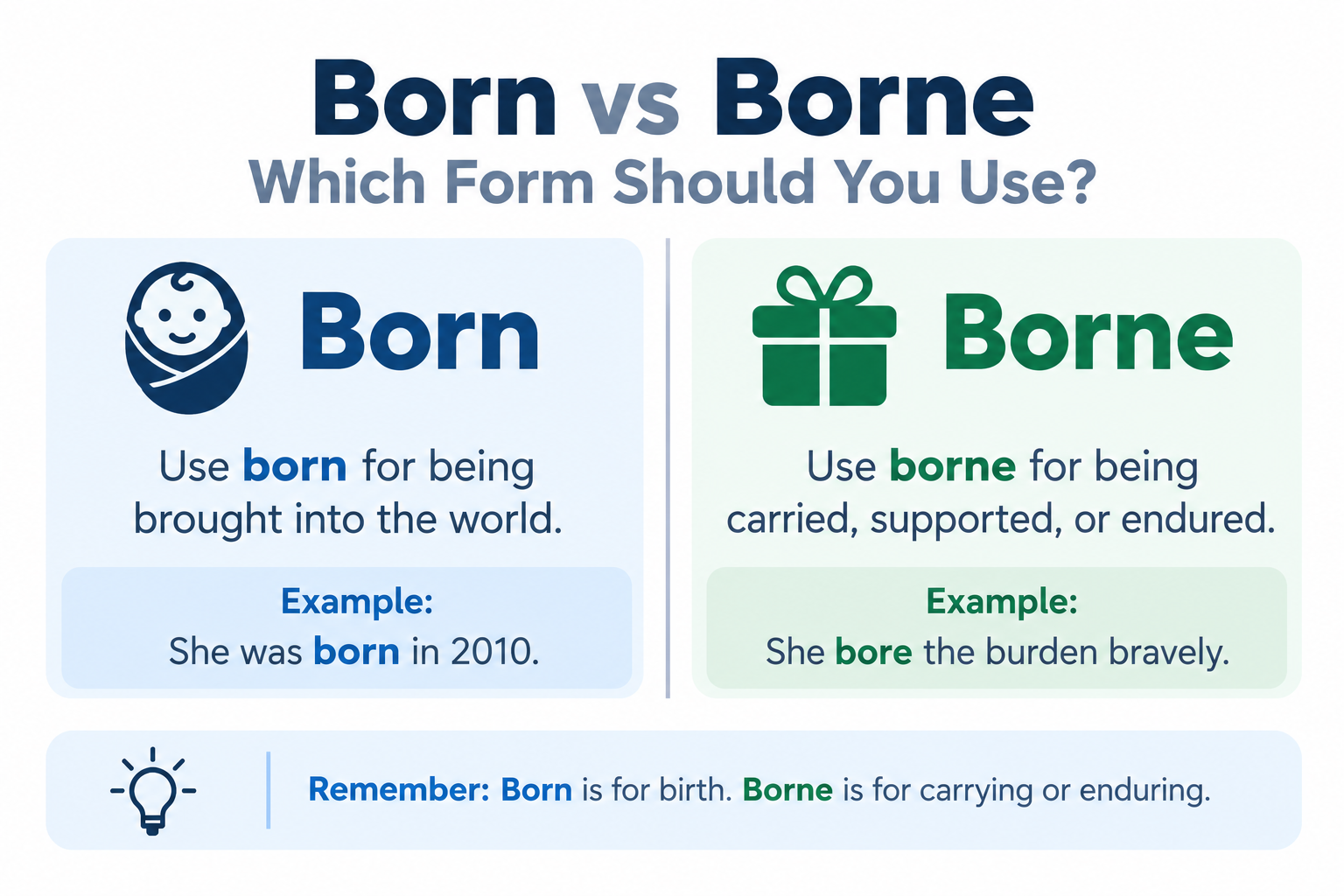
The difference between born vs borne can be confusing because both words come from the same verb, bear. They also share a similar pronunciation, but they do not mean exactly the same thing. The good news is that each form has a clear role in English grammar. Born usually relates to birth, origin, or the beginning of a life, while borne generally refers to something carried, endured, supported, or brought about.
You will often see born in sentences about someone’s birthplace, family background, or the beginning of an idea. Borne appears in expressions such as the cost was borne by the company or the burden was borne by her family. The difference becomes easier to understand once you connect each form to its grammatical function. This guide explains their meanings, pronunciation, history, and common patterns. It also provides practical examples to help you select the right word in everyday conversation, professional communication, and formal writing.
A related grammar guide is incite vs insight Meaning, Difference and Correct Usage.
Quick Answer
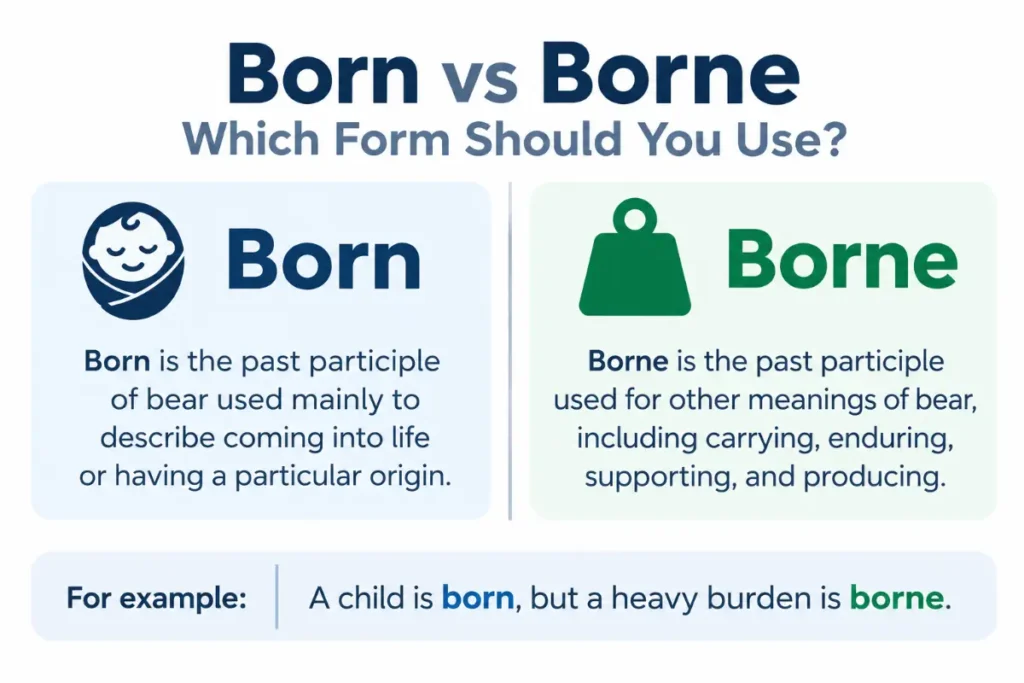
Born is the past participle of bear used mainly to describe coming into life or having a particular origin. Borne is the past participle used for other meanings of bear, including carrying, enduring, supporting, and producing. For example, a child is born, but a heavy burden is borne.
Comparison Table
| Feature | Born | Borne |
|---|---|---|
| Main meaning | Brought into life | Carried, endured, supported, or produced |
| Part of speech | Past participle of bear | Past participle of bear |
| Main use | Birth and origin | Carrying, responsibility, costs, and results |
| Grammar | Often used in passive constructions | Used in passive and perfect constructions |
| Pronunciation | /bɔːrn/ | /bɔːrn/ |
| Formality | Standard in all types of English | Standard in all types of English |
| Common phrases | Born in, born on, born to, born with | Borne by, borne out, borne in mind |
| Example | She was born in Texas. | The expense was borne by the company. |
Meaning and Definition
The easiest way to understand these words is to look at the different meanings of the verb bear. This verb has several uses, including giving birth, carrying something, tolerating difficulty, and producing a result. Its past participle changes according to the meaning being expressed.
What Does Born Mean?
Born means brought into life through birth. It is commonly used to describe the arrival of a person or animal, but it can also describe the beginning or origin of something in a figurative sense.
For example:
- She was born in Chicago.
- Their first child was born in May.
- He was born into a family of teachers.
- The idea was born during a conversation.
In the first three examples, the word relates directly to birth or a person’s circumstances at birth. In the final example, it describes the beginning of an idea.
The word also appears in expressions about natural ability or personality.
For example, She was born to lead suggests that leadership seems natural to her. Similarly, He is a born musician describes someone who appears naturally gifted at music.
In grammar, this form usually appears with a form of the verb be, such as was born, were born, or is born. It can also appear in phrases such as newborn baby and born and raised.
What Does Borne Mean?
Borne is the past participle of bear when the verb means to carry, support, endure, tolerate, or produce. It does not normally describe the physical birth of a person.
Consider these examples:
- The financial burden was borne by the parents.
- She had borne years of hardship.
- The message was borne across the country.
- The results have borne out our expectations.
In the first sentence, the parents carry the financial responsibility. In the second, the person has endured hardship and In the third, the message has been carried from one place to another and In the fourth, the results have confirmed an earlier belief.
This form often appears in formal writing because it can express responsibility, suffering, costs, and outcomes in a precise way.
Common expressions include:
- Borne by: Carried or paid by someone.
- Borne out: Confirmed or supported by evidence.
- Borne in mind: Remembered or considered.
- Airborne: Carried through the air.
- Waterborne: Carried or transmitted through water.
One useful detail is that borne is not limited to physical objects. A person can bear responsibility, a company can bear a cost, and a community can bear the effects of a decision.
Key Differences Explained
Although the two forms share the same root verb, their meanings and sentence patterns differ.
1. Difference in Meaning
The main distinction is the action being described.
- Born refers to coming into life or having a particular origin.
- Borne refers to carrying, enduring, supporting, or producing something.
For example:
- My sister was born in Florida.
- The responsibility was borne by my sister.
The first sentence describes the place where someone entered the world. The second describes someone carrying responsibility.
2. Difference in Grammar
Both forms are past participles of bear, but they appear in different grammatical contexts.
The birth related form usually appears with a form of be:
- The twins were born yesterday.
- He was born in a small town.
- She was born with excellent hearing.
The other form often appears with helping verbs or in passive constructions:
- She has borne the responsibility for years.
- The expenses were borne by the employer.
- The evidence has borne out the claim.
The verb pattern helps determine the correct choice.
3. Difference in Part of Speech
Both words function as past participles. They can appear in passive verb constructions and in adjective like expressions.
For example:
- A child born in winter may have a January birthday.
- The costs borne by the family were substantial.
In the first sentence, the word describes the child’s birth circumstances. In the second, it identifies the costs that the family carried.
4. Difference in Pronunciation
In most American English accents, the two words sound the same. Both are pronounced /bɔːrn/, with one syllable.
This means pronunciation alone cannot help you choose the correct spelling. You need to understand the sentence’s meaning.
5. Difference in Formality
Neither spelling is more formal or more correct than the other. Both are standard English forms.
The choice depends on meaning, not writing style. Use born for birth and borne for the other meanings of bear, even in casual messages.
6. Difference in Context
The surrounding words often reveal the intended form.
Look for phrases such as:
- Born in a city.
- Born on a date.
- Born into a family.
- Borne by a person.
- Borne at someone’s expense.
- Borne out by evidence.
These patterns provide useful clues when editing or proofreading.
7. Difference in Regional Usage
American, British, Canadian, and Australian English generally follow the same distinction. There is no major regional spelling rule that changes the meaning of these two forms.
Which Form Is Correct?
Both forms are correct. The right choice depends on the meaning of the sentence.
Use born when you describe someone’s birth, birthplace, family background, or natural qualities. Use borne when you describe something carried, endured, supported, or produced.
Compare these sentences:
- The baby was born last night.
- The medical expenses were borne by the family.
Both sentences follow standard English grammar. Replacing one form with the other would change the meaning or make the sentence incorrect.
The reason for this distinction comes from the verb bear. English uses born for the birth related sense of the verb, while borne serves as the past participle for its other major meanings.
A useful grammar pattern is:
Be + born
- She was born in 1995.
- They were born in Canada.
Have or be + borne
- He has borne the responsibility.
- The costs were borne by the business.
There is also an important exception worth remembering. In the phrase borne by, the word usually indicates who carries a cost, burden, or responsibility. In the phrase born by, the intended meaning is usually related to birth, although that exact construction is less common than born to or born of in ordinary writing.
Sentence Examples
Here are 10 natural examples showing how each form works in different situations.
Examples Using Born
- Everyday conversation: I was born in Ohio, but I grew up in California.
- Text message: Happy birthday! You were born to do amazing things.
- Workplace communication: Our new team leader was born and raised in Seattle.
- School writing: Abraham Lincoln was born in Kentucky in 1809.
- Formal writing: The child was born into a family with a long history of public service.
Examples Using Borne
- Workplace communication: The company agreed that all travel expenses would be borne by the employer.
- Academic writing: The findings have borne out the researchers’ original hypothesis.
- Everyday conversation: She has borne a lot of pressure over the past few months.
- Formal writing: The financial losses were borne by several small businesses.
- Social situations: He has borne the responsibility for organizing the family event for years.
These examples show that the correct form depends on the action or meaning, not the type of writing.
Common Mistakes and Confusions
Writers often mix up these forms because they sound alike and come from the same verb. The following mistakes are especially common.
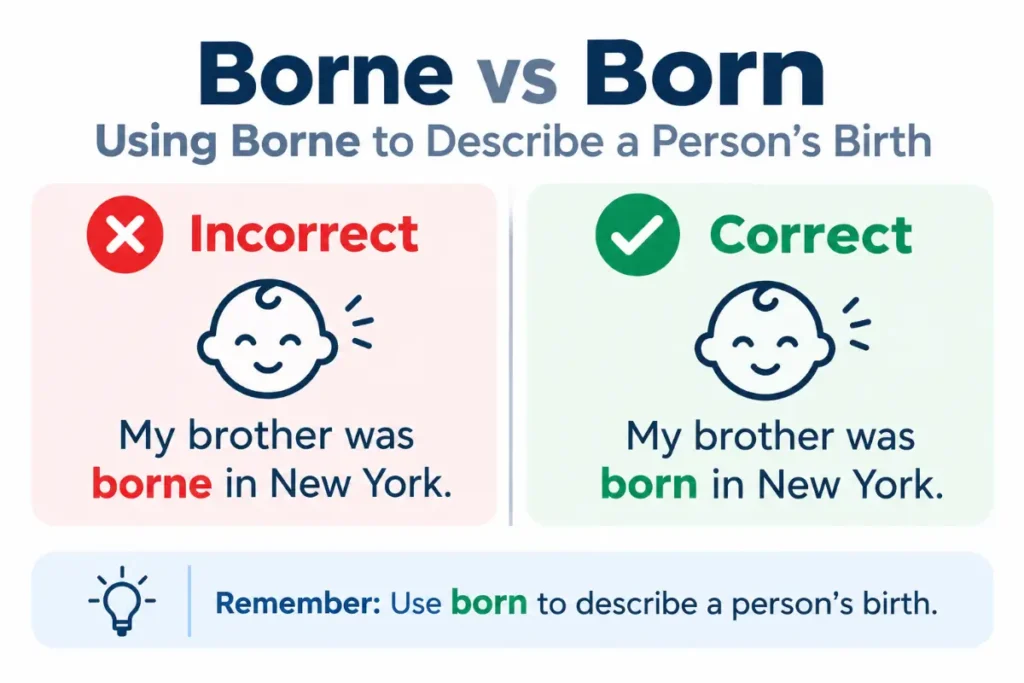
1. Using Borne to Describe a Person’s Birth
Incorrect: My brother was borne in New York.
Correct: My brother was born in New York.
The sentence describes the place of someone’s birth, so the birth related form is required.
2. Using Born for a Financial Responsibility
Incorrect: The cost was born by the company.
Correct: The cost was borne by the company.
The company carried or paid the cost. The sentence uses the carrying meaning of bear, so the correct past participle is borne.
3. Confusing Born Out With Borne Out
Incorrect: The evidence has born out his theory.
Correct: The evidence has borne out his theory.
The expression bear out means to confirm or support something. Its past participle is borne out.
4. Using Borne in a Birth Related Expression
Incorrect: She was borne to wealthy parents.
Correct: She was born to wealthy parents.
The phrase born to describes someone’s family or circumstances at birth. The other form does not fit this meaning.
5. Assuming Both Forms Are Interchangeable
Incorrect: The workers were born the extra burden.
Correct: The workers bore the extra burden.
This example reveals another useful grammar point. The simple past tense of bear is bore, while its past participles are born and borne, depending on meaning.
Remember the three forms:
| Verb Form | Word | Example |
|---|---|---|
| Base form | Bear | I can bear the responsibility. |
| Simple past | Bore | She bore the responsibility last year. |
| Past participle | Born or borne | She has borne the responsibility for years. |
You may also want to read Elicit vs Illicit Meaning and Usage Explained.
Pronunciation Guide
The two words are pronounced the same way in standard American English. Their spelling and meaning differ, but their spoken forms are generally identical.
| Word | IPA | Syllables | Easy Pronunciation |
|---|---|---|---|
| Born | /bɔːrn/ | 1 | BORN |
| Borne | /bɔːrn/ | 1 | BORN |
How to Pronounce Them
- Start with the sound /b/, as in book.
- Follow it with the vowel sound in or for many American speakers.
- Finish with the /rn/ sound.
Both words have one syllable, so there is no separate stress pattern to learn.
Some accents pronounce the vowel slightly differently. In American English, the pronunciation may sound close to born or bawrn, depending on the speaker’s region. This does not change the spelling rule.
Common Pronunciation Confusion
Because both forms sound alike, people sometimes assume they are interchangeable. This is a spelling and grammar issue rather than a pronunciation issue.
If you hear someone say, “The cost was borne by the company,” you cannot identify the spelling from sound alone. You must use the sentence’s meaning and grammatical structure.
Etymology and Word Origin
Both forms come from the Old English verb beran, which meant to carry, bring, or produce. The verb developed from an older Germanic root and is related to words in other Germanic languages that also express carrying or bearing.
Over time, English developed different forms of the verb for different grammatical uses. The simple past form became bore, while the past participle developed into borne and born.
The birth related form became distinct because English speakers used it specifically in expressions about giving birth and entering the world. The other form continued to serve meanings connected with carrying, enduring, and supporting.
This historical development explains why the two words are closely related but not interchangeable in modern English.
The base verb still appears in many everyday expressions:
- Bear a responsibility.
- Bear the cost.
- Bear a child.
- Bear the consequences.
- Bear the weight.
- Bear witness.
The past participle changes according to the intended meaning. This is why understanding the original verb helps explain the modern spelling distinction.
Regional Usage
The distinction is consistent across the major varieties of English. There is no standard American or British rule that changes one spelling into the other.
American English
In the United States, born is standard for birth and origin. It appears in familiar expressions such as born in New York, born on Monday, and born into a large family.
Borne is standard for carrying, enduring, or supporting something. American writers commonly use phrases such as costs borne by taxpayers, burdens borne by families, and evidence borne out by research.
British English
British English follows the same distinction. A person is born in a place, while a responsibility can be borne by an individual or group.
Some pronunciation details may vary by region, but the spelling rules remain the same.
Australian English
Australian English also uses both forms according to their established meanings. For example, born in Sydney describes a person’s birthplace, while the cost was borne by the government describes financial responsibility.
There is no special Australian spelling variation for these words.
Canadian English
Canadian English follows the same standard pattern. Writers use born for birth and borne for carrying, enduring, or producing something.
The distinction is consistent in both everyday communication and formal writing.
Grammar Rules and Part of Speech
Both forms belong to the verb bear. Understanding the verb’s different forms makes it easier to use them correctly.
The Main Forms of Bear
| Verb Form | Spelling | Example |
|---|---|---|
| Base form | Bear | I cannot bear the noise. |
| Third person singular | Bears | She bears the responsibility. |
| Present participle | Bearing | He is bearing the cost. |
| Simple past | Bore | They bore the burden together. |
| Past participle | Born or borne | She was born in June. The cost was borne by the company. |
The simple past form bore is different from both past participles. This is a common source of confusion, especially for people learning English.
How to Use Born in a Sentence
This form most often appears after a form of the verb be.
Common patterns include:
- Was born: He was born in Boston.
- Were born: The twins were born in July.
- Is born: Every child is born with unique needs.
- Born into: She was born into a musical family.
- Born with: He was born with a rare talent for mathematics.
- Born to: They were born to parents who loved traveling.
The preposition following the word can add important information. Born in usually introduces a place or period, born on introduces a specific date, and born into introduces a family or social setting.
For example:
- She was born in 2001.
- He was born on April 12.
- They were born into a large family.
How to Use Borne in a Sentence
This form appears in several common grammatical structures.
With have or has:
- She has borne the responsibility for years.
- The company has borne the cost of repairs.
With had:
– He had borne the burden alone before asking for help.
In passive constructions:
- The expense was borne by the customer.
- The consequences were borne by the entire community.
In expressions with out:
– The investigation has borne out the original concerns.
The passive voice is especially common when the writer wants to focus on the cost, burden, or responsibility rather than the person carrying it.
Is Borne the Same as Bore?
No. Bore is the simple past tense, while borne is a past participle.
Compare:
- She bore the responsibility last year.
- She has borne the responsibility for several years.
The first sentence describes a completed past action. The second uses the present perfect tense to connect an earlier action with the present.
Can Born Be Used as an Adjective?
Yes. It can describe a person or their natural qualities.
Examples:
- She is a born leader.
- He is a born storyteller.
- They are natural born competitors.
The expression natural born is often written as two words, though hyphenation can depend on its position and the applicable style guide. In ordinary writing, the important point is that the birth related form remains born.
Can Borne Be Used as an Adjective?
Yes. It can appear in compound words and descriptive expressions.
Examples include:
- Airborne particles.
- Waterborne diseases.
- Windborne seeds.
In these words, the element borne carries the sense of being transported or carried by air, water, or wind.
Real Life Usage Examples
The following examples show how the two forms appear in different types of communication.
Daily Conversation
People often use the birth related form when talking about family, personal history, and life events.
- “I was born in Denver, but I have lived in New York for most of my life.”
- “Their baby was born early, so the family spent a few days at the hospital.”
The other form appears when people talk about difficult experiences or responsibilities.
- “She has borne a lot of stress at work lately.”
- “The whole family has borne the financial pressure together.”
Email and Workplace Communication
Professional writing often uses these words to describe employee responsibilities, company expenses, and personal background.
Born:
- “I was born and raised in Atlanta, and I currently work in Chicago.”
- “The new employee was born in Canada and has lived in the United States for ten years.”
Borne:
- “All approved travel expenses will be borne by the department.”
- “The additional costs were borne by the contractor under the terms of the agreement.”
In business communication, the second pattern is particularly useful for describing financial obligations clearly.
Academic Writing
Academic writers use born when discussing historical figures, demographic information, and the origins of ideas. They use borne to describe evidence, effects, costs, or burdens.
Born:
- “The author was born in London in the late nineteenth century.”
- “The movement was born from growing public concern about industrial pollution.”
Borne:
- “The findings have borne out the original research hypothesis.”
- “The economic burden was borne mainly by low income households.”
These examples show how the words can appear in academic contexts without changing their basic meanings.
News and Journalism
News reports often use born in stories about people and borne in reports about financial or social responsibility.
Born:
- “The actor was born in a small town before moving to Los Angeles.”
- “A baby was born during the family’s long journey to safety.”
Borne:
- “The costs of the emergency response were borne by local authorities.”
- “The impact of the storm was borne most heavily by coastal communities.”
The choice helps readers understand the event or responsibility being reported.
Literature and Storytelling
Writers use the birth related form to establish a character’s background or describe the beginning of a story. The other form can communicate hardship, duty, or emotional weight.
Born:
- “She was born beneath a summer sky in a quiet village.”
- “A new hope was born when the old friends met again.”
Borne:
- “He had borne the secret for years without telling anyone.”
- “The weight of the past was borne by every member of the family.”
In storytelling, both forms can carry literal and figurative meanings.
Related and Confused Terms
Several words and expressions are connected to these forms. Understanding them can help you use the verb bear more accurately.
1. Bear
Bear is the base form of the verb. It can mean to carry, support, tolerate, or give birth.
Example: “I cannot bear the thought of losing my home.”
2. Bore
Bore is the simple past tense of bear.
Example: “She bore the responsibility without complaint.”
It is also a separate verb meaning to make someone feel uninterested, as in “The long speech began to bore the audience.” Context tells you which meaning applies.
3. Bearing
Bearing is the present participle of bear. It can describe carrying, supporting, or enduring something.
Example: “He is bearing the cost of the repairs.”
4. Birthed
Birthed is the past tense and past participle of birth when used as a verb. It can describe giving birth or bringing something into existence.
Example: “The project was birthed from a simple classroom idea.”
Unlike born, this form comes from the verb birth, not the past participle of bear.
5. Birth
Birth is a noun that refers to the process of being born or the beginning of something.
Example: “The birth of their first child changed their lives.”
6. Born and Raised
This common expression describes where someone was born and where they grew up.
Example: “She was born and raised in Miami.”
The two parts can refer to different places. Someone might be born in one city and raised in another.
7. Borne Out
Borne out means confirmed or supported by evidence.
Example: “The latest figures have borne out the team’s concerns.”
Do not write born out when you mean that evidence confirms a claim.
8. Burden
A burden is a responsibility, difficulty, or heavy load. It is closely related to the carrying sense of bear.
Example: “The burden was borne by the entire community.”
The noun and verb often appear together in discussions about responsibility and hardship.
Expert Editor Insight
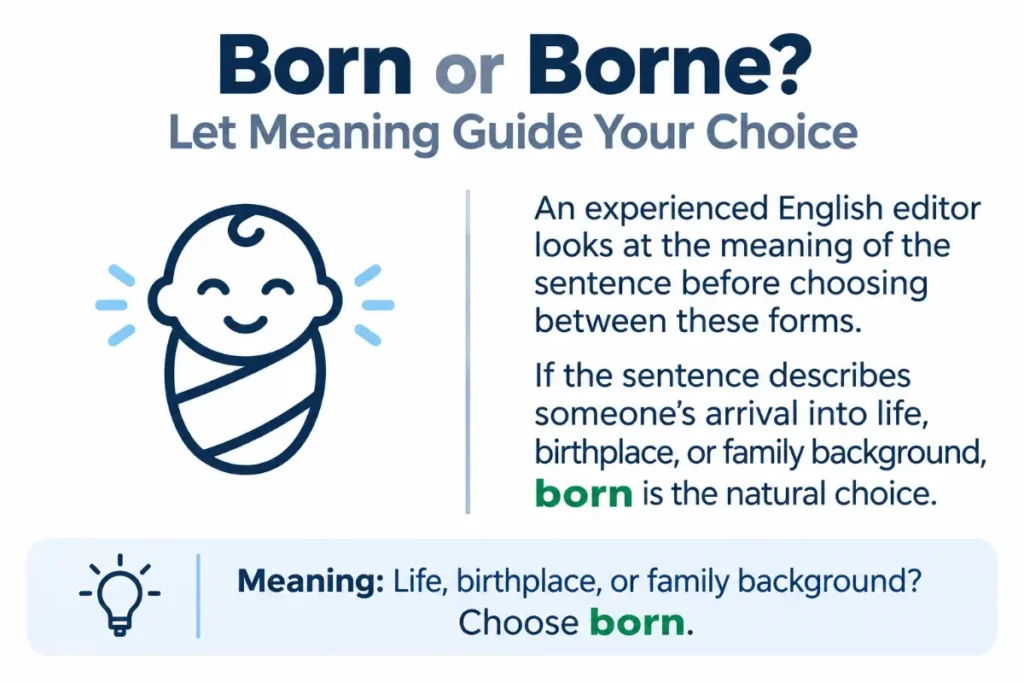
An experienced English editor looks at the meaning of the sentence before choosing between these forms. If the sentence describes someone’s arrival into life, birthplace, or family background, born is the natural choice. If it describes a cost, responsibility, hardship, or result, borne is usually correct. The confusion is common because the words sound alike and share a verb root. Spelling tools may catch some mistakes, but they cannot always understand the intended meaning. A sentence can contain a correctly spelled word and still use the wrong form. The best editing habit is to replace the word mentally with given birth or carried and see which meaning fits.
For another common grammar confusion, see Challenge vs Challange Which Spelling Is Correct.
Conclusion
The difference between born vs borne comes down to the meaning of the verb bear. Use born for birth, birthplace, family background, and the beginning of something. Use borne for carrying, enduring, supporting, or producing a result. Both forms are correct, and neither is a regional spelling variation or a casual alternative to the other.
Remember this simple editing tip: a person is born, but a responsibility is borne. If you are unsure, check the meaning of the sentence rather than relying on pronunciation. That one habit will help you choose the right form in everyday and professional writing.
FAQs
Is Born a Real Word?
Yes. Born is the past participle of bear used mainly to describe coming into life. It is standard English and appears in expressions such as born in, born on, and born into. It can also describe the beginning of an idea or movement, as in “The organization was born from a shared goal.”
Is Borne a Real Word?
Yes. Borne is a standard English word and the past participle of bear for meanings such as carrying, enduring, supporting, and producing. You will see it in phrases such as costs borne by the company, burdens borne by families, and the evidence has borne out the claim. It is not an incorrect version of the birth related form.
What Is the Main Difference Between Born and Borne?
The main difference is their meaning. Born describes birth, origin, or the beginning of something. Borne describes something carried, endured, supported, or brought about. For example, a child is born in a hospital, but the cost of the hospital stay may be borne by the parents or an insurance company.
How Do You Pronounce These Two Words?
Both forms are usually pronounced the same way in American English: /bɔːrn/. Each has one syllable and rhymes with words such as corn and torn in many American accents. Since their pronunciation is alike, you cannot choose the correct spelling by sound alone. You need to consider the sentence’s meaning.
Can Born Start a Sentence?
Yes. The word can begin a sentence when it forms part of a descriptive phrase or a reduced clause. For example, “Born in a small town, Maria always dreamed of traveling.” The sentence uses the birth related form correctly. Starting with a participial phrase can make writing more concise, but the phrase must clearly describe the subject that follows.
What Is a Synonym for Borne?
The best synonym depends on the intended meaning. If it means carrying, you might use carried or transported. If it means enduring, tolerated or suffered may fit and If it refers to a cost, paid or covered may work. For borne out, useful alternatives include confirmed, supported, and substantiated.
Why Do People Confuse These Two Forms?
People confuse them because both come from the verb bear and usually have the same pronunciation. Their spelling difference is tied to meaning and grammar rather than sound. English learners may also expect regular verb patterns, but bear, bore, born, and borne do not follow the simple pattern used by regular verbs.
Is Borne Appropriate in Formal Writing?
Yes. Borne is fully appropriate in formal, academic, legal, and professional writing. It is especially useful when discussing costs, obligations, risks, responsibilities, and evidence. Expressions such as the costs were borne by the employer and the findings have borne out the theory are standard. Just make sure the sentence describes carrying, enduring, or supporting something.