
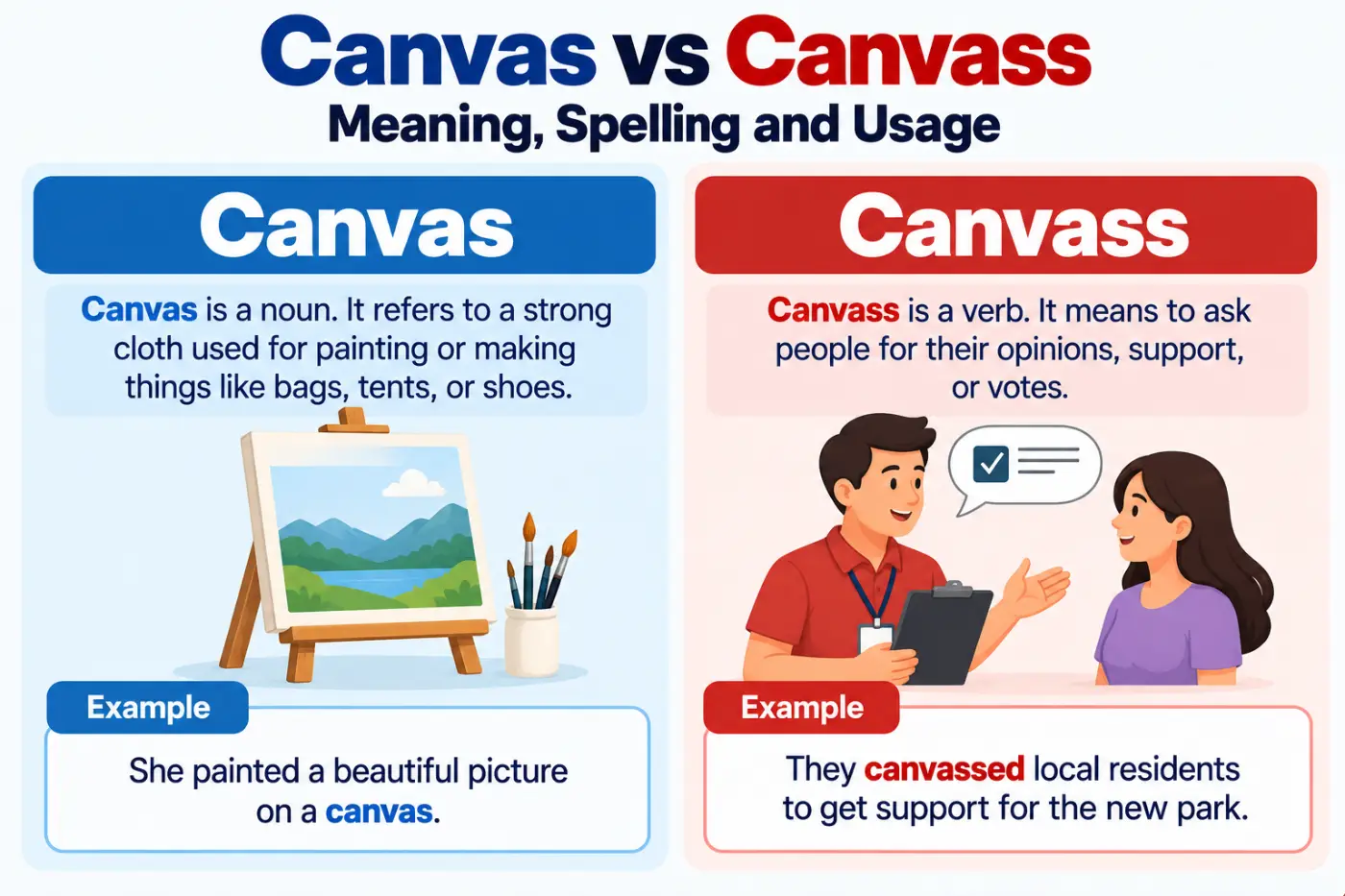
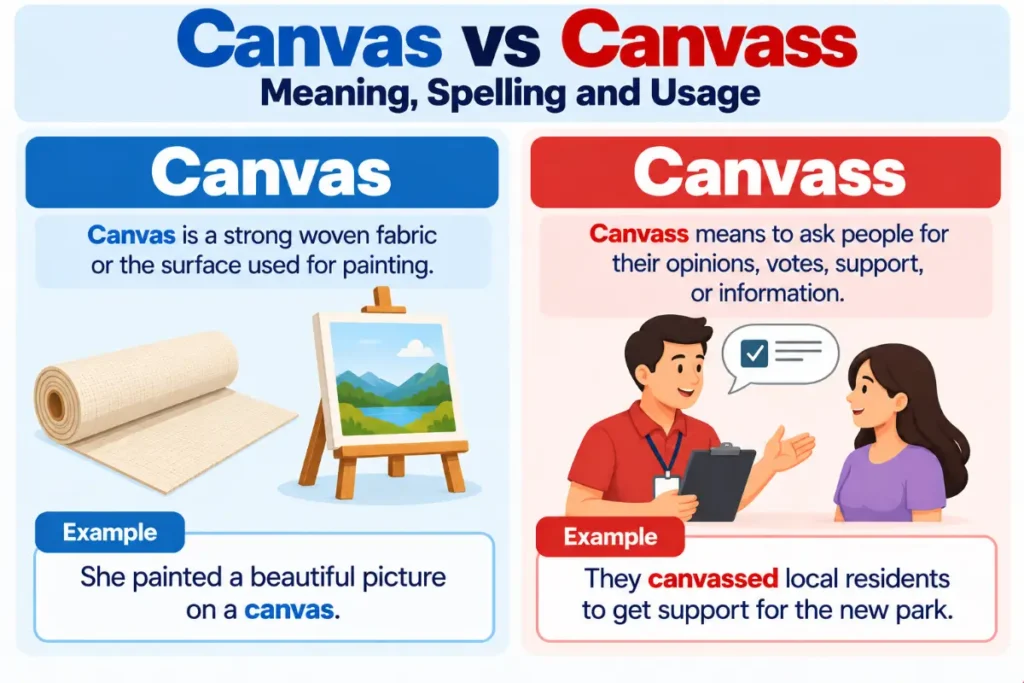
Confused by canvas vs canvass? These two words look and sound almost identical, but they have different meanings. Canvas is a strong, durable fabric used for paintings, bags, tents, and other products. Canvass is a verb that means to ask people for opinions, votes, support, or information. It can also be a noun referring to an organized effort to gather opinions or votes.
The confusion is understandable because both words share the same pronunciation in standard American English. The extra S in one spelling does not create a different sound, so you cannot rely on pronunciation alone to choose the correct form. You need to understand the meaning of the sentence.
This guide explains both words in plain English. You will learn their definitions, spelling differences, grammar, pronunciation, origins, and common uses. You will also see practical examples that show how to choose the right spelling in everyday conversation, schoolwork, business writing, and formal documents.
Many readers also check Appendices vs Appendixes Which Spelling Is Correct.
Quick Answer
Canvas is a noun that refers to a strong, heavy fabric or a surface used for painting. Canvass is mainly a verb meaning to ask people for opinions, votes, support, or information. Both words are correct, but they are not interchangeable. Choose the spelling that matches the meaning you intend.
Comparison Table
| Feature | Canvas | Canvass |
|---|---|---|
| Correct spelling | Canvas | Canvass |
| Main meaning | Strong fabric or painting surface | To seek opinions, votes, support, or information |
| Part of speech | Noun | Mainly a verb, sometimes a noun |
| Pronunciation | /ˈkæn.vəs/ | /ˈkæn.vəs/ |
| Number of syllables | Two | Two |
| Origin | From an older form of fabric related to hemp | From the same historical word family as canvas |
| Formality | Standard in all forms of English | Standard in all forms of English |
| Common contexts | Art, clothing, tents, bags, painting | Elections, surveys, fundraising, research |
| Example | She painted a landscape on canvas. | Volunteers will canvass the neighborhood. |
Meaning and Definition
Although these words share a sound and a similar spelling, they serve different purposes. One usually names a material or surface, while the other describes an activity involving communication with people.
What Does Canvas Mean?
Canvas is a noun that describes a strong, thick fabric. It is traditionally made from cotton, linen, or other sturdy fibers. The material is known for its durability and ability to handle regular use.
People use it to make many everyday products, including:
- Painting surfaces.
- Backpacks and travel bags.
- Tents and outdoor covers.
- Shoes and casual clothing.
- Awnings and protective coverings.
- Upholstery and decorative items.
In art, the word often refers to the surface on which an artist creates a painting. Traditional painting surfaces may be made from woven fabric stretched over a wooden frame. Artists can apply a prepared coating before painting to create a suitable surface.
For example:
- The artist bought a large canvas for her new painting.
- He carried his books in a canvas backpack.
- The outdoor crew covered the equipment with canvas.
The word can also have a figurative meaning. Writers sometimes use it to describe an opportunity, setting, or space for creative expression.
For example, someone might say that a city is a canvas for artists. This does not mean the city is made of fabric. It means the city provides opportunities for creativity, expression, and new ideas.
What Does Canvass Mean?
Canvass is mainly a verb. It means to contact people and ask them for information, opinions, votes, support, or donations. The activity usually involves speaking directly with individuals, visiting places, making phone calls, or sending messages.
The word appears frequently in political campaigns, community projects, fundraising activities, and research.
For example:
- Campaign workers will canvass local neighborhoods before election day.
- The research team will canvass residents about public transportation.
- Volunteers canvassed the community to collect donations.
The central idea is reaching out to people to learn what they think or encourage them to take action.
The word can also be used as a noun. In this form, it describes an organized effort to collect opinions or support.
For example:
- The campaign organized a weekend canvass.
- The volunteers completed a door to door canvass.
As a noun, this use is less common than the verb form, but it is still standard English.
Is Canvas a Real Word?
Yes. Canvas is a standard English noun with a long history. It refers to a durable fabric and, by extension, a surface used for painting or a setting for creative work.
Is Canvass a Real Word?
Yes. Canvass is also a standard English word. It is mainly used as a verb for contacting people to gather opinions, votes, information, or support.
It is especially common in political, social, and research contexts. The extra S is part of its correct spelling and should not be removed when describing this activity.
Key Differences Explained
The easiest way to remember the distinction is to connect each word with its main purpose. One refers to a material or painting surface. The other describes an effort to communicate with people.
Here are the main differences.
1. Spelling
The first word ends with one S after the A and second N sequence: canvas.
The second word ends with two S letters: canvass.
That final extra letter is meaningful. It distinguishes the verb from the noun in ordinary usage.
2. Meaning
Canvas refers to a physical material or a surface used for painting. Canvass refers to the act of asking people questions or seeking their support.
Consider these examples:
- The photographer used a canvas backdrop.
- The volunteers will canvass the neighborhood.
The first sentence describes a material. The second describes an activity.
3. Grammar
Canvas is usually a noun. It can act as the subject or object of a sentence.
For example:
- Canvas is often used to make durable bags.
- She placed the painting on the canvas.
Canvass is usually a verb. It describes an action and can take a direct object.
For example:
- The team will canvass voters.
- We canvassed local businesses for donations.
It can also function as a noun, as in a political canvass.
4. Pronunciation
Both words are pronounced the same way in standard American English. They have two syllables, with the stress on the first syllable.
This shared pronunciation explains much of the confusion. A listener cannot usually identify the spelling from the sound alone.
5. Formality
Both forms are appropriate in formal and informal English. Neither is slang, and neither is an incorrect version of the other.
The choice depends on meaning rather than tone or writing style.
6. Context
The surrounding words usually make the intended meaning clear.
Words such as painting, fabric, bag, tent, and material often appear near canvas.
Words such as voters, residents, opinions, donations, and support often appear near canvass.
Context is the most reliable way to select the correct spelling.
7. Regional Usage
The distinction remains the same in American, British, Canadian, and Australian English. There is no major regional spelling change that makes one form replace the other.
Which Form Is Correct?
Both spellings are correct. The right choice depends on the meaning of your sentence.
Use canvas when you mean a durable fabric, a painting surface, or a figurative space for creative expression.
Use canvass when you mean contacting people to gather information, opinions, votes, or support.
The distinction is based on established English spelling and word usage. Standard dictionaries recognize both forms as separate entries with different meanings and grammatical functions.
Here is a simple way to check your sentence:
- If you are talking about fabric or painting, write canvas.
- If you are describing an effort to contact people, write canvass.
- If you are describing an organized effort to gather opinions or votes, canvass can also work as a noun.
- If the sentence is unclear, replace the word temporarily with its meaning. If the sentence still makes sense, you have probably chosen correctly.
For example, consider this sentence:
The volunteers will canvas the neighborhood.
If the intended meaning is that volunteers will visit homes to ask residents questions, the correct spelling is canvass. The sentence should read:
The volunteers will canvass the neighborhood.
However, if you are describing a piece of fabric, the single S spelling is correct:
The artist stretched the canvas over a wooden frame.
Sentence Examples
The following examples show how both words work in natural English. Pay attention to the surrounding words to see how meaning determines spelling.
Examples Using Canvas
- The artist chose a large canvas for her landscape painting.
- My brother bought a canvas backpack for his weekend trip.
- The workers used canvas to cover the outdoor furniture.
- She prefers painting on canvas because it holds color well.
- The tent was made from thick, weather resistant canvas.
- The designer used a blank canvas to test several color combinations.
- Our teacher asked us to bring a small canvas for art class.
- The company makes durable canvas bags for everyday use.
- The museum displayed an old oil painting on a restored canvas.
- The open countryside became a beautiful canvas for the photographer.
Examples Using Canvass
- Volunteers will canvass the neighborhood before the local election.
- The campaign hired workers to canvass registered voters.
- Our team will canvass customers to learn about their shopping habits.
- The charity asked its members to canvass local businesses for donations.
- Researchers canvassed residents about traffic and road safety.
- The mayor’s supporters went door to door to canvass voters.
- The school plans to canvass parents about the proposed schedule.
- The organization will canvass the community for ideas.
- Reporters canvassed several experts before preparing the article.
- The political group organized a weekend canvass across the district.
Common Mistakes and Misspellings
These two words are easy to mix up because they sound alike. The main problem is not pronunciation. It is choosing a spelling that does not match the intended meaning.
Here are five common mistakes to watch for.
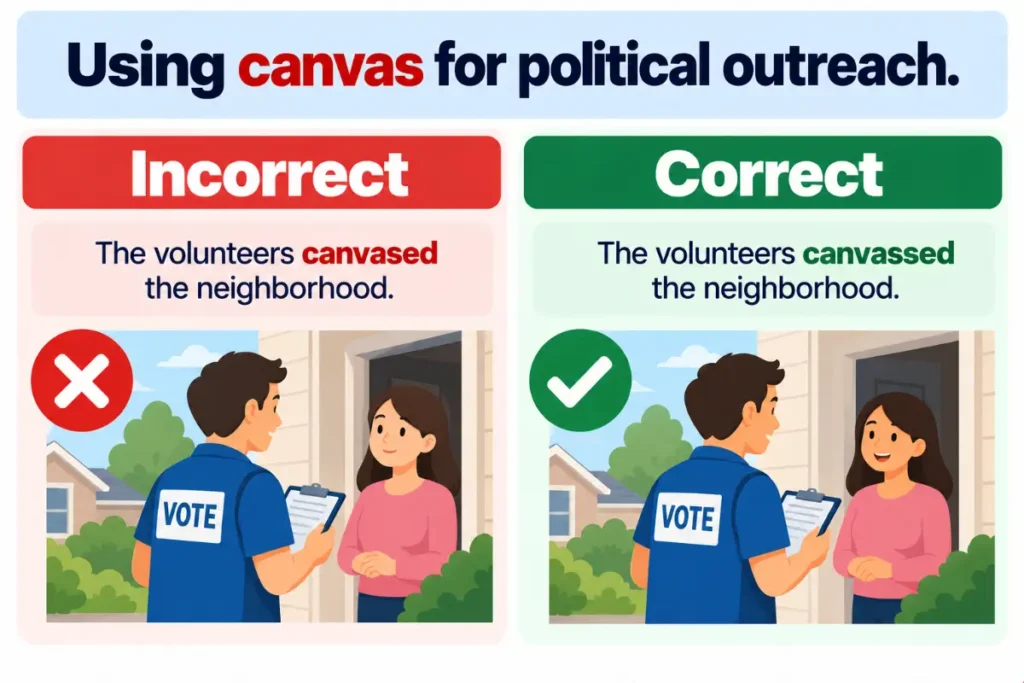
1. Using Canvas as a Verb for Gathering Opinions
Incorrect: The volunteers will canvas the neighborhood for support.
Correct: The volunteers will canvass the neighborhood for support.
The mistake happens because people often remember the fabric word but forget the second spelling. When the sentence describes contacting people, the correct verb has two S letters at the end.
2. Using Canvass for a Painting Surface
Incorrect: She painted a beautiful picture on the canvass.
Correct: She painted a beautiful picture on the canvas.
A painting surface is called canvas. The extra S changes the word and does not belong in this context.
3. Confusing the Words in Political Writing
Incorrect: The campaign ordered a canvas of local voters.
Correct: The campaign organized a canvass of local voters.
When describing an organized effort to contact voters, the noun form is canvass. Using the material related term can make the sentence sound incorrect or confusing.
4. Adding an Extra S to the Fabric Word
Incorrect: The bag is made from canvass.
Correct: The bag is made from canvas.
This error often comes from remembering that both words sound alike and assuming their spellings can be used interchangeably. They cannot. A material made from strong woven fabric is canvas.
5. Choosing a Spelling Based Only on Sound
Incorrect: The committee will canvas residents about the new plan.
Correct: The committee will canvass residents about the new plan.
Since both words share the same pronunciation, listening alone does not help. You need to identify the action or object in the sentence before choosing the spelling.
For another common grammar confusion, see Loot vs Lute Which Word Is Correct and What Is the Difference.
Pronunciation Guide
Both words have the same standard American pronunciation. The extra S in the second spelling does not create another syllable or change the sound.
IPA: /ˈkæn.vəs/
Syllable breakdown: CAN + vuhs.
Easy pronunciation: KAN vuhs.
The first syllable receives the stress. The second syllable is shorter and softer.
Common Pronunciation Mistakes
Some speakers may pronounce the second syllable too strongly or try to create a different sound for the word ending in two S letters. That is unnecessary.
In standard American English, both words sound alike. The spelling difference appears in writing, not in the usual pronunciation.
When speaking, the surrounding sentence provides the meaning. When writing, you must choose the spelling that fits the context.
Etymology and Word Origin
The two spellings have a shared historical background. Their development helps explain why they look so similar despite having different modern meanings.
Origin of Canvas
Canvas entered English through Anglo French and Old French forms related to the word for hemp. The term ultimately traces back to Latin cannabis, which referred to the hemp plant.
Hemp fibers were traditionally used to make strong woven cloth. Because the material was durable, people used it for practical products such as sails, coverings, bags, and other heavy duty items.
Over time, the word became closely associated with the fabric itself. It also developed its artistic meaning because painters used the material as a surface for their work.
Today, the word can describe the fabric, a painting surface, or a figurative space for creative expression.
Origin of Canvass
Canvass developed from the same historical word family. The spelling became associated with examining or discussing something in detail, especially by asking people questions.
One historical explanation connects the word with the practice of examining cloth closely. The meaning later developed toward seeking opinions, collecting information, and gaining support through direct contact.
In modern English, the verb is strongly associated with elections, surveys, fundraising, and community outreach.
The shared history explains their similar appearance. Their present day meanings, however, are distinct.
Regional Usage
There is no major spelling difference between American and British English for these two words. Both forms are standard across the main English speaking regions.
American English
In the United States, canvas is commonly used in art, clothing, manufacturing, and outdoor products. It also appears in figurative expressions such as a blank canvas.
Canvass is common in political campaigns, local elections, surveys, and fundraising. Campaign volunteers often canvass neighborhoods to speak with residents and encourage voter participation.
Both spellings are standard in American dictionaries and formal writing.
British English
British English uses the same distinction. Canvas refers to the fabric or painting surface, while canvass describes asking people for opinions, votes, or information.
British political and community organizations also use the verb when describing door to door outreach or public opinion gathering.
There is no special British spelling that replaces either form.
Australian English
Australian English follows the same standard usage. Canvas is the material, while canvass is the act of contacting people to collect views or support.
Both words appear in ordinary and formal Australian writing.
Canadian English
Canadian English also maintains the distinction. Writers use canvas for fabric and artistic surfaces and canvass for political or community outreach.
The meanings do not change based on Canadian spelling conventions.
Grammar Rules and Part of Speech
Understanding the grammatical role of each word makes the spelling easier to remember. One mainly names a thing, while the other usually describes an action.
How to Use Canvas as a Noun
Canvas is a countable noun when it refers to a piece of fabric or a painting surface. It can appear in both singular and plural forms.
Examples:
- The artist bought a canvas.
- Three canvases were displayed in the gallery.
- The company produces canvas bags.
The plural form is canvases, not canvass or canvasses.
Canvas can also be used as an uncountable noun when referring to the material in general.
For example:
- Canvas is a popular material for sturdy bags.
- The workers used canvas to protect the equipment.
How to Use Canvass as a Verb
Canvass describes the action of contacting people to gather information or support. It can be used in several common grammatical patterns.
Canvass someone or a group.
- The team will canvass local residents.
- Volunteers canvassed business owners.
The verb can appear in different tenses:
| Verb Form | Example |
|---|---|
| Base form | They canvass voters every weekend. |
| Third person singular | She canvasses local businesses. |
| Past tense | We canvassed the neighborhood yesterday. |
| Present participle | They are canvassing the district. |
| Past participle | The area has been canvassed already. |
How to Use Canvass as a Noun
Although the verb is more common, the same spelling can function as a noun.
Examples:
- The campaign completed its first canvass.
- The weekend canvass brought in several new volunteers.
- The organization planned a community canvass.
In these examples, the word refers to the organized activity rather than the act expressed by a verb.
Common Grammar Errors
A common error is using the noun spelling when the sentence needs a verb.
Incorrect: The volunteers canvas residents about the new project.
Correct: The volunteers canvass residents about the new project.
Another mistake involves using the wrong plural form.
Incorrect: The gallery displayed several canvass.
Correct: The gallery displayed several canvases.
Remember that the plural of the fabric noun is canvases. The verb’s third person singular form is canvasses.
Real Life Usage Examples
Both words appear in different areas of everyday life. Looking at real situations makes their meanings easier to understand and remember.
Daily Conversation
Canvas often comes up when people talk about art, clothing, bags, and outdoor equipment.
- I need a new canvas bag for my gym clothes.
- The painting looks better on a larger canvas.
Canvass appears in conversations about community activities, elections, and surveys.
- The volunteers are going to canvass our street this weekend.
- The school wants to canvass parents before changing the lunch schedule.
Email and Workplace Communication
In a workplace email, canvas might describe a material needed for a project.
Example 1: Please order two rolls of canvas for the display installation. We need the material before Friday.
Example 2: The design team has prepared a blank canvas for the new campaign artwork. Please review the proposed layout.
The verb can appear in professional communication about gathering feedback.
Example 1: We plan to canvass customers next month to learn more about their experience. The feedback will help us improve our services.
Example 2: Please ask the outreach team to canvass local businesses for sponsorship opportunities. We need to confirm interest before preparing the final budget.
Academic Writing
In academic writing, canvas often appears in discussions of art, textiles, design, and material culture.
Example 1: The study examines how nineteenth century artists used canvas as a support for oil painting.
Example 2: The researcher compared the strength and durability of several types of woven canvas.
Canvass may appear in research methods and political studies.
Example 1: The research team canvassed residents to collect opinions about public transportation.
Example 2: The study describes how political organizations canvass voters during local election campaigns.
News and Journalism
News reports may use canvas when discussing paintings, art exhibitions, or products.
Example 1: The gallery opened an exhibition featuring large scale paintings on canvas.
Example 2: The manufacturer recalled several outdoor products after discovering a problem with the canvas covers.
Canvass is common in political and public affairs reporting.
Example 1: Volunteers will canvass neighborhoods across the district ahead of the election.
Example 2: Campaign officials canvassed residents to understand concerns about housing and public safety.
Literature and Storytelling
Writers can use canvas in both literal and figurative ways.
Example 1: The painter stared at the empty canvas, waiting for the first idea to take shape.
Example 2: The quiet village became a living canvas of color, sound, and memory.
Canvass can describe a character’s effort to gather views or seek help.
Example 1: She spent the afternoon canvassing the village for information about the missing traveler.
Example 2: The young candidate canvassed the town, listening to every concern before making a promise.
Related and Confused Terms
Several words are closely connected to these two spellings. Some describe similar materials, while others relate to the process of gathering opinions or support.
1. Fabric
Fabric is a broad term for material made by weaving, knitting, or bonding fibers. Canvas is one specific type of fabric.
For example, cotton, denim, silk, and linen are also fabrics, but they do not have the same properties or uses as canvas.
2. Cloth
Cloth refers to a piece of woven or knitted material. It is a general term, while canvas describes a particular durable type of cloth.
For example:
- The tailor cut a piece of cloth.
- The artist stretched canvas over a wooden frame.
3. Textile
Textile is a broad term used for materials made from fibers. It often appears in manufacturing, fashion, design, and academic writing.
Canvas is a textile, but not every textile is canvas.
4. Painting Surface
A painting surface is the material on which an artist creates an image. Canvas is a common option, but artists also use paper, wood panels, and other prepared surfaces.
The phrase describes the function rather than one specific material.
5. Survey
A survey is a method of collecting information from people by asking questions. It can involve online forms, interviews, phone calls, or written questionnaires.
Canvassing may include conducting surveys, but the two terms are not identical. A survey describes the information gathering method, while canvassing often describes the outreach activity.
6. Poll
A poll collects opinions or preferences from a group of people. It is common in elections, public opinion research, and customer feedback.
A campaign might canvass voters to learn how they plan to vote. It might also conduct a poll to measure public opinion.
7. Solicit
To solicit means to ask for or seek something, such as money, support, advice, or business.
Canvassing can involve soliciting donations or support, but the verb has a broader meaning. A person can solicit help without visiting a neighborhood or conducting an organized outreach effort.
8. Outreach
Outreach refers to activities designed to contact, inform, or support people in a community or target group.
Canvassing is one form of outreach. Other forms include public meetings, phone calls, community events, and online communication.
Expert Editor Insight
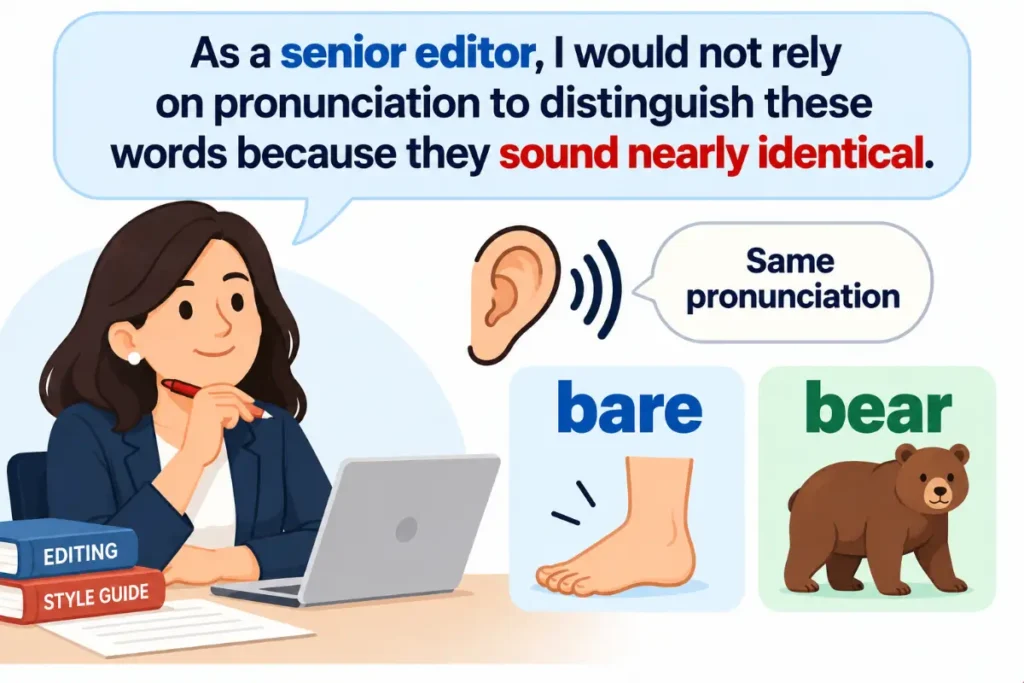
An experienced editor looks at the meaning of the sentence before checking the spelling. Both forms are legitimate, so a spelling checker may accept either one even when the writer has chosen the wrong word for the context. The best editing tip is to replace the word with its meaning while proofreading. If you mean fabric or a painting surface, use canvas. If you mean contacting people for information or support, use canvass. This simple meaning test catches errors that ordinary spell checking may miss.
Learn the difference in to bad or too bad which is correct.
Conclusion
The difference between canvas vs canvass comes down to meaning, not pronunciation. Canvas is the correct noun for durable fabric, painting surfaces, and figurative creative spaces. Canvass is mainly a verb for contacting people to collect opinions, votes, information, or support, although it can also function as a noun. Both spellings are standard English, so neither should be treated as a simple misspelling.
The easiest editing trick is to check what the sentence describes. If it involves material or art, choose canvas. If it involves asking people questions or seeking support, choose canvass.
FAQs
Is Canvass a Real Word?
Yes. Canvass is a standard English word, mainly used as a verb. It means to contact people to ask for opinions, votes, support, donations, or information.
What Does Canvas Mean?
Canvas is a strong, durable fabric often made from cotton or linen. It is used for products such as bags, tents, covers, and shoes. In art, it refers to a surface on which painters create their work. The word can also describe a figurative space for creativity, such as a blank canvas.
Which Is Correct for Political Campaigns?
Canvass is the correct spelling when describing political outreach. Campaign workers canvass voters by visiting homes, making phone calls, or contacting people to ask questions and seek support. The noun form can also describe an organized outreach effort. Canvas is incorrect for this meaning because it refers to fabric or an artistic surface.
How Do You Pronounce These Two Words?
Both words are pronounced the same way in standard American English: /ˈkæn.vəs/. They have two syllables, with the stress on the first syllable. A simple pronunciation guide is KAN vuhs. The extra S in the second spelling does not create another syllable or change the usual spoken sound.
Can Canvas Be Used as a Verb?
In standard everyday English, canvas is mainly used as a noun for fabric or a painting surface. Canvass is the established verb for contacting people to gather information, opinions, votes, or support. If you are describing political or community outreach, use the spelling with two final S letters.
What Is a Synonym for Canvass?
Useful alternatives depend on the context. You might use survey, poll, question, interview, or solicit. For example, a research team might survey residents, while a political group might canvass voters. These words have related meanings, but they are not always interchangeable. Choose the alternative that describes the exact action.
Why Do People Confuse These Two Words?
People confuse them because they have nearly identical spellings and the same standard pronunciation. The extra S is easy to overlook, especially when writing quickly. Their meanings are also connected through a shared historical background. Remembering that one refers to fabric and the other describes contacting people makes the distinction easier.
Is Canvass Appropriate in Formal Writing?
Yes. Canvass is appropriate in formal writing, especially in political reports, research documents, business communication, and community planning. It clearly describes efforts to collect opinions, information, or support. Canvas is also fully appropriate in formal writing when discussing fabric, art materials, or a figurative creative surface.