
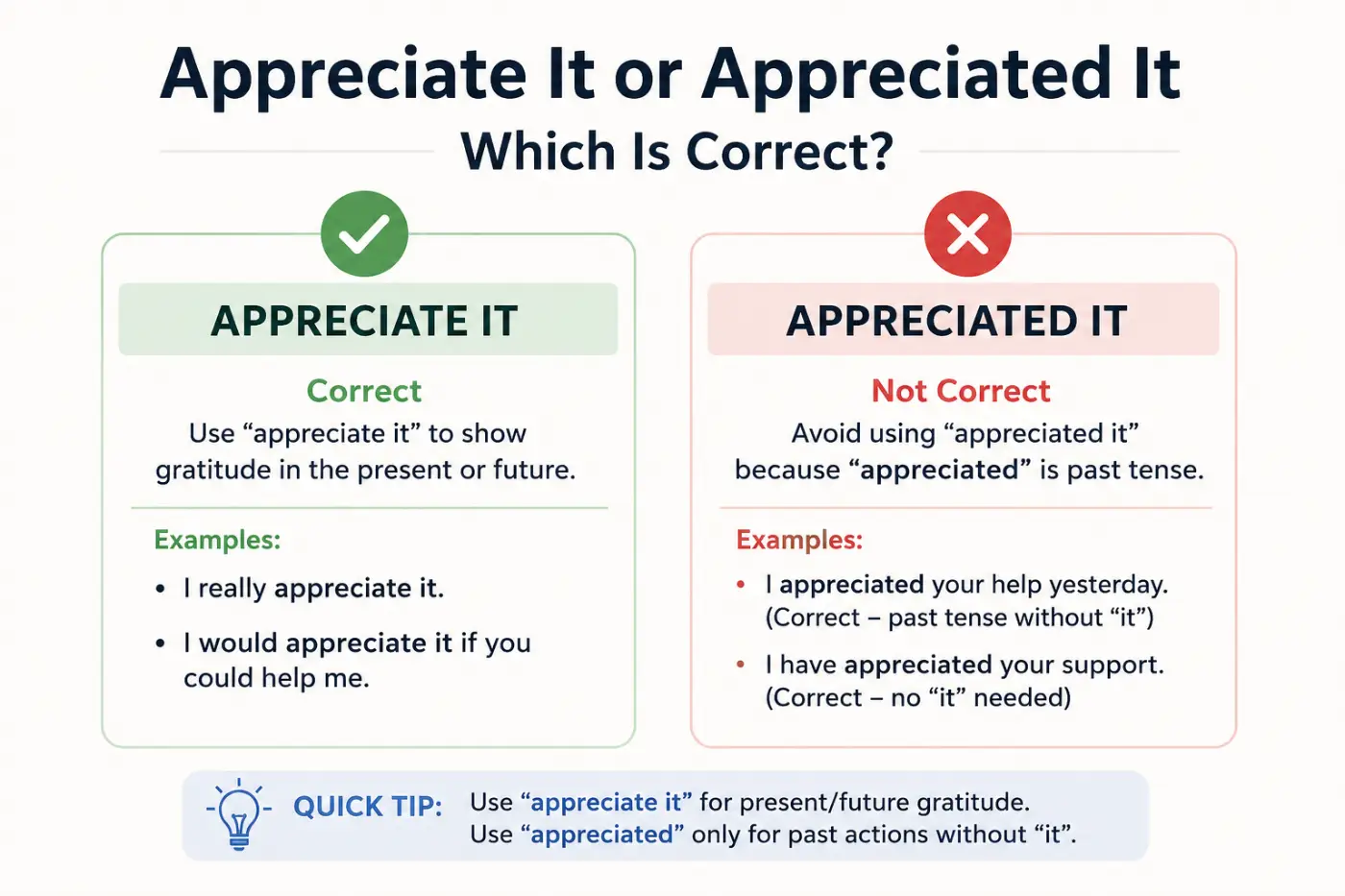
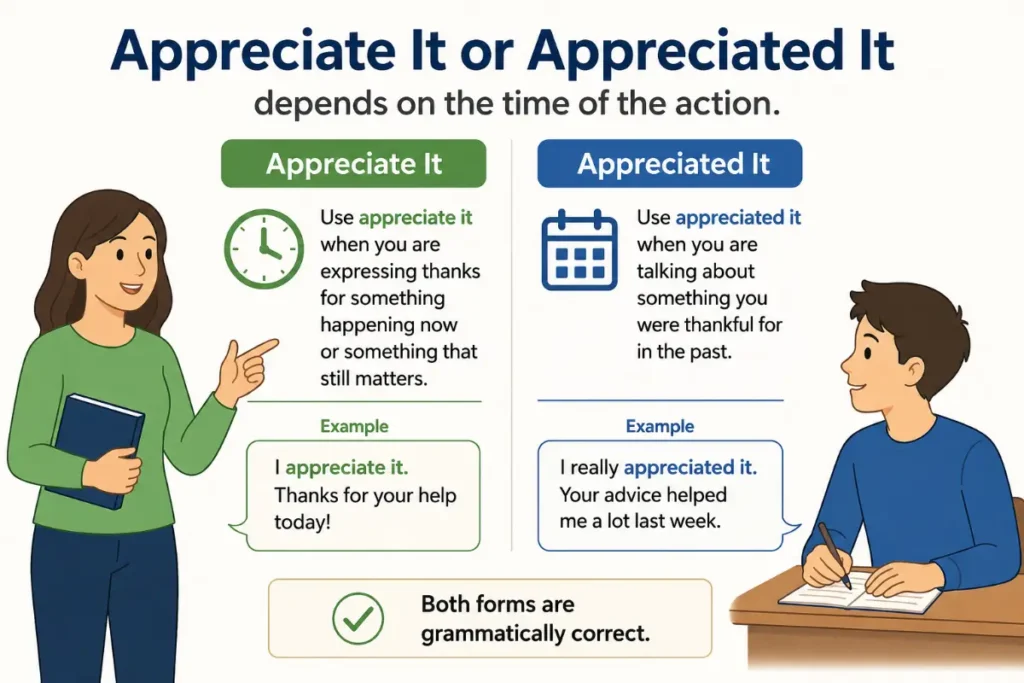
Choosing between Appreciate It or Appreciated It can be confusing when you want to thank someone. Both expressions are correct, but they refer to different times. Use appreciate it when you feel thankful in the present. Use appreciated it when you are talking about gratitude you felt in the past. The right choice depends on when the action or favor happened and when you are expressing your thanks.
For example, if someone sends you a helpful document today, you can say, I appreciate it. If you are talking about help someone gave you yesterday, you can say, I appreciated it. You may also hear I would appreciate it when someone makes a polite request, such as asking for a reply or a favor.
These expressions appear often in text messages, emails, workplace conversations, and everyday speech. Understanding their tense and meaning will help you sound polite without making your sentences awkward. You will also learn how to use them with different subjects, how to avoid common grammar mistakes, and which alternatives work best in formal and informal situations.
You may also want to read halfday or half-day: Correct Spelling and Usage.
Quick Answer
Both expressions are grammatically correct. Use appreciate it to express gratitude in the present or for something you are receiving now. Use appreciated it to describe gratitude you felt in the past. For example, I appreciate your help means you are thankful now, while I appreciated your help refers to a past situation.
Comparison Table
| Feature | Appreciate It | Appreciated It |
|---|---|---|
| Main meaning | Feel thankful for something | Felt thankful for something |
| Verb tense | Simple present | Simple past |
| Part of speech | Verb phrase | Verb phrase |
| Time reference | Present or general | Past |
| Typical use | Current thanks or ongoing gratitude | Gratitude for a completed event |
| Tone | Natural and polite | Natural and reflective |
| Common contexts | Texts, emails, conversations, requests | Thank you messages, past events, follow up emails |
| Example | I appreciate your support. | I appreciated your support. |
Meaning and Definition
What Does Appreciate It Mean?
Appreciate it is a phrase that expresses gratitude, recognition, or thankfulness for something someone has done or provided. The verb appreciate is in the simple present tense, and it tells the other person that you feel thankful now or generally value their help.
The word it acts as the object of the verb. It refers to something already mentioned or understood from the situation. That thing could be a favor, a gift, a kind message, advice, support, or someone’s time.
For example, if a coworker helps you finish a report, you can say, I appreciate it. The word it refers to the coworker’s help. You are telling the person that their effort matters to you.
This expression can also refer to something that is not a favor. You might say, I appreciate the opportunity, I appreciate your honesty, or I appreciate how carefully you handled the problem. In each case, you recognize the value of something.
Common uses include:
- I appreciate it.
- I really appreciate your help.
- I appreciate your time.
- I appreciate the support.
- I appreciate your understanding.
- I appreciate everything you have done.
The expression is common in both spoken and written English. It works in friendly conversations, professional emails, customer service messages, and formal communication.
What Does Appreciated It Mean?
Appreciated it is the simple past form of appreciate followed by the object it. It describes gratitude or recognition that existed at an earlier time.
For example, if a friend helped you move last weekend, you can say, I appreciated it. You are looking back at the help and explaining that you felt thankful for it.
The past tense does not mean the gratitude must have ended. You may still feel thankful today. The verb simply places the act of appreciation in the past. If you want to make your current gratitude clear, you can say, I still appreciate it.
Consider these examples:
- I appreciated your advice yesterday.
- We appreciated your support during the event.
- She appreciated the extra time you gave her.
- I really appreciated your kind message.
- They appreciated everything the volunteers did.
This form is useful when you describe a completed event, thank someone after receiving help, or reflect on a past experience.
What Does I Would Appreciate It Mean?
I would appreciate it is a polite expression used to make a request. It often introduces something you would be thankful for if another person did it.
For example, I would appreciate it if you could send me the report by Friday. You are asking the other person to send the report, but the conditional wording makes the request sound considerate.
This structure is common in professional emails and formal communication. It can sound warmer than a direct command, such as Send me the report by Friday.
You can also use it in everyday conversation:
- I would appreciate it if you could call me later.
- I would appreciate it if you kept this information private.
- I would appreciate a quick response.
- I would really appreciate your help.
Notice that would appreciate does not mean the same thing as appreciated. It expresses a possible or expected feeling of gratitude connected to a request, not necessarily gratitude for a past action.
Key Differences Explained
1. Present Tense Versus Past Tense
The main difference is verb tense. Appreciate is the present form, while appreciated is the past form.
Use appreciate when you want to express gratitude now or describe something you generally value. Use appreciated when you refer to gratitude connected to an earlier event.
Compare these examples:
- I appreciate your help with this project.
- I appreciated your help with last month’s project.
The first sentence describes current gratitude for help with an ongoing project. The second refers to help given during a completed project in the past.
2. Current Gratitude Versus Past Gratitude
The present form is useful when someone has just helped you or is helping you now. You can use it immediately after receiving a favor, advice, or support.
The past form is useful when you look back on something that happened earlier. For example, I appreciated your patience during the interview describes how thankful you were for someone’s patience at that time.
However, past tense does not always mean that your feelings have disappeared. You can still be grateful today while describing a past experience. The tense simply shows the time frame of the statement.
3. Grammar and Sentence Structure
Both expressions follow the same basic structure:
Subject + verb + object.
In the present, you say:
- I appreciate it.
- We appreciate your support.
- They appreciate your kindness.
In the past, you say:
- I appreciated it.
- We appreciated your support.
- They appreciated your kindness.
The word it is a pronoun that receives the action of the verb. You can replace it with a noun phrase when you want to identify the specific thing you value.
For example, I appreciate your patience is more specific than I appreciate it. Both are correct, but the longer version makes the meaning clearer when the context is not obvious.
4. Formality and Tone
Both forms are polite and suitable for professional communication. The present form often sounds immediate and direct, while the past form sounds reflective.
For example, I appreciate your quick response is a natural way to thank someone in a current email. I appreciated your quick response is appropriate when discussing a response you received earlier.
Neither expression is automatically more formal than the other. The surrounding words and the situation determine the tone. Adding really, sincerely, or greatly can change the strength of the message.
5. Context and Timing
The timing of the event helps you select the right tense.
Use appreciate when:
- Someone is helping you now.
- You want to thank someone for a current favor.
- You are expressing general gratitude.
- You want to recognize ongoing support.
- You are making a polite request with would appreciate.
Use appreciated when:
- You are describing a completed favor.
- You are discussing a past event.
- You are writing about help you received earlier.
- You are reflecting on someone’s kindness.
- You are describing how someone felt at a previous time.
6. Pronunciation
The present form appreciate is commonly pronounced /əˈpriːʃieɪt/ in American English. The past form appreciated is pronounced /əˈpriːʃieɪtɪd/.
The past form has an additional syllable because of the ending ed. The spelling changes by adding ed, but the pronunciation of the original verb remains recognizable.
7. Regional Usage
Both expressions are standard in American, British, Canadian, and Australian English. There is no meaningful regional spelling difference between the present and past forms.
The same tense rule applies across these varieties. Speakers use appreciate for present gratitude and appreciated for gratitude connected to a past situation. Differences may appear in personal style or preferred expressions of thanks, but not in the basic grammar.
Which Form Is Correct?
Both forms are correct. The right choice depends on the time you want to express.
Use appreciate it when you are thankful now. Use appreciated it when you are describing gratitude you felt in the past. The verb appreciate is regular, so its simple past form is made by adding ed.
Here are examples that show the distinction:
- Correct: I appreciate your help today.
- Correct: I appreciated your help yesterday.
- Correct: We appreciate your continued support.
- Correct: We appreciated your support during the event.
- Correct: I would appreciate it if you could reply soon.
A common mistake is choosing the past form just because the favor has already happened. That is not always necessary. If someone helped you a few minutes ago and you are thanking them now, I appreciate it is perfectly natural.
For example, if a colleague sends you a file, you can reply, I appreciate it. The action of sending the file may be complete, but your gratitude is being expressed in the present.
Likewise, you can use the past form even if you still feel thankful. If you say, I appreciated your help during the meeting, you are describing your reaction to a past event. You could add, and I still appreciate your support, to show that your gratitude continues.
Sentence Examples
Ten Natural Examples Using Appreciate It
- Everyday conversation: I appreciate it when you take the time to listen.
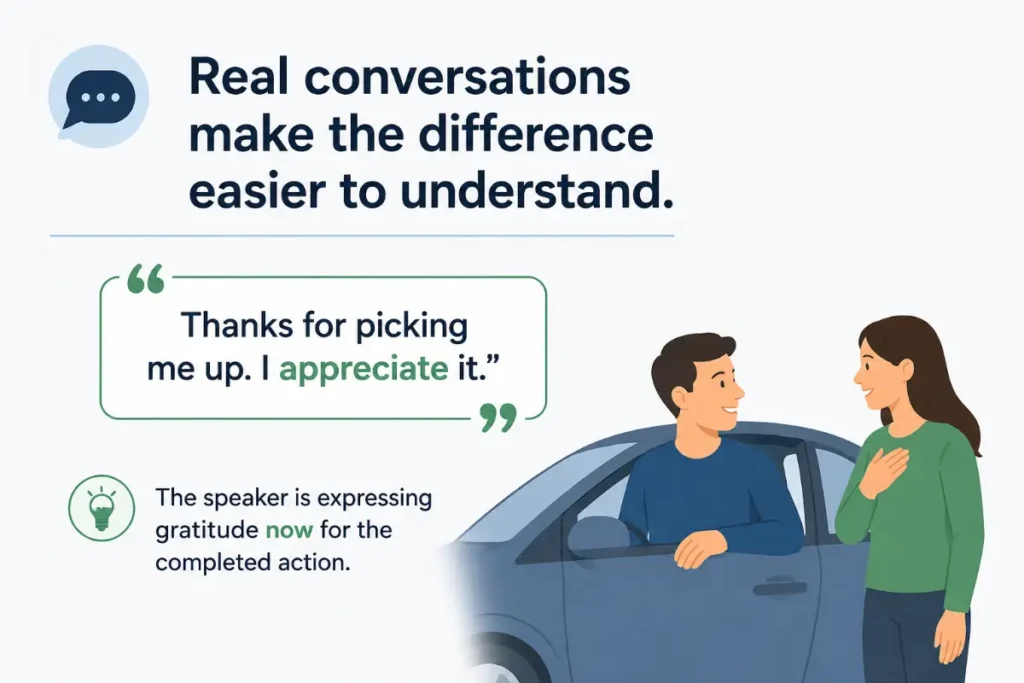
- Text message: Thanks for picking me up. I really appreciate it.
- Workplace communication: I appreciate your help with the presentation.
- School: I appreciate the extra explanation because it helped me understand the lesson.
- Academic communication: I appreciate the feedback provided by the review team.
- Formal writing: We appreciate your continued interest in our organization.
- Social situations: I appreciate you inviting me to dinner.
- Online communication: Thanks for sharing this useful information. I appreciate it.
- Customer service: We appreciate your patience while we resolve the issue.
- Family conversation: I appreciate everything you do for our family.
These examples show that the present form can express gratitude for a recent action, an ongoing effort, or something you value in general. It also works well when you want to acknowledge a person’s kindness without writing a long thank you message.
Five Natural Examples Using Appreciated It
- Everyday conversation: I appreciated it when you checked on me last week.
- Text message: I appreciated your help yesterday. Thanks again.
- Workplace communication: We appreciated your flexibility during the schedule change.
- School: The students appreciated the extra time the teacher gave them.
- Formal writing: The committee appreciated the careful work completed by the volunteers.
The past form is useful when the situation you are discussing has already happened. It can describe your own gratitude or the gratitude of another person or group.
Examples With Would Appreciate It
The expression would appreciate it deserves special attention because it is often used in polite requests.
- I would appreciate it if you could send the details today.
- We would appreciate it if you arrived a few minutes early.
- I would really appreciate it if you kept me updated.
- The team would appreciate it if you shared your feedback.
- I would appreciate it if you could review the document before the meeting.
These sentences do not describe gratitude for something already completed. They express a polite expectation of gratitude if the requested action happens.
Common Mistakes and Grammar Problems
The most common problems involve tense, sentence structure, and the use of the word it. Understanding the basic patterns can help you avoid these errors.
1. Using the Past Form for Present Gratitude
Awkward: I appreciated it. Thank you for helping me right now.
More natural: I appreciate it. Thank you for helping me.
The past form is not always wrong, but it can sound as if you are referring to a previous event. If you are thanking someone for help they have just given you, the present form is usually more direct.
2. Using the Present Form When Describing a Completed Past Experience
Incorrect for a simple past narrative: I appreciate your help during yesterday’s event.
Better: I appreciated your help during yesterday’s event.
The first sentence may still work if you mean that your gratitude continues now. However, if you are simply describing how you felt during a completed event, the past form fits more clearly.
3. Confusing Appreciate With Appreciated in a Polite Request
Incorrect: I appreciated it if you could send the file today.
Correct: I would appreciate it if you could send the file today.
A polite request commonly uses would appreciate. The past form appreciated does not normally introduce this kind of request by itself. Adding would gives the sentence the correct conditional meaning.
4. Leaving Out It in a Common Request Pattern
Awkward: I would appreciate if you could call me.
Better: I would appreciate it if you could call me.
In this common structure, it acts as a placeholder object before the if clause. Including it makes the sentence complete and natural in standard formal English.
5. Using Appreciate With the Wrong Verb Form
Incorrect: I am appreciate your help.
Correct: I appreciate your help.
Appreciate is a main verb in the simple present, so it does not need am before it. You can use am with the ing form in a different structure: I am appreciating your support more each day. However, the simple form is more natural for ordinary expressions of thanks.
6. Confusing Appreciate With Thank
Awkward: I appreciate you for your help.
More natural: I appreciate your help.
Also correct: I thank you for your help.
The verb appreciate can take a person as its object in some contexts, but the expression appreciate someone for something may sound less natural in many everyday sentences. Naming the action or quality directly often makes the sentence clearer.
7. Using an Unclear Pronoun
Unclear: I appreciate it.
Clearer: I appreciate your time and effort.
The short expression is fine when the other person knows what it refers to. In a new email or message, naming the favor or action can prevent confusion. A clear object also makes your gratitude feel more personal.
Pronunciation Guide
How Do You Pronounce Appreciate?
The American English pronunciation of appreciate is /əˈpriːʃieɪt/. It has four syllables: uh, PREE, shee, ayt. The main stress falls on the second syllable.
A simple pronunciation guide is uh PREE shee ayt. The word begins with a soft unstressed sound, followed by the stressed long ee sound. The ending sounds like ayt.
Some speakers pronounce the middle sounds slightly differently depending on their accent. These variations are normal as long as the word remains clear.
How Do You Pronounce Appreciated?
The American English pronunciation of appreciated is /əˈpriːʃieɪtɪd/. It usually has five syllables: uh, PREE, shee, ayt, id.
The ending ed is pronounced as an extra syllable because the verb ends in a /t/ sound. This follows a common English pronunciation rule for regular past tense verbs. The same pattern appears in words such as wanted and needed.
Common Pronunciation Mistakes
- Leaving out the final syllable in appreciated.
- Placing the main stress on the wrong syllable.
- Pronouncing the ending ed as a separate syllable in appreciate.
- Making the middle vowel sounds too short or unclear.
Practice the two forms slowly, then use them in complete sentences. For example, say I appreciate your help and I appreciated your help yesterday. This helps you connect pronunciation with tense and meaning.
Learn the difference in Wholey Vs Wholly Which Spelling Is Correct in 2026?.
Etymology and Word Origin
The verb appreciate entered English through French and is connected to the Latin word appretiare, meaning to set a price or value on something. The Latin root combines ad, meaning toward, with pretium, meaning price or value.
Over time, the meaning developed beyond financial value. The verb came to describe recognizing the worth, quality, or importance of something. It also developed the familiar sense of being thankful for a person’s help or kindness.
The modern forms appreciate and appreciated follow regular English verb patterns. The present form uses the base verb, while the simple past adds ed. This is why appreciated is not a separate word with an unrelated meaning. It is simply the past tense of appreciate.
Understanding the word’s history can help explain why appreciation includes both recognition of value and gratitude. When you appreciate someone’s help, you recognize that the help matters to you.
Regional Usage
American English
In the United States, appreciate it is a common way to express thanks. You may hear it in conversations, text messages, customer service exchanges, and workplace emails.
Appreciated it is also standard. It appears when people talk about past help, support, or kindness. For example, I appreciated your advice during the interview describes gratitude connected to an earlier event.
The expression would appreciate it is especially common in polite professional requests. It can soften a request without making the message unclear.
British English
British English follows the same tense distinction. Speakers use appreciate it for present gratitude and appreciated it when referring to a past situation.
There is no different British spelling for these forms. Expressions such as I appreciate your help and I appreciated your support are standard in both British and American English.
Australian English
Australian English also uses the same grammatical patterns. Appreciate it is common in everyday conversation, while appreciated it describes gratitude for something that happened earlier.
The choice depends on the time being discussed, not on a special Australian rule.
Canadian English
Canadian English follows the same usage. Both forms are standard, and the present and past tense distinction remains unchanged.
In professional communication, Canadians may use I appreciate your assistance or We appreciated your cooperation. Both expressions are natural when the tense matches the situation.
Grammar Rules and Part of Speech
Appreciate is a verb. In the phrase appreciate it, the verb is in the simple present tense and it is the object pronoun. In appreciated it, the verb is in the simple past tense, while it remains the object pronoun.
Subject Agreement
In the simple present tense, the verb changes slightly depending on the subject.
| Subject | Correct Form | Example |
|---|---|---|
| I | appreciate | I appreciate your help. |
| You | appreciate | You appreciate honest feedback. |
| We | appreciate | We appreciate your support. |
| They | appreciate | They appreciate your kindness. |
| He | appreciates | He appreciates your advice. |
| She | appreciates | She appreciates the opportunity. |
| It | appreciates | The company appreciates your patience. |
The third person singular uses appreciates. Do not write she appreciate or he appreciate in a standard present tense statement.
Past Tense Agreement
The past form appreciated does not change according to the subject.
- I appreciated your help.
- You appreciated the advice.
- We appreciated the invitation.
- They appreciated the extra time.
- She appreciated the support.
The same form works with singular and plural subjects. This makes the past tense pattern easy to remember.
Using Appreciate With Nouns
You can place a noun or noun phrase after the verb to identify what you value.
Examples:
- I appreciate your honesty.
- We appreciate the opportunity.
- They appreciate your patience.
- She appreciates the effort.
- He appreciated the advice.
These structures often sound more specific than using it. Choose a clear noun when the reader might not know what the pronoun refers to.
Using Appreciate With Gerunds
The verb appreciate can also be followed by a gerund, which is the ing form of another verb.
Examples:
- I appreciate you helping me.
- We appreciate having extra time.
- She appreciated being included.
- They appreciate working with the team.
In these sentences, helping, having, being, and working function as gerunds. Do not use the infinitive form after appreciate in the same pattern. Write I appreciate your helping me or I appreciate you helping me, not I appreciate you to help me.
Using Appreciate With Would
Would appreciate is a common pattern for polite requests.
Examples:
- I would appreciate your response.
- We would appreciate your feedback.
- I would appreciate it if you could wait.
- The manager would appreciate it if everyone arrived on time.
The structure helps make a request sound courteous. It is useful in emails and formal messages, but you should avoid adding it to every request. Sometimes a simple please is clearer.
Punctuation and Sentence Position
The verb can appear at the beginning of a sentence after the subject, as in I appreciate your help. It can also appear in a longer clause, as in We appreciate your patience while the issue is being resolved.
No special punctuation is needed around the phrase. Use a comma only when normal sentence structure calls for one. For example, Thanks for your help. I appreciate it. contains two separate sentences, so a period is appropriate.
Real Life Usage Examples
Daily Conversation
In daily conversation, the present form is common when someone does something kind or helpful. The past form appears when you talk about a previous event.
- Thanks for waiting for me. I appreciate it.
- I appreciated it when you helped me carry those bags yesterday.
The first is an immediate expression of thanks. The second looks back on an earlier favor.
Email and Workplace Communication
In a professional email, the present form can acknowledge current support, while the past form can refer to completed work.
- I appreciate your quick response and the information you provided.
- We appreciated your flexibility during the recent schedule change.
The first sentence thanks someone for a current response. The second recognizes cooperation during an earlier event.
Academic Writing
Academic communication often uses these expressions to acknowledge feedback, support, or contributions.
- I appreciate the reviewers’ careful comments on the paper.
- The research team appreciated the assistance provided by the participants.
The first sentence expresses current gratitude. The second describes a past response to assistance.
News and Journalism
News articles may use the verb when reporting a person’s reaction to help or support.
- The mayor said she appreciated the volunteers’ work during the storm.
- The organization said it appreciates the public’s continued support.
The first reports a past expression of gratitude. The second describes ongoing appreciation.
Literature and Storytelling
In storytelling, the present form can express a character’s feelings, while the past form can describe a remembered act of kindness.
- I appreciate everything you have done for me, she said quietly.
- He appreciated the kindness of the stranger who had helped him find his way home.
These examples show how tense helps establish the time and point of view of a sentence.
Related and Confused Terms
These eight expressions are useful alternatives when you want to express gratitude or recognize someone’s effort.
1. Thank You
Thank you is the most direct and widely used expression of gratitude. It works in casual and formal situations. You can say thank you for your help or I appreciate your help. Both are polite, but the second places more emphasis on recognizing the value of the help.
2. Grateful
Grateful is an adjective that describes the feeling of being thankful. For example, I am grateful for your support. Unlike appreciate, which is a verb, grateful describes a state or feeling.
3. Appreciate Your Help
This expression is more specific than appreciate it because it names the action or support you value. It is useful in emails and professional messages where the reader may not know what it refers to.
4. Much Appreciated
Much appreciated is a shortened expression that means something is greatly valued or welcomed. For example, Your help is much appreciated. It is common in workplace messages, but a complete sentence may sound warmer in a personal conversation.
5. Thanks in Advance
Thanks in advance expresses gratitude before someone completes a requested action. It is often used in emails, but it can sometimes sound as if the other person has no choice. A more considerate option is I would appreciate your help with this.
6. Acknowledge
Acknowledge means to recognize or show that you have noticed something. You can acknowledge someone’s effort without necessarily expressing gratitude. For example, The manager acknowledged the team’s hard work. This does not always mean the manager thanked them.
7. Value
Value means to consider something important or useful. I value your advice emphasizes the importance you place on someone’s guidance. I appreciate your advice focuses more directly on gratitude or recognition.
8. Be Indebted
Be indebted to someone means to feel that you owe them for help or support. It is stronger than simply saying you appreciate it and may suggest a lasting sense of obligation. For everyday thanks, appreciate is usually more natural.
Expert Editor Insight
A careful editor checks the time reference before choosing the verb. Native speakers commonly use appreciate it as an immediate response to a favor and appreciated it when reflecting on past help. The confusion often comes from the fact that the favor may be complete even though the speaker is expressing gratitude now. Grammar tools can identify the verb form, but they may not understand the intended time reference. A useful editing tip is to look for time clues such as today, right now, yesterday, last week, and during the event. Then decide if the sentence describes current gratitude or a past feeling.
Key Takeaways
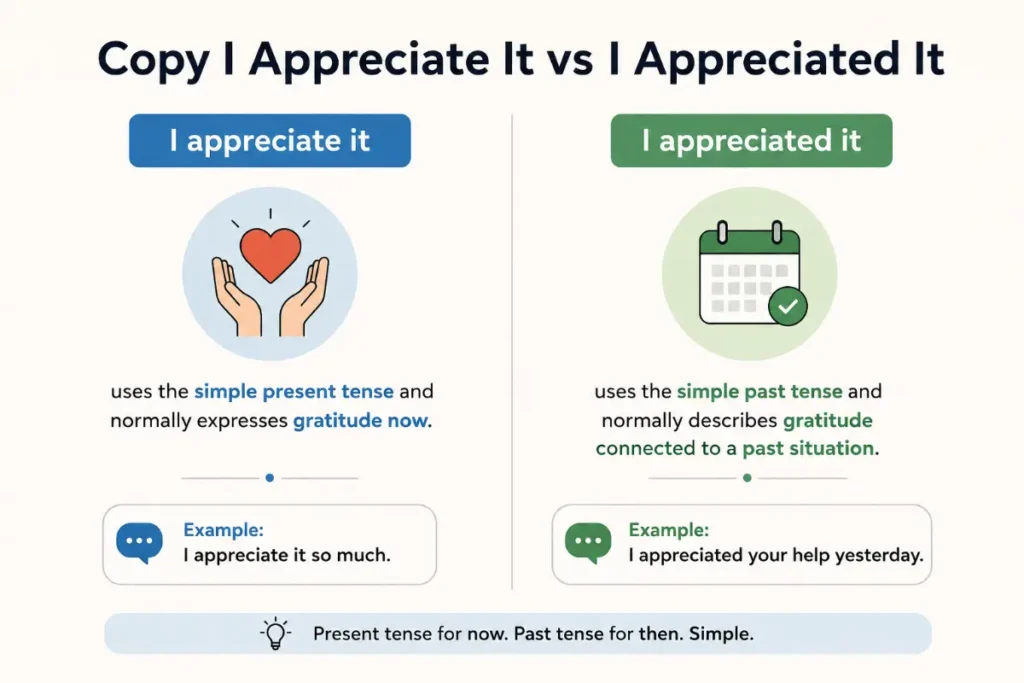
- I appreciate it uses the simple present tense and normally expresses gratitude now.
- I appreciated it uses the simple past tense and normally describes gratitude connected to a past situation.
- A past action does not automatically require appreciated. You can still say I appreciate it if you are expressing gratitude in the present.
- I’d appreciate it is commonly used to make polite requests.
- Context determines the most natural choice.
- The main distinction is the time perspective of the gratitude rather than only the time of the helpful action.
- In direct thank you messages, I appreciate it is usually the more natural choice.
- In stories about past experiences, I appreciated it often fits better.
- Appreciate can also mean understand, recognize, or value something.
- Learning the difference between present and past perspective will help you use both expressions naturally.
A related grammar guide is authorization or authorisation Correct Spelling And Usage.
Conclusion
Appreciate It or Appreciated It depends on the time of the gratitude you want to express. Use appreciate it when you are thankful now or recognize ongoing support. Use appreciated it when you describe gratitude connected to a past event. Both forms are correct, so the choice is about tense rather than spelling.
Remember this simple editing tip: check the time reference before choosing the verb. Words such as today and right now often point to the present, while yesterday and last week may point to the past. This small check helps keep your messages clear and natural.
FAQs
Is Appreciate It Grammatically Correct?
Yes. Appreciate it is grammatically correct when you want to express present gratitude or describe something you generally value. For example, I appreciate your help is a natural way to thank someone. The verb is in the simple present tense, and it is the object pronoun referring to the help, favor, or action being recognized.
Is Appreciated It Grammatically Correct?
Yes. Appreciated it is also grammatically correct. It uses the simple past form of appreciate to describe gratitude connected to an earlier situation. For example, I appreciated your help yesterday is correct because the sentence refers to a past event. The expression can describe a feeling from the past even if you remain thankful today.
Should I Say I Appreciate It or I Appreciated It?
Say I appreciate it when you are expressing gratitude now. Say I appreciated it when you are talking about a past situation. If someone has just helped you, I appreciate it sounds natural. If you are discussing help received last week, I appreciated it may be more suitable.
Can I Say I Would Appreciate It If?
Yes. I would appreciate it if is a standard and polite way to introduce a request. For example, I would appreciate it if you could send the document by Friday. The phrase expresses that you would feel thankful if the other person completed the requested action. It is common in professional emails and respectful everyday communication.
Is It Correct to Say I Appreciated It Yesterday?
Yes. The sentence is grammatically correct, but the context determines its exact meaning. You might say I appreciated it yesterday to describe your gratitude at that time. If you mean that someone helped you yesterday and you are thanking them now, I appreciate it is also natural.
What Is the Difference Between Appreciate It and Much Appreciated?
Appreciate it is a complete verb phrase, as in I appreciate it. Much appreciated is a shortened expression that means something is greatly valued or welcomed. You can say Your help is much appreciated in a formal message. In a personal conversation, I really appreciate your help may sound warmer and more direct.
Can I Use Appreciate It in a Formal Email?
Yes. Appreciate it is polite and suitable for professional emails. For example, I appreciate your time and consideration is a natural way to express gratitude. You can also use I would appreciate it if you could send the updated file. The second structure is useful for making a respectful request.
Why Do People Confuse Appreciate It and Appreciated It?
People confuse the two expressions because the favor may have happened in the past, but the gratitude is being expressed in the present. A completed action does not automatically require the past tense. If you are thanking someone now, the present form is often correct. If you are describing how you felt during an earlier event, use the past form.