
Have you ever stopped while writing because you were unsure which form to use: their vs there vs they’re? These three words sound exactly alike, but they have different meanings and grammatical jobs. The good news is that each one has a clear purpose, and a simple grammar check can help you choose the right form every time.
Use their to show that something belongs to people or things. The problem often appears in fast writing because your ears cannot tell the difference. You need to look at the meaning and structure of the sentence instead.
This distinction matters in text messages, school assignments, work emails, social media posts, and formal writing. A wrong choice can change the meaning of a sentence or make your writing look careless. Below, you will learn what each word means, how it works in a sentence, how to remember the difference, and how to avoid the mistakes that writers often make.
You may also want to read withdraw or withdrawal Meaning Difference And Usage.
Quick Answer
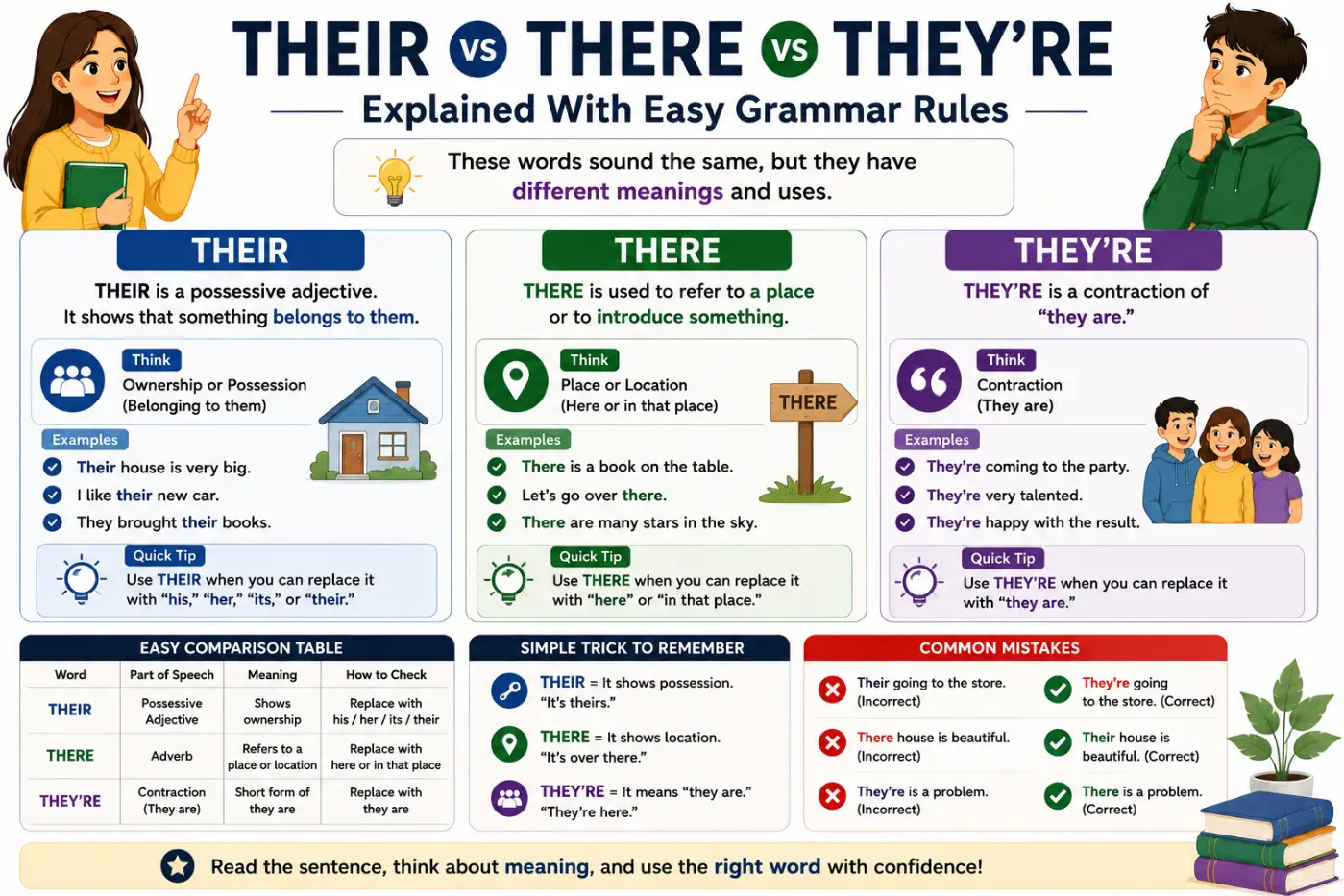
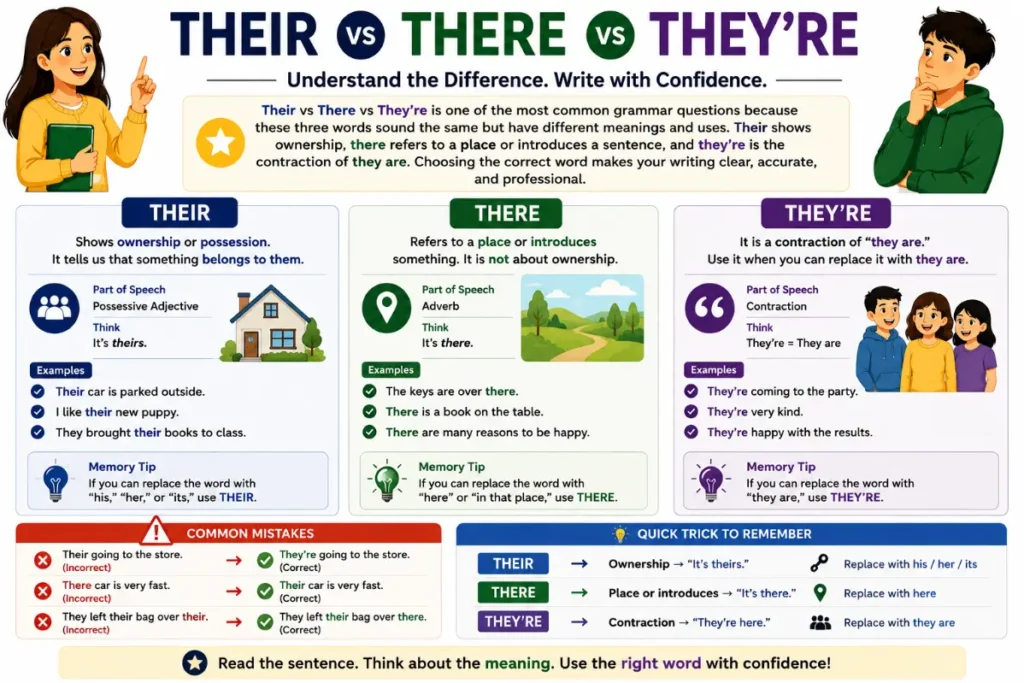
Their shows ownership, as in their house. There refers to a place or introduces a sentence, as in the book is over there or there are two books. They’re is a contraction of they are, as in they’re ready. All three are correct words, but they cannot be freely exchanged.
Comparison Table
| Word | Meaning | Part of Speech | Main Function | Common Context | Example |
|---|---|---|---|---|---|
| Their | Belonging to them | Possessive determiner | Shows ownership or association | People, groups, animals, organizations | Their car is outside. |
| There | In or at that place; used to introduce a sentence | Adverb, pronoun, or introductory word depending on use | Shows location or introduces existence | Places, directions, statements | The keys are over there. |
| They’re | Short form of they are | Contraction of pronoun and verb | Replaces they are | Descriptions, actions, states | They’re waiting for us. |
Meaning and Definition
What Does Their Mean?
Their is a possessive determiner. It shows that something belongs to, is connected with, or is associated with a group of people, animals, or things. It is the possessive form of they.
For example, in the sentence Their house has a blue door, the word their tells you that the house belongs to or is associated with them. You do not need to name every owner because the word already points to the people or group being discussed.
Here are some common examples:
- The students submitted their assignments.
- The children packed their bags.
- The company changed their opening hours.
- The dogs wagged their tails.
- Everyone should bring their own notebook.
Their normally appears before a noun or a noun phrase. You can write their books, their new teacher, their family home, or their decision. It helps connect an owner or group with something associated with them.
One useful point is that their can refer to a single person when the person’s gender is unknown, irrelevant, or when they use they as a personal pronoun. For example, Someone left their phone on the table is standard English. Here, their does not mean that several people own the phone. It refers to one person whose identity is unknown.
What Does There Mean?
There has several uses in English. Its most familiar meaning refers to a place or location. It tells the reader or listener where something is.
For example, in the sentence Your shoes are over there, the word there points to a location. It can also appear in expressions such as go there, stay there, put it there, and look over there.
There can also introduce a statement about the existence or presence of something. This is called the existential use of there.
Examples include:
- There is a problem with the printer.
- There are three messages in your inbox.
- There was a long line outside the store.
- There will be a meeting tomorrow.
- There seems to be a mistake in the report.
In these sentences, there does not identify a physical location. Instead, it helps introduce the fact that something exists, happens, or is present.
The word can also appear at the beginning of a sentence to attract attention or respond to someone. For example, There you go can mean that something has been handed over or completed. In There is your answer, it introduces the answer being pointed out.
What Does They’re Mean?
They’re is a contraction of they are. A contraction combines two words into a shorter form, usually by leaving out one or more letters and using an apostrophe to show the missing letters.
The apostrophe in they’re replaces the letter a in are. When you expand the contraction, they’re becomes they are.
Examples include:
- They’re coming to dinner.
- They’re very excited about the trip.
- I think they’re at school.
- They’re working on a new project.
- They’re ready for the meeting.
The word can describe a state, condition, location, or action. For example, They’re happy describes a state, while They’re running describes an action. They’re at home describes location, but it still means they are at home.
A simple way to check this word is to replace it with they are. If the sentence still makes sense and keeps the intended meaning, they’re is likely correct.
Are These Three Words Interchangeable?
No. They have different meanings and grammatical functions, even though they sound alike.
Compare these sentences:
- Their bags are near the door.
- Their bags are over there.
- They’re putting their bags over there.
This example shows why context matters. The words can even appear together in the same sentence, but each one performs a different job.
Key Differences Explained
1. Ownership Versus Location
The clearest difference is that their shows ownership or association, while there often points to a place.
Compare:
- Their classroom is on the second floor.
- The students are waiting there.
In the first sentence, their identifies the classroom associated with the students. In the second, there tells you where the students are waiting.
A helpful question is: Does the sentence show who owns or is connected with something, or does it tell you where something is? If it shows ownership, use their. If it points to a place, use there.
2. Possession Versus Contraction
Their and they’re may look similar, but their grammatical roles are different. Their comes before a noun to show ownership. They’re replaces they are.
Compare:
- Their teacher is friendly.
- They’re friendly.
In the first sentence, their describes the teacher as someone connected with a group. In the second, they’re means they are friendly.
Try expanding they’re into they are. If the expanded sentence works, the contraction is correct. If it does not, you may need their or another word.
3. Place Versus Existence
There can refer to a physical place, but it also introduces statements about existence.
For example:
- Your notebook is there.
- There is a notebook on the desk.
The first sentence identifies a location. The second tells you that a notebook exists or is present on the desk.
This second pattern is especially common in English. It appears with is, are, was, were, will be, and other forms of the verb be.
4. Grammar and Sentence Position
Their usually appears before a noun. There can appear at the beginning or end of a sentence, depending on its meaning. They’re normally appears where they are would fit.
Examples:
- Their parents live nearby.
- Put the package there.
- There are many reasons to study.
- They’re learning a new language.
Looking at the word that follows can help you identify the correct form. A noun after their often signals possession. A verb after they’re may be part of a verb phrase. The position of there depends on its role in the sentence.
5. Pronunciation
In most standard English accents, all three words are pronounced the same way: /ðer/ in many American pronunciation systems, with some variation in the vowel sound across accents.
Because they are homophones, listening alone usually cannot tell you which spelling is correct. You must use the sentence meaning and grammar to make the choice.
6. Formality and Context
All three forms are standard English and can appear in formal or informal writing. They’re is a contraction, so some formal documents may prefer they are. However, the contraction is not grammatically incorrect simply because it is shorter.
Their and there are not informal alternatives. They are necessary words with their own meanings. Choose the form that matches the sentence rather than assuming one is more professional than another.
7. Regional Usage
American, British, Canadian, and Australian English use the same spellings and basic grammatical distinctions. There is no regional spelling change that makes one form correct in one country and incorrect in another.
Accent differences may affect pronunciation slightly, but the meaning and grammar remain the same.
Which Form Is Correct?
All three forms are correct. The mistake happens when a writer uses one in place of another.
Here is a simple comparison:
| Incorrect Sentence | Correct Sentence | Reason |
|---|---|---|
| There going to the store. | They’re going to the store. | The sentence means they are going. |
| The students forgot they’re books. | The students forgot their books. | The sentence shows ownership. |
| Put your coat over their. | Put your coat over there. | The sentence refers to a location. |
| Their is a new student in class. | There is a new student in class. | The sentence introduces someone’s presence. |
| I think there ready. | I think they’re ready. | The sentence means they are ready. |
A reliable editing method is to check the meaning first, then test the grammar. Ask yourself three questions:
- Does the word show ownership? Choose their.
- Does it refer to a place or introduce the existence of something? Choose there.
- Can you replace it with they are? Choose they’re.
This method works in most sentences and helps you catch errors that spellcheck may miss.
Sentence Examples
The following examples show how the three forms work in everyday and professional writing.
Ten Natural Example Sentences
- Their children attend the same school as my brother.
- I left my phone over there beside the window.
- They’re planning a family trip for the summer.
- The employees finished their work before the deadline.
- There are several ways to solve this problem.
- I heard they’re opening a new restaurant downtown.
- The players forgot their uniforms at home.
- Your keys are right there on the kitchen counter.
- They’re studying for their final exams this week.
- The visitors said there was enough space for everyone.
These examples include ownership, physical location, existence, and the contraction of they are. Notice that two or even all three forms can appear in one sentence without confusion when each is used correctly.
More Examples in Different Situations
Everyday Conversation
- Their dog is very friendly, so you can pet it.
- I think they’re waiting for us outside.
In casual conversation, the correct form usually becomes clear from the meaning. Their identifies the dog’s owners, while they’re means the people are waiting.
Text Messages and Online Communication
- Your friends are already there.
- They’re asking if you can join them.
Short messages often encourage fast typing, which makes these words easy to mix up. Reading the sentence once before sending it can prevent many simple mistakes.
Workplace Communication
- Employees should bring their identification cards to the meeting.
- They’re reviewing the new schedule this afternoon.
The first example uses their to identify items associated with employees. The second uses the contraction to describe what the employees are doing.
School and Academic Writing
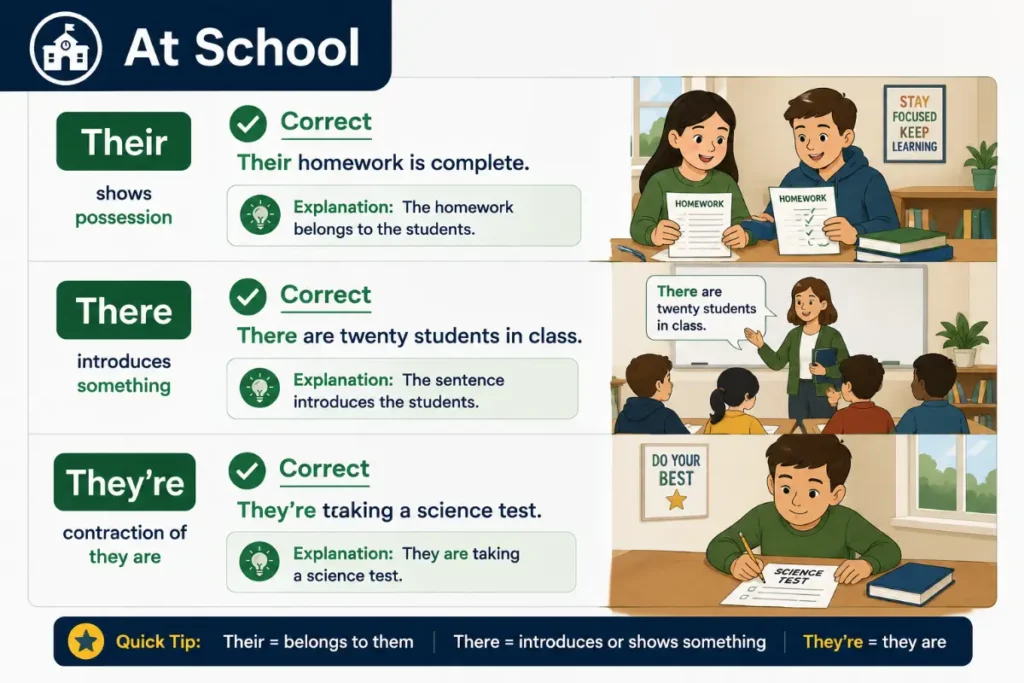
- Students should check their answers before submitting the test.
- There are several factors that may affect the results.
In academic writing, accuracy matters because a small word error can distract readers. The grammar remains the same, even in a research paper or formal assignment.
News and Journalism
- Residents said their homes were damaged during the storm.
- There are concerns about the effect of the new policy.
News writing often uses their to identify people and their belongings. It also uses there are to introduce events, facts, and concerns.
Literature and Storytelling
- They’re walking through the forest, hoping to find their way home.
- A small cottage stood there, hidden behind the trees.
These examples show how the words can help describe characters, possessions, actions, and settings. Their and there can provide details about the story, while they’re describes what the characters are doing.
Common Mistakes and How to Avoid Them
The most common errors happen because the three forms sound alike. Writers may type the first spelling that comes to mind without checking the sentence. Here are five mistakes to watch for.
1. Using There Instead of They’re
Incorrect: There going to visit their grandparents.
Correct: They’re going to visit their grandparents.
The sentence means they are going to visit. Since they’re is the contraction of they are, it is the correct choice. There cannot replace a subject and verb in this structure.
2. Using They’re Instead of Their
Incorrect: The children packed they’re lunch boxes.
Correct: The children packed their lunch boxes.
The sentence describes ownership or association. The lunch boxes belong to or are assigned to the children, so their is needed. They’re would expand to they are, creating the incorrect phrase the children packed they are lunch boxes.
3. Using Their Instead of There
Incorrect: Their is a good reason to wait.
Correct: There is a good reason to wait.
The sentence introduces the existence of a reason. It does not describe ownership, so their is not suitable. The phrase there is is a common structure used to say that something exists or is present.
4. Using There Instead of Their Before a Noun
Incorrect: The team celebrated there victory.
Correct: The team celebrated their victory.
The victory belongs to or is associated with the team. Their is the possessive determiner needed before the noun victory. There would suggest a location or introduce an existential statement, neither of which fits this sentence.
5. Using They’re When They Are Is Not Intended
Incorrect: They’re house is near the park.
Correct: Their house is near the park.
The incorrect version expands to they are house, which is not grammatical. Their is needed because the sentence identifies a house associated with a group of people.
Why Spellcheck May Not Catch These Errors
Spellcheck tools often recognize all three forms as correctly spelled words. If you write They’re going home, the software may accept it. If you write Their going home, the words are also spelled correctly, even though the sentence may not express your intended meaning.
This is a context error rather than a simple spelling error. A grammar checker may identify some cases, but it cannot always understand the writer’s intended meaning. Reading the sentence carefully is still the best way to catch the mistake.
Pronunciation Guide
How Do You Pronounce Their, There, and They’re?
In most American English accents, the three words share the same pronunciation, commonly represented as /ðer/. The first sound is the voiced dental fricative /ð/, like the sound at the beginning of the word this. The vowel is similar to the one in air, and the word ends with an r sound.
Each word has one syllable:
| Word | Common American IPA | Syllables | Simple Guide |
|---|---|---|---|
| Their | /ðer/ | 1 | thair |
| There | /ðer/ | 1 | thair |
| They’re | /ðer/ | 1 | thair |
The exact vowel may vary by accent. In some pronunciation systems, the transcription may use /ɛər/ or another symbol to represent the vowel quality. The important point is that the three spellings are generally homophones.
Why Pronunciation Does Not Help You Choose
Because the words sound alike, you cannot rely on speech alone to decide which spelling to use. You need to understand the meaning of the sentence.
For example, these sentences sound the same when spoken:
- Their friends are here.
- There friends are here.
- They’re friends are here.
Only the first sentence is correct if you mean that the friends belong to or are associated with them. The other two do not express that meaning correctly.
The best approach is to connect each spelling with its grammatical job rather than trying to hear a sound difference that usually does not exist.
A related grammar guide is Grate or Great Which Word Is Correct.
Etymology and Word Origin
The three words have different histories, which helps explain why modern English uses separate spellings for them.
Origin of Their
Their developed from Old Norse forms related to the third person plural pronoun. It entered Middle English and gradually became the standard possessive form used to show ownership or association with a group.
Its history reflects the influence of Old Norse on English, especially during the period of contact between English speakers and Scandinavian settlers. Today, it is used for plural groups and for singular people who use they as a pronoun.
Origin of There
There comes from Old English forms such as þær, which referred to a place or location. The word developed through Middle English and retained its basic spatial meaning. Over time, it also became common in existential expressions such as there is and there are.
This development explains why the word can point to a place in one sentence and introduce the existence of something in another.
Origin of They’re
They’re is a modern contraction of they are. The pronoun they has roots in Old Norse, while are comes from the English verb be and has a long history in the language. The apostrophe marks the omitted letter in the contraction.
The contraction became useful because spoken English often combines common words into shorter forms. It allows writers to represent natural speech in a concise way.
Regional Usage
American English
In the United States, all three spellings are standard. Their shows ownership, there refers to a place or introduces existence, and they’re means they are.
American speakers generally pronounce the three forms alike. The distinction is mainly visible in writing, so students and professional writers need to rely on grammar and context rather than pronunciation.
British English
British English follows the same spelling and grammar rules. Their, there, and they’re have the same basic meanings as in American English.
Some accents may pronounce the vowel differently, but the words remain homophones for many speakers. There is no special British spelling that changes the choice.
Australian English
Australian English uses all three forms in the same way. Their identifies ownership, there refers to a location or introduces existence, and they’re is the contraction of they are.
Pronunciation may vary across Australian accents, but the written distinction remains the same.
Canadian English
Canadian English also follows the same standard usage. Writers use their for possession, there for location or existence, and they’re for they are.
The main challenge is not regional spelling. It is recognizing the grammatical role each word plays in a sentence.
Grammar Rules and Part of Speech
Their as a Possessive Determiner
Their is a possessive determiner. It comes before a noun and shows that the noun is connected with a person or group represented by they.
Examples:
- Their house is near the river.
- The students brought their books.
- The company updated their website.
- Everyone should respect their neighbors.
Do not confuse their with theirs. Their comes before a noun, while theirs is a possessive pronoun that can stand alone.
Compare:
- Their car is new.
- The new car is theirs.
The first sentence uses their before the noun car. The second uses theirs without a noun after it.
There as an Adverb of Place
When there refers to a location, it functions as an adverb. It can tell the reader where something happens or where something is.
Examples:
- We will meet there tomorrow.
- Put the groceries over there.
- She left her bag there.
- The children are playing outside over there.
In these sentences, there answers the question where. It points to a place that the speaker or reader can identify from context.
There in Existential Sentences
There also appears in sentences that introduce the existence or presence of something. In these structures, it is often called an existential or introductory there.
Examples:
- There is a book on the table.
- There are two people outside.
- There was a problem with the order.
- There will be an announcement tomorrow.
The verb usually agrees with the noun phrase that follows it in standard written English. Use there is with a singular noun and there are with a plural noun.
Correct: There is a student in the room.
Correct: There are five students in the room.
They’re as a Contraction
They’re combines the subject pronoun they with the verb are. It can appear before an adjective, a present participle, a location phrase, or other expressions that follow are.
Examples:
- They’re excited.
- They’re studying.
- They’re at home.
- They’re ready for lunch.
The contraction can be expanded to they are in each sentence. This simple test helps confirm the correct spelling.
Punctuation and Apostrophe Use
The apostrophe in they’re marks missing letters. It does not show ownership. This is an important distinction because apostrophes often appear in possessive forms, but they’re is a contraction.
Compare:
- They’re waiting outside. This means they are waiting.
- Their bags are outside. This shows ownership or association.
Their does not need an apostrophe because it is already a possessive determiner. Adding one creates the incorrect form their’s.
Real Life Usage Examples
Daily Conversation
In everyday speech, the three forms sound alike, so listeners usually understand the meaning from context. In writing, you need to select the correct spelling.
- Their parents are coming to dinner.
- They’re already waiting over there.
The first sentence identifies the parents as connected with a group. The second says the people are waiting at a location.
Email and Workplace Communication
Professional messages often include instructions, updates, and descriptions of other people’s work. The correct form keeps the message clear.
- Please remind the team to bring their laptops to the training session.
- They’re reviewing the updated proposal before the meeting.
The first sentence identifies the laptops as items the team should bring. The second reports what the team is doing.
Academic Writing
School assignments and research papers require careful word choice. These forms often appear in sentences about students, researchers, results, and findings.
- Students should explain their reasoning in complete sentences.
- There are several possible explanations for the results.
The first sentence refers to reasoning associated with students. The second introduces the existence of several explanations.
News and Journalism
News reports use these words to describe people, places, events, and statements.
- Residents returned to their homes after the storm.
- There are concerns about the safety of the damaged bridge.
The first sentence shows ownership or association. The second introduces concerns that exist among the public or officials.
Literature and Storytelling
Writers use these forms to show relationships, describe settings, and report actions.
- They’re searching for their missing dog near the old bridge.
- A small wooden house stood there at the edge of the forest.
The first sentence describes what a group is doing and identifies the dog as associated with them. The second establishes the location of a house in the story.
Related and Confused Terms
Several other English words and forms can cause similar confusion. Understanding them can help you improve your grammar and avoid common writing errors.
1. Their and Theirs
Both forms show possession, but they do not work in exactly the same way. Their comes before a noun, as in their books. Theirs stands alone, as in the books are theirs.
Incorrect: The books are their.
Correct: The books are theirs.
2. There and Here
Both words can refer to locations. There points to a place away from the speaker or to a place already identified. Here refers to the speaker’s current location or a place being presented as close.
Example: Your coat is here, but your shoes are over there.
3. They’re and They Are
These two forms have the same meaning. They’re is simply the shorter contraction. Use they are in more formal situations when a style guide or document requires it, or when you want to place emphasis on are.
Example: They’re ready. They are ready.
4. Your and You’re
These words create a similar problem because they sound alike but have different grammatical roles. Your shows possession, as in your phone. You’re is a contraction of you are, as in you’re welcome.
A useful check is to expand you’re into you are. If the sentence still makes sense, the contraction is likely correct.
5. Its and It’s
Its shows possession or association, as in the dog wagged its tail. It’s is a contraction of it is or it has. The apostrophe marks missing letters rather than ownership.
Example: It’s raining, and the dog is looking for its bed.
6. Who’s and Whose
Who’s is a contraction of who is or who has. Whose is a possessive form used to ask or explain who something belongs to.
Example: Who’s coming to dinner? Whose jacket is this?
7. To, Too, and Two
These three words sound alike but have different meanings. To is commonly a preposition or part of an infinitive, too means also or excessively, and two is the number 2.
Example: I want to buy two books, and I want the notebook too.
8. Then and Than
Then usually refers to time, order, or a result. Than is used in comparisons.
Example: We ate dinner, then watched a movie. This movie is longer than the last one.
Expert Editor Insight
A careful editor checks the meaning of each word rather than relying only on spellcheck. These three forms are especially easy to confuse because they sound alike and are all correctly spelled words. Native speakers can also make typing mistakes, particularly in fast messages. A grammar tool may catch some errors, but it may not recognize the intended meaning in every sentence. An effective editing tip is to replace they’re with they are, check if their comes before a noun to show possession, and ask if there points to a place or introduces existence. This quick review catches most mistakes.
Key Takeaways
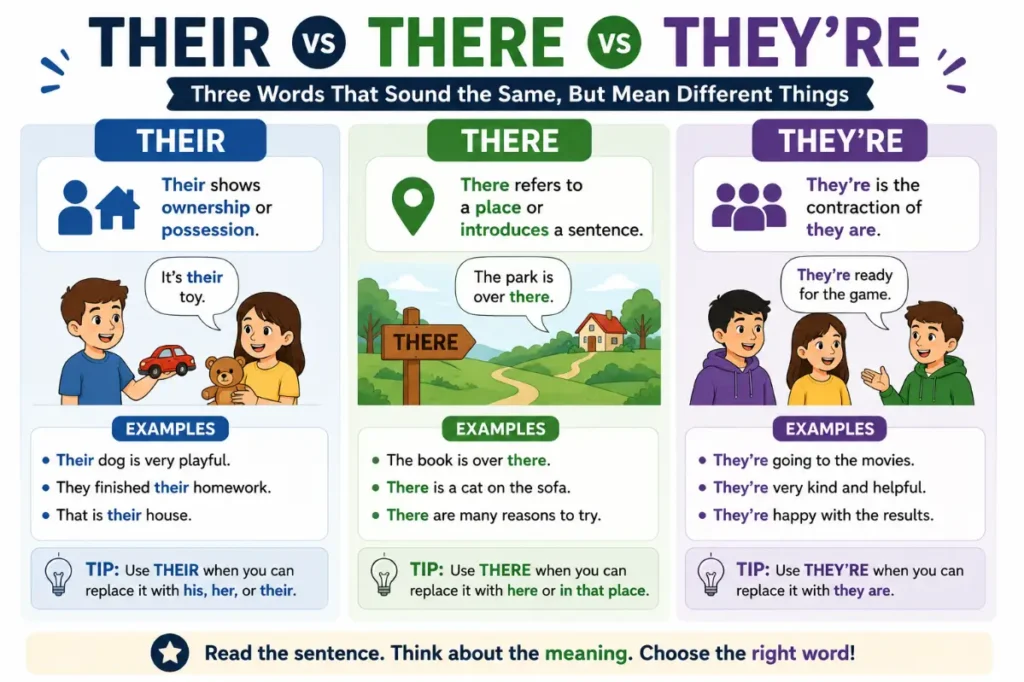
- Their shows ownership or possession.
- There refers to a place or introduces a sentence.
- They’re is the contraction of they are.
- All three words sound the same but have different meanings.
- The apostrophe in they’re replaces the missing letters in they are.
- Their is also commonly used with singular they in modern English.
- Reading your sentence carefully is the best way to catch mistakes.
- Understanding the function of each word makes choosing the correct spelling easy.
Learn the difference in Undecisive or Indecisive Which Is Correct.
Conclusion
The difference between Their vs There vs They’re becomes simple once you focus on meaning and grammar. Use their to show ownership, there to refer to a place or introduce existence, and they’re when you mean they are. All three are correct words, but they cannot replace one another.
Remember this quick editing trick: expand they’re into they are, check if their comes before a noun, and use there for location or existence. Since the words sound alike, do not rely on pronunciation alone. A quick check of the sentence will help you choose the right spelling and keep your writing clear.
FAQs
What Is the Difference Between Their, There, and They’re?
Their shows ownership or association, there refers to a place or introduces the existence of something, and they’re is short for they are. For example, their house shows ownership, the house is over there identifies a location, and they’re at home means they are at home. The correct form depends on the sentence’s meaning.
Is Their a Possessive Word?
Yes. Their is a possessive determiner that shows something belongs to or is associated with people or things represented by they. It appears before a noun, as in their car, their ideas, or their children. It can also refer to one person when their is used as a singular gender neutral pronoun.
Is There Only Used to Describe a Place?
No. There can refer to a physical location, as in put the box there, but it also introduces statements about existence. For example, there are three people outside tells you that three people are present. This use is common in spoken and written English and is often called existential there.
What Does They’re Mean?
They’re is a contraction of they are. The apostrophe shows that the letter a has been omitted. You can use it before an adjective, an action, or a location phrase. For example, they’re happy means they are happy, and they’re working means they are working. If replacing the word with they are works, they’re is likely correct.
Are Their, There, and They’re Pronounced the Same?
Yes. In most standard English accents, all three are homophones, meaning they have the same pronunciation but different spellings and meanings. Their, there, and they’re are commonly pronounced /ðer/ in American English, although the exact vowel sound can vary by accent. Because they sound alike, grammar and context must guide your spelling choice.
Can You Use Their for One Person?
Yes. Their can refer to one person when the person’s gender is unknown, irrelevant, or when that person uses they as a pronoun. For example, someone left their umbrella in the office is correct. This use of singular they and its related forms is standard in modern English.
Why Do People Confuse These Three Words?
People confuse them because they sound alike but have different meanings and grammatical functions. Fast typing makes the problem more common because writers may choose a spelling without checking the sentence. Spellcheck may not catch the error because each form is a valid word. Reading for meaning is the best way to identify the correct choice.
Which Form Should I Use in Formal Writing?
All three forms are appropriate in formal writing when used correctly. Use their for ownership, there for location or existence, and they’re when a contraction suits the style of the document. Some formal style guides prefer they are instead of contractions, but that does not make they’re grammatically wrong in every formal context.