
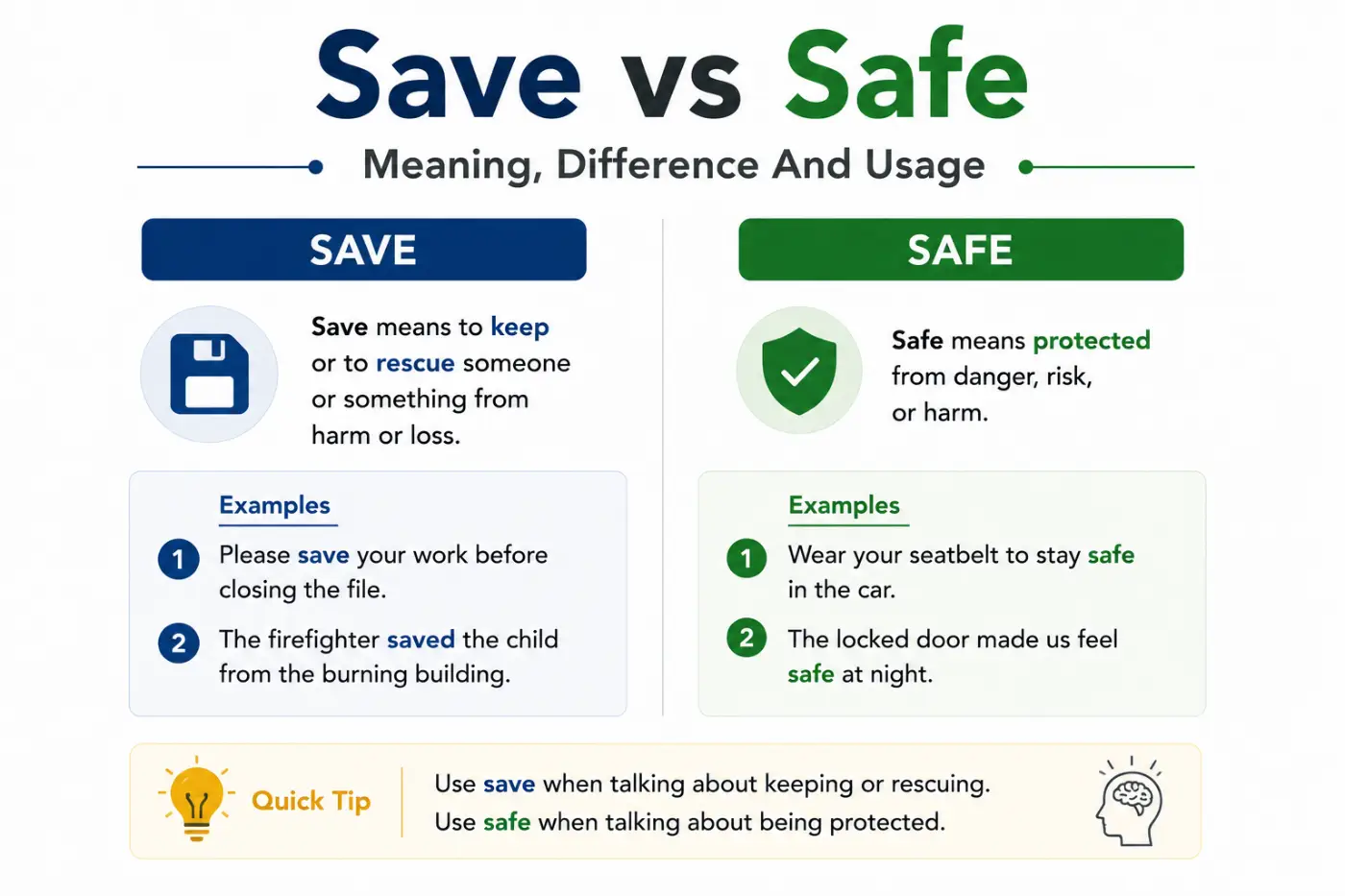
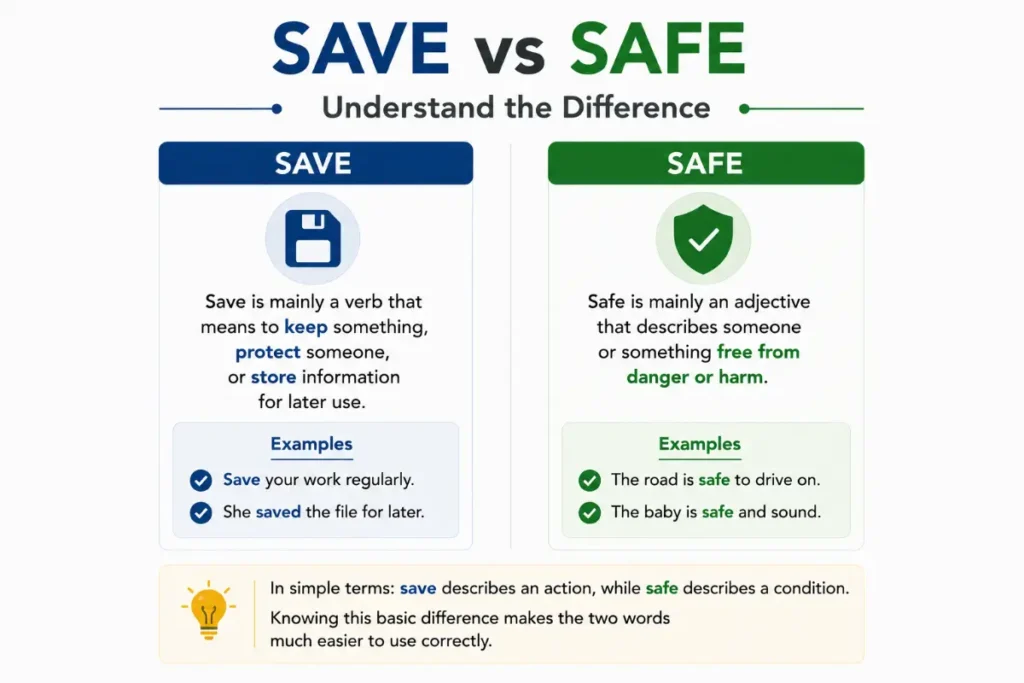
The words “save” and “safe” look almost identical, but they have different meanings and grammatical jobs. “Save” is usually a verb that means to protect something, keep it from being lost, or store it for later. “Safe” is usually an adjective that means free from danger, harm, or risk. The final letter changes both the sound and the meaning.
This difference matters in everyday writing. You save a document on your computer, but you keep your computer safe from damage. You save money for an emergency, but you want your money to be safe in a bank. Mixing up the two words can make a sentence confusing or grammatically incorrect.
The easiest way to remember the distinction is to connect “save” with an action and “safe” with a condition. Once you understand how each word works, you can choose the right one in emails, school assignments, text messages, reports, and everyday conversations. The examples and grammar tips below will help you use both words with confidence.
You may also want to read Headed vs Heading Meaning and Usage.
Quick Answer
“Save” is mainly a verb meaning to protect, rescue, preserve, or store something. “Safe” is mainly an adjective meaning protected from danger or harm. For example, you save a file to prevent losing it, and you keep the file safe by protecting it from damage or unauthorized access.
Comparison Table
| Feature | Save | Safe |
|---|---|---|
| Main meaning | To protect, rescue, preserve, or store | Free from danger, harm, or risk |
| Part of speech | Mainly a verb; also a noun in some contexts | Mainly an adjective; also a noun in some contexts |
| Pronunciation | /seɪv/ | /seɪf/ |
| Final sound | /v/, as in “very” | /f/, as in “fine” |
| Common phrases | Save money, save time, save a file, save a life | Safe place, safe choice, stay safe, safe environment |
| Main function | Describes an action or result | Describes a condition or quality |
| Common context | Technology, money, emergencies, conservation | Health, security, travel, personal protection |
| Example | Please save your work before closing the program. | Keep your password safe. |
Meaning and Definition
What Does Save Mean?
“Save” is a verb that means to keep something from being lost, wasted, damaged, or destroyed. It can also mean to rescue someone from danger, store information, or set something aside for future use.
The word appears in many parts of everyday life. You can save money for a vacation, save time by planning ahead, save a person from an accident, or save a document on your computer. Although these actions are different, they share a central idea: keeping something valuable or useful from being lost or wasted.
Here are the main meanings of the verb.
- Protect or rescue: A firefighter saved the family from the burning building.
- Keep for future use: I save a little money every month.
- Store digital information: Save the document before closing the application.
- Avoid wasting something: Taking the train can save time.
- Keep something available: Please save me a seat near the window.
- Prevent loss or failure: The final goal saved the team from defeat.
In computing, “save” is especially common. A save command stores changes so you can access them later. It may refer to saving a file, saving a password, saving a game, or saving changes to an online account.
What Does Safe Mean?
“Safe” is an adjective that describes someone or something protected from danger, injury, damage, or loss. If a place is safe, people can stay there without facing an unreasonable level of risk. If an object is safe to use, it is suitable for use without causing harm under the stated conditions.
For example, a child may be safe inside a locked home, a traveler may feel safe in a well lit area, and a product may be safe when used according to its instructions.
Common meanings include:
- Free from danger: The children are safe at home.
- Protected from harm: Wear a helmet to stay safe while cycling.
- Unlikely to cause injury: Check that the equipment is safe to use.
- Secure from theft or loss: Keep your passport in a safe place.
- Reliable or unlikely to fail: This is a safe choice for a first time buyer.
- Not likely to offend or cause trouble: The speaker chose a safe topic for the discussion.
“Safe” can also function as a noun. A safe is a strong, secure container used to protect valuables, cash, documents, or other important items. For example, “The hotel keeps important documents in a safe.”
It can also appear in familiar expressions such as “safe and sound,” which means unharmed and in good condition. Someone who returns home safely has reached home without being hurt or facing serious trouble.
Is Safe a Verb?
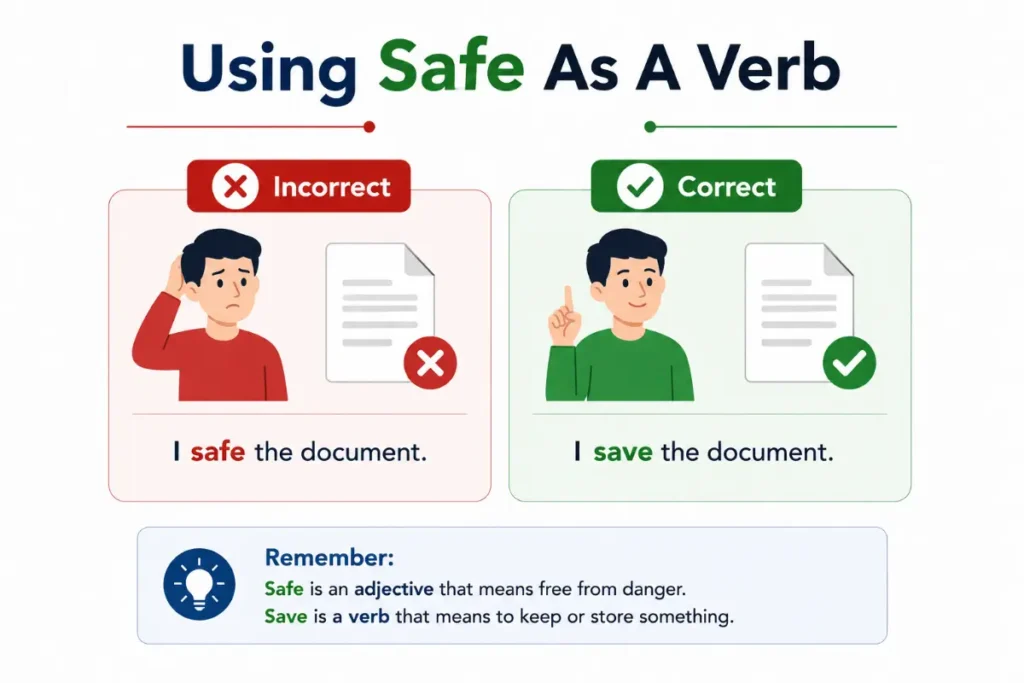
No. In standard modern English, “safe” is not normally used as a verb. The verb you need is “save.” For example, write “Save the file” rather than “Safe the file.”
The adjective describes a condition, while the verb describes an action. You can make someone safe by protecting them, but the action itself is to save or protect them.
Is Save an Adjective?
“Save” is not normally used as an adjective in standard everyday English. It is mainly a verb, although it can function as a noun in certain contexts. If you want to describe something as free from danger, use “safe.”
For example, “The children are safe” is correct. “The children are save” is incorrect in this meaning.
Key Differences Explained
1. Meaning
The most important difference is meaning. “Save” describes an action that protects, preserves, rescues, or stores something. “Safe” describes a condition in which someone or something is protected from danger or harm.
Compare these examples:
- The lifeguard saved the swimmer.
- The swimmer is now safe.
In the first sentence, the lifeguard performs an action. In the second, the adjective describes the swimmer’s condition after the rescue.
The same distinction works in technology. You save a document to preserve your work, then keep your device safe from damage or unauthorized access.
2. Part of Speech
“Save” is mainly a verb. It tells the reader what someone does or what action takes place. It can take an object, as in “save the file,” or appear without one, as in “I need to save.”
“Safe” is mainly an adjective. It describes a person, place, object, or situation. For example, “a safe road,” “a safe building,” and “a safe decision” all use the word to describe a quality.
The word can also be a noun when it refers to a secure storage container. Its grammatical role depends on the sentence.
3. Pronunciation
Both words have the same long a sound, represented by /eɪ/ in the International Phonetic Alphabet. The final consonant creates the difference.
“Save” ends with /v/, a voiced sound made by bringing the lower lip close to the upper teeth and using your voice. “Safe” ends with /f/, an unvoiced sound made with a similar mouth position but without vocal cord vibration.
The words are therefore not pronounced exactly alike. Listen for the final sound: “save” ends like “have,” while “safe” ends like “life.”
4. Grammar
The words do not normally fit in the same sentence positions. “Save” often follows a subject and expresses an action: “She saves money.” “Safe” usually follows a linking verb or appears before a noun: “She is safe” or “a safe neighborhood.”
Compare:
- The guard saved the visitors.
- The visitors are safe.
The first sentence needs a verb. The second needs an adjective after “are.”
5. Formality
Both words are standard in formal and informal English. Neither is a casual spelling of the other. You can use “save” in a formal report about financial planning or emergency response. You can use “safe” in safety instructions, workplace policies, academic writing, and everyday conversation.
The difference is grammatical and semantic, not a matter of formality. Choosing the correct word makes your sentence accurate regardless of the setting.
6. Common Contexts
“Save” often appears in contexts involving actions and resources:
- Saving money.
- Saving time.
- Saving energy.
- Saving lives.
- Saving computer files.
- Saving a seat.
“Safe” often appears in contexts involving protection and risk:
- Safe drinking water.
- A safe workplace.
- A safe journey.
- A safe distance.
- A safe password.
- A safe environment.
These common combinations can help you recognize the right word quickly.
7. Regional Usage
There is no major spelling difference between American and British English for these words. Both forms are standard in the United States, the United Kingdom, Canada, and Australia.
Pronunciation can vary by accent, but the distinction between the final /v/ and /f/ sounds remains useful across English varieties. The grammar and meanings are also consistent.
8. Standard and Nonstandard Usage
Both spellings are correct English words. The mistake occurs when a writer uses one in place of the other. “Safe your work” is not standard English when the intended meaning is to store a document. “Save your work” is correct.
Likewise, “I hope you are save” is incorrect when describing someone’s condition. The correct sentence is “I hope you are safe.”
Which Form Is Correct?
Both forms are correct words, but they cannot replace each other in every sentence. The right choice depends on the meaning and grammatical role you need. Use “save” for an action such as rescuing, preserving, storing, or keeping something for later. Use “safe” to describe someone or something that is protected from harm or danger.
The spelling difference comes down to the final consonant. The letter v represents the voiced sound in “save,” while f represents the unvoiced sound in “safe.” That small change creates two separate words with different meanings.
Consider these pairs:
| Incorrect Sentence | Correct Sentence | Reason |
|---|---|---|
| Please safe the document. | Please save the document. | You store a document by saving it. |
| The children are save. | The children are safe. | An adjective describes their condition. |
| I want to safe money. | I want to save money. | Saving money is an action. |
| Keep your account save. | Keep your account safe. | Safe describes the account’s security. |
| The doctor helped safe his life. | The doctor helped save his life. | Save means to rescue or protect. |
A useful way to check your sentence is to ask what you are trying to express. If you mean an action, you probably need the verb. If you are describing a condition or quality, you probably need the adjective.
Sentence Examples
The following examples show how each word works in natural American English.
Ten Examples Using Save
- Everyday conversation: I need to save some money before we plan our vacation.
- Text message: Please save me a seat if you get to the theater first.
- Work: Remember to save your changes before closing the spreadsheet.
- School: The teacher showed us how to save our assignments in the correct folder.
- Academic writing: The new method may save researchers several hours during data collection.
- Formal writing: The emergency team worked quickly to save the residents trapped inside the building.
- Social situations: I saved a place for you at the dinner table.
- Online communication: You can save this post to read it again later.
- Technology: The application saves your progress automatically.
- Environment: Turning off unused lights can save energy.
These examples show that the verb has several related uses. It can describe protecting a person, preserving a resource, keeping something for later, or storing information. The object of the verb helps readers understand which meaning applies.
Five Examples Using Safe
- Everyday conversation: Let me know when you get home safe.
- Text message: Have a safe trip, and call me when you arrive.
- Work: All employees must follow the safe handling instructions.
- School: The teacher checked that the playground was safe for the children.
- Technology: Use a strong password to keep your online account safe.
In these sentences, the adjective describes a person, journey, process, place, or account. It tells the reader that something is protected or not exposed to an unacceptable level of danger.
Examples Showing the Difference
Sometimes the clearest way to understand the two words is to use them in the same situation.
- The rescue team worked hard to save the hikers and bring them to a safe location.
- I saved the file in a safe folder so I would not lose it.
- The company wants to save money while keeping its employees safe.
- The driver helped save the passengers, who were later confirmed to be safe.
- We saved enough money to move into a safe neighborhood.
Notice the different jobs each word performs. The verb describes what someone does, while the adjective describes the condition or quality of a person or thing.
Common Mistakes and Misspellings
The most common error is choosing the wrong final letter. Since the words look and sound similar, writers sometimes type one when they mean the other. These mistakes are easy to correct once you recognize the grammar of the sentence.
1. Writing Safe Instead of Save
Incorrect: I need to safe my work before the computer shuts down.
Correct: I need to save my work before the computer shuts down.
The sentence describes storing information so it will not be lost. That is an action, so the verb “save” is necessary. The adjective “safe” cannot perform that grammatical job.
2. Writing Save Instead of Safe
Incorrect: The children are save inside the house.
Correct: The children are safe inside the house.
The sentence describes the children’s condition. The linking verb “are” needs an adjective that tells us how the children are. “Safe” provides that description.
3. Confusing Save With Safety
Incorrect: The workers must follow the save rules.
Correct: The workers must follow the safety rules.
“Safety” is a noun that refers to protection from danger or harm. “Save” is a verb, so it does not normally work as an adjective before “rules.” Use “safety rules” for rules designed to prevent accidents or injury.
4. Using Safe as a Verb in Technology
Incorrect: Safe the changes before leaving the page.
Correct: Save the changes before leaving the page.
Computer programs use the command “Save” to store changes. The instruction tells the user to perform an action, so it requires a verb. This error is especially common when someone types quickly or relies on the similar sound of the two words.
5. Confusing Saved With Safe
Incorrect: The passengers were saved after the accident, and everyone was safe from injury.
Better: The passengers were rescued after the accident, and everyone was safe from injury.
The original sentence is not necessarily grammatically wrong, but the meaning can be unclear if the writer uses the words without considering their roles. “Saved” describes the rescue, while “safe” describes the passengers’ condition. A more precise sentence may use “rescued” for the action and “safe” for the result.
A Simple Memory Trick
Think of the final letters:
- Save ends in V. Connect the V with a verb. You save something.
- Safe ends in F and E. Connect it with a feeling of protection. You feel safe when you are free from danger.
You can also remember the sentence: “Save your work and keep your work safe.” The two words appear together, making their different meanings easier to recall.
Pronunciation Guide
How Do You Pronounce Save?
The American English pronunciation of “save” is /seɪv/. It has one syllable and rhymes with “gave,” “wave,” and “brave.” The vowel sound is the long a sound heard in words such as “day” and “make.”
To pronounce it, begin with the /s/ sound, move into the long a vowel, and finish with /v/. The final sound is voiced, which means you use your vocal cords as air passes through the narrow space between your lower lip and upper teeth.
How Do You Pronounce Safe?
The American English pronunciation of “safe” is /seɪf/. It also has one syllable and uses the same long a vowel sound. It rhymes with “life,” “wife,” and “strife.”
The main difference is the final consonant. The /f/ sound is unvoiced, so your vocal cords do not vibrate as they do when you pronounce /v/. Place your lower lip near your upper teeth and let air pass through to make the sound.
Pronunciation Comparison
| Word | IPA | Syllables | Final Sound | Rhymes With |
|---|---|---|---|---|
| Save | /seɪv/ | 1 | /v/ | Gave, wave |
| Safe | /seɪf/ | 1 | /f/ | Life, wife |
Common Pronunciation Mistakes
Some English learners pronounce the final sounds too softly, making the words difficult to distinguish. Others use /f/ for both words or pronounce the final /v/ as if it were /f/.
Practice saying “save” and “safe” one after the other. Hold the final consonant briefly and notice the difference. For /v/, you should feel your voice vibrating. For /f/, you should feel air moving without that vibration.
Both words have one syllable, and neither needs extra stress on a separate part. The long vowel carries the main sound in each word.
For another common grammar confusion, see less then or less than Correct Usage Explained.
Etymology and Word Origin
The Origin of Save
“Save” entered English through Old French, from a form related to Latin “salvare,” meaning to make safe or preserve. The Latin word is connected to “salvus,” meaning safe, sound, or unharmed.
The word developed in English with meanings related to rescuing, protecting, and preserving. Over time, its use expanded to include keeping resources, preventing waste, and storing information. The modern technology meaning follows the broader idea of preserving something so it remains available.
This history creates a useful connection between the two words. Their meanings are related to protection, but their modern grammatical roles are different. “Save” names an action, while “safe” describes a condition.
The Origin of Safe
“Safe” also entered English through Old French and can be traced to Latin “salvus,” meaning unharmed or in good condition. Its history is closely connected to ideas of security, protection, and freedom from danger.
In modern English, the adjective describes people, places, objects, and situations that are protected from harm. The noun “safe,” referring to a secure container for valuables, developed from the same general idea of protection.
How Their Histories Help Explain the Difference
The shared historical background explains why the words have related meanings. Saving someone can help make that person safe, and keeping something safe may prevent the need to rescue or recover it later.
However, related origins do not make the words interchangeable. Modern English grammar assigns them different functions. Their current meanings and sentence patterns should guide your choice rather than their shared history.
Regional Usage
The spelling and basic meanings are the same across major English varieties. American, British, Canadian, and Australian English all use “save” as a verb and “safe” mainly as an adjective. There is no standard regional spelling that changes one word into the other.
American English
In the United States, both words are common in daily conversation, business writing, education, and technology. People save money, save files, save time, and save lives. They also describe secure places, protected accounts, and reliable choices as safe.
American speakers pronounce the words with the same long a vowel, although regional accents may affect the exact sound. The final /v/ and /f/ distinction remains important.
British English
British English follows the same spelling and grammar. A person might save a document, save money, or save someone from danger. The adjective describes something protected, such as a safe route, safe workplace, or safe place.
There is no meaningful spelling difference between British and American usage for these two words.
Australian English
Australian English uses both words in the same standard ways. “Save” appears in phrases about money, time, energy, and digital information. “Safe” appears in phrases about personal protection, health, travel, and security.
The distinction is based on meaning and grammar rather than a regional rule.
Canadian English
Canadian English also follows the same pattern. Writers use “save” for actions involving preservation or storage and “safe” for conditions involving protection. Both spellings are standard in Canadian writing.
Does the Meaning Change by Region?
No major regional difference changes the central distinction. A speaker in the United States, the United Kingdom, Australia, or Canada can use the same basic rule. Local accents may affect pronunciation, but the final consonants still distinguish the words.
Grammar Rules and Part of Speech
Understanding the grammatical role of each word is one of the easiest ways to avoid mistakes. “Save” usually works as an action verb, while “safe” usually describes a noun or pronoun. Their position in a sentence often tells you which one belongs there.
How to Use Save as a Verb
The verb can appear in different tenses and sentence patterns. It may describe a direct action, an ongoing activity, or something that happened in the past.
Present tense: I save part of my paycheck every month.
Third person singular: She saves her documents in a separate folder.
Past tense: The doctor saved the patient’s life.
Present participle: We are saving money for a new car.
Past participle: The file has been saved successfully.
The verb can be transitive, meaning it takes a direct object. In “Save the document,” the document receives the action. It can also appear without a direct object when the object is understood from the context, as in “Remember to save before you close the program.”
How to Use Safe as an Adjective
The adjective usually appears before a noun or after a linking verb.
Before a noun: Wear a safe and comfortable helmet.
After a linking verb: The children are safe.
You can also use it with adverbs that describe the degree or extent of protection. For example, “The documents are completely safe” and “The building is relatively safe” are both grammatically correct.
Comparative and Superlative Forms
The adjective has comparative and superlative forms.
- Safe: This is a safe route.
- Safer: This route is safer than the old one.
- Safest: This is the safest route through the mountains.
The forms compare levels of protection or risk. “Save” does not use these adjective forms because it is mainly a verb. Do not write “saver” or “savest” when you mean more protected or most protected.
Related Word Forms
Several words come from the same word families.
| Word | Part of Speech | Meaning | Example |
|---|---|---|---|
| Save | Verb | Protect, rescue, preserve, or store | Save the document. |
| Saved | Verb form or adjective | Rescued or stored | The saved file is ready. |
| Saving | Verb form or noun | The act of preserving or keeping | Saving energy reduces waste. |
| Saver | Noun | A person or thing that saves | She is a careful saver. |
| Safe | Adjective or noun | Protected from danger; a secure container | The children are safe. |
| Safely | Adverb | In a way that avoids danger | They arrived safely. |
| Safety | Noun | The condition of being protected | Safety comes first. |
| Safeguard | Verb or noun | Protect or a protective measure | Use a safeguard to protect the data. |
These forms are useful because they let you express related ideas without forcing one word into the wrong grammatical role.
Common Grammar Patterns
Use these familiar expressions as models:
- Save something for later. Example: Save some food for tomorrow.
- Save someone from danger. Example: The guide saved the hikers from the storm.
- Save money on something. Example: We saved money on the tickets.
- Keep someone safe. Example: The fence keeps the children safe.
- Stay safe. Example: Stay safe during the storm.
- Be safe from something. Example: The equipment is safe from water damage.
- Feel safe somewhere. Example: She feels safe in her new neighborhood.
The expressions “save someone from danger” and “keep someone safe” are closely related, but their grammar is different. The first uses an action verb followed by an object and a phrase beginning with “from.” The second uses “keep” followed by an object and an adjective.
Punctuation and Formal Usage
Neither word requires special punctuation. Use normal sentence punctuation according to the sentence type. For example, “Save your work before leaving” is an instruction, while “I hope you stay safe” is a statement.
Both words are suitable for formal writing. In a workplace policy, you might write, “Employees must follow all safety procedures.” In a technology guide, you might write, “Save your work regularly to prevent data loss.” The important point is grammatical accuracy, not formality.
Real Life Usage Examples
Daily Conversation
People use both words naturally when talking about plans, personal protection, and everyday tasks.
- “Can you save me a piece of cake for later?”
- “Text me when you get there so I know you’re safe.”
The first sentence requests that someone keep something for future use. The second describes a person’s condition after reaching a destination.
Email and Workplace Communication
In professional messages, the verb often appears in instructions, while the adjective appears in guidance about protection.
- “Please save a copy of the completed report in the shared folder.”
- “Make sure the customer information remains safe and confidential.”
The first sentence gives a clear action. The second describes the level of protection required for information.
Academic Writing
Both words can appear in research papers and educational material.
- “The new irrigation method may save water in areas with limited rainfall.”
- “The researchers followed safe procedures when handling the samples.”
The first sentence discusses conservation. The second describes procedures designed to prevent harm.
News and Journalism
News reports often use the verb when describing rescue efforts or resources and the adjective when reporting on people’s condition.
- “Firefighters worked through the night to save residents from the damaged building.”
- “Officials confirmed that everyone had reached a safe location.”
The first sentence describes an emergency action. The second reports the result and the condition of the people involved.
Literature and Storytelling
In storytelling, these words can help describe both action and relief.
- “He knew he had to save the old photograph before the rain reached the box.”
- “At last, the family was safe, and the long journey was over.”
The action in the first sentence creates a sense of urgency. The adjective in the second provides a feeling of relief and security.
Related and Confused Terms
These eight words and expressions are closely connected to the meanings of protection, preservation, and security.
1. Safety
“Safety” is a noun that means the condition of being protected from danger or harm. It is closely related to the adjective “safe.” For example, “The company puts employee safety first” describes a priority, while “The workplace is safe” describes the condition of the workplace.
2. Safely
“Safely” is an adverb that describes an action performed without harm or danger. For example, “The driver arrived safely.” Use it to describe how an action happens. Do not use “safe” in place of the adverb when the sentence needs to describe the manner of an action.
3. Safeguard
“Safeguard” can be a verb or a noun. As a verb, it means to protect something from harm or loss. As a noun, it refers to a measure that provides protection. For example, “The company introduced safeguards to protect customer data.”
4. Protect
“Protect” means to keep someone or something safe from harm, damage, or danger. It is a close synonym of “save” in some contexts, but it does not always mean the same thing. You can protect a building from damage without rescuing it from an immediate danger.
5. Rescue
“Rescue” means to free someone or something from danger, difficulty, or confinement. It is especially close to one meaning of “save.” For example, firefighters rescued the family from the building. “Rescue” is more specific than “save” when describing the act of getting someone out of danger.
6. Preserve
“Preserve” means to keep something in its original or useful condition. You can preserve old photographs, historical buildings, natural habitats, or family traditions. It is related to “save” because both words can describe preventing loss, but “preserve” often emphasizes maintaining something over time.
7. Secure
“Secure” can mean to make something safe, stable, or protected. You can secure a door, secure a computer system, or secure a valuable object in a locked container. It can also mean to obtain something, as in “secure a position.” The intended meaning depends on context.
8. Risk
“Risk” is the possibility of harm, loss, or an unwanted result. It is closely connected to the meaning of “safe.” A safe action reduces or avoids risk, while an unsafe action may increase it. For example, “Wearing protective equipment can reduce the risk of injury.”
Expert Editor Insight
An experienced editor checks the grammatical role before checking the spelling. If the sentence describes an action such as storing a file, rescuing a person, or preserving money, the verb “save” is usually needed. If it describes a condition, “safe” is the right choice. The confusion is common because the words share most of their letters and have similar vowel sounds. Spelling tools may catch an incorrect form in context, but they can miss it when both words are valid dictionary entries. A useful editing habit is to read the sentence aloud and ask if you are describing an action or a condition.
Key Takeaways
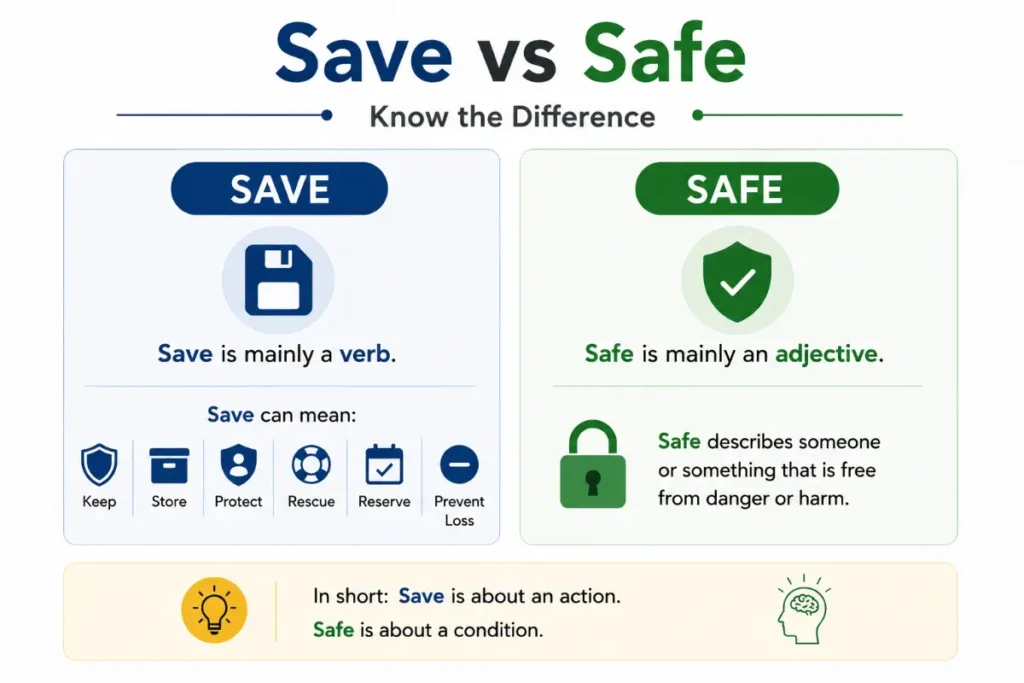
- Save is mainly a verb.
- Safe is mainly an adjective.
- Save can mean keep store protect rescue reserve or prevent loss.
- Safe describes freedom from danger harm or excessive risk.
- You save a file but a file can be safe.
- You save money but you can keep your money safe.
- A firefighter can save someone and the person can then be safe.
- Save is pronounced /seɪv/.
- Safe is pronounced /seɪf/.
- The final sound is an easy way to distinguish the words when speaking.
- Save and safe have the same standard spellings in American and British English.
- The fastest grammar check is to ask if the sentence needs an action or a condition.
Need another quick comparison? Read stoped or stopped Correct Spelling And Usage.
Conclusion
The difference between “Save vs Safe” is simple once you focus on meaning and grammar. “Save” is the action of protecting, rescuing, preserving, or storing something. “Safe” describes a person or thing that is free from danger or harm. Both words are correct, but they cannot replace each other in a sentence.
Remember this practical rule: save is the action, and safe is the condition. You save a document so your work stays safe. Use that example as a quick check whenever you are unsure which spelling belongs in your sentence.
FAQs
Is Save or Safe the Correct Word?
Both are correct English words, but they have different meanings. “Save” is mainly a verb that means to rescue, protect, preserve, or store something. “Safe” is mainly an adjective that means free from danger or harm. Use “save your work” when storing a document and “keep your work safe” when protecting it.
What Is the Main Difference Between Save and Safe?
The main difference is their meaning and grammatical role. “Save” describes an action, such as saving money or rescuing someone. “Safe” describes a condition, such as being protected from danger. The final consonant also changes the pronunciation: the first ends with /v/, while the second ends with /f/.
Is Safe a Verb or an Adjective?
“Safe” is mainly an adjective. It describes a person, place, object, or situation that is protected from harm or danger. For example, “The children are safe” uses it as an adjective. It can also be a noun when it refers to a secure container used to store money or valuables.
Can I Say Safe the File?
No. In standard English, the correct instruction is “Save the file.” The verb “save” means to store information so you can access it later. “Safe” is an adjective and cannot normally replace that verb. You can say “Keep the file safe” when you mean to protect it from loss, damage, or unauthorized access.
How Do You Pronounce Save and Safe?
“Save” is pronounced /seɪv/, while “safe” is pronounced /seɪf/. Both have one syllable and the same long a vowel sound. The difference comes at the end. The /v/ in “save” is voiced, while the /f/ in “safe” is unvoiced. Listen for the final consonant when speaking.
What Is the Difference Between Safe and Safety?
“Safe” is an adjective that describes something protected from harm, while “safety” is a noun that names the condition of being protected. For example, “The building is safe” describes the building. “Building safety is a priority” refers to the broader idea of preventing danger and injury.
Is Save Appropriate in Formal Writing?
Yes. “Save” is a standard verb that works in formal and informal writing. You can use it in a business report about saving money, a technical guide about saving files, or an emergency report about saving lives. Choose it whenever you mean to protect, rescue, preserve, or store something.
Why Do People Confuse Save and Safe?
People confuse the words because they look almost identical and share the same long vowel sound. Only the final letter and consonant sound differ. Fast typing and unfamiliarity with their grammatical roles can also cause mistakes. Remember that “save” names an action, while “safe” describes a condition, and the distinction becomes easier to apply.