
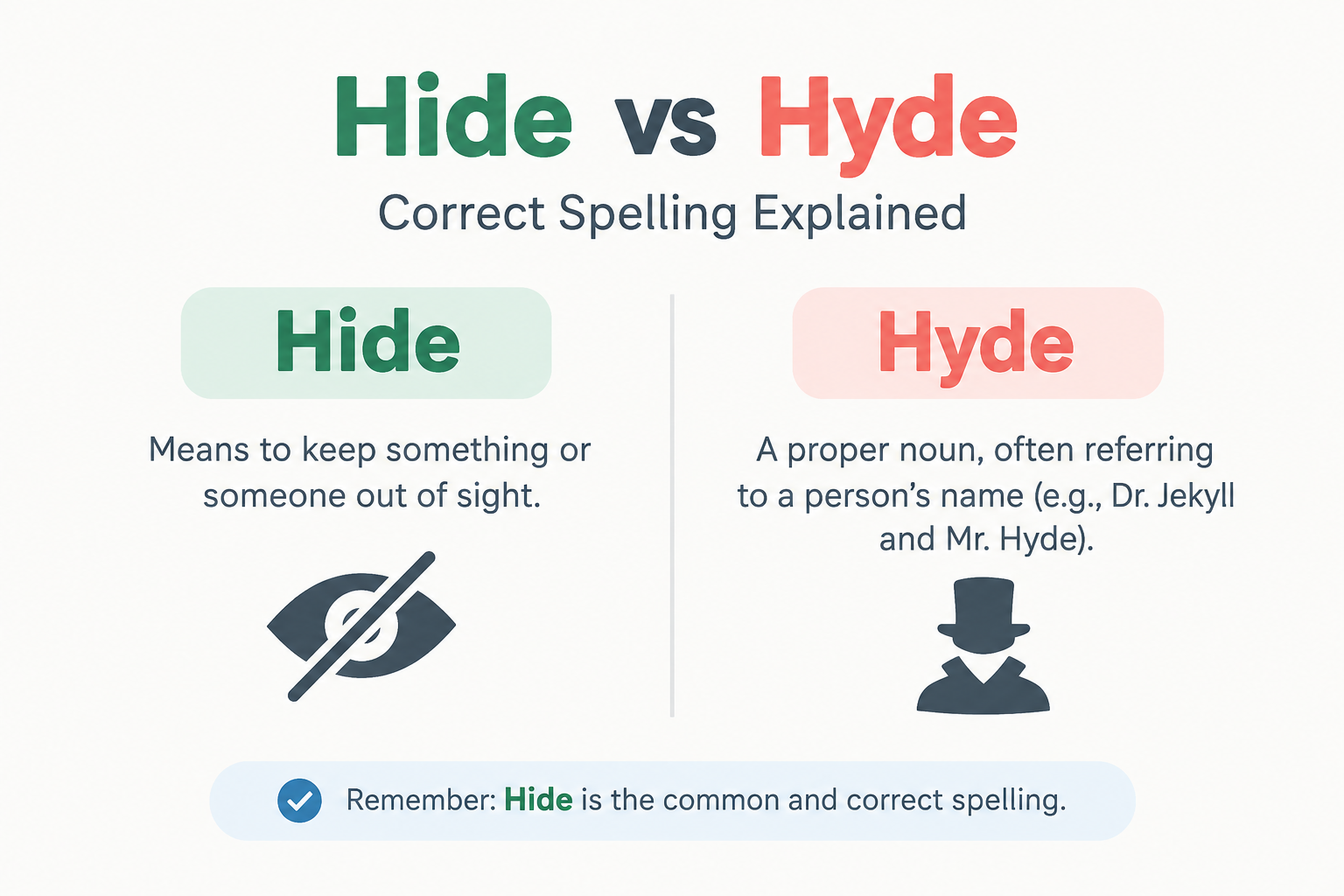
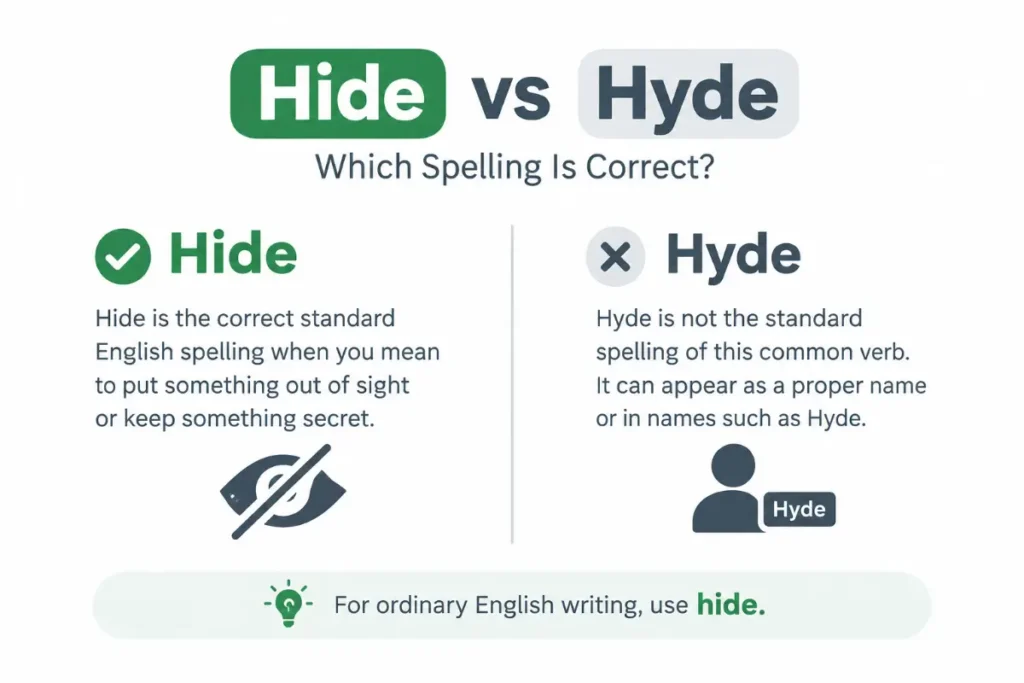
Choosing between hide vs Hyde can be confusing because both spellings are valid in English. However, they do not mean the same thing, and you cannot always use one in place of the other. The correct choice depends on what you want to say. Hide is the standard English word used as a verb meaning to put something out of sight or as a noun referring to an animal’s skin. Hyde, on the other hand, is generally a proper noun, such as a person’s surname, a place name, or the name of a fictional character.
The confusion is understandable because the two forms sound exactly alike in standard English pronunciation. Their only visible difference is the final letter, but that small change affects their grammatical role and meaning. Knowing the distinction will help you avoid spelling errors in emails, school assignments, professional documents, and everyday communication. Here is how to recognize each form and use it correctly.
For another common grammar confusion, see Implicit vs Complicit Which Word Should You Use 2026.
Quick Answer: Which Spelling Should You Use?
Hide is the correct spelling when you mean to conceal something, stay out of sight, or refer to an animal’s skin. Hyde is a proper noun used in names, surnames, and specific titles, such as Mr. Hyde in Strange Case of Dr Jekyll and Mr Hyde. They sound alike but have different meanings and grammatical functions.
Comparison Table: Hide and Hyde
| Feature | Hide | Hyde |
|---|---|---|
| Standard usage | Common English word | Proper noun |
| Meaning | To conceal, cover, or keep out of sight; animal skin | A surname, place name, or fictional name |
| Part of speech | Verb or noun | Proper noun |
| Origin | Old English hȳdan | English surname and place-name history |
| Pronunciation | /haɪd/ | /haɪd/ |
| Capitalization | Usually lowercase | Capitalized |
| Formality | Standard in formal and informal English | Depends on the name or context |
| Common contexts | Everyday speech, instructions, writing, descriptions | Personal names, literature, geography |
| Example | Please hide the spare key. | Mr. Hyde is a character in a famous novel. |
The main distinction is grammatical rather than phonetic. One is an ordinary dictionary word, while the other normally identifies a particular person, place, or named entity.
Meaning and Definition
What Does Hide Mean?
Hide is a standard English word with several related meanings. It can function as a verb or a noun, depending on the sentence. Its most familiar use is as a verb meaning to put something somewhere it cannot easily be seen or found.
As a verb, it can describe a person concealing an object, keeping information secret, or moving somewhere to avoid being noticed. It can also describe something that is naturally difficult to see.
Examples include:
- She decided to hide the birthday present in the closet.
- The child tried to hide behind the sofa.
- He wanted to hide his disappointment.
- The small animal can hide among the leaves.
The word does not always refer to physical concealment. It can also describe keeping emotions, facts, intentions, or problems from other people.
For example, someone might hide their feelings during a difficult conversation. A company might hide important information from customers. In both cases, the central idea is preventing something from being seen, known, or discovered.
As a noun, hide can refer to the skin of an animal, especially when it is used as material for leather products. This meaning appears in discussions of farming, traditional crafts, manufacturing, and animal products.
For example:
- The leather worker inspected the animal hide.
- The thick hide protected the animal from rough vegetation.
The noun and verb meanings are different, but both are established uses of the same English spelling.
What Does Hyde Mean?
Hyde is generally a proper noun. Unlike an ordinary vocabulary word, it usually identifies a specific person, family, place, or fictional character.
It is particularly familiar from Robert Louis Stevenson’s 1886 novella Strange Case of Dr Jekyll and Mr Hyde. In the story, Mr. Edward Hyde is closely connected to Dr. Henry Jekyll, whose experiment leads to the emergence of a separate and disturbing personality.
The name has become widely recognized in English-language culture. The expression Jekyll and Hyde is sometimes used to describe someone who appears to have two very different sides to their personality.
However, the word itself is not a general verb meaning to conceal something. You would not normally write, “Please hyde your phone,” when asking someone to put their phone out of sight.
The spelling is also used in real surnames and geographical names. For example, Hyde is the name of towns and other places in English-speaking countries. It can also appear in business names, organizations, fictional works, and historical records.
Because it is a proper noun, capitalization is normally required when referring to the name itself.
Is Hyde a Real English Word or Just a Name?
Hyde is a legitimate spelling, but its usual modern role is as a proper noun rather than an ordinary vocabulary word. It is not simply a misspelling of hide in every situation.
For example, these sentences are both correct:
- I need to hide my wallet.
- Dr. Jekyll and Mr. Hyde is a famous literary story.
The first sentence uses a common verb. The second uses a fictional character’s name.
There is also a historical distinction worth understanding. Old English had the word hīd, referring to a unit of land used for assessment and taxation. Modern English inherited the spelling hide for the historical land term. This does not make Hyde an interchangeable spelling of that word.
Therefore, the existence of the name does not mean it can replace the ordinary English spelling.
Key Differences Explained
Although the two forms are pronounced alike, their meanings, functions, and writing conventions are different.
1. Spelling
The standard spelling of the everyday English verb is hide. It ends with the letter e.
Hyde has a y in place of the i. This spelling is associated mainly with proper names.
Compare:
- Correct: Hide the documents in a safe place.
- Incorrect for the intended meaning: Hyde the documents in a safe place.
- Correct: Mr. Hyde appears in Stevenson’s story.
The spelling should reflect the meaning you intend to communicate.
2. Meaning
The verb hide means to conceal, cover, or keep something from view. Its noun form refers to animal skin.
Hyde generally identifies a person, place, or named character. It does not have the same everyday meaning as the verb.
The surrounding sentence usually makes the intended meaning clear, but choosing the right spelling still matters.
3. Grammar and Part of Speech
Hide can function as both a verb and a noun.
As a verb, it describes an action:
- They hide their valuables in a locked drawer.
As a noun, it identifies an animal skin:
- The hide was used to make leather.
Hyde is generally a proper noun. It identifies someone or something rather than describing an action.
For example:
- Hyde is a common surname in English-speaking communities.
- The character Hyde represents a darker side of human nature in Stevenson’s story.
4. Pronunciation
Both forms are usually pronounced /haɪd/.
The vowel sound is the same as the sound in words such as side, ride, and wide. The final consonant is a voiced /d/.
Because they are homophones, listening alone may not help you determine which spelling a writer intended. You must consider the meaning and sentence structure.
5. Capitalization
Capitalization is another useful clue.
Hide is usually lowercase unless it begins a sentence or appears in a title or another context requiring capitalization.
Hyde is capitalized because it is normally a proper noun.
Compare:
- Please hide the package.
- Mr. Hyde entered the room.
Writing the surname with a lowercase letter would generally be inappropriate when referring to the named character or person.
6. Formality and Context
The ordinary word appears in both casual and formal English. It is suitable for conversations, instructions, reports, academic writing, and professional communication.
The name appears in contexts where a particular person, location, or fictional subject is being discussed.
Neither spelling is inherently more formal than the other. Their appropriateness depends on what the writer is referring to.
7. Regional Usage
There is no major American-versus-British spelling distinction between these two forms. English speakers in the United States, United Kingdom, Canada, and Australia generally use the same spelling conventions.
The distinction is based on meaning and grammatical function, not regional preference.
Which Form Is Correct?
Neither spelling is universally incorrect. The correct choice depends on the sentence.
Use hide when you mean:
- To put something out of sight.
- To avoid being noticed.
- To conceal information or feelings.
- The skin of an animal.
Use Hyde when you mean:
- A person with that surname.
- A fictional character named Hyde.
- A geographical location with that name.
- A business, organization, or other named entity using the spelling.
This distinction follows standard English conventions for common nouns, verbs, and proper nouns. Ordinary vocabulary words are generally written in lowercase, while proper names begin with capital letters.
A useful editing method is to replace the word mentally with a simple definition. If you mean conceal, the correct choice is hide. If you are identifying someone or something specifically named Hyde, retain the proper name.
Sentence Examples
The following examples demonstrate how the standard forms work in natural English.
10 Examples Using Hide
- Everyday conversation: Can you hide the remote control before the children find it?
- Text messages: I need to hide the surprise gift in your bedroom until Saturday.
- Workplace communication: Please hide confidential customer details before sharing the presentation.
- School: The students had to hide their notes before the examination began.
- Academic writing: Some animals use camouflage to hide from predators in their natural environments.
- Formal writing: The organization must not hide information that is relevant to the public interest.
- Social situations: She tried to hide her embarrassment after forgetting everyone’s names.
- Online communication: You can hide unwanted comments by changing your account’s privacy settings.
- Journalism: The investigation examined whether officials had attempted to hide important evidence.
- Literature and storytelling: The traveler decided to hide beneath the wooden bridge until the soldiers passed.
5 Incorrect Examples for the Meaning of Conceal
The following sentences demonstrate a spelling mistake. In each case, hide is required because the intended meaning is concealment.
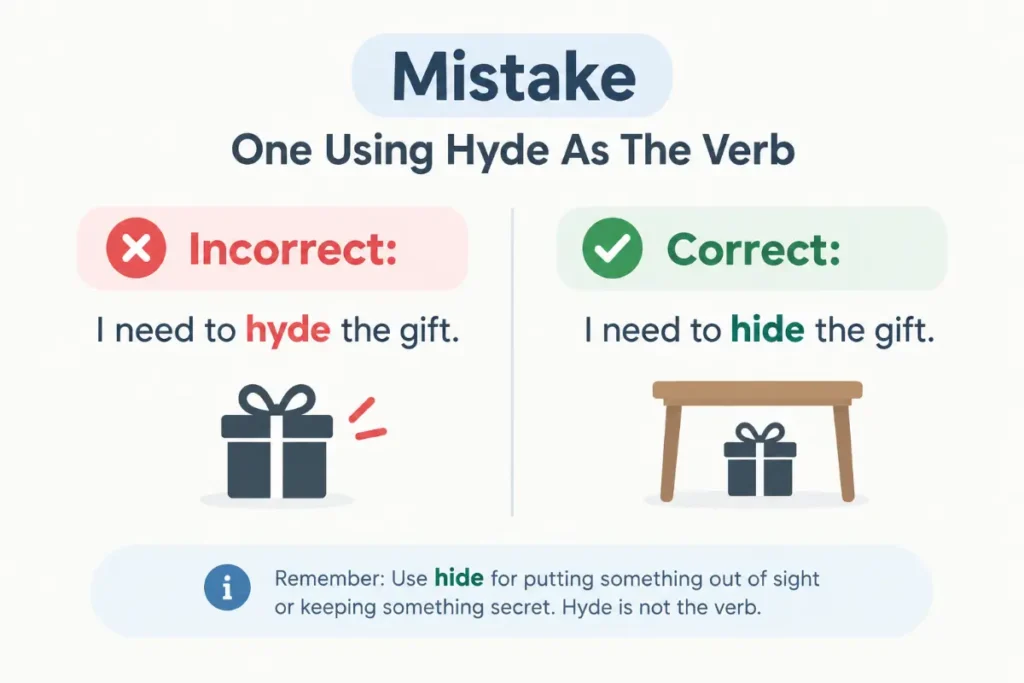
- Incorrect: Please hyde the spare key under the flowerpot.
Correct: Please hide the spare key under the flowerpot. - Incorrect: The cat tried to hyde beneath the bed.
Correct: The cat tried to hide beneath the bed. - Incorrect: He wanted to hyde his disappointment.
Correct: He wanted to hide his disappointment. - Incorrect: You should hyde your password from other people.
Correct: You should hide your password from other people. - Incorrect: The children decided to hyde behind the curtains.
Correct: The children decided to hide behind the curtains.
These examples are incorrect only because the writer intends the ordinary English verb. The same spelling is perfectly acceptable when referring to a person or place actually named Hyde.
Common Spelling Mistakes and Confusion
Several factors can lead writers to choose the wrong form. Understanding these patterns makes the distinction easier to remember.
1. Replacing the i With a y
Incorrect: Hyde your belongings in the cupboard.
Correct: Hide your belongings in the cupboard.
The mistake often happens because Hyde is a familiar surname and appears in well-known literary references. However, familiarity with a proper name does not make its spelling suitable for an ordinary verb.
Remember that the standard verb contains an i.
2. Treating Both Forms as Interchangeable
Incorrect: I will hyde the documents before the meeting.
Correct: I will hide the documents before the meeting.
Both forms have the same pronunciation, but their meanings are different. A sound-based spelling choice is not always reliable, especially when two words are homophones.
Use the sentence’s meaning to determine the correct spelling.
3. Forgetting to Capitalize a Surname
Incorrect: Mr. hyde is a character in the novella.
Correct: Mr. Hyde is a character in the novella.
Names of people and fictional characters normally begin with capital letters. This rule applies even when the name appears in the middle of a sentence.
4. Assuming Hyde Is Always a Typo
Incorrect assumption: Hyde is never a legitimate spelling.
Correct understanding: Hyde is valid when it is a proper name.
A writer may correctly use Hyde in a sentence about a person, town, or literary character. Automatically changing every occurrence to hide can introduce an editing error.
5. Confusing the Verb With the Noun
Incorrect: The craftsman examined the animal’s hyde.
Correct: The craftsman examined the animal’s hide.
The noun referring to an animal’s skin uses the same spelling as the verb meaning conceal. The two meanings belong to one standard English spelling.
Pronunciation Guide
The two forms have the same standard pronunciation in English.
| Feature | Pronunciation |
|---|---|
| Hide | /haɪd/ |
| Hyde | /haɪd/ |
| Syllables | One |
| Stress | Single syllable |
| Easy pronunciation | HYDE |
| Rhyming words | Side, ride, wide, pride |
How to Pronounce Hide
The word has one syllable. Begin with the /h/ sound, followed by the long vowel sound /aɪ/, and finish with the voiced /d/ sound.
A simple way to practice is to say:
- Side
- Ride
- Wide
- Hide
The vowel sound remains the same in each word.
How to Pronounce Hyde
Pronounce the name in exactly the same way. There is no standard pronunciation difference caused by replacing the letter i with y.
Common Pronunciation Mistakes
Some learners may pronounce the word with a short i, similar to the vowel in sit. That is not the standard pronunciation.
Another possible mistake is adding an extra syllable. Both forms are one-syllable words, so avoid stretching them into two separate sounds.
The most important point is that pronunciation cannot distinguish the spellings. Context is essential.
Need another quick comparison? Read cleverer vs more clever Which Form Should You Use.
Etymology and Word Origin
Understanding the history of these forms provides additional insight into why they are written differently.
The Origin of Hide
The ordinary English word hide comes from Old English hȳdan, meaning to conceal or cover. It developed through the historical forms of English and became the modern verb used for putting something out of sight.
The word’s meaning expanded into several familiar contexts. It can describe physical concealment, keeping information secret, or avoiding attention.
The noun hide, referring to animal skin, has a separate historical development associated with the Old English word hȳd. Its modern use is especially familiar in discussions of leather and animal products.
There is also a historical English term, hīd, meaning a unit of land used in assessments of land and obligations. Although its spelling is the same as the modern verb, it represents a different historical meaning.
The Origin of Hyde
Hyde developed as an English surname and also appears in place names. Like many surnames, its historical spelling and use are connected to the development of family names and geographical identification in England.
The name is associated with the historical English word hide, particularly in place-name and surname discussions. However, its exact origin can vary according to the family or location being considered.
The spelling became especially recognizable through Robert Louis Stevenson’s novella, published in 1886. The character Mr. Hyde helped establish the name in popular literary culture.
It is useful to distinguish the historical origins of the two spellings rather than assume that they are simply different versions of one modern word.
Regional Usage
There is no significant regional spelling difference between the two forms. The same basic distinction applies across the major varieties of English.
American English
In American English, hide is the standard spelling for the verb meaning to conceal something and the noun referring to animal skin.
Hyde is used for surnames, locations, and proper names. The literary reference to Dr. Jekyll and Mr. Hyde is also widely recognized in the United States.
Examples:
- Please hide the documents in the locked cabinet.
- Hyde is the surname of the character in Stevenson’s story.
British English
British English follows the same general conventions. Hide is the ordinary English spelling, while Hyde is used for proper names.
There is no standard British spelling rule that replaces the i in the verb with a y.
The historical spelling of place names and family names should be preserved, even if it differs from an ordinary dictionary word.
Australian English
Australian English also uses hide for the verb and animal-skin noun. Hyde remains appropriate for names and geographical references.
The distinction is not affected by Australian spelling conventions.
Canadian English
Canadian English follows the same pattern. Writers should use hide for the ordinary vocabulary word and retain Hyde when referring to a proper name.
In all four varieties, context determines the correct form.
Grammar Rules and Part of Speech
Understanding how the ordinary word functions in a sentence is useful for avoiding spelling and grammar errors.
Hide as a Verb
As a verb, hide describes an action. It can be used with or without an object, depending on the sentence.
Transitive use: A transitive verb takes an object.
- She decided to hide the letter.
- He hid the money in a drawer.
In these sentences, the objects are the letter and the money.
Intransitive use: An intransitive verb does not require a direct object.
- The children hid behind the wall.
- The animal hides among the rocks.
The action is complete without a direct object.
Verb Forms of Hide
The verb has several forms that appear in different grammatical structures.
| Verb Form | Spelling | Example |
|---|---|---|
| Base form | Hide | Hide the gift. |
| Third-person singular | Hides | She hides her diary. |
| Past tense | Hid | He hid the letter. |
| Past participle | Hidden | The keys were hidden. |
| Present participle | Hiding | They are hiding. |
One common mistake is writing “hided” as the past tense. The standard past tense is hid, while the past participle is hidden.
For example:
- Correct: She hid the package yesterday.
- Correct: She has hidden the package.
- Incorrect: She hided the package yesterday.
Hide as a Noun
The noun is used to refer to animal skin, especially when discussing material used to make leather.
Examples:
- The animal’s hide was thick and durable.
- The factory purchased hides for leather production.
In this meaning, the word is a countable noun. Its plural form is hides.
Hyde as a Proper Noun
Hyde generally functions as a proper noun. It can appear as a subject, object, or part of a larger name.
Examples:
- Hyde wrote his name on the document.
- The museum displayed a reference to Mr. Hyde.
- They traveled to Hyde for a family visit.
Proper names are not normally changed to create ordinary verb forms. For example, adding -s or -ed to a surname does not automatically turn it into a standard English verb.
Sentence Position and Punctuation
The verb can appear in several positions depending on the sentence structure.
- Beginning: Hide the package before the guests arrive.
- Middle: She will hide the package upstairs.
- End: The children wanted somewhere to hide.
The proper name follows the normal rules for names. It is capitalized wherever it appears, except in unusual stylistic contexts such as deliberate lowercase branding.
Neither spelling requires special punctuation. Normal sentence punctuation depends on the sentence type.
Real-Life Usage Examples
The best way to understand a spelling distinction is to see how it works in different settings.
Daily Conversation
People commonly use the verb when talking about objects, surprises, and personal information.
- Can you hide my birthday present until tomorrow?
- The dog likes to hide under the dining table.
These examples use the ordinary meaning of concealment.
Email and Workplace Communication
Professional writing often uses the word in discussions about confidentiality, information security, and document handling.
- Please do not hide any relevant details from the project team.
- The system allows users to hide sensitive information before exporting a report.
A surname may appear in an email when identifying a colleague or client named Hyde.
Academic Writing
Academic writing may use the verb in scientific, psychological, historical, or literary discussions.
- Certain species hide during periods of extreme heat.
- Stevenson’s portrayal of Mr. Hyde explores the contrast between public behavior and hidden desires.
The second sentence uses the proper name because it identifies a literary character.
News and Journalism
Journalists may use the verb when reporting on investigations, public information, or concealed evidence.
- Investigators questioned whether the company had attempted to hide financial records.
- Officials denied trying to hide the findings from the public.
The name may appear in cultural reporting, historical articles, or literary reviews.
Literature and Storytelling
In fiction, the verb often describes suspense, secrecy, and movement.
- The stranger tried to hide his face beneath the hood.
- She discovered a hidden message inside the old book.
The proper name has a different role in literary writing.
- Dr. Jekyll and Mr. Hyde remains a familiar example of a divided personality in literature.
- The character Hyde becomes a symbol of a darker side of human behavior.
Related and Confused Terms
Several words and expressions are connected to the meaning, pronunciation, or literary use of these forms.
1. Conceal
Conceal is a synonym for hide when the meaning involves keeping something from view or knowledge.
Example: The company attempted to conceal the problem from its customers.
Conceal is often slightly more formal than hide, particularly in professional and legal writing.
2. Disguise
Disguise means changing someone’s appearance or the appearance of something to make its true identity less obvious.
Example: He wore a hat and glasses to disguise his appearance.
Unlike hide, disguise does not necessarily mean removing something from view. It means making it look different.
3. Cover
Cover means placing something over another object or preventing it from being exposed.
Example: Cover the food before putting it in the refrigerator.
Cover and hide can overlap, but they are not always interchangeable.
4. Camouflage
Camouflage refers to disguising something so that it blends into its surroundings.
Example: The insect uses its natural colors to camouflage itself among the leaves.
This term is particularly common in discussions of wildlife and military operations.
5. Secret
A secret is information that is kept from others or not widely known.
Example: She shared a secret with her closest friend.
The word can be a noun or an adjective, while hide is commonly used as a verb.
6. Hidden
Hidden is the past participle of hide and can also function as an adjective.
Example: A hidden compartment was discovered beneath the floor.
It describes something that cannot easily be seen or found.
7. Jekyll and Hyde
Jekyll and Hyde is an expression associated with Robert Louis Stevenson’s literary characters.
It describes someone who seems to have two sharply contrasting sides to their personality or behavior.
Example: His friendly behavior at work and aggressive behavior at home made people describe him as a Jekyll and Hyde.
8. Homophones
Homophones are words that sound the same but have different meanings, spellings, or grammatical functions.
Examples include:
- Their and there.
- See and sea.
- Right and write.
- Hide and Hyde.
This linguistic category explains why the two spellings are easy to confuse. Pronunciation alone cannot tell you which written form is appropriate.
Expert Editor Insight
An experienced English editor looks at meaning and grammatical function before changing a spelling. The pronunciation of these forms is identical, so a spell-checker may not catch every error, especially if the incorrect form is itself a valid proper name. Automated writing tools can identify unusual usage, but they cannot always determine whether a reference to Hyde is intentional. The most reliable editing habit is to read the complete sentence and ask whether the writer means concealment or a specific name. That simple context check prevents both accidental substitutions and unnecessary corrections.
Key Takeaways
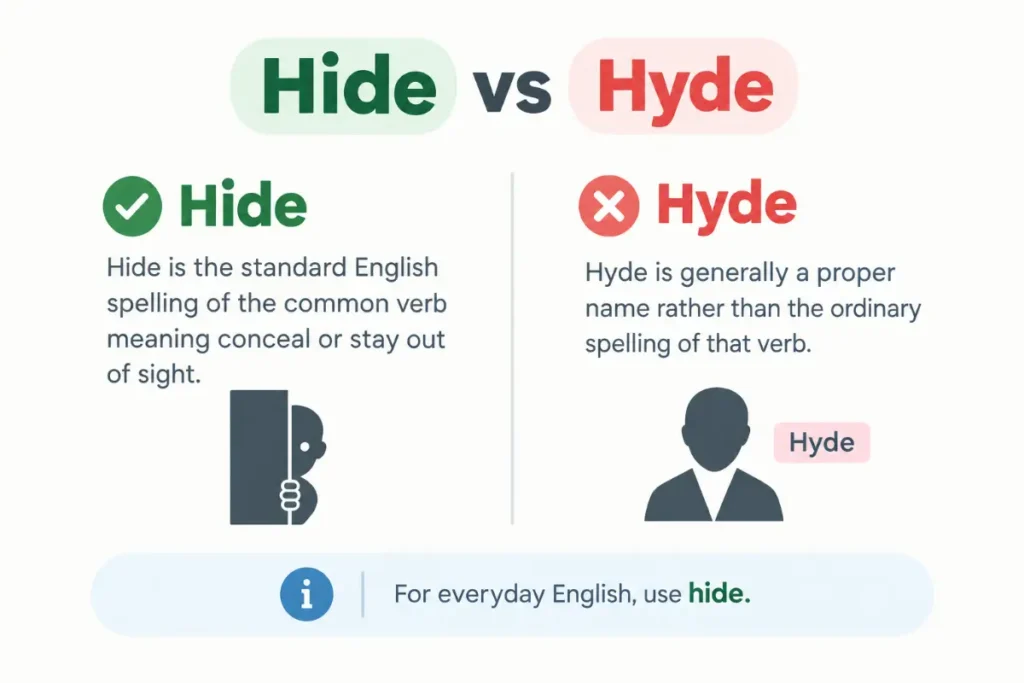
- Hide is the standard English spelling of the common verb meaning conceal or stay out of sight.
- Hyde is generally a proper name rather than the ordinary spelling of that verb.
- Hide can also be a noun meaning animal skin.
- In British English, hide can also mean a place used for watching wildlife.
- The main verb forms are hide, hid, hidden, and hiding.
- The standard pronunciation of hide is /haɪd/.
- American English and British English use hide as the standard spelling of the ordinary verb.
- Do not automatically correct Hyde when it is part of a proper name.
- If you mean conceal, use hide.
- A useful memory trick is to connect hide with side, ride, and wide.
Still confused? Compare Wack or Whack Which Word Is Correct? (2026).
Conclusion
The distinction between hide vs hyde comes down to meaning, grammar, and capitalization. Hide is the standard English verb for concealing something and the noun for animal skin. Hyde is generally a proper name used for people, places, and fictional characters. Although both forms sound identical, they cannot replace each other in ordinary sentences.
A simple editing trick is to ask whether you mean to conceal something or identify a named person or place. If you mean concealment, choose hide. If you mean the name, preserve Hyde. Checking the sentence’s meaning is the easiest way to avoid this common spelling mistake.
FAQs
1. Which spelling is correct: hide or Hyde?
Both spellings are correct, but they have different uses. Hide is the standard English word for concealing something or referring to animal skin. Hyde is generally a proper noun, such as a surname, place name, or fictional character. If you mean to put something out of sight, use hide rather than Hyde.
2. Is Hyde a real English word?
Yes. Hyde is a legitimate English spelling, most commonly used as a proper noun. It appears in surnames, geographical names, and literary references. It is particularly familiar from Robert Louis Stevenson’s character Mr. Hyde. However, it is not the standard spelling of the ordinary verb meaning to conceal something.
3. What does hide mean in English?
Hide has two common meanings. As a verb, it means to conceal something, keep it out of sight, or avoid being noticed. As a noun, it refers to an animal’s skin, especially when used to produce leather. Its precise meaning depends on how it functions in the sentence.
4. Why do people confuse these two spellings?
People confuse them because they are pronounced exactly alike in standard English. This makes them homophones, meaning their sounds are identical even though their written forms and meanings differ. Familiarity with the surname Hyde can also lead people to use that spelling accidentally when they intend the ordinary verb.
5. How do you pronounce hide and Hyde?
Both forms are pronounced /haɪd/. They contain one syllable and rhyme with side, ride, and wide. The pronunciation begins with an h sound, followed by the long i sound, and ends with a voiced d. There is no standard pronunciation difference between the two spellings.
6. Can hide be used as a noun?
Yes. Although hide is widely recognized as a verb, it can also be a noun referring to an animal’s skin. For example, a leather worker may examine an animal hide before processing it. The noun is different from the verb in meaning, but both use the same spelling.
7. Is Hyde appropriate in formal writing?
Yes, provided it is a proper name. You can use Hyde in formal writing when identifying a person, place, organization, or literary character with that name. However, it should not replace hide when you mean concealment. In professional editing, the intended meaning and capitalization should always be checked.
8. Is hide a synonym for conceal?
Yes. Hide and conceal can have similar meanings when they refer to keeping something out of sight or preventing information from being discovered. For example, “hide the documents” and “conceal the documents” communicate similar ideas. Conceal often sounds more formal, while hide is more common in everyday conversation.