
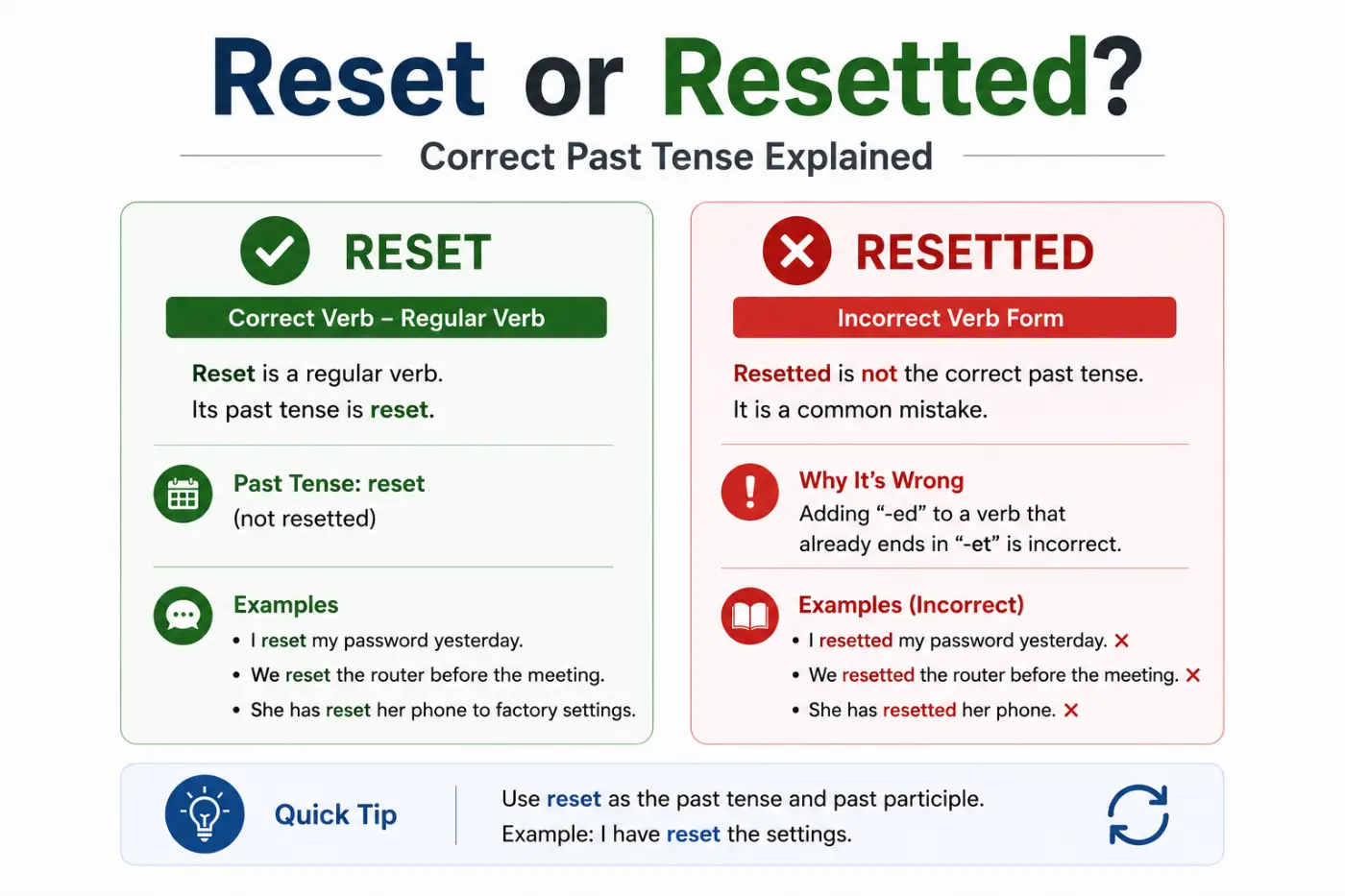
Have you ever written a sentence such as “I resetted my password” and wondered if it sounded right? You are not alone. Many English speakers are unsure whether to use reset or resetted when talking about an action that happened in the past. The confusion makes sense because most regular English verbs form their past tense by adding -ed. However, some verbs follow different patterns.
The correct past-tense and past-participle form of reset is reset, not resetted. Although the verb describes an action that has already happened, its spelling does not change. For example, you should write, “I reset my password yesterday,” rather than “I resetted my password yesterday.”
Understanding this simple grammar rule can help you avoid spelling mistakes in emails, school assignments, workplace messages, and everyday conversations. Below, you will learn how the verb works, why people confuse its forms, how to pronounce it, and how to use it naturally in different situations.
Learn the difference in Meny vs Many Which Spelling Is Correct?.
Featured Snippet: Quick Definition
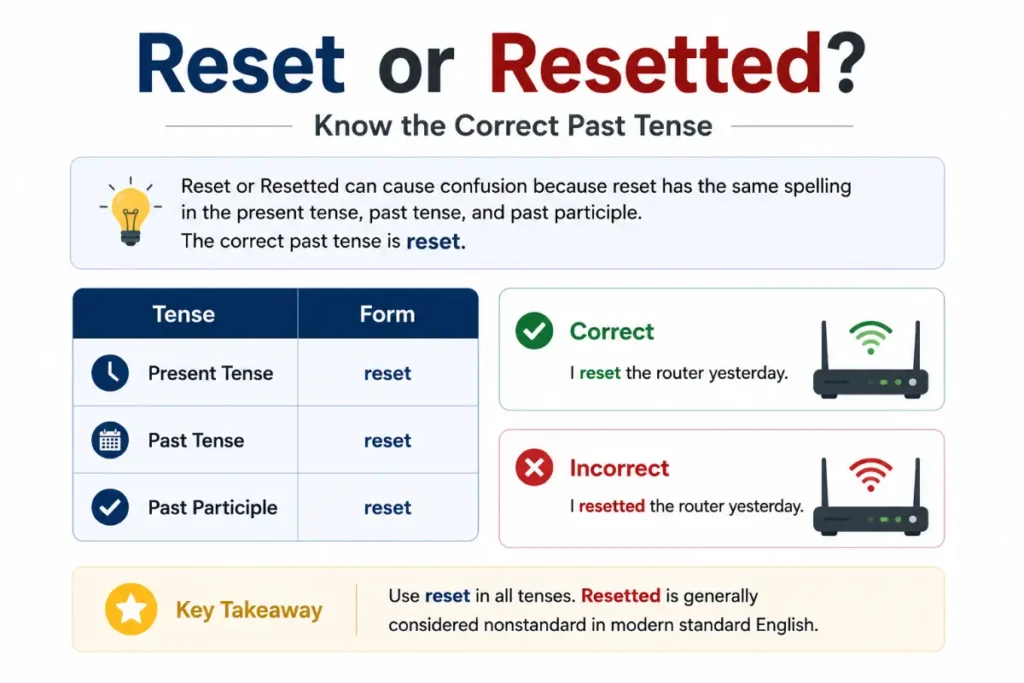
Reset is the correct base form, simple past tense, and past participle of the verb. Resetted is a nonstandard form and should generally be avoided in standard English. For example, “I reset my computer yesterday” is correct. The spelling remains the same even when the action happened in the past.
Quick Answer: Reset or Resetted?
Reset is correct. Resetted is generally incorrect in standard English.
The verb reset is an irregular verb that does not change its spelling when used in the simple past tense or past participle. You can write “I reset the router yesterday” or “She has reset her password.”
Do not add -ed to create a past-tense form. The correct forms are reset, reset, and resetting.
Comparison Table: Reset vs. Resetted
The following table explains the difference between the two spellings.
| Feature | Reset | Resetted |
|---|---|---|
| Standard spelling | Correct | Nonstandard |
| Part of speech | Verb and noun | Attempted verb form |
| Base form | Reset | Not applicable |
| Simple past | Reset | Incorrect in standard English |
| Past participle | Reset | Incorrect in standard English |
| Present participle | Resetting | Not resetted |
| Meaning | To set something again or return it to an earlier state | Intended to express the past action of resetting |
| Formality | Suitable for formal and informal writing | Avoid in standard writing |
| American English | Standard | Nonstandard |
| British English | Standard | Nonstandard |
| Common contexts | Technology, equipment, passwords, systems, routines | Common spelling error |
| Example | I reset the device yesterday. | I resetted the device yesterday. |
The key difference is grammatical rather than semantic. Both forms are usually intended to describe the same action, but only reset is accepted as the standard past-tense form.
Meaning and Definition
What Does Reset Mean?
Reset is a verb that means to set something again, restore it to an earlier condition, or return it to a starting position. It can also describe restarting a process, changing a setting, or establishing a new beginning.
The word is commonly used in technology, electronics, business, education, and everyday conversation.
For example:
- You can reset your password if you forget it.
- The technician reset the computer after identifying the problem.
- The coach reset the team’s strategy before the next game.
- I reset my alarm after changing my morning routine.
The meaning depends on the context, but the central idea remains the same: something is being returned to a previous state or established in a new way.
What Does Resetted Mean?
Resetted is a nonstandard past-tense form that some people use when trying to describe an action that has already happened.
It usually appears because English speakers apply the regular past-tense pattern to a verb that does not follow that pattern.
For example:
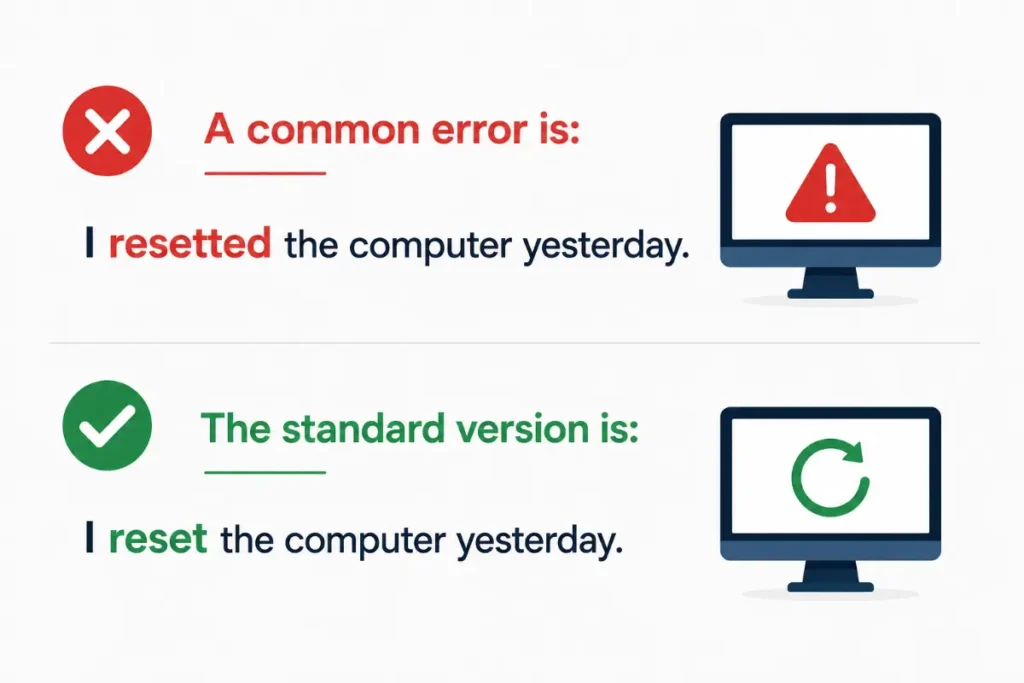
Incorrect: I resetted my phone last night.
Correct: I reset my phone last night.
The intended meaning is clear in both sentences. However, the second sentence follows standard English grammar.
Resetted is not the appropriate choice in ordinary professional, academic, or edited writing. If you encounter it in a message, it is generally best understood as a grammatical or spelling error rather than a separate word with a different meaning.
What Is the Difference Between the Verb and the Noun?
The word reset can function as both a verb and a noun.
As a verb, it describes the action of setting something again.
Example: “Please reset the password.”
As a noun, it refers to the action or process of starting again or restoring something.
Example: “The system needs a complete reset.”
The pronunciation and spelling remain the same in both cases. The sentence structure helps readers understand which function the word performs.
Why Is the Correct Form Reset Instead of Resetted?
The main reason is that English has both regular and irregular verbs. Regular verbs generally form their simple past tense by adding -ed, while irregular verbs follow other patterns.
For example:
- Walk becomes walked.
- Clean becomes cleaned.
- Open becomes opened.
- Play becomes played.
These verbs follow the regular pattern.
However, several English verbs do not add -ed in the same way. Some retain the same spelling in the present and past forms.
Examples include:
- Cut becomes cut.
- Put becomes put.
- Set becomes set.
- Hit becomes hit.
- Shut becomes shut.
- Reset becomes reset.
The verb reset follows the pattern of set because it is formed by adding the prefix re- to that existing verb.
The prefix re- means again or anew. Therefore, reset means to set something again.
Since set remains unchanged in its simple past form, reset also remains unchanged.
This is the grammatical reason that adding another -ed is unnecessary.
The Three Main Verb Forms
Understanding the three basic verb forms makes the rule easier to remember.
| Verb Form | Correct Word | Example |
|---|---|---|
| Base form | Reset | I need to reset the device. |
| Simple past | Reset | I reset the device yesterday. |
| Past participle | Reset | I have reset the device. |
| Present participle | Resetting | I am resetting the device. |
| Third-person singular | Resets | She resets the system every week. |
Notice that only the present participle and third-person singular forms change their spelling.
The simple past and past participle remain identical to the base form.
Which Form Is Grammatically Correct?
Reset is the grammatically correct choice in standard modern English.
The reason is its connection to the verb set. Reset is a compound verb created by attaching re- to set. Since the original verb retains its spelling in the past tense, the compound follows the same pattern.
Consider these examples:
- Present: I set the alarm every evening.
- Past: I set the alarm last night.
- Present: I reset the alarm every evening.
- Past: I reset the alarm last night.
The pattern is consistent.
You do not need an additional -ed ending to show that the action happened in the past. The tense is already clear from the sentence structure and the surrounding words.
For example, yesterday, last week, already, and two hours ago can indicate when the action occurred.
This rule applies to both spoken and written standard English.
10 Correct Sentence Examples
Here are ten natural examples showing how to use the verb in different situations.
- Everyday conversation: I reset my phone because it stopped responding to touch.
- Text messages: I forgot my old password, so I reset it this morning.
- Workplace communication: The IT department reset the office network after the connection failed.
- School: The teacher reset the online quiz so everyone could complete it again.
- Academic writing: The researchers reset the equipment before beginning the next experiment.
- Formal writing: The administrator has reset the account settings in accordance with the updated security policy.
- Social situations: After a stressful week, I took a short break and reset my routine.
- Online communication: If the application freezes, close it and reset the device before trying again.
- Business: Management reset its priorities after reviewing the quarterly results.
- Personal use: I reset my alarm clock because I wanted to wake up earlier.
Each sentence uses the same simple past or past participle spelling. The surrounding words establish the tense and meaning.
Five Examples of the Common Spelling Mistake
The following examples show how the nonstandard form may appear and how to correct it.
| Incorrect Sentence | Correct Sentence |
|---|---|
| I resetted my password yesterday. | I reset my password yesterday. |
| She has resetted the router. | She has reset the router. |
| We resetted the settings last night. | We reset the settings last night. |
| He resetted his account after the security warning. | He reset his account after the security warning. |
| They have resetted the system twice. | They have reset the system twice. |
The problem in each example is the same: an unnecessary -ed ending has been added.
The meaning is usually understandable, but the corrected sentences are more natural and grammatically appropriate.
Common Mistakes and Misspellings
People make several spelling and grammar mistakes when using this verb. Most occur because they apply familiar English patterns without considering whether the verb is regular or irregular.
Here are five mistakes worth avoiding.
1. Adding -ed to the Past Tense
Incorrect: I resetted my laptop.
Correct: I reset my laptop.
This is the most common grammatical mistake. Writers assume that every verb needs an -ed ending to express a past action.
However, reset follows the same pattern as set. Its past-tense spelling does not change.
2. Using an Incorrect Past Participle
Incorrect: She has resetted the security settings.
Correct: She has reset the security settings.
A past participle is commonly used with helping verbs such as has, have, and had. Because the participle of reset is also reset, the additional ending is unnecessary.
Remember that the same form works with all three helping verbs.
3. Confusing Reset With Restarted
Incorrect: I reset the computer by restarting it.
This sentence is not automatically grammatically wrong, but it may describe two different actions as if they were identical.
Resetting generally means restoring settings or returning something to a previous or starting state. Restarting means turning something off and starting it again.
For example, restarting a computer does not necessarily erase its settings or restore factory defaults.
Choose the verb that accurately describes what happened.
4. Confusing the Past Tense With the Present Participle
Incorrect: I am reset the device.
Correct: I am resetting the device.
The present continuous tense requires the verb ending in -ing after a form of the verb be.
Examples:
- I am resetting the device.
- She is resetting her password.
- They are resetting the equipment.
Do not confuse this form with the simple past.
5. Using the Wrong Verb After a Helping Verb
Incorrect: The technician has resetted the machine.
Correct: The technician has reset the machine.
Helping verbs affect the grammatical structure of a sentence, but they do not change the spelling of the past participle.
After has, have, or had, use reset.
For example:
- I have reset the settings.
- He had reset the system.
- We have reset the password.
These patterns work in both formal and informal writing.
Many readers also check Analyze or Analyse Which Spelling Is Correct..
Pronunciation Guide
The word reset is pronounced with two syllables.
IPA: /ˌriːˈsɛt/
Easy pronunciation: ree-SET
Syllable breakdown: re-set
Stress pattern: The main stress falls on the second syllable.
The first syllable sounds like the word “ree,” while the second sounds like “set.”
When speaking naturally, pronounce both syllables clearly. Avoid placing too much stress on the first syllable.
The pronunciation does not change when the word is used in the past tense.
For example:
- I reset the device.
- She has reset the password.
- They reset the machine yesterday.
All three sentences use the same pronunciation.
The present participle, resetting, is pronounced with an additional syllable: ree-SET-ing.
Is the Pronunciation Different in American and British English?
There is no major difference in the basic pronunciation between American and British English. Some speakers may pronounce the vowel sounds or stress slightly differently because of their regional accents.
However, both varieties use the same standard spelling and past-tense form.
Etymology and Word Origin
The history of reset is closely connected to the older English verb set.
The word set has Germanic roots and has been part of English for centuries. It developed from earlier Germanic language forms and has retained a wide range of meanings, including placing, fixing, arranging, and establishing something.
The prefix re- comes through Latin and French and generally means again or back.
When the prefix was added to set, it created reset, meaning to set something again or establish it anew.
This construction follows a common English word-building pattern. Adding re- to an existing verb creates another verb with a related meaning.
Other familiar examples include:
- Rebuild: build again.
- Rewrite: write again.
- Reopen: open again.
- Reconsider: consider again.
- Reconnect: connect again.
The structure of reset helps explain why it retains the spelling pattern of set.
The word also became increasingly useful as mechanical equipment, electronic devices, and computer systems became common. Today, it appears in both technical and everyday language.
Its basic meaning, however, remains connected to the idea of setting something again.
Regional Usage: American, British, Australian, and Canadian English
One useful feature of this spelling rule is that it does not change significantly across the main varieties of English.
American English
Reset is the standard form in American English.
People commonly use it when discussing passwords, smartphones, computers, electronic equipment, schedules, and personal routines.
Examples:
- I reset my password this morning.
- The technician reset the computer.
Resetted is not considered the standard past-tense form in professional American writing.
British English
British English also uses reset as the standard base form, past tense, and past participle.
There is no established British spelling rule that makes resetted correct.
Examples:
- I reset the heating system yesterday.
- The engineer has reset the controls.
The spelling remains the same as in American English.
Australian English
Australian English follows the same grammatical pattern.
Reset is standard, while resetted is generally treated as a nonstandard form.
For example:
- She reset her phone before the trip.
- The technician has reset the equipment.
There is no special Australian past-tense spelling for this verb.
Canadian English
Canadian English also follows the standard English pattern.
Writers use reset for the base form, simple past, and past participle.
For example:
- I reset my account settings.
- The system has reset automatically.
Although Canadian English may use different spelling conventions for some words, this verb does not have a regional variation.
Regional Usage Summary
| English Variety | Standard Past Tense | Nonstandard Form |
|---|---|---|
| American English | Reset | Resetted |
| British English | Reset | Resetted |
| Australian English | Reset | Resetted |
| Canadian English | Reset | Resetted |
The rule is consistent across these varieties. You do not need to change the spelling based on your audience’s location.
Grammar Rules and Part of Speech
Understanding how reset functions in a sentence will help you use it correctly.
1. Reset as a Main Verb
As a verb, reset describes an action performed by a person, machine, or system.
Examples:
- I reset my password.
- The technician reset the equipment.
- She resets her alarm every evening.
The verb can appear in different tenses, but its spelling changes only when the grammatical form requires it.
2. Reset in the Simple Present Tense
Use reset with the subjects I, you, we, and they.
Examples:
- I reset my password regularly.
- They reset the machine after each use.
- We reset the schedule every Monday.
With he, she, or it, add -s.
Examples:
- He resets the router every week.
- She resets her alarm before going to bed.
- The system resets automatically.
3. Reset in the Simple Past Tense
Use reset when describing an action completed in the past.
Examples:
- I reset my phone yesterday.
- She reset the password last week.
- The technician reset the machine this morning.
The spelling stays the same regardless of the subject.
4. Reset With Has, Have, and Had
Use reset after these helping verbs when forming perfect tenses.
Examples:
- I have reset the settings.
- She has reset her password.
- They had reset the equipment before the meeting.
The past participle is identical to the base form.
5. Reset in the Present Continuous Tense
Add -ing when describing an action that is happening now or around the present time.
Examples:
- I am resetting my computer.
- She is resetting the account.
- They are resetting the equipment.
The final consonant is doubled before adding -ing, producing resetting.
6. Reset as a Noun
The word can also be used as a noun to describe the action or process of starting again.
Examples:
- The computer needs a reset.
- A complete reset may solve the problem.
- The company announced a major strategic reset.
When used as a noun, reset often follows an article or another determiner, such as a, the, or this.
7. Common Sentence Patterns
Here are several useful grammatical structures:
| Pattern | Example |
|---|---|
| Subject + reset + object | I reset my password. |
| Subject + has/have + reset + object | She has reset the account. |
| Subject + had + reset + object | They had reset the system. |
| Subject + be + resetting + object | He is resetting the device. |
| Subject + resets + object | The application resets the settings. |
| Subject + needs + a reset | The machine needs a reset. |
8. Punctuation and Sentence Position
The verb does not require any special punctuation. Use commas, periods, and other punctuation according to normal sentence rules.
For example:
“After checking the connection, I reset the router.”
The comma separates the introductory phrase from the main clause.
You can also begin a sentence with the verb when using an instruction or command.
“Reset your password before signing in again.”
The word works naturally at the beginning, middle, or end of a sentence, depending on the grammatical structure.
Real-Life Usage Examples
The following examples demonstrate how this verb appears in different types of communication.
Daily Conversation
In everyday speech, people often use the word when discussing electronic devices, routines, or personal changes.
- “I reset my phone, and now everything is working properly.”
- “After a difficult day, I took some time to reset and relax.”
The first example describes a technical action. The second uses the word more figuratively to describe starting fresh.
Email and Workplace Communication
In professional settings, the verb often appears in technical support messages, instructions, and workplace updates.
- “I have reset your account password. Please sign in using the temporary credentials provided.”
- “The support team reset the server after identifying the connection issue.”
Both examples are appropriate for business communication.
Academic Writing
Academic writing may use the word when discussing experiments, equipment, processes, or research procedures.
- “The laboratory equipment was reset before the second phase of the experiment.”
- “Researchers reset the measurement device to ensure consistent starting conditions.”
These sentences show how the verb can be used in formal descriptions of completed procedures.
News and Journalism
News reports may use the word when describing technical problems, policy changes, or major developments.
- “Officials reset the emergency communication system after the technical failure.”
- “The company reset its business strategy following a decline in sales.”
The word can describe both a practical technical action and a broader organizational change.
Literature and Storytelling
In creative writing, the word can help describe actions or symbolize a fresh start.
- “She reset the old clock and waited for the familiar ticking sound to return.”
- “After losing everything, he decided to reset his life and begin again.”
These examples show how its meaning can move beyond technology and into personal experiences.
Related and Confused Terms
Several words and expressions are connected to reset. Understanding their differences will help you choose the most accurate term.
1. Set
Set means to place, arrange, establish, or put something into a particular condition.
Example: “I set the alarm for 7 a.m.”
Reset means to set something again.
Example: “I reset the alarm after changing my schedule.”
2. Restart
Restart means to start something again, usually after stopping it.
Example: “Restart the computer to complete the update.”
A restart does not always change settings or restore the original condition.
3. Reboot
Reboot is commonly used in computing to describe restarting a computer or electronic system.
Example: “I rebooted the laptop after installing the software.”
Although reset and reboot may sometimes be used in similar situations, they are not always interchangeable. A factory reset, for example, may erase stored settings, while a reboot generally restarts the system.
4. Restore
Restore means to bring something back to an earlier or original condition.
Example: “The technician restored the deleted files.”
It is often used when recovering data, settings, or previous versions.
5. Reinitialize
Reinitialize means to initialize something again, usually in a technical or computing context.
Example: “The developer reinitialized the application after changing its configuration.”
It is more technical than the everyday word reset.
6. Refresh
Refresh means to update, renew, or reload something.
Example: “Refresh the browser to view the latest information.”
Unlike a complete reset, refreshing does not necessarily remove settings or return a system to its original condition.
7. Clear
Clear means to remove information, content, or stored data.
Example: “Clear the browser cache to free up space.”
Clearing data may be part of a reset process, but the two actions are not identical.
8. Start Over
Start over means to begin a task, activity, or process again from the beginning.
Example: “The team decided to start over with a new project plan.”
It is a natural alternative in everyday conversation, especially when discussing personal or professional situations.
Expert Editor Insight
An experienced English editor will always use reset for both the simple past and past participle. The confusion occurs because writers often apply the regular -ed pattern to verbs that do not follow it. Professional editing focuses on the actual grammatical form rather than relying only on how a word sounds. Spelling tools may flag the nonstandard version, although automated checkers do not always understand the intended context. A useful editing habit is to check the verb set whenever you are unsure about its compound form.
Key Takeaways
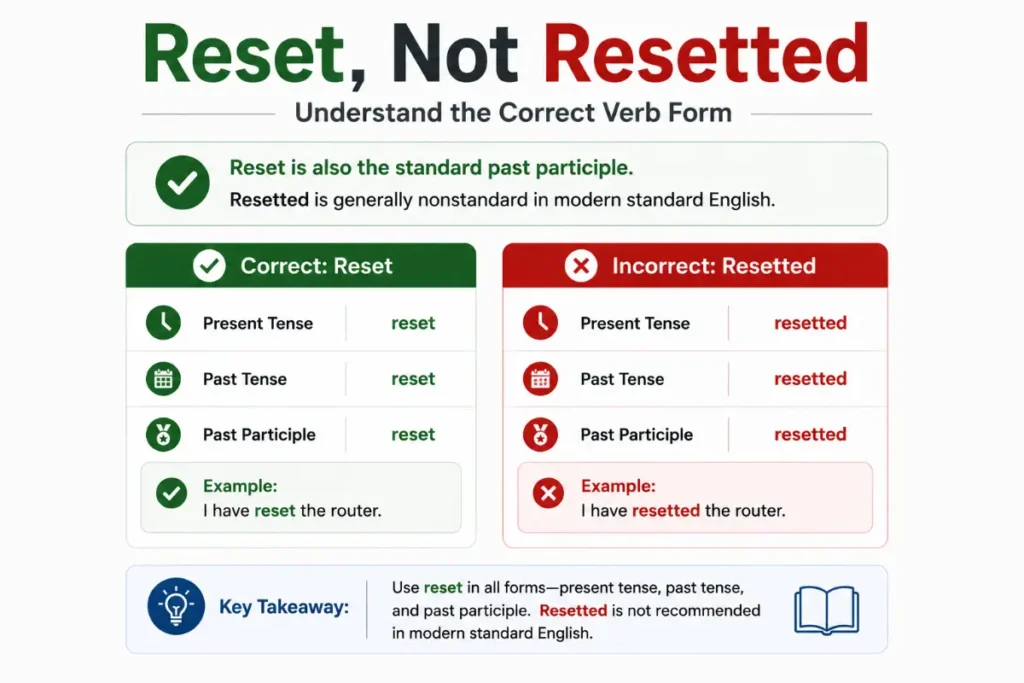
- Reset is the standard past tense of reset.
- Reset is also the standard past participle.
- Resetted is generally nonstandard in modern standard English.
- Reset follows the same basic pattern as set.
- The simple past can be reset even though the spelling doesn’t change.
- The present third person singular form is resets.
- The continuous form is resetting.
- Reset works in both American and British English.
- Reset and restart can have different technical meanings.
- The easiest memory trick is set stays set and reset stays reset.
Many readers also check Occured or occurred: Correct Spelling and Usage.
Conclusion
When deciding between Reset or Resetted, remember that reset is the correct form in standard English. It works as the base verb, simple past tense, and past participle, while resetted is a nonstandard form that should generally be avoided. The reason is simple: reset follows the same irregular pattern as set, so it does not need an additional -ed ending. This rule applies across American, British, Australian, and Canadian English.
A useful editing tip is to remember the connection between set and reset. If you can write “I set it yesterday,” you can also write “I reset it yesterday.” Keep the spelling simple, and your sentences will remain grammatically correct.
FAQs
1. Is Resetted a Real Word?
Resetted is a form that people sometimes use, particularly when applying the regular past-tense pattern to the verb. However, it is not the standard past-tense or past-participle form in modern English. In edited writing, use reset instead. The intended meaning is usually understandable, but the nonstandard spelling should be corrected.
2. What Is the Past Tense of Reset?
The simple past tense is reset. The spelling does not change from the base form. For example, you should write, “I reset my password yesterday.” The same form also works as the past participle: “I have reset my password.” There is no need to add -ed to the end.
3. Which Is Correct: Reset or Resetted?
Reset is the correct form in standard English. Resetted is a nonstandard spelling that results from adding the regular past-tense ending to an irregular verb. Since reset follows the same pattern as set, it remains unchanged in the simple past tense and past participle.
4. How Do You Pronounce Reset?
The word has two syllables and is pronounced ree-SET. Its IPA pronunciation is /ˌriːˈsɛt/. The main stress falls on the second syllable. The pronunciation remains the same when describing a past action. For example, “I reset the device yesterday” uses the same pronunciation as “I reset the device every morning.”
5. Can Reset Start a Sentence?
Yes. Reset can begin a sentence, especially when giving an instruction or command. For example, “Reset your password before accessing your account.” It can also appear at the beginning of a sentence in other grammatical structures, such as “Resetting the equipment took several minutes.” The correct form depends on the sentence.
6. What Is a Synonym for Reset?
Useful alternatives include restart, restore, renew, reinitialize, refresh, and start over. However, these words do not always have identical meanings. Restart generally means starting something again, while restore means returning it to an earlier condition. Choose the alternative that best describes the action you intend to communicate.
7. Why Do People Confuse Reset and Resetted?
People confuse the forms because most regular English verbs create their past tense by adding -ed. For example, walk becomes walked and clean becomes cleaned. Writers naturally apply the same pattern to reset. However, reset follows the irregular verb set, so its spelling remains unchanged in the past tense.
8. Is Reset Appropriate in Formal Writing?
Yes. Reset is completely appropriate in formal writing, including business emails, academic papers, technical instructions, reports, and professional documents. It is the standard form across American, British, Australian, and Canadian English. You can confidently use it when describing a completed action or a process that has been restored to an earlier condition.