
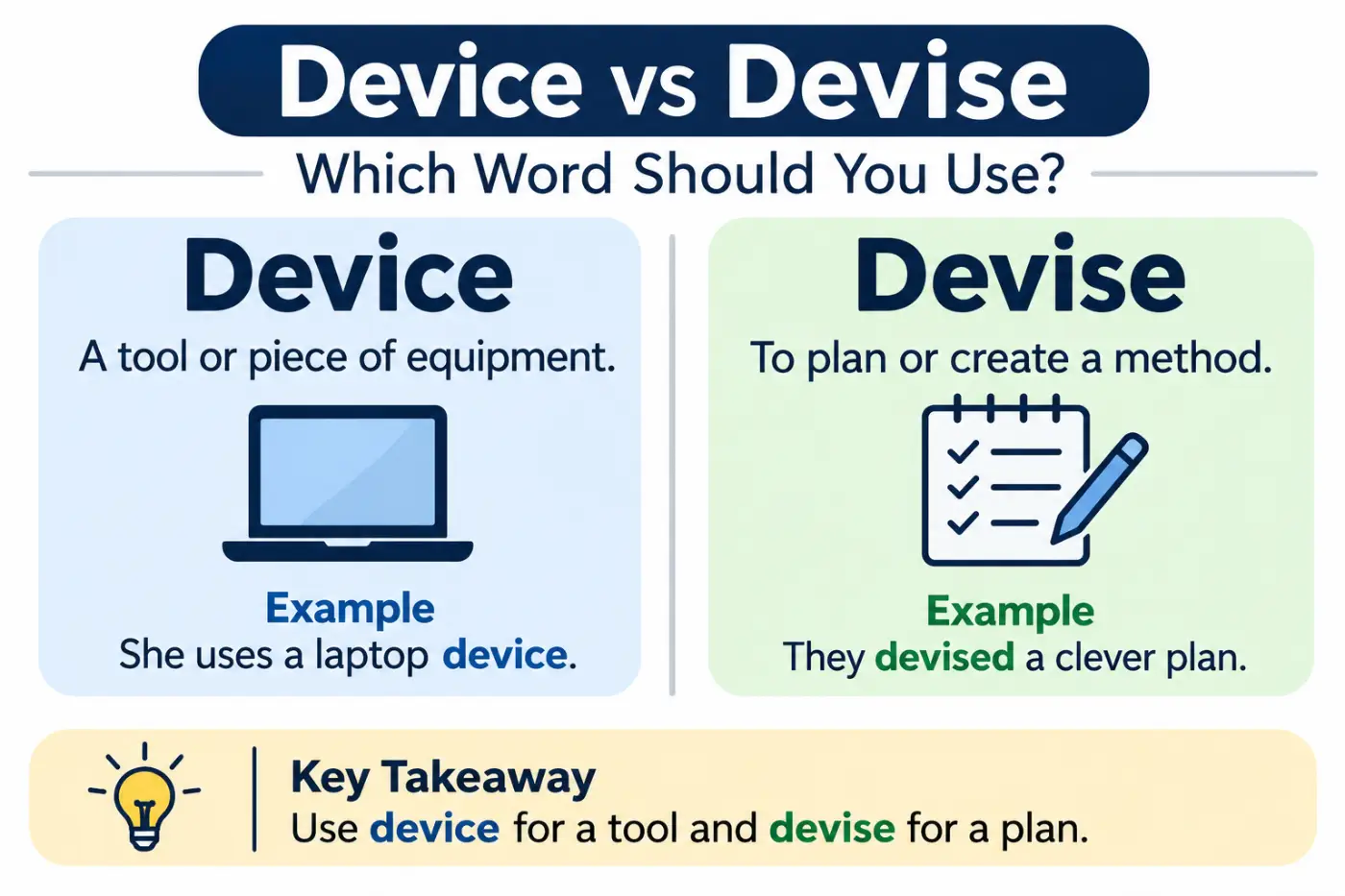
Confusing device vs devise is easy because the two words look and sound almost alike. They share the same first five letters, and their final sounds are identical. However, they have different meanings and serve different purposes in a sentence. Device is a noun that means a tool, machine, or piece of equipment made for a particular purpose.
Devise is a verb that means to plan, invent, or create something through careful thought. For example, you might use a device to measure temperature, but you devise a plan to solve a problem. The difference comes down to what you want to express. Are you naming a physical object or describing the act of creating a plan or solution?
This guide explains both words in simple American English. You will learn their meanings, grammar rules, pronunciation, origins, and common mistakes. You will also see realistic examples that make the distinction easier to remember and apply in everyday writing.
For another common grammar confusion, see run vs ran Which Form Is Correct.
Quick Answer
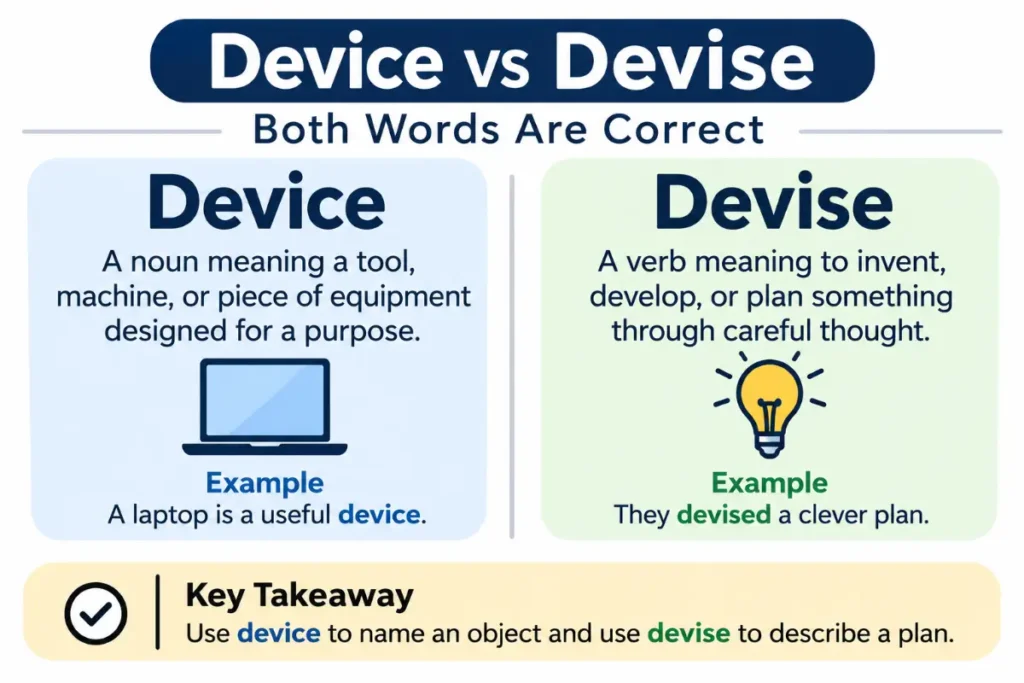
Device is a noun meaning a tool, machine, or piece of equipment designed for a purpose. Devise is a verb meaning to invent, develop, or plan something through careful thought. Neither spelling is incorrect. Use device to name an object or mechanism, and use devise to describe the act of creating a plan, method, or solution.
Comparison Table
| Feature | Device | Devise |
|---|---|---|
| Correct spelling | Device | Devise |
| Meaning | A tool, machine, or mechanism | To plan, invent, or develop something |
| Part of speech | Noun | Verb |
| Main function | Names something | Describes an action |
| Pronunciation | /dɪˈvaɪs/ | /dɪˈvaɪz/ |
| Final sound | S sound | Z sound |
| Origin | Latin through Old French | Old French from Latin roots |
| Formality | Standard in all forms of English | Standard in all forms of English |
| Common contexts | Technology, tools, equipment, safety | Planning, problem solving, invention |
| Example | She bought a new device. | They devised a better strategy. |
Meaning and Definition
Although these words share a similar appearance, their meanings are quite different. Understanding their definitions is the simplest way to choose the correct one.
What Does Device Mean?
Device is a noun that refers to an object, tool, machine, or piece of equipment designed to perform a particular task. It can describe something simple, such as a measuring instrument, or something advanced, such as a smartphone or medical machine.
A device may be mechanical, electrical, electronic, or designed for another specific purpose. The word also has broader meanings in writing, design, and communication.
Consider these examples:
- A smartphone is a device used for communication, entertainment, and online activities.
- A smoke detector is a safety device that warns people about possible fires.
- A calculator is a device that helps people perform mathematical operations.
- A writer may use a literary device to create a certain effect in a story.
The word does not always refer to an electronic product. It can describe almost any object or technique designed to achieve a specific result.
For example, a simple latch is a mechanical device. A metaphor is a literary device. A special method used in a speech can also be described as a rhetorical device.
Grammatical role: This word functions as a noun. It can act as the subject or object of a sentence.
Examples:
- The device stopped working.
- I need a device for measuring humidity.
- She placed the device on the desk.
Its plural form is devices.
What Does Devise Mean?
Devise is a verb that means to plan, invent, design, or develop something through thought and effort. It often describes the process of finding a solution, creating a strategy, or developing a new method.
Unlike the noun discussed above, this word describes an action rather than naming an object.
For example:
- The engineers devised a safer way to operate the machine.
- We need to devise a plan before the meeting.
- The teacher devised a new activity for her students.
- The company devised a strategy to improve customer service.
The word often appears in situations that involve creativity, planning, or problem solving. It suggests that someone has thought carefully about an idea before putting it into action.
It can also describe creating something complicated or original. A scientist might devise an experiment, a business owner might devise a marketing strategy, and a family might devise a plan for managing household expenses.
Grammatical role: This word functions as a verb. It can appear in several forms:
- Base form: devise.
- Third person singular: devises.
- Past tense: devised.
- Present participle: devising.
Examples:
- They devise practical solutions.
- She devises new teaching methods.
- He devised a clever system.
- We are devising a better approach.
Is Devise a Noun or a Verb?
Devise is a verb in standard modern English. It describes the action of creating or planning something. Its grammatical forms include devises, devised, and devising.
Do not use it as a replacement for the noun device. For example, write, “I bought a new device,” rather than, “I bought a new devise.”
Key Differences Explained
The most useful distinction is simple: one word names an object, while the other describes an action. A closer look at their spelling, sound, grammar, and context makes the difference even clearer.
1. Spelling
The two words differ by only one letter at the end.
- Device ends with the letters ice.
- Devise ends with the letters ise.
That small difference changes both the pronunciation and the grammatical role.
The spelling pattern can be confusing because English words do not always pronounce the letter s in the same way. In one word, it makes an S sound. In the other, it makes a Z sound.
2. Meaning
Device refers to something that exists as an object or a recognized technique. Devise refers to the process of developing an idea, plan, or solution.
Compare these sentences:
- The technician repaired the device.
- The technician devised a new repair method.
In the first sentence, device names the object being repaired. In the second, devised describes the action of creating a method.
3. Part of Speech
This is one of the strongest ways to tell the words apart.
| Word | Part of Speech | Function |
|---|---|---|
| Device | Noun | Names an object or technique |
| Devise | Verb | Describes creating or planning |
A noun can follow an article such as a or the. A verb usually works with a subject to express an action.
Examples:
- The device is expensive.
- They devised a solution.
4. Pronunciation
The words have nearly identical pronunciations, but the final consonant sound differs.
- Device: dih VICE, ending with an S sound.
- Devise: dih VIZE, ending with a Z sound.
The second syllable receives the main stress in both words. Listening for the final sound can help, although spelling and sentence meaning remain more reliable clues.
5. Formality
Both words are standard English and suitable for formal and informal communication.
Device appears frequently in technology, medicine, engineering, education, and everyday conversation. Devise is common in business, academic writing, legal discussions, planning, and problem solving.
Neither word is slang or an incorrect version of the other.
6. Context
The surrounding words often reveal the intended meaning.
If the sentence includes words such as phone, machine, tool, instrument, or equipment, device may be appropriate.
If the sentence includes words such as plan, strategy, method, solution, or approach, devise may be the intended verb.
Examples:
- The company introduced a new security device.
- The company devised a new security system.
The first sentence names equipment. The second describes the creation of a system.
7. Regional Usage
The distinction does not change across major English varieties. American, British, Australian, and Canadian English all use device as a noun and devise as a verb.
There is no regional spelling rule that makes one word replace the other.
8. Standard and Nonstandard Usage
Both forms are standard words, but using one in place of the other is a grammatical and spelling error.
Writing “She bought a new devise” is incorrect when you mean a physical object. Writing “They will device a plan” is also incorrect when you mean that they will create a plan.
The problem is not that either spelling is invalid. The problem is choosing a word that does not match the intended meaning and grammatical function.
Which Form Is Correct?
Both device and devise are correct English words. The right choice depends on the meaning and grammatical role you need.
Use device when you are talking about:
- A physical tool or piece of equipment.
- An electronic product such as a phone or tablet.
- A mechanical object designed to perform a task.
- A literary or rhetorical technique.
Use devise when you are talking about:
- Creating a plan.
- Developing a strategy.
- Inventing a method.
- Finding a solution.
- Designing a system through careful thought.
The distinction follows established English dictionary usage. Device is classified as a noun, while devise is classified as a verb. Their different parts of speech explain why they cannot normally replace each other.
A useful test is to ask yourself what the sentence needs. If you need to name something, use the noun. If you need to describe the act of creating or planning, use the verb.
Sentence Examples
The following examples show how both words work in natural situations. Pay attention to the meaning of each sentence rather than relying only on the spelling.
10 Examples Using Device
- Everyday conversation: My phone is the most useful device I own because I use it for work, shopping, and communication.
- Text message: I left my charging device at home, so my battery is almost dead.
- Workplace: The technician installed a new device to monitor the temperature inside the storage room.
- School: Students used a digital device to complete their science project.
- Academic writing: The researchers developed a measuring device to record small changes in pressure.
- Formal writing: Each employee must use the approved security device when entering the restricted area.
- Social situation: He showed his friends a small device that could translate spoken words.
- Online communication: This device supports wireless connections and works with most modern computers.
- Technology: The company released a compact device with a longer battery life and a faster processor.
- Literature: The author used a symbolic device to show the main character’s growing fear.
5 Examples Using Devise
- The team devised a practical plan to finish the project before the deadline.
- She devised a simple way to organize her daily tasks.
- The engineers devised a system that reduces energy waste.
- The teacher devised a classroom activity to help students understand fractions.
- After several failed attempts, the researchers devised a new method for testing the material.
How Both Words Can Appear in One Sentence
Using both words together is a helpful way to remember the distinction.
- The engineers devised a device that could detect gas leaks.
- She used a digital device to devise a better study schedule.
- The company devised a safety plan for employees who operate heavy devices.
- The inventor devised a small device to help people with limited mobility.
In each sentence, the noun identifies an object, while the verb describes an action.
Common Mistakes and Misspellings
Most errors happen because the words look similar and have related sounds. Some writers also choose the wrong form because they focus on pronunciation instead of grammar.
Here are five mistakes to avoid.
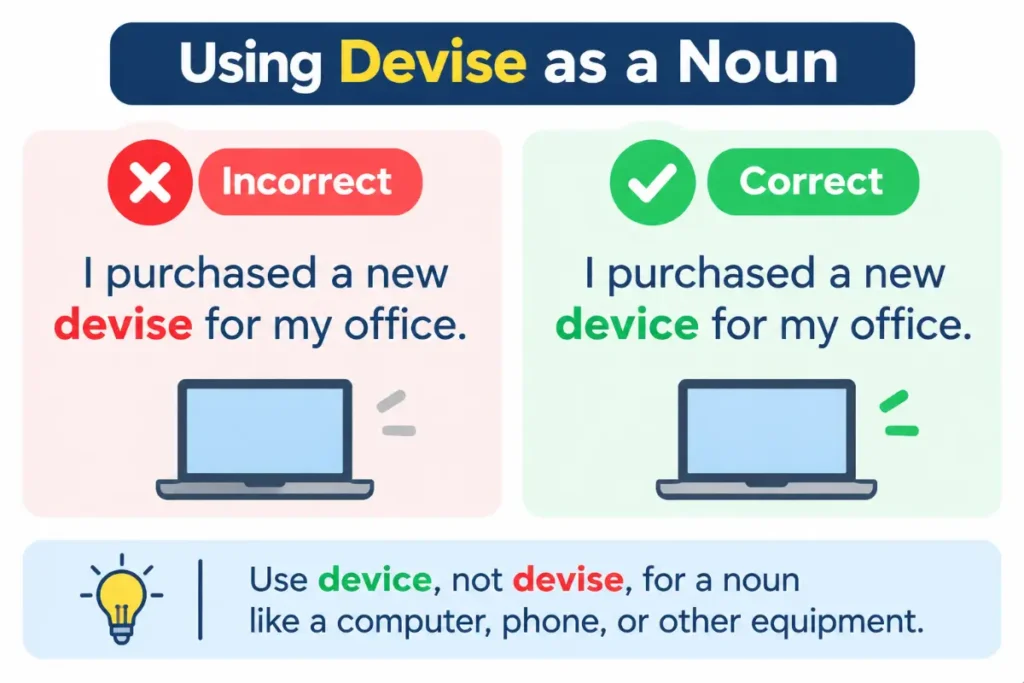
1. Using Devise as a Noun
Incorrect: I purchased a new devise for my office.
Correct: I purchased a new device for my office.
The sentence names a product or piece of equipment. It needs a noun, so device is the correct choice.
2. Using Device as a Verb
Incorrect: We need to device a new strategy.
Correct: We need to devise a new strategy.
The sentence describes an action. The speaker wants to create a strategy, so the verb devise is required.
3. Confusing Past Tense and Noun Forms
Incorrect: The team device a new solution yesterday.
Correct: The team devised a new solution yesterday.
The sentence refers to an action completed in the past. The correct past tense is devised.
4. Choosing by Sound Alone
Incorrect: The manager bought a new devise for the office.
Correct: The manager bought a new device for the office.
The similar pronunciation can lead to spelling errors. Think about the meaning and grammatical role before choosing a form.
5. Confusing Related Word Forms
Incorrect: The company device several methods to reduce costs.
Correct: The company devised several methods to reduce costs.
The subject performs an action in the past. The verb needs its past tense form, devised.
A Simple Editing Check
When you are unsure, look at the word’s position in the sentence.
- If it follows an article such as a or the and names an object, device is likely correct.
- If it follows a subject and describes creating something, devise may be correct.
- If the action happened in the past, use devised.
This small check can prevent most errors.
Learn the difference in Bailer or Baler Meaning and Correct Usage.
Pronunciation Guide
The two words are similar in sound, but their final consonants are different. Knowing the pronunciation helps you recognize the difference when speaking and listening.
| Word | IPA | Easy Pronunciation | Final Sound |
|---|---|---|---|
| Device | /dɪˈvaɪs/ | dih VICE | S |
| Devise | /dɪˈvaɪz/ | dih VIZE | Z |
Syllable Breakdown
Both words have two syllables.
- Device: de + vice.
- Devise: de + vise.
The second syllable receives the main stress in both words. Say the first syllable lightly, then place more emphasis on the final syllable.
How to Pronounce Device
Say device as dih VICE. The final sound is like the S in the word nice.
Try saying:
- A useful device.
- The electronic device.
- A safety device.
How to Pronounce Devise
Say devise as dih VIZE. The final sound is like the Z in the word prize.
Try saying:
- Devise a plan.
- Devise a method.
- Devise a solution.
Common Pronunciation Mistakes
A common mistake is pronouncing both words exactly alike. Their vowel sounds and stress patterns are similar, but the final consonant changes from an unvoiced S sound to a voiced Z sound.
To practice, place your fingers gently against your throat while saying the final sound. You should feel vibration when pronouncing the Z in devise. The S in device does not create the same vocal vibration.
Etymology and Word Origin
The words have related historical backgrounds, which helps explain their similar appearance. However, their meanings and modern grammatical roles developed in different ways.
Origin of Device
Device entered English through Old French, where related forms referred to planning, arrangement, or design. Its history connects to the Latin word dividere, meaning to divide, through the development of related Romance language forms.
Over time, its meaning expanded. It came to describe an arrangement, method, or invention and eventually became widely used for tools and machines designed to perform particular functions.
Today, it can refer to both physical equipment and abstract techniques, such as literary devices.
Origin of Devise
Devise also came into English through Old French. Its historical development is connected to the idea of arranging, planning, or dividing something through thought.
The verb developed the modern meaning of forming a plan, inventing a method, or creating a solution. It is still used in situations that involve careful thinking and purposeful design.
Why Their Origins Matter
The shared historical background helps explain why the words look alike. However, their modern meanings are distinct.
You do not need to remember their Latin or French roots to use them correctly. The practical rule remains simple: device names something, while devise describes creating or planning something.
Regional Usage
There is no meaningful spelling difference between these words in the main English speaking regions. Their definitions and grammatical roles remain the same.
American English
In the United States, device is commonly used for electronic equipment, tools, machines, and technical products. It also appears in phrases such as mobile device, medical device, and security device.
Devise is used as a verb in expressions such as devise a plan, devise a strategy, and devise a solution.
Examples:
- The school provides each student with a digital device.
- The manager devised a new training schedule.
British English
British English follows the same distinction. Device is a noun, and devise is a verb.
Examples:
- The engineer repaired the electronic device.
- The council devised a new traffic plan.
The spelling does not change based on British usage.
Australian English
Australian English also uses both words in the same way. Device appears in technology, education, healthcare, and workplace communication. Devise is used when discussing planning, design, and problem solving.
Canadian English
Canadian English follows the same standard pattern. Writers use device for equipment and devise for the act of developing a plan or solution.
Regional takeaway: You can use the same rule in American, British, Australian, and Canadian English. There is no need to memorize separate regional spellings.
Grammar Rules and Part of Speech
Understanding the grammar behind each word makes it easier to use them correctly. The main rule is that one is a noun and the other is a verb.
How to Use Device as a Noun
A noun names a person, place, thing, or idea. Device names a tool, machine, object, or technique.
It can appear in different parts of a sentence.
As a subject:
- The device needs a new battery.
- This device works well in cold weather.
As a direct object:
- She purchased a device for measuring air quality.
- We tested the device before using it.
After a preposition:
- The instructions are stored on the device.
- He connected the cable to the device.
Singular and Plural Forms
Device is a countable noun. You can use it in both singular and plural forms.
| Form | Example |
|---|---|
| Singular | A device is available. |
| Plural | Several devices are available. |
| With an article | The device is ready. |
| With a number | Three devices were tested. |
The plural form is devices. Add s to the singular noun.
Common Expressions With Device
These combinations appear often in everyday and professional English.
- Electronic device.
- Mobile device.
- Medical device.
- Security device.
- Safety device.
- Measuring device.
- Digital device.
- Mechanical device.
Each expression describes a type of object or equipment.
How to Use Devise as a Verb
Devise is an action verb. It normally takes a direct object that identifies the plan, idea, method, or solution being created.
Common grammatical patterns include:
Devise + a plan
– We need to devise a plan for the event.
Devise + a strategy
– The business devised a strategy to attract new customers.
Devise + a method
– Scientists devised a method for testing the sample.
Devise + a solution
– The team devised a solution to the problem.
Verb Forms
The verb changes according to tense and sentence structure.
| Verb Form | Example |
|---|---|
| Base form | They devise new methods. |
| Third person singular | She devises useful plans. |
| Past tense | He devised a solution. |
| Present participle | They are devising a new system. |
| Past participle | The strategy was devised carefully. |
Passive Voice
Devise can also appear in passive constructions.
Examples:
- A new method was devised by the research team.
- The safety plan was devised after the inspection.
- Several solutions were devised during the meeting.
In these sentences, the focus is on the plan or method rather than the person who created it.
Formal and Informal Usage
Both words work in formal and informal writing. The choice depends on the meaning rather than the level of formality.
For example, device is suitable in a casual conversation about a phone and in a technical report about medical equipment. Devise works in an everyday discussion about planning and in a formal paper about developing a research method.
Real Life Usage Examples
These words appear in many areas of daily life. The following examples show how their meanings fit different situations.
Daily Conversation
In everyday conversation, device often refers to common tools or electronic products. Devise appears when people talk about making plans or finding ways to solve problems.
- My new device keeps losing its wireless connection.
- We should devise a better way to divide the household chores.
Email and Workplace Communication
Professional communication often uses both words. Device may describe equipment used by employees, while devise can describe creating a policy or strategy.
- Please return your company device to the IT department before your final working day.
- Our department will devise a new process to handle customer requests more quickly.
Academic Writing
In education and research, device can refer to instruments, equipment, or literary techniques. Devise often appears when researchers create methods or experimental procedures.
- The students used a measuring device to record the temperature of each sample.
- The researchers devised a procedure to test the accuracy of the results.
News and Journalism
News reports may mention electronic devices, security equipment, and newly developed technology. They may also describe plans devised by officials or organizations.
- The school district introduced a new digital device program for students.
- Officials devised an emergency response plan after reviewing the safety concerns.
Literature and Storytelling
In literature, device has a special meaning because it can refer to a technique used by a writer. Devise can describe the creative process behind a plot or fictional plan.
- The author used a literary device to build suspense throughout the story.
- The detective devised a clever plan to reveal the truth.
Related and Confused Terms
Several words are closely connected to these two terms. Learning their differences can improve your vocabulary and make your writing more precise.
1. Gadget
A gadget is a small tool or piece of equipment, often designed to make a task easier. It usually sounds more informal than device.
Example: He bought a kitchen gadget that cuts vegetables quickly.
A gadget can be a type of device, but not every device is a gadget.
2. Equipment
Equipment refers to the tools and objects needed for a particular activity or job. It is usually an uncountable noun.
Example: The laboratory purchased new equipment for its research team.
A device can be one item of equipment.
3. Instrument
An instrument is a tool used for a specific purpose, especially measurement, science, medicine, or music.
Example: The doctor used a medical instrument to examine the patient.
An instrument may also be described as a device.
4. Tool
A tool is an object used to complete a task or perform a job. It can also refer to software or a method that helps someone achieve a goal.
Example: A spreadsheet is a useful tool for organizing financial records.
Device and tool sometimes overlap, but device often suggests a more specialized mechanism.
5. Invent
Invent is a verb meaning to create something new, especially an object, process, or idea.
Example: The engineer invented a machine that saves water.
Devise and invent are close in meaning, but devise often focuses on planning or developing a method or solution.
6. Design
Design can function as both a noun and a verb. As a verb, it means to plan how something will look, work, or be structured.
Example: The company designed a device for people with limited mobility.
Design often emphasizes the structure or appearance of something, while devise emphasizes the act of developing a plan or solution.
7. Develop
Develop means to create, improve, or grow something over time.
Example: The team developed a new system for managing orders.
Develop is broader than devise. It can describe gradual improvement as well as the creation of something new.
8. Plan
Plan can be a noun or a verb. It refers to an intended way of doing something.
Example: We need to plan the event carefully.
A plan is something you may devise. The verb devise describes the process of creating it.
Expert Editor Insight
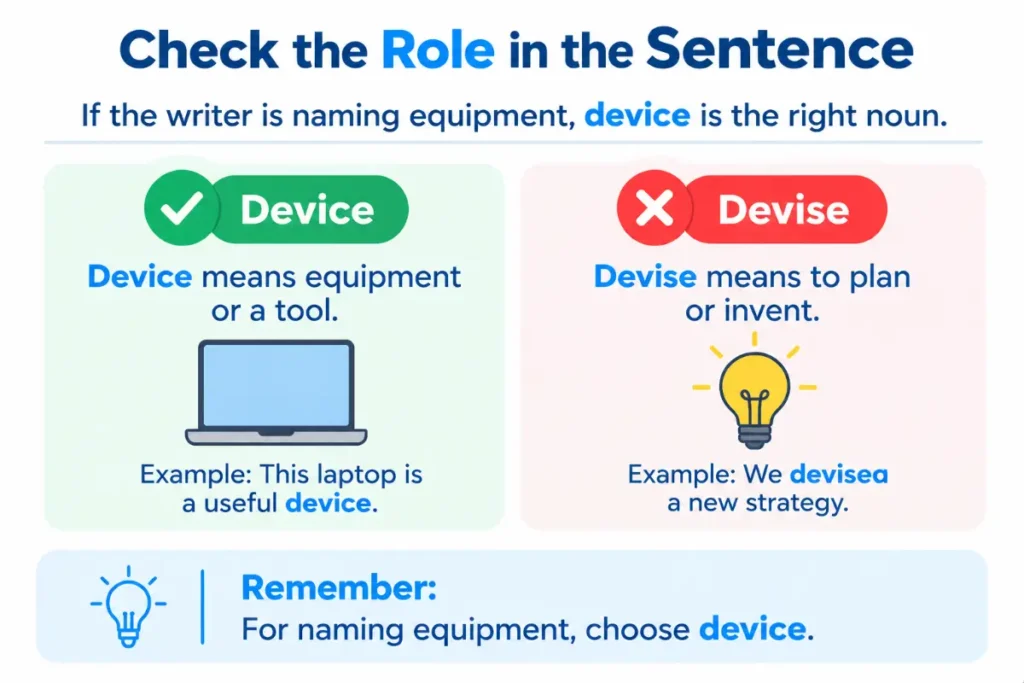
In professional editing, the easiest way to catch this mistake is to check the role of the word in the sentence. If the writer is naming equipment, device is the right noun. If the writer is describing the creation of a plan or method, devise is the correct verb. The confusion is common because the words differ by one letter and have similar sounds. Grammar checkers may catch some incorrect uses, but they cannot always understand the intended meaning. Read the whole sentence before accepting an automatic spelling suggestion.
Many readers also check Successfully or Succesfully Which Spelling Is Correct.
Conclusion
The difference between device vs devise comes down to meaning and grammar. Device is a noun that names a tool, machine, or technique, while devise is a verb that means to plan, invent, or develop something. Both are correct English words, but they cannot replace each other in ordinary sentences.
Remember this simple rule: you use a device, but you devise a plan. If you are unsure while writing, check the role of the word in the sentence before choosing its spelling. This quick habit will help you avoid confusion in emails, schoolwork, reports, and everyday communication.
FAQs
Is Device a Noun or a Verb?
Device is a noun. It names a tool, machine, piece of equipment, or technique designed for a particular purpose. For example, a smartphone is a device, and a smoke detector is a safety device. It does not function as the standard verb for creating or planning something. Use devise when you need that action.
Is Devise a Real Word?
Yes, devise is a standard English word. It is a verb that means to plan, invent, develop, or create something through careful thought. You might devise a strategy, devise a solution, or devise a new method. It is not a misspelling of device. The two words have different meanings and grammatical functions.
What Is the Difference Between Device and Devise?
Device is a noun that names an object, tool, or mechanism. Devise is a verb that describes creating or planning something. For example, a technician may repair a device, while an engineer may devise a new repair method. The final letter also changes the pronunciation, with an S sound in the noun and a Z sound in the verb.
How Do You Pronounce Device and Devise?
Device is pronounced dih VICE, with an S sound at the end. Devise is pronounced dih VIZE, with a Z sound at the end. Both words have two syllables, and the stress falls on the second syllable. Their similar pronunciation is one reason people confuse them, so paying attention to the final sound can help.
Can Device and Devise Be Used in the Same Sentence?
Yes, both words can appear naturally in one sentence because they perform different grammatical roles. For example, “The engineers devised a device that detects smoke.” Here, devised is the past tense verb describing the action, while device is the noun naming the equipment they created.
What Is a Synonym for Device?
Useful alternatives include tool, gadget, instrument, machine, apparatus, and equipment. The best choice depends on the object and its purpose. For example, gadget often describes a small practical item, while instrument may refer to a specialized tool used in science or medicine. These words overlap in meaning, but they are not always interchangeable.
What Is Another Word for Devise?
Depending on the sentence, alternatives include invent, create, develop, formulate, design, and plan. For example, you can devise a strategy or formulate a strategy. You can also devise a solution or develop a solution. Each alternative has a slightly different meaning, so choose the one that best describes the action.
Is Devise Appropriate in Formal Writing?
Yes, devise is appropriate in formal writing, including business reports, academic papers, technical documents, and professional communication. It is especially useful when describing the development of a strategy, method, or solution. Device is equally suitable in formal writing when referring to equipment or a specific technique. The important point is to use the correct word for the intended meaning.