
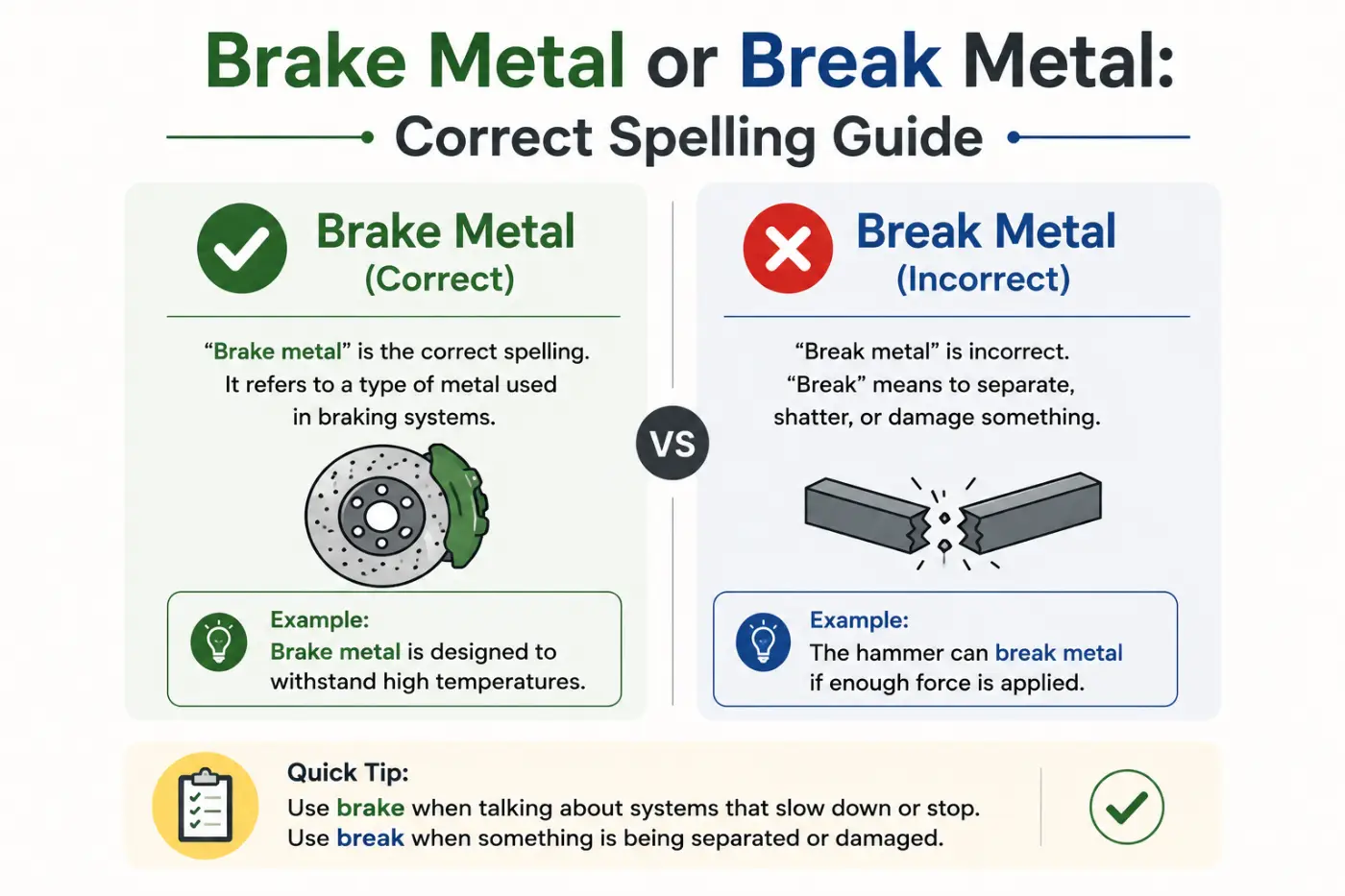
If you have heard someone say “brake metal or break metal,” you may be unsure which spelling to use. The answer depends on what the speaker means, but in most discussions about metal parts in vehicles, machinery, or construction, neither phrase is automatically correct. “Brake” refers to a device or action used to slow or stop movement, while “break” means to damage, separate, or interrupt something.
The confusion comes from the fact that these words sound almost identical in American English. Their meanings, however, are very different. A vehicle has metal brake components, such as brake rotors, pads, and calipers. A piece of metal can also break if it cracks, bends, or separates under pressure. In this guide, you will learn how to choose the right word, understand the phrase in mechanical contexts, avoid common spelling errors, and use both terms correctly in everyday and technical writing.
Still confused? Compare ight meaning Explained With Examples and Usage.
Quick Answer
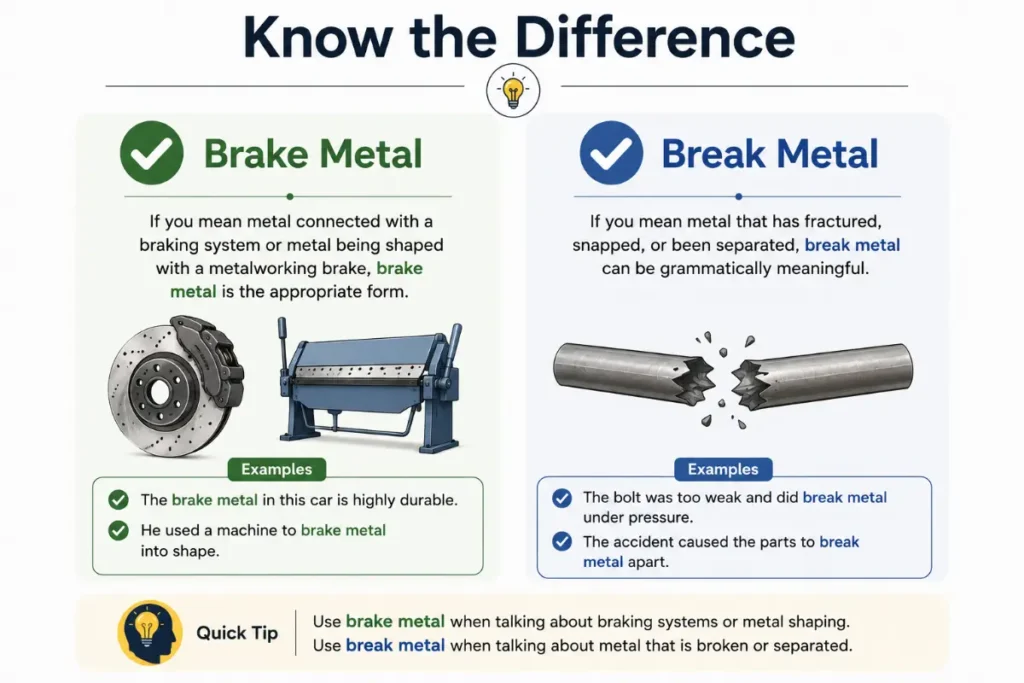
“Brake” is correct when you mean a vehicle or machine’s stopping system, or the action of slowing movement. “Break” is correct when you mean to damage, crack, split, or separate metal. The phrase “brake metal” is not a standard general term for metal, and “break metal” is not a standard expression either.
Comparison Table
| Feature | Brake | Break |
|---|---|---|
| Main meaning | A device or action used to slow or stop movement | To damage, split, separate, or interrupt something |
| Part of speech | Noun and verb | Verb and noun |
| Pronunciation | /breɪk/ | /breɪk/ |
| Meaning in metalwork | Metal parts used in a braking system | Metal that cracks, fractures, or separates |
| Common phrases | Brake disc, brake rotor, brake pedal, brake system | Break a metal bar, metal breakage, break apart |
| Vehicle context | Correct for stopping components | Correct for damaged components |
| Formality | Standard in technical and everyday English | Standard in technical and everyday English |
| Example | The brake rotor is made of cast iron. | The metal rod broke under pressure. |
Meaning and Definition
What Does Brake Mean?
“Brake” is a word connected with controlling movement. As a noun, it refers to a device that slows or stops a moving vehicle, machine, or wheel. As a verb, it describes the action of using that device to reduce speed or bring something to a stop.
In cars, trucks, motorcycles, bicycles, and many industrial machines, brakes use friction or another stopping mechanism to control movement. Many brake components are made from metal because they need strength, heat resistance, and durability.
For example, a car’s brake system may contain steel lines, iron rotors, metal calipers, and other parts made from metal alloys. The exact materials depend on the vehicle and component. A mechanic might say, “The brake rotor is worn,” or “The metal brake line needs inspection.”
Common uses include:
- Press the brake pedal.
- Replace the brake pads.
- Inspect the metal brake line.
- Repair the brake system.
- Apply the brakes before turning.
- Check the brake rotor for damage.
The word can also appear outside vehicles. Machines, elevators, trains, and industrial equipment may have braking systems. In all these cases, “brake” relates to slowing or stopping movement.
What Does Break Mean?
“Break” is a verb that means to damage something, cause it to separate, or make it stop working. It can describe physical damage, such as a metal bar snapping, or a change in a process, such as breaking a long period of silence.
When used with metal, the word usually refers to a crack, fracture, split, or complete separation. Metal can break because of excessive force, repeated stress, fatigue, corrosion, manufacturing defects, or sudden impact.
For example, a steel rod may break when a load exceeds its strength. A metal bracket may develop a crack after repeated vibration. A thin aluminum sheet may tear or split during bending if the material or process is unsuitable.
Common uses include:
- Break a metal rod.
- Break a steel chain.
- Break a metal lock.
- Break a piece of aluminum.
- Break apart a metal frame.
- Repair a broken metal bracket.
“Break” can also function as a noun. A break in a metal surface may refer to a fracture or discontinuity. In technical writing, more specific terms such as “fracture,” “crack,” “rupture,” or “failure” may describe the damage more accurately.
Is Brake Metal a Real Phrase?
The words can appear together in a sentence, but “brake metal” is not usually a standard name for one particular material. It may be used informally to describe metal parts in a braking system, but technical writing normally uses more precise terms.
For example, “metal brake components” is clearer than “brake metal.” If you mean a metal disc that helps a vehicle stop, use “brake rotor” or “brake disc.” If you mean the metal pipe that carries brake fluid, use “brake line.”
The phrase may also appear in a specialized business name, product label, or informal conversation. Such uses do not make it a general technical term.
Is Break Metal a Real Phrase?
“Break metal” is not a common fixed expression in standard English. However, the two words can appear next to each other in a grammatical sentence.
For example, “The machine can break metal sheets” is correct. Here, “break” is a verb and “metal sheets” is its object. The sentence means that the machine can damage or separate sheets of metal.
You may also see “metal breakage” or “metal fracture” in technical discussions. These expressions describe damage to a metal object more clearly than the phrase “break metal” used by itself.
Key Differences Explained
1. Meaning
The biggest difference is the action each word describes. “Brake” is about controlling movement. “Break” is about damage, separation, or interruption.
A vehicle’s brakes help it stop. A broken brake component has been damaged and may no longer work properly. One word names the stopping system, while the other describes a possible type of damage.
Compare these sentences:
- The mechanic replaced the brake rotor.
- The mechanic found a crack in the rotor, and the metal had started to break.
The first sentence refers to a vehicle component. The second describes damage to that component.
2. Spelling
Both words have five letters and contain the same final four letters. They differ only in their first letter:
- Brake begins with B and R, followed by A, K, and E.
- Break begins with B and R, followed by E, A, K, and the final E.
The letter order matters because each spelling carries a different meaning. A spelling checker may accept both words, so it may not catch an incorrect choice if the sentence is grammatically possible.
3. Pronunciation
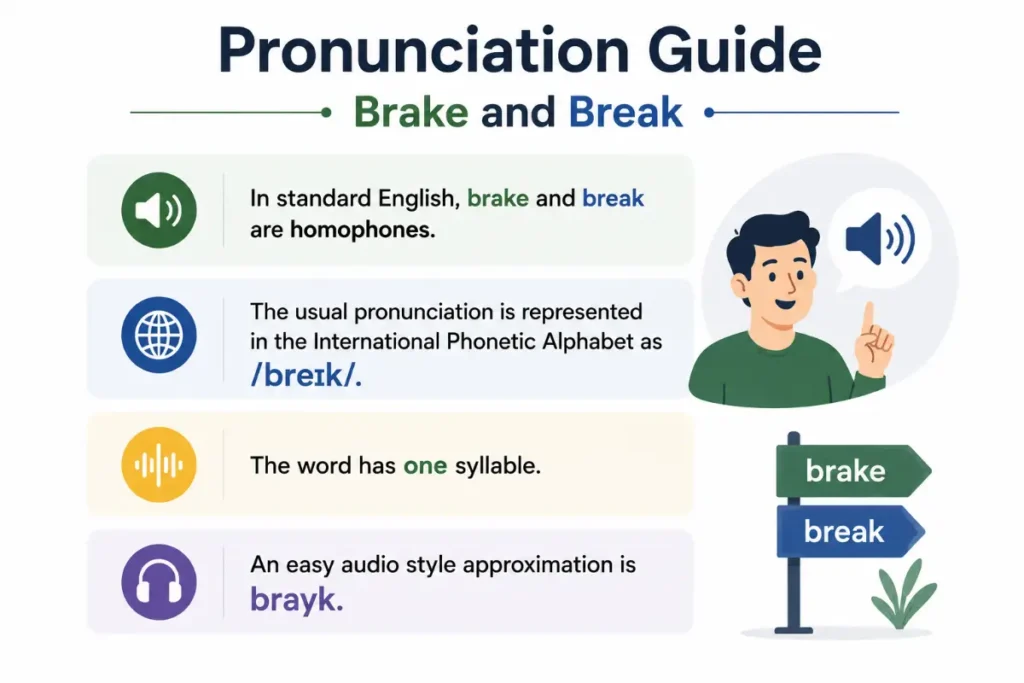
In most American English accents, the two words sound exactly the same. Both are pronounced /breɪk/. This makes them homophones, which are words that share a pronunciation but have different meanings and spellings.
Because you cannot hear the spelling difference, you must use context to decide which word belongs in a sentence. The subject and action usually make the meaning clear.
4. Grammar
“Brake” can work as a noun or a verb. As a noun, it names a stopping device. As a verb, it describes using that device.
Examples:
- The front brake needs repair.
- Please brake slowly on the wet road.
“Break” can also function as a noun or a verb. As a verb, it describes damage or separation. As a noun, it can refer to a pause, an interruption, or a damaged area.
Examples:
- The metal pipe may break under pressure.
- The engineer found a break in the metal surface.
5. Context
The correct spelling depends on the subject of the sentence. If you are discussing a vehicle’s stopping system, use “brake.” If you are discussing damage to a metal object, use “break.”
A mechanic may inspect a brake rotor and discover that it has a crack. In that sentence, both words can appear because they describe different things. The rotor is a brake component, and the crack is a form of damage.
6. Formality
Both words are standard in formal and informal English. Neither is more professional by itself. The difference is meaning, not tone.
In a repair invoice, “replace the damaged brake line” is clear. In an engineering report, “the steel component broke during the load test” is also clear. Technical documents may use more exact terms such as “fractured” or “failed” when describing material damage.
7. Regional Usage
American, British, Canadian, and Australian English use the same basic distinction. The words have the same standard spellings and meanings across these varieties.
Accent differences may affect how people pronounce the vowel, but they do not create a spelling difference. In all these forms of English, the vehicle stopping system is a brake, and damage to a metal part can be described with break.
8. Standard and Nonstandard Expressions
“Brake system,” “brake rotor,” and “brake pad” are established expressions. “Break a metal bar” is a normal grammatical phrase. By contrast, “brake metal” and “break metal” are not generally used as fixed names for specific materials or components.
That does not mean the word combinations can never appear. A sentence can use them naturally if the grammar and meaning support them. The key is to avoid treating either combination as a standard technical label without a clear reason.
Which Form Is Correct?
There is no single correct choice for every situation because “brake” and “break” are both standard words. The correct spelling depends on the meaning you want to express.
Use “brake” when referring to:
- A vehicle’s stopping system.
- A brake pedal, rotor, disc, pad, or caliper.
- The action of slowing a vehicle or machine.
- A device designed to control movement.
Use “break” when referring to:
- Metal that cracks or fractures.
- A metal object that snaps or separates.
- Damage caused by impact or pressure.
- A machine that damages or cuts metal.
- A pause or interruption in another process.
In mechanical writing, precise terms make a big difference. If you mean a component used to stop a car, write “metal brake component,” “brake rotor,” or the exact part name. If you mean the material has fractured, write “the metal broke,” “the metal cracked,” or “the component fractured.”
A useful rule is to connect “brake” with stopping and “break” with damage. This simple meaning test will help you choose the right spelling in most sentences.
Sentence Examples
The following examples show how each word works in everyday English, vehicle maintenance, metalworking, school, and professional communication. Notice that the spelling changes with the meaning, even though both words sound alike.
Ten Natural Examples Using Brake
- Everyday conversation: Press the brake gently as you approach the stop sign.
- Text message: The mechanic says my front brake needs to be checked.
- Workplace: Please inspect the metal brake components before approving the repair.
- School: The science teacher explained how friction helps a brake slow a moving wheel.
- Technical writing: The brake rotor must meet the manufacturer’s thickness requirements.
- Formal writing: The inspection found damage to one of the vehicle’s brake lines.
- Social situation: I had to brake suddenly when a dog ran into the road.
- Online discussion: Does this model use steel or cast iron for its brake discs?
- Vehicle repair: The shop replaced the worn brake pads and cleaned the calipers.
- Safety instruction: Always test the brake system after completing maintenance.
These examples use the word as both a noun and a verb. In the first, third, and fifth examples, it identifies a stopping system or one of its parts. In the second and seventh examples, it describes the action of slowing a vehicle.
Five Natural Examples Using Break
- Everyday conversation: The metal handle broke when I tried to open the old gate.
- Text message: The steel bracket broke, so I need to buy a replacement.
- Workplace: The technician reported that the metal support broke during testing.
- School: The class learned how pressure can cause a metal rod to break.
- Technical writing: Repeated stress caused the aluminum component to break near the joint.
Each sentence describes damage or separation. The word does not identify a stopping device. It tells the reader that something has failed, snapped, or come apart.
Examples That Use Both Words
Using both words in one sentence can make the distinction easier to remember.
- The brake failed after a metal part broke inside the assembly.
- The driver applied the brake when he noticed that the metal barrier had broken.
- A damaged brake bracket can break further if the vehicle continues to operate under heavy load.
- The mechanic inspected the brake system after a metal mounting tab broke.
- The report explains how a broken component affected the performance of the brake assembly.
These examples show that the two words can appear close together without sharing the same meaning. One identifies the stopping system, and the other describes damage to a physical object.
Common Mistakes and Misspellings
The most common problem is choosing a word because it sounds right rather than checking its meaning. Since the two words are homophones, spellcheck software may not identify the error. A sentence can contain a correctly spelled word that still communicates the wrong idea.
1. Writing Break When You Mean a Vehicle Stopping Device
Incorrect: The mechanic replaced the front break.
Correct: The mechanic replaced the front brake.
The sentence refers to a component that helps stop the vehicle. It needs the spelling associated with slowing or stopping movement. A useful reminder is that a car has brakes, not breaks.
2. Writing Brake When You Mean Physical Damage
Incorrect: The metal bar will brake if too much weight is placed on it.
Correct: The metal bar will break if too much weight is placed on it.
The sentence describes a metal object that may crack or snap under pressure. It does not describe a stopping action. Use “break” for damage to the bar.
3. Using Brake as a Noun for a Fracture
Incorrect: The engineer found a brake in the metal sheet.
Correct: The engineer found a break in the metal sheet.
Here, the noun refers to a damaged or separated area. “Brake” would suggest a stopping device, which does not fit the meaning.
4. Treating Brake Metal as the Name of a Material
Unclear: The factory ordered brake metal for the new project.
Clearer: The factory ordered metal components for the braking system.
The original wording does not tell the reader exactly what material or component the factory needs. If the order concerns a particular part, name it, such as a rotor, bracket, caliper, or brake line. Clear technical language prevents costly misunderstandings.
5. Treating Break Metal as a Fixed Technical Term
Unclear: The technician recorded a break metal problem.
Clearer: The technician recorded a fracture in the metal component.
The phrase “break metal problem” does not clearly identify the fault. A more exact expression tells readers that the material has fractured. In engineering reports, the words “crack,” “fracture,” “failure,” and “breakage” may be more useful, depending on the type of damage.
How to Avoid These Errors
Use the meaning of the sentence as your spelling guide.
- If the sentence refers to stopping a vehicle, choose “brake.”
- If the sentence refers to damage or separation, choose “break.”
- If you mean a damaged area in a material, consider “crack,” “fracture,” or “break.”
- If you mean a vehicle component, use its proper name rather than a vague phrase.
- Read the whole sentence after using spellcheck because both spellings may pass an automatic check.
A simple memory trick can help: a brake helps you stop, while a break can happen when something stops working or comes apart. The words sound alike, but their meanings point in different directions.
You may also want to read Gnaw or Knaw Which Spelling Is Correct.
Pronunciation Guide
How Do You Pronounce Brake?
The word “brake” is pronounced /breɪk/ in standard American English. It has one syllable and rhymes with “make,” “take,” and “lake.” The vowel is the long A sound, as in “day,” and the final sound is a clear /k/.
You can break the pronunciation into three parts:
- Start with the /b/ sound.
- Add the long A sound /eɪ/.
- Finish with the /k/ sound.
Say the word as “brayk.” Keep it to one syllable rather than adding an extra vowel sound at the end.
How Do You Pronounce Break?
“Break” is also pronounced /breɪk/. It has the same initial consonant, vowel sound, and final consonant as “brake.” In ordinary American speech, there is no pronunciation difference between the two words.
This is why people sometimes choose the wrong spelling in emails, text messages, repair notes, and online posts. Hearing the word alone does not reveal which spelling the speaker intends. You need the surrounding sentence to understand the meaning.
Are They Homophones?
Yes. “Brake” and “break” are homophones because they sound the same but have different spellings and meanings. Other familiar examples include “right” and “write,” “pair” and “pear,” and “flower” and “flour.”
Homophones can cause spelling mistakes because English does not always use one spelling for each sound. The best way to handle them is to learn each word in a useful phrase. Remember “press the brake” and “break a metal bar” rather than trying to memorize the letters alone.
Etymology and Word Origin
The Origin of Brake
The noun “brake,” in the sense of a device used to stop or slow movement, developed through older forms of English and European languages. Its history is not as simple as a direct connection to the modern verb meaning to stop a vehicle. Earlier uses of the word referred to devices or mechanisms that restrained movement.
As transport and machinery developed, the term became closely linked with systems that control the movement of wheels and other moving parts. Today, it is a familiar technical and everyday word in vehicle design, maintenance, and safety.
The modern verb “to brake” describes using a braking device to slow down or stop. For example, “The driver braked before reaching the intersection.”
The Origin of Break
“Break” comes from Old English “brecan,” meaning to break, shatter, or burst. Related forms appear in other Germanic languages. Over time, the word developed a wide range of meanings involving damage, separation, interruption, and change.
Modern English uses the verb in many expressions. You can break a glass, break a promise, break a rule, break a record, or take a break from work. The shared idea is that something is divided, interrupted, damaged, or brought out of its normal state.
Why Their History Does Not Make Them Interchangeable
The words have different histories and meanings, even though their modern pronunciations are the same. Their similar sound is a feature of English pronunciation, not evidence that they share the same meaning.
For practical writing, the history is less useful than the modern distinction. Think of the device that stops a vehicle when you write “brake.” Think of damage or separation when you write “break.”
Regional Usage
American English
In the United States, both spellings are standard. Drivers use the brake pedal, mechanics inspect brake rotors, and engineers may report that a metal part broke during testing.
American pronunciation generally makes the words sound identical. The spelling choice depends on the sentence, not on a regional rule. In repair documents, use the exact component name whenever possible.
British English
British English uses the same spellings and meanings. A driver applies the brakes, while a damaged metal part can break or develop a fracture. There is no general British spelling rule that changes one word into the other.
Some technical terms may differ between British and American vehicle terminology, but the distinction between the two verbs remains the same.
Australian English
Australian English also follows the standard distinction. People refer to a vehicle’s brakes and describe damaged metal as broken, cracked, or fractured. The words do not have different regional spellings in standard Australian usage.
Canadian English
Canadian English uses both forms in the same way as American English. A vehicle has brakes, and a metal object can break. The same meaning based spelling rule applies in everyday conversation, schoolwork, and professional documents.
Does the Meaning Change by Country?
No major regional difference changes the basic meaning of these words. A reader in the United States, United Kingdom, Australia, or Canada will normally understand “brake” as a stopping device and “break” as damage or separation.
If you are writing for an international audience, focus on clear context. Phrases such as “brake rotor,” “brake pedal,” “metal fracture,” and “broken steel rod” are easy to understand across English varieties.
Grammar Rules and Part of Speech
Both words can function as nouns and verbs, but their grammatical roles depend on the sentence.
How to Use Brake as a Noun
As a noun, “brake” names a device or system that slows or stops movement. It can refer to a complete system or one part of that system.
Examples:
- The rear brake needs attention.
- The mechanic inspected the brake pads.
- The driver pressed the brake pedal.
- The bicycle has a front brake and a rear brake.
You can also use the plural form “brakes” when referring to the stopping devices on a vehicle. For example, “The brakes need to be checked before the trip.”
How to Use Brake as a Verb
As a verb, “brake” describes slowing down or stopping a moving vehicle or machine. It can be used in the present, past, and continuous forms.
Examples:
- Brake before you reach the sharp turn.
- She braked when the traffic light changed.
- The driver is braking to avoid the obstacle.
- He has braked too late several times.
The verb can also appear with adverbs that explain how the action happens. Phrases such as “brake gently,” “brake suddenly,” and “brake firmly” describe the way someone slows down.
How to Use Break as a Verb
“Break” is an irregular verb. Its main forms are:
| Verb Form | Example |
|---|---|
| Base form | break |
| Third person singular | breaks |
| Past tense | broke |
| Past participle | broken |
| Present participle | breaking |
Examples:
- The metal pipe may break under pressure.
- The machine breaks thin sheets into smaller pieces.
- The support beam broke during the test.
- The metal has broken near the joint.
- The workers are breaking the old structure into sections.
One common error is using “breaked” as the past tense. The correct form is “broke.” Use “broken” with helping verbs such as “has,” “have,” or “had.”
How to Use Break as a Noun
As a noun, “break” can mean a pause, an interruption, or a damaged section. In a metalworking context, it may describe a fracture or separation.
Examples:
- We took a short break after the inspection.
- The technician found a break in the metal cable.
- A break in the surface coating exposed the steel beneath it.
The meaning comes from context. A break at work is a rest period, while a break in a metal component is damage.
Sentence Position and Punctuation
Both words can appear at the beginning, middle, or end of a sentence. Their position does not change their spelling.
Examples:
- Brake carefully on a wet road.
- The driver used the brake before the crossing.
- The metal bracket broke during the inspection.
- A small break appeared near the edge of the sheet.
Neither word requires special punctuation. Use a period for a statement and a question mark for a direct question. In technical documents, avoid vague wording and identify the exact part or type of damage.
Real Life Usage Examples
Daily Conversation
People usually use “brake” when talking about driving and “break” when describing something damaged.
- “The road is slippery, so use the brake gently.”
- “I think the metal latch broke when I closed the gate.”
Both sentences sound natural because each word matches the action being described.
Email and Workplace Communication
Clear wording is especially useful in repair requests and maintenance reports. A vague description can lead to the wrong part being ordered or the wrong repair being completed.
- “Please inspect the front brake assembly and let me know if any components need replacement.”
- “The metal support broke during operation, so the equipment has been taken out of service.”
The first message identifies a system that needs inspection. The second reports a failure in a physical component.
Academic Writing
In engineering and materials science, writers use specific language to explain how materials behave under force. The word “break” may be suitable in a general explanation, while “fracture” or “failure” may be more precise in a technical report.
- “The experiment measured the force required to break each metal sample.”
- “The study examined how temperature affected the performance of metal brake components.”
These sentences use the words in separate technical contexts. One describes material damage, and the other refers to parts of a stopping system.
News and Journalism
News reports may use “brake” when describing a vehicle incident and “break” when reporting damage to equipment or infrastructure.
- “The driver applied the brake before the vehicle struck the barrier.”
- “Investigators said a metal support broke during the construction work.”
Journalists should choose the word that accurately describes the event. If a report concerns a mechanical failure, a more exact term may help readers understand what happened.
Literature and Storytelling
Both words can add detail to a scene. “Brake” can describe a sudden action during a journey, while “break” can describe damage that changes what happens next.
- “He hit the brake as the old truck slid toward the gate.”
- “A sharp sound filled the workshop as the metal rod broke in two.”
The words create different images. One describes stopping movement, and the other describes a physical object coming apart.
Related and Confused Terms
These eight terms are useful when writing about vehicles, machinery, metalworking, and material damage.
1. Brake System
A brake system is the collection of parts that slows or stops a vehicle. Depending on the design, it may include pads, rotors or drums, calipers, lines, and other components. Use this expression when referring to the complete stopping system rather than one individual part.
2. Brake Rotor
A brake rotor is a rotating disc connected to a vehicle’s wheel assembly. In many disc brake systems, brake pads press against the rotor to create friction and slow the vehicle. Rotors are commonly made from cast iron, although other materials are used in certain applications.
3. Brake Pad
A brake pad is a friction component that presses against a rotor in a disc brake system. It gradually wears down during use and needs inspection and replacement according to the vehicle manufacturer’s guidance. It is not the same thing as a metal fracture or a broken part.
4. Crack
A crack is a narrow split or opening in a material. A metal component can develop a crack without separating into two pieces. In inspection reports, describing the location, length, and depth of a crack can be more useful than simply saying the part is broken.
5. Fracture
A fracture is a break or separation in a solid material. Engineers use this term when discussing how and why a material fails under stress. It can describe a small crack or a more complete separation, depending on the context.
6. Breakage
Breakage is the noun form used to describe the process or result of something breaking. For example, “The report examined metal breakage during repeated testing.” It is useful when discussing damage in general rather than one specific fracture.
7. Failure
In engineering, failure means that a component or material no longer performs its required function. A part can fail because it breaks, bends, wears out, leaks, or stops operating correctly. Not every failure involves a visible fracture.
8. Friction
Friction is the force that resists movement when two surfaces come into contact. It plays a central role in many braking systems because friction between brake pads and rotors helps slow a vehicle. It is a physical principle, not a name for a brake component.
Expert Editor Insight
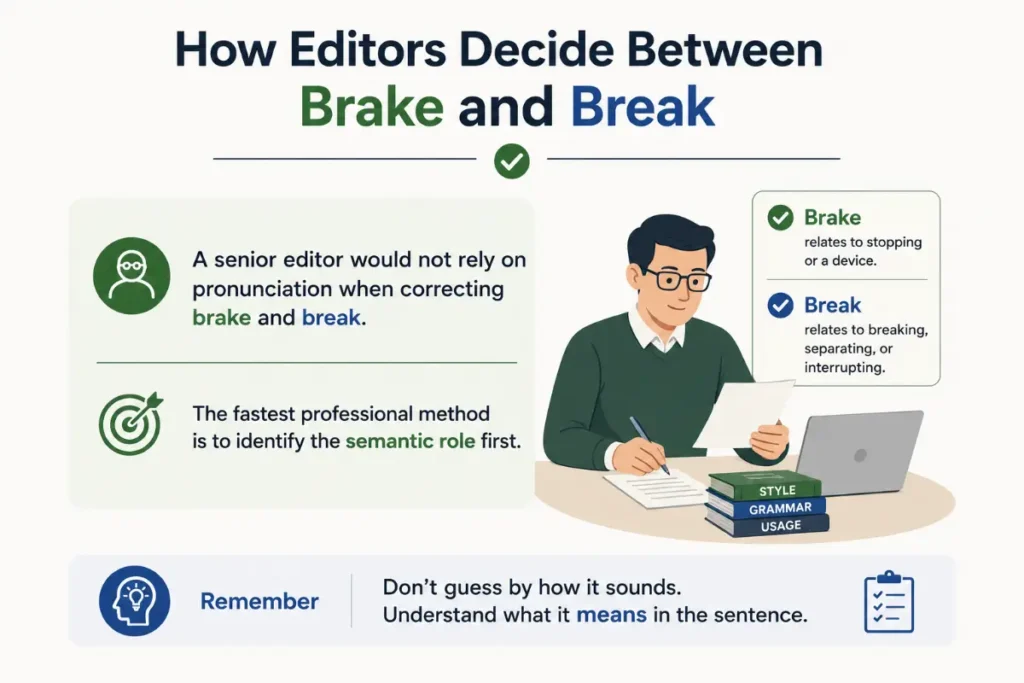
An experienced editor checks the meaning of the whole sentence before choosing between these spellings. Native speakers generally use “brake” for vehicle stopping systems and “break” for damage, but both words can pass a basic spelling check because each is valid English. In technical writing, editors also look for precision. “The metal broke” may be enough in a casual message, but a repair report may need to identify a crack, fracture, or failed component. A useful editing habit is to replace vague phrases with the exact part name or type of damage.
For another common grammar confusion, see Natzi or Nazi Meaning, Usage, and Correct Form 2026.
Conclusion
The choice between “brake metal or break metal” depends on the meaning you want to express. Use “brake” for a vehicle’s stopping system and its components. Use “break” to describe metal that cracks, snaps, or separates. Neither phrase is a standard general name for a metal material, so identify the exact component or type of damage when writing about machinery.
A simple memory tip can prevent most mistakes: brakes help vehicles stop, while things break when they become damaged. Check the meaning of the full sentence before choosing the spelling.
FAQs
Is Brake Metal a Correct Term?
The phrase can appear in a sentence, but it is not a widely established general name for a type of metal. If you mean metal parts in a vehicle’s stopping system, write “metal brake components” or name the specific part, such as a rotor, caliper, or brake line. This wording is clearer in technical and everyday communication.
Is Break Metal a Real Phrase?
The words can appear together in a normal sentence, such as “The machine can break metal sheets.” In that example, “break” is a verb and “metal sheets” is the object. However, “break metal” is not generally used as a fixed technical name for a material or component.
What Is the Difference Between Brake and Break?
“Brake” refers to a device or action used to slow or stop movement. “Break” means to damage, crack, separate, or interrupt something. A car has a brake system, but a metal bracket can break under pressure. The words sound the same in American English, so their meaning and sentence context guide the spelling.
Is It Brake or Break on a Car?
Use “brake” when referring to the stopping system or one of its parts. For example, a car has brake pads, brake rotors, and a brake pedal. Use “break” only when describing damage, such as a metal part breaking during an accident or a component breaking under stress.
How Do You Spell the Metal Part That Stops a Car?
The correct spelling is “brake” when you mean a component used to slow or stop a vehicle. Common terms include brake rotor, brake pad, brake caliper, and brake line. The word “break” describes damage or separation, not the stopping device itself.
Do Brake and Break Sound the Same?
Yes. In standard American English, both words are pronounced /breɪk/. They are homophones, meaning they have the same pronunciation but different spellings and meanings. Because speech does not reveal the spelling, writers need to use the sentence context to choose the correct form.
What Is Another Word for Metal Breaking?
The best alternative depends on the type of damage. “Cracking” describes a narrow split, while “fracture” refers to a break in a solid material. “Failure” is broader and describes a component that no longer performs its intended function. In an engineering report, choose the most precise term supported by the inspection.
How Can I Remember Which Spelling to Use?
Connect “brake” with stopping a vehicle and “break” with damage or separation. You can remember the first through the phrase “press the brake” and the second through “break a metal bar.” Reading the full sentence before sending it is also helpful because spellcheck may accept both words even when one has the wrong meaning.